
Oh wait, you're listening to Radio Lab from WNYC. Okay, I'm Jad, this is Radio Lab. So last week we heard a story from Molly Webster, who's all about a new emerging disease. And this week we're actually going to go back to Molly.
Hello. Hey, there you are. High five. Because she has some new information about a story that she did a while back about being back a disease, a disease that's been around for a while.
So we're talking about, well, sorry, you start. No, we're talking about gamma, which is interesting because gamma was when we were when you were gone. Yeah, I remember that. It was during this sabbatical.
So here's the deal. It was 2016. I take a little break from the show just a few months. And Molly, along with Robert, decided to do something a little bit different on the show.
She actually broke some news. She got a hot tip about some research that was just out from MIT and it was about Alzheimer's. And when I was there, they were in the midst of doing some really exciting follow-up research that they had told me about off the record, but they weren't ready to talk about. But now they are ready to talk about it.
Cool. Okay, so here's what we're going to do. We're going to play the original piece. And then current day 2020, Molly and Jad will pop in along the way with some updates.
But for now, here is 2016, Molly with 2016. Robert. Hi, I'm Robert Croweich. I'm Molly Webster.
This is RadioLab and today. We've got breaking news, Robert Croweich. On rate, this is something we've never done before. Never done before.
Does anybody know about this yet? Well, it is a new bit of research that's being published today. We've known about it for the last few months, but we haven't been able to talk about it until now. What's this thing about?
Oh, this is a discovery about Alzheimer's disease, which I think at this point is something that affects basically every family. I've affected my family. Yeah. And this is a discovery that is not a cure, but it's basically about looking at the brain, which is one of the most complicated things in the universe, I think, and poking at it in this super simple way and getting this bizarre result.
How bizarre? It's pretty bizarre. Hello. Hello.
Hello. Hi, Molly. Hi. How are you?
All right. So last May, I was talking to some folks over at the Brain Institute at MIT. And while I was on the phone with them, they started telling me about some research that hadn't been published yet. So it was all very hush-hush.
It was pretty cool, though. We ended up deciding to sign a non-disclosure agreement. And it was based on the work of this woman, Li Wei Tai. Li Wei Tai.
Tai. Tai. I'm a professor and a director of the PicoA Institute for Learning a Memory at MIT. Holy crap.
You're the director. How do you have time to do all that? I know. That's a good question.
She is like a badass is what she is. But this is the piece of work I'm very proud of and very excited about. Okay. Cool.
So let me begin. Okay. So historically, people work on Alzheimer's really focused. So I would say generally when you talk to researchers about Alzheimer's disease, they either focus on individual genetic factors.
The genetics of the disease, so the genes that predispose you maybe to Alzheimer's. The brain chemistry and how Alzheimer's affects the chemicals in the brain. Molecular pathological features. In my conversation with Li Wei, she was talking about something totally different.
We sort of look at it from a different angle. Her work all centers around something called the gamma frequency. The gamma frequency? Mm-hmm.
Gamma. And what is gamma? I'm like, it feels like something from Battlestar Galactica. So I don't think it's that.
So the gamma is so cool. You could think of it as a particular beat in your brain. A beat in the brain. Yeah.
Yeah. Which means, well, that's exactly. You're simplified one of the most complicated things in the known universe. Okay.
Please do. You've got your brain full of neurons, which are a certain type of brain cells. We have billions of neurons in the brain. They have these long tentacles that are reaching out towards other neurons.
And for the brain to function, neurons have to communicate with each other to process information. And the way they do that is, they fire. Yes. An electrical signal will go through them and it'll like zap.
Another neuron and it'll turn it on and then an electrical signal will go through it and it'll zap another neuron and it'll turn it on. But the cool thing is, is that when your brain is doing things like making you move or write a poem or think great thoughts, groups of neurons are instinct altogether on the same beat. And there's a bunch of different beats that happen in the brain. Some of them are slow, like one beat per second and that's when you're sleeping.
If you're beating around 10 beats per second, like maybe you're sitting next to a campfire in an Adirondack chair. Or on like the totally other end of the spectrum, like some neurons fire at 600 beats per second. What are they doing? That I have no idea.
But all this is going on in your head simultaneously? Yeah. Yeah. Yeah.
No, that's the cool thing is that when all of these beats in your brain come together, that's when you're able to process the world and understand it as it exists as human beings. But getting back to our story, when your brain is doing something really tricky that requires super focused attention, working memory and so on, like trying to find your way home from the subway station or if you're in a new city, you know, navigate around it. There's a certain beat that sort of rises above them all. And that is the so-called gamma frequency.
This range between 30 beats per second, all the way up to 100 beats per second. And this gamma frequency has been considered to be very important for the higher order cognitive function. The other thing is that when you look at an Alzheimer's brain, what you see is there's actually less gamma happening or people say like the power of gamma is reduced. Not all the neurons can be recruited to oscillate at the gamma frequency.
It's still there. It's just quieter. It's like you turn the volume down. Right.
All right. So just to briefly sum up here, what we've got is a rhythm which we call gamma, which is used when we have complicated or higher thoughts in the brain, which when you've got Alzheimer's, kind of gets saggy or tired. Yeah. Yeah.
Totally. And of course, obviously in an Alzheimer's brain, there's a lot going on. And this is just one of the things, right? You've got the plaques that build up around the neurons.
It's got to go up your brain and makes it hard to think. Yeah. Totally. It's like cobwebs in the brain.
And then the connections between neurons gets all muddy. And immune cells get messed up. But leeway time is like, forget all that. What would happen if I just bring the gamma back?
Yeah. We decided to just manipulate gamma oscillation. How do you do that? Well, technology.
Hi, this is Molly. Hi, hi, hi. Technology, you can find at the Massachusetts Institute of Technology. And actually I went and took a train up to Boston to MIT, not too long ago.
We're walking into the big hour, dude. Big shiny glass building. Hi, hi. Eventually, leeway time came striding into her office to meet me.
My understanding is that you want to see some of the experimental setup. And so leeway led me down the hall to this tiny room. And mice just entered the room. Brought in these adorable little mice.
Oh my gosh, they're like little black and soft and furry. Their ears are tagged. There's a little metal tag on there. Okay, so here's what they did.
They get some ice. We started always a mouse model. Not the mice I actually got excited over, but mice set up an early stage of Alzheimer's disease. Was multiple notable defects.
Do they have the gunky black stuff in them yet? Or is that later? No, but they do have elevated levels of beta-anroloid peptides, which is this protein that forms the plaques. So it's like basically pre-plac gunk.
But the important thing to leeway-tiner team is that they have less gamma going on in their brains. If you remember, the whole plan here is to bring the gamma back. Yes. So to do that, they get what might be the world's tiniest drill.
And they drill a small hole into the skull of the mouse. And then they take a really thin fiber optic cable, they slide it through the hole into the brain. And then they get this laser of blue light to flaker at 40 beats per second. Yeah, I'm off you can see.
So when they hit the light on and the light travels down the fiber optic cable deep down into the brain to this group of cells that they've modified in the hippocampus to be sensitive to light. So when this pulsing light hit these cells, they actually began to fire at 40 beats per second at gamma frequency. And they would keep these cells firing at gamma. But when our firing and firing and firing and firing and firing and then after one hour, they turn off the light and then eventually they started looking at the brains of these mice, trying to figure out if anything was different after the light flashed.
And they see to our much surprise. We're not expecting this at all. We found after they shot this pulsing light into the brain, there was suddenly nearly half as much of that soon to be nasty plaque gunk stuff that was filling up their hippocampus. Half of the stuff was just swept away.
Yes, 40 to 50% reduction of beta amyloid. That just seems crazy. This is crazy. I mean, we were just so surprised.
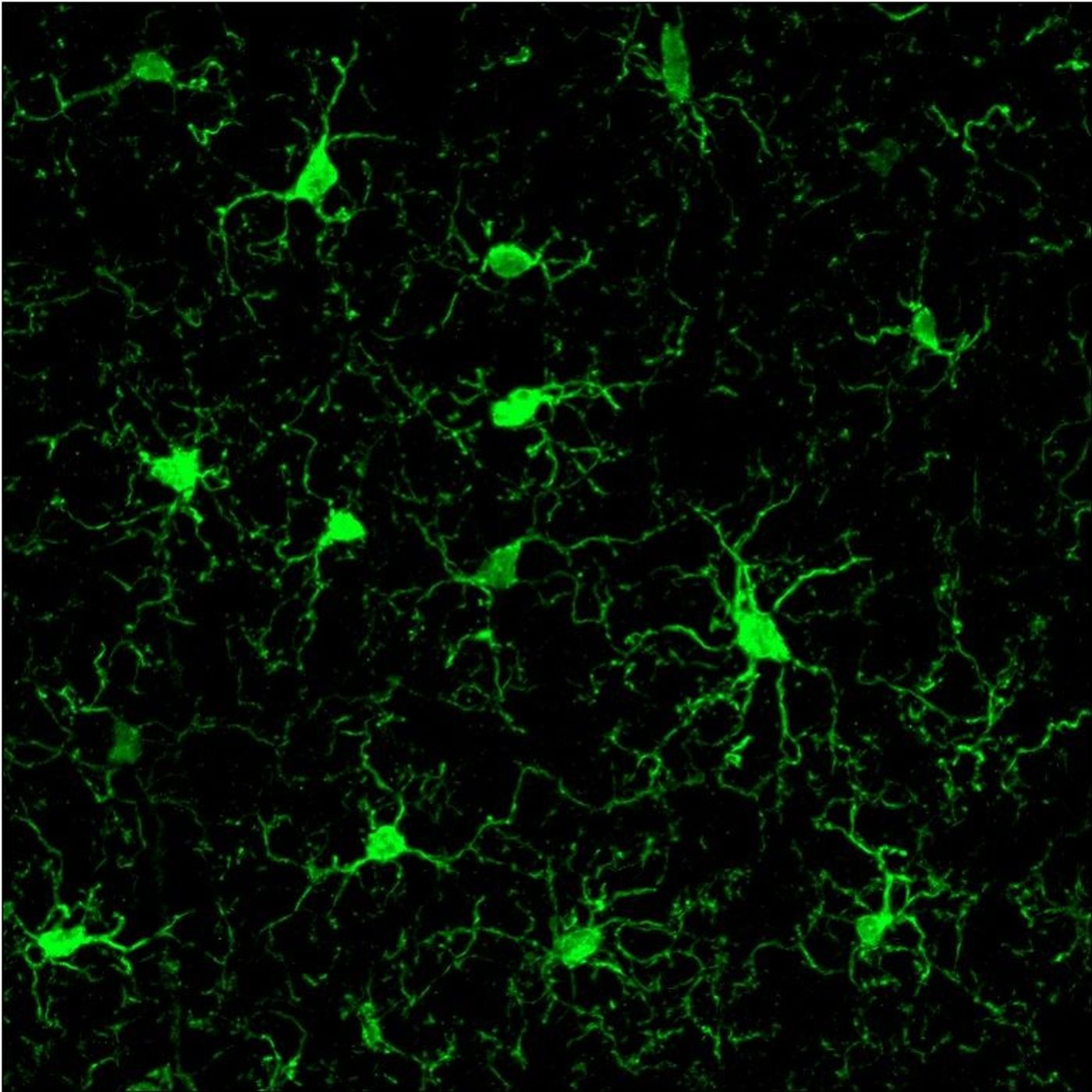
Do they know why the floodlight would- Yeah, yeah. So turn out the pulsing light somehow triggered the brain's cleanup group. Michael Glia, these cells in the brain that are called microglia. You can say they're the janitors of the brain.
And in a normal brain, these janitors cells usually gobble up the gunk. But in Alzheimer's disease, it's known that Michael Glia, they don't sort of function normally anymore. It's like these janitors just sort of stop cleaning up and go on strike. There we go.
Okay, cool. Okay, so we're looking at a screen that's now flat. It's not- When I was at MIT, one of Li-Waze grad students- My name is Anthony Marturo, second year. Was showing me side-by-side comparisons of these mice brains on the screen.
Can you guess what that is? Which part? The green things? Microglia.
Yeah. And you see after one hour of gamma, the microglia, the cell, seems a lot bigger. Clearly see these round bodies. Yeah.
And also the belly seems to have more amyloid. Oh, like they're doing more eating. Yes, they go back to eat more amyloid again. It's like somehow making the neurons fire turned on the sanitation system in the brain.
But the most wild results- Wait, there's more wild? Oh my god. You gotta hear this. Because what I'm about to tell you, you may say, no, I don't believe it.
It's science fiction. Okay. So one of the things Li-Waze and her team were starting to think was that drilling and fiber optic cable is very invasive, right? You'd never be able to do that on a human.
Exactly. So we started to say, well, what if we can get the light into the brain in a different way? Maybe we could go through the eyes. So the hole in your head would be your eyes instead of a hole in your head?
Yes. So Li-Waze and her team created what I like to think of as the flicker room. Wait, is this the room? This is the room.
Okay. It turns out I learned about my visit. It is just a storage closet. You know, you have a plastic table.
Very DIY. Yeah, it's a plastic table. You can buy a target. There were some plastic shoe box sized containers lined up on the table for the mice.
And then you can see the strip around the edge of the table. Basically surrounding all the tables are duct tape strips of LED lights. And the reason why we use LEDs is because a regular light bulb can't flash fast enough. And so the idea is what if we just put the mice in this room and just let the light flicker at 40 beats per second?
So you want to show Molly like a turn this off? Yeah. And so we turn off the overhead light in the room. So it's very black.
And then, oh wow. The room was now glowing with this light LED light. Okay. So the light is turning on enough 40 times a second.
You don't see anything going on or off. It just looks like something's on. But it kind of feels like my eye is twitching. And so it's blurring the light a little.
Just on the edges though. Just on the edges. And then we put mice in this room for an hour and just let them kind of bathe in this glow. And guess what?
What? We look at the amyloid beta levels in the visual cortex. And we found there is a 50% reduction. 50%?
50% reduction. Shining light in their eyeballs? Yes. Wait a second.
They didn't do any drilling in their skull or anything. No. No. They didn't drill.
They didn't tweak the mouse's brain cells to be sensitive to light. They just build the room with occasional LEDs flashing at a particular frequency. For an hour. Now do you see?
Are you going to tell me I don't believe it is science fiction? And they followed the study up with another study which was done in the same way. So the same flicker room, light through the eyeballs. And only this time they put the mice in there for one hour a day for seven days.
And they took mice that had full blown Alzheimer's. So this is like cognitive decline. They're forgetting things. And they've got hardened plaques in their brain.
And they see the same thing. Nearly half of the stuff was cleared away. Wow. Half.
It's just flickering light in front of the mice. That's the shot. I mean that's the shocking thing. The thing I didn't understand after talking to you about your study was I was like, why hasn't everyone done this before?
Like why didn't everyone go, we should just shine light through eyes. See, well, you know, that's really the most unexpected and exciting aspect of our study, which is something this simple yet, you know, it has never been done before. You know that one of the things, one of the caveats here is that if you don't do the flicker light room every 24 hours, the level of gunk in the brain starts going back up again. And so now they're trying to figure out how they can keep those levels down, maybe even for good.
Okay. Current day, Jad here. We'll come back to the original story in a bit and to a big question that all of this work raises. But first of the update, 2020 Molly recently called leeway tie again.
Hello. Hello, Molly. To see what she has been up to since that original research. How are you?
I'm doing great. Yeah. So much new things coming up and I'm just excited all the time. And so as I said, when I was there in 2016, we had talked a bit off the record and since then, leeway tie has published papers gone on the record.
And what we were talking about is that they were looking to expand their sensory toolkit. So instead of using gamma light, they did gamma sound. What made you pick sound? So we know that we can see, we can hear, we can taste, we can smell, we can touch.
And among all of this, we figure that sound is relatively straightforward to produce a 40 Hertz gamma sound. Interesting. So instead of shining a light in the subjects eyes, they would play a tone or something and it would have the same effect? Yeah.
So they just built a sound that has that same gamma frequency built into it like the lights in the flicker room and then they play it for the mice. Yeah. What is the equivalent of like the sound flicker room? We basically just add, you know, loudspeakers.
So the sound comes in through the mouse ears. Right. So there are sensory nerve cells. Like the waves come in, it gets converted to an electrical signal.
This electrical signal then can be transmitted across the brain circuits. So wait, do we know what it sounds like? I have it here. Oh.
So, uh, I'm going to hit play and then you tell me if you can hear it. Okay. Oh my God. It's kind of crazy sound.
I almost don't want to hit play. Okay. Three, two, one. Oh God.
Yeah. Whoa. Yeah. That's the most stomach like, oh right.
I, the first time I heard it, I like ripped my headphones off my head and then I then really converted and found it super soothing. I'm not there yet. I think we should probably also do the caveat of like there could be some way in which this comes through your headsets in a weird way. It depends on where the speaker is set.
Yada, yada, yada, where this is not the sound. Yes. In a way that they are playing. Totally.
And maybe we even want to take a step further and say do not use the sound. Yes. Please do not use this sound at home to self treat. They were playing this for mice.
So when they were playing it for mice, we were able to see very similar beneficial effects as those exposed to 40 Hertz gamma light. They see like the, what we talked about in the first episode, which were the micro glia, which she calls like the, the trash picker uppers of the brain. They just, you know, completely surround the amyloid plaques. And so they start eating all that stuff up.
After one to two weeks of exposure, we saw about 30 to 40 percent reduction of the amyloid plaques. Wow. So listening to that sound that you just played, just listening to it is a kind of, a kind of cleansing brain therapy of a kind. I mean, yes, for mice right now.
Yes. The interesting thing is, is they as of yet still have no idea why all this is happening. Why micro glia seem to eat more of the trash. They have no idea.
But they must have some, some theory, right? No. No. And she's done these studies at other rhythms, like 41 Hertz or 42 Hertz or 38 Hertz.
You know, they've tried 80 and they've tried 20. And for some reason, 40 is the sweet spot where you see this activity and you don't see it in other places. But beyond the why, like, why is it 40 or why does gamma do this and nothing else does this or other things like gamma don't do this. All the new stuff with sound actually leads us to the same question we had in the original episode, the big question which Robert put to me.
If the mouse no longer has quite as much junk in his head, does that mean that it can remember things that happened to it that it gets meant to work? Yeah. That is their big next research. They don't know.
They don't know. That's what that is now the next step. It really understands how plaques and the gunk build up in the brain relates to memory and cognition. And the dogma in the field is that when you have Alzheimer's, you can't form new memories and once you lose a memory, it's gone for good.
But there is another group at MIT that is actually sort of challenging that assumption that you can never get a memory back. Because the patient could never tell us, we all assume the information had to be gone. Oh, really? Yeah.
And we'll get to them. But first we have to go to a break. And of course, we'll be back with more updates right after this. Hi.
My name is Rachel Melima and I'm calling from Alice Brings, Northern Territory, Australia. The NPR is supported in part by the Alfred P. Sloan Foundation, enhancing public understanding of science and technology in the modern world. For more information about Sloan at www.sloane.org.
Science reporting on Radio Lab is supported in part by Science Sandbox, a science foundation initiative dedicated to engaging everyone with the process of science. Each story you hear on Planet Money starts with a question. What happens if we refund tariffs? Why are grocery so expensive?
At NPR, we stand for your right to be curious because the force is shaping our world can be hard to see. Follow NPR's Planet Money wherever you get your podcasts and start seeing how the economy really works. Hey, Jad here. We are back looking back at Molly Webster's piece in 2016, peppering in some updates as we go.
We're going to keep rolling here with the original for Beat and then we'll get more from current day 2020 Molly and me in a little bit. I'm Robert Grobich. I'm Molly Webster. This is Radio Lab.
And we're back. And just before the break, you said that there may be a way to bring a memory back from the Alzheimer's disease, pull the memory back into place. Yeah. Why are we so quick to jump to the conclusion that the information was somehow completely gone.
And the person who said that to me is this guy. I'm D.R.I.S.R.I.R.I. I'm a fourth-year graduate student in the Smithsonian Gao Lab. Over at the Tonic Gao Lab, they were thinking, what if we could figure out exactly where the memory should be in the brain and just give that spot a little bit of juice?
Right. So they took some mice that were just starting to lose their ability to remember things and they thought, okay, let's try to give them a memory. We put them in a box that has a particular smell, some sort of lighting and some texture on their feet. A little mouse carpet or...
That's exactly what it is. Wait, really? Okay. Nice on carpet.
Scotty. The point is the box looks and feels and smells different than any other box they would hang out in. And the mice, they just freeze. They don't move at all.
Which is a sign that they're afraid. They hate the box. And for the rest of the afternoon, which is a very long time and mouse time, they go on hating the box, which means with the carpet and the light and the smell, if you put it back in there, it'll freeze because it remembers the shot. Yes.
But... A day or a week later, which... When the same mice were put back into the same box. Instead of being scared of the box, they would just continue investigating as if nothing happened.
They could not remember. So Darrage and his team did what Liwei did. They got some modified mice and then they put a little hole in their head. They slid in a fiber optic cable.
They shined some light. To trigger the neurons that they think hold this memory. And they were near the fear section. So leading on the path to the fear section.
So we do this? And then... Put them back into the box. The box with the particular lighting and smell and carpet.
And ask, is there any change in their behavior? Will they act afraid again? Do they show any more memory? And they did.
Wait, shut up. They actually were scared of the box again? Exactly. They showed recovered memory.
Wow. So that's like BAM, that memory's in there. Exactly. Voila.
The behavior was back. You can dig up the memory by shining light in the right place? Yeah. And I was always under the impression that the memories were totally lost.
Right. So I think that's not just you. I think that's essentially the entire field where you described. Just because the patient could never tell us, we all assumed the information had to be gone.
So one of the things to say is that Deraj did tell me that all of the experiments they did are in mice that have early Alzheimer's. The thought is that once you get to the late stage of the disease, there's enough damage in the brain that you really wouldn't be able to get those memories back. That might be right. That a memory loss is just lost.
When you have someone in your house and you live with this disease, they in and they out, the disease just goes its own way and it can puzzle you or frighten you or subtly declare something new that you didn't expect. So for example, my dad had it for about nine, ten years. It was a slow, active disappearing that he did where the last time my father came to was so far into the disease, he hadn't spoken for a year and a half. He was sitting at the table for the Passover Seder, and there's a song that you sang when it goes, dah, dah, dah, dah, dah, dah, dah, dah, dah, dah, dah, dah, dah, dah, dah, dah, dah.
So it was the chorus. And from out of nowhere, this being at the end of the table, I knew, was my father who hadn't spoken in a year and a half or two and not spoken coherently for three, suddenly flew into the song and sang the song full, throatily, at the table. Like the reappearance of some just last figment of himself. And it was both horrifying and extraordinary.
Both, you know. I mean, I think that's the fact that maybe some information still persists. Hopefully someday we did kind of... maybe there's something we could do.
But yeah, this is all in the mind at the moment. As long as we can figure out how to rebuild the pathway to retrieve the memory, then I think there is hope. And then I want to jump in here with one more part of the sound update, which is that Li Wei and her team in particular are thinking about it in regard to capturing memories. Because where this research probably gets even more interesting is when you do the light flashing and that sound at the same time.
We eventually just decided why don't we, you know, put this two together and see how the animals respond. This is becoming like a mice spa. And when they did that, they saw this gamma beat in the brain, but not just in the auditory cortex, or the visual cortex. And now just in one particular brain region.
Now we are seeing across different brain regions. So the hippocampus got involved and the prefrontal cortex got involved, and then there was the neocortex and maybe even the parietal lobes. So there was like activity like all across the brain. Is it a little bit like a whole bunch of like clocks coming into a sink?
Yeah. Yeah. And imagine thinking it's only going to affect one clock, but it actually somehow pulls them all into synchrony. Again, they saw the microglia doing their clean up thing all across the brain, but most cooly, they also saw just like almost like a rebuilding of neuronal circuitry.
So like the synapses between neurons seem to improve. Then basically this repaired the disrupted neurocircuitry. And I think this in turn can lead to recovery of learning a memory. And what she's been finding with mice is that it seems to.
Basically, in a way, she's done something very similar to what DROSH has done, but with her own light and sound technique and the memories came back. That's so interesting. And the mice show very impressive improvement to their cognitive ability. So it's almost like two things happening, which is you're seeing physiological effects in the brain, and then you're seeing the layer on top of that, which is then the memories that live in the physiology are also having some impact.
Yes. So with all the stuff, super new, so I feel like it's caveat time. And for the caveat, I am going to throw back to the caveat we had in the original piece. I personally think the most important question is whether humans respond similarly.
I mean, keep in mind that both DROSH's study and leeway ties are in mice, not humans. Right. So I do have a thought that like, is there a reason that a human neuron might react differently than a mouse? The thing is, I think especially in Alzheimer's field, I mean, people got burned a lot.
There's like a 99.6% failure rate in moving something that seemed to work in mice to humans in Alzheimer's. 9.6? Yeah. That was a study that came out in 2012.
That's a horrible number. So I just got to be really conservative here. I'll dial it back. I'll dial it back.
You know, while we have in mice, they're just so exciting and so unexpected, so much fun. But I'm going to keep my eye open when it comes to humans. The plan is that we're going to find out because they're going straight to humans. They're going to do human trials.
Well, they want to. And so we have my final, final update, which is that leeway tie and her crew have indeed started human trials. So we indeed managed to get our be approved for our first very small scale study in early stage Alzheimer disease subjects. They're doing a clinical trial with 15 Alzheimer's patients.
How far, how far into the study are they? I talked to leeway in January and they had some people enrolled. So we have recruited 15 individual people. We basically installed our light and sound device in their home.
Really? Yeah. So they themselves or their caregiver can turn on the device. And then they sit there and they get the light flashed in their eyes and they get the sound flashed at their ears.
And they're doing it an hour a day for six to eight months, maybe six to nine months. And they're just collecting data. And I guess we're going to see. You know, we're talking about living human beings.
It's not that we can take out the brain and see their microglia or all of this. But we are evaluating all of the subjects in terms of their cognitive ability. And we also do MRI scan to look at how active their brain activity is. And do you have any, any intel on what they're seeing so far?
Not. I wish. I mean, every step of the way to be quite honest, it's always a surprise. It's like, oh, this can do, you know, gamma can do this and gamma can do that.
You know, I think about the journey. It's like a magic carpet ride. This is a glorious part of all this. This organ of ours, the brain is so crazily complicated with like, whatever, a hundred trillion connections or whatever it is.
There's so much chance. There's going to be a lot of surprise. Yeah, it's like almost even if it doesn't lead to any treatment in humans or something super concrete. It's like, we know this little secret about the brain now.
And there's something that feels beautiful in that. Yeah, I'm actually setting this up for my Christmas tree. Are you really? Yes.
Yeah, we, I just bought the new LED lights and they can, they can figure a different color with different colors. Oh, so each individual bulb can travel through colors, but while they're doing that, they're going to be flickering at 40. We're going to have a very therapeutic Christmas in the leeway, Thai household. This is a tree in your home.
Yes, yes. I want to have an eggnog next to that tree. Yeah. And this year, you might even add some 40-gamma jingle bells.
Who knows? Wow, this is so cool. And that's the update. Yeah, thank you.
Thank you, Molly. Obviously, this update was reported by Molly Webster and it was produced by Rachel Cusick. And of course, don't say this enough, Big Props the Sorn Wheeler. Special thanks to DROGS ROY.
I am JAD ABUM ROT, just a man who longs for the 40 kilohertz calming hum of the gamma. I shall go and listen to that sound now. In the meantime, thank you for listening. See you next week.
My name is Ferri T. going from Bristol in UK. Radio Lab is created by JAD ABUM ROT, with Robert Grawich. I'm produced by Silent Wheeler.
Then in Chief, his director of Sam Design, he's the Lechtenberg's Arctic producer. Our stars include Simon Adler, Jeremy Bloom, Becca Breslin, Rachel Pissock, David Gabel, Bethel Hamtee, Tracy Hanks, Matt GLC, Toby Lo, Annie McKewen, Lucky Snassen, Sarah Quarry, Ariann Wack, Pat Walters and Molly Webster. With help from Shima Oliai, Sarah Samba, and Russell Gregg, our fact jacket is Michelle Harris.