Hey, what's going on, good people? It's going to do the show, Oyster Ninja, back with the fall season. This is gonna be the first episode to drop in a very long time. It's been a very busy, shucking season, so I guess that's a good thing.
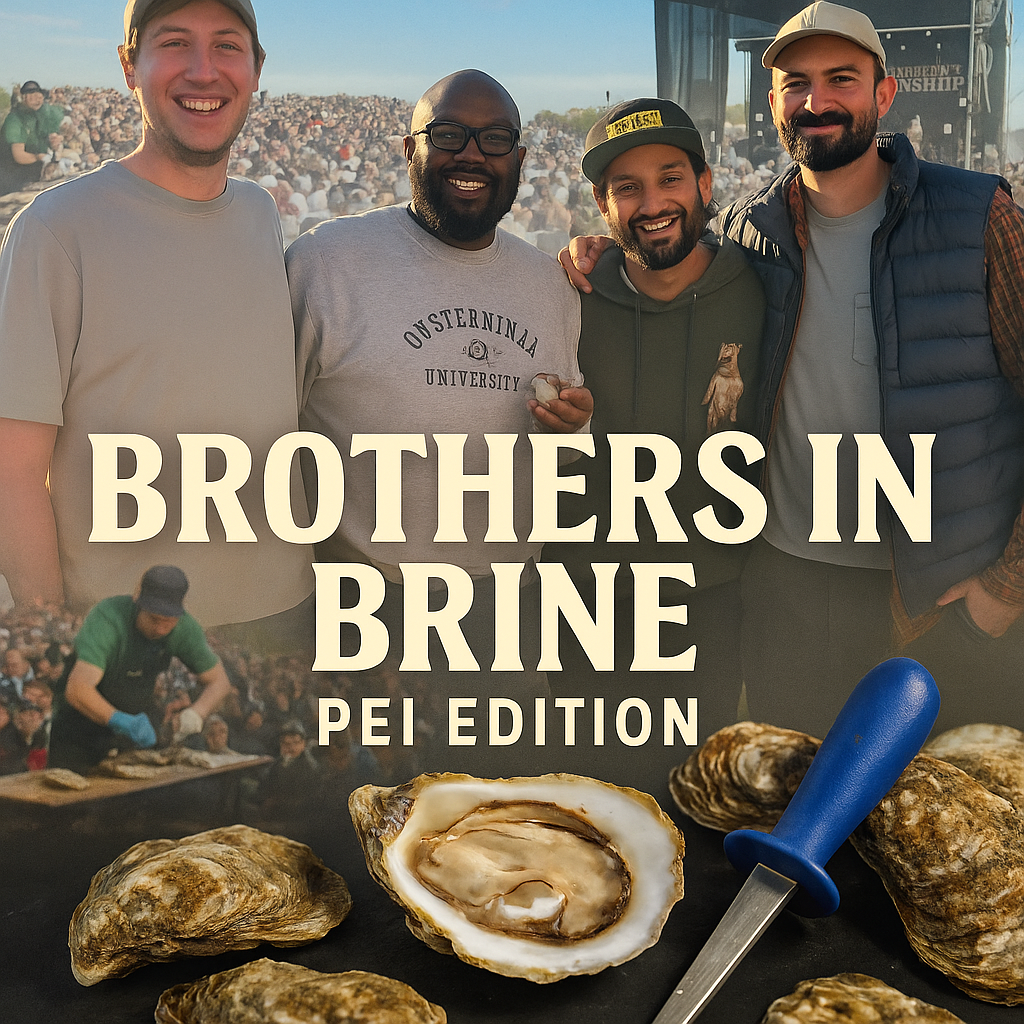
And for your listening pleasures today, we're gonna be talking about the last trip, not the last trip, but this past trip to Prince Edward Island, doing the International Shucking Competition, Raspberry Point International Shucking Competition. Such a great time. We had a SHUCK Team USA for the first time. And today I have some of the gentlemen here that represent it today.
We have, he's a wandering shucker up in New York, Brian Clark, and then we got Chris Clark from Florida. And then we got the Big Bad Boss. We got Mr. Josh from down, Dad Cajun Place.
All right, so that was just a brief introduction. I'm gonna let y'all jump in any way you want. I'm Josh, I'm chilling over here in Florida, hanging out, slinging orching baby. I'm a DCP, short DCP for all the locals, that catered place for everybody else.
And Josh, you have competed in the National Oyster Shucking Competition, the Florida Shucking Competition now in the Prince Edward Island. The folks a little bit of your sets. All right, so right now, number two in the state of Florida, I have been number one, currently two times, third place in the US nationals. Hopefully I can hold it down one more time or get a little bit higher up in the ranks.
We're going for number one, hopefully this year. But we'll see how it goes. I know there's a couple people on my way. I know how much you can, Brian.
How you doing? My name is Brian Clark. I'm from Houston, Florida. Currently shucking at my brother's oyster bar and restaurant called TQS Robar and Grill in Taveri, Florida.
We do right now, we're doing mostly Mid Atlantic oysters. And then Canadian oysters as well. Scratch, scratch kitchen, everything's made from scratch. 95% of the stuff's all fresh made.
And there's not a bad thing on the menu. Also, salt oyster shells, save shells for your landfills. And then I clean and recycle them, sun-dry them and then ship them all over the continental US. And then I also stream part-time on whatnot, doing TCG cards like Pokemon and doing rips and just having fun.
Hi, my name's Chris Clark. I'm a Houston, Florida also. My restaurant is called TQS Robar and Grill. I'm really giving good introduction there.
So I'll leave it at that. Shucking at the end of the past two years in the US, finished second to third in Florida. I've won the oyster jam in Jacksonville and then I finished second to wait to make contests. So that's fun.
But yeah, glad to be here. Glad to be with you guys. All right, and last but not least, Mr. Ruttik.
Hey guys, how's it going? My name is Ruttik Bataila. I'm out of New York City. I run the wandering shuckers go.
Wow, I am in some company, man. I don't know how I find myself here, but this is so cool. Getting to PDI, getting to see all these guys shuck. This was only my sixth competition ever.
Six times being on stage, shucking oysters like this. And I have never had so much fun. So I'm excited to take this further. I'm excited to watch more people like this go and just calling it out right now, Brian, that was insane.
And you do, Josh, I have no idea. That was so cool. Yeah, that's exactly where I wanted to start. Let's go straight to the shucking competition.
And I wanted to, first of all, we're going to congratulate everybody. I mean, we all did a great job. I think we represented the United States very well. I also think we represented ourselves very well.
Nobody got out of control. Nobody got in any trouble. You know, it's always, it's even when you're thinking about shuckers because you never know what a shucker is going to get into. I don't know if we're going to skip over the second competition for right now.
I'm going to ask y'all and you can jump in. Anybody can answer this. What do you think, what makes a good oyster shucker? Great personality, hard work.
I mean, you got to train every day, and make, you got to have technique, technique, technique, technique. And that's why I train all my shuckers. And technique, and then we worry about speed later because they're all worry about, I want to be as fast as everybody else. It's like slow and slow and go, man.
And speed will come. I mean, it's all about technique when you first start now and telling people how to do it. I mean, you have a great oyster, and a bad oyster shucker and everything go wrong, man. It's been happening many times, many restaurants I visited, and they didn't know who I was.
Josh, I want to talk to you real quick about your technique because when I watch you shuck, it's amazing, honestly. I'm in all when I watch you shuck. And for the simple reason, it looks like you barely touch the top shell and it just, it runs away from you, actually. And then you disconnect the bottom of my duck drum muscle with like butter, like less than water, like, I mean, less than butter but water, like, you're in such a flow.
How does that happen? Is it the knife, is it you, is it skill, is it practice? What is it? It's everything, man.
I mean, I practice all the time. I mean, we're, I mean, at DCP, I try to get the oysters. We're going to do it at the next competition, showcase them and practice in front of a crowd. The bar will be rooting.
Try to get in the zone. Always being in the zone when you're trying to do stuff and technique, I practice technique every day. And then, as like when I was up there, it just all turns off and all you see is, you see the oyster, it's like, it's game time. I love that, man.
Anybody else want to tune in on what makes a good oyster or professional oyster shucker? I haven't been doing this long, but I've bartended a long time, and I've served a long time in New York. And I think a good oyster shucker is, of course, has to serve them perfectly. That is just the bare minimum of what we do.
But it's a storyteller. It's a connector. He or she knows what they're serving, where it comes from, what it means, the seasonality, the flavor profile. There's a lot, lot to this little thing that we do.
And we are the final step before it reaches the guest. And if we don't know much about what we're serving, I think that speaks for itself. I think a storyteller is what we are, we are the connector between the beginning and the end, the final step. We're very important in this industry.
And I think there should be more of us who are doing it at this high level and connecting more people. I honestly love the way you put that. And I was telling a bunch of people, while we were in Canada, that I feel like, personally, the oyster shuckers are carrying a heavy load. And I think that's how I referenced it, as far as in this oyster community.
I prefer oyster shucker. I feel like we are doing a lot of the heavy lifting that nothing against anybody and what they're doing. But when it comes to oyster farmers, I think oyster farmers can be doing a lot more as far as educating people about their product. I feel like even the distributors should be doing a lot more.
You gotta think about a distributor literally has all the product, but they only care about the sales. There are some distributors who are doing it properly, where they will take trips out to an oyster farm. They will do fishing trips. They will do educational portions where they bring in the farmers and have the farmers talk to the buyers and the restaurants.
But that's great, but not all people take that same seriousness. So I think that oyster shucker is doing a lot of heavy lifting as far as informing the customer, informing the oyster slipper, oyster eater about where this oyster is from, how it's harvested. You can find more here. You can pair it with this.
I mean, like we was talking about at a bartender, oyster shucker is all that oyster shucker has to be informed and knowledgeable about farming practice, what pairs will with it. Safety regulations, all of that, and it all falls on oyster shucker. Now, I wanna talk a little bit about, Rob, you talked about, this was your sixth competition on the big stage. Like for you, first of all, I wanna give you props because I don't know anybody who came in the game like you.
I mean, just all in, and I give you props, man. I really do. But on the big stage, this is your sixth competition. What's your mindset like?
I was very nervous this time around, because this was huge. Like, I mean, I've been to nationals, I've been to a couple of other competitions in one in Texas, some locally in Maine as well, but this was another level. And before the competition, what do you guys do? Your reps, it was no wrecking a little bit.
But once you're up there at the end of the day, I do that every day, right? I struggle with you every day. I know what I'm doing. I have to get up there and try and do it a little faster.
So I'm still getting to the point where I'm trying to work on the technique more. I'm trying to get faster. But like Josh said earlier, it's just about the reps. Keep doing it, keep doing it, keep getting better.
And I think the more competitions I enter, the more I hang out with people like this, I'll just keep getting better at what I'm doing. And it translates really well into what I'm doing on my daily bill as well as my actual work, because when I come back from these competition, then I've seen the kind of quality and the kind of care that you guys put into your work. I can come back and translate all that into what I'm doing over here, because I'm still new to this industry. I'm still learning from everyone.
That just is the more I take part, it's better for me. That's how I go. You mentioned reps, and I don't think anybody put more reps in than Brian. Chris, you're close second, don't get me wrong.
Brian, can you talk a little bit about your mindset? And for those who don't know, Brian actually won the competition. I'm still waiting on my 5%. But anyway, Brian, talk a little bit about your mindset and the reps and what goes through your head during competition?
I definitely try to get some practice rounds in. Like Josh is saying, you got to do your reps, you got to do your heats. But I do smaller heats these days. I do sets of three, sets of six.
I don't do full sets. I do enough oysters every day at the restaurant. I don't need, obviously, doing these competition heats are different, different kind of shucking than at the restaurant. But I just do the smaller heats for practice mostly and try to figure out the oysters the best I can.
Make sure my knives good, my tips good, for the oysters opening, because sometimes you got to modify your tool for the oysters a little bit. Sometimes you want to sharpen points. Sometimes you want to more amount around a point. Sometimes a shorter knife, sometimes a longer knife.
So it really depends. I do switch knives periodically. I switched knife two years ago. I've been using it since.
I've always used a short knife in the beginning, like a short knife. And then I went to a longer knife. And then I'm sort of like in between the longer and like a four inch and a three inch now. So I'm trying to find that happy medium.
I've only been competing not too long, honestly myself. I've been shucking a long time. I've only been competing for, I don't know, I started in 2017. So I then COVID shut down everything for a good three years.
So. How did you know you was ready for the competition? That's my third time there is this year. So the first time there I got 10th, which I mean, you got 10th, I got 10th last year in nationals.
I mean, shit happens. So I try to do better the next year so I got the third last year, which I was ecstatic. I didn't think I got third. So I was happy with it.
I worked a little bit harder, figured out the oysters got more oysters, practice more oysters and practice more oysters. And practice with different knives and trying to figure out what I needed. And this year I was doing my sets of threes. And I had a few good sets of threes.
And I just walked away. I said, I'm good. I don't even know. I felt it.
I felt like I was good. I felt like I popped three oysters. Three oysters were shocked. It's perfect as it can be.
And I just stepped away. I didn't even, it's worse to overdo it, I think. And this is because you overthink stuff, you overanalyze stuff, you're trying to figure out stuff. And like Revik said earlier, it's just shucking oysters.
We all know how to shuck oysters. It's just two oysters. It doesn't oysters. It's a minute right there.
Like, come on. We all got it. Brian, you were talking about going through blades, long blade, short blades. I want to talk to Chris for a little bit because he has, honestly, in my opinion, wanted a more unique oyster knives and it looks like it shouldn't work, but you make it happen.
Can you talk a little bit about your oyster knife, Chris? I use a Carolina oyster knife. And it tends to be a pretty short pointy, or kind of like a pointy blade, but it's pretty round to start. Then for a lot of the PI or Canadian oysters, I tend to get a really sharp blade on it.
And then because it's a shorter pointy knife, I'm going to come to like some bigger bulkier like Mid-Atlantic or Gulf oysters. I tend to sharpen it up quite a bit on the sides. And then once I'm done, I flatten the tip of it. So just like break because those big bulk oysters really put a hurt on it.
But yeah, it's not the most conventional knife, but it's something I was kind of forced into when I was younger and then I became comfortable with it. So I just did with it. What was your favorite part of Canada? I probably say, you know, I have favorite parts.
I got multiple favorite things. Honestly, the people are always really nice. The shucker's always really welcoming. I mean, the first time I went was in, I think, 18 to the Raspberry Point, imitational.
And then, I mean, like all the shackers were really welcoming. They were looking at my technique. I was looking at their technique. And it was all just really cool.
I mean, afterwards we got all hang out afterwards. And, you know, it's just like, when we got done this time, it's like, what's your done doing? Your dozen oysters, it's like, it's all better now. So then everyone can relax and have fun and enjoy the time together.
And then, you know, it's just no different with them than it is with us and the US. You know, we all know each other. And we start catching up a little bit. How's the family?
How's the kids? You know, how's life? So, you know, you get the same camaraderie over there with the shackers you do here, you know, because they're all super nice people. And then, honestly, you know, the food, food's great up there.
They have different things that are really strong over there, like potatoes and cheese and obviously, mussels. So, you know, those are probably two of my favorite things up there, along with the weather, not being like, Florida weather, which is nice too, to get rid of that heat for a bit. Andy and I actually drove up from New York to Prince Edward Island. And I picked up Andy on the way.
What a beautiful country to drive through all of it. And then when Jason took us around that night, that was something like, I can't get over how beautiful everything is. I kept telling Shelley Jason's wife that, I'm tired of saying, oh, that's so pretty. That's so pretty.
Everything was that so pretty. And I was like an idiot saying that. But everything was just so beautiful. And that dinner at a North Shore canteen, oof.
Yeah. Yeah, I don't know how to describe it. So, I went, there's a place in Houston, Texas, called Josephine's Gulf Post. And it's similar, like, with my tell people, there's no, there's no, I can't tell you.
Like, there's no word I can use for this brand, the food you have to just go there and experience it. That's the only way to eat that food. That's the only thing you do. Well, my favorite part about Canada was the, the Washington farm and learning knowledge.
Brian, dropping knowledge, don't mean I didn't know. Jason, taking us around, dropping knowledge. It was pretty cool. I mean, I love going out and learning things.
That's it. That makes trips wild. Just like, dude, can't believe it's like, dude, that's really how they do it. It's cool, it's like, tell you how this water changes, this profile.
I do want to thank everybody, because I lost my luggage. And my luggage got lost and everybody came together, gave me an oyster knife, hoping I could make it through this. I do want to say it, I appreciate y'all. Oh, I was a little stressed with every minute, but I did like the camaraderie, that's awesome.
I mean, everybody comes together and tag times, it seems like at every competition, I've seen it in two or three different ones where somebody's knife broke and practice and it's like, hey, I'm about to go on stage, you got a knife and it's like, yeah, you get broke. And it's awesome how the oyster shucking community just comes together, no matter where you're at. Yeah, you bring up a good point. I think that's always gonna be my favorite part about anything oyster related I do is the people, is the community, is the thoughtfulness.
And I think how we make people a priority in our thoughtfulness, like we want everybody to feel included. We want everybody to enjoy ourselves, not be an outcast because everywhere we go, we are outcast. Let's talk about oysters. Oh, get away from here.
I'm tired of talking about oysters. But we never get tired of that. We never, this is what we do. This is what we've dedicated our time and our mind and our abilities to is shucking oysters, talking about oysters, educating people about oysters.
And it's just such a blessing to get around like-minded people. This is our comic kind. You know, this is our family reunion. This is our community.
And I think what we don't realize is we're building something bigger because every time we get together, people see us and they wanna be part of what we are and what we're doing. So I wanna thank all of you guys for being just balls of energy and positivity. And Andy is a part of this. Isabella is a part of this.
Quincy is a part of this. I mean, it's tons of shuckers in the United States, but just as far as, you know, they were part of this planning and strategy. I also wanna give a huge shout out to Rubik because you put a lot of heavy lifting in the planning and getting the Airbnb and making stuff happen. Creating group chats and all of that kind of stuff.
So I appreciate that too. I wanna talk about going forward. Like Prince Edward Island going forward. What would y'all do differently?
What we did this time, we kind of just put it together out of nothing, didn't really know what was gonna happen. With Brian's win, with Quincy coming in third and us going there as a team like this, there is a lot of opportunity here. There are people who wanna be involved. There's a shuckers who wanna be involved.
There's brands that wanna be involved. There's an actual opportunity here to create something larger than just what we did. And I think we should get more people involved and take us forward. So that's my take.
Yeah, I'm glad you brought that up. Cause I also of course wanted to thank everybody who donated. We had so many people who donated monetarily. They donated money so that we could make this trip really a success.
I'm not gonna lie. I feel like whether we got donations or not, I was going. I was going, I'm not gonna miss it. But those donations helped take away some of the stress.
And what does stress, what does a lack of stress do to you on that stage? You know what I mean? You're not worrying about, I gotta pay for this. Oh, my bank account is gonna be, you're not worrying about any of that.
So those supporters who poured into us. Wow. Thank you. Thank you.
Yeah, for sure. So there's a salty soul oyster company, of course, in New Jersey. There's Cebo oysters. There's this girl Shucks in Connecticut.
There's big tree oysters in Texas. Fallen pine oyster company in Maryland, Arfren Dan Naverle. There's Arfren Leonard Goose from Philadelphia, Jodi from Chicago, Maria from Philadelphia. I'm sure I'm missing out of someone.
Yeah, but that is the core list there right now. Yeah, thank you. Thank you guys so much because it did help a lot with the living situation, the traveling situation. Yeah.
I'd like to give a shout out to my sponsor, that Cajun playing is for all the sponsors I mean for going to all my competitions. I got great boss. They're awesome people. They're like a family.
I've been working for 11 years. So they're great people. I love cooking and that chopped kitchen, they set up competition. That was awesome.
I watched some of that. I love watching that stuff, man. I can sit there and watch that stuff for hours. But you get there, watch it live and in person and watch them go head to head.
That takes us off of you right there. I was going to say chowder. Chowder, yeah. Lots of roles are phenomenal.
I didn't expect that much of a crowd to show up with the music, I was insane. Yeah, it takes a picture and never looked at crowd was well, that's the biggest crowd I've ever shown in front of. Yeah, man. That was heartbreaking.
There's something I want to say about the first thing you said and it's a horrible time to say it now because we're already at the end. But the one thing that I don't think anybody said about what we do as oyster shackers is we do like the golden rule of food. So we treat others as we treated. So the way we're supposed to do is I always tell people like, shuck it as if you want you eat yourself.
So you don't want to have the grit in there. You want to make sure it looks pretty. You don't want to have to make them work to get it off the bottom. So you ultimately treat every oyster as like, you know, what I put that in my mouth.
You know, and you're not going to put a bunch of, you know, I've had people I've trained before where, you know, if they keep on making them dirty and I keep on getting on about it, I'm like, hey, you know, eat the oyster. And when they eat it, I'm like, do you taste all that grit? I'm like, that's what you're given to the customers. So I mean, I think that's really important that we are like, I guess the ultimate golden rule of treating people is to be treated, you know, with food, shrimp, toberfest come up.
Oop, oop, oop. You want to go over that? Yeah. Oh, man.
So other seafood restaurants have always, you know, had their fest and stuff, not saying what seafood restaurants they are, some of them may be out of business or close to. But they would always have their things. They'd put on TV, so I was like, man, screw that. I'm going to put my own thing up.
So I just went from toberfest and was like, now every year I just went to go to to the store and I just pushed for a month. Hey, it's awesome, dude. Yeah. You remember Shucktober by the same?
Shucktober, yes. I get to say something. I got to say something. I got to have a lot of places and been fortunate enough to witness a lot of shucking culture across the country.
And I thought I'd seen some of the Florida culture, but I was off. I need to visit you guys. I need to get involved more with you guys. There was some insane shucking.
I've seen some fast shuckers. I thought I'd seen some of the fastest, but apparently not. So expect me to be down there soon. That was lovely meeting all of you.
Thank you for that question. What is the oyster culture in your community? down by us, I would say it's getting there. It's people, people are stuck in their old ways, the bigger the better the oyster.
We don't even bring in golf oysters right now, like bringing in made Atlantic oysters in, for our char grilled, for steamed oysters. And then, you know, we're offering the James River as a raw, but we're also offering the raw beauty, for the people that really like good oysters, not just a bigger oyster, so to speak. Something actually has good taste, a decent quality, and it tastes like an oyster. That's what I think an oyster should taste like.
It should have that salt and everything else. Some, we have to educate a lot more people down here, because it's not as big down here, especially down by us in Central Florida. You know, we're six hours south of where Josh is basically, so, you know, they fucking breed oysters up there. His neck of the woods, we gotta like educate people and tell them why they have to pay, you know, two dollars an oyster sometimes, and they're, you know, they don't understand, like two dollars an oyster ain't that bad.
I've seen $15 an oyster overseas in China, so like, like, I pay anything, like for good oysters, good seafood, you pay good money for it, and that's the way I look at it. And sometimes you get what you pay for with that stuff. She prefers not always better. Yeah, we're here, we're at Mac, we got a lot of farms, we're doing it all over, most of them coming out of Appalachia right now, trying to build up Appalachia's name again.
But we're still educating people over here. We're doing Louisiana oyster, and then we do like, I came back home, we had the Malpack oyster and a checkered toner, that was the last night. Ooh, I was like, dang, I couldn't get enough of those, I feel like. And then we do like, alligator harbor, we'll do a couple of bays in Alabama, we'll get a rail snake cove, but I try to mainly do, and then we do West Bay, it's really like 30 minutes up the road, it's a little mom and pop farm, he brings them out every once in a while, I try to help out the mom and pop and local guys around me, because there's a lot of little farms, they don't have names, they're just good old boys bringing oysters in, trying to make it farming.
And then you do gotta educate people, because they're like, oh man, I want that big old Louisiana oyster, it's like dude, this is buttery, salty, sweet, it's gonna change, blow your mind. And then, I mean, you let them try one of each, and you got about 75, 25, that old guy's still gonna be like, man, I don't wanna just feel like getting more bang from a bud, I'm like, come on brother. But that other one's really good. I get that a lot, and it's like dude, you don't know what you're missing.
And then you got the ones, the younger crowd, that have been around, and they're like, oh you got these oysters, oh man, I can't wait. They educated itself, or you've already educated them, or they're like, hey, you got these this week, you got these today. And I mean, we asked, because we always try to have a top notch oyster for the raw, and just do the Louisiana and Texas for our big oysters. I'll knock off the rest of Florida real quick, because I know we've already gone to them already.
Brian and Josh said a lot of it, a lot of people just, you know, the bigger the better, that's how they always felt. And a lot of it's re-educating, but we've brought our oysters before, like they have a buttery finish on a raw oyster. And it's like, hey, you want to taste butter on a raw oyster? Try this oyster right here, you know?
Because there's something out there besides just, you know, something's been sitting on the bottom of the bay and they rake out of there, or dredge out of there, whatever they do. I mean, we pretty much, I mean, you can ask Brian, I mean, we've hardly touched about oysters in the past like four or five years. I mean, it's just, there's just the mortality rates, not the best at times, you know, especially in the summer. You know, the winter's obviously a lot better.
You know, Texas had a really good salty year this last year. They were great. But yeah, it's definitely an education for people. They're getting there.
It's one of those things like a slowly but surely situation where, you know, as people see it and they try it, it's always tell people, it's just like a steak, you know, there's a flame, there's a sirloin, you know? And, you know, the sirloin may be a lot bigger. It doesn't mean it's going to be better. You know, the flakes probably going to be better.
But, you know, it's each the realm. And, you know, so, you know, it's just, we just like to have the options there for them, let them know what's there. And, you know, usually, you know, if I serve both of them to people, like I serve both of them the other day to somebody and I struck three dozen of the Virginia oysters and I said, he wanted to try two of the Canadian ones. I said, listen, you know, all these Virginia oysters first and those Canadian oysters last.
I said, because you're not going to enjoy those Virginia ones nearly as much, we try the Canadian one first. That's just realistic, you know? So, I have to tell people to say anything. They're like, Canadian oysters, I'm like, do you not know what you're missing?
It's like, wow. I guess I'm in a very unique, different situation, I guess. New York oyster culture is, I don't get many of those big ones. I don't ever have to go looking for them because now that I know what those big ones offer, the here, raw culture is great.
So, I get oysters from all over, but I don't get those big oysters that I can put stuff on and dress them up to play with them the way I want. So, I actually go looking for bigger oysters and try feeding people bigger oysters. I'm not having an opposite problem, but oysters are, New York, there's no trouble getting good oysters. People are eating oysters all the year long, like all the time, although this is on.
But unfortunately, if you came to New York and you asked me where you should go for oysters, there's probably not any place I can recommend. I probably second up to my house. There you go. But it's, I'm very fortunate.
I mean, there's a Fulton fish market, there's green cornfish and lobster, there's aqua best, there's a bunch of farms in Long Island, Connecticut, everything's within reach, everything's easy to get. I can get oysters from Hamahama on the west coast really really easily. It's a good place to be for oysters, definitely, if you wanna serve oysters. If you know what you wanna serve and how to get it, like I showed Brian Ellis from one of my bistromineers the other day, and there's just so much stuff available, you know?
So, yeah, that's in the York culture for you. Everything's available, you just gotta make sure you chuck it right and serve it, right? Which is missing sort of. In Washington DC, oyster culture, I would say, I have no clue.
I'm not connected to the DC oyster scene, but I would feel like I have my own scene that I project. So I kind of create the scene that I wanted to be. Think of the oyster ninja I want you to think of. Oh, I can go to him for educational classes.
I can go to him for mobile oyster bar needs or consulting. I can go to him for recommendations, but even my recommendations can be more so for festivals, like the oyster riot. Or I know that old Abbott has a late night happy hour. I would say for the listeners, for the new listeners, you probably don't know that I don't really eat a lot of oysters, but in Prince Edward Island, I ate the most oysters I think in one sitting there every eight almost probably like two dozen, a dozen, a dozen, and I really love them.
But yeah, I would definitely say DC has a good oyster scene. I'm not gonna downplay it, because I would definitely say without, I don't think if I was anywhere else, it would have been as easy for me to start my business and kind of cultivate it. I feel like I would make it happen, but I feel like I came to DC at the right time, the right place. I started every pan at Oyster Bar who really cared about oysters, they cared about presentation, they cared about education, and I kind of just fell in place and kind of got in line.
And then kind of took what they taught me and elaborated on it. There's just gonna be restaurants who care, and there's gonna be some places who just wanna push oysters. They don't even wanna be known as a raw bar oyster bar. They just wanna sell anything.
I've been in those places. It's not fun as a shucker. It's not fun being the person who cares the most and get paid at least. It's no fun in that.
So I would say to all my future oysters, because I'm people who are in the oyster community, cultivate the space that you wanna be in. Don't just get along and do as told. Do what you gotta do, but cultivate. All right.
A couple of weeks ago, I don't know what it was, but I jumped on one of Brian's streams, and I had him sign a shell for me, and he wrote the future. Like he wrote a shell that says, P.E.I. here we come, we're gonna take it home. And he took it home.
Congratulations again, man. Manifestation, bro. Manifestation. Congratulations, bro.
Thank you. Well, I wanna thank all you gentlemen for your time, first of all. And it was great being in Prince Edward Island, Canada, together. Of course, we're missing Andy, and we're missing Jason.
But I'm glad y'all come in, honestly. Quincy, sorry. Y'all been Quincy. But until the next time, I hope it's sooner than later, but I wish y'all peace and safe travels.