Building and Closing Nuclear Plants
from The Innovation Attorney Podcast Hosted by The Innovation Attorney
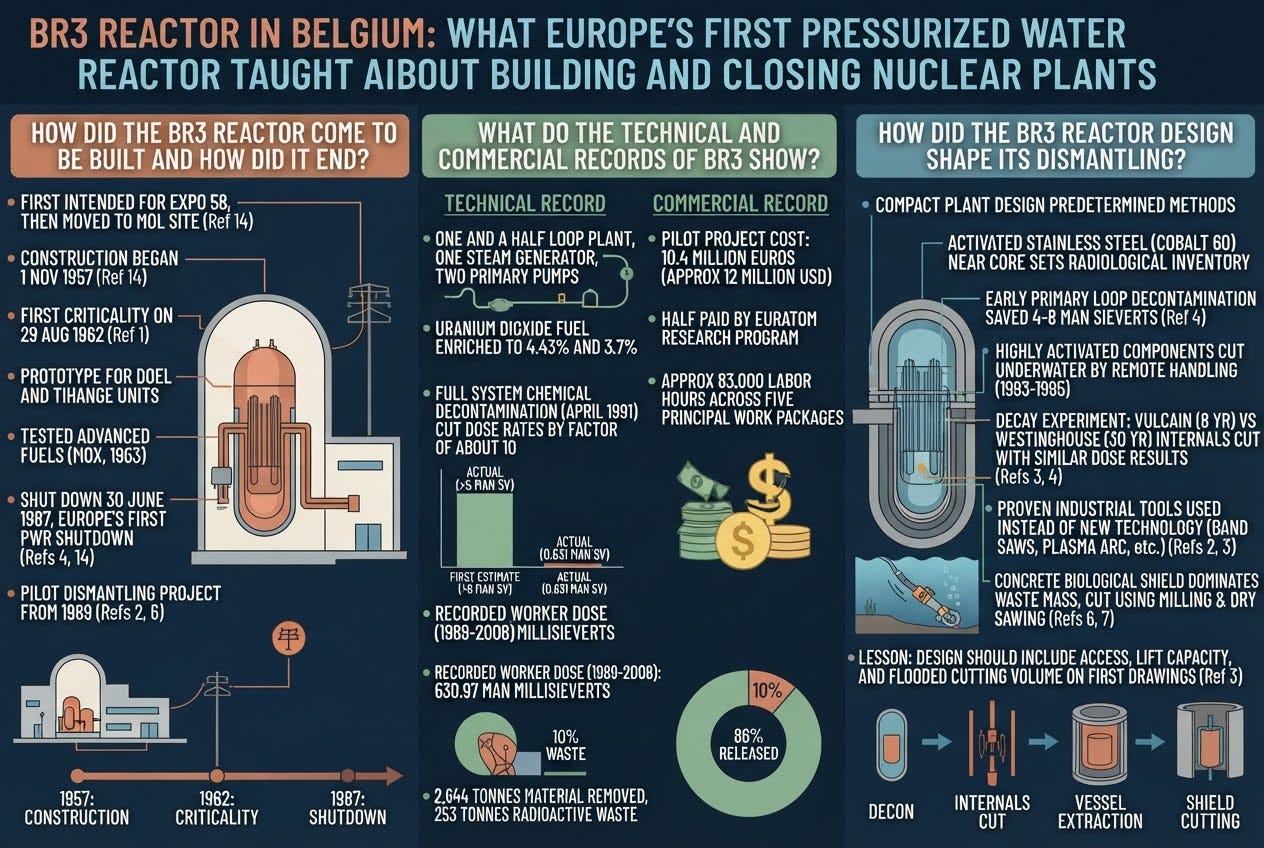
What Europe’s First Pressurized Water Reactor Taught About The BR3 reactor at Mol, Belgium, a 40.9 megawatt thermal pressurized water reactor that first reached criticality on 29 August 1962, became the European Commission’s pilot dismantling project in 1989. BR3 operated until 30 June 1987, tested advanced fuel for the Belgian program, and served as the prototype for the Doel and Tihange units. Its dismantling has run for about 35 years and produced the dose, waste and labor data that Belgian owners now use to plan the closure of their commercial plants. The reactor is forgotten because of its size: at about 10.5 megawatts electric it never competed for a market, and its largest product is a decommissioning record. Classification: BR3 is classified as a power and demonstration reactor, because it was built and connected to the grid as the first Belgian nuclear power station and served as the prototype for the commercial pressurized water fleet, even though it also carried a fuel test mission. The technical record shows a one and a half loop plant with one steam generator and two primary pumps, uranium dioxide fuel enriched to 4.43 percent and 3.7 percent, and a full system chemical decontamination in April 1991 that cut dose rates near the primary loop by a factor of about 10. Recorded worker dose from 1989 through 2008 totaled 630.97 man millisieverts against a first estimate above 5 man sieverts. Of 2,644 tonnes of material removed, 253 tonnes remain radioactive waste. The commercial record shows a pilot project that cost 10.4 million euros, about 12 million US Dollars, with half paid by the Euratom research program, and about 83,000 labor hours across the five principal work packages. The record consulted does not state the original construction cost or the total cost of the full dismantling. How Did the BR3 Reactor Come to Be Built and How Did It End? The BR3 reactor came to Mol, Belgium because a Westinghouse pressurized water reactor design, imported from the United States, was first intended to power Expo 58 in Brussels, and safety concerns and administrative problems moved it to the research site at Mol (Ref 14). Construction began on 1 November 1957 (Ref 14). The nuclear research center at Mol had been established in 1952, the BR1 reactor reached criticality there in 1956, and construction of BR2 began in 1957, so BR3 joined a site that already employed the country’s reactor engineers (Ref 14). BR3 first reached criticality on 29 August 1962, according to the December 1963 operating report, and Belgian sources list commercial operation from 10 October 1962 (Refs 1, 14). The plant sat at Mol Donk, about 90 miles from Brussels. The research center owned it and an industrial group operated it, with operators drawn from conventional power plants and trained in nuclear and conventional work (Ref 1). The first months produced the data that a prototype exists to produce. Engineers measured control rod and boron worth, temperature and pressure coefficients and rod drop time, first at zero power and again after 441 effective full power hours, which equals 750 megawatt days (Ref 1). They also logged radon released from the concrete, a primary leak of about 100 liters per hour and leaks at charging pumps and valves (Ref 1). After two fuel cycles in 1964 the owners replaced the original Westinghouse internals, except the thermal shield, with Vulcain internals for a separate experiment, and the original set went into a shielded chamber in the refueling pool and was never reloaded (Ref 3). The plant’s main purpose was testing advanced pressurized water reactor fuels under irradiation similar to large commercial plants, and in 1963 it became the first reactor in the world to generate electricity from mixed oxide fuel (Refs 3, 14). It ran for about 25 years (Ref 3). The commercial program that BR3 prototyped arrived late. Doel 1 began construction on 1 July 1969 and entered commercial operation on 15 February 1975, which is 12 years and 6 months after BR3 reached criticality (Ref 14). Tihange 1 began construction on 1 June 1970 and entered commercial operation on 1 October 1975 (Ref 14). Doel 1 and Doel 2 are Westinghouse two loop designs, and Tihange 1 is a Framatome three loop design (Ref 14). The plant stopped for good on 30 June 1987, the first pressurized water reactor shutdown in Europe (Ref 14). The records consulted state the date and do not state an engineering cause (Refs 4, 14). In 1989 the European Commission selected BR3 as a pilot project to demonstrate the technical and economic feasibility of dismantling a reactor under real conditions (Refs 2, 6). The dismantling timeline then runs through four decades. Primary loop decontamination took place in April 1991, internals were cut between 1992 and 1996, the vessel was extracted and cut in 1999 and 2000, fuel left the site in 2002, and teleoperated work on the neutron shield tank began in 2007 (Refs 3, 4, 5). The 2009 completion date planned for the pilot was missed by at least 14 years, because the concrete shell around the vessel was sawn off in 2022 and the outer biological shield was scheduled for 2023 (Refs 3, 7). What Do the Technical and Commercial Records of BR3 Show? How Did the BR3 Reactor Design Shape Its Dismantling? The Established Position The BR3 design predetermined the dismantling method because it packed a commercial pressurized water plant’s components into a small footprint. The primary loop held one steam generator and two primary pumps in a one and a half loop layout, the vessel was a 28 tonne forged carbon steel piece clad in stainless steel, and a stainless steel thermal shield 76 millimeters thick surrounded the core (Ref 3). The core produced 40.9 megawatts thermal and the turbine was rated at 11,700 kilowatts (Ref 1). Fuel was uranium dioxide clad in stainless steel at 4.43 percent and 3.7 percent enrichment in two regions, cooled and moderated by light water at about 1,990 pounds per square inch (Ref 1). The Mechanism Neutron flux at the core activates the steel that surrounds it. The thermal shield and the vessel wall sit closest to the core and hold most of the activated metal, so those two components set the radiological inventory that every later decision must handle. Activation of stainless steel produces cobalt 60 with a half life of 5.27 years, and the dose rate from that isotope falls by half every 5.27 years after shutdown. Fuel removal takes away the dominant source, and contamination deposited on the inside of the primary loop becomes the next source, because corrosion products circulate with the coolant and settle on pipe walls. A one and a half loop layout shortens the pipework that must be decontaminated and cut. One steam generator and two pumps mean fewer large components to lift, and that fact lowered the labor count at BR3 relative to a three loop commercial plant. The design also left the concrete shield as the largest mass: about 2,200 tonnes of reinforced concrete in a cylinder 15 meters high and 1.2 meters thick (Ref 6). The Supporting Evidence The pilot project cut the thermal shield in place into rings and then cut the rings into segments in a flooded chamber in the refueling pool, and it compared mechanical sawing, electrodischarge machining and plasma arc cutting on performance and secondary waste (Ref 2). Thermal shield cutting accounted for 39.55 man millisieverts of the dose, and vessel cutting accounted for 28.09 man millisieverts (Ref 4). Removing the reactor vessel from its surroundings before cutting it into pieces cost 2.42 man millisieverts (Ref 4). The vessel extraction took place in 1999 and the shell was cut and packaged into 400 liter drums in 2000 (Ref 3). The start up program tested the plant at zero power and again after 441 effective full power hours, and it covered load transient tests and the determination of the power coefficient (Ref 1). The steam generator carried a nominal capacity of 70 tonnes of steam per hour, and the primary water lea… This is a public episode. If you'd like to discuss this with other subscribers or get access to bonus episodes, visit theinnovationattorney.substack.com/subscribe
Embed this episode
No transcript yet.