Entrepreneurs, business owners, professionals who seek excellence, bringing the business classroom to you. It's the Business Builder Show. Here's Marty Wolf. We've still got a long way to go.
Yes, we all got a long way to go. Welcome to the Business Builder Show with Marty Wolf, the show for entrepreneurs, business owners, and business leaders. I'm Marty Wolf, your host for the Business Builder Show, and along with my executive producer, D.C. Taylor.
We will be your guides on this learning journey. I want to let you know that we record this show in the studios of 94.3 FM, the Parker, which is part of Bold, Bold Media. We are in my hometown of Scranton, Pennsylvania. D.C.
Taylor, hooray for Scranton, Pennsylvania. Yes, we're getting it done here in northeastern Pennsylvania. There you go. We always like to give a shout-out to our hometown.
The Business Builder Show is distributed by C-Suite Radio. That's C-Suite Radio.com. You can find the Business Builder Show and many other fine shows on C-Suite Radio. You know, D.C., and people know this, but we pay our bills with our sponsors.
You know that, right? How about that? Yeah, we have to pay our bills, and we've got new sponsors, Neapost Postage Meters. Welcome.
Yeah, welcome to that new sponsor. We're going to be talking about that on a special offer. So in addition to this incredible guest that we have, who is – do we have him on the line? We have him.
We have him on the line. Ira S. Wolfe joins me. Hi, Ira.
How are you? Hey, hello, guys. How are you doing? Marty in D.C.?
Great to be back. Yeah, you've been on before. You're one of my favorites, that's why. Well, that's good to hear.
Well, you misspelled your name, you know, but, you know, mine's W-O-L-F-F and yours's W-O-L-F-E, but that's okay. I look past that. Now, getting serious. Ira is a special guy.
I've known him for a while in the power of networking. We were at a networking event one time, and that's how we met him. That's probably already two years ago, Ira. So let's get to it.
What are we here for? Let me tell you about Ira. Ira. If there is a crystal ball for what the future of jobs and work will look like, it probably lies in the head of Ira S.
Wolfe. His near-perfect forecasting of the future workplace has positioned him as one of human resources' most visionary leaders. Ira was one of the first and most outspoken leaders to talk about job and skill shortages about 20 years ago. More recently, Ira has been on the leading edge of how exponential change is reworking work.
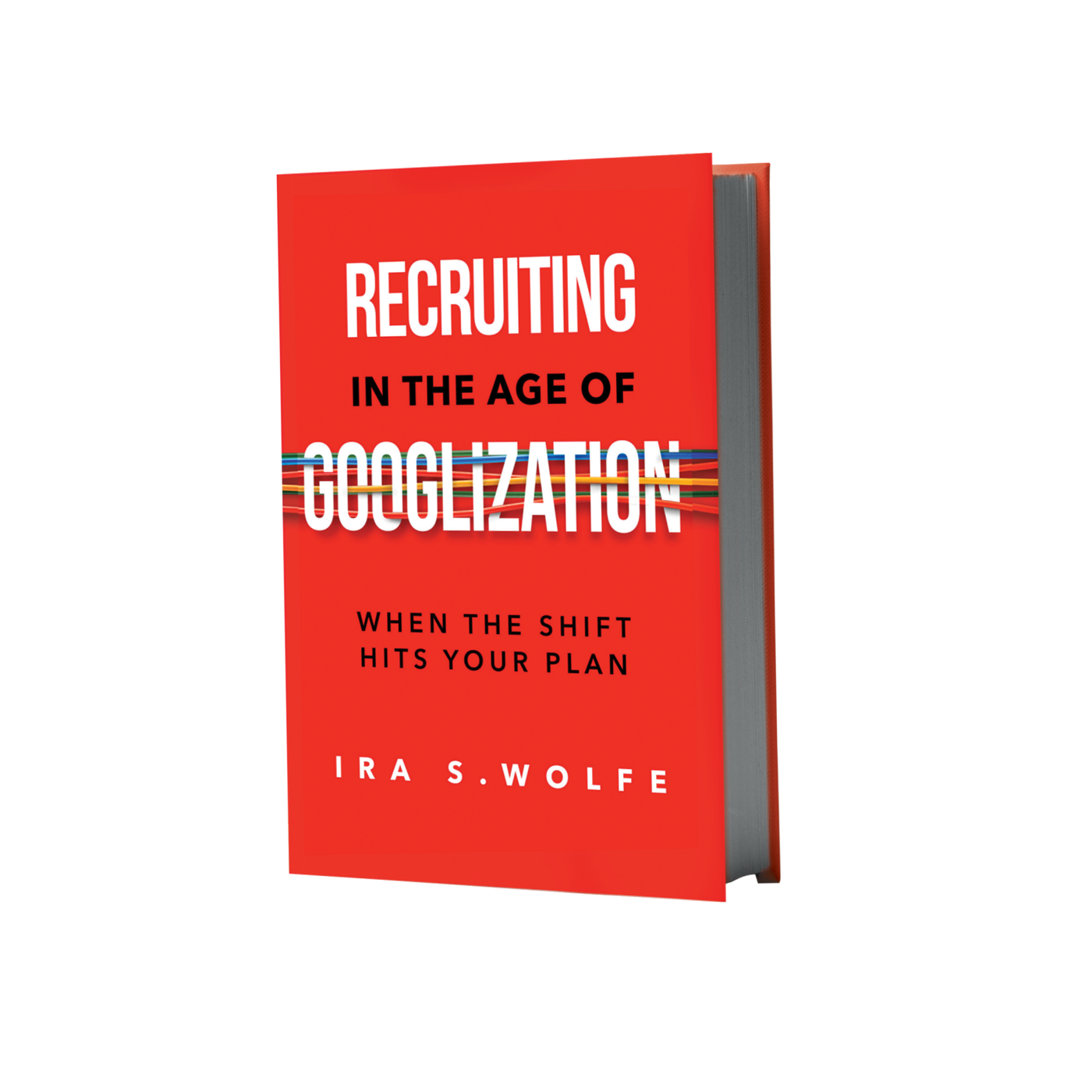
Ira speaks, writes, and consults frequently on disruptive innovation and its impact on talent management, talent intelligence, employee selection, and 21st century leadership. Ira is the president and founder of Success Performance Solutions and has written a great book called Recruiting in the Age of Googleization. Did I say that word right, Ira? Oh, absolutely, you did.
And the subtitle is When the Shift Hits Your Plan by Ira S. Wolfe. Now, you let me know about this book some time ago, and I was honored when you asked me to review it. And I had some comments that you were kind enough to put in the book.
So, Business Builder Show listeners, let me tell you what I said about Ira's book. Having read hundreds of books and interviewed an equal number of business experts on my Business Builder Show, I know real insight when I see it. The way we do business, and especially the way human resource operates, must change. Recruiting in the age of Googleization is one heck of a read.
Ira, welcome to the show, man. Hey, thanks, Marty, very much. And thank you for that endorsement. It was great when I sent the book out to be reviewed by a lot of people.
It was humbling to get some of the responses back. So, I really appreciate yours because I know you talk to a lot of business leaders. You're out and about and networking. And to get that was very, very humbling.
So, thank you. My pleasure, my honor. It's a great book. So, let's get to it.
Why did you write this book? I guess, where did you see the need? Why did you write it? And then I'd like to know, who was it written for?
Good questions. You know, I was on before. We talked about the geeks and the geeks geezers in Googleization. I think that was our first conversation.
Yeah, it was. The first stumbling block on Googleization for you. And then, so, you know, I went and looked back and certainly things have, I don't know if they progressed or not, but things have changed a lot. And, you know, we were talking in that, when I wrote that book, now it's 2009.
I talked about the millennials and I talked about technology. And the thing that I realized is that it needed updated. You know, I started this process about two years ago and six years had passed. And it was amazing because, you know, certainly we've moved beyond the millennials or we should move beyond the millennials because now we have Generation Z.
But especially in the technology part, which is really talking about Googleization, the one thing that I realized is when I wrote that book only, at the time it was only six years prior to that, now it's seven or eight, there was no such thing as an iPad. We didn't even know what tablets were. I mean, tablets were paper tools with lines on it. And so I started writing it as an update to that book and realized it had to be written over from first word to the last.
It was no longer an update. It was no longer version two. It was something startling new because things were exponential change. It was just changing much faster than it would be before.
Yeah, let me jump in. How the hell do you write a book and stay current? I mean, things are changing virtually every second. You kind of talk about that in the book.
So maybe that's an unfair question because I do want to know who you wrote it for. But how the heck do you do that? Or I'm putting you on the spot. Yeah, I have a great answer for it because, you know, I kind of finally, I got to tell you, I think I was on the show last year just about this time.
It was around Thanksgiving. And we talked about when the shift hit your plan. That was one of the original tentative titles and made it to the subtitle. And part of it was my goal was to have it to the publisher by Thanksgiving and then by Christmas and then at the end of January and then by Easter.
And finally in May, I just had to stop and talk about that in the book a little bit. You do, yeah. Every single day I thought I was finished. Something new happened.
And I wanted it to be current. I finally just have to pull the plug in, you know, six months, five months have passed since I sent it to the publisher. And every single day, I don't know if I started on another book, but I have so many notes for disruptions, new technologies, new changes, new shifts. Well, but people can keep up.
Let's give people your website because I know you blog. I know you're active on social media. People, you share your information. The book is sound.
We're going to get into details and stuff that people should know. But how do people stay up with you and your current thoughts? Well, there's a couple of ways. You know, we're living in the world of technology and everybody has a different favorite source.
I'm certainly on a lot of social media, you know, Facebook, LinkedIn, Twitter. But my website, Success Performance Solutions, a long name, but successperformancesolutions.com. I also have another blog at perfectlabourstorm.com. And I do have a podcast at geekspeachersgooglization.com.
Okay, we're going to keep repeating that. But at the beginning of the show, I mentioned that we've got to pay some bills. Okay, we take a short break, Ira? No, absolutely.
All right, so we're going to talk about a new sponsor. It's Neapost of PostageMeters. And what they want to be known for is to be a business champion, a business ally. They want to be problem solvers.
And, you know, think about this. If we think about all the time that business spends to process and send mail-in packages, if we spend just 15 minutes a day doing that, that's more than seven full days a year focused on mailing and shipping. That's crazy. So I'm going to talk to you in a few minutes about a special offer you can get from our newest sponsor, Neapost.
And so stay tuned. You're learning a lot from our guest, Ira S. Wolf, and his book is Recruiting in the Age of Googleization, When the Shift Hits Your Plan. So I did ask you a few minutes ago, who did you write this for?
Tell me that quickly. And then I want to get into what you mean by when the shift hits your plan. Yeah, you know, the target audience is certainly, I deal with HR, you know, human resources a lot, small business owners. We work with mostly small and medium-sized business owners.
But really the book is, you know, I have a few C-suite senior executives from large companies, you know, really appreciate my take on things and where things are going. But it's also for people, you know, that have kids or people looking for a new career. What's the new world going to look like? What's the new world of work?
Yeah, so the new world of work, I guess that, again, go back to the subtitle of the book, When the Shift Hits Your Plan. What do you mean? And that seems to resonate with a few people, huh? Yeah, absolutely.
And here's one of my favorite quotes. And I'll give Thomas Friedman, you know, from The World is Flat, and thank you for being late to fame and be a great columnist. I picked this quote up in his book, and it's from Richard Miller. He's president of Bowling College of Engineering.
He's probably one of the most progressive schools in the country. He says, today's job market is like marching into a forest that no one has explored in search of things you have never seen, searching for jobs you can't imagine. Wow. That pretty much sums up the world we live in.
And, you know, he was trying to make sense of that. In this book, people are probably pausing, highlighting, making notes. You say, exponential change doesn't play favorites. Exponential change doesn't play favorites.
What do you mean by that? Well, let's start with exponential change. And, you know, it just means things are changing really fast in a greater scope than they ever have before. But to put some maybe numbers so people can picture that, we are used to, and, you know, we're baby boomers, and we grew up in a time when it was always change.
Things always happened. But change happened at, let's say, 10%. There was a 10% change every year over time. And that was pretty predictable.
It was incremental. When exponential change is, things change at 10 times the pace that they used to. And that's the world we're living in. I mean, things are just accelerating that much faster.
You know, it's not that things are 10% different than the year before. They're now 10 times different. So, you know, part of that is how fast things are changing. And it affects everyone.
I mean, people think that, oh, they live in Scranton. You know, that's different than living in California. It's not technology. It affects the world.
We're all globalized. It affects everyone. It sure does. So give me the title of your book again and tell people how they can reach you and keep up to speed on what your work is.
Recruiting in the Age of Googleization is the title of the new book. Keeping up with me, my website, successperformancesolutions.com. Frankly, I can probably type my name into Google and find out that I've got a series of videos. I've got a couple of blogs going.
I've got a podcast. Pretty easy to find me. And his name is Ira S. Wolf, W-O-L-F-E.
So I promised you some information. You're probably waiting for this information, Ira, on Neopost. So here's what we got. We got a special offer for a limited time.
The Business Builder Show listeners can get up to six months free by using the promo code MartyWolf. So visit Neopost280.com slash MartyWolf. That's just the way it sounds. N-E-O-P-O-S-T 280.com slash MartyWolf.
And enter your zip code to see if you qualify. And then make sure you put in the promo code MartyWolf to lock in six months free. Ira, that's a good deal, huh? It absolutely is.
That's a great deal. I've not heard of that before. Yeah, write that down, man. We got to pay some bills here at the Business Builder Show, you know?
So, again, Neopost280.com slash MartyWolf. Make sure you put in the promo code MartyWolf to lock in six months free. You have to put in your zip code. So please do that.
Stay here for more of the Business Builder Show with Marty Wolf. This episode of the Business Builder Show is brought to you by Contractor Succession LLC. If you are in a construction-related business and you want to exit your business in the next five years, then contact us at ContractorSuccession.com. That's ContractorSuccession.com.
If you want to exit your construction business in the next five years to finish strong and finish well, contact us at ContractorSuccession.com. Okay, back to Ira S. Wolf. Okay, maybe this is a little negative, but I've got to ask this.
You're in the world of human resources, of talent management, talent recruitment, et cetera, et cetera, et cetera. What kind of blunders do you see companies make? What do you think are the biggest recruiting blunders you see companies make? And do you talk about them in the book?
Well, absolutely, you talk about them in the book. I know you do. There's a couple things. First of all, I always try to dispel a few myths, and these are stumbling blocks people just fall into.
One is, as I say, millennials are not aliens. They actually share a lot of the same DNA as we do. So one thing is people blame the shortages and the difficulty in hiring on the attitudes, and the enemy became the millennials, and it's time to get over that. I agree.
I agree. Amen to that, brother. They make up 75% of the workforce in just a few years, so get over it. The other part is that the future isn't coming.
It's here. So the line between science fiction, automation, artificial intelligence, machine learning, 3D printing, autonomous vehicles, coming much faster. But all that kind of falls into how does that affect recruiting? Well, because things are moving so much faster, there's still a lot of companies that are hung up on when there's an opening is when they start looking.
And the expectation to hire just in time, to hire somebody in two or four weeks. I just did a seminar yesterday for the American Staffing Association, and I did a poll. And the poll was, you know, what's the average length to hire people? And it's essentially, over half of them said it's longer than two months.
Some of them said it's longer than 90 days, and a few said 100 longer than 180 days. It used to be that somebody quit. You put an ad in the paper. You did a couple interviews, and within two to four weeks, you had somebody to replace them.
You know, now it's months, and for some difficult to fill positions in engineering, in health care, specialized nursing, it takes a year, year and a half. It's everybody's position. So, you know, the number one wonder, I see, is just the expectation that you have an open position, you're going to fill it in a few weeks. That's just not the case.
Let's everybody start with, and again, you said at the beginning of the show, this is for everybody. If you're job hunting, you're obviously HR, but everybody in an organization, you've got to read Ira's book because it's always changing, but there's a lot of current thinking here, as he just pointed out. I want to make this statement. You know that I do executive coaching, and I'm a company just like you.
Let me tell you something. In my opinion, the number one issue is talent recruitment and retention. Number one, I have clients who are struggling to do work because they cannot find talented people. It's a huge issue, man.
Yeah, I've had clients that I know, and I've heard from people like yourself, that they're strategic clients. I mean, they basically say they can grow at 20, 30, 40, 50%, and they cut way, way back just because they don't have the talent and the resources to do it. It's huge. So Ira S.
Wolf is my guest. Give me the title of your book again, and tell us again how we can reach you. Recruiting in the Age of Googleization is the book. It's available up on Amazon, and it'll be in all the bookstores in just a couple weeks.
And they can reach me at successperformancesolutions.com, or just type my name into Google. I'll show up in a lot of places. You will, and good stuff. So, you know, we're limited with time.
So we like to kind of say, well, okay, we've identified the problem. Do you have some recommendations that maybe some of these companies can go to first, I guess? Or what thoughts did you have? Well, I created an acronym, and it actually talked about going through the recruitment funnel.
The acronym is called REACH. It's R-E-A-C-H. So it talks about breaking down the cycle. When you're struggling to find people, you know, where is the problem?
And the first thing is, is how do you reach enough people? Which is a marketing issue, by the way. That's not an HR issue. It's a marketing issue.
Amen. And a branding issue. The next stage is engaging. That's the E.
So we have REACH, engage. You know, once you contact, once an applicant or a candidate is interested, you've got to reach out to them right away. This is no longer a, hey, when we have time, we'll do it. And there's multiple, we can spend the whole session on that.
But the third step is the application, which is the A. And I've got to say that this is probably the number one stumbling block people have. Yep. Their applications are horrible.
We track this. And the number, one of the first questions I always ask somebody is, how many people, how many applicants start an application but don't complete it? And they don't know, first of all. So that's my first suggestion.
And if you don't know, find out. And it's as high as 95%. And those are people literally walking through your front door saying, hey, I want to buy, I want to apply for a job. And your application process deters people.
That's probably the number one spot. And then the final two, which we don't have a lot of time to spend on, is even if they're not a candidate that fits today, have a conversation with them. Send them blogs. But just treat them like customers.
They may be a future employee or they may know people who would be a good fit for your organization. So just because they don't fit doesn't mean you should ignore them. And the final stage is hiring doesn't stop at your job offer. You need to do a good job at onboarding and retention.
Many, many people are hired, but then they get lost in the pipeline once they get on your payroll. And that's really silly, a bad practice for onboarding process. So reach is kind of the five steps. Reach, engage, apply, have a conversation.
And when you're hired, it doesn't stop at the job offer. Yeah, keep on hiring them. Yeah, keep on recruiting them. Yeah, it's good for us.
Yeah, yeah, keep it going. So we need to wrap up. And engaging, very engaging. So wrap up by taking the last minute or so.
And what are you really, close, strong, what do you want people to really take away from this book? I think there's two parts. The first part of the book talks about is that exponential change, which we talked about briefly before. I think the one statistic that's most powerful and seems to resonate most well with people is that nearly two-thirds of all jobs will be at least one-third automated, which means that everybody's job is going to change.
At least two-thirds of people's jobs are going to change. The other third are going to go away. So that's even scarier. That's scarier, yeah.
But everybody's job is going to change. The level of skills that are going to come up, I think everybody needs to be aware of what jobs are going to look like, what work is going to look like. That's going to change how we recruit, and it's going to change how we work and basically make a living. And the other part is directed more at HR and businesses.
They just need to adapt. They need to change quickly the way that they recruit people. We're no longer living in the age of the typewriter. We're living in the age of mobile devices.
Yeah, so we're talking about when the shift hits your plan. My guest has been Ira S. Ira S. Wolfe, again, give me the title of your book and how people can reach Ira.
Thanks, Marty. The title of the book is Recruiting in the Age of Googleization. It's available on Amazon and other bookstores across the country. And they can reach me at successperformancesolutions.com or just type my name, Ira S.
Wolfe, into Google, and I will come up in many places. Ira, you are a gentleman. You are a smart man. You are doing great work.
This is a phenomenal book. Thanks so much for sharing your wisdom with us on The Business Builder Show. Yeah, thanks for having me again. Really appreciate it anytime, and good luck.
Thanks so much. Thank you again to Ira S. Wolfe for being our guest on The Business Builder Show. I want to remind you again about a special offer from our sponsor, Neapost.
For a limited time, our listeners could get up to six months free by using the promo code MartyWolf. Visit Neapost280.com slash MartyWolf and enter your zip code to see if you qualify. Followed by the promo code MartyWolf to lock in six months free. That's Neapost280.com slash MartyWolf.
Enter your zip code to see if you're lucky enough to participate in that great deal. On behalf of myself, Marty Wolf, your host for The Business Builder Show, and D.C. Taylor, my executive producer, thank you for listening to The Business Builder Show. Bringing the business classroom to you, it's The Business Builder Show with Marty Wolf.