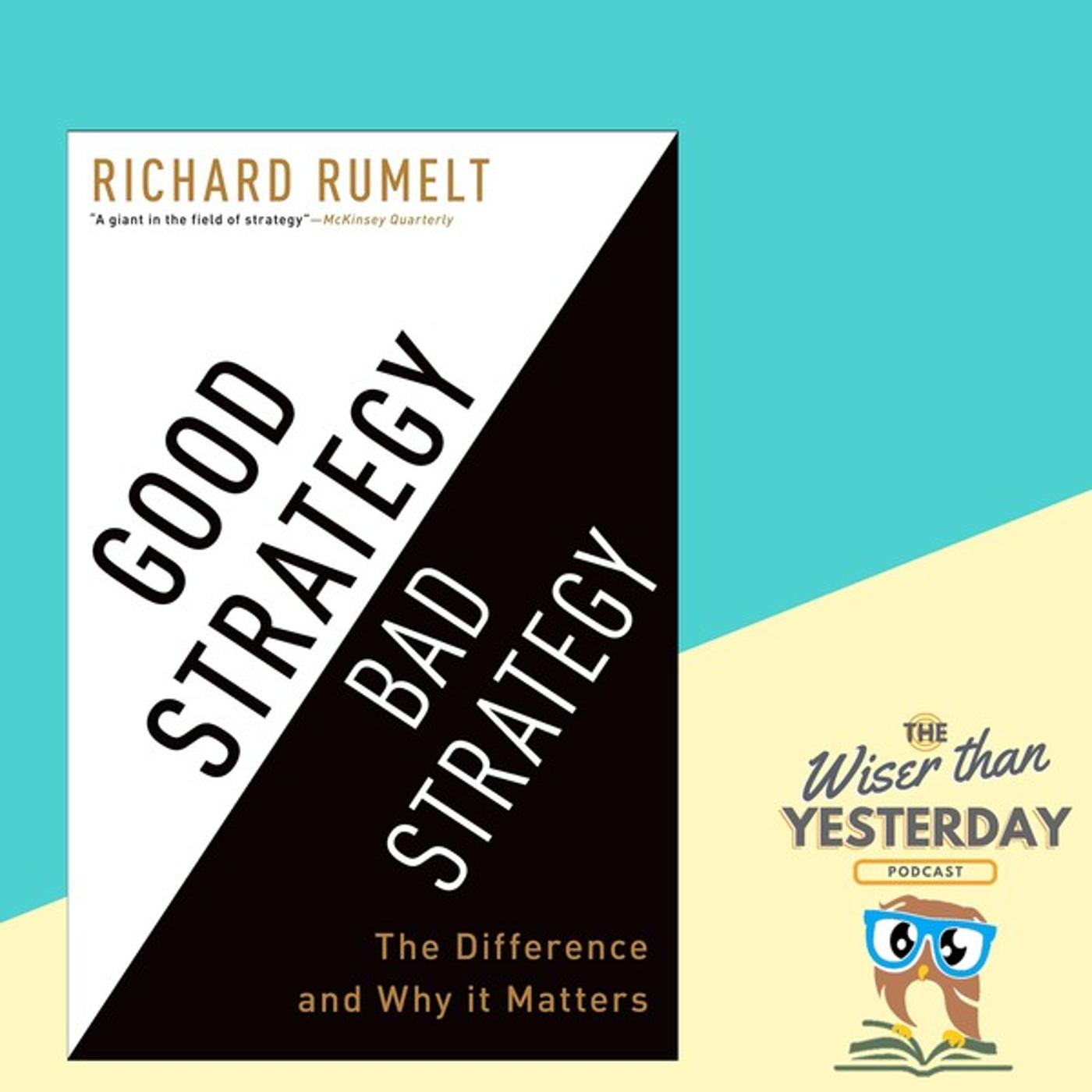
Business: Good Strategy, Bad Strategy - Richard Rumelt episode artwork

EPISODE · May 19, 2021 · 42 MIN

Business: Good Strategy, Bad Strategy - Richard Rumelt

from Wiser Than Yesterday: Educational Book Reviews and Summaries

Good strategy, bad strategy: The difference, and why it mattersBy Richard RumeltKey insightsStrategy =/= ambitious goal setting, vision, charismaAround the 60’s, many authors started ascribing leader’s success to their vision, combined with their charisma. This has resulted in a lot of bad strategy, based on ambitious goal setting. Example: 20/20 plan - 20% growth with 20% profit margin. Often a goal or a vision can be a perfectly fine starting point for a strategy. However, the strategy itself must include precise information on how these goals will actually be achieved.Example: warzoneEvery good strategy has the same foundation: a diagnosis, a guiding policy and a set of coherent actionsDiagnosis: What is the challenge to be overcome? Often requires focus on critical elements to simplify complex realitiesA guiding policy is an overall approach chosen to cope with or overcome the obstacles identified in the diagnosis. Like the guardrails on a highway, the guiding policy directs and constrains action in certain directions without defining exactly what shall be done.A set of coherent actions dictate how the guiding policy will be carried out. The actions should be coherent, meaning the use of resources, policies, and maneuvers that are undertaken should be coordinated and support each other (not fight each other, or be independent from one another).A good strategy demands that you make a choice, based on your diagnosis (strengths, weaknesses). Example: BonsaiGood strategy vs bad strategy-Good strategy identifies the key challenge to overcome. Bad strategy fails to identify the nature of the challenge.-Good strategy includes actions to take to overcome the challenge. Actions are not “implementation” details-Good strategy is designed to be coherent – all the actions an organization takes should reinforce and support each other. Leaders must do this deliberately and coordinate action across departments. Bad strategy is just a list of “priorities” that don’t support each other, at best, or actively conflict with each other, undermine each other, and fight for resources, at worst. Good strategy is about focusing and coordinating efforts to achieve an outcome, which necessarily means saying “No” to some goals, initiatives, and people.Developing a strategy is not a one-time-exercise. The only constant in any situation is change. Your action points, and maybe even your strategy will need to adapt to this change. Change can come from technology, industry trends or competitors. Next to adapting to change, it is also possible to use change to your advantage.Example: The author once asked Steve Jobs how he was going to compete against the Win-tel standard in the personal computer industry. His answer was - ‘I’m not going to, I’m going to wait for the next big thing in the tech industry, and take it’. A good strategy maximises your competitive advantage by limiting your rivals’ opportunities and maximising your resources. Approach strategy like science, start with a hypothesis and continue to test your hypotheses. Once in a while, it pays off to stop doing and reflect on your priorities, example: interview of the CEO. Don't Forget to leave a comment on this episode See podvine.com/privacy-policy for podcast listener privacy info. Hosted on Acast. See acast.com/privacy for more information.

Good strategy, bad strategy: The difference, and why it mattersBy Richard RumeltKey insightsStrategy =/= ambitious goal setting, vision, charismaAround the 60’s, many authors started ascribing leader’s success to their vision, combined with their charisma. This has resulted in a lot of bad strategy, based on ambitious goal setting. Example: 20/20 plan - 20% growth with 20% profit margin. Often a goal or a vision can be a perfectly fine starting point for a strategy. However, the strategy itself must include precise information on how these goals will actually be achieved.Example: warzoneEvery good strategy has the same foundation: a diagnosis, a guiding policy and a set of coherent actionsDiagnosis: What is the challenge to be overcome? Often requires focus on critical elements to simplify complex realitiesA guiding policy is an overall approach chosen to cope with or overcome the obstacles identified in the diagnosis. Like the guardrails on a highway, the guiding policy directs and constrains action in certain directions without defining exactly what shall be done.A set of coherent actions dictate how the guiding policy will be carried out. The actions should be coherent, meaning the use of resources, policies, and maneuvers that are undertaken should be coordinated and support each other (not fight each other, or be independent from one another).A good strategy demands that you make a choice, based on your diagnosis (strengths, weaknesses). Example: BonsaiGood strategy vs bad strategy-Good strategy identifies the key challenge to overcome. Bad strategy fails to identify the nature of the challenge.-Good strategy includes actions to take to overcome the challenge. Actions are not “implementation” details-Good strategy is designed to be coherent – all the actions an organization takes should reinforce and support each other. Leaders must do this deliberately and coordinate action across departments. Bad strategy is just a list of “priorities” that don’t support each other, at best, or actively conflict with each other, undermine each other, and fight for resources, at worst. Good strategy is about focusing and coordinating efforts to achieve an outcome, which necessarily means saying “No” to some goals, initiatives, and people.Developing a strategy is not a one-time-exercise. The only constant in any situation is change. Your action points, and maybe even your strategy will need to adapt to this change. Change can come from technology, industry trends or competitors. Next to adapting to change, it is also possible to use change to your advantage.Example: The author once asked Steve Jobs how he was going to compete against the Win-tel standard in the personal computer industry. His answer was - ‘I’m not going to, I’m going to wait for the next big thing in the tech industry, and take it’. A good strategy maximises your competitive advantage by limiting your rivals’ opportunities and maximising your resources. Approach strategy like science, start with a hypothesis and continue to test your hypotheses. Once in a while, it pays off to stop doing and reflect on your priorities, example: interview of the CEO. Don't Forget to leave a comment on this episode See podvine.com/privacy-policy for podcast listener privacy info. Hosted on Acast. See acast.com/privacy for more information.

NOW PLAYING

Business: Good Strategy, Bad Strategy - Richard Rumelt

0:00 42:29

No transcript for this episode yet

We transcribe on demand. Request one and we'll notify you when it's ready — usually under 10 minutes.

MG Show MG Show The MG Show, hosted by Jeffrey Pedersen and Shannon Townsend, is a leading alternative media platform dedicated to uncovering the truth behind today’s most pressing political issues. Launched in 2019, the show has grown exponentially, offering unfiltered insights, comprehensive research, and real-time analysis. With a commitment to independent journalism and factual integrity, the MG Show empowers its audience with knowledge and encourages active participation in the political discourse. Breaking News Show | eTurboNews Juergen Thomas Steinmetz News is relevant to the global travel and tourism industry, human rights and global issues.Breaking news when it happens and only from the source. Eat to Live Jenna Fuhrman, Dr. Fuhrman Our health is our most precious gift and smart nutrition can change your life. Each month, join Dr. Fuhrman and his daughter, Jenna Fuhrman as they discuss important topics in the world of nutrition. Eat to Live will change the way you eat and think about food. French Your Way Jessica: Native French teacher founder of French Your Way Boost your French listening skills and test your comprehension with this one of a kind series of podcasts. Get the chance to listen to a real conversation between native speakers talking at normal speed AND customise your learning experience through carefully designed sets of questions (2 levels of difficulty) available for download at www.frenchvoicespodcast.com. All interviews also come with the transcript. French teacher Jessica interviews native speakers of French from around the world who share a bit of their life and passion. Where else would you meet in one same place a French yoga teacher based in Melbourne, a soap manufacturer from Provence, or a couple cycling around the world?

Frequently Asked Questions

How long is this episode of Wiser Than Yesterday: Educational Book Reviews and Summaries?

This episode is 42 minutes long.

When was this Wiser Than Yesterday: Educational Book Reviews and Summaries episode published?

This episode was published on May 19, 2021.

What is this episode about?

Good strategy, bad strategy: The difference, and why it mattersBy Richard RumeltKey insightsStrategy =/= ambitious goal setting, vision, charismaAround the 60’s, many authors started ascribing leader’s success to their vision, combined with their...

Can I download this Wiser Than Yesterday: Educational Book Reviews and Summaries episode?

Yes, you can download this episode by clicking the download button on the episode player, or subscribe to the podcast in your preferred podcast app for automatic downloads.
URL copied to clipboard!