
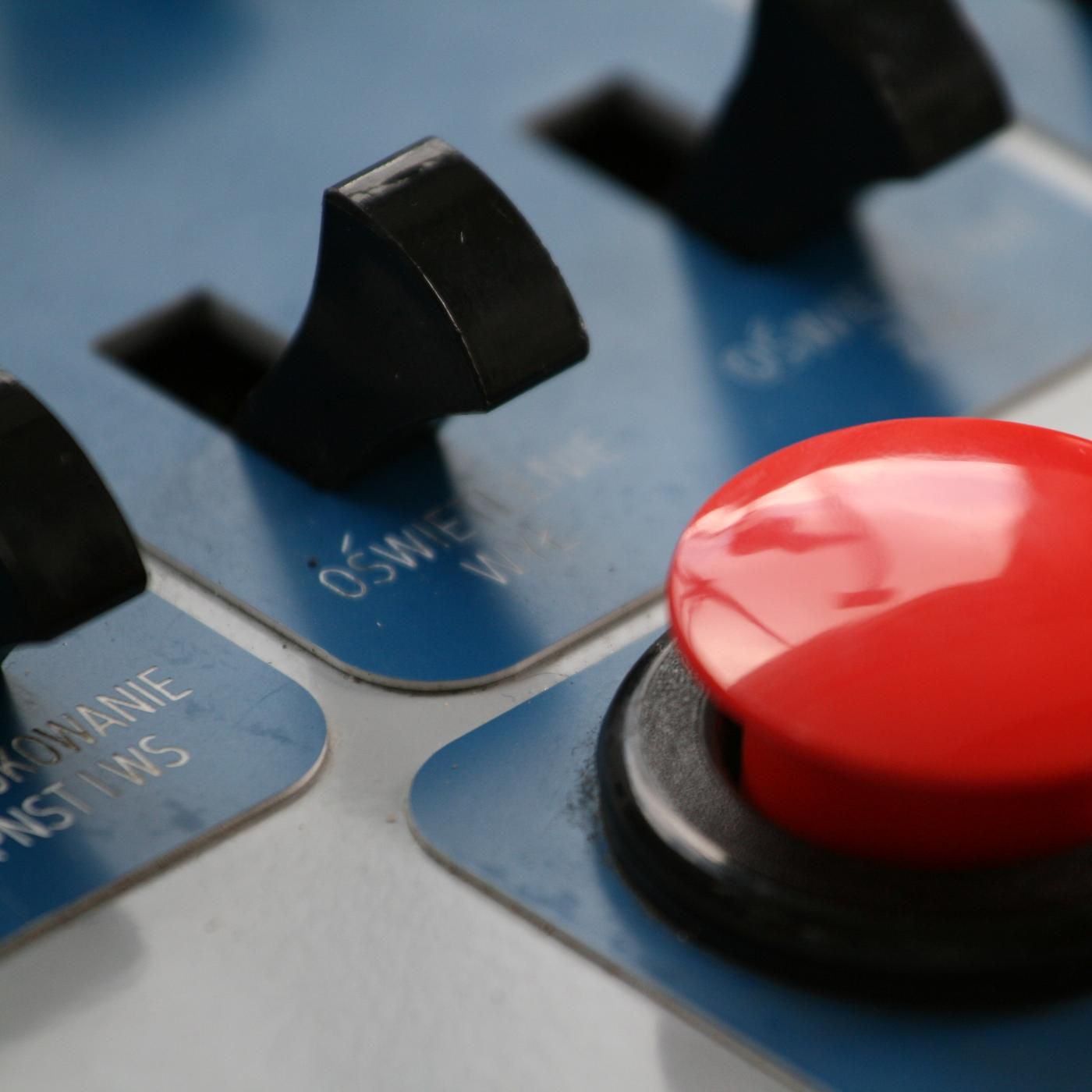
Wait, you listen to radio lab Radio lab from WNYC Hey! And NPR How did you even get on to I feel like buttons has just become a fixture? How did it happen? Can I boost the blame?
Let me start. I'm gonna start. This is reporter Luddif Nasser and today on Radio Lab Luddif and I are bringing you Wildly different stories about buttons that are really about power and freedom and destruction. So this all started because I could not convince any of my friends to go to the elevator history museum with me.
There was not a single person out of the 8.5 million people in New York who wanted to go to the Button Museum with me. You found one. Except for I'll recall it. I'll go to anything.
Exactly. Jamie told me never to sound recording but I didn't know. So we go to Long Island, so you think it's right that door right there? I usually can't find it.
We got a lot of stuff. This entirely taxi yellow. The only thing we saw was a big old boring building covered with taxi signs. We have no interest in taxis.
I'm using a museum in here. We found something on the street. Yes there is. You gotta go upstairs.
I'll take the air. I'll take the air. I'll take the air. I'll show you the way anyway.
You go all the way down, make a lift. Right now. All the way down to the end. Thank you very much.
Wow. That's quite a sign. Elevator Museum. Founded in 2011 by Patrick Carson.
So we open up the door. Wow. We have no idea what's going to be on the other side of this. Hello.
This is different from what? In large rooms. It's a large room. It's a world.
Are you building up to something? It's filled with... What is it? What is it?
What? Elevator Matchbook here. Pins or switches and locks. Just random stuff.
These are things you can get with. Yeah. The Rosenberg. Lubricant.
Small brass objects of one kind or another. There are these giant paintings of escalators and moving sidewalks. And sitting in the corner. Hi, I'm Latham.
Across the room. We see a guy sitting. He's an older guy. Patrick Carr.
He has his glasses down on his nose. And he's in charge of the place. They can call me if they want to come visit 718-361-863. Apparently you're supposed to make an appointment.
If I'm going to move they'll get a song. Patrick has been the lead singer in a number of bands and he even studied constitutional law. This is a man for all seasons. He's got so much elevator stuff.
I've been collecting some 11 years old. Because when you were 7 years old you were walking to an elevator and had a million years old. I started working with my dad. I went to college.
I got a couple of degrees and stayed in the elevator business. Never left. I actually liked first items over on one of the walls here. Let me show you something.
And as we're walking along. Oh, that's like a hall of buttons. We come inevitably to a series of elevator button panels. Here's a golden up and down.
Here's a bronze up and down. Ooh, that's really classy. He has all kinds of antique buttons from different eras. Here's one where you go.
So this is the Genesis right there. The insult begins. And it is an insult. Because what is about to happen is he's about to tell us that we are fools and have no power in the world in which he inhabits.
And he does that by pointing to the closed door button. You know, you push and the door is supposed to close. He says, just says. About 80% of the way non-functional.
Oh, wow. Because they are broken and no one fixes them. Because they never wired up. They were never wired up.
Most of the time we don't do it. About 80% of them don't work. I just assume they don't work. You assume they don't work?
I assume they don't work. Yeah. I thought, no, no, no, no, no, no. Of course it doesn't work.
No, this cannot be right. What do you mean it cannot be right? Have you ever pulled a closed button that has had any effect on the door? Yeah.
It's like a logical tool for you. You need a button to go back and back. That's not... He said also...
He had also a very fancy reason. What was his fancy reason? They're extremely intelligent, all of it is. The elevator is actually remember what happens every day.
So the elevator system knows that between 8.55 and 9 o'clock we get 373 people on an average morning coming in. So we're going to return two cars to the main floor as soon as we possibly can. We're not going to park anything up as upstairs. But it knows that at 4.45 it gets 650 people leaving the building.
You get three wheelchairs, you get two old people. And so we program the timing of the elevator to accommodate the whole. So all you're doing is screwing up on timing by touching that thing. I mean you have thousands and thousands of people anxiously trying to urge the machine to do their will.
Like watching people just keep pressing a stupid button and I know. This is the rule. I have to tell you. His idea that we would somehow have the authority or the power to close the door was offensive thing.
Yeah. No. In my building they work. I'm sympathetic to that.
Because it's customer. I think what a building is. It's a crazy ass vertical stack of humanity. How is that going to work if not for beautifully designed systems like the elevator?
This is about freedom. This is about freedom. And this is about power. You're insane.
So we then began looking around for some little soup of hope to give the radio lab listeners. Some tiny bit of power that they could have back in this otherly fascistic system. And you know what you're saying? You did.
We did. What did you find? We have hacked the close button. Really?
Wait. Now I'm suddenly in for the first time I'm interested. What did you discover? The next time, Jack, that you walk into an elevator, the door closes and mysteriously.
And mysteriously, although you're going to the eighth floor, it stops on five. The door opens. You peer out. There's nobody there.
Anyway, yes. Six endless seconds. We'll roll by, leaving you powerless and hapless. But not anymore.
Now here's what you can do. And we check this and it's true. You can put your arm through the door, breaking the beam with your arm and then yank your arm back very suddenly. That will convince the stupid, stupid, supine elevator that you have just, someone has just entered the elevator and now it will close.
Whoa. That was a really? Amazing three, four, five seconds off your waiting time. All right.
And it will give you that sense of being superman. That's 45 minutes of your life back. You're welcome. I should just say, Patrick was actually really awesome guy and everyone should visit the elevator in his room.
So the next story, this is maybe the most valuable button in the world. It's not a button exactly. It's, it's, he was a guy. And his name was Button Gwynette.
Button? What is it? Button Gwynette. But you TTON?
Yep. Is that his real name? That's his real name. That's Bobby Livingston from R&R Auction House in Boston.
Who is Button Gwynette? Button Gwynette is one of two signers of the Declaration of Independence that were born in England and moved to the United States or moved to the colonies. He is a founding father. You've seen his signature thousands of times without realizing.
And the thing about that signature gets interesting in a minute. But you just started at the beginning. Button Gwynette was born in England in early 1700s and then moved to Georgia in 1965. And he bought an island and I believe he began an important one.
That's when Ireland? Yep, St. Catherine's Island. Truth is he leaves it, but whatever.
So he's like a just a wealthy guy? No, Button Gwynette was a serial debtor actually and he owned everybody, he owned everybody money. So he failed at his business and he became a radicalized revolutionary and he joined Georgia politics late in the 1760s and when it got to be 1776 in Philadelphia, he was in Independence Hall and he signed the Declaration of Independence. Really?
It's at the left and below of John Hancock. But then he goes home to Georgia and gets in a duel with his political rival and is killed in 1777. And then I believe in 1780 his wife passes away, leaving only his daughter. And then by 1800 his daughter passes away and his lineage has disappeared.
So Gwynette's passed into history. Yes. But his signature is on that very important piece of paper. True.
True. Which becomes important because around the 1820s the last of the signers of the Declaration of of Independence were dying. And so there was a nostalgia for the founding fathers and that's when people began collecting the signatures that were placed on that document. So people collected Jefferson and Adams and Hancock and they started thinking, okay, I want a whole set of the 56 men that signed that document.
People want the set. They want the set. For an American, I don't think there was any more important signature than the signatures that were placed on that document. Get them all in a problem.
A rose. Button Gwynette signatures were almost impossible to find. And even now, like a hundred and some odd years later, I went to see his collection and he had a beautiful house in Florida overlooking the bay, I won't tell you which bay. He showed me some great stuff and I said, what else you got?
He goes, I swear he pushes a button on a wall begins to rise. And on the wall, he's got like, you know, incredible Wilbur Wright and George Washington. But I could see in the middle my eye goes right to it. The unmistakable signature of button Gwynette is like the centerpiece of the secret wall that it raises up.
And I go, my goodness, you've got a button Gwynette. It was pretty amazing. This is the autographic equivalent of some really famous diamond, you know, or something like that. You know, it's the Holy Grail.
How many signatures still exist? There are 50, 51. 51 known examples in the world. And most of the things exist are IOUs.
If you have one of these things, what were they worth? Well, I'll tell you this. It is more valuable than Lincoln. Much more.
A hundred times more than Lincoln. What? Really? What about George Washington?
Yep. Ben Franklin? Yes. Yes.
But when he outsells, outsells Ben Franklin was a world famous person. But Ben Franklin was a man of letters. He wrote tons of letters. He was president of Pennsylvania.
He was the ambassador to France. He wrote and wrote and signed and signed. Well, Bobby, let me tell this with the exception, possible exception of William Shakespeare. This guy, button Gwynette ran up a bunch of that did basically nothing else.
He is the most valuable signature in the world. Today, what makes it extremely hard to complete a set of signers of decoration dependency because of the 51. 41 are in libraries or institutions and will never be able to get it. So there's only 10 examples in public hands.
Hello, sir. Hello, sir. Good. Okay.
You checked your bags and everything. So it turns out that there are four button Gwynettes at the, at the, at the, you know, public library. Which is my, my, my neighborhood closed. I believe the reading room is still closed, but we're going to a kind of super secret place where you need to ring a bell to get in.
Really? So I, so I, I emailed them up. I emailed the guy named Thomas Lanan. I work at the main Scips and archives division at the New Republic Library.
He took us into a special room on the top, on the top floor. Oh, wow. This is awesome. We'll buy ourselves.
Yeah. We'll just, I guess we'll put them on the wood. We're standing at a, a wooden, like a kind of beautiful, wooden table. And we have four on the table.
Four button Gwynettes. Four. Wait, hold on. Just, just so I can appreciate it.
Tell me what one of these is worth. You don't know until they're sold because they're different quality, but the last one that we know that was sold here in New York was sold for $722,500. I don't, I'm not in the business of estimating value of things, but I can say that button when I autographs at the New Republic Library are classified as splendid. They're not, they're not simply cut autographs.
They're document signs. Look at this. Look at this. This is the most extravagant.
Oh, wow. It has like seals on it, like red wax seals. They might have been like $4 million on that table. We got $4 million.
So for me, the impulse, the impulse I'm having right here is not just putting these in my pocket and running away. Like the impulse I'm having and I'm being totally frank here is the same impulse I have. Like, you know, when you want to pull the fire alarm, like I just want to tear these all up right now. Kind of.
I just wanted to take all of these papers that were on this table and just tear them all to shreds. I can't, I can't speak to your desire to destroy history. And the guy really looked along. You really don't really want to tear these up.
You have to admit. It's just so, like it's so arbitrarily valuable. Like I could just, I could just rip it up. Like how could it be that valuable if I could just rip it up.
But it is. Okay. So taking a cue from London, when we come back, we're going to take a decidedly anti button turn. We'll be right back.
This is Adrian Stein from New Brunswick, New Jersey. RadioLab is supported in part by the National Science Foundation and by the Alfred P. Sloan Foundation, enhancing public understanding of science and technology in the modern world. More information about Sloan at www.slown.org.
The stock market is hitting all time high as despite the ongoing economic turbulence caused by the Iran war. Cognitive dissonance, anyone? People are screaming that we are going to be running out of a supply we have. We're seeing airline companies, cancel flights and mass.
We're seeing engine rationing happening throughout parts of Asia. The psychology of sticking our head in the sand on this week's On The Media from WNYC. Find on the media wherever you get your podcasts. This is RadioLab on Jada Boom Run, today on the podcast, a lot of Nasser and Robert Krollwich are talking buttons.
So we have one more button tail. In a way, this sort of, once we were on buttons, this sort of presented itself because it is the most high stakes button. Ever. Yeah.
Mr. President, we have a crisis situation at one of our missile centers. A thermonuclear button. You mean to tell me, a renegade general's got a finger on the button of a type of missile?
Is it a button? I mean, it's a big thing to get in Hollywood. It's a big red button. Exactly.
So we just figured, okay, let's go find the button that destroys the world. We brought in a friend of mine, Alex Wellersink. He's a historian of all things nuclear weapon related. Yeah.
He sat down in the first thing he told us was that. There's no button. No button. No button.
Wait a second. When you get to like 1952, 1953, in ordinary parlance, people say, well, the president has his finger on the button. I don't know. Do you have any way to where that phrase comes from?
The button. It's older. It's much older than the bomb. So 1910 is when all of this stuff, HG Wells is sort of famous.
But there's all this literature about the crazy scientists to invent a new form of gas that can like kill everybody. And he has a button. And he's a red button? I don't know if they say red.
But he's definitely a button. And according to Alex, by the time we develop nuclear weapons, existing imagery about the scientists can blow up the world using their button transfers to the president can blow up the world using his button. And then Alex told us something that we had really surprised us. He said, when the US government dropped those first bombs on Japan, so the bomb that they dropped in Hiroshima, they didn't take off with the bomb armed.
They took off with the bomb missing a piece. And the missing piece is, it's a chunk of uranium. And then one of the scientists who was also a military guy crawled into the back of this plane while it was in route, opened up the bomb, put the missing piece back into it, and then closed it back up again, and turned on all the electrical switches that said, if we drop you out of a plane, you're gonna have to detonate. It will explode when it's a certain number of feet off the ground, so pressure will trigger it.
And as for finger on the button, the finger, which belonged to Harry Truman present United States, was 11 time zones removed, and frankly unaware of the act. Truman, he didn't issue an order himself. He sort of approved an order that was already being issued from the Secretary of War to the commanders out there. And it said, you have two of these special bombs, that's what they call them, special bombs, and here are your four targets.
You can drop them on Hiroshima, you could drop them on Nagasaki, you could drop them on Kukura, and you could drop them on Yigata. Basically says, any day after August 3rd. Feel free to drop the bomb. What?
He said, here's a couple of different options, choose. Choose. Here's some cities, here's some days. Go for it.
No, f***ing way. Rather than that, the only considerations are operational. So the bombing order says, you have to be able to see the target before you drop it. And that's it.
Wow. One of the interesting things that I found out later, there was a town called Kukura, and that was the Plan B town for Hiroshima, but the weather that happened to be good in Hiroshima, so they dropped it there. And then the next time, that was actually the Plan A city for Nagasaki, but the weather was bad there, and so then they bombed Nagasaki, but so this city of Kukura got spared twice. Like it was so close.
And so Truman doesn't even know, he gets told, oh, by the way, we dropped the bomb yesterday. You mean when the bomb dropped in Hiroshima? He had no idea what would be Hiroshima. You didn't know what day?
The second bomb, he seems to have been caught off guard, and he actually issues his only way of getting involved. He issues an order, which says, stop dropping atomic bombs until I tell you to. I feel like if you're a president and you're gonna do that to that many people, I feel like you should be directly responsible. It should not be an arbitrary decision.
Like, I kind of want a button in this case. No, no, no, no. You wouldn't actually want there to be a button, right? You could bump a button, right?
A button is too easy, right? You don't want to be easy enough that you set your coffee down on the Oval Office table and like kill the world, right? Like obviously nobody wants to do that. Nobody wants to do that.
And I think it's, you know, I have to admit, when you first were pitching the button thing, I was thinking, where are they gonna go with this? How's this gonna work? And the more I was thinking about it, it's sort of a deep concept, right? It's about the ease in which you could actually destroy all of civilization because of the technology, which you could not do in the 19th century, you could not do it with the Angus Con, he could do a lot of damage, but he could not kill, you know, all the people in the world.
The button is the symbol of how easy that is. And the reason this becomes kind of crucial is we now are moving through the 50s into the 60s. Well, the first time, the studies of the United States and the people who live in them are vulnerable. In the early 60s, the United States is in a face-to-face with Khrushchev over the stupid missiles.
They're Soviet military units, all the states of combat, and the world gets really, really, really close to annihilation. The way that it works at this time is that the president has an assistant, a military guy who has all the nuclear codes in a briefcase, a handcuff. To the assistant. And the assistant, if the president is in the bathroom, the assistant is outside the door in the corner, if the president is out of the football game at all times.
And so weirdly, the suitcase is called the football and I believe the page with the nuclear launch codes on it is called the biscuit. Why? I have no idea where I got the name. So it's the 60s and things between the US and the Soviet Union are very tense.
And there are generals on the Joint Chiefs, Khrushchev's, among them, who are- They call bombs away LeMay. Yeah, they are not at all troubled by the possibility that this would be a weapon they would use, and they advocated very specifically and very specifically. So even though there are no buttons and there are all these codes, people are still worried at the time about just how easy it would be for the president to launch a nuclear attack. Right, so, and one guy in particular.
This guy Roger Fisher, this sort of academic policy guy. He's a Harvard Law School Professor. He advised secretaries of state on the Iran hostage crisis on Israel, Egypt, peace accord. He definitely had the ear of the Pentagon.
And he was troubled by this idea that, you know, the president could very dispassionately start nuclear war. And so he proposed this idea. I'll jump in. The notion comes from his long interest in reducing the risk of war.
Roger Fisher passed away, but we were able to talk to his two sons. I'm Elliot Fisher. I'm a professor at Dartmouth. And I'm Peter Fisher.
I'm a senior fellow at the Tuck School of Business at Dartmouth. So his solution to this, and by the way, this would be just in the case of a US surprise attack, which is called the first strike, was to instead of having all the codes be just in a suitcase. This idea was to get a volunteer who'd have the codes put under their heart. You embed the codes in some sort of capsule in the guy's heart.
Surgically. And he'd carry around a briefcase with a knife in it. A butcher knife. And if the president ever felt the urge to fire off the missiles.
He has to go to the guy and say, well, now's time. Give me the knife. And then he would have to take the knife and drive it into the guy's chest. The president has to chop out this code from this guy's heart.
The president would have to kill someone and pull the code out of their body. That he would have to first kill one person in order to get at the codes that would let him kill millions of people. He has to look at someone and realize what death is, Fisher writes, what an innocent death is. Blood on the White House carpet.
It's reality brought home. Fisher then says that he suggested this to friends in the Pentagon. And they reply, my god, that's terrible. Having to kill someone with the president's judgment.
He might never push the button. Yes, the whole point. Yes. The strongest objection is it might work.
And even now, I think, gosh, not a crazy idea at all to have the president be if they're going to pull the trigger and blow the world out, kill one person. Because you're just about to kill tens of millions, mostly innocent people. And the button is just too easy. So it doesn't make it harder.
The buttons too easy? Exactly. Yeah. Yeah.
The butcher knife is the ultimate anti-button. But how you can find a guy to put the codes inside his heart? I would volunteer. I would volunteer to be that guy.
Really? I would. Totally. And a second I'd volunteer to be the guy.
You would volunteer to be stabbed in the heart by the president of the United States. And you know what I would do? I would make like our best friends with the president. We would take walks.
We would go swimming together. It would be great. We'd be best friends. That would be my mission would be to make it as hard as humanly possible for him to carve a bucket.
OK. We have some thank yous to make here. Why don't you go ahead? All right.
First, thank you to Catherine Kilcowski, elevator historical society museum in Long Island City, New York. And the Slade elevator company and Pride and Service elevator company both in New York for helping us learn things. And to our friends Steve who helped us understand what goes on among autographed collectors. Thank you to the very indulgent New York Public Library Archives and manuscripts division.
And Alex Wellstein has a nuclear history blog. He calls it restricted data. Check that out. Alex in turn wanted us to thank John Costner Mullen, Michael Gordon, Eric Schlosser, and Spencer Weirton.
And special thanks to actors and Michael Chernison, Noah Robbins. And also, let's not forget Damian O' Marchetti for production sport. And we thought we would just go out with our final salute to buttons. By the one mechanism man created that hates a button.
The music you are hearing was arranged by the composer, Keith Harrison is a zipper rag. Zippers being mortal enemies. On that note, you hear those. We should go.
I'm John Avermura. I remember Carl Rich. Go ahead, Lata. And I'm Lata Tungser.
Thanks for listening.