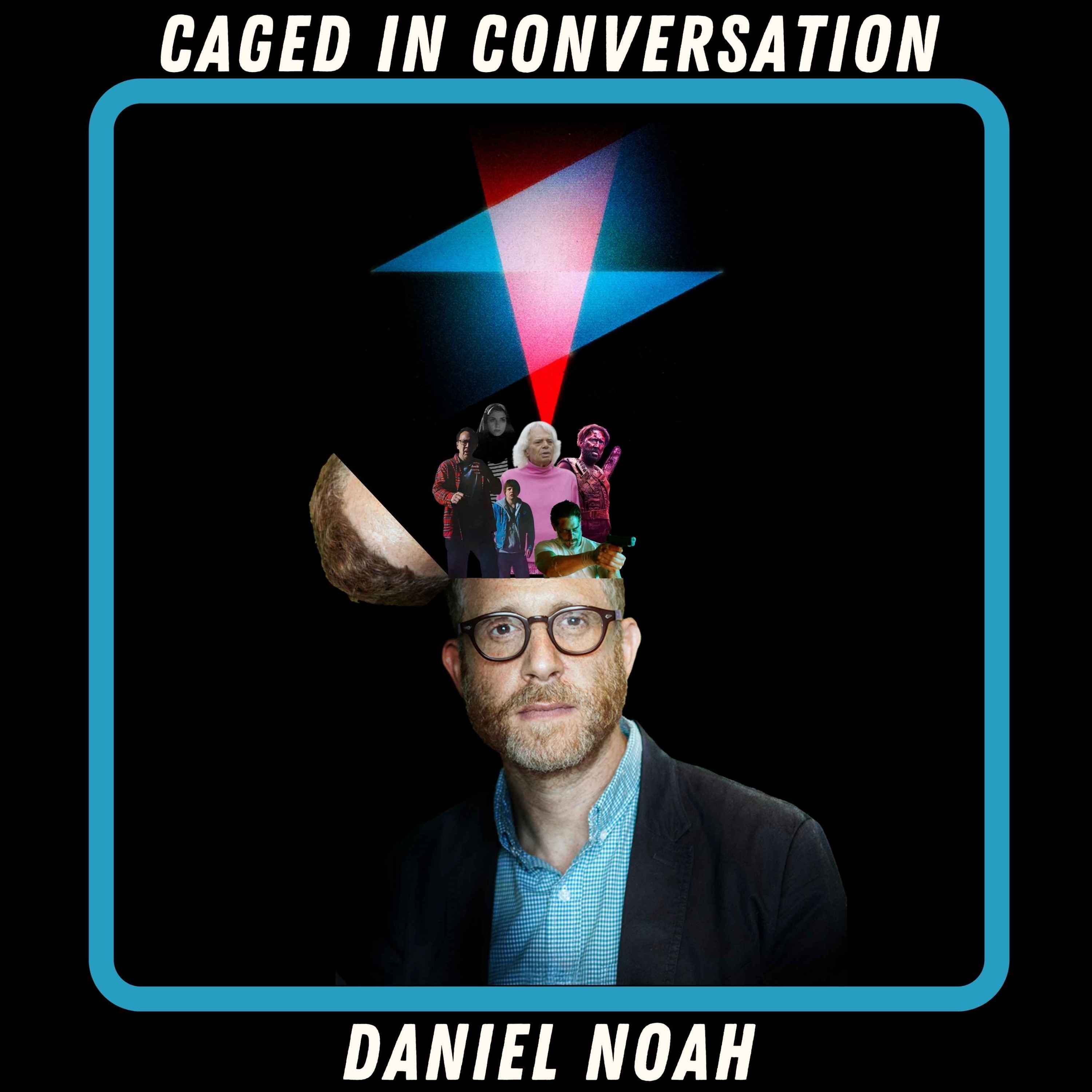
Hello guys and welcome to this Caged in Conversation, where I sat down with Daniel Noah, a writer, producer, director, and co-founder of the Fantastic Spector Vision, along with Lisa Welland, Josh Waller, and Elijah Wood. This is possibly one of my favorite conversations I've ever had on the podcast, so I know you're gonna enjoy it. I very much enjoyed having this conversation. It gets off to like this really esoteric start.
We get into the things for the paranormal, and I feel like that really helped us to kind of like get into that heavy topic right up front, and then just kind of made the rest of the conversation really easy to have them in. Daniel ended up just chatting afterwards for a little bit as well, and there's certain things that he told me that unfortunately I cannot tell a living soul. Don't try and hit me up on social media to know what that is, because I don't want the Spector Vision hitmen after me for divulging some tales. But yeah, yeah, yeah, it was a great conversation.
And one thing I really wanted to address up front is the elephant in the room on this episode, which is Richard Stanley. And I want to make it perfectly clear my views on Richard Stanley. I believe Richard Stanley to be, and I think rightfully is a piece of shit. I want to quickly read out what Spector Vision had to say when the news of Stanley's abuses that he had caused to an ex-partner came out.
They handled it perfectly by coming out straight away and really saying, this is who we are. We believe women, something that a lot of studios don't tend to, so it was a real breath, fresh air, to hear this or to read this statement, which is, Spector Vision will no longer work with Richard Stanley. We are proud of the talented cast and crew behind Colorado Space, yet we are horrified by the charges against its director. We will be donating future revenue from the film to charities devoted to stopping domestic violence.
You can't really argue that that is fucking hats off to them. Anyone from Spector Vision is listening hats off to you guys. And I wanted to take a quick moment to kind of, because I have this soapbox and this platform, this week and any week, I would love, especially this week, I know I sometimes ask for you to join Patreon and stuff like that. I don't want any of that.
You'll be able to look in the show notes. And I've listed a handful of domestic abuse charities that you can donate to, because I believe this is like, yeah, with this platform is sometimes good. Well, it's always good to share things that can help people. And if in any way, like I, we can help people, that's amazing, right?
So yeah, so be sure to check all that out and be sure to enjoy this conversation. I just wanted to get, obviously, all of that stuff out of the way. But yeah, that's why it's not addressed in this conversation because it's, this podcast isn't about that. So enjoy my conversation with Daniel Noah.
Today, I have the absolute pleasure of being joined by a writer, director, producer, Claire Voyen, Daniel Noah of Spector Vision. So you may be aware of his name. Well, he's one of the people when you see that produced by the producers of Mandy. This is one of the guys they're talking about.
Daniel Noah, how are you today? Hi, good. Thank you. That was the first time I've heard Claire Voyen.
It's a production that's so funny sounding just the word. I recently listened to a podcast show in Hollywood, it's dead. And I guess that's, yeah, you refer to yourself. Is that a fair assessment of who you are?
Would you align yourself as a clave oil? Or is that kind of a muddled area for you? You know, I'm so uncomfortable with the vocabulary around this stuff. I think it's, you know, we use the best words available to us, but I don't know that I feel that they're sufficient.
You know, in a nutshell, I was a very hardcore skeptic for my entire life until 2015, when I was sort of a key party in an undeniable paranormal event that completely turned my head around and then strangely inexplicably from that event forward, it has been somewhat nonstop. There's been so many subsequent anomalous experiences that I've been a part of that. It's just completely changed my whole relationship to reality and even really my relationship to the work that we do, which I used to think was just the stuff of fantasy and I've now come to wonder if on some level I was unconsciously trying to address real phenomena that I didn't understand intellectually was real. And, you know, and the reason that I speak about it publicly is that when it first happened, I was very ashamed and I felt very embarrassed and afraid of how my peers and colleagues would react to me talking about this stuff because until it happened to me, I was very judgmental of people who talked about these things.
And when we were publicizing visitations or podcasts, the publicist reached out and said, would you be interested in, you have an invitation to be on SPOOK to have you ever had any paranormal experiences? And I was like, oh shit, I don't know if I want to do this. But, you know, the reason that I did it was that I was so lost with what I was going through and I had no idea where to turn for support or information. And one of the things in particular that was very confusing for me was that anytime I ever heard a good ghost story or someone sharing a paranormal experience, it was always just the story of a one-off.
And I was desperately searching for any examples of people like me for whom it was happening all the time over and over again. And I was overwhelmed and afraid. And because I couldn't find any resources, what went through my head was, well, maybe then I need to become a resource because people don't seem to be comfortable talking about these things. And maybe one way that I can contribute to the furthering of this cause is by being the person that I can't find.
So I went on SPOOK and that led to invitations from a lot of other paranormal podcasts. And I just decided I'm going to say yes to every invitation that I get because, you know, if I can help others like me to realize that they're not alone, then maybe I've done some good. And it's led to actually me being plugged into a vast network of other experiencers, many of whom are closeted. I mean, it's shocking how many high profile people in my industry are either interested in these subjects or like me or our experiencers who are afraid to talk about it publicly.
I mean, I wouldn't be right for me to name them, but like it's people you know and love. And so, you know, it's really been rewarding. And so far as I've made some incredible friends and now I've been captain to incredible resources. And the study of the paranormal has become a central preoccupation of my life at this point.
I mean, I'm constantly collecting out of print books, which I would argue are suppressed information. When you really approach this area with an open mind and a scientific mind, the evidence is absolutely overwhelming that there is legitimacy to the paranormal phenomenon. And the reason that I think the powers that be suppress this information is that it suggests that our scientific method is extremely limited, which is a very unsettling concept to a species that likes to believe they're in control. And so, you know, there, I mean, this stuff gets really wild, but you know, history is written by the winners.
And that extends to publishing. And when you start to understand the burned books concepts, I mean, if you go back even to the birth of, another birth of, but the, the, there's no better word for it. The war that happened from the Catholic, on the part of the Catholic church in the 1300s, they literally burned anyone who didn't subscribe to their belief system. They scrubbed every other belief from the books.
I mean, burning books, burning people. And, and although ironically Catholicism today is one of them, is probably the only organized religion or institution that is someone open to paranormal, a phenomenon. I mean, like they believe in demon possession and exorcism. And so by today's standards, they're quite progressive.
But, but you know, you start to, you start to, when you, when you seek out these out of print texts, you start to understand that things that we now regard as quite silly stuff of fantasy, there may be some legitimacy to some of these sciences like alchemy. And, and, but how can we know? Because the evidence has been erased. And, and so I'm not saying that alchemy is, but I'm not saying that it isn't.
And, and so I just, I, you know, I've been humbled because I've had things happen to me that I don't understand and I can't explain. And, and the more that I open myself to it and, and willfully look at it, as they say, you know, if you stare into the abyss, eventually the abyss will stare back. You know, the, so the more, the more I've sort of spiritually dedicated myself to engagement with these anomalous phenomena, the more they engage back. And it's a fascinating, fascinating process.
At times I think I'm losing my mind. But, but I think that, you know, that in some ways is, is really the role of the artist in, in the civilization is to be willing to engage with experiences that frankly can make you crazy. And then, you know, you, you walk out of the dark cave and you tell the tale. And so, so I, I do look at my advocacy for the legitimacy of paranormal research as an extension of my role as a storyteller.
I think they're very aligned, very similar. And it's advocating for highly, highly subjective experiences that are difficult to talk about, difficult to quantify, to qualify. So whether those are, you know, purely earthbound emotional experiences or inexplicable paranormal experiences, to me they all sort of live in the same world. They're, you know, they're things that are hard to talk about.
And that's the role, the role of the artist, the shaman, you know, is to talk about those things. And so, so I try to. It's fascinating for me that obviously this kind of openness to the paranormal and you kind of speaking about it, came out of that promotional tour for Visitation. So an episode that really stood out to me was the Fly Lotus one.
And he's very open about that. He believes his house is haunted. And there's something amazing you guys managed to capture on that episode. Like, I know the episode, you kind of get a feeling of the person with like, and on that one, it's raining and like, he does that amazing, like improvised, like, just shows you guys a bit like piano, work and stuff like that.
And it's just like, I remember like feeling like, I don't, like yourself, I used to be like, I've always, I don't feel always been a skeptic, but kind of been in that kind of gray area of being like, I want to believe, Jim. It's very much like the ex, I like that. And then like, even listening to something like that, it's like, I think like, I think there is, there is something there. And I'm looking at the films you got.
And I think it's a great jumping off point to talk about the paranormal. Cause it feels like, especially two of the films that star Nick Cage have kind of ghosts like looming over them, whether it's Mandy, like with like kind of, I know that Panos has said that that film is an expression of his grief, like the kind of outpouring of grief of losing loved ones. So he very much like, I don't know, I think once I heard that in an interview, it really like opened my mind to watch that film again and kind of like, put myself into it and that thing. And color out space as well.
I know Nick has openly said that he was kind of channeling the spirit of his father on that one. It's like, how does like, yeah, so kind of like, I don't know, backtrack with that. Like, were you privy to any of like this, like with Mandy, especially, were you privy to kind of like the subjects that Panos had in there? And like from the start, I was it kind of later on that you picked up on it?
It was only later on, I think it, you know, when the film was released and everyone was looking at it, including us, you know, I think a lot of times when you make the work of art, you're operating on instinct and it's only later that you go, oh, this was about my dad or what, you know, sometimes you're aware of it and sometimes you're not. I have no idea how aware but Panos was at the time, but I didn't know that he started to discuss the film having, well, both of his films have also been on the Black Ringo, which I think he described as an inhale and Mandy as an exhale, were him processing the loss of his parents. And so yeah, whether or not he was aware of that at the time, I can't say you'd have to ask him, but he brought it up a lot when you were looking back at the completed film for sure. But I'm color Nick was talking about it on set.
And you know, he is a very professional kind, the hearted very, you know, easy to deal with artists, contrary to what I think a lot of people would expect from him, he's actually a total pro. But he's on set, he said, I'm channeling my father, be careful. And you know, he, you know, he, I hope he wouldn't mind my saying. I mean, there were times when he said, like I feel like I'm losing my mind on this.
And he really went, he went all in. And that voice that he does that people were saying, oh, he's doing Trump, you know, that didn't occur to any of us. You know, he was doing his dad. He was, that was his dad's very critical voice that I think he's still here in his head.
So he really became his father. And I think it was hard for him. I think it was, it was, but again, you know, this is an extension of what I said earlier about the role of the artist is to walk into that dark cave and confront the demon and then live to tell the tale. And he did that on Colorado Space.
So you and Elijah got to visit the set of Colorado Space. How was that? Cause obviously like those, I had the pleasure of speaking to Dan Martin, the, the first on that film last October. I'm like, yeah, he had nothing to, nothing but kind words to say about Nick and the kind of way he wasn't.
I guess from what you're saying, like, it must have been like that weird thing that he is channeling his fight. And he's kind of like, yeah, how was Nick on set and how was the set in general? It was, it was a beautiful and haunting experience. We were shooting at the top of a mountain in Cintra, Portugal, which is a very, very, a very special place.
You know, I, again, it's hard for me to talk about these things without constantly invoking paranormal stuff. But, you know, there is a long legacy of mountains being, places on our planet that vibrate energies that are hard to understand. And when you were on that set, you could feel it. I mean, there was a very, very strange feeling there.
You know, the, the shot of the, there's a shot right before the meteor hits of the full moon with a big ring around it. Yeah, that's not a VFX. Wow. That's not VFX.
That happened. And we pointed the camera at it and put it in the movie. And there were things like that happening constantly on that set, just strange little events and experiences. It felt very disorienting, but it was, it was, it was a beautiful, very positive experience.
Cintra is a strange place. Alsar Crowley spent time there. And it's traditionally been a place for people who are, who have somehow been ejected from society. They will land in Cintra for some reason.
Like Lord Byron was there looking at his wounds for a long time. And like I said, in Crowley was there. And obviously, it was so the, the, the, the, the, the, the, the, the, the, the, the, the, you know, this, it's, you can feel it, you can feel it kind of hanging over the place. And the, the house where we shot was a, and it's had once been the home of a very wealthy man.
And I'm forgetting his name, but he lost everything in the house. And just been, you know, sort of standing there and disrepair at one point we discovered that if you walked, there were thick woods around the, on the properties surrounding the house. And at one point we, we, someone discovered that if you wandered back through the woods, there was a tiny pagan church. Wow.
And there were, you could see where some sort of, you know, like pagan symbols had been, once you can see their outlines of their silhouettes on the wall, like someone had pulled them down. And my girlfriend and I went back in there and remember just felt you could feel something very weird. Like what, who built this, why, what happened? And then we discovered that there are these underground tunnels on the property that were so narrow that no one had the courage to, you could have probably crawl through.
I don't know what you call that in the army, where you get, you get under, you're crawling under elbows. Yeah. I forget what that's called, but I think you could, you could have, you could have made it through if you did it. And I actually went in at one point and I got about 25 feet and I was like, I got, get me out of here.
I can't, this is terrifying. So none of us know where those tunnels go, but they're, they're down there. It's like hearing that kind of thing, like makes that film, like, yeah, ever so more special and stuff like that. And I guess like one of the things I wanted to ask you is obviously SpectorVision has this almost look at looking for people who have these singular visions, like the films you've produced, whether it's a girl walk time alone at night or, I guess, I guess one that is kind of like the most divisive film you've ever put out is the greasy strangle.
What, what, what is it you guys kind of look for when you're looking for a script or looking for someone to work with? I think first and foremost, we're, we're director driven, we're filmmaker driven. And something that we often say is people amount projects. Yes.
When we first met with Panos, we had seen Beyond the Black Rainbow. And I remember saying to his manager, Luke Rivet, you know, that this was before we even met Panos. And I said, I think Panos might be one of the most important filmmakers alive, you know, just based on that film. And of course he was like, that's music.
My hair is great. I mean, when we met with him, Elijah and myself, we, we, the first thing we said was, we don't even care what it is. We want to produce your next movie. We don't even need you to pitch it.
It's just because it's you, we're in. And then some number of months later, he gave us the script for Mandy. And, you know, we were already in before we even read it, because of course, anything this filmmaker produces is going to be incredible. So, and in fact, the script for Mandy, Elijah doesn't always agree with me on this.
But as you might be able to imagine, in my opinion, the script was sort of dull. It's, you know, and the reason is, as Panos likes to say, and I love this phrase, he uses the tyranny of narrative. He is sort of like a, he's an enemy of plot. And when you really look at what happens in Mandy, it's like nothing.
Yeah. You know, there's like 45 minutes of a couple hanging out watching TV, and then she's killed. And then he just kills all the people that killed her. That's the whole pitch.
So on paper, it was hard to convince people that this was going to be an important film. And what we finally end up doing was, instead of sending the script out, we started sending out links to Beyond the Black Rainbow and saying, look it, don't like stop. Stop looking at the script. Look at this person's mind to understand what this film will be.
And it was only then that it came together. So this is a very long way to say. We love singular artists. And I think we look at our job as being, you know, how can we support the mining of their ideas as best as possible, protect them, and challenge them and push them to be the best versions of themselves that they can possibly be.
So with like, you know, with Mandy, it's a very fascinating film. And the fact that like kind of the storm around it, like they're kind of like a lot of films take years to become cult films. And that film felt like even before it came out, it kind of had this cult like status. And like, what was it like to be in like the somewhat middle of that like whirlwind of everything that was going on?
Like kind of, yeah, almost like pictures. Like this is the next midnight movie. I mean, I know when the look, I think what you have to understand is that we, I'll put it this way, the night that it premiered at Sundance, it wasn't that yet. Yes.
It was just, you know, it was a Sundance program and that was it. There was no trailer, there was no. I walked in convinced that 25% of the people would be their favorite movie, 25% of the people would think it was a little weird and 50% would heat it. And when it was actually like 100% left it, I was very, very shot.
I had the same, I thought, I thought the same thing would happen with Brissy Strangler, which I know is more divisive, but you know, I was expecting walkouts, you know, and one of the things I've learned is that when you're working on a film or any kind of a work of art, it's very hard to trust your own feelings about it. I've also, you know, worked on stuff where I've thought, this is going to change the world and then it doesn't. And so I just sort of learned to wait and see, you know, but once it, I think that when you work on something that is successful, it's easy to sleepwalk through it a little bit and not stop to recognize that you're in the middle of a very privileged moment. And so I think when I look back at the Mandy Experience, it was great fun, but if I could do it over again, I wish I could be a little more present.
I think it can really stop and breathe and take in what was happening. I often joke like Mandy will probably be on my gravestone, like, you know, it's the, you know, everything we do now is from the producers of Mandy. And I hope we'll make it, you know, I mean, now it's saying producers of Mandy and color of space, but, you know, I hope we'll achieve that height again. But you know, you can't control these things.
You do your best, you hope for the best, and then whatever happens happens. So when did you become aware of Jim Hoskin as well? Like, speak of the greasy strangler because Jim, to me, is a fascinating guy in the stuff he's done since. And I kind of fell down a wormhole the other day of watching his old like shorts or like TV commercials.
He did like some iconic like TV commercials here in the UK and stuff like that. So like, yeah, how did he drop onto your radar? That started with Tim Lee, actually, from Elmo, draft house and he, you know, he and Elijah are very close friends and I forget, I think he and Timson approached us and we're like, you got to see this thing. You got to redescrib and look at this guy's work.
You know, we're putting in money. We need one more partner. And I remember Elijah did something that we don't, we don't, we typically don't do here is he, he said, he called and he said, we're making this. No one else has a vote.
And so we, you know, we came in as the third investor, flash producer and we, you know, we ended up then also doing production services on the film. And so we were sort of the, you know, the front line along with ants. And yeah, I mean, it was a teeny little low budget. I don't know if the budget's out there in the world or not, but it was, I'll just say, sub 1 million, very sub 1 million.
And, you know, our experience of it was hanging out in a weird rundown house on the east side and, you know, a lot of weird sweaty nudity. And, you know, we, you never know when you're working on something. You don't know. You don't know what the outcomes can be.
And you just try to have a good time. So, but Jim's actually really like, like a lot of filmmakers who make weird cinema. He's very normal. And my theory about that is that it's because they get the weird out.
So, you know, in that way, art is an exorcism. You're taking the strangest, most unique and sometimes painful parts of yourself. And you're extracting them and putting them on a screen or in a novel or in a painting. And by doing so, you sort of make yourself healthier.
You get it out. You know, imagine if Jim didn't have that outlet, he could be the greasy strangler. Exactly. That's what I was going to say.
Yeah. So he's a very sweet, normal, you know, you would never guess that he made some strange stuff by just sitting and talking with him. So kind of the backtrack, when did, where did Spectavision come from? What did you guys set out to do when it first kind of came to you?
Well, we met. Elijah and Josh Waller and I, well, Josh Waller and I are old old friends. And we met on a project that never got made. I had been working as a screenwriter.
This is a phenomenon that I never knew existed until it happened to me, which was a very well paid, unproduced Hollywood screenwriter. I've been doing that for about 10 years. I'd only had one movie get made. And and so I had written a film that Elijah was attached to Star and Pico YT was attached to direct.
And this was back in 2010. And and that movie didn't get made. And and we were so frustrated with that experience that Tika said, I'm going to go home and make a little low budget movie with my friends. It's going to be a mock doc about the vampires.
And he went home and made what we do in the shadows. And then and Elijah came to us and said, let's start our own company. And then we can we can do two things. One, we can be a home for artists that want to make a strange, wonderful, weird, unique genre movies.
Because at that time, the genre landscape was pretty dominated by exploitation. You know, the Eli Roth films were very popular and and saw. And and I don't I don't disrespect those movies. I think they're they're great.
But but there was sort of an emphasis on sadism in genre. And whereas Elijah and I were looking at movies like Let the Right One In and the Orphanage and and then, you know, looking back in time, don't look now and Rosemary's Baby and the films of Val Luton from the 1940s and the Universal Monster movies and going like, where are these films in English? In in in America, who's making these movies? And the answer was no.
So we wanted to create a home for filmmakers that wanted to sort of return to the elevation of genre. And but simultaneously, we had had collectively so many disappointing experiences with producers who were were ultimately somewhat transactional. You know, your film is a widget for them to sell and nothing more. And and you know, as people as two guys were very passionate about the art form, you know, we had had some wonderful experiences with producers who we felt kinship with, but they were hard to find.
So the other experiment was, well, I guess sort of like I said earlier about when I couldn't find anyone to advocate for paranormal experiences, I think, you know, Elijah and Josh and I were like, well, what let's just become the producers that we are sure we're finding. And so, you know, most companies, the way they start are with economic considerations and then everything is an outgrowth. So it starts with you get an equity partner and you open an office, you and now right out of the gate, every decision that you make is based on meeting your obligations to your investor. And as such, you can't take chances.
You have to be as conservative as possible. We decided let's flip it. Let's have our first step, the engagement with material. So we did not go out and find equity partner.
We did not rent an office. We used to joke that we were the Lincoln lawyer or production companies because we were literally driving around, taking meetings and coffee shops, that which, you know, I think in some ways we were afforded that luxury by having Elijah's a partner, it legitimized us because he was so established. But the other thing that we had going for us was sincerity. You know, we were very sincere.
And so we would sit down. We just call people we knew, like we went out with someone that we just knew and wrote kudos for us. And, and we would sit down and say, do you have a passion project in the genre space that no one will help you with because it's too hard or it's too weird. And that's a magic question with an artist.
So every time they would kind of be like, is this a trick question? Of course I do. And then they would pitch us these gorgeous projects. And those were exactly the types of films that we wanted to build our brand around.
A Girl Walks on the Loon at night is a great example. But you know, we, it was very synchronous. Like two different people approached us separately. One, Moja and Marno was a friend of mine.
She was like, I'm attached to the Saranian vampire film. That sounds like exactly what you guys are saying you want to do. And then Sherry Devani, who was the AD on that film approached Elijah, was a friend of his and said the same thing. And we were like, it was a strange, like we both got hit up about a movie.
And when we sat down with on a lily, it was just immediately evident that she like, and it was was just a visionary filmmaker. And so we got on board that, you know, right away. And then Koudis was an idea that Josh had had that Lee was so excited about because he'd been desperate to move into comedy. And no one would let him do that.
They just wanted more saws and excuses. And then so we made those two movies and they both got into Sundance the same year. And so we had sort of this spectacular coming out to speak and we were off and running. What would you say is the like, specter vision ethos?
If you have one, do you guys kind of have this like thing of like, this is what the company is like, do you mean, or is it kind of? Yeah, I would say so. I mean, I think it's, I guess then two ways. One is the content and one is the context, I guess.
So, so you know, content wise, we're interested in singular visions. And I think, you know, like I said earlier, in some ways, I think you only understand your work in retrospect. Yes. But when I look back at our catalog, what I see is not only unique voices, but sort of a strange story being told about windows and other worlds.
And in fact, we named the company. We took a six months to land. We were very picky about it. And what we said was, and I think it's, well, this is still content.
But what we said was, you know, we want in the name, we want to represent the fusion of two things, something, something ineffable, ethereal, untouchable, undefinable, and then something mechanical, like a window into another universe. And so that's literally that the breakdown spectrum is literally looking into another world. And so I think that's what all of our films have in common, is that whether it's greasy strangler, which is not a paranormal story, but it's certainly an alternate universe, or something like color out of space, where there's an actual intrusion of an alien that's so alien. Now we can't even perceive it.
You know, I mean, the finale of that film is about something that's happening that exists outside the spectrum of five senses. So what actually happens at the end of color out space? Human beings can't know. If you saw the finale of that film from the perspective of the alien that came in on the media, right, it would be a completely different story.
I can't tell you what that is. I don't know. I'm only game, right? And then in terms of the ethos of the, I guess, you know, the context is, you know, it sounds, I don't know, maybe pretentious, but I think we just try to be good people as much as we can.
And, you know, sometimes we stumble, but we try to honor our commitments and be genuinely loving and supportive to the people that we work with and who work for us. And because, you know, look, in the 10 years since we started this business, there's been a real reckoning in Hollywood of people being held accountable for bad behavior, and it's great. You know, I'd like to think it was something that was on our minds before people were being held accountable for it. And, you know, we've always really gone.
We've always worked very hard to be good as much as we can. And our company's grown. I mean, let's start out with the three of us. Josh has subsequently left to focus on his directing career, which, you know, power to him.
He directed three movies before. We started SpectraVision and then SpectraVision sort of took over his life. And so he sort of, I think, reclaiming his original intention. But, you know, we've grown significantly and, you know, we are trying to treat our company like a family and, you know, our employees like a family.
And I think, you know, they seem to stick around. So I think they, I think they feel that way too. I want them to. Well, it definitely comes across in the films you make, because it kind of feels like that thing of, like you said, it comes across that SpectraVision is about like the people, the directors before, and it's what they want to say and what they want to show people, as opposed to being like, here's just another, do you mean, like, here's another X film?
Or do you mean, like, yeah, I don't want to start bad, bad, Melvin, like companies, but like, it's kind of what I like about Spectra. Every time I kind of see that logo pop up on a film, it's like, well, I don't know what I'm going to get because like, not one, two movies are the same. But like, I think that the one similarity that they do or share is that they are unique unto themselves. And yeah, you mentioned about Josh going off to direct.
Obviously you've directed a film in email. We kind of chatted about the fact that it's it possible to find in the UK. Is there any like, is there any like, like, learning inside of you to direct again? Or are you kind of like happy to be on the other side of it, the producing?
I'm very happy we're in. I, you know, Matt Rose was, it was a complicated experience for me. You know, it was, it was based on the story of my grandfather, who was beloved figure in my life and my childhood. And when he, when he, when my grandmother passed away, I was very up close and personal with his grieving process.
And, and, and what I watched him go through for the little window of time that he was still alive after he lost her was a phenomenon that I felt like I, again, I'm going to keep repeating these same ideas, but I felt like I didn't, I didn't know where to turn to, to look for, for any context about, you know, what it's like to lose your soulmate and, and have people all over you saying, in some ways denying your pain, you'll find new reasons to live. And, and when you've lost the person who was your reason to live, that's a funny thing to hear, you know, and, and so while my grandfather did not commit suicide, I think, I think one does in a way in that position by sort of losing the will to live. And, and what confused me as someone who cared deeply for him was while he was telling me in private, I don't want to live on without her. I'm in my eighties.
This is an idea that I'm going to have a new chapter of my life is ridiculous. And I don't want to. And then everyone around him sort of sticking to a script of, no, no, everything's going to be great. You know, and, and I was like, I know I'm not supposed to say this, but I'm with him.
And also who are we to tell him how to feel? He's the one who's experiencing this. He's our elder. And so I decided to write a script about it.
And so because it was such a personal movie to me, I felt like no one else could make that movie but me. And then when I was we were lucky enough to get Jerry Lewis to play the part, that ended up being an incredibly seismically important relationship in my life. I mean, we were very close for the last 10 years of his life. And he was an incredible mentor to me and became kind of a father figure in a lot of ways.
And it's funny, there was a point in that where I realized, oh, I'm doing it to myself again. I was I was knocked out by losing my grandfather. So I found a replacement for him who will also die soon. And then no, and that's exactly what happened.
But anyway, so you know, Max Rose was it was a complicated experience. The reception of the film was very mixed. And you know, and I myself have a complicated relationship to it. But what I realized mostly from making that film, I think that we willed it into existence, despite great opposition.
And what I realized coming off of it is that I don't enjoy directing. I thought that was what I wanted. But when I got it, I realized that it didn't feel right to me. It didn't feel comfortable.
And I'm much more at ease supporting filmmakers. I think that had I not gone through the process of writing and directing film, I don't know that I would be as good at my job as I am now because I've been there. I know what you go through. I know it's experiences in every way, technically, emotionally, spiritually.
But I have I will never direct it. I don't have any desire to no one's asking. And I'm very, very happy. I'm very, very content where I'm making films with spectrum.
Do you feel that like producing movies, you can kind of like you can enjoy them to some extent as well? Or is it kind of like you're like a cog in there as well? And you kind of like, I don't know, you have a snake at play whilst watching them. What are you like?
I like this vision that's been shown to me. You know, to me, I studied screenwriting and NYU. And for me, story is the, you know, the heart, the brain, the backbone of all aspects of the filmmaking. And so you can't perform any duty on a film without an understanding of story, hopefully a mastery of story.
It doesn't matter what your job is. If you are a sat deck, you have to understand the story that you're doing. And so to me, whether I'm writing, producing or directing, it's, it's about constantly trying to get better at mastery of story. And so when, you know, I directed one movie, I was a professional screenwriter for about a decade.
And when people ask me to miss writing, first of all, I still write. And I've written, you know, I've done, I've done a lot of writing that I'm not credited on. And I have scripts that I've written that are going into production soon that I'll be able to talk about when they're announced. But but my answer is, you know, I'm still writing.
I'm not sitting down and typing, but I work so closely with every writer and every filmmaker. And, and I think that, you know, when, when at first I was a little unsure of how writers would feel about another writer as their boss, frankly, you know, coming in and having opinions and I thought, are people going to feel proprietary? But what I discovered is that as I felt when I was in that position, when I was a writer, when you have a producer who actually understands writing, it's just incredible, you know, wave of relief and excitement. And that was how I felt when I was the writer who occasionally get a producer who actually understood how the process worked.
And I've found, I mean, I've had one after another wonderfully satisfying, delicious collaborations with with writers. And so in some ways I feel like as a producer, because I'm not actually writing anything, I'm able to work on exponentially more stories than I could if I were writing them myself and get in and out and I cycle through them. But it's still storytelling. So what does like a producer tend to normally do?
And how do you think you guys do something different to other like producers and kind of like, yeah, you treat your, I don't know, your directors differently to how not to bad mouth like other studios or. I think, you know, one of the most common questions that people ask is, what does a producer do? There's a lot of answers to that question. I mean, there's there's raising money.
There's managing a set. There's managing a budget. And then there's managing creative. So that's the one that I manage creative.
And that's what Elijah does as well. Lisa Whalen, who's our third partner, is also creative, but she is also feels in the largest of my blanks in terms of running business, the operational aspects that we're not so good at. So I think, yes, I think we're very, very hands on. I think we're in some ways when you make a film with Spectorition, you are partnering with Spectorition.
We have a strong voice. We're very opinionated. We we're not shy about our opinions. But what we're very, very careful to do is to always make sure that every opinion that we have and every move that we make is in service of the director's vision.
It's not our vision. It's the director's vision. And that's something that I've always enjoyed. And it's one of the reasons why I'm so happy to not be a director anymore, but to be working with the directors is that I love getting inside someone else's head, getting inside their intention and helping.
I find that incredibly delicious and rewarding, much more so than shepherding my own vision. Yeah. So so being a wingman for someone else is what I love to do. It's what Elijah and Lisa love to do.
And so I think I do I often hear that we're far more involved than most producers are. But I think, you know, I think, you know, if a filmmaker doesn't want that, then they shouldn't work with us. And and many don't, you know, for that reason. I mean, we've had filmmakers that we wanted to work with who have declined.
And I think in some ways, because they were, they didn't need the kind of active creative partnership that we bring. And they were right to decline. And so, you know, the things that we tend to work out. So do you guys have like this kind of whiteboard that has a list of directors that you're like, we'd like to go after?
Or is it like the people who you haven't heard of that you're most excited about? Like, yeah, it's both. I mean, you know, I mean, it would be uncouth with me to name names, but we, we have a hit list of, I don't know if any of them are listening. You know who you are.
I mean, there's a couple of people that we've been trying to, you know, coax back to the scene like we did, like we've done in the past with some other filmmakers and that's, you know, a long game takes years. There's one person in particular who I hope to be able to say this person's name sooner or later, who is one of the finest filmmakers live that we're trying to convince to make a movie. And we're very lucky that we get access to these people. We have their ear and we take advantage of it.
So, you know, I think we, you know, we're nerd fans at heart and we try to approach our work through that lens of like what would be, what, what's the announcement and variety that would make us lose our minds. Let's create that announcement. You know, and, and, but at the same time, you know, we're all, we love being blown away by someone new. I just saw this film called Come True, like Anthony Scott Burns, that, you know, it was blooming away.
And, and he and I be talking and, you know, we're looking for a project to do together. You know, we're, I think, you know, we're, because we've taken chances on new voices, I think oftentimes we don't have to necessarily work for it. People just call us and go, have you seen this kid? No, you know, you know, you're going to love it.
And then we watch it and we do. So, you know, whether it's coaxing someone out of retirement or enabling someone that no one's heard of, you know, that, you know, that if we believe in the voice, we're all in. In that thing of coaxing people, are you going to somehow coax Nick Cage back to Spectavision to kind of finish off this kind of Spectavision trilogy that he's probably asking me. Yeah.
You know, look, we've, Nick's, he's a friend of family. We have mutually expressed a desire to continue working together. It's just, you know, in the right project comes along. We almost did something with him a couple years ago, right before the pandemic, but it ended up not working out.
But yeah, I'd love to make more than one more movie with Nick. I'm not even going to play it cool. I'm the press other than you, the biggest Nicholas Cage fan. I mean, I couldn't was beside myself that we were making a movie with him on Mandy.
I couldn't believe it. I think he is one of the finest, most vital artists of any medium ever. I mean, and it has been until recently, I think widely misunderstood. I'd like to think we've been a little bit of a part of people understanding him correctly.
He is insofar as an actor's body is their instrument. He's taken that to the empathy degree and he is an artist who lives in extremes. He is as good or as bad as his director. And I think that's what people don't understand.
Oh, that's a drum I've been beating for a long time. It's like covering all of the Nick Cage films. Like there's so many I watch and I go like, this is a case of a director not knowing what to do with Nick Cage. Exactly.
And it's that thing of like when a, like from speaking to directors he's worked with, it's like he is the art professional guy. He will turn up day one. He will know the script back to front. He will kind of like, yeah, Brian Taylor is working with him a couple of times.
It was like he kind of like he will come in. He'll be like, yeah, I know the script. I'm on Dad back to front. Like I will do everything to be done.
And I think Julian Hillard mentioned on Twitter recently that like Nick Cage taught him how to improvise. Like, I mean, he's kind of like, he's got this Julian. Oh, yeah. Yeah.
Yeah. From color. Yeah. So it's like, he comes in not only knowing the script backwards and forwards, but but knowing the like having done script analysis in the quiz on Sunday, you know, he comes in with such a profound date on the material.
And, you know, and he, I think that's why those who have had successful relationships with him are always emphasizing that he's a pro because you can, you can look at his wilder performances and you would make the assumption that he would be an unwieldy presence on set. He is if you let him, but you tell him no, and he says, okay, you know, he had a thing on color where, you know, every, some people don't pick up on this, but every member of the family has a different sensory relationships of the experience. So his is smell. He's constantly talking about bad smells.
He wanted to have a closed pin on his nose, the entire movie. He'd be talking like this. And we were like, yeah, no, he's dropped it. But, you know, I think when you, this is a testament to him as a professional, he's completely differentials of the filmmakers.
And, and, you know, he knows his job is to take direction. So he is, he is a, he's a little bit like a garden house that's spraying water wildly. And if you know how to grab it and control it, you can water your garden brilliantly. But if you don't, if you're scared to touch it, because you think it's going to whack you in the face, it's going to fly all over the place, right?
And so, you know, I think when, to me, when I see a quote unquote bad Nick Cage performance, what I see is it's not a bad performance. It's that they didn't know how to craft it. They didn't, and, and Panos would talk about Nick through the lens of, um, he would say that his job was to be Nick's equalizer, like, like as a piece of, like a stereo component. And they crafted an art in which, you know, he started as like a very subdued Nick Cage and then little by little, he became more unhinged and that was graphed.
That performance was grafted together collaboratively. And, and Panos would talk about having his fingers on the levels of like, you know, knowing exactly when to go, you know, the, you know, the basis to kick in here. The, and, you know, the result is one of Nick's best performances. And, and I think we did the same thing on color, you know, where it was, you know, this, this journey from this sort of button down family man to this complete maniac, you know, it was, it was very carefully crafted.
And, and, um, so yeah, to me, he's one, it's quite simply one of the best actors we've ever had. And, um, I think, you know, it's really exciting to see this Renaissance, you know, that he's having now and people suddenly, instead of, you know, joking about Cage rage, they're now worshiping at the altar of one of our finest artists. And it's amazing to watch. I love it.
Well, what's interesting about the two films that like who's worked on with you guys is that they both have what other people would put in like a sizzle reel of like Nick Cage loses his shirt. Right. Right. Is that like, even that kind of freak out he does in the middle of Mandy and that moment in color, when he does the like he freaks out in the car, I call them, I call them, they earn freak outs that within the story, they, they totally make sense.
It's like him in that bathroom. Yeah. Totally makes sense to the plot of that movie. It's like, he has just witnessed the death of the woman.
He loves more than any of his savior. So like, of course, like that is a humanistic reaction to that. And it's like, it's testament to panels for kind of like bottling that energy in the green. And like it's a kind of like thing.
I agree. I definitely think that like Cage, when I came to this podcast, it was around the time that it was kind of like height, memeable cage. Yeah. Yeah.
Like that. That I think there is a YouTube video called Nick Cage loses a shit. And even in that, and it's like there's a link back to like one of my personal favorite Nick Cage films as Vampire's Kiss. He kind of recycles like that voice from that in color.
And I know that he said in interviews that that was inspired by his dad as well. Because he's like, well, because it's yeah, his dad was like a professor or like a kind of. Yeah. So it's like a academic.
Yeah. Yeah. Yeah. Yeah.
These academics kind of have this transatlantic accent that makes them sound a bit more like, like, they know what they're borrowing a bit of Britishness to it and stuff like that that makes them seem a bit more. Yeah. Yeah. Why, you know, the bathroom scene in many is one of my favorites because it's so it's so emotionally wrong that, you know, the few times that I saw that film in the theater, I remember half the audience is laughing and half is crying.
And that's amazing to me. And I always felt that the half who are laughing are laughing because they're scared to cry. It's, you know, that is not funny, that scene. It's funny if you're avoiding what it's about.
But, you know, I watched, I remember very clearly the LA premiere of that film was at the Egyptian theater and I was literally that morning had returned from Big Sur where my girlfriend and I had got engaged. We were so this like vibrating with a feeling. And then when that scene hit and it's the scene of a man who's lost the love of his life, I was just, I mean, I worked on the movie, you know, and yet I was just ragged and overcome with feeling. And then I'm listening to people laugh and I'm going, wow, this is what movies can do.
It's a really, it's an amazing, it's an amazing thing. Yeah, it's that thing like I mentioned to you earlier, like, it wasn't on like the second watch of Mandy, like, I was like, I need to give myself over to this film a bit more. And it's that thing I've never gone through like a loved one, the grief of a loved one, but like, I kind of like brought that element of just like losing like that kind of love of your life, whether it's like a separation. And it's like even just bringing that to that film, just really like, you see it in a whole different prism of it.
And it's just like, and I guess it's that thing, because the criticism I see a lot of the time is, I think people expect it to be this kind of, I don't know, like, 80 minute, like B movie and it's, and no. And I think that, yeah, the vision that Panos gives us with this kind of quite slow and like, yeah, I think I'll repeat what she kind of get that feeling that like all of the latter half, all of the vengeance and destruction that red goes on is earned by this kind of first 45 minutes of him and Mandy, like just expressing their love. Yeah, absolutely. It's a beautiful picture.
So, yeah, as we start to wind things down, I guess we need to talk about some of the future projects. First of all, a project that's kind of been floating around in the ether for a while is the man with kaleidoscope eyes. Yeah. Is there any like news or that?
We're trying. Yeah. Male Chinese Tobias is a film that Joe Dontable directs that is a comedy, a comedic account of the events of 1967, during which Roger Corman was preparing to direct the movie The Trip, which was about Pier Fonda taking a dropping acid. And what happened in life was that Peter and a young unknown actor named Jack Nicholson approached his very button down Roger Corman.
Hey, man, you can't make a movie about acid if you have a drop to acid. And Corman, who was very logical, said, Oh, that's a good point. So he went up to Big Sur, this little caravan of Bohemians and he dropped acid and it changed his life. It was it was after that that he started his own company.
He married his wife, Julie, whom he had just met and had been sort of a serial bachelor until that time. He had an incredibly positive therapeutic experience. So it's a script that's been around, gosh, 20 years or something. Colin Firth was going to do it at one time and I can't.
There's like this long history of actors that were attached to it. So we're we've been trying to put this movie for years and it's frustrating. I, you know, this is my great frustration with the world of film finance is that it's built entirely around the value of the actors who are attached. And, you know, it's it's just sometimes you just want someone who can write a check for $3 million to just go, you know what?
I get this. It's got an audience. Yeah, just go guys, just go. And because it's the catch point to it is that you can't it's very hard to get the actors who can support a budget until you have money to offer them.
And, you know, and so we've we've been trying and we have actually a I can't say who they are, but we've actually cast most of the parts. We just have a cast corner. And so we're we're working on it. It's never far from our thoughts.
We're we're we're, you know, we had this incredible stage reading of the of the screenplay in LA and Bill Hader Red Corn and it was amazing. You know, unfortunately, he is scheduled with Barry and and he can only make like one feature film a year and it's, you know, it's not possible for him to do a budget movie in that little window. But yeah, we're trying. We're trying.
Perfect. Well, let's talk about a project that is imminent for release and also getting a get in his premiere at Tribeca, which is no man of God. And I guess like the whole Ted Bundy thing has kind of like been done to death. And I know I'm excited at the fact that you guys with your kind of single vision of things must have seen something in the script.
Like what can you tell us about? No, God, well, no man of God is when we first heard the pitch, like anyone, any reasonable person, we were like, no, there's way too much Ted Bundy stuff. We don't want to do this. We don't want to contribute to the deification of this man.
And then we read it and what we saw in it was an opportunity to make a film that's not about Ted Bundy. It is about the audience for popular cultures desire to defy serial killers. And so the intention of the film is to turn the lens, so to speak, back onto the viewer and say, why do you keep showing up for the story? Look at who this is and look at what he's done.
You know, it's one thing to have a Hannibal Lecter character who is sort of exists in a comic book world. But even that, you think about who you're rooting for and what he's done. And Amber Sealy, who we hired a director film who was just a huge, hearted, brilliant, beautiful humanist, did something with a movie that is really incredible. It's there's only one female character in the film, Bundy's lawyer, but she made the film with a feeling of it being viewed through the eyes of the victims.
Though they're not represented in the film, that was very deliberate, that we didn't name them, we didn't put any images of them. Amber, every time she made a choice with the camera, with the music, with the editing, it was always about the ghosts of the women whose lives that he took. So it's really the story of accountability and not only accountability for Bundy, who has been treated as a rock star, you know, and even the Zac Efron movie, you know, if you cast Zac Efron, of course, he's going to be a sex symbol, right? And there's no disrespect.
Luke Kirby is a very handsome guy, but Luke came in and he said, I want to play this guy like a dirty ashtray. He lost a ton of weight, you know, and so we wanted to kind of pull the curtain back on the wizard a little bit and say, this isn't a movie about a serial killer, it's a movie about movies about serial killers. And it hopefully asks the question, why do you like this and what harm are you doing by continuing to treat these people as rock stars and celebrities? I hope that's what we accomplished with it.
I think we did. But we'll see how people feel about it. Well, I'm sure I speak for a lot of people. And I can't wait to see it.
I'm sure I'm sure plenty of people like just saying like, I think they want there's two like steals from it. And I'm just like, yes, please, like, I mean, say, as I always ask people on this podcast, especially when it's revolved around Nick Cage's, what is your personal favorite Nick Cage movie? Oh, man. Wow.
And I know you've got a couple of horses in the race. They don't count. OK, yeah. It's hard not to say leaving Las Vegas.
He's so heartbreaking in that film. And it's like everything that he's great at. You know, it's heightened, but it's heightened in an exist in a real world. And you know, he just absolutely breaks my heart in that movie.
He's so tender and so vulnerable and so brave. Yeah, I'd have to go with leaving Las Vegas. Perfect. Well, Daniel, thank you so much for coming and joining me for this podcast.
It's been absolutely pleasure. Same. I really enjoyed the conversation. I'm so glad that you invited me.
And there we have it, guys. That was my conversation with Daniel Noah. And I'm sure you agree that it is one of the best ones, right? Like, no offense, though, with my previous guests or interviewees.
I just there's something about that one that just really, really stood out to me. And I had a lot of fun jacking to Daniel and I really, really do hope that you enjoyed listening to it. And I'd love to know what you guys thought. Like, please, please, like you don't have to do it even like publicly on social media.
Drop me a message. Like on all of them, I'm always in my DMS. You can always find me in the DMs. Yeah.
And or drop me an email, just cagedinpod at gmail.com. One thing I really want to do for this episode as well is say a massive thank you to two people. One of them is Darryl Edge of the Cage Rage podcast. It helped me set up this interview in a weird way by I noticed that Daniel Noah was following him on Twitter and said, Hey, man, could you slip into Daniel Noah's DMs and get him to find me?
Or like, yeah, give him, give him my email or get his email for me. So I can get an interview. When I started this podcast, or like when I came back this podcast, and I say I wrote the list of the people I'd love to speak to the top of that list were three names. And they were Elijah Wood, Daniel Noah on Panos Cosmophos.
So that's one of the three down. Let's let's let's pester the other two. Not too much, but let's try and pester the other two to see if they can come on the podcast at some point. And the other person I'd really like to thank is Hannah Wood from SpectorVision, who really, yeah, for like emailing that really helped to kind of make this a really smooth effort.
Like like, maybe really smooth for like me and Daniel to get connected and sort of the dates and stuff. So yeah, Hannah, you can let me thank you very much. So as always guys, I've been Petra Spatservus. I've been Caged in.
I'll catch you next time. This podcast is presented by the Breadcrumbs Collective, home of the Podge Hall Santa Cast, Caged in Copa Connections, Adripton Limary Main, Franchise, and Mini-Morda-Com. Our shows are all presented ad-free and made possible by listeners like you. Please support our shows by subscribing, leaving ratings and reviews, and becoming patrons at patreon.com.
If you'd like to learn more about Breadcrumbs, head over to Breadcrumbs Collective.com. Breadcrumbs is more than a podcast network. It's family.