
You've got social dialed in. Search is doing its thing. So why do your marketing results look the same as six months ago? That's because you're fishing in the same pond as everyone else.
Podcast listeners are a different audience entirely, more engaged, harder to reach their traditional channels and ready to act when someone they trust makes a recommendation. We're ACAST, and we put them right in front of you. Browse thousands of the world's leading podcasts, book host reads or run your own ads, and track every conversion in real time. Same skills you already have.
Brand new results. ACAST. ACAST.com. Hello, and welcome to a Caged In Conversation episode.
This is about 18. It feels like I had a lot more interview episodes on this, but this one is very special. And those of you who listened to the podcast, maybe thinking, hey, what's up? You said the end of last week's episode, this week's episode would be your conversation on big eyes.
It's kind of twofold reason for that. I kind of had this episode, really wanted to put it out. I could have put it out as bonus episode, but I really feel like this conversation needs to be a main episode. This is a, yeah, I don't want to just like drop it, I don't know, on another day or something that's something that's, yeah, I want as many ears on this one as possible.
And I want to hold off on big eyes just because starting next week, we will be doing Schwartzman Summer. So for the whole month of August, we'll be looking at five different Jason Schwartzman films. And big eyes in the can. So it felt like a perfect one to slot into that season.
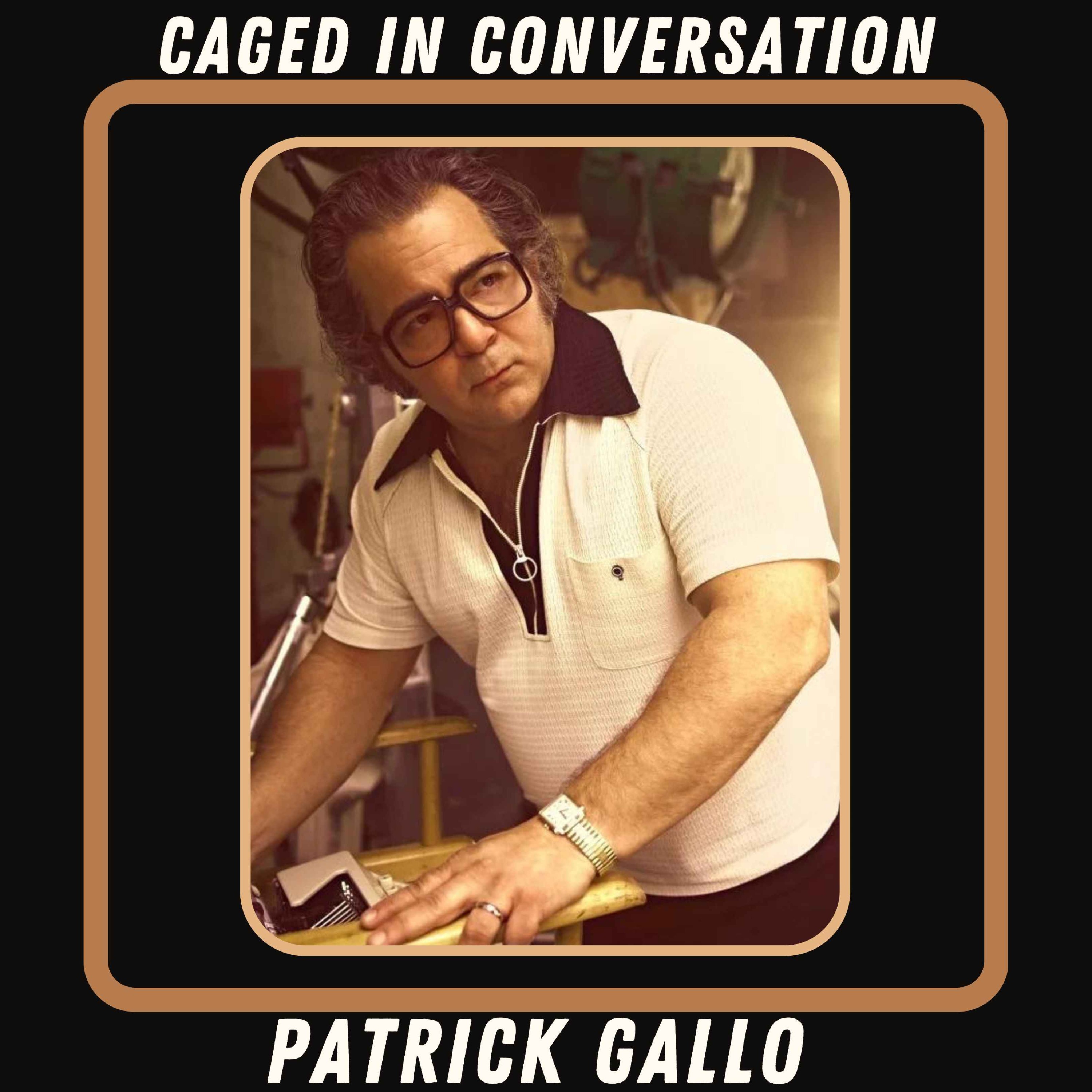
So there you go. Well, my conversation today is with Patrick Gallo. And it's a fantastic conversation. For those of you who have been keeping up to date with the offer, the TV show on Power Plus at the moment, Patrick is one of the leads in that show.
He's fantastic. I really, really, really enjoy his performance in it. And we get into that. We get into some of the stuff that he's done before.
The guy got to, yeah, we took away. He got to be in the Irishman and the same partners are insane, but we get all into that. And we talk about the kind of profound work he got to do. One of the proud projects he got to work on, at least when they see us.
And yeah, I could have talked to Patrick for hours as well on this one. I look forward to getting back on at some point with discussing potentially him. Just coming off a regular episode of the podcast, which would be really interesting, especially getting it from, I don't know, other side of things, speaking to like somebody who's yeah, who's worked with some of the people who have been in these films that we're kind of talking about. So that's the kind of, and I don't know, especially I think I could talk to him about the God of God for ages and kind of delve into some of the stories he probably has from growing up in an Italian American household as well.
I imagine he's got stories upon stories. There was a few technical issues with this episode, but I think I've ironed them out in the edit and there was a couple of interruptions. One of them I edited out, but one of them I left in because Patrick's dog, Mooney, interrupted the conversation and just picture what I pictured in speaking to Patrick, all of a sudden behind him, I just see this beautiful big dog just kind of jumping up just head on the window sill, looking into the room and it made me laugh and I just thought like, hey, that's kind of a human interaction. Well, I've seen this guy's dog, but it's kind of, it's life getting in the way of things.
And yeah, I think often in podcasts and stuff like that, all of that kind of human real life stuff is pulled out. So for, yeah, it made me smile. It made me laugh. So maybe it'll do the same for you.
So yeah, sit back and enjoy my conversation with the fantastic Patrick Gallo. I'm joined today by Patrick Gallo, who you may have seen with a fantastic turn as Mario Puzo on Paramount Plus's limited series, the offer. Yes. Patrick, how are you today?
I am good, my friend. I am good. I am relaxed and it's hot where I am as well. But I am blessed with the tremendous cross breeze.
Nice. Lots of windows and it's nice. It's nice. It's been a pleasant day and a wonderful summer.
So what did I guess? Yeah, one of the best places to start with this is kind of like where did you grab in like a film, loving and TV, loving household or was like, what was it like growing up for you? No, not. I mean, you know, I think there was a love of music of, you know, very, you know, classic Italian American family, a lot of music, a lot of food, a lot of humor, a lot of extreme highs and extreme lows, but there was always an enormous plate of pasta or pork chops or something in front of you.
I was trying to eat your, you ate your troubles away. But it was, it was nice, very colorful. Yeah, but yeah, very, very, very, you know, fun and interesting, childhood. Yeah.
In Buffalo, New York. So where did like, where were those early experiences with film that kind of like, I don't know, got you excited about maybe being an actor? Was there like an experience? Like, do you remember first like going to the movies and kind of being like, I like what they're doing up on the screen?
Yeah. Yeah. I guess what really drew me to it. I guess I got curious about it was the great film Time Band.
It's Terry Gilliam. You know, that film really kind of gave me another view of cinema and film and, you know, and I was very young at the time with the fantasy of it, you know, and how many walls you can break when you're telling a story. And I don't think I processed it like that as a childhood. It definitely made me feel, you know, much more differently than I felt watching anything else that I'd grown up with.
Probably the jerk. Yeah. You know, Carl Reiner and Steve Martin and Bernadette Peters, you know, that's a film to this day. You know, that had affected me.
That kind of thing of where you leave a film where you finish watching a film and it never leaves you, you know, kind of hangs onto your sleeve. And then it was, and then I think it was in high school when it really, I started getting it, I guess right before I got into theater in high school, I got, you know, I had this dream of living in New York even before I was an actor. And what do you Alan's films really, you know, carved out a house within my soul for like, that's where I want to be. And this is the kind of life I want to lead and I want to be around these people, you know, these sort of environments that were filled with, you know, arts and intellectuals and that New York, you know, and that music, Gershwin and all that.
I think that all drove me into theater and I did cabaret in high school. And, and when I, I think when I did that performance, that was when I made a decision of, oh, okay, you know, this is a number one. It's cool to tell girls you can't hang out because you're rehearsing. I thought that was really cool.
I think it's the equivalent to the musician playing guitar because it, you know, I'm like, I've got a gig. I can't get a gig or I can play this tune. You know what I mean? And so I think that like that kind of got me, you know, you know, I was a very kind of insecure kid, a lot of anxiety.
So I think it like it gave me some kind of a, of a, you know, kind of a rock to hold onto, you know, that I had this thing called theater. And that was it. And that was it. I decided that I was going to move, you know, forward in my life of theater and that was, and I never look back, you know, to this day.
I'm 30 years or so, you know, yeah, I'm interested because you're going back to talking about like the household you grew up in the story. Yeah, it kind of reminded me because I'm half Greek. So I've kind of got like that side of my family where it's like that plate of food. Just it seems to be affection is shown through eating, right?
And it's kind of like, you can't say no, but the elders in the family kind of see that, see that thing of like, he wants more. He wants more. You're kind of fed up and like, you just get to know, he's a beautiful way to show love to people and. Yeah.
Yeah. It kind of brings brings me onto the Godfather because as it's kind of said in the show, it's a film that is fundamentally about a family. And do you remember the first time that you saw that film and what was the experience like? Yeah, I mean, I saw that film.
You know, it was kind of a rite of passage at some point. I mean, the book was always, you know, was a regular, you know, kind of, you know, your familiar, your optics, the cover of the Godfather was not every house that I went into. And it was in our house too. Not that there were many people sitting in couches reading, but was there, you know, you kind of had to have the book.
So I was very aware of it visually, you know, of the Mary and I, you know, I mean, it was such an iconic image. And then I'd, yeah, I watched it with my dad and it was, you know, it was cool because that was another moment in cinema that I thought, wow, you know, like I said this in so many interviews, it was, you know, it was like I was watching a whole movie. Like I could smell the people in the film alone. I could feel their energy, I could feel their suits and their, their joy and their tension and their aggravation and their anxiety.
But I felt it because those were the kinds of people that were around me when I was a kid, you know, my dad knew a lot of these, a lot of these guys that were in the mafia and they were in my house and I spent many a night eating dinner at a table with both gangsters and detectives. You know, there was these kind of, it was kind of these moments where there was a no-man's land. Yes. It was like, you're not going to arrest me and I'm not going to run from you because we come from the same neighborhood.
And so there was a, it wasn't on the table. It was about eating and drinking. And so I was about these guys. And so it was like watching a whole movie.
I related to the rooms, the sets, you know, the locations and I don't think I knew how I was related to it then. But I know that just through the way I was taking it in, it felt very normal to me. It was like, oh, you know, I know this. Yes.
And then that also made me feel very comfortable with the show, you know. As I said, like kind of going back to Greece, like when I go for a long time, when I come for summers and stuff like that. Yeah. Or always like watching the Godfather again recently, like I managed to catch it on the big screen for the 50th anniversary.
Yeah. And watching those scenes, I think go to Sicily. It was like just the kind of small towns that's very much where my family are from. It's like, even though it's a different culture, they are very similar, like the kind of Mediterranean families is these small towns.
Everyone kind of knows each other. Like, do you know, like the, just the loving embrace of people and the mood and everything. I feel like, I don't know, I get this. I mean, it's just something that clicks with me kind of watching.
I totally understand what you mean. Yeah. So many similarities, you know, and I, yeah, without a doubt. So when it came to, when it came to this part, when did it, when did it arise for you?
Like, what was the kind of process? Was it, was it, I mean, it was an audition that, you know, that came up like they do, you know, I mean, it was, you know, I read the script was very safe and, and, and, and, and, but I, you know, I got my pages, and that was it. And I read, and I auditioned. I mean, it was as normal as the process always is.
You read and then if they did, you, they call you back and, and you have a discussion. And there were lots of little hoops that, you know, I kind of had to jump through, you know, together there. It doesn't come that easily, but, and, and, and it happened, you know, I got the call that, you know, that I got the gig. And, and at that point, I knew that it was Mario Puzo and that it was the make, you know, I had been able to gather information, more information over this sort of six week period between auditioning for it and actually getting it.
And, you know, it was just tremendously exciting. It was, it was a lot to get your head around, but you knew it was real. So you just kind of moved with it, you know what I mean? And it was a wonderful experience from the moment I auditioned, honestly, to the moment I wrapped and, and then the months following, you know, it's been, it was, it was experienced.
I'd never forget on, on infinite levels. When you first got those pages, was it a case of you didn't know like what part of your auditioning for you just auditioning for this project? No, I knew the part that I was auditioning for, but it wasn't clear as the who it was. But I could tell obviously Puzo or Sinatra, one of the audition scenes was the Puzo and Sinatra scene, but I couldn't tell what it was about.
I could assess that it was Mario Puzo speaking of his, you know, his book and talking Sinatra and my room is where, you know, so I could put those simple elements together. But I had no idea as to what it fit into what the structure was or what it was at all. I had no clue at that point. It was really tied down to the, to the scene.
And that was it, you know, and that was, that was all I was able to kind of work for. How did you go? How did you go about getting into the role of Mario Puzo? Obviously somebody who is a real world character.
So was there like a sense of trepidation to obviously portray him in a certain way? Yeah. Yeah. And I think it was a decision of doing a personation of him or, you know, or do I do a variation of him and, you know, I wanted to do a variation.
You know, I didn't want to put myself in a position to impersonate him. I'm not that kind of an actor. So it really wasn't, really wasn't, wasn't where I wanted to go. And then I read all of his work and I found his spirit within his writing.
And of course I read about him and his life. And I kind of let that settle into my body and hope that it harnesses his spirit. And then when we went to set and we were shooting it, I just hope that it remained and it kind of came out, you know, within the circumstances of the scene. What's that?
What kind of things did you draw upon from your own experiences to kind of play? It was anything you drew upon to like play character like this? Absolutely. I think his struggle, you know, his desire to be seen as an artist, you know, and that was desperate for, you know, he was desperate for that.
He wanted to be seen as an artist and wanted his work to be seen as art. He knew it and he was open about that. So yeah, that was one of the main things that I was like, oh wow, like I know that. Because I was, you know, that insecurity, that need for people to identify you with art and with being an artist.
I, you know, that's how I feel. And that's all I've always felt. And it isn't insecurity to a certain extent. But I related to that first and foremost.
And I think that was the thing that I related to most. Yes. And so I really, really, really tried to hold that close to me whenever I was doing a scene because that was the thing that we really, I really connected to with him. And I felt as soon as I found that out, I was like, okay, I can, I can, I can use that as a tunnel to find him and to relate to him.
There's some really, there's a really standout scenes kind of on that kind of topic. And there's a scene in episode three where there very much pertains to what you were talking about where Mario's talking to Francis about how he's never done, he's never, he's never turned a script before. And obviously like you kind of get that desire in the character and it's, yeah, by yourself has played fantastically well. And there's so many, there's so many things.
I guess that's like the stuff I really connected with a lot is they scenes between you and Dan as Mario and Francis like me and Will, the guy I've been kind of chatting about week by week about each episode. We've kind of every week we tell a broken record where again, do you know what, I could watch a whole kind of season of just these two hanging out kind of bickering and kind of breaking the script. What was it like working with Dan and how did you kind of create this chemistry that that's so radiant on screen? That's a beautiful thing to say, man.
You know, Dan and I, you know, we got this opportunity to live together. And I think that was the main thing that helped us. So we got to live in a house together and just be Danny and Patrick and celebrate life together and get to know each other and get up in the morning and you know what I mean? It was morning, noon and night, you know.
And so we developed a friendship, we developed an intimate understanding of each other and we had a lot of laughs and we found each other's humor. And so it was like, it was an effortless and it was a gift to us by the acting gods, you know, that we were able to hang out because then when we get to set, it wasn't like we had to put a lot of effort into like finding that connection. Like we had it and it was just there. So I mean, really everything you're seeing, every smirk, every kind of look of confusion or understanding or support is me and Dan being me and Dan within the circumstances.
You know, I mean, that's pure. And so that was a real joy because you didn't have to worry about it. You didn't go, Jesus, I hope we connect. I hope we can store up an energy.
We had it. We knew that and we trusted it and we let it go. How did it come about that you two ended up living together? That sounds like a kind of comedy of errors in itself.
It really was, man. He had a guy, buddy of his, Larry, who was supposed to stay with him. It turned out that Larry couldn't come suddenly. I had a place that I was going to stay.
That place fell through and it all happened in like the same week. And he's like, and I was like, I need a place to stay. And he's like, I got a place like, why are we not? This is clearly meant to be.
And it was like, oh my God, you know what I mean? And that was it. It was that simple. Go in method with it.
I love it. I mean, it was a very, very meta situation and we just took advantage of it. You know, we just were like, all right. It's just, you know, all it was kind of kids and it all worked out.
So, where are you hanging out? Was it a lot of wine drinking, a lot of pasta eating? Was it kind of sharing meals? Was it the scene she's seeing the show kind of reminiscent of your time living together?
It was all of that, man. Perfect. It was it was it was hanging out every single day and and you know, doing whatever we wanted. And enjoying all the things we wanted to enjoy in large amounts at all times.
And that's what we did morning, noon and night. Amazing. So. Were there any particular scenes that you found like stood out to you that were like, over enjoyable to shoot or like once you kind of wrapped you like, we got something to say.
There's something special about that scene. Oh, yeah. I mean, you know, I think the Brando scene, that was a really special day for me. Justin was amazing.
And I think it was just a beautiful scene where it was mostly Justin channeling Brando, his version of Brando. And it was us just kind of sitting and being and and it became very magical. And it was one of those moments where you kind of as an actor, you know, you're not on set anymore. Like your brain just kind of lets you allows you and your soul allows you to kind of be in the environment.
You're hoping you can be in that you're pretending to be in and it kind of clicks over. And that happened there. And that was really beautiful and emotional for me. And I think that also happened in the scene in the sands when victim own tells us that he you know, announces to the audience that he's not going to do the film.
And that environment was another wormhole moment, you know, and a beautiful, beautiful moment. Yeah, there's a moment. But those those were really special. Yeah, they come across that that moment you guys share that group hug was kind of like, I felt it when I was at that moment.
I was like, yeah, there's like there's a there's a brothely bond right here. Yeah, yeah, yeah. You've got social dialed in searches doing its thing. So why do your marketing results look the same as six months ago?
That's because you're fishing in the same pond as everyone else. Podcast listeners are a different audience entirely more engaged, harder to reach the traditional channels and ready to act when someone they trust makes a recommendation. We're a cast and we put them right in front of you browse thousands of the world's leading podcasts, book host reads or run your own ads and track every conversion in real time. Same skills you already have brand new results.
Acast acast.com slash advertised. We talk about special scenes. I've got to ask you about some of your previous projects because one of them is the Irishman and speaking of special scenes have to ask you about what it was like to film. I simply noticed the traffic scene where you're sat around the table with Al Pacino, Robert De Niro and one of our own, a British boy, Stephen Graham.
What was that like because kind of watching it, I'm kind of dumbfounded. How was it being in that scene? Yeah, man. It was surreal.
It was unbelievable. I mean, for any actor, I don't think there's an actor in the world in the past 50 years to now and it will continue. That doesn't have Martin Scorsese, Al Pacino and Robert De Niro on the bucket list. I mean, like these are the people you want to work with.
You want to have an opportunity to work with these unbelievable artists, these icons of and I got it all in one shot and it was an incredible, incredible experience for me. I mean, I think I got on the phone and I've said this before and I would call my mother in between setups, crying, you know, because I just couldn't believe that it was happening, that I was the guy that got chosen to sit at this table and Scorsese and De Niro and Pacino and Stephen and I work with Stephen, you know, on another scene in the Irishman earlier. So I had known Stephen from a couple of weeks before we shot the next scene. And it was just an unbelievable experience.
They were amazing. They, we, it was just a table of equality. There wasn't anything that I had to be afraid of or nervous about. Like what you think you would have to kind of feel like as an actor, they made me feel that I had complete not our freedom and I did and I got to improvise and play and I never felt like anybody was looking at me like, you better not fuck up because you're with these people.
That was not, it was like a bunch of New York City actors sitting at a table doing a scene. And it was the greatest acting class and they were absolutely wonderful and I was very, very, very grateful that that's just a rare opportunity that I was given and it was incredible. It was just hard to articulate it. Yeah, can imagine.
You know, it's hard to articulate it because you know, you're sitting there and you're focused on your craft. But there's that part of you that grew up watching these guys and they kind of led me down the road that I was on. And so you're kind of like, you're in that struggle of like, who am I right now? And it's like you have to be the actor and the craftsman.
But De Niro sit next to me, but she knows across from me and it was like, Jesus. And Stephen, who was unbelievable. Yes. You know, and when actors can give you that kind of a performance, you know, Stephen's performance is extraordinarily strong and you can't not do well when that kind of energy is coming at you.
I remember hearing it in an interview with Stephen Graham and he recounted a story of him doing the scene with Al Pacino, I think with the ice cream and he hits the ice cream across the table and Al didn't know it was coming and kind of turned to school. So he went, oh, this guy, this guy, this is the guy that kind of didn't really know who Stephen was. He's setting the tone for what we're doing here. And it's like, yeah, that kind of stuff like exciting shit.
That's the best right. Yeah. Yeah. It's a kind of, I don't know.
And guys like Petino and De Niro, you know, that you would think, you know, you have to have some kind of certain protocol about it. They want that. They are open to it all. They are, they, you could give them anything and they will take it in and return it to you.
That's the beauty of acting. That's the joy of it. That's the playground of it. And we can do anything.
And no, it's not people saying, what the fuck? You're not supposed to be saying, no, it's whatever happens, we'll work with it. We'll keep building. It's just an absolute joy to be around anyone, whether it's in your own, or someone nobody knows, it's the joy of the craft that allows those things to happen.
It's very exciting. Was there a feeling of being involved in a project that's obviously about like a film that like it's synonymous with kind of Al Pacino's like rise to kind of superstar them? Like, were you kind of like, I wonder what I would think about this project? Because obviously he's portrayed in the show and stuff like that.
Was it like a great guy and an unbelievable job. I just read an article, I believe someone asked Al Pacino at the Tribeca Film Festival, are you watching the offer? Uh-huh. I'm absolutely watching the offer and I love it.
So that was a really cool thing to hear. Yeah, because we did it on the show, because obviously a lot of people, I don't know, Anthony, yeah, he blew it away from some fire for his betrayal of Al Pacino. But then I dug out the oldest interview of Al I could find. And I was like, that's who Al was at that time.
Obviously, I guess, we've said it. It's so hard to not get an image out of your head of who you think someone is. People think of Al Pacino, they think of, oh-ha. Do you know what I mean?
Oh, no. Off-Broadway, like kind of, I'm sure of himself, like, actually. But I think of the character and not the actors. I think critics are just afraid to give anyone credit for portraying someone like Al Pacino.
I think there's a fear there. And so they're gonna bash it. That's the stuff that's gonna come on the fire with the show like that, right? It's the kind of the people in the spotlight and unless it's kind of, I don't know, it's that thing, some of the best kind of portrayals of like real life people have been from people who look and sound nothing like them, like whacking Phoenix and walk the line.
It's like, he looks and kind of sounds nothing like Johnny Cash, but he embodies the spirit of the character. Right. Yeah. Yeah.
Yeah. I think that's a much deeper interpretation and I think that gets overlooked. It kind of runs through the, I think it runs through the show of kind of people capturing the spirit of these characters. And no more so, I think, then.
Obviously, yeah, a lot of people may not know like Mario Puzo by kind of the way he was or the way he sounded or Francis, they might have like a kind of thingy, but I definitely think you and Dan capture like even as characters, like as I said, you two are a joy to watch on screen. That's so wonderful, brother. Thank you. Thank you.
I can, I don't hear that enough. I can always hear that. I guess another project I wanted to bring up before I let you go because, especially, especially being a New Yorker, I wanted to kind of ask you about was it important for you to be, like when you got to being, when they see us, like obviously as a New Yorker, was there something important about being in that show? Obviously, like that story is so kind of, I don't know, it's really, it's really important.
It's such like a profound moving show. I'm sorry, I got money. Laura, can you let baby girl in? She knows where we are, so she finds the windows.
Amazing. And what did you ask me about that about when they see us? Like, like what was it like being involved in that project? And was it a case of like, did you feel like the importance of it?
Because obviously, but yeah, especially being a New Yorker, like you must, you must have remembered that kind of real life kind of tragedy as it is, right? Absolutely. And that was a very, once again, another project that I worked on that was, you know, I feel very grateful to have been a part of the hotel that story. Yeah, that was a tough story to tell.
And it was, it was, it's such a rough moment in history and difficult. And certainly to play the bad guys in that brought a lot of very exciting elements for an actor, but very certain, being very exciting, you know, you have to, you kind of can't be soft with it, you kind of go, oh, I want to, I'll be lighter with it. It's like, you got to go all the way. And that was really hard.
It was really emotional. I mean, I think we, every time we did a scene, you know, with, you know, what we were doing it was useful. And, you know, I mean, we were hard afterward because I felt so bad because we were all doing such intense work with them, seeing them working with David DuVernay, you know, who was such a champion of the actor in the process and really lets us go. And we were able to really have the freedom to go as far as we could emotional with this beautiful book, but it's, you are carrying a lot with you.
Yeah. And we did, and I carried a lot with me after I finished it. It was wonderful to be a part of telling that tragic, tragic awful story. And once again, another experience that, you know, it's like, if you're a lucky actor, you know, you get a handful of experiences that kind of alter your being as an artist after you finish, not just a gig.
It's an experience, you know, and when they see us with definitely that. I think that that shows a testament to like the power of like kind of narrative storytelling and kind of television and film because I guess a lot of people wouldn't have been away, especially around the world. Obviously Netflix is a kind of like a worldwide platform and that like, I don't know, yeah, I'd sin the documentary that the central book five years ago, but like, I don't know if like Joe blogs on the street is checking out that documentary. So for that kind of, I remember having a discussion with that show with my parents and stuff like that.
And it's kind of to bring up those conversations. I can only imagine like, yeah, from being a New Yorker, especially kind of getting to be a part of telling that story must have been, as you said, it's profound and kind of changes your makeup as who you are as an artist. Oh, it actually does. Absolutely does.
Yeah. I hold those in an extremely high regard. And like I said, you know, to get a chance to tell a story like that, you know, that feeling of that doesn't go away. You just you always know that you were able to be an element in a huge, huge mass about is telling this unbelievable story.
It's a gift. And once again, you know, because that very fortunate, you know, to help tell that story. Amazing. Well, yeah, I'm conscious of time.
I know that you've got you've got a family there and you've got a dog who's doting on you. So before I let you go, obviously, what's kind of like, obviously, it's hard for actors a lot of the time to say what's coming up. But is there stuff like we can look forward to seeing you in or are you kind of, is there more Patrick Gallo coming to our screen anytime soon? Yeah, there is.
And a lot of different forms of a couple of things brewing right now that I can't really speak too much on. But yes, you know, absolutely. And if you, you know, you'll know, you know what I mean, I'll make word. I can't really say much about it.
You know, there's always something there's always something on a grill. Perfect. And some of that been a direct like relation to the response from the offer or is it stuff that's kind of been brewing beforehand? No, no, I mean, I think some some in direct and some just kind of in the momentum or just kind of existing for, you know, 30 years, you know, like opportunities.
But I don't really, I don't know, you never really know unless it's spoken up, you know? I don't know if you really care. You know, I did the gig. I don't really care.
Exactly. Yeah, yeah, yeah, if someone saw me on that episode of boardwalk empire or the douche, like if that's not going to be the job or if it's something else, I don't quite care as long as it's good. Yeah, amazing. So when anything comes up, you know what I mean?
Like, can you see me post something and you know, we just make sure you hit me up, man. We'll let you do another talk. We'll be glad to. Of course, Patrick, this is this I could I genuinely feel like I could talk to you for for hours.
I love talking to you too, brother. I look forward to the next time you do an interview, man. Absolutely. Yeah, this has been absolute joy.
As I said, like, I can't say this enough, like your performance in the offer has like been one of the standouts for me kind of getting like getting really kind of folded me into the family of that show. And as I said, any time you and Dan, especially on screen, it feels like that time living together, like paid dividends because it kind of it shows on screen and it kind of. Well, it's bad. Yeah, it's well said, brother.
Take a million. That really warms my heart. Thank you. Thank you so much for expressing that to me.
It really means a lot to me. Well, Patrick, this has been an absolute pleasure. Thank you so much for coming and chatting to me. God, brother, talk to you soon, man.
And there we have it guys. My conversation with Patrick Gallo and what a conversation it was. A lot of fun, Jan to Patrick. And yeah, I hope you had fun listening to it because I don't know.
I really, really, really, really love interviewing people. I really love having people on the podcast as well. It's I don't really see a distinction between the two, but there is something about interviewing people being able to kind of do that research and getting to know their work and kind of finding, I don't know, find it something you love and what they do. And I guess I'm a lucky point that it's normally me chasing down people to interview.
It's not I'm not I'm not a massive podcaster. It's like I'm being handed people to talk to and it's not I just have to talk to them. It's no, I want to talk to people that really enjoy talking to him. Patrick was one of them.
I saw his performance on the offer. If you're not watching it, check it out. It's fun. It's fun.
That is something I said about the offer. It is a fun show. It's obviously as somebody who's kind of really delved into the making of the Godfather, it's not all necessarily how things went down, but it's still a fun old time. As for next week on the podcast, we'll be kicking off Schwartzman Summer.
So I'll be looking at five Jason Schwartzman films. I'm not going to tell you what all of them are. I'll tell you what next week's episode is. You may be thinking, we already know it's going to be big eyes.
It's not. I'm going to be doing these in Crawl and Chorda. So when they were released, so I'll be kicking off next week with Spum from 2002. And I'll be joined by previous guests, Matt Stocks, talk about that film, which is directed by Jonas Ackland.
And I know that Matt has interviewed him on his fantastic Life in the Stocks podcast. And yeah, if you're not aware of Jonas Ackland's work, he's fantastic director. He's done a lot of music videos and stuff like that, but did from Lords of Chaos. He did that film with Matt Nicholson on Netflix as well that is escaping my mind right now, but you're probably screaming up to your phone going, it's called this.
But yeah, as I said, I can't think of it right now. But yeah, be sure to check out my chat with Matt Stocks on that film. I assure you, it will be a lot of fun. So if you've enjoyed this conversation, if you enjoyed this episode of the podcast or any episode of the podcast for that matter, I would like to help out if you'd like to get involved and give me some sweet, sweet cashola, you can do so by heading over to patreon.com forward slash caged in pod where for as little as £2.50 a month, you can become a movie brat bro and get access to our limited series.
Oh, not limited. It's kind of ongoing series all about the contemporaries of Francis Ford Coppola at the moment, we're looking at the films of Brian de Palmer, kind of seeing why his career stacks up against Francis Ford Coppola. I will take a year, for instance, the film in question that we talked about, for instance, we discussed Mission Impossible with Nathaniel Metcalfe and at the end of the conversation, we kind of just asked who had the better year? Was it Brian de Palmer or was it Francis Ford Coppola?
You can have a little look as to what to film to release in 1996. Yeah, Mission Impossible versus Blank and see, you'll be out of town who had a better year. To backtrack slightly, the film I was thinking of is Polar from 2019, a very good film, very fun. So if you don't want to give me any money, that's also fine.
You can head on over to Apple Podcasts, Spotify or whatever you're listening to this right now and leave a five-star rating and review. It's always fun to do that. It kind of helps me feel like I'm making the right moves and moving and shaking in the right direction, as I always wish I am. I don't want to be out of step with my dance partners, which is you, the lovely listeners.
So yeah, let's make sure we're doing the charge our charm together and it's not me treading on your toes or vice versa. So if you want to get in touch with the podcast, I always love hearing from you. We're excited for Schwartzman Summer. What are you hoping to hear me discuss?
Are you hoping there are certain film I've got to use on Twitter? Yeah, Twitter is a good place to get a hold of me or all the social medias for that instance, Twitter, Instagram, Facebook, Letterbox and TikTok. You can just type in AppCagedinPod and you'll be able to find me on all of those and let's just keep the conversation going. Or if you'd like to drop me an email, do that at cagedinpod at gmail.com.
I love hearing from you. I feel like we've been out of touch a lot recently, guys, please, please, let me an email. It's on needing right now, but yeah, drop me an email. Right, on social media, let's just have a lovely old time together.
So as always, I've been Petch Patzilos, your guide through the crazy world of the Copeland family tree. Even though this one, yes, it's kind of been related to the Copeland family in some capacity because Patrick is betraying Mario Puzo on the offer which relates to the Copeland family in regards to Francis Ford, Copeland and the making of the godfather. Remember, keep it Cagedin and I'll catch you next time.