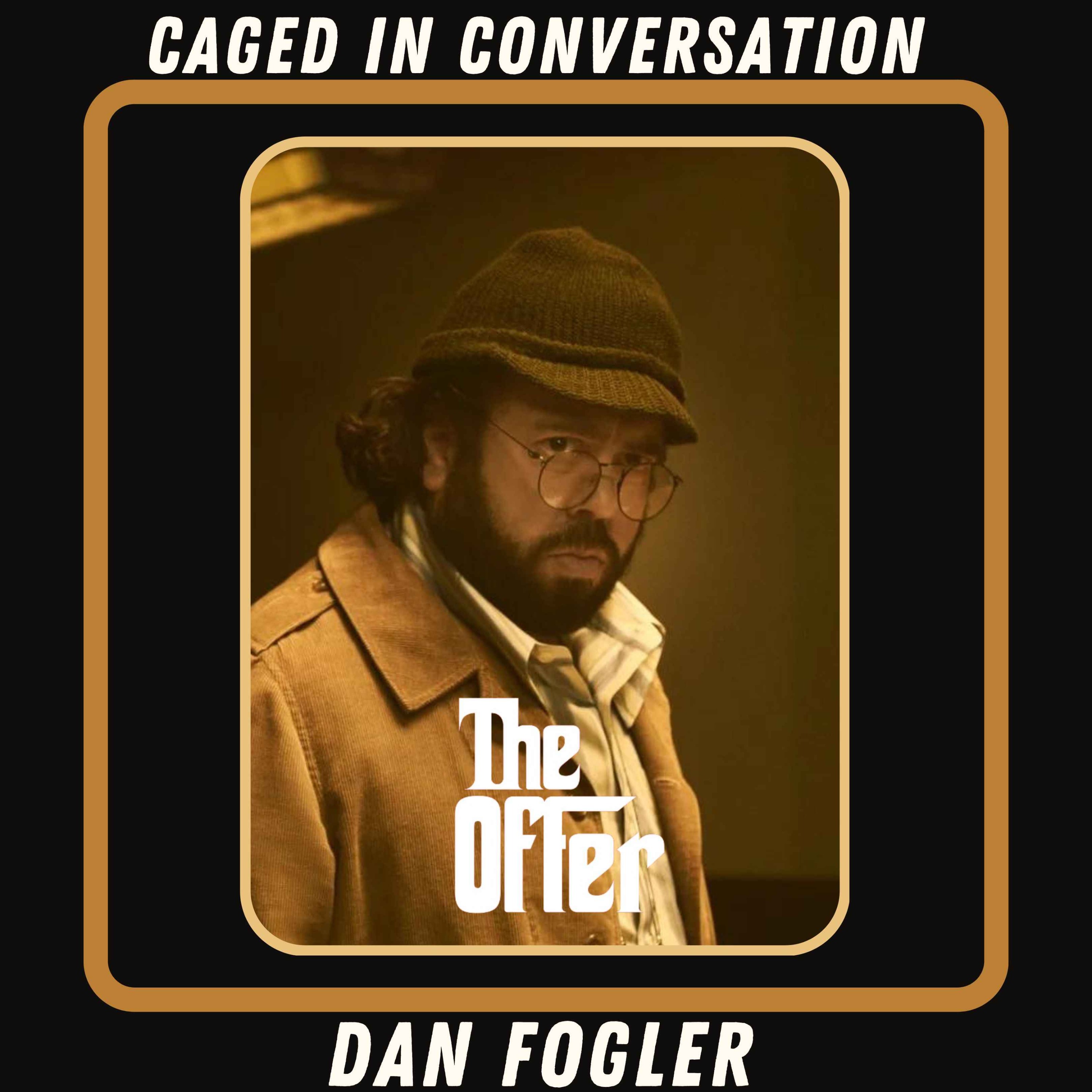
Hello and welcome to a very special Caged in Conversation. As ever brought to you by the Bread Gams Collective and hosted by me, Petros Pat Silvus. This week on the podcast, we have a very special guest in the form of Dan Fogler. It was an absolute joy to pick his brain, all about playing the main man himself, Francis Ford Coppola in Paramount Plus's limited series, the offer which, I mean, will Chitch have been covering week by week here on the podcast and from next week, that's gonna be taken full focus.
No longer gonna be Friday bonuses. Up until the end of the season, we've got episodes eight, nine and 10 left to cover. They're gonna be just your regular choose episodes. I'm gonna do a nice little wrap up episode, kind of talk about our overall thoughts with that.
So if you're not watching that offer, now is your time to watch it, get involved. It's been a lot of fun. And I think this, yeah, this little season we've been doing deserves its own shine. As for this conversation, it's absolutely joyous.
I'm gonna tell you right now, if you're here for Fantastic Beasts chat, we don't do it. I was aware that my time of Dan might be slightly limited. So I made the conversation very, very, very offer-centric. And we kind of, yeah, we really get into the weeds on it.
We really get into what it was like playing Francis Ford Coppola, what it was like being on this show and seeing these recreations of these really famous sets and costumes. And yeah, we get into all of that. We get into the critical reception of this show. Obviously, critics haven't been the kindest to this show.
And we kind of, we asked the question why. And it's kind of fascinating to ask a question like that with one of the stars of the show who has some big opinions on it. And I've got to say, as you're here in the conversation, I agree with Dan on those points. And I'd like to say up front, a massive thanks to Dan for his time.
He really didn't have to do this, but I don't know. I just found he's a guy who loves what he does. And it was, yeah, he carved out an hour of his time. So I'm gonna step away and let you enjoy this conversation with the one, the only Dan Fogler.
Today, I have the pleasure of being joined by a Tony Award-winning actor, podcaster, comic book creator and writer who you may know from such films as Balls of Fury, Fan Boys, The Fantastic Beasts Films, The Walking Dead, or playing Francis Ford Coppola in the offer to name but a few of his credits. Ladies and gentlemen, Dan Fogler. How are you today, Dan Fogler? Hey man, never cut off the applause.
They wanna keep, they wanna keep applause. I think that's fine by me. Yeah, that's a rule to live by, right? If there's gonna be applause, take them.
Relation to your applause, yes. So I guess, yeah, the one of the main reason I wanted to speak to Dan, so you've got this illustrious career, as I said, a Tony Award winner, like, so is it right in saying that the stage was like your first love when it came to acting, what was the kind of, do you know, what was like early years like and when did you, I don't know, what made you wanna get into acting, I guess? Yeah, my introduction was school plays and stuff like that and school musicals and, I mean, I always loved watching television, watching movies and my parents would take me to Broadway and stuff like that. And so I think that, yeah, I mean, I think my first, my first gateway was TV, I would have probably gone that way, but it was theater, that's what was most accessible.
So that's what I knew, which was good, it was really good training in the theater, man. It's like, it's really, it's, I strongly recommend if you're gonna become an actor to do that, it's kind of like, you gain a lot of skills like you would like, like a pirate ship or like a sailing ship, you know, you learn how to do certain things that come in handy along the way. I guess like that, not monotony, but doing the same thing day in, day out and you get to ride those rough waves, right? Like you've kind of got the audience right there in front of you, so it's not a case of like, let's do another take, it's the case of, let's roll with the waves of how the show is going on the night, right?
Yeah, you own a lot of skills walking that tightrope. So you, yeah, I mean, it's priceless really as an actor to be able to maintain that character, become an expert at the character, maintain that kind of stamina and endurance and energy every single night, to be able to, you know, recreate before everybody's eyes, something that when you have, you don't have one take at it. And so that's really quite exciting. And if you do mess up, then you gotta hone the skills of improvisation, which is also really helpful.
Yeah, so, you know, it really comes in handy. And you, just to be in front of people, is something really special, like that audience interaction, when it's going well. And you're kind of writing that, the wave of laughter or whatever, or you can hear a pin drop, there's nothing like that, that's like the best. And that translates into, like I still use those skills while I'm on set.
So like if I'm on set and I'm trying to gauge how things are going, I'll use the crew as like my mini audience, you know, everyone standing around the character, everyone standing around the camera. I feel if they are kind of holding giggles, like I know it's funny. And if they're like really listening and like they'll tell you, they'll come up after and just be like, that was great. You know, so it's good.
All those skills I would never change a thing about my training. I guess with the theatre as well, you get a chance to, I guess the way to put it is, understand like the internal workings of a character. Have you found that is something that you've taken to like your screen work, kind of like really developing the characters? Yeah, absolutely.
Everything I learned in creating characters, like some characters, you can really pull from your own life. And that's what I usually do. Like that's like Uda Hogg and stuff, you know, like that's one of the first acting books I ever read, where you are acting with somebody, you don't really know them, but you take from your own life, oh, who does this person remind you of? That person that was my, you know, friend or girlfriend or you know, whatever.
And you project that onto them. And then suddenly in an instant, you have, you know, 20 year relationship with them. And that's something that's like instant chemistry that you can that you can come up with. So usually the characters that I play are start from, oh, how is this person like me?
And then I kind of find something or stories that happen to me or people that I knew and I grow characters out of that. Sometimes like very in a very theatrical way, sometimes it's just a hat, you know, sometimes it's just shoes or a mustache, you know, like for Jacob, even though I had a tremendous amount in common with Jacob Kowalski, it wasn't until I had the mustache. I was like, oh, there he is. You know, that's that iconic, you know, Baker look.
It's fascinating because I, when like, you know, researched like the making of the Godfather myself and like comb through loads of books. And I think it's in Mark Seals' great book, Leave the Gun, Take the Canole, and he kind of says how copler would get trinkets for people to kind of like put this in your pocket, have this lighter and like just to try it, obviously a guy who was all about actors, as we kind of see throughout the offer, it's like there's that great, well, they seem between yourself and like that. Yeah, the Gordy Willis, like the kind of biting heads of like the look of it versus the actors doing their job. And I find that fascinating finding those details to make a performance, something special.
It's great to hear that that's something you draw upon as well. Yeah, copler was legendary for those little quirk, because he comes from the theater. And so I think that you see that in his work, it's pervasive the way he talks to the actors and relates to them. They're the small details I picked up on in the show.
Like I think there's a scene quite early on with you and Patrick and you're slicing out pages of the novel, which like instantly in my head is like a kind of big nerd on the on copler and the Godfather was like, ah, he's creating the kind of the famous like notebook. And I think there's a moment like later on in a board meeting and like you slam it down on the table. And it's obviously if you don't know that minor detail that copler went through creating this kind of something he had gathered from the theater, right? This like kind of this will do this and kind of writing all in the margins and stuff like that.
Yeah, the Godfather notebook was a part of my homework that Dexter Fletcher told me that I needed to do before we got started. And that was just genius because what it was was copolas, theatrical, directorial, theatrical training and what you do in that situation is you take the play and you cut out all the pages and then you put it into a larger notebook so that you can have a larger, so you have the page from the play and then on the margins you have places so you can write and you tape all of those and paste all of those pages. And I love that he did this and he paste all the pages from his play, which was the novel, the Godfather and he puts it into this enormous notebook and he has these giant pages with the novel pages at the center and all around the novel pages are his anxieties and his notes and all of his little tidbits of like how the hell am I gonna do this scene? And having those, there's literally like a microscope into his brain exactly what he was thinking for those scenes in that moment.
I was like, oh my God, this is like the keys to his psyche, which was really obviously really helpful to have that notebook. And that came, he did that because this was a big job. This was a big thing and he said, okay, I'm going to do what I do as a director in these situations. And he, it's incredible that he chopped up all of, that's a big book man, that's a big novel, because Godfather, that's a lot of pages.
That's two copies, right? Because obviously you've got a, you can't have, yeah, you can't flip over the page, like, Jeremy, you have to have two copies on one side. Do you know what I mean? Oh, right, I see what you're saying.
Yeah, yeah. Yeah, yeah. So it's even larger. Well, he did it when you have the front of the page of the book and the back of the page of the book and you just put that in the middle of the big old page.
So, and then if you watch the show, he holds onto that for all of the shooting. That's like his Bible. He says that he rarely looked to the script, that whenever he was referencing his shots, he always looked in that gigantic sandwich of a notebook. And that was a great prop to have around.
That was his like, his shield, you know, walking into those producer meetings and he could kind of, you know, if things were going well, he could kind of hide behind it or if things were upset, he could smash it down, you know. Yeah, that was a great prop man. And yeah, I strongly recommend just getting that book. If you love the Godfather, you see what was on Copeland's mind on every single, in every single scene, which is genius.
You said that, obviously, you normally try and look for a similarity, like with a character. How was it different? Because I'm right, I'm thinking this is the first like true life person you've played, like on screen. How was that different?
Like what was it in? Like someone who's living. Yeah, yeah, yeah. I mean, somebody who has been alive.
Yeah, I just realized I did, this is the most, I guess, major one. I did do it before in a movie called Taking Woodstock, where I played this guy called, Devin, who was one of the earth, the head of the leader of the earthlight players. That was easy, man. I just had to do like theater exercises, you know.
But yeah, Copeland was kind of daunting. But there were moments of like, where I was instilled with like confidence where it was in the audition. I like, if you told me, okay, you're gonna audition for Copeland. I was like, I'd be like, okay, really?
That's awesome. But then when I was doing the audition and I put the glasses on and I put my hair to the side and I had the beard and I was like, oh man, I kind of look like him, you know. So that was helpful, just knowing that I, it wasn't hard to look like him. And then where he was in his life at the time and where he was in his career, I understood that.
I understood where he was hungry. He wanted to prove himself. He was, he had gained notoriety as a writer, but not as a director. And so he was in this kind of limbo.
And I've been there, man. I've been in that place where I'm just like, just give me a shot. Just let me just get in the room. And being in a situation where he has this idea, but he's the youngest guy in the room in a lot of situations.
So it's even harder for him than whatever people to trust his vision. And oh, what a battle. Like what a great part to play. So I understood a lot about what he was going through at the time or at least I was able to project my own, you know, past what was my career.
And so I got that, you know, and there was also, I've been watching copolis since I'm 15. Like I've been, that's when I saw Heart to Darkness. And I was like, who is this lunatic? I'm making this in a movie.
Like who is this ringleader at the middle of all of these incredible performers and recreating a war, like an entire war, you know? And so right away just watching him and just being like, oh, he kind of reminds me of like an uncle of mine or he reminds me of like, because he and my dad are from similar regions in New York. And so my dad kind of sounds like him. And so watching him, it was almost like I was watching someone from the neighborhood or someone from my family or so copolis has been very, felt very familiar to me since the beginning.
And yeah, so, and then there's certain things, you know, like getting into those outfits. Yeah, like, especially I was kind of waiting for the premiere of the Godfather, just to see, just to see you walk down in that bright light and so like the velvet fog. Velvet and corduroy and corduroy and velvet, man. Yeah, that velvet orange shoot.
I had a velvet one, I also had a blue one, I think it is. It was, oh yeah, for the Oscars, I had a blue velvet tuxedo. The, that orange shoot was not a lot of people could pull that off, you know, but it's just like cemented in the time period in such a great way. Like that's so 70s, you know?
And it's so ballsy, like copola, who I'm pretty convinced that he has a lot of fears and he faces those fears by swinging the pendulum toward the other's total other side, you know? He's just like, he's like, oh my gosh, we're going to this event. Everyone's gonna be like judging my film. Oh my God, I have a lot riding on this.
I just want to hide. No, I'm going to wear a shiny orange outfit, you know? And just like you can hide, you know? And that's, it takes an interesting ego to wear something like that.
Exactly. Exactly. What, what I find fascinating about this and obviously you've, yeah, you've stepped into like the Wizarding World like you came into the Walking Dead at a later stage. Were the kind of, those have like inbuilt audiences and like a level of expectation?
Was there like a different kind of pressure? Like when it came to playing Francis Ford Copola? Because obviously they would be, you kind of, did you know that there would be eyes on this project? Like a lot of eyes and a lot of kind of like, do you know what I mean, people?
I don't know. I mean, I don't know. Everything like that you were doing. Is it like a, what's that feeling like?
It's kind of like, you have to let go and just have fun or else you're just going to go nuts, scrutinizing every little bit and boop you do. I had like Dexter Fletcher was just a huge, you know, really a huge help for boosting confidence right away. Like he like, first this rehearsals really, he was like, you've got it, mate, you're him. You're like, he and me.
And just like, all right, I guess I'm him. You know, he like hypnotized me and I had to believe that I was him and I really felt like I got his essence, you know? And, and my God surrounded by those performances. Like someone like Matthew Goode.
Yeah, I can only, I can only fathom what it would have been like on set to see him go for Bob Evans. Yeah. So, so I call him the time machine because there were moments where he'd be talking and I would have an antibody experience. Like I would be in my POV and I would see, you know, copeless glasses and copeless hands and copeless, you know, notebook and there's Evans just being Bob Evans, baby.
And then just be like, whoa, and then like see the paramount sign and everyone perfectly dressed in the period. There were moments where I almost forgot my lines because I was like, well, we are here, man. And I think it's hard to do that. And sometimes you're feeling it and, you know, but I really feel like they're like in the recreation of all of these certain things, we didn't do it all the time.
But when we did do it, it was pretty magical. Yeah, I was going to ask about it. Because one of the things me and my co-host Will when we've been talking about the offer, we've constantly saying like the recreations of like some of the sets and the locations from the film. What was it like being on there?
Obviously, you've grown up with copeless and she was 15. Was it kind of feeling like your, I don't know, a weird feeling to walk onto like something that you probably, yeah, I imagine you've probably sinned countless amounts of times. Well, growing up watching Copeland and watching the Godfather and like, yeah, any time there was any recreation of the smallest, little thing, everyone who was a fan would just be like, they would have a, they would have just a little, you know, this warm, nostalgic feeling in their heart of, I mean, the smallest thing where it was just like, you know, the guys, just the guys waiting on the steps, I think just even a fraction of this made it into the show. But for me, when I first saw that, I was like, whoa, this guy really looks like Enzo the baker being, you know, put up there to look like a hitman in that scene where they're protecting his father in the hospital.
That's such an emotional, powerful scene. And then for the guy to like, suddenly, I'm standing there, I was like, yeah, I'm acting like Copeland turned around and suddenly there. Enzo walks up, you know, out of the mist. The only crowd I'm in the movie.
Like, what the hell is happening? Intense, man. I mean, that's just something that's tiny. Seeing being in Brando's office, you know, that was like, that's I wasn't like, I was in like a dream.
Yeah, that's like Patrick said. He said that day felt very special. Just like kind of being the small group of you with Miles teller and, you know, temple and Justin Chambers, like, they felt really magic that day. Well, that's well, I'm talking about when he's already the Don and we're in his office, you know, on the stack like that.
But Patrick, love Patrick. We had that brilliant scene where we, which is like a legendary scene where they really went to Brando's house to convince him to do the movie. And, and couple took his like little 16 millimeter camera or whatever and filmed him. And Brando was in like a kimono with like blonde hair and did not look like the Don.
And then Brando, the genius, you know, the actual actor, just like, give me some shoe pilots and some cotton balls for my, for my jowls. You know, and the next thing you know, he, Brando transforms into the Don behind him. And that's a famous like story. And we recreated that moment, which was really quite magical.
But I'll talk about anytime we recreate a moment from the actual movie. Was really surreal, very special. Like we, we created like at the, on the cover of the, the Godfather Notebook, there's a picture of Coppola leaning over Brando, while Brando's in the tuxedo and he's got the cat and they're in the office there. And I said, we got to recreate that moment.
And that's that moment is in the show, where I'm leaning over him and I'm saying, so how do you feel about it? And I'm like, you wanna try another one? And so that was, I was like, I love that. I love that we did that.
I think my favorite one that we recreated was the one where Sonny beats up Carlo. Because there were just so many different overlaps of Sonny getting justice for his sister, but he's also getting justice for my sister. You know, I love all that. And then they're me and Miles and our little like, our little undercover action there was, I love that, man.
I love that bit. It makes me smile. There's a little line as well, I think about the authenticity of like the fire hydrant and stuff like that, which obviously like, yeah, if you're a fan of the Godfather it's like you just kind of always remember that, like spraying fire hydrant in that scene. And I think the show does it really well in, you see the setups of these shots.
And like, I'm always like, I don't know how you would have felt like being in it, but obviously watching it, you're almost hesitant of an imagination, it's obviously a choice by the makers of like, we're not going to show you recreations of these scenes because that's almost like sacrilege. But like, just to see the reactions from people is, and I think that's a lot of what you get to do in the show, right? There's a lot of just reaction shots of. Using those scenes as an emotional backdrop to the story of how they made this movie.
That's basically what we did. Yeah, which I always love those moments because it's, I don't know, it's, it's that classic thing of, it's what you're not seeing and you're imagining going on as well. It's kind of that plays as much as a part of what you are seeing at the same time and it kind of works in this kind of magical tandem to make you a moat even more. Like, I guess a scene, yeah, that how it felt for you to do was that scene at the dinner table with the kind of the cast and Al Ruddy.
Like, what was, what was that like? Were you kind of, as like, you as an actor, were you kind of as amazed and awestruck as copularies, isn't that scene? Yeah, that was, that was also another legendary story that we were recreating. So like, we heard about that story in, I heard about the story in college.
Like that bit was written about where copula got all the actors together and, you know, the backroom, this restaurant and got real Italian food. And this was his acting exercise. And he was, copula was all about the sensual and getting actors to hang out together and eat together and party together because that just made for better chemistry, like it's just undeniable. So this was his first version of that for the Godfather.
And I guess he had done this for other theater things and so at this dinner, and it's basically how it plays out in the show, you have Brando sit down at the table and everybody's just kind of like, you know, Jimmy Khan, maybe you're a rest in peace man, all. Jimmy sits next to him. He's like vying for his attention and then, you know, John Casale, he's like, he's sitting there, he's trying to like, you know, awkwardly get his attention to everyone's side of like, and because of this hierarchy, it's just like, yeah, that's how they would be with their father, you know, hey dad, look at me, you know, and copula, you know, legend was legendarily awestruck by it. He was just like, oh my God, it's working.
It's just working. You get all these talented people together. Suddenly Michael was Michael and, I mean, you know, Pacino was just like, instantly Pacino's sitting next to Diane and Keaton and love already. He's like, this is easy, yeah.
And so it was, that was a legendary scene that we had to recreate. Cause I think we pulled off really well, but you know, it's, you're walking a tightrope, you're just like, you know, we have to pay homage to this. We have to make it our own, you know, obviously, but you have such high expectations about what it is, you know. But people, people responded to people love that scene.
People were tweeting, tweeting like crazy about it. Have you, have you, did you find that obviously being in the show? Were you able to enjoy it as like a viewer? Have you watched it as well?
Or do you kind of keep things separately? Yeah, I was really interested because I didn't see anything while we're doing it. I just kind of trusted them that it was going well. I usually like to see playback, you know, after each take, but I didn't see anything.
And so they gave me 10 episodes all 10 about a month before it came out. And I fell in love with it. I was like, oh my God, everyone, and it's such a pity that, that Emmy's just snubbed the hell out of it because I was convinced that, you know, I was at least convinced that Matthew was going to get nominated at least, you know, I was like, Juneau, I was, I was convinced. I was going to get some attention.
I was, I was convinced that it was going to get, you know, but obviously I was wrong. But at the time I was like, this is great. I showed it to my family. I showed it to my friends.
Everyone was like, this is awesome. And it's so funny because the reviewers had 99% of the reviewers had their heads up their assets. It's just crazy. It's like, they were all paid off or something.
I don't know. But the audience reviews really tell you what's going on. They're people freaking love it. And I always think that's, well, what do you think about that?
When you have such a strange, you know, like, it's just so, it's such a juxtaposition. Like you have on one side people who are actually watching it, who we make it for, the audience loving it. And then you have all these reviewers who are, you know, who you think are probably respectable companies. They just totally missed it.
Like, how does that happen? They're a professional, you know? Because obviously, yeah, I've probably spent a lot more time than a lot of people kind of dissecting each individual episode. And it's like, how can you not find something good in it?
It's like, it's upgraded all of it. And obviously, like knowing the kind of people, as soon as you've got like, Dexter Fletcher kind of setting the tone of what the show is, it kind of, that comes with a certain kind of, I don't know, like, you know the tone that it's going to be setting. And one of the things I found like, I would enjoy all about the show is the kind of the fun tone to it. And then I guess the where it might, yeah, and it's something we speculated on the show is, obviously people within, especially a lot of like film critics have got involved in the conversation is because of the nature of what the show is about.
And it's obviously a film that is held up so high. And there is so much about it. And people kind of know the internal workings that they get to caught up on the, well, actually, it didn't happen exactly like that. And I kind of, I'm kind of like yourself baffled about why it's kind of got this disconnect.
And yeah, the audiences seem to love it. And I'm not sure if that is a thing of people taking it on face value for an entertaining show about something they don't know, whereas maybe the press, if they're kind of embedded into knowing about the machinations of how the godfather was actually made, get caught up on all the small details to kind of just enjoy it for the fun show that is. Yeah, that's my kind of take on it. Well, I guess, yeah, we talked about Dexter Fletcher there.
Obviously he did set the tone, but kind of, and it's interesting because you have Adam arkin there. And how was it that difference between working with those two who are actors themselves? And then obviously you've got kind of acclaimed season pros, kind of TV directing in Gwyneth, Horda, Peyton, and Colin Bucksy. Like how was the difference in those episodes?
Or was it kind of a nice, fluid thing? Were there, were there, were there, were there different? No, everyone's got their own style, you know? Dexter is like a one man circus, basically.
Like he's, he's pumping up everybody's egos and he's calling the shots and he's walking up and he's giving great, great actors, director direction. And then he's walking back to the camera and like making all the extras laugh on the way back to the camera and just setting a really fun, exciting tone. Adam arkin, he directed the most episodes, you know? He is part of Hollywood royalty, you know?
Really knows how to get great performances. And he maybe would have had like, well, could have got some, well, first handed like experience of that time because I believe he was acting even from around like 72 in a couple of things. But then obviously like he could have easily spoke to his dad about like, yeah, and probably would have throughout the years known what it was like and Hollywood at that time as well. Did that kind of come into play at all?
Did the discussions have like kind of, or did it just come from naturally in the way he directed you that there was like, I don't know, it's legacy. I love the scenes that I love the, like he was really cool with the, you know, dialogue scenes like the intimate two person, like I love the scenes with me and Pooso. And it's like the brainstorming scenes, which is my favorite, probably my favorite bits because that's what I think it's all about. The scene where a couple of is talking to Pooso and saying, no, you wrote great characters.
You gotta trust yourself, man. This is like, it's like you're suddenly there, you know? It's like you're there. And that's what was really important for me at least, to recreate.
And those are Adam's first directing scenes. I thought those scenes were great where you see Coppola in real time think of a great idea. And he takes Pooso's foundation of brilliance and says, ooh, let me run with this. And then comes up with a moment that is iconic.
Yeah, yeah, yeah. The holding on to the gun. And during the, just that little moment, Michael holds on to the gun too long when he kills Salats on McCluskey. And everyone remembers that.
Everyone's watching the movie and is like, why is it all not the gun? Drop the gun. And, but I thought it was so important for the audience to see those moments because it, that's real. And that's how people come up with these scripts.
Two people sit and layer bouncing off ideas of each other and someone has a spark of genius. Like you got to see that spark of genius. Like I thought it was really important to recreate that. Obviously those scenes between you and Patrick as Francis and Pooso, that's something we talk about on the shows like how special they are.
And kind of as the season progresses and Patrick's like, kind of as it happened when the film was made, kind of wasn't about anymore. It was kind of both of us are kind of a bit heartbroken. Oh, no, we don't get we don't get more of these scenes, but you guys had a kind of unique experience in the fact that you ended up living together. Can you tell us about that experience and how that came to be?
Yeah, in the vein of Coppola saying, you know, the actors should hang out together from the first rehearsal I walked in. And I saw him sitting there and I just, I projected onto him, oh, this is guy. This is a guy I grew up with in the neighborhood because he is kind of like that guy. And I was talking to him, just gave a big hug as soon as I saw him.
And he was saying, you know, he got to the part last minute and he came out to LA and he was just like going with the flow and still looking for a place. And I was like, well, I got this, this place that I'm renting and, you know, my family, my wife and kids were, I had like three weeks or like a month before they were gonna come out and be with me because I thought that was also like a Coppola thing. You know, he would have his family around with him. So I was like, I got some time before they get here.
Do you want, I got an extra room, you wanna be roomies. And I thought that was genius because Coppola and Puzo spent a lot of time together, right in the Godfather. And I thought, yeah, man, we should do that in the vein of the classic method actors. So we hung out, we partied, we tried to improvise as our characters as much as possible.
And we had a blast, man, and it shows. Like the chemistry is real. Like when you see Juno and Miles, Betty and Ruddy and they're just like, well, like an old married couple. And they're just like chatting away there.
And I was like, okay, if that's what it says in the script, then we gotta act like we're just like best pals from the start. So that's what we did. It gives me a chance to say like, Juno Temple is, is she something else right? Like kind of, she's amazing.
And it's kind of, I think with this and Ted Lasso kind of, as built a niche for herself as being like the woman who's sorting men shit out, basically. Do you know what I mean? Like she's kind of on that show, yeah, keeping. Well, you know, in Ted Lasso, she really gets to show this very sensitive side.
And that's, I feel like that character is very close to her personality. You know, the dial is turned up a little bit. But I think that's that, you know, Keeley is very close to her. Betty is also closer in a different way, but obviously Betty's American and, and I love every moment of playing with Juno.
She's become a great friend. Yeah, she's just like one of those people that lights up a room, you know. And she really makes you feel comfortable. But she is so, she's very disarming, and she's very charming.
But she also is just like, no bullshit, you know. We're here to work. Like, this is the fun, working, you know. Yeah, yeah, yeah.
That comes across as like great scenes. So there's kind of what we've coined as the gang, kind of hanging out with it's like bar scenes and stuff like that. And there was a joy to her. How great is she in that scene where she's wasted at the bar and she's calling Lupita's lapinas over and over again?
Yeah, I love that kind of whole set piece, because we kind of follow her throughout the bar and then kind of dip into different people's conversations. Yeah, that's a stand out moment in there. We're going to Sicily! Yeah!
Love that, man. One of the things I particularly love about the whole, because obviously that is a big thrust of the show is, will they go to Sicily? Where were those Sicily scenes at Shot Dam? Can you shed some light on that?
Oh, it was just like, oh, in California. You were like, you're like Malibu and it's terrible. I love it. It's amazing how like, someone else places it really looks like a little villa, you know.
It's amazing. You know, they would shoot in movies and westers and crazy. You know, stuff around up in California for years. So they got all those places mapped out.
But it was sad. We were supposed to go to Sicily, actually go to Sicily. And then it was like, ooh, we're going to the Canary Islands. And then it was like, I'm going to the earthquake.
So we're going to stay here. It was like, okay. So you had that real real life kind of turmoil of where we get to Sicily on it as well. You got to go to that as well.
Yeah. That's perfect. Well, kind of as the show ends, we see like, yeah, Copular and Pozo pitching part two and like, Copular's on like a high of, I don't know, yeah, infused for what the future brings. Obviously, there probably won't be a second season of this because I imagine, well, there's not a lot of drama that went on with part two, right?
It kind of seemed like, I don't know, there doesn't seem to be the wealth of books and kind of material on part two. But if, if the world would you come back to the character of Francis Copular? Absolutely. Yeah.
I would love it. I think that, yeah, it's tough to do a part two because unless Paramount takes it from, unless Paramount takes it from Al Ruddy and they're just like, all right, we're going to do our own story of part two because Al steps away from part two, which is like, what? But he steps away to do his own thing. I guess Michael Tolkien has to have a chat with Fred Roost or someone.
Somebody was a producer on that one instead. I think there are tons of stories to tell about part two. There are a million stories to tell. Those would be great, obviously incredible scenes to do.
The backdrop, as emotional backdrop to the story. The Nero infusion, like holy crap, you would have, I think there's a lot of potential and they did. So if you started to go into part two and after a little bit of apocalypse now, a little bit of cotton club. Copula is becoming copula, you know, and you get a little bit of that.
Evans and he butt heads quite a bit on the cotton club. I think that you might squeeze out another season for sure. Yeah. That's just me.
That's something I was going to ask you is like of the kind of productions that Copula did and like returning to this character, what for you would be like the dream making of that you would love to either see or kind of be a part of like, see, yeah. Apocalypse now. I mean, it's already hard to darkness. I mean, it would be weird to to do a series with apocalypse now as a backdrop, but there's so many insane stories.
Like, how would you, how do you top the offer? You'd have to introduce apocalypse now, I think. Yeah. And I mean, and all those, all those actors, man.
Martin Sheen's heart attack. Yeah. Doesn't that episode just be like, what the fuck? Yeah, that's an episode cliffhanger, right?
That's kind of like, but she had a heart attack. Like boom. Yes. That's kind of writes itself or even something like, I guess, for some, it's the downturn of copeless career, but even the making of something like one from the heart, which I guess is like, like, when he had like built the dream, right?
He had zow a trope studios and then it was that film that kind of. It's been said on this podcast, like, the whole 80s output is basically paying off the debt of that movie and that kind of follow directing from inside of a Winnebago, essentially. Yeah. I'm not sure how fun it would be as an actor to portray that just kind of like, control.
It's always fun. It's cool to see con club and get a little cage in there. And that would be a, right? Yeah.
And what a crazy performance from Cajun. That's like, it's most insane. And I guess that would end up turning into a courtroom drama as well, right? Because right.
Bob Evans and Francis will cope and end up in court over who had control of that movie. So yeah, that's a, if there was a bookend, the week. So this podcast of yours, it's all about, or started out as the love for the love of. The bookend.
Yeah. Cool. Yeah. Yeah.
And that is, how do you get to know somebody? You get to know their family. So once I'd finished all these movies, I was like, let's talk to the copeless movies. However far reaching that is, there's kind of, there's a fascinating thing that even seems to be the people we marry into the family.
Their career is tend to change. You're like, I mean, like, you can look at it. And yeah, in the ways of Spike Jones, we always use an example is like, he's married to Sophia Copeland. I think there's a story that Francis was offered being John Malkovich and said, I know a guy who should direct this.
And it's like, is Spike Jones to the world? Or yeah, there's so many interesting kind of Jack Swartzman as well. I think, yeah, Tally Ashire's second husband was an attorney and then Mary Tally Ashire. Then he was a film producer.
So it's like, they've kind of, it is, they're like the call he owns in the fact of, they draw people into the family business and like, yeah, I don't know if they look at Spike Jones, I don't like, we're in your place to say, but you like, I'll say, people could speculate that he's a bit of a Carlo Rizzi and the fact that like, I think Lost in Translation is based upon him as the Giovanni Rizzi character. So, what do you think of Giovanni in the offer? I loved him. He's a favorite that we like to do impressions of.
And we have an ongoing joke of how high upper shoulders going. Yeah, he did that thing where every time he sat down, did this? I love it. Yeah, him and actor playing Joe Gallo said like some of the best eye acting.
Like, yeah, what about Lou Ferrigno, man? Yeah, when you know who he's playing as well, it's like genius casting. Yeah, look at Bratik. But what's, come on, man, I grew up on the Hulk on the Incredible Hulk and then like, that was cool because I grew up watching the Incredible of loving Lou Ferrigno, going to Comic-Con and then like seeing him at a Comic-Con and like getting him to like walk up to him and say to him, I've been the huge fan, you know, he's going to go, yeah, yeah.
And then being on set of the offer and in walks Lou Ferrigno and he's looking around like for people he recognizes and he walks up to me, man. He will recognize me. Like, hey, that'll do it. Like, holy crap, the Hulk recognized me.
I was like, that was very special. Very special moment. The thing I loved about him in the show is for a while, he's just kind of floating around in the back of scenes as well. Yeah, he's kind of doesn't get a chance to like, like, when you know he's playing Lenny Montanner, you're like, oh, yeah, that's perfect.
But at the beginning, he's like, he's just one of, yeah, one of Joe Colombo's like men. It's like, what's Lou Ferrigno just doing hanging around in the back of this scene, like, whilst they chat around in a dinner table? Yeah. Amazing.
I could speak to you tonight, but I'm cautious of your time. Yeah, I should go. So obviously, yeah, as well as doing acting kind of like, well, you've directed in the past, you have a graphic novel and that's one of your graphic novels, Moon Lake, has been turned into a TV show. Is that something we'll be able to see in the near future?
How's the production on that going? Yeah, thanks for bringing it up, man. I'm publisher is Heavy Metal, who I grew up, you know, Heavy Metal, movie, Heavy Metal magazine. That's another dream come true to be able to be working with them.
My books are all homage is to the stuff I grew up watching past my bedtime. So Heavy Metal has published Moon Lake, which is my own modded M, my own modded Twilight Zone and Tales from the Crypt. Yeah, we're making an animated show out of it with Bardell, who are the guys that do Rick and Morty. And so that's really exciting.
I hope so. We just started pitching it to sell. I think there's a really good shot. We have an amazing cast, Keith David, who is a spond and Phil Lamar, Samurai Jack, that come on.
Cooper Andrews from The Walking Dead and Allison Sudalas in it as well. She's Queenie from Fantastic Beasts. She's just the Maggie Q. It's an all-star cast, so I think we're going to have a good shot.
Yeah, and then my other book is Brooklyn Gladiator and Fish Kill. Those are my other books with Heavy Metal and Brooklyn Gladiator is my sci-fi dystopian book. Like Blade Runner, Escape from New York style. And then Fish Kill is more, is a prequel to that and takes place now.
And it's more of like a modern noir with a little bit of sci-fi sprinkled in. And that's Ben Temple Smith is drawing that, which is really cool. Simon Beasley, man. Simon Beasley, who one of my favorite books was Lobo, growing up.
And Simon drew those. And he's drawing Brooklyn Gladiator, which is awesome. So if you're a fan of Simon, he does a great job with Brooklyn Gladiator. Yeah, man, I'm a kid at a candy store.
I got all this stuff going on from when I was happening now, from when I was a kid. All these things are coming full circle. It's really quite nice. So what can we see you on the screen next?
Are we going to see you on the big screen? There's only small screen stuff. I know it's often hard to tell people what's coming down the pipeline. Yeah, that's a good question, man.
I am up for a couple different parts. Nothing's been solidified yet. I got a lot of interesting. Like after doing Coppola, you know, it's hard to go back and do a silly comedy and I really want to do something special afterwards.
So we're really trying to mine and find something good. There's really some good prospects. I'll be able to talk about it more probably in a month or two. I'll be getting a lot more voiceover work, which is great.
I recently took my son to the cinema for the second time and I would have heard you in DC's League of Superpats. Yeah, I did a couple voices in that, which was cool. They threw me a bone during the lockdown, man. I was like, because fantastic beasts shut down.
And so I was like, Oh my gosh, I have to pay some pills. So Warner Brothers very kindly threw me a couple voices from that. And that's always fun to, that's like my favorite thing to do those voices, especially doing a couple different voices. That's like my jam because I love Mel Blank and Looney Tunes and all that.
And it's always fun to go and take my kids and just be like, OK, see how many voices you can tell the dad he's doing. They can always pick him out. It's great. Sometimes I miss it.
Sometimes I miss it. And I was like, that was you, Daddy. I was like, Oh, yeah, that's cool. Amazing, Dan.
Well, yeah, I'll be sure to keep an ear out or keep an eye out on social media to see any announcements for stuff that you're going to be able to make. The Dan Fogler 4D Experience podcast. That's my podcast and a lot of cool interviews on there. And check that out.
That's on Spotify and all the regular things. Amazing. Well, Dan, thank you so much for your time. This has been an absolute pleasure.
Thank you for having me, man. Appreciate it. Let's always fun to talk about the offer. And there we have it.
Ladies and gentlemen, my conversation with Dan Fogler. And what a joyous time that was. I really thoroughly enjoyed Chatterdown and could have talked to him for ages. I always say that on interview people.
But very much is the case on this time. Very much like Patrick Gallo, who played Mario Puzo on the show. So if you haven't listened to that episode, head on back and listen to that. I think those two guys are very much two people in the entertainment industry.
I would love to share a bottle of wine with and just talk about movies, talk about their experiences. I could have talked to, I would collectively love to talk to both of them for ages. My eyes didn't research with this one into Dan's comic book work. Something that I kind of peripherally knew about.
But it's really given me, and listening to his passion as well, talking about is really kind of give me a kick up the arts to check out those books. So I will be getting those on order. And today, maybe in the future, maybe if Dan ever gets a playcopper again, maybe he'll just want to come back, just me and Patrick come back for a chat. Who knows?
So as for next week on the podcast, let's head up the beginning. We're kind of just to give myself a little bit of a break as well. So I'm not recording two episodes a week. And to give this series a little bit of a shine, because it's kind of been relegated by it's been just released on Fridays for a bonus.
Yeah, the final three episodes plus a bonus wrap up episode will be the next four weeks of programming on this podcast, all talking about the offer. So if you haven't listened to the previous seven episodes on the feed, go back and listen to those. If you haven't watched the show, I do recommend it. It's got its force.
And we're honest about those in our recaps and our discussions myself, or we'll chitch. But I think it's fun. I think if you meet it on its level, it's a really great show. So, yeah, I'll say this here now.
I think I'm going to reach out to somebody who was involved with the making of the godfather. So kind of, yeah, their impressions of the show as well. If they've been watching it, I think that would be quite fascinating. I won't say who it is yet.
I always make the mistake of letting people know guests that I'm thinking of getting on. And then it doesn't come to fruition, then the egg is very much on my face. So I've learnt from that and I can't announce stuff until it's kind of in the bag, in the bank, ready to roll. So I'll do that, especially on this case, because it may not come to fruition.
But yeah, if you enjoyed this episode or any other episode of the podcast, please leave a five-star rating and review. You can do that on any podcast platform, a podcast, Spotify, or whatever you're listening to this right now. As always, leave a message in there with what you think, Bill Murray says to Scarlett Johansson, at the end of Lost in Translation, as well as just some nice words about the show, if you're enjoying it. It always brightens my day.
So just kind of chatting to you guys. So you can reach me on all the socials, so that is Twitter, Instagram, Facebook, Letterbox, and TikTok, all at Cajun in Pod. Nice and simple, all the same handle. You cannot forget it.
Or if you'd like to drop me an email, that's always fun. You can head on over to kazdenpod.com and let me sign the long form. Let's have a chat. What would you like to see covered on the podcast?
Let me know that. Obviously I kind of hold off on certain things. I don't want to go too heavy earlier this year. We covered the Godfather.
Maybe do we cover part two in a year like matching a year later? Do we hold it later? So many films to go through. Is there anyone you would like to hear on the podcast, whether it's a journalist, whether it's a filmmaker, whether it's an actor, whoever, if you have any connections to anyone who's worked with the Co-Plur family, if you have any connections to anyone in the Co-Plur family themselves, please do slip into any DM's or into that inbox on my email with any leads.
Always fascinated to talk to people. I think this conversation is testament to it. Not too bad at these interviews. I think I'm pretty good.
I think it's something I particularly enjoy. There's something fun and fascinating about interviewing people. I love doing the research. I love just getting better with it every time and kind of, I don't know, having my idiot charm I like to call it when speaking to guests.
I think maybe it's slightly deers me doing the thing. Oh, this guy is passionate. He's a bit of a goof. So yeah, I open up to everything that happened in this chat with Dan.
If you'd like to support this show financially, head on over to patreon.com forward to last page in the blog, which is in Pod, where for as little as one pound amount you can get some bonus content. So as always guys, I've been Patris Pat-Cilivis, your guide for the crazy world of Co-Plur family tree. Remember to keep it caged in and I'll catch you next time. It's more than a podcast network.
It's family.