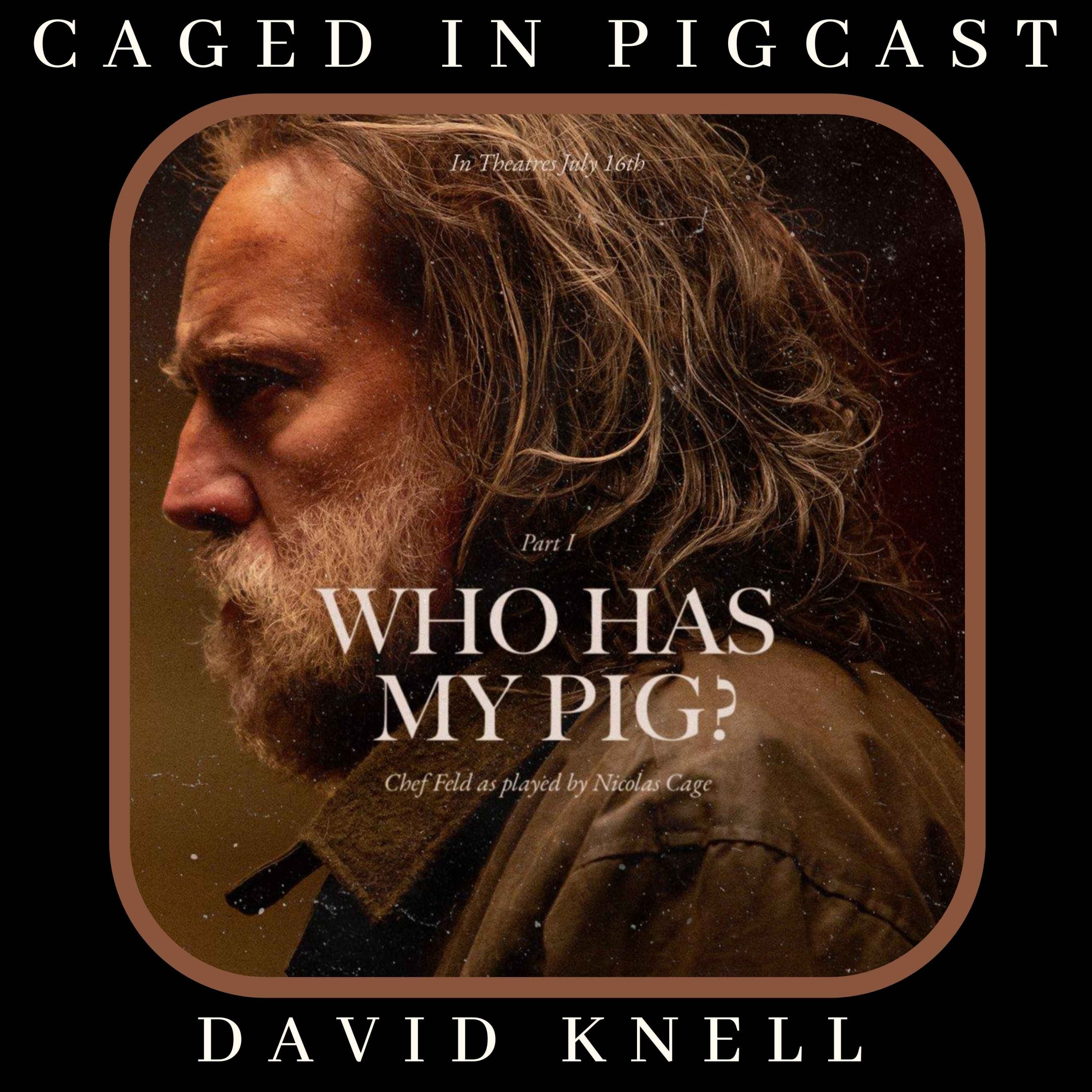
Hello and welcome to Cagedin Piggas, the companion podcast to the new Nicolas Cage film Pig, where I will be talking to people in front of and behind the camera all about the making of this movie and get a bit deeper into the characters and the stories behind everything. Today I have the absolute pleasure of being joined by David Nell. We talk all about his time on the film and the vital scene he has as Chef Finway. We talk about his time in Hollywood as well as how he deeply related not just to the character Chef Finway but also to the character of Rob.
If you haven't seen this film, it's best to watch it before you enjoy this conversation. It's currently playing in theatres in the US and will be released on the 20th August here in the UK. Hi I'm Chef Finway, welcome to your Riddity. Food is.
Really good. Well thank you, I'm so glad you're enjoying it. We heard there were some new truffles on the menu. Well we are planning a few truffled dishes for the winter menu.
It's a fascinating and expanding local industry with deep roots in old world traditions. Great. I'm looking for a truffle pig. I don't understand.
I just want to know about the pig. Tell me where you are. There you go. That confused voice you heard in that clip is today's guest David Nell.
How are you David? Great. How are you? You're from here.
I'm very well. First of all, massive congratulations on pig. How does it feel now you're the other side of it? It's very gratifying that it came out just the way that I was intending to do it which is its own thing there.
We shot this a year and a half ago, September of 2019, just in the before time, the long long ago. I was on my way back from an in keeping job that I was doing in Michigan 2,000 miles away and was literally on the road back driving across the country. I got a call from an agent saying, hey they're doing a movie in Portland. I went, cool.
I said, is there a David Nell part in it? They said yes. They were really right. Which is very cool.
Yeah, and just the whole process of doing this. It was over very quickly as many things are like this. I think even Adam Arkin who had a really key part in it, I think he probably only worked a couple of days on it too and we shot our entire thing in one day. So almost no prep time.
It's very cool and I'm very pleased that it came out as I intended. What are your thoughts on the reception? It's getting good. Of course the board, it seems like the reviews are phenomenal for it.
It's so gratifying and so rare. I mean, for me, it's like I've done just all kinds of things. I've been in the business off and on for nearly 40 years. I've done things where I've had leads in movies and not gotten any sort of feedback from it at all.
And a lot of stuff that I've watched and gone, it's just not very good to be a part of something that is not just popular because I don't know if this is popular yet. But genuinely good. It's so much of the stuff they're dealing with in the movie thematically is true of this. This is really this beautiful, beautiful meal that is kind of a once in a lifetime thing.
And it's just lovely. It's getting all the great responses. Everybody who worked on it is and I have some friends who have other parts in the film. It's like, yeah, we're part of this thing that we'll stick around and people will remember it and talk about it.
And that's just so nice. Are you a Portland native then? I grew up in New York City. And then when I was about 17, I went to Los Angeles and was there for some 35 years.
And which was about 25 years too long. And I had a pretty good career act, in the 80s. I did a bunch of things then. And then not so much.
And I was more and more disappointed with what kinds of things I was doing. Which is why I said, thematically, it's like I could be, there's a lot of been way in me emotionally, but also what Rob did. How he just kind of had it for big reasons. But I kind of went into the woods.
That's kind of where I am now. I actually live in the woods. And it's astonishingly beautiful. And you're the ocean.
And that's remarkable. The Oregon coast is just amazing. And it is thousands of miles away from LA and the movie scene. So it's just, yeah.
What were your first impressions when you read the script? Because obviously, the elevator picture of this, and it's kind of been seen online when the trailer first dropped off this kind of John Wick with a pig. Yeah, it's really tricky. Because it's a hard pitch.
Because I saw that as soon as the trailer dropped. Even before the trailer, as soon as it was mentioned, when Neon picked it up and said, hey, we picked up this movie. It's about Nicholas Cage loses his pig. And then you automatically go to all those places.
Ah, yeah. I want to say that. I want to say John Wick with a pig. And I love that all of the reviews are really encouraging you to see it, no matter what your preconception of it is.
And they're really, really very carefully saying this is not whatever you thought it was going to be. It is not that. And mostly they're saying it's better, which is great. But when I read the, you know, I mean, as an actor, I didn't get the script first.
I didn't get the concept first. I got here's, here's eight pages of dialogue. I'll go and figure out what you want to do with it. And you know, so I read this scene.
I read another one. No, I think pretty much everybody, all the actors in town who are between 40 and 60 were reading for Finway. And not just men. Men and women.
My wife, Julie Elizabeth Nell, who is also who is a marvelous actress, character actress, she read for Finway too. So you know, we knew that there could only be one and it was, it was going to be me. So but she would, I loved what she did with it too. It's a totally different thing because she does, she does some really interesting stuff too.
But you know, and there is one of the actors in the, in the film, Darius Pierce, who plays Edgar, you know, the guy who runs the fight club. He is, he has made, maybe my favorite actor ever until I worked with Nick and now, now I'm just in love with him. But, but Darius, I just love, I will, I would literally watch him read the phone book. He's done a one man show out in Portland, the Santa, Santa, Santa Land Diaries, which is a David Sederis, one person, Joe, and he's just amazing, just as such wonderful quirky stuff.
And I was convinced that he would get the part of Finway because honestly God, I would have cast him. And I didn't see him on the list of callbacks. And when I did get cast, I, I made sure I had a meeting with the, with, with Michael, the director before that, before actually working. And I told him I was, I was glad that didn't see Darius on there because I would have cast him and he said, Oh, no, we cast Darius.
He's like, Oh, good. Yeah, it's awesome. But yeah, when I, so when I got the, the, I said, I didn't get the whole script. I read my scene and it was just, you know, there's a, there's a thing that I always tell, uh, actors who are starting out that, that kind of the ideal is you want people to pick up a script or the casting people or anything and go through the script and go, Oh, that's the David Nilfart.
Especially if you happen to be David. And, you know, and that's, and I don't, I find it hard to sort of peg myself into what kinds of thing I can sort of see, you know, over the years, I look at stuff and I go, yeah, like, okay, like that, like, like, you know, the stuff I'm doing in Turner and Hooch, you know, I think I did with, with, with, with Tom Hanks, another, you know, one scene in a movie. It's kind of this, but, but just funny, you know, right? So that's just the funny.
So I got sort of the thing that I, I'm particularly narrowly, uh, when I do, right? Yeah, whatever that is. But this was just had kind of everything that I knew all the tools that I could bring into this. And, and the cool thing was, I, I think that there have been parts that I've done in the past where I auditioned really well and I had a lot of ideas for things that I wanted to do.
And then when I got cast and the rubber hit the road and I was, I chickened out a little bit, like I didn't do quite the, the, the interesting things that I maybe had for the audition because I thought it was too much. You know, um, I've got several, you know, movie things like that, where I just, I can just see that I'm just really kind of keeping it boxed in. And something like this, if it was literally anybody except Nick List Cage, then I could have shown up on the set and done, you know, the thing that I did in this. And I could see a scenario where, you know, if that was De Niro in that part, I could totally see him turning to the director and going, is that what he's fucking gonna do?
Like, is he gonna do so? And then like, okay, let's bring it down. Right? Like, you know, and then being really intimidated about like, oh, how much?
Because I auditioned one way, but I don't know if it's, if it's appropriate to bring all of the, you know, I mean, I just layered all kinds of stuff into somebody, somebody just tweeted out. I love this. They said something about like, like in one moment, I had like 10 emotions at once and all of them are awkward. I was like, excellent.
I love that. Um, you know, so, and the other thing is when you, when you work on a movie, if you're working for any length of time, let me back up. If this was a theater piece, you'd have weeks and weeks of rehearsal and you'd have all the time to feel out the other actors and to try out things, experiment and, you know, and see how it goes and see what works and see what plays with the other people. This is one day, right?
So this was just hit the round running and, you know, hope for the best. And you know, and I had no, I also had no idea what Nick was going to bring to this performance. You know, I, I'm not, I am, I am now an unequivocal, almost a word, Nick Cage fan. I saw just before doing this, I literally before I literally googled, what is it like to work with Nicholas Kage because I had no idea where's he going to be?
What does he cover me? Is he, you know, I didn't know if he was going to be somebody who is, you know, a loof or arrogant or an asshole or you don't know, you don't know. And I saw an interview with Elijah Wood, which is, I did kind of a buddy cop movie with, and he said he talked about it just being a surreal experience about how you would just be watching him do things and how he will just take a line reading and just take it in some unexpected direction, just to kind of mix it up and not let it be a standard line reading. So, so I kind of thought, well, good.
That kind of gives me the opportunity to do kind of the same thing, you know, to kind of meet him at that and to not do, not to do what would might be expected. But to really, you know, and the other, the other element of that is that Michael's script is so beautifully written. If you ever get a chance to actually read the sweeping play, do it. It is just just a beautifully, beautifully written, written, all the descriptions of the moments of the scenes, of the characters of moments that the characters have.
I mean, you know, the things that I was doing were all written in the script very specifically. I mean, Finway is described as looking vaguely like, I think it was like vaguely reminiscent of a ventriloquist dummy is the way he's described it. I was like, wow, that's an interesting, you know, like, like, and then what does that mean? How do you, how do you portray that?
Which is that kind of God? Okay, he's putting on, he's entertaining. He's putting on a show. He's being, you know, and it's like when he walks out, it, you can almost hear the strings rattling and you don't actually see me walk out.
But there was, but so that like informed what I was going to do with stuff. And it's like, this is, you know, okay. And there's a moment when he kind of describes the breakdown that Finway has with, as, you know, as Robin is, is literally deconstructing it, which I love that metaphor that he's, so they're eating, was it a deconstructed scallop or something? Yeah, a pine coat mister or something.
And which is all real stuff. That is real food discussions of things. And I did. Wow.
And, you know, so, so the fact that Robin is just taking him apart and that he's twig, it's so quietly. It's, it's so great. You know, how was it like kind of, I'm not sure like not having this preconceived notion of Nick Cage, but obviously like, he will do what he wants. And then obviously in this film, as it's been remarked a lot in the press and obviously somebody who's a big fan of Nick Cage's days, it feels like a tote like a performance we don't see from often.
So was it was it a shot? I know. It quite quiet and preserved. It was.
Yes, because that was what I what I had. Okay. So several things that I saw before that in my in my prep work where was I watched a couple of videos. There's one of those is a GQ or bad vanity fair where actors go and like talk about their roles over the years.
Yeah. And I watch he has like half an hour long of him talking about everything that he did, everything that he's done. And I do to Peggy Sue got married and which I remember watching and going, what the hell is he doing? He's doing this strange voice.
And and I heard the story that you know, Kathleen Turner when he did that was expecting to see the guy who she saw in birdie, you know, which was another one of those kind of under plate things. And which I auditioned for it, but I was the back there for the Matthew Moody part. Yeah, my friend Vincent Spano and I were both read where we grew up together and so it would be great for you to live. But yeah, so I auditioned for that film, but digress.
So Kathleen Turner is expecting that actor that perform. And he tells the story Nick does in this GQ thing about how, you know, his uncle Francis word, Cobala says Nick, you should do this movie because I don't know if it's the kind of thing I don't really interested in uncle. It's not the kind of thing that I want to do more interesting more thing. He says come on, you can do it.
He says, I don't know. And he says, I'll do it if I can do it using the voice of Pokey from the gumbi cartoon. It's literally what he said. And he admits that.
And he said, and Cobala said, yeah, okay, we'll try that. So that's what he's doing. He's actually doing the voice of Pokey from the end. And you know, he has always really tried to shake up himself in a way that I was never brave enough to do.
That's what I was talking about all my stuff, early stuff, tend to be very low key because I never was brave enough to actually literally do that kind of shit on camera. And he did. And sometimes, you know, to my thing, it was spectacularly wrong. But God bless him for making that that choice.
And so he does those things. He does these really big things. But he was the thing that I really discovered from watching that thing is that every choice that he makes is absolutely earnest. And it's absolutely done with a real dedication to his craft.
And he's never being frivolous when he makes a choice. Even if it's what appears to be a big goofy thing, he's doing that really deliberately and on purpose. And I really respect that. And one of my favorite performances when I was a teenager before that was George C.
Scott in Dr. Strangelove. And up until then, he had only done, you know, he played Patton. He played Sherlock Holmes.
He's doing really serious stuff. And he played this really broad, really comedic, really just way, way, way huger than reality. And it completely works within the context of that movie. And I was always in awe of how he could do that, how he could make those kind of big choices and do that sort of thing.
And Nick is, by far, over his career, just taking those things and done huge things. And then not always. You know, sometimes he will do these things that are just really genuine and really tight and introspective. And, you know, leaving Las Vegas, because he'll be immediately and I think like a modern film that very much encapsulate has almost like the same spirit as Pig is Joe, the David Gordon Green film from 2013, which is another kind of like Nick Cage.
I need to see that. I haven't seen that. I've heard that. They would make a fantastic like double build.
Yeah. Nick Cage beaded in the woods kind of. Right. Yeah.
So yeah, I want to know I'm interested in anything. Because my Netflix queue is all filled with. So the other, and there was also one of the other things that my research was that great SNL thing where I forget who it was, is Adam Sandberg, who used to do a Nick Cage interviewing actors and that he's interviewing himself. He's interviewing Nick Cage.
And the thing he says is like the hallmarks of a Nick Cage action film. One, every line is either whispered or screamed. And two, everything's on fire. And so, so bringing all that around too, I made sure that I had a meeting with Michael before I actually showed up on set because I didn't want to have that moment where I go, oh, I'm doing this big crazy thing or whatever it is that.
And then, and he's not doing that or he's going to, you know, or I'm going to be intimidated and he's going to, and I'm going to have to dial it back. And it's like, okay, so I want to give you the performance that I gave you in the audition. I want to make sure I have your permission to go as far as I possibly can. If that's what you want.
And, and he told me, he said, no, Nick is actually, he's been very respectful. He's not, he's not a diva at all. He's just, he's supportive. He is collaborative and I went, well, great.
Okay. And when we actually got to the set that morning, you know, we're first time, I'm in costume, he's already in costume. He's already fully made up. So this is my only time I see him is when he looks, you know, like he's just been through a several bar fights and things.
And, and so we sat down to do the scene and Michael said, let's not do a performance. We're just going to run through just the lines. And, but I knew that, well, no, I can't just run lines. I have to, I have to show him what I'm about to get us into here.
So I did, I did the performance like just, just as, you know, as full as I was going to, just in the rehearsal. But it was so great because Nick kind of just leaned back. And the first of all, that was the first time I heard it before him. I realized, oh, I'm doing all of this.
He is whispering. He's doing the thing. He's just, yeah. Where's my pig Derek?
And, you know, even when I was auditioning and Julie, my wife was reading the lines with me, you know, she's doing, where's my pig? You know, it never does that. And it was just like, and I thought, wow, this is going to be really interesting because, you know, I'm texting occasionally. I said, the irony of this is that I'm literally nose to nose with Nick Cage and I'm the one who's overacting.
Right. Just like, this is, this is surreal. And but I did the, see, we did the first take and he kind of leaned back and he went, all right. Okay.
And it just felt like, oh, good. Okay. This is on now. And then it was, then it was just, you know, like, like a day of tangoing with a master.
It was just beautiful. What, just, you know, what was the atmosphere like on that day? Like, because I know that there's been a lot of stuff and I know that Nick and Alex got on like really well, I think Alex kind of stated that, well, it's like a master class for him. Yeah.
It was great. It was, it was, well, I could tell, and this was very gratifying that just from that first, you know, I could tell that the two of them had a bond already. You know, they've been working together. I don't know how long they've been shooting.
I don't know how long they shoot with. I imagine it's short. I think it was only about three weeks for the whole thing. And they had clearly, they were, they were really bonding very nicely.
And that was, you know, and I'm only there for one day. So it's not like I'm going to be included in that. But I kind of was, which was really great. It was like, once we did that first rehearsal, I think it was like, okay, you can be in this club, which felt awesome.
They had like a little tiny room the way, the back of the restaurant where there was just the two of them hanging out, but it was the three of us hanging out. It was nice. It was like, you know, so that felt very good. You know, it just, so the, and I've heard different people who worked on the film, which the premiere the other day, so I had people who said, including Alex said that particular day was just a magic day for everybody, which is great, you know, just that it was just this that was very surreal and ethereal and, and you know, so the stuff I was going through, it seems like a lot of people were experiencing that being there, which is really sweet.
It very much feels like a very special scene as well, like watching the film, it kind of sits perfectly in the middle of it. And it's kind of, it's the centerpiece to this kind of whole thing. And it's, as you said, you got to tango with an arcade and almost like, as you say, out, not out acting, but like do the kind of like the more wild, like, actually, off the walk kind of stuff. So what would you like, you might not have considered this, but what do you consider your character of Chef Finway took away and did after that conversation with Robin?
Well, that's, I got somebody, somebody tweeted the other day. I hope Chef Finway opens his pub. You know, that's the thing that that's what those who haven't seen it, Robin, just completely takes down my character, Chef Finway, who was, you know, like the top chef in Portland, but, but clearly has sold out in order to do this thing and to be doing very popular, he's not doing the thing that he always wanted to do, which was open a pub. And, and how he just takes him apart like that is just, is just great.
But, you know, there's a lot of people have talked about, a lot of times in reviews, people will imagine stuff like, like, like, oh, well, Nick must have been thinking, well, this is very much like my career and stuff like whether or not that's true. You know, you kind of, you kind of think, well, surely he must be thinking like this is a, he took this on because it was a commentary about selling out in Hollywood and like that. It's like, no, I think it took it on because it was very script. And yes, that's also, the rest of it's also maybe true.
But, you know, a lot of stuff that I brought to it kind of emotionally was, you know, I said my own stuff with my own career, you know, I also wanted to be, you know, there was a point early on where like, you know, Nick and I were going out for the same auditions, you know, so, you know, and he took off and thing and my career just didn't for all the reasons that things happened, you know. And so, so there's so much in this, in this, in the character in the performance that I'm able to just kind of go, ah, you know, just bringing stuff to it that it's like, yeah, no, I can totally relate to what's going on with him and that. And it's great to be able to, you know, have those tools in my little, my little actor box that I can do and go hear this and, and like that. So, you know, yeah, I love the idea of that, that Finway now goes, you know, well, what am I doing?
What am I doing? What am I doing? I'm doing cooking this stuff because it just, because it just, because it just, he's so, you know, the writing and what Nick and what Robin do to him is just, just quietly, just, you know. Do they sort of write them right?
Yeah, but in such a, such a beautiful way, you know, he's not, he's not being mean about, you know, he just completely takes my part, but it's really, you know, what are you doing with your life, man? It's just really what you know, it's not what you want because I don't, and the fact that he remembers that from 15 years ago, that he remembers what, you know, what their dreams are. And you see the moment in there where, where, where, where, where, where, like just goes, no, I don't know. I don't, was that really?
That was a long time. No, I don't remember ever having that dream. He clearly does. And when he, and he asked him what his signature dish is, and it's just like right there and a little too loud and he just cracks, he just breaks at that point.
And it's like, you know, that's, and that's all just, and was so beautifully written. And so, you know, that, that, that, that kind of, that delivery that, when you kind of spit out what the signature dish is, was that on the page or was that something that you found like working on that scene. I want to say it was on the page and I just understood it immediately. But I don't know.
It was just something about it that the, the fact that he comes up with that thing so, and it's so specific what that thing is. You asked him what was, what was your signature dish without a thought? He says, liver was liver Scott Jaggs with a honey curry mustard and says it a little too loud and he's trying to, he's also the levels of he's having this conversation and he's surrounded by, by people who are, you know, in awe of him and he's being taken down and he's just can't, you know, he's trying to deal with all the levels of humiliation and embarrassment and memory and everything else. And just when that comes out, it's just, like, ha, ha, ha, ha, ha, ha.
But that's always, that, that is always thinking of that moment. Or that is something that I've always loved, that I always loved when you see it happen. And I've always is inspired to have that kind of moment, which is to be able to get people laughing at you and then completely knock knock their feet out from under them and make them feel bad for having laughed at. Yeah.
It's got an uncomfortable feeling to that scene, but like totally deserved because it makes you question yourself. Do you know what I mean for that moment again? Am I doing really what I want to be doing? Like just the way that in mixed delivery and the kind of the words that Michael has written, like they're just kind of really, that's what I mean.
That's why that scene for me very much. It has like the mission statement almost of what this film is about. Sure. And I think it's also a really big thing that a lot of people have been feeling lately, you know, that the whole pandemic thing has forced people to start really maybe uncomfortably looking at what they've been doing.
You know, reading a lot of things about like people are not wanting to go back to work. And it's not because they're getting more money from unemployment, but because it's like, why the hell were they doing this for the last 10 or 20 or 30 years at all? You know, and that's it. That is an uncomfortable question to ask, you know, and people who have been saving up for, you know, like saving up a retirement or something and then you get there and you go.
That was it. That was what I did. I spent my whole life working and trying to do this thing, you know, whatever it is. You're just spending your whole life trying to make money so that you can.
And then going, why did I? Why did you really? There was something that I want to be a cowboy at some point. I think it's like, yeah, yeah.
Well, why not an astronaut? Why did Jeff Bezos get to go into space? Yeah, right. So yeah, so I love that that it's.
You know, that it just strikes really deep emotional cords that get people going. And maybe thinking, you know, it's like it's nice. You know, Nick does a lot of stuff that's entertainment. And I don't mean to make that ever pain meant like that, but I've done things, you know, I've done movies that people enjoy, you know, and that I don't understand.
But that's my own personal thing with my own attachments to, you know, spring break was a movie that I did in the early 80s that I had the lead in. And it was like, I just don't like that. And total recall, the Schwarzenegger thing. You know, I have a small part of that.
Yeah, you got to tranquilize him, right? I give him the memory implant and I also give away the ending of the movie. You know, I say, you know, with a little cartridge that I've got to look at it. Oh, blue sky on Mars.
That's a new thing. You know, and it was fun working. It was a week's work on. And I know people who just love that movie.
And, you know, a few years ago, I was working, I had a day job for five minutes. And there was a guy who said, I love that movie. And I sat him down and I said, why? I don't tell me explain me why you like this movie.
And he did. And I went, Oh, oh, yeah, okay. No, I get it. You know, I mean, I have, you know, I have movies that I enjoy that I think that, you know, other people probably don't and I don't care.
I like, you know, booty tang is one of my favorite movies. And it's like, you know, with with Chris Rock and and Louis C. K directed. And it's just this weird little movie.
It's like this sort and I think it's great. And many people will say I'm wrong. Okay. But I get having a, you know, a movie that you think that that only you like.
And that's another thing about this one is one of the things I'm getting from a lot of the reviews is a lot of people think nobody else is going to get this movie. But you know, I completely get this movie and you should see it anyway. But most people aren't even going to get it. It's like that idea that you can have like a movie that is so personal that you think is yours alone.
Yeah. I think that is very much. I think that is saying special. What was it like working with Michael?
Plus he's the first time director and like, was it he was great? He was, you know, and he'd written this. But he had he and Vanessa block it written this piece that I said was just beautiful. And I got to read it.
But this is this is really like special and interesting. And, you know, he got the right people to work with him on it. And, you know, I said when I met with him, I just said, look, I just want to, I want to give you every version and possibility for you to pull from, you know, and then he was totally there with that, which was great. And, you know, so and he's been real supportive ever since.
I mean, he's been really great that he just, he was thrilled with what I did, which is nice. And we go, okay, well, go ahead. What was it like on that day with like what was this kind of direction style? Like, is it kind of, well, let's just go again or is there specific things he are pretty much, he gave me some specific things because I'd asked him to do.
I said, if there's anything, if you need things to be, you know, it could be technical things, you know, make that a little faster or slower things. I was really interested in the fact that some of the takes that he used were like, there's one, I think that the first thing, there's a thing where I talk about Truffle hunting or something that, okay, yeah, the first question I think maybe in the clip that you actually did where he says, you know, Truffle dishes and I did sort of a mini monologue about the Truffle industry. And I can hear in my voice that that that was an earlier take and I didn't really have my lines down. So I can hear myself from from only my perspective that I sound to me in that line like I didn't know what my line was.
And of course, that's not something that anybody else is going to get, except, you know, while you're listening, so we'll go back and look and go. Oh, yeah, lucky. There's a moment in the film that, yeah, I discuss with Brett Buckman, the editor, who's that moment where Alex is in the mirror kind of giving himself a pep talk, it very much speaks to your point of the interesting takes because I think it's very interesting using that earlier take of chef in way kind of, yeah, not quite, I don't know, yeah, not quite delivering it like work for work. There's that moment with Alex in the mirror and he kind of like, it's actually Alex breaking because he like, stop a line and then just goes back into it and said something.
Yeah, which is great. That fits a me because it's like, he's like, I need to jump back into this pep talk being like, you're the man, you've got it. Right. Yeah, if I think it very much.
And I got that and I totally, I saw it, the, the, the, the fiddway line that I look, you know, like, like that was a line because there were a couple of lines that, that I thought needed to be sort of like, well, this is something I've said before and I kind of say often. So it's just going to be sort of, you know, spitting it off like, Oh, well, we do we have this or what's our winter menu is, but I'm like, and, and that he didn't always go with that. And I think with the more halting sort of things that, that, which I thought was a great and interesting choice and that he thought that like there was, you know, that quality that, that is me not knowing where I am in the moment, which, you know, like it's happening right now. But that kind of thing, but he thought, no, that's perfect for a fiddway.
I was like, great. Okay. Cool. So I love that.
I love his choices and that was what I said. That's what I wanted to just give him a range of stuff. I'd heard many years ago, Helen Hunt, who was a friend of mine years ago, did as good as it gets with with with Jack Nicholson, for which he went on Oscar, which was awesome. But she said working with Jack Nicholson was it's not like doing a play.
It's not like he has all of his lines and is doing the thing. It was like he would do a line and he would stop and he'd make a face and he would come back and he would do it again. He would stop and do with that in the next line and do things and he would just, you know, move around. He would just, you know, find different ways to get that line out in a lot of different ways.
So he gives the editor so much choice, but it's not a straight, you know, it's not like a monologue will consist of bits and pieces from 10 different versions and which is a beautiful thing about when you're doing film and it's great to be able to because I also edit as well in another life and it's great to be able to go this bit from there and that bit from there and now, you know, helps sort of sculpt the performance out of it. So, so I love how he did that with with with with this movie. He took all these little great bits and you know, his choice to have to have Adam Arkin's character Darius at the end. He's got that great line before he says, you go find yourself another pig and you're looking at the back of his head, you know, and it's just like, wow, that's just and it's so powerful because it could have been something that could have been like in a close up and you would have just just owned that moment, but you don't see him and it's so terrifying and powerful and it's like just making those kind of choices is just so great.
So Michael Sarnas. But before I let you go, you obviously said you went to the premiere and you said you also went to like a cruise screening with the film. What was that experience? Like what's the kind of atmosphere for everyone who worked on it?
Like a buzz about the film? It was it was great fun. It was good fun to see the at the premiere, you know, and I went my wife Julie was working in last working up here in Portland. She was doing a film, so she didn't get to come with me there.
So I had a surrogate Julie with me and and and and Gary as a peerist was not going to premiere. He was on a road trip with his family at the time and he texted me and said, are you going to the LA premiere? Should I go? I said, I'm on a road trip.
I said, you should totally go because I thought it'll be someone else I can kind of hang on to and go here. But so we were kind of sitting there in the theater and just watching, you know, for the first time with an audience is always kind of surreal experience, but it was great to see, you know, like when people got to my scene and people are laughing at all the right places, some that I wasn't and having that reaction. It's great. That's, you know, that's the part of what you're doing.
The theater versus doing stage, you know, theater, the audience is there with you and you're playing all the dance that happens is with your fellow actors on stage, but also with the audience and you don't get that move. You do your thing. One day it worked and then people are watching it for the rest of your life and saying, oh, I love that thing. And he goes, okay, thanks.
It was, I don't, I barely remember that one. But so it's nice to do that. And then the next night, you know, I flew up the next day with Dr. Portland with Michael and Vanessa and went to the cruise screening.
So I was so, Julie got to be there for that. And that was a different feel to it. So that was for the people in the audience there. It was like a family review.
Everybody had this intense experience together and now we all got to enjoy it. And so I got to watch it again and still like appreciate the audience reaction. But also just to, you know, the first night I was in a bit of a font because, you know, it was a big deal. This one felt a lot more casual and I could just, okay, good.
No, I can just appreciate it and watch the film for itself. And my God, it's a lovely little film. Yeah. It's great.
And I said, like, I said throughout this conversation, I very much think the senior in and you especially very vital to make this kind of like a very special film. It feels like, yeah, I'm going to be beating the drum, like, to tell people to watch it because it's that thing you can't argue with the reviewers or the game. It's not what you expect. Like it's like, it almost feels like you shouldn't have to be saying to people like, this is actually good.
It's like, you know, so watch the trailer. It's kind of like, and one of the thing. What's cool is that people, even if they, they have the wrong intention on it, they still think it's going to be good, which is nice. So you're not having to convince people to go to theaters.
It's like, people think that like, oh, I'm definitely going to go see that. And then it's something else and people still kind of appreciate it. For the most part, if you look at like the, the, the, the Rotten Tomatoes, things you've got the user reviews and those are all people who are just downloading pirated copies of the movies and they're wrong. But, yeah, people are watching going, what was that?
Nothing happened. He's looking for a pig. He doesn't quite a pig. He goes on.
Amazing. That feels like a perfect place to end the conversation. Thank you so much for coming. You're so welcome.
Thank you so much for listening. And if this is your first time to the podcast, please do check out my back episodes where I look at all the Nick Cage films as well as starting to look at the films of the wider Copa family. I assure you, it's lots of fun and there's plenty more interesting conversations like this. You also spoke to Brett Buckman, the editor of Pig and He Can Colour Out Space.
That was the last interview episode I did. So please do check that one out. And if you enjoyed the podcast, please don't hesitate to rate, review and subscribe on Apple Podcasts, Acast or wherever you're listening to this podcast right now. This podcast is presented by the Brett Crumbs Collective, home of the Podge Hall Santa Cast, caged in Copa Connections, the Triptone Limerick Main, franchise and Mini-Mordacom.
Our shows are all presented ad-free and made possible by listeners like you. Please support our shows by subscribing, leaving ratings and reviews and becoming patrons at patreon.com. If you'd like to learn more about Brett Crumbs, head over to BrettcrumbsCollective.com. Brett Crumbs is more than a podcast network.
It's family.