
EPISODE · Jul 30, 2026 · 38 MIN
Can Quarter-Acre Trials Guide Whole Farms?
from Red Dirt Agronomy Podcast · host Dave Deken, Brian Arnall Ph.D., Josh Lofton Ph.D.
A new farming practice should earn a producer’s confidence before it is trusted with an entire field. Oklahoma State University Extension specialists Brian Arnall, Ph.D., and Josh Lofton, Ph.D., explain how small-plot research becomes practical agronomic guidance for Oklahoma producers. They discuss replication, field variability, statistical confidence, and the steps researchers take before recommending changes involving nitrogen, plant population, varieties, or other crop-management decisions. They also explain why on-farm cooperators and producer-run trials are critical for testing whether research results hold up under commercial conditions. Key takeaways: Small plots help researchers isolate treatment effects by reducing differences in soil, rainfall, pests and field management. A large field demonstration may look convincing, but without replication it can be difficult to separate a treatment response from normal field variability. Results should usually be repeated across multiple years, locations, soil types and weather conditions before becoming a broad recommendation. Researchers may require greater confidence when a recommendation would significantly change established practices or put a producer’s return on investment at risk. Producers can manage adoption risk by testing a new practice on a few strips or limited acres before applying it across the operation. Detailed Timestamped Rundown: 00:00–02:13 — Episode introduction and research question Dave Deken introduces the discussion of “big science on small acres” and previews how small-plot trials become real-world recommendations. Brian Arnall and Josh Lofton are introduced along with their OSU Extension roles.02:16–05:09 — Why researchers use small plots Arnall explains that an entire trial may fit within roughly a quarter acre. The smaller area allows researchers to keep treatments on similar soil and under comparable rainfall, pest pressure and environmental conditions. Small plots also make it possible to test many treatments with several replications.05:09–08:19 — Matching plot size to field variability Lofton explains that researchers must decide whether to minimize variability with smaller plots or include more variability within longer plots. Forage research may require longer plots, while detailed plant-physiology questions may be studied in one-foot-by-one-foot microplots.08:21–10:14 — Demonstrations versus replicated science Large demonstrations can show whether a practice appears workable across several acres, but they may not provide strong scientific evidence without replication. Researchers are cautious about using a producer’s land for an idea that may reduce yield or profitability.10:14–13:26 — Testing across years and environments A practice that works repeatedly near Stillwater may respond differently in western Oklahoma’s sandy soils or the wetter, heavier soils of northeastern Oklahoma. Researchers distinguish between an observation, a tentative practice to try and a formal recommendation.13:26–16:19 — Blocking, variety trials and experimental tradeoffs Lofton describes how treatments are grouped into blocks so each treatment experiences a comparable environment. Trials containing too many varieties can stretch across changing soils and conditions, so researchers may divide varieties into separate maturity groups.16:19–19:15 — Statistical error and recommendation risk The group discusses the possibility of concluding that a treatment works when it does not, or concluding that it does not work when it actually does. Arnall emphasizes the risk of recommending a product or practice that fails to produce a dependable return.19:15–22:10 — Why confidence standards can change Lofton and Arnall discuss the difference between 90% and 95% confidence. The appropriate threshold depends on the research question, the quality of the field conditions and the consequences of being wrong. Major changes to accepted practices demand stronger evidence.22:10–24:22 — Evidence behind major management changes The speakers compare agricultural risk with the much higher certainty required in medicine and engineering. Arnall says he had approximately six years of data before becoming highly vocal about delaying some nitrogen applications.24:22–26:54 — Challenging assumptions and explaining mechanisms Researchers do not rely on statistics alone. They ask whether a result makes biological and agronomic sense, discuss it with colleagues and collect additional plant or soil measurements to explain why it occurred.26:54–29:44 — Scientific disagreement strengthens recommendations Arnall and Lofton explain that members of the research team frequently disagree about mechanisms and interpretations. Those arguments continue until the data support a consistent OSU recommendation. Repeating work with different students or projects can provide additional confirmation.29:46–32:10 — Moving research into producer fields The discussion returns to the progression from controlled plots to practical use. Some practices move into formal demonstrations, while others are tested through a few producer-applied passes or strips. Starting with a limited area gives producers a way to evaluate an unfamiliar practice without risking the whole operation.32:10–34:31 — Why farmer-hosted small plots matter Arnall emphasizes that many small plots are located on commercial farms rather than research stations. These sites provide different soils, management histories and production environments, although the plots can create extra work for the cooperating producer.34:31–35:30 — Helping producers become experimenters Lofton describes producers who begin with one research project and then start conducting their own field demonstrations. County Extension educators can help producers establish useful comparisons and interpret the results.35:30–37:20 — Building a statewide cooperator network Arnall discusses working with different groups of cooperators over time and matching projects with farms that provide the appropriate crop, soil, management system and region. This network improves the relevance of OSU agronomy research.37:20–38:22 — Closing thoughts The episode concludes with appreciation for producer cooperators and an invitation for listeners to visit Red Dirt Agronomy, submit questions and learn more about the research discussed on the program. RedDirtAgronomy.com
Embed this episode
What this episode covers
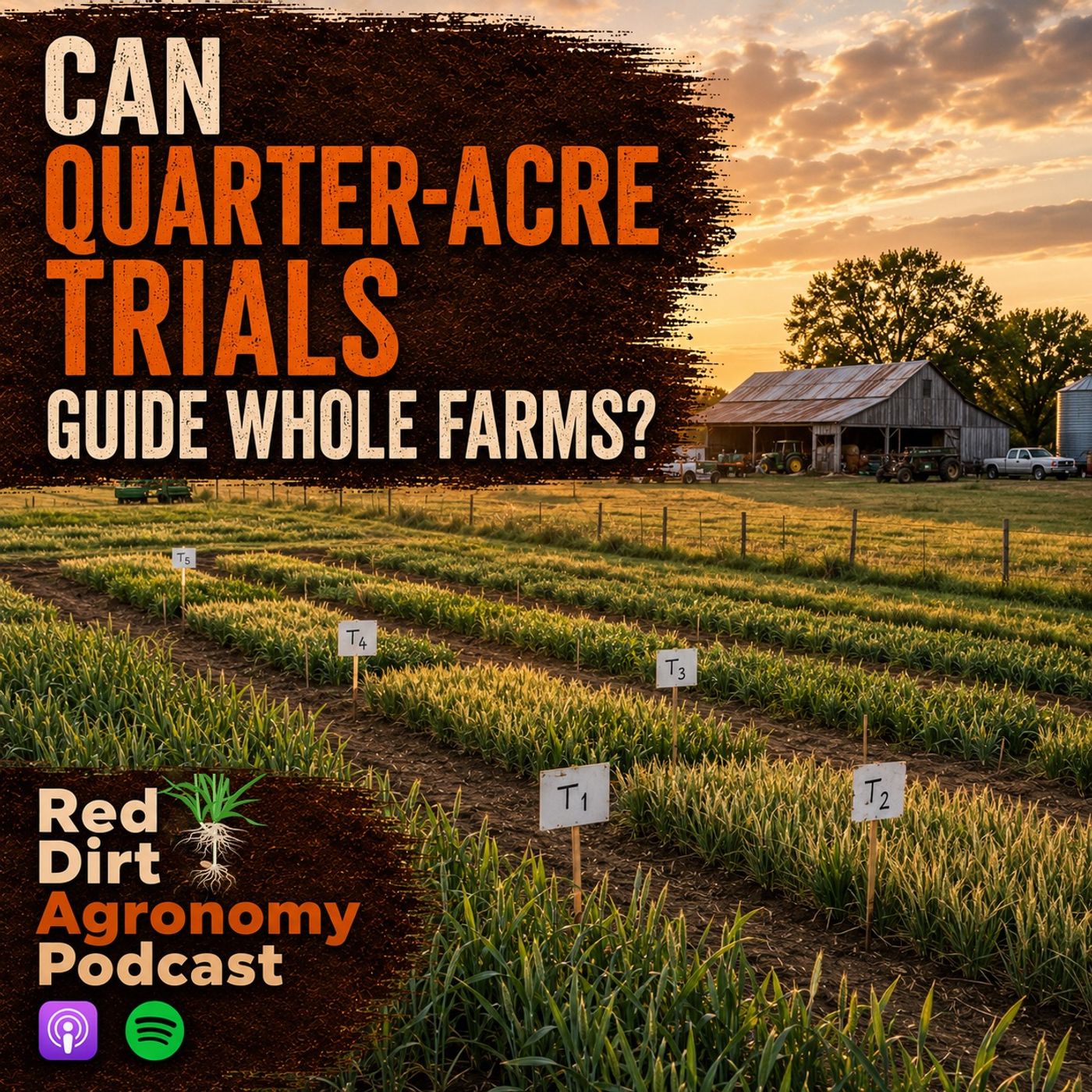
How can research conducted on a fraction of an acre produce recommendations for an entire farming operation? In this episode of the Red Dirt Agronomy podcast, Oklahoma State University Extension specialists Brian Arnall Ph.D. and Josh Lofton Ph.D. explain why small-plot research remains one of the most important tools in agricultural science. Small plots allow researchers to control soil, rainfall, pests and other variables while repeating treatments enough times to determine whether a result is dependable or simply field variation. The conversation follows an idea from its earliest controlled trial through multi-year testing, larger demonstrations and eventual use on commercial farms. Arnall and Lofton also discuss statistical confidence, the financial consequences of a poor recommendation and why an isolated yield response is not enough to justify changing a producer’s management program. The researchers emphasize that producer cooperators are essential. On-farm trials expose practices to different soils, weather patterns and management systems while giving farmers a way to test a recommendation on limited acres before adopting it across an operation. The main message is practical: research should not simply show that something worked. It should help producers understand where it works, why it works, when it may fail and whether the likely return justifies the risk.
Ready to play
Can Quarter-Acre Trials Guide Whole Farms?
No transcript for this episode yet
Similar Episodes
Dec 17, 2025 ·30m
Dec 11, 2025 ·26m