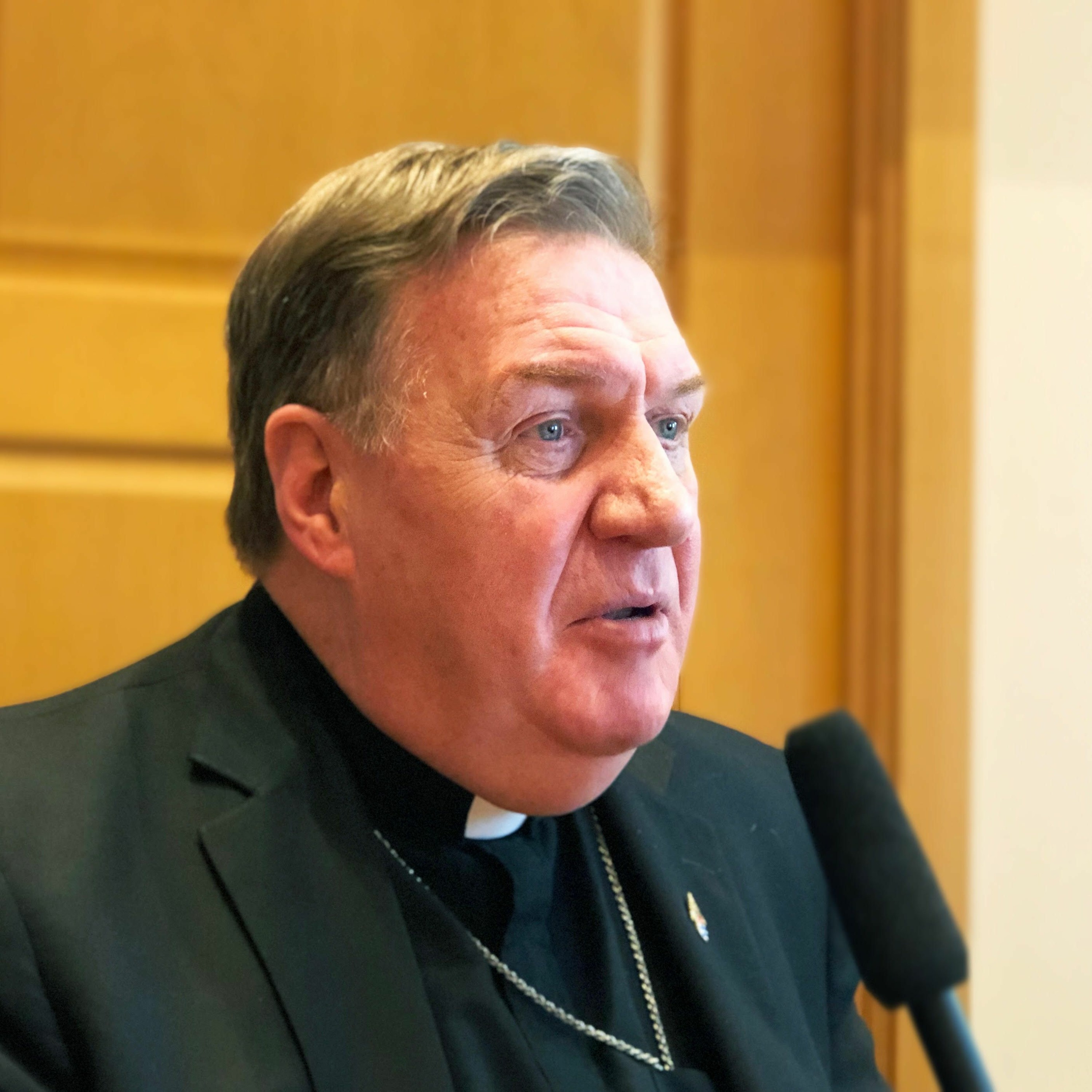
Hello and welcome to CMS On Air, the podcast on migration and refugee issues brought to you by the Center for Migration Studies of New York. I'm H.O.A.S., CMS's Director of Communications. In this episode, we speak with his eminence Joseph William Cardinal Tobey, Archbishop of the Archivistic's of New York, New Jersey. Ordained in 1978, Cardinal Tobey served as a pastor and Holy Redeemer parish in his hometown of Detroit, Michigan until 1990.
Throughout much of his career, he served in a number of positions within the Redemptorist congregation, including as the Superior General of the Redemptorist in Rome. In 2012, Pope Benedict appointed Cardinal Tobey as the sixth Archbishop of Indianapolis. Then in 2016, Pope Francis elevated him to the College of Cardinals and appointed him as the Archbishop of the Archdiocese of New York. Cardinal Tobey has supported migrants and refugees, accompanying immigrants to deportation hearings and speaking out against unjust immigration policies.
In 2015, as Archbishop of Indianapolis, he famously directed Catholic Charities of Indianapolis to resettle a Syrian refugee family in the Archdiocese, against the wishes of the then-Indiana Governor and now Vice President Mike Pence. In this interview with CMS's Executive Director, Donald Kerwin, Cardinal Tobey discusses Catholic teaching on immigrants and refugees, developments in immigration and refugee policy, ideological polarization surrounding immigration in the United States, the provision of sanctuary to migrants, and how faith communities can become more involved on immigration issues. And now here's our interview with Cardinal Tobey. So your eminence, you've been a strong steadfast supporter of migrants and refugees, and I wonder if you could tell us a bit about your family's own immigrant history and how that's impacted your view of migrants and your work with migrants today.
Well, on both sides of my family, I'm descended from Irish immigrants. The most immediate contact, my paternal grandmother, Molly Sullivan, Tobey, who came from Connie Kerry. And I was thinking of her recently because she came over in the first part of the 20th century, a 17-year-old girl on the boat, and she made some friends when she was crossing the Atlantic. And there were two Irish girls with her.
They went to work for a rather wealthy family in Hianna Sport, Massachusetts. And in 1960, one of the first times I ever watched television was to watch John F. Kennedy accept the Democratic nomination in the Chicago. I think I was eight years old.
And I recall afterward my dad wanting to put up an image of John Kennedy, like everybody else not only on the block, but in the neighborhood. My grandparents as well. My grandmother wouldn't permit it because she said that the two girls she came over with later reported to her that the old man had abused the mates. And her point was always made very markedly.
He forgot where he came from. And I think this question has made me remember where I came from. And that's simply the emerald aisle. My grandmother came over when she was 17.
She went back when she was 75. Even though my dad and my uncles would often put together some money and say, why don't you let us pay your way back? And she would reply, all I knew there was poverty. You go back.
So it wasn't some sort of whim that brought her to the United States. She was fleeing a very difficult existence. It kind of segues nicely into my second question, which has to do with immigrants that come to work, come from Detroit. Your mom lives in Ontario now, but you had close ties coming up with organized labor and you have had for many years.
I wonder if you could speak on the importance of the labor movement itself to immigrant workers, both historically and at present in the role of the church in facilitating that and supporting immigrant laborers. You know, there are caricatures of the Irish politicians, but people forget where that came from. And it came out of the experience of the Irish taking the lowest paying jobs in New York, basically hauling the stuff out of outhouses overnight, the nightsoil, they called it euphemistically. Later using that experience to organize into unions, which eventually gave them a political base where their voice could be heard in the Big Apple.
I think this has been true for any number of unions, whether we're talking about coal miners in Pennsylvania or auto workers in Detroit, or people who came to harvest the crops. I worked as a young priest rather closely with the United Farm Workers and says, Chavez, they had no one speaking for them except for their union. And I think that this is also true here in the metropolitan area, the service employees in the national union is made up of many locals of immigrants who have the lowest paying jobs in airports and in public buildings and the unions speak for them. I think because one of the principles of the labor movement is solidarity, it conjugates very well with the needs of immigrant workers.
I wonder if you think that there's a role for labor schools to actually come back and some of the work that say father Pete Kylie is doing in terms of promoting this ministry among particular priests, the old labor priests of the 1950s and 60s. I've heard Rich Trumka, we hosted him here at Seton Hall last month, say that labor unions have to make sure that they're true to their own principles, especially the leadership, and that they don't get too removed. Francis says that bishops and priests should smell like the sheep. I think he would say the same thing to labor union leaders, that they can't be removed from the experience of the rank and file.
But having said that, I think that there's a sort of fragmenting force at work in society that deserves at least to be answered by principles such as solidarity and an inveterate respect for human dignity. And I simply individual rights, but the dignity of human beings is a collective. The church is sometimes criticized for not acknowledging the importance of the private sector to business leaders and creating jobs and more broadly and contributing to the common good. What is Catholics teaching state of business leaders in the private sector more broadly in terms of their contributions and their responsibilities?
I think if I understand the criticism done, the criticism comes from, I think, a mistaken identification with church teaching and a particular political or economic system. The Catholic Church in its social doctrine doesn't identify with any political system or any political or economic system. It does have some principles that it holds to be part of the divine revelation that we receive and we treasure and we share with others. So the four basic ones would be first the dignity of the human person before what they have or how they look, a human being has an inherent dignity, and we believe that that is a reflection of the divine reality.
Secondly, the notion of working together for the common good. Business people and church people and all are called because of our human nature, which is essentially a social nature, to work together for the good, especially for those who are underserved or less capable. And then the other principles would be the principles of subsidiarity and sense that we don't have one size fits all solution for everything and solidarity, which is I think Benedict the 16th said was everyone being concerned about everybody else. That's beautiful way to put it.
You're well known for having stood up to or maybe engaged with Governor Pence of Indiana when he was governor. When you brought in a Syrian family to be resettled in Indianapolis in 2016, the US is on a track to admit a record low number of refugees in the US. I think the ceiling is 45,000, but it looks like it's going to be around 20,000 for the year. What's your view of how this happened and how the administration is responding to the needs of refugees, of course, but how we can better advocate for a program that's been a round jewel of humanitarian programs and it's a life-saving program.
It's a life-saving program. Well, I think it's particularly appropriate you asking me that question because of a lady that resides within the archdiocese of Newark. And she's green and she stands out in the harbor welcoming people, the Statue of Liberty and a good portion of Ellis Island are actually part of the archdiocese of Newark. The plaque which has been sort of disdained at the feet of the statue welcoming people because of who they are and not seeing them simply as objects of charity, but as potential contributors to this experiment that is the United States of America.
We above all are in a position to say, yes, what this reduction in immigration represents is a heartening of the American heart. I think we should be concerned about that. We should be concerned about the success that some voices of public square have had in demonizing the other. We should ask why we want to become so ethnocentric.
Yeah, I don't think the word xenophobic is too strong to describe some of the caricatures that are proposed to Americans. I want to believe that Americans are smarter than that and that our hearts are bigger. There are quite a few institutions and individuals, Catholic and other, that urge the resettlement of more Christian refugees and certainly Christians are being persecuted severely in parts of the world. Should they be more vocal now in the defense of this program overall because it seems like hardly anybody's coming in?
And as a matter of fact, the people that are being deported include a great numbers of Christians. My hometown is Detroit, Michigan, which has a large Chaldean community, which is being eviscerated by ICE here closer to home in the Hudson County Detention Center. I speak time to time with one of several Indonesian Christians who are being deported. But I don't think the church should advocate for preferred status for Christians.
Prophrassus certainly is not adopted that position. And while we recognize the plural to announce the persecution of Christians or any other faith-based community in the world, I find the argument that we should only work for the resettlement of Christian refugees akin to the notion that we should close our schools in the inner city because they are Catholic neighborhoods any longer. And my response is always we don't have Catholic schools because they're Catholic. It's because we are.
Our own principles and our own understanding of our mission in the world leads us to support that in the same way we don't simply accept or advocate for the acceptance of Christian refugees because they're Christian. We accept refugees because we are. So politically confusing time in the country. You have the administration in Congress who often speak of the need for strong families when they're talking about poverty-related issues.
But they're supporting mass and discriminatory deportations and also large cuts to the family-based immigration, cutting our legal immigration system up to 50%. And that's going to devastate U.S. families and communities. What's your sense of the larger picture of what's going on now in the nation that leads the support for these kinds of policies?
A major difficulty is the paralysis of our congressional system. I lived outside the United States for practically two decades. People will ask me, what changed while you were gone? And I often reply, well, I never saw Seinfeld.
I came and went while I was gone. And I hear people quote Seinfeld. I think I got to sit down something and watch some of these episodes. But then I say this sort of red-state, blue-state polarization, which has, to some degree, been adopted uncritically within the believing community, serves to paralyze, debate, discernment, flies in the face of revered figures like someone like Ronald Reagan who had very little to say about the Democrats.
But ultimately Mr. Reagan and Mr. O'Neill Tiponie would sit down and say, okay, what can we do for this country? And what it leads to is the political exploitation of issues, one over them would be families.
And from my own experience here, Don, underscore the horrendous effect that the current actions of the immigration authority is having on families. I have any number of people here in the archdiocese say to me, when I kiss my kids goodbye in the morning, I'm not sure I'll be there when they return from school. And for some, that's okay. It isn't for us.
You've spoken a lot about just mentioned it, kind of the ideological polarization in the country. I guess on immigration and other issues, the concern might be that Catholics in general have fallen into that secular rut. And the question is, how do we get beyond that? How do we get to a point where we're unified based on our faith as opposed to mostly have allegiances to political parties and political positions?
Well, if I could illustrate it with an experience I had that was a fairly seminal experience in my life, when I began to work in the leadership of my religious order. I had a Roman address, but I spent a good portion of each year in other countries. And one of my first assignments was to go to Chile in the early 1990s. And I arrived there just after the members of my order had elected their national leadership.
And a fellow that was elected the provincial superior or the leader of the communities in Chile was elected on the 35th ballot. And he had received no votes on the verse 34. You don't have to be a rocket scientist, to figure out this was a pretty divided group. And I remember a couple days later talking with the sacrificial lamb as we walked in the garden of our house in Santiago.
I said, Rowell, what happened in that electoral assembly? And he said, well, you have to understand that we lived under a military dictatorship here in Chile from 1973 to the late 1980s. So the change had come just a few years before. He said, we hated it.
We preached against it. We demonstrated against it. We put our lives on the line and some of us went to jail. Without us being aware of it, that penetrated us.
We began to treat each other that way. I saw the same thing later on in Eastern Europe where people detested the Communist Party. But after the Communists had fallen from power, continued to treat each other with great suspicion. So I think that as a believing community, we're not immune to the larger social matrix.
But we have to be more critical about what we bring home into our own communities, into our own churches. Like the Holy Father, you've shown the importance of journeying with migrants both in terms of accompanying immigrant deportation proceedings here in New Jersey and visiting the tainies and local facilities. Do you think there's the need for more accompaniment of immigrants and refugees at this time, especially from church leaders? I would say yes, and I would maybe specify it a little bit.
So that's simply providing service, making them aware of what rights they have. It's also putting a face on people. Because when people are reduced to caricatures, it's much easier to do in human things to them. And the experience of immigrants is that people who don't like them, reduce them to caricatures.
Where the Irish, it was cartoonists like Thomas Nast, who would portray the average Irish person with ape-like features and usually drunk and the threat to women and children. Similar threats are in the political discourse here. If they're not rapists or drug smugglers, they're at least going to be taking jobs from Americans, all of which aren't true. And people forget that they're part of families.
They love their children. Many of them are here at great sacrifice, leaving behind their families, their wider family, so that they could provide for their children. I think what religious leaders can do is help people understand, because if you could put a face on someone, it's much more difficult to do really in human things to them. You and Shor and other bishops receive appeals to provide sanctuary to persons facing deportation.
And the church has always been steadfast in serving people based on their need, not based on immigration status or other characteristics. But what are your thoughts on using church institutions themselves to provide sanctuary in the way that people are asking you to do? Well, if sanctuary means that I declare the Cathedral across the street here or the 214 Catholic churches of the Archdiocese as no entry zones for the Immigration Enforcement Authorities or other law enforcement authorities, I would be very hesitant for a couple of reasons. I was active in the 1980s when the sanctuary movement made its most recent manifestation.
And what we were trying to do at the time was to help refugees from the horrendous civil wars in El Salvador, Nicaragua, and Honduras. I was skeptical of declaring churches sanctuary. I understand the history and the medieval concept of it. Unfortunately, I think that by declaring a church a sanctuary, you may be promising something you can't guarantee, because at the end of the day, if the law enforcement authorities have a warrant and they want to enter your church synagogue or mosque, you have to let them in.
I don't see another way around it. Secondly, I worry about exploiting immigrants by putting them, whether you like it or not, that declaration kind of puts them in the showcase. And I'm not sure that really helps them. But it's not a question that of doing nothing.
There are many things that we can do. One is, and I've asked the perishes of the archdiocese to conduct workshops on the rights that undocumented people have. Wherever possible, I think, to ensure that people have legal counsel when they have been arrested and brought a federal judge in New York who is very active in a pro bono project for immigrants who told me a startling statistic. He said that if you go to your immigration, your deportation hearing with an attorney, you have a 73% chance of remaining.
If you go without a rate, it's reduced to 13%. So I think that getting conscientious and generous attorneys to offer pro bono services is something else that we can do. Thirdly, our advocating for immigration reform, which includes and respects the right of a nation to control its borders, but also respects the dignity and the common good of those who are here. Many of us here from legislators and some of the Catholic faithful, even the refugee and immigration issues that the church advocates for, these are matters of prudential judgment and they're not doctrinal issues.
Less important in the hierarchy of church issues. A lot of people use that language of prudential judgment to justify support of the harsh enforcement that we're seeing, the detentions, the deportations, the separation of families. I wonder, do you believe that immigration and refugee protection are matters of prudential judgment or issues of secondary concern to the church on which people of good faith can disagree? I'm glad you added that second because it serves as a way of understanding the first.
If prudential judgment simply means or reduces the question of the help to undocumented people, immigrants and refugees as a matter of secondary concern, I think that that's wrong. I think that that is a misrepresentation of some of the fundamental principles of the church's social doctrine. Certainly the capricious nature of the law, the enforcement of law, the law around immigration is an offense of human dignity. It is a wound to the common good.
So yes, I don't have a whole lot of time for people. It's reduced assembly to a prudential. I'll listen to everybody, but I think that there it's more of a self-fulfilling prophecy to justify the present chaos. Polls show that the majority of Catholics, as well as Americans, more broadly support broad immigration reform, including the citizenship for the undocumented.
But that support isn't translating into legislation or new immigration laws, and we see that very glaringly with the dreamers and other populations too. The question is what can we do to motivate US-born Catholics to act on the behalf of newcomers and in support and solidarity with newcomers, who in many cases are their co-religionists, which is something that gets overlooked. And what can diocese do to get the Catholic and the few more involved in these issues? I think that one is to recognize that this simply is not a political issue isolated from others.
But it is a very clear manifestation of the overall paralysis of our legal system. Everyone seems to admit that the legal system around immigration is broken. The dominant voice now in public policy is that you fix the broken system by kicking everybody out and by having the consequence of the collateral damage of broken families. And in some cases of people who are going to be killed because of being returned to their circumstances.
And then the widespread anxiety of people who are living under these threats, rather than sitting down and discussing what in the great moral traditions of our faith communities and also of our country, what's the best way forward. Some oppose immigrants and refugees coming to the country based on the different fears that they have or fears that they have, whether they're justified or not. And they think that immigrants are coming to change our way of life, to impose their own cultures, to take jobs to harm us. You mentioned some of these earlier.
That fear is being exploited by politicians and elected officials. How can faith communities, what can they do to address the fear that some US-born people may feel about newcomers, as well as concerns about their own economic security and their own place in the nation? The first thing is to remember, not to forget where you came from. People will say, well, my grandmother, my grandfather entered legally.
Well, whether they entered legally or not, they faced the same sort of prejudice and fear that undocumented people then faced. It wasn't that people distinguished between the legal Italian and the paperless Italian. They were all lumped into the same offensive group. So I think that remembering that and remembering that out of those immigrant communities came people like Marconi, who gave the radio to the world and Riga Caruso and all these people who enriched our nation's lives in so many ways.
That's one thing, is to remember. Secondly, is to listen to your faith before you listen to a particular ideology. God is pretty clear that he doesn't favor one nation over another. All the so-called religions of the book, all three, counsel very strongly against persecuting the alien in your midst.
Two of them do it for the wrong reasons. A third of the one that I follow, it's because God himself identifies in a very real way with those who are foreigners among you. The church is regularly criticized for taking open borders, positions related to immigration enforcement. I wonder if you could speak to that and the role that immigration enforcement plays in an effective immigration system.
If you look at the larger question here, Don, we're living through an age that's been called postmodernism. And one very simple definition of postmodernism is the elimination of borders. When I went to Rome in the early 1990s, I had to wait three days to get any football scores from the United States. It was a great pain.
Now, wherever you are in the world, you can tune into the internet and get the latest results. You would say that's a good thing. Well, there's other borders that have been eliminated. It's interesting, the most criticized fruit of globalization are the immigrants.
This is a terrible thing that people are moving back and forth across borders. When arguably, the more pernicious effects are ones you can't see, things like currency transfers that are highly unregulated, that can make a stock market in a far off country fall through the manipulation of currency or the manipulation of electoral processes by interferences of foreign power. So I don't think borders are necessarily wrong. Borsers give a group an identity, and even physical borders in the north or south of the United States helped define who Americans are.
But when they achieve almost an idolatrous force that they become so sacred that you would close your eyes to the needs of people who come across the border seeking a better life or help, or when they reduce human dignity to a caricature, or when they break the fundamental solidarity that we all even across national or cultural borders, then I think as believers, we have to question that. It's a difficult time for immigrants and their children in the US. It's kind of a final question. What would your message be if this juncture in our nation's life to immigrants and their children who are fearful and are losing hope regarding their lives and their futures in the United States?
If they belong to the same faith-based community as I do, I would say to them what the Holy Father said last Easter in Rome. He said to the people, you know, we're all aware of the great shadows and difficulties and tragedies that people are facing across the world. But Christ has risen. And so he said to the people, I want you to, on your way home, just repeat to yourself, but Christ has risen.
And his resurrection wasn't simply a far off historical fact. It is the judgment of God on death and suffering that it doesn't have the final word. And so I would say that that's going to be true in the lives of these people as well. When I came here to Newark where we have such a stunningly beautiful cathedral, I was told that in the late 19th century, the city leaders found out that the Catholics, which were synonymous with immigrants, had purchased as property to build their church.
They immediately decreed that the garbage dump would be located across the street. Right now, that former garbage dump is a beautiful hill with cherry trees and flowering for cythia. And I think that God is going to, because he's a God of justice, will ultimately transform the suffering into a better world, not only for these immigrants, but for the United States of America. Thank you very much for being with us and for doing this interview.
Greatly appreciate it. You're welcome, Doug. Keep up with Cardinal Tobin and Archdiocese of Newark by visiting their website, www.rcaen.org. CMS On-Air's The Music is provided by Danny Durbristine and the Music Case.
Thanks to Amy Chen and Nikita Mendez for assistance with the production of this podcast. To get more information on CMS's research, publications and events, visit us at CMSNY.org.