
EPISODE · Mar 7, 2026 · 19 MIN
Causal Identification from Counterfactual Data: Completeness and Bounding Results
from Best AI papers explained · host Enoch H. Kang
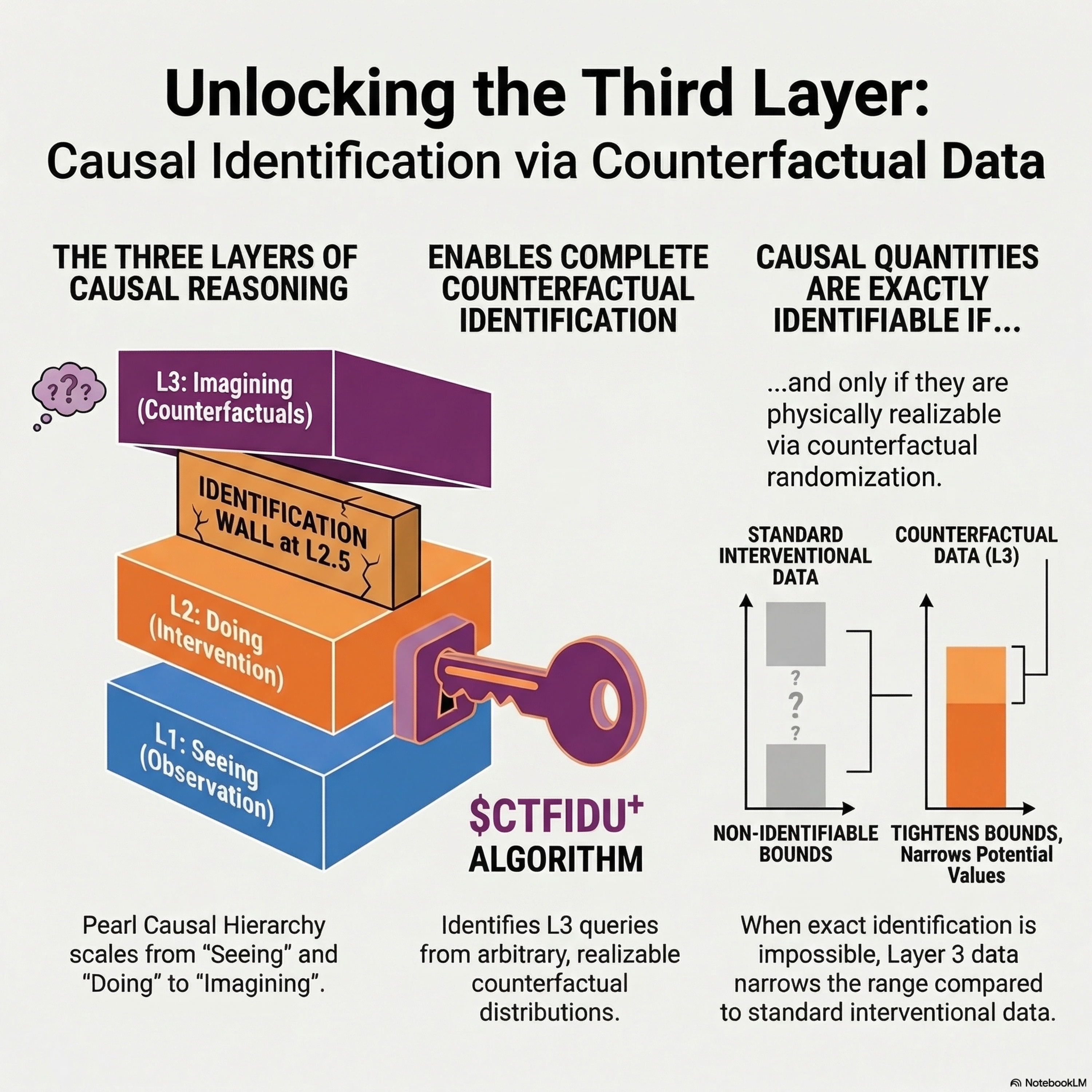
This research establishes a complete algorithmic framework for identifying counterfactual quantities by utilizing a newly discovered family of physically realizable Layer 3 data. While traditional causal inference was restricted to observational and interventional data, the authors introduce the CTFIDU+ algorithm, which can determine if a counterfactual query is identifiable from arbitrary sets of counterfactual distributions. The study defines a fundamental limit to exact causal inference, proving a duality where a query is only point-identifiable if it is also physically realizable through counterfactual randomization. For queries that remain non-identifiable, the authors derive novel analytic bounds that are significantly tighter than previous methods. These theoretical advancements are validated through simulations in fairness and personalized decision-making, demonstrating that access to counterfactual data yields more precise results in practice.
Embed this episode
NOW PLAYING
Causal Identification from Counterfactual Data: Completeness and Bounding Results
No transcript for this episode yet
Similar Episodes
No similar episodes found.