
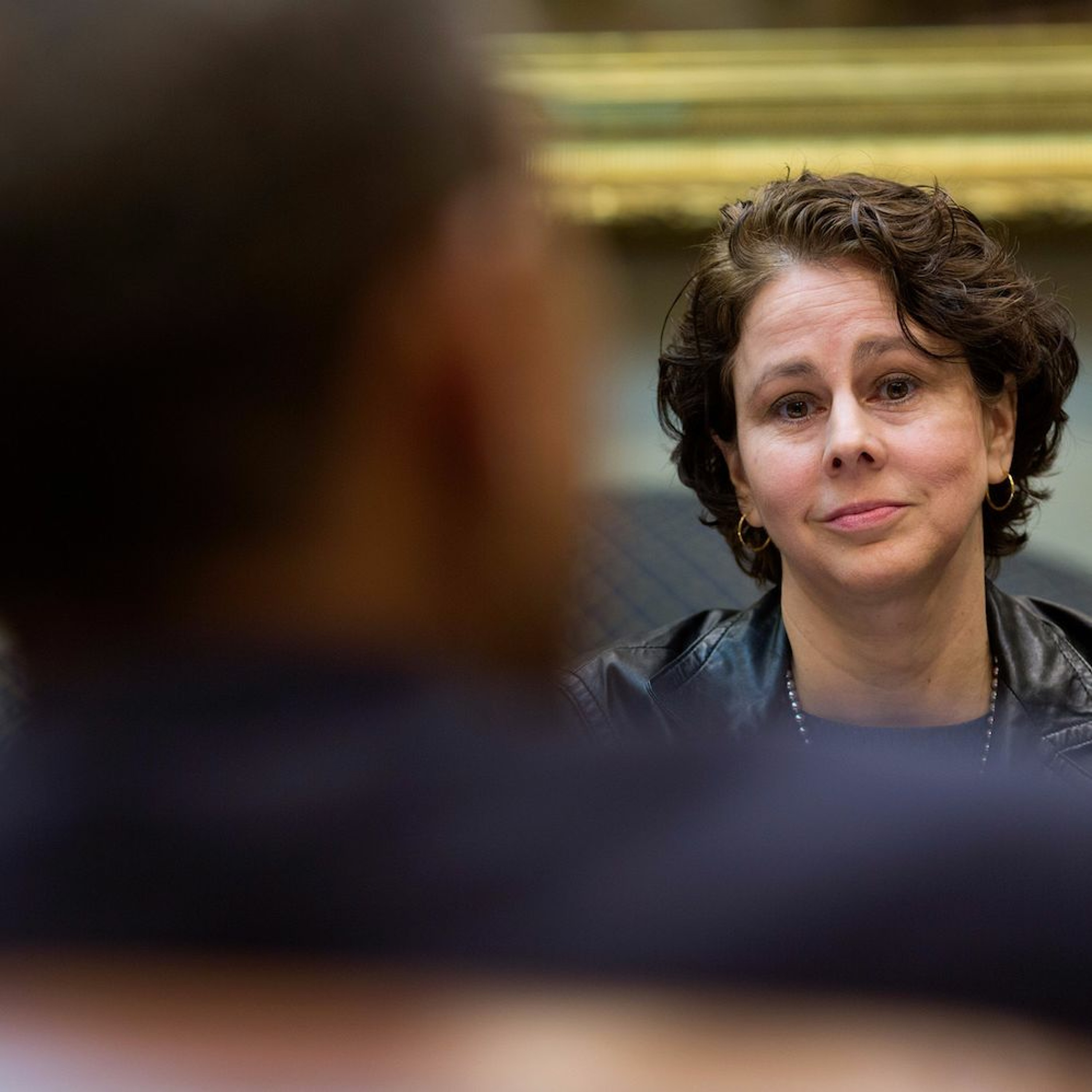
Welcome to CMS On Air, the podcast on migration, refugee and population issues brought to you by the Center for Migration Studies of New York. This is Rachel Reyes, CMS's Director of Communications. Cecilia Munoz is Assistant President Barack Obama and Director of the Domestic Policy Council, which coordinates the domestic policy-making process in the White House. Prior to this role, she served as Deputy Assistant to the President and Director of Intergovernmental Affairs, where she oversaw the Obama Administration's relationships with state and local governments.
And before joining the Obama Administration, Cecilia served as Senior Vice President for the Office of Research, Advocacy and Legislation at the National Council of LaRaza. In this episode, CMS's Executive Director, Donald Kerwin, speaks with Cecilia on the Administration's efforts to reform the U.S. Immigration System and the Refugee Resettlement Program. Obama's Executive Action, specifically the Deferred Action for Childhood Arrivals Program, and the government's response to Central American children and families crossing into the United States.
Here's Donald Kerwin and Cecilia Munoz. Well Cecilia, thanks very much for agreeing to do this. We really appreciate it. Sure.
Let me just jump in. You were a very prominent pro-immigrant activist in the NGO world prior to joining the Obama Administration, and you've been at the Obama Administration since the very outset. Do you want to talk about the immigrant successes that you've had and disappointments that you've had in this position over the last eight years? Sure.
I mean the biggest and most obvious disappointment is that we didn't get an immigration bill through Congress. It wasn't for trying. We got a strong bipartisan bill through the Senate in 2013 and couldn't. And we're pretty confident we had the votes for it in the House, but couldn't get the House to take it up.
So that is a source of huge frustration because we now know what it would mean for the country just in economic terms, what it means in terms of reducing the deficit and growing GDP. And that's all quantified because we had the Congressional Budget Office took a look at the Senate bill. So the easily greatest source of frustration is that. But having said that, we've managed to accomplish a lot with changing what happens within the agency itself within the Department of Homeland Security, from sort of streamlining some visa processes where we have the authority to do it.
Things like creating programs for spouses of people with H1B visas or entrepreneurial parole or some of the other things that we've been able to move forward to beginning to modernize application processes, which is actually a huge undertaking in government and which is citizenship application, for example. The process is more streamlined and just moving in the direction of being able to automate these things like forms. But I also think for the first time this administration is making choices on setting priorities for enforcement, that hasn't happened before in the immigration arena, and it's tremendously important. The Department of Homeland Security and its predecessor, the INS, never got a strategy, never got an approach, never had priorities.
And the priorities exercise and this notion that you want this law enforcement agency, which is, I think, the largest in the country, to apply the same law enforcement principles to its job that any police agency around the country does, is a huge and very important innovation. Yeah, it's the largest many times over of the federal enforcement agencies. Let me ask you a couple of legalization-related questions, historical questions. The first is, of course, hindsight is 20-20, but with the benefit of hindsight, do you think it was a mistake not to prioritize or highly prioritize immigration reform in the first two years?
So I disagree with the premise of the question. We did prioritize immigration reform. What we didn't do was find bipartisan group willing to bring it up in the Congress. The President held, I think, folks forget he had bipartisan by camera meetings.
He tried to get allies in Congress to get this conversation started and did not get any takers, except in 2010, when we got the Dreamac up for a vote. And it passed the House of Representatives for the first time. It failed largely because Republicans who had previously voted for the Dreamac, and in some cases, co-sponsored it. Didn't vote for it, which is why it's not the law today.
But we did prioritize immigration reform, but what we didn't have was allies in Congress willing to move it forward, not until 2013. On the Dreamac, there were five Dems that didn't vote for it at the end of the day. That must have been extraordinarily disappointing. Sure.
I mean, the failure of the Dreamac was disappointing, but the failure of the Dreamac, I mean, if you look back at pretty much every immigration vote in the Congress or the United States going back decades, Democrats generally in the Senate lose about five. So that's not unusual. What was unusual and very frustrating was that there were Republican co-sponsors of the Dreamac who didn't vote for it when it was on the floor of the Senate in 2010. These were folks who decided against something which they believed in so much that they had actually drafted the bill.
And that was enormously frustrating because there were 11 of them in the Senate. Why did they decide on that? What's your thinking on that? Well, so I mean, it's hard to fully understand their motives.
In some cases, I think they felt the politics of the issue had shifted. They were afraid of whatever the blowback was going to be. And we know, because they said it out loud, that there were some on the Republican side who did not want to give the President any successes. So I don't know exactly, member by member, what the motive was.
What I do know is that it hurt a lot of people. So the record numbers of deportations was a major controversy during the first term and into the second term. Did the administration believe that large numbers of deportation would build support for legislative reform? No, I've heard a lot of folks in the advocacy community suggest that that was a motivation.
Look, when you swear and else to uphold the law, you have to uphold the law. And so the administration, the DHS was doing his job. And if you follow the clearest indicator of what the removal numbers are likely to be, it's generally the appropriations process in the Congress. So the reason that the numbers were higher in the Obama administration than they were in the Bush administration was because Congress allocated a lot more money to this function.
The priorities turned out to be tremendously important. So there are first efforts to put in force on priorities in price started in 2010. And frankly, the agency refined them over time because it took a while for them to produce what the agency was hoping for, which was people in the removal pipeline who were serious offenders. And so the changes and revisions, which ultimately resulted in the enforcement priorities that were part of the President's executive actions in 2014, were really the result of attempts that ultimately didn't produce what the agency was hoping for.
And one of the indicators, and this is when Secretary Napolitano was in charge of DHS, one of the indicators that she was looking at was did dreamers end up in the pipeline. And if they were ending up in the pipeline, it was an indication because they were clearly low priorities for removal. That was an indication that the priorities weren't working very well. And that's why you ended up with DACA.
Right? DACA is an exercise of enforcement authority by DHS. Having named folks who are their high priorities, DACA is an effort to get folks who are low priorities out of the pipeline altogether. Can I ask you a question about the, there's recently been a claim that there's two to three million undocumented people who are serious criminals, violent criminals, everyone had to find that.
And yet removal of serious criminals has been an enforcement priority for a long period of time now. Do you have any sense of what the numbers are there? I mean, it's impossible to know for sure the total number of folks with convictions in the undocumented population. But what I do know is that that has been a clear enforcement priority throughout this administration.
And the folks that get removed every year, something like 97, 98 percent of our removals are totally consistent with those enforcement priorities. So the pipeline of removing folks who are convicted of serious crimes is well established, and that's what the agency's efforts are focused on. Let me go back and ask a similar question to the one on deportations and it's related to border enforcement. And the question is, it seemed like the more the administration invested in border enforcement, and the more successful it was in those investments, and I think the statistic now is that crossings are at about one-tenth of what they were a decade ago, the more Congress and Congressional Republicans in particular argue that the border wasn't secure.
And kept moving the bar in some of the man that absolutely 100 percent security, which of course is impossible. I wonder if you'd like to respond to that. Yeah, so the border is that there's this sort of mythology around the border. It's the ultimate symbol of the immigration debate, and it is largely a kind of a fact-free zone, a conversation about what happens at the border.
So just numerically speaking, the number of people trying to cross into the United States is kind of near its lowest levels in the last 40 years. The undocumented population in the United States has started to shrink for the first time in again in decades, I think since we've been paying attention. Our number showed strength by a million over a short period of time. So you wouldn't you wouldn't know that by the tenor of the overall debate?
And actually one of my big worries when we get back to a place where we're having a legislative debate in Congress is that we may be trying to solve a policy problem from 20 years ago, which was the high levels of migration from Mexico to the United States. And that's not the problem that we face at the border right now. Now we do have challenges at the border, but that's not what our challenge is. And so it would be really useful for the policy debate to catch up with the reality of what we're facing.
So the mythology about people essentially evading the border patrol, that happens between much, much less than it used to. The challenge that the border patrol faces now are people from countries other than Mexico who show up and turn themselves in. And they're actually managing a population which is showing up and raising their hand and saying, here I am, the debate isn't really focused on what the particular challenges of the border are now. It's focused on something from ages ago that there's such a mythology built up around that it's hard to have a conversation based on facts.
It's kind of jumping to who is coming in now. It's central American migrants and refugees. And there's a lot of concern that these families that are fleeing violence and the individual children that are fleeing violence, particularly in the Northern Triangle states of Central America, are being treated like illegal border crossers, regular migrants, and in fact, they're refugees. Do you think that there needs to be a shift in policy towards these vulnerable groups?
Do more for them? Treat them more as refugees than is undocumented people, for example? Well, so there has been a shift in policy. We're trying to confront this in multiple ways.
The first is to deal with the situation that presents itself at the border. And we've been managing essentially what I think is two sides of the same coin. One is our responsibility to have a secure border and the other is our responsibility to address humanitarian concerns. And so the way that works the way our law is structured, by the time folks get here, the avenue for them to see protection is through the political silent process, which is backlogged in which we've been working to increase the resources towards without much cooperation from the Congress.
The policy change that has already taken place, because I completely agree that we can't just enforce your way out of this problem, or expect that we will successfully deal with the refugee dynamics here just through our political silent process, is to actually focus on what's happening in the Northern Triangle countries themselves. So we fought for 18 months and finally secured an investment from Congress of $750 million that's being invested. And there's some initial signs that particularly in Honduras that that's having some positive impact on reducing crime and violence. That's the alliance for prosperity money, is that?
So one piece is investing in the region and making sure that you're actually dealing with the root causes here, but that's not a short term solution. The second piece is allowing people who are in fact fleeing out of fear the ability to seek protection before they take this incredibly long and dangerous journey. Too much of this conversation has been focused on what happens for those people who survive the trip and actually get to our border. And we've been working very hard to try to focus the conversation on developing protections for people so that they don't have to take that dangerous trip in the first place.
So we have a couple of years ago established a modest program for children to provide a legal avenue as an alternative for putting your kid in the hands of smugglers to take them all the way through Mexico. And we have begun to do the same now for adults so that people can make their case that they're refugees before they do this incredibly dangerous thing. There's much more work to be done there to make that a real and as robust a process as it needs to be. But I think ultimately that's the policy shift that has begun under this administration and the conversation which needs to continue.
I'd like to go back to the prosecutorial discretion issue quickly. The whole idea of prosecutorial discretion and you've raised this is that it's premised on the idea of necessarily limited enforcement funding. That is you couldn't deport all the undocumented immigrants even if you wanted to so you have to prioritize. But aren't there populations that shouldn't be removed no matter what the enforcement priorities were.
I mean, you know, think about the dreamers, think about the parents of US citizens because it's likely that there will be more enforcement funding in the future. Sure. I mean, I guess theoretically, like if you assume either that Congress ups the resources so that there's enough to remove everybody that's removed or that population is small enough that it doesn't take just a crazy infusion of resources. But look, here's the thing.
Congress decides who's removable and the executive branch's job is to remove the people who are removable. So given that the job that this executive branch faces at this particular moment is that there are 11 million people in this situation. And it's clear that there are going to be the resources to remove all of them. The executive branch is properly making choices as to how to expand those resources in the most impactful way.
But the under the sort of theoretical basis of your question, the issue is really that Congress determines who's removable. And it's appropriate to set priorities if the job is bigger than Congress can provide for. But if the bigger question is, are there people who just should be here and should they be allowed to be here legally because we all recognize they're here and they're making a contribution, nobody really wants them to leave, you need Congress to fix that. It's not a, the executive doesn't have the capacity to do that in a permanent way.
That's one part of the question. The other part of the question is that they'll be requests for huge infusions of enforcement funding to deport many more people. And so... We already spent a huge amount of money on it as it is.
And there's definitely going to question whether that's the best use of our resources because we've allowed this problem to build as a result of our failure to enact legislation that fixes what's broken about the system. In defending the DACA in the DAPA program, the argument, there's broad arguments made related to the executive authority of the president in this area. To the point that some were saying that authority is so broad that you wouldn't have to deport any of the 11 million undocumented. What's your position on the scope of executive authority at this point?
Well, so this is something that we, that the administration thought about very, very carefully. The president's very clear preference, which he stated many, many times was for congressional action because he understood very deeply that there are limits to his authority as the executive and there are limits to the how permanent those changes can be, which is to say they're not permanent. They could be undone by some future executive. And so his clear preference was for, to stay focused on passing legislation and he did not ask his team to prepare executive actions until after the speaker, the House called him to say I'm not going to move the bill.
So we did careful, careful legal swabs of what DHS had the authority to do. This was an exercise, as I said, of DHS's enforcement authority. We went to the office of legal counsel at the Department of Justice for guidance. For example, they produced a memo on the question of whether or not you could provide it, for example, to provide defer to action to the parents of folks with DACA.
And the basis of their legal analysis was Congress has made judgments on who gets to be an immigrant. The people who ultimately would have benefited from DACA had the administration been able to implement it. Our people who ultimately, under our laws as they exist now, are going to be eligible for a visa because they have a U.S. citizen child.
And when that child turns 21, they can petition for a visa for their parents. And so the theory of the case here is it's reasonable, so those people are ultimately, Congress has made a choice about those people down the road. And so it's reasonable to defer to those folks and to give them the ability to support themselves while they are waiting for that long process to take place. So that's the legal basis for the decisions that the president made.
Obviously, there's still more legal. So the legal basis is reasonable to those people will ultimately be eligible to legalize. That's the way the immigration laws are structured. The DACA program has been the terrific success in demonstrably benefiting 800,000 young people, their families, their communities.
It was also implemented very successfully through a strong public-private partnership. I wonder if you could speak about the long-term lessons of that program. Yeah, I think the success of DACA, it really depended on a couple of things. And I compared it to the legalization process from 1987, which I was also a part of, where obviously the technology was very, very different than.
So these things happened. One is that the agency mobilized effectively early and made, I think, very good choices about how to ramp up its adjudications process and make sure that it had integrity. They did a very good job of connecting with the community affected to make sure that people had information early on about what the parameters of the program were, so that people, when they submitted, there are petitions that they had produced the right supporting documents. So people could tell whether or not they were likely to get through, and so they could self-select and decide whether or not to come forward or not.
Because these are people essentially admitting to be undocumented in the United States, which is not an easy decision to make. So people had the information that they needed to put to send in quality applications, if you will. And the networks of folks who are in the civil society who are supporting these folks, the networks of dreamers and networks of NGOs that were supporting them, were really effective in getting that information around. And so what you had was a process where not so many people needed two or three passes in order to have a complete application.
And the people who participated were quite well-informed in advance and could make well-informed decisions about whether or not to come forward. Given that it's been such a success, and this is such a sympathetic group in an American, really, and everything legal status, is there anything more that the administration can do in these final days and is planning to do to protect DACA beneficiaries and refugees too? And for example, this plan to use the President's constitutional authority, the pardon offenses against the United States, which has been used with large groups in the past, could that be used to pardon some part of this population, say, the DACA beneficiaries? Yeah, I know people are hoping for use of pardon authority as a way, and people are obviously deeply concerned, I think, as we all are, for what could happen next.
Look, because DACA is an executive, is a use of executive authority, obviously the next executive can make whatever decisions they're going to make about it, and that has been clear, and again, as the President has said since the very beginning, this is why he preferred legislation, because anything that he had the capacity to do for people was by definition temporary. I know people are hoping that pardon authority is a way to protect people. It's ultimately not for a couple reasons. One is that pardon authority is generally designed for criminal violations, not civil, but also it doesn't confer legal status.
Only Congress can do that, and so ultimately it wouldn't protect a single soul from deportation, so it's not an answer here for this population. I know people are hoping for an answer, but by its very nature, the use of executive authority in this way is subject to the will of executive. It doesn't get people legal status either. A pardon authority does not.
So, skipping to the US Refugee Resettlement Program, really one of the most successful humanitarian programs in history, 3.2 million people protected since 1975. It has its shortcomings still, and yet it's come under fierce attack during the Obama administration, both for national security reasons, and because local communities are saying that they can't absorb additional refugees. Would you address those concerns? Yeah, you're right.
The refugee program is tremendously successful. It is also just from the straight-up security standpoint, which is the basis for a lot of the attacks on the program. The refugee program is extremely successful. These are the people who are vetted the most of any entry to the United States and buy a lot.
This process, it takes 18 months. There are multiple layers of security screenings. So, the concerns that get raised about the security resulting from the program are just unfounded. And of course, what this program means and is produced for the United States is enormous.
This is one of those areas where you do well by doing good. The communities of millions of people who have come to the United States as refugees don't just reaffirm who this nation of immigrants and refugees is, but their contributions are extraordinary. And we're rightfully proud of having increased the number of refugees that we brought to the United States, and to have strengthened the kind of interagency process so that the security clearance piece remains absolutely robust. But we're streamlining things which were happening sequentially happening concurrently now, so that we're trying to make it as efficient as possible.
And the communities that we said are refugees largely, you know, this is an exercise of kind of fundamental grace by the American people. It's a sign of our strength and a sign of our leadership in the world. And exceptionalism. Absolutely.
It's one of the things which makes us great. As a follow-up, some have been concerned about the administration not doing enough to protect Christian and religious minorities in the Middle East with the refugee program. I guess through resettlement, could you respond to that? Yeah, so the point of a refugee program is to protect people who are refugees, period.
So you don't focus on whatever it is that makes them refugees, makes them refugees. So you don't pick and choose on the basis of religion either to bring people or to not bring people. Once the determination has been made that someone is a refugee, then they're deserving of protection. And there's a feeling that there's not sufficient numbers of Christian refugees in the Middle East.
When people raise those concerns, that's what they don't see many Christian refugees for example coming into the United States. And I wonder why? Yeah, and I think a better understanding of the refugee process and how those determinations get made is really what's called for here. For our purposes, and this is tremendously important when the United States receives refugees, we're not applying a religious lens.
And the folks who are making determinations about who in fact is in need of protection, the lens that they should be applying is the lens of our people suffering persecution or people in danger. And sadly the world is a dangerous place for people of pretty much all faiths, and our job is to protect them. The administration has prioritized immigrant integration in a way that past administrations did not. And we also see stark differences in the receptivity to immigrants in particular communities.
It's very different being an immigrant in California than it is in Alabama or Mississippi. I wonder, could you speak to the importance of the federal government's role in kind of organizing integration response, and then also the importance of local communities and what they can do to safeguard and protect the incorporated immigrants? Yeah, so this is one of the President Obama's executive actions from November 2014 was he created the Task Force under Americans, which I co-chair. And it, our work has really been inspired by the work of local communities.
There's this welcoming America movement that is organized, all kinds of interesting coalitions of folks, and all kinds of different parts of the country around this notion that communities that are investing in helping immigrants and refugees be successful actually thrive as a result of that effort. And so we, in the Cross-Federal government took inspiration from that. We're going to ask the federal agencies just a simple question of, you know, how can we be supporting that work more effectively through the work that we already do, right? So the Small Business Administration gives out small business grants, but by being thoughtful about how that intersects with the immigrant integration, we can really kind of maximize the impact of what we accomplished, not just from immigrants and refugees, but for the whole entire communities where they live.
So the federal government's work in this respect is more deliberate, it's sharper. We're doing a better job of supporting the integration of immigrants and refugees. But in some ways the real inspiration here is the local work that's going on around the country, you know, where good people recognize that. We are all more successful when we help newcomers be successful.
Are there any criticisms of the administration in this area that you'd like to respond to after eight years? I'm sure there's plenty of them. And also, you came from the immigrant rights community. Do you have any words that you'd like to share with the immigrant rights community as you kind of move to the next stage of your career and reflecting on your past eight years?
Yeah, I think it's important for folks who care about immigrants and refugees. I mean, it's a powerful movement that has grown a lot. It also, I think, rightly expresses the deep emotion around these issues. And that emotion is real.
It comes from a good place. We're a country of immigrants and refugees, and there should be emotion around these issues. But the strategic work of folks who are working on the have immigrants and refugees is tremendously important. It's important to be able to conduct this debate in a way that other people can hear, and so that the more people in the country can see and appreciate how this is important to our collective future.
And I worry that on both sides of the immigrant debate, of the immigration debate, emotion gets in the way of sound thinking with respect to what are the problems that we can fix. And on both sides of the debate, I think the degree of emotion can interfere with just making good policy judgments and good strategic judgments so that we can get to solutions here. Ultimately, the thing that I think all Americans pretty much agree on is that our immigration system is broken and needs to be fixed. And the fact that the yelling gets in the way of what everybody kind of agrees we need to do is has had tragic results in this country, and we need to do better.
I wonder, could you, you may not want to, but could you provide examples of that? I mean, I feel like this. Yeah, so rightfully so the American rights community is focused very much on the question of protection for the folks who are here without immigration status, understandably. That's what I did for many, many years.
The protection issue, understandably, got so huge that it ended up being bigger than the legislative debate. And so folks, I think, pivoted to this notion that what the president should do, whatever he can do right now because we need to protect people right now. And that probably happened several years before, you know, we had the opportunity, we still had a window for congressional consideration of immigration reform, and much of the advocacy community wasn't focused on it because they were just really wanted the president to take executive action. And the president insisted that we should leave no stone unturned in getting Congress to do its job because his authority was limited.
And, you know, unfortunately, we're now in a situation where folks took the heat off of Congress, Congress didn't do its job. No one can answer the question of whether or not if we kept the heat on, the House would have gotten there. We'll never know. But as a result, it's possible we missed an opportunity to fix what's broken.
So premature calls for executive action and kind of blaming the president for what was a slow process in Congress. Is that? Yeah, people got frustrated with Congress, understandably so. I think no one was more frustrated with Congress than the president of the United States.
But they got frustrated with Congress and insisted that the president could just fix it himself. And that happened at a time when a little pressure on the Congress could have been really useful and they were just completely off the hook. You want to, since you've raised this issue of consensus and people listening to other people and talking across the aisle and saying things in ways that people will actually hear on what are shared priorities, maybe even. Do you want to talk about what it takes to, based on your experience, to build consensus and the country on these issues?
Yeah, it's very hard work and building consensus requires listening, which is hard, especially when we all understand we arrive. We have arrived at a place where we're pretty bitterly divided as a country. But the president goes back to this over and over and over again. He just deeply believes in the goodness of the American people and I think he's right.
And he's good at communicating with people who don't agree with him. And he's really good at listening. And that's how he built a coalition which ultimately succeeded in putting him in the White House. I think there are lots of lessons to be learned from that.
It's really important that we express that we as immigrants, advocates, I still consider myself one, express the truth of what we see in the community, including the real agony that communities go through. It is also really important that we hear and are able to respond to the agony that other Americans go through who are unsure about their economic future. Now I believe that the evidence clearly shows that immigrants are not, not only not part of the problem, but they're part of the solution. But we have work to do to help people hear each other.
And the more effective we are doing that work, the sooner we're going to fix our problems, not just the immigration problem, but all kinds of other ones. Do you have any final words for us? No, I just appreciate your attention to the issue. This work is challenging, but it's fundamental to who we are, especially in this country.
And Lord knows we have more to do. That's true. Thank you very much. See you.
Thank you. CMS on Air Spi Music is provided by Danny Dabberstein and the Music Case. To get more information on CMS projects, publications and events, visit us at CMSNY.org.