So these two cops are talking in front of me. It doesn't matter where or when, but one says the other, hey, you know, you should listen to his podcast. It's really good. He plays Pink Floyd, which is bizarre, that that's the impression that he'd be left with, that I play Pink Floyd.
I don't recall playing a whole lot of classic Pink Floyd. I've used a lot of psychedelic sit-barret stuff, particularly in the episodes having to do with the Pinell Institute or the Douglas Hospital. And that's kind of it. I've saved a classic, Floyd intentionally.
It was a big favorite of my sister's, those four classic albums of metal, dark side of the moon, animals, wish you were here, those four. And this song, I remember quite a bit coming from her room. Montrealers know one of these days because it was used as the intro to the nightly news, the C-6, the broadcast. C-F-C-F-12, I think.
This is who killed Theresa. In performance arc, in fear, there's a concept known as the motivated cross. The idea is you never in movement, moving across the stage, you never take an unjustified movement. It has to be motivated.
Otherwise, you're just dancing around the stage. So if you're stage right and you want to go stage left, there needs to be justification. You're going over to the desk to have a glass of water or pick up your glasses or put on your hat to go up the door. But you can't just be careening around the stage.
It just translates as nervous energy and let you don't know what you're doing. So today's episode about Secco Secco is what I would call a motivated cross. I'm going to talk about Secco as a means to justify getting into other things that we want to talk about. So today is, this is about a governmental report.
About the 1970s that was produced in early 1980. And it's pithy, it's dense, and it should be considered and reflected upon deeply. Because it sets the table for what? It followed in several biker wars.
When you say the biker wars in Quebec, it has different meanings for different people. There were several biker wars. Certainly one in Montreal in the 60s, certainly a second wave in the 70s, certainly in the 845 era. And then later with the rock machine and the Hells Angels in the 90s.
That's the one most people traditionally think of. But there are waves of biker wars. And what I would argue is, you know, a lot of people with these things cost millions of dollars in lives. You always see the hand-wringing.
And how would this happen? How could this happen in the province? And I would contend that the government knew the extent of the problem and sat back and watched it unfold for decades. So this may be a short episode.
But I want it taken in context in isolation, because I don't want it to get lost under the wheels of another story. So Secco was the commission of inquiry into organized crime. And it was set up under the Liberal Party's premier, Robert Barasa, 1972. And the goal of Secco was the dismantling of drug, gambling, and prostitution networks.
And Quebec, targeting in particular the Italian mafia. The commission's original mandate lasted only three years, but that mandate was extended 12 times, 10 times those extensions at the request of the Pateekurak was Justice Minister Mark Andre Badard. And so Secco lived well into the 1980s. And before we beat up too much on the Pateekurak, the Liberals under Barasa was Robert Barasa.
We were every, but as corrupt. Nothing would have been any better under the Liberal Party had the separatists not gotten into power in 1976, 1977. Let's be clear on that. So Secco was intended to only go after the high echelons of mob power and was to, like, avoiding street level operations.
But the government quickly broke their own rules, and they began to prod and probe into everyone's business. If you haven't already said it, Quebec-Sico is a very small place. In the beginning, there were these hearings, right? And these hearings looked into the gaming world and wiretapping initiatives like Operation Vegas.
By the 1980s, they had their noses into corruption in the fur industry. The liquor commission tainted meat scandals, well-known at the Cottroni family, so tainted meat expo in 1967. The Haddock-Cabex, a bar association, quits. Any gang of bums is considered to be organized crime.
Now, some very good work got done under Secco, the Cico. The commissioners, one of whom was Denis Dion, the ad hoc coroner, who found officers criminally responsible in the Rock Forest massacre case. He held mobsters like Palauvioli and Vincent Cattroni to account daily and live on Quebec radio and television. Mr.
10-4, Cica Viel's Club Poiret was a constant presence on the city of the city. It was a constant presence on the radio in that era, covering the whole Cico affair. The commission investigated the Du Bois clan, the nine brothers with a criminal operation at 200 people in Montreal, St. Non-Reed District.
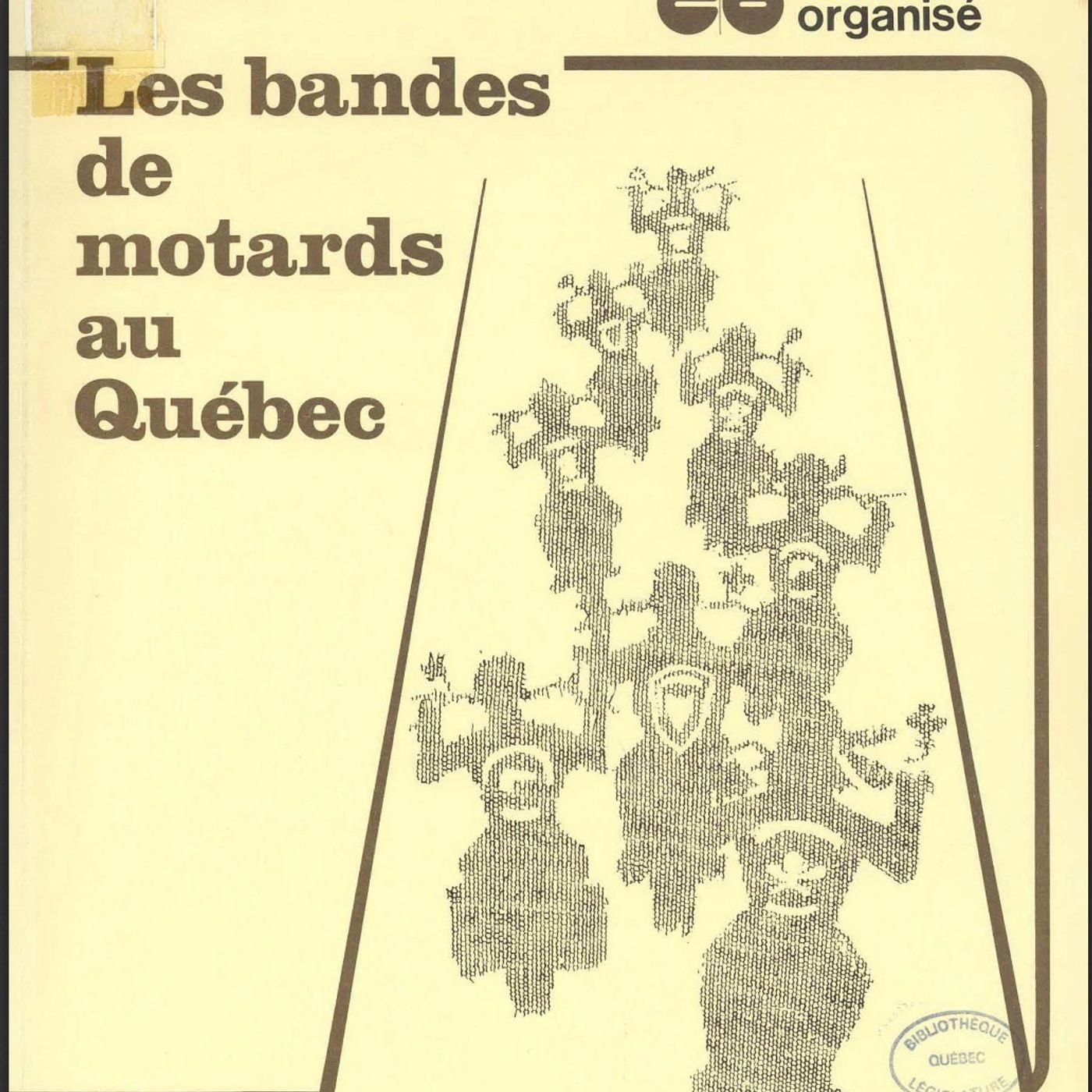
And it's worth noting that Cico operated under the umbrella of the Quebec Provincial Police, the Cetoteti Quebec, and their offices were located on the top floors of the SQ headquarters on Rue Parthane in downtown Montreal. So for today, I want to focus on a Cico report published in 1980 titled Biker Gangs in Quebec, Le Bando Motau de Ochebec. And for our purposes, this report tells us what the government knew about motorcycle gangs in the 1970s or what they thought they knew. And I think that's really important.
There's a lot of information here where you're going to probably know well, we know that. We know that. It's not important what you know. It's important.
It's important that you understand that this the government's understanding in 1980, what we know now is that within the decade of the 1970s, police severely underestimated the threat of biker gangs. The Quebec government incubated their growth, providing government assistance through projects like the Merck experiment, which we've talked about. And by the end of the decade, biker gangs, it becomes such a serious threat that Mark Andre Bédard saw the need to study them. And that's important to study them, not to do anything about it, just to look at the matter and we'll get, we'll get to that in a moment.
So biker gangs have come back, this report. And if you go to the website, teresellor.com, T-H-E-S-A-A-L-L-O-R-E plant com, there's a link to the entire report, to Gebec in French, but nevertheless, a listener, this is not my work, a listener, found this report. It's gold, it's absolute gold, primary document. It's broken down into two sections.
Part one focuses on biker gangs in several targeted regions where the commission held these focus groups, these sessions. And they are the port of Saint-Pierre, Setil, Mongely, San Gideon, Sherbrooke, and the Spastus, and Danville. Part two is more of a sociological study where the commission conducted interviews with various players in the biker world. And the report ends with recommendations.
And we'll get to those. Punch line, it's a real kicker. So the CECO report begins with a simple question. Who are these bikers?
These bands of fun-loving misunderstood youths who had grown from street peddling of drugs and prostitution to now acquiring substantial assets, like $1,000 vehicles and tracks of real estate. Who are these guys? So CECO then answers this question. To be honest, some motorcycle clubs, especially those discussed in this report, are bands of lazy, lawless parasites, drug addicts.
They diminish and then get contaminated. They have no legitimate aim or ambition. They expect nothing from life and society and have nothing to offer to others. They are violent and dangerous for those around them and for themselves, which makes them an organized crime environment even more dangerous than the mafia or other organized crime groups, which have been identified in the past and whose ongoing criminal activities consist of murder, trafficking of drugs, and offensive weapons.
Theft and concealment of automobiles and motorcycles, assault, rape, and intimidation. That's the Bambu Moutau, Quebec, 1980. The introduction continues, indeed, these gangs are well-structured and their members appeared to us as major traffickers in drugs and offensive weapons. It is from there that they obtain most of their means of subsistence, as well as the capital necessary to acquire buildings and very expensive motorcycles.
The number of crimes of which they are guilty, the sexual orgies of which young girls sometimes under age are victims, they're dirty clothes, the heavy metal belts, the knives, the chains, and the metal badges they wear, their sessions, initiation secrets, have earned them the admiration and fear of others. But we must keep in mind that all this staging is only a facade to cover up well-established criminal organizations whose activities are very lucrative. And that's the 1980, that's very, very true. And greatly argued, stagings, these visual cues that are so seductive.
Even to this day, you see, if you go on social media, you see the glorification of the image of the biker gangs. And it's a very contrived effort, whether you're on Facebook or whether you're on Instagram or anything, to solidify the glory days of the biker and that legacy. The introduction ends with this account of the typical biker. And it's telling, because though it's not specifically addressing Lennoxville, Quebec, it gives an accurate account of how drugs might take control of a high school in Lennoxville, like Alexander Galtzay, or a college like Champlain or Bishops University, how organized crime could coexist with seemingly upstanding homeowners, taxpayers, local businesses in a sleepy little town like Lennoxville.
This is from Cico. You needless to say, the meeting with a 22 year old biker physically built as a piano mover who received a social assistant check for $417 per month on the pretext that occasional asthma prevented him from having a job and who confesses to us that in reality, he leads a very comfortable life because he is a wholesaler of drugs sold to adolescents in secondary schools and séjaps. He's an experience that we have experienced and that should be the launch of a collective effort to a limb. You gotta have a cat.
A collective effort to eliminate these unnecessary and harmful groups. The outlaws and the Hell's Angels are arguably the most powerful clubs on the North American continent and possibly the world. The Hell's have their headquarters in Oakland, California. The outlaws are established in Chicago, Illinois, as attached annexations show.
During the 1970s, we saw the Hell's Angels and the outlaws lead an intensive campaign to amalgamate the other motorcycle clubs with a view to exerting even greater territorial grip and making substantial profits in the drug trade, prostitution, counterfeiting and other related crimes. Several members of these gangs are now investing their profits in legitimate businesses, restaurants, shops, furniture, et cetera. In the following chapters, we relate the main incidents and activities of bikers in each of the regions visited during this investigation. It continues, the evidence shows us the evolution of bikers.
The turbulent youth have moved on to organized crime, weak clubs rally to stronger ones when they are not devoured by them. Luka wins thanks to narcotics. Bikers engage in all kinds of criminal activity as long as it pays. We're actually seeing a restructuring of clubs that will make them more powerful, more elusive.
In Quebec, there are 14 biker clubs with a criminal tendency which should not be confused with a majority of honest sportsmen. It is known that in the province of Ontario, the outlaws have recently allied Toronto's two most powerful clubs, the Vagabonds and the Paradise. They took over the Satan's Choice, the Last Chance, the Ironhogs, as well as the Queensmen and the Lobos in the area of Windsor. This annexation phenomenon began to make itself felt in Quebec as well.
The Hells absorbed the Popeyes of Montreal and became affiliated with the Marauders of Asbestos, the missiles of Laxangión, and the sex fox of Shabugamu. It is always a good day when you get to say the words, the sex fox of Shabugamu. Okay, keep the gatajan. Continuing to the outlaws in Quebec, they had already absorbed the Satan's Choice of Montreal and they recently succeeded in affiliating themselves with the nomads of Valleyfield, all these names, starting to come together.
And then we get to a bit that I love. Women are abused in motorcycle clubs. After a first motorcycle ride, the young girl is exploited like a thing, it belongs to a member, or to all members of the club. It, that's the way it's written, it belongs to a member.
It is exploited like a thing. Sumer later, she will be abused. Many work as dancers, well, withdrawing social assistance, which they pass on to the bikers. They often become prostitutes.
Well, there it is. And again, I'll say to many, this will seem like old news, possibly quaint. To me, it's astonishing that as early as 1979, the Quebec government had a full grasp, had completely contextualized the problem at hand and still did not see the need to address the crisis with any serious actions. And this is clear when we turn to Seco's recommendation in this report.
So here it is, this is the recommendation. We recommend to the directors of municipal police forces to inspire the methods used by your authorities in Quebec City and its police force to eliminate the annoying and noisy presence of bikers among your local and tourist populations of old Quebec within the limits of this territory. The police force of your city of Quebec also applies for your entire summer season, the Foot Patrol Program, which employs two to six police officers in the evening, depending on the extent of the foreseeable faults. The instructions given to the police officers who carry out this patrol and the equipment with which they are provided should, in agreement with the authorities of the police force of this city of Quebec who deserve to be recognized for their efforts and their successes in the field, do subject of verifications on the initiative of the police forces, which have to interviewing to suppress the escapades of the motorcyclists in order to apply at home the fruit of a profitable experience and fertile in results.
Ah, very flowery. No, I'm not kidding. That's it. That's it.
I am not kidding. To the prospect of biker gangs, totally overrunning society and overtaking business, government, property transaction, the Quebec government recommended increased foot patrols in the summer months, so not to disrupt the tourist trade. And I guess a noise reduction ordinance that it's like putting a bandaid on an amputation. And when you read the report, I can only guess because it don't get me wrong, this report is not complete junk.
Many of the conclusions argued in the report are very well argued. Lucor wins thanks to narcotics. That's it. That's the game in a nutshell.
And they're arriving at this very, well, I'm sure they knew it in the 60s even, but we'll get there. I can only think that someone intervened when they got to the point of recommendations and said, hold up a bit. Let's not go too far here because they were corrupted because Lucor wins. Yeah, it's like putting a bandaid on an amputation.
And what I find acutely disturbing is that this is coming out on the heels, you know, personally, of my sister's body having been discovered in the spring of 1979. So if you consider that, I think the inquiries would have finished by then, and the report was probably being drawn up, being written. So this is being written and considered in the wake of not only Theresa's murder, but hundreds of murders of women, and abuses of women, still unsolved to this day in the decade within the scope that this study took place. This is who killed Theresa.
If you have any information about unsolved crimes, cold cases, you can contact the Sartidou Quebec at 1-800-659-4264, or at CIC, which is Santral in Formacion of Criminal, CIC at Ceraté, S-U-R-E-T-E, Poincuise, QC, Poincia. And if you go to the website for the Sartidou Quebec, see some interesting new cases here, which I have not seen before. Some new cases, De'Anco-Tour is here. Sure work on Solvecase 1997, De'An-Malloway.
It's the 1977 the woman found behind the Falls, Mont-Marcy Falls, near Quebec City, 1977, De'An-Malloway. You know, I thought that was solved, but apparently not. Now I also have links to Quebec, EVAC, but they're neighbors. The RCMP, they link to RCMP New Brunswick, they link to the OPP, Ontario Provincial Police, on Solve Investigations website.
That's a very neighborly, and on the social media front, they have links on the Facebook, Twitter, et cetera. Good stuff, Sartidou Quebec, keep it up. That's all for today. Yeah, this is the spot in the show, where I make a pitch, real simple.
I'm just going to the website, threeceller.com. It's, since the reboot of the website, redesign of it, it's really good. I use it, because I forget information. And so if I wanna find information on a case, or even when I'm trying to connect these podcasts, I have to go there and search different cases and see what's tagged and see what's categorized.
And I see more people using it. And if you go to the website, all roads diverge from there, you can find us, where we are on social media, like Facebook, Twitter, Instagram, all of those things, YouTube. It'll get you where you wanna go, but I would invite you to continue to, if you like the stories, and this story, particular on SEL, you can go on the website and you can explore some of the ideas and some of the personalities that are discussed here. That's what it's meant to be.
That's the whole purpose and focus. If you're here because you're a true crime enthusiast and you just like that form of entertainment, that's cool too. I got a truck in any disfavor for that. That's cool.
If that's your game. But if you wanna go a little deeper, I know like the police who listen, which is great, that they listen. A little concerning that they're only listening to the episodes of mental illness, but that's what they say they're listening to, right? No, but if you're a police, if you're a Quebec reporter, if you're somebody in Ottawa, working for the government and you wanna know more about Quebec because you really can't figure it out and I don't blame you because it's unpenetratable, unpenetratable, and penetrable, check it out, truthable.com.
Come on around, so I'm up top-down with all the teams and I'll drown you. Now I'm gonna touch her off on page by the film of Michael Caine. That's enough for today. This has been Who Killed Theresa, and your host, John Avar.
Your self's great, it's great today. I'm a trade-o-2 drain, boys and girls don't understand that they'll make work right on hands. Me, because I don't get what I need. What I say tomorrow's done another day.
Fast me when I wanna go to Pune then and it's well for me.