KPBS On Demand is supported by the National Conflict Resolution Center, geopolitics, polarization, budget concerns, all topics that can cause tension in the workplace. NCRC can help seasoned and emerging leaders navigate polarizing issues with the Culture, Communication, and Conflict Certificate. More at ncrconline.com. Welcome back to another edition of listener-supported KPBS Cinema Junkie Podcast. I'm Beth Accomando.
To start the show, I want to make a quick mention of the blaxploitation films Filmstruck just added to its programming last Friday. Filmstruck is showcasing eight classics of blaxploitation cinema, so I want to remind people to revisit Cinema Junkie Podcast 60 featuring David Walker, writer of the Shaft comic books. Walker talks about his love for blaxploitation films of the 70s and says we're due for Blaxploitation 2.0. This month, Filmstruck added the titles of Shaft, Sweet Sweetback's Badass Song, Cleopatra Jones, Superfly, The Mac, Black Belt Jones, Dolomite, and Petey Wheatstraw. The films will be presented Maze was too young to have seen those films on their first run, but he discovered them through his parents, who spent their youth ingesting those films. He said there was a tradition on Sundays of going to church and then watching an oldie for what he calls Soul Cinema Sundays. He saw films, such as Shaft, which impressed him as being unapologetically black, thanks to photographer-turned-filmmaker Gordon Parks. Maze prefers the term soul cinema to blaxploitation, but he loves all the films in the collection that will be available on Filmstruck for the next six months. We spoke briefly about the films in the collection.
Sweeback's badass. And for different reasons. They all affect me for different reasons. Shaft, because it was like a studio picture that was really dope. And it's Sweeback, Sweeback, that song, because it's just like... Do you think the legacy of these films are, or, I mean, do you see that there's an impact from those films on films being made today or some filmmakers today? Absolutely. A, the swagger. B, not just like people of color, like on movie making. I mean, independent cinema during the time period was a big, big, big thing. How movies were being made was a big, big, big thing. It was unapologetic. It was daring. It was dashing. Having music be so intertwined in the cinema itself.
If you had to tell someone who's never experienced any of these films, never tried them, what would you tell them to kind of invite someone to come watch these? That was Malcolm Mays, one of the co-presenters of Filmstruck's Blaxploitation Collection. Now to the podcast I wanted to pull out of the archives in honor of a special anniversary.
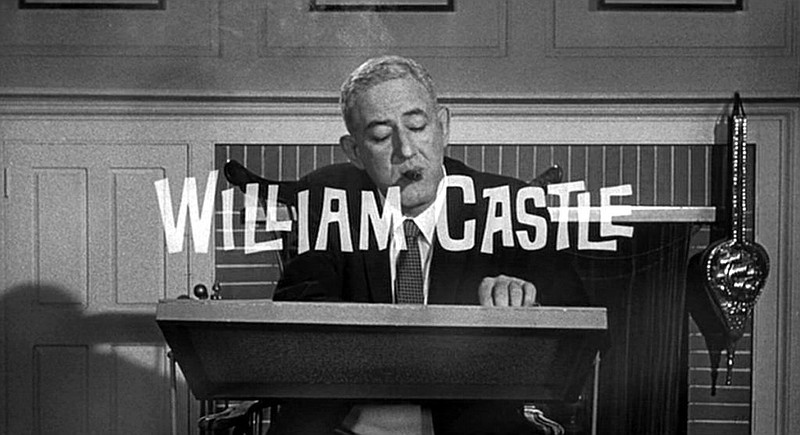
50 years ago this month, a horror classic was born. Paramount Pictures presents Mia Farrow in a William Castle production, Rosemary's Baby. Most people remember that the film was directed by Roman Polanski, but the man who got billed above him in the trailer and the first person whose name appears in the opening credits is that of William Castle. Castle, not Polanski, is the man I want to talk about today because his unique brand of showmanship is something that deserves being celebrated. Ironically, Rosemary's Baby is the one prestige picture that Castle is associated with, but it's his other films that defined his distinctive approach to filmmaking, an approach that included audacious gimmicks to lure people into the cinema. I'm William Castle, and I feel obligated to warn you about the next attraction you will see at this theater.
The picture is the tingler, which I directed. And for the first time in motion picture history, members of the audience, including you, will actually play a part in the picture. You will feel some of the physical reactions, the shocking sensations experienced by the actors on the screen. I guarantee that the tingler has more shocks per minute than my last film, The House on Haunted Hill. But don't be alarmed. You can protect yourself.
When you see the picture, you will be told, and remember the instruction, how you can guard yourself from attack by the tingler. This year marks the 50th anniversary of two wildly divergent films in Castle's catalog. One, the prestige film Rosemary's Baby that he produced, and the other, the B-movie he directed called Project X. For today's podcast, I dig back into the archives for a 2011 interview I did with William Castle's delightful daughter, Terry Castle. First of all, I just want to ask, you were fairly young when your dad was kind of in the prime of his filmmaking. What kind of memories do you have of his work? Well, I was on the set.
all of my dad's pictures. Now, House of Haunted Hill in the Cobb, I was really little, so I have very little memory. Although I do remember going over to Vincent Price's house and having turtle soup. I still don't want to know what's in the turtle soup, but it was delicious. But I do remember so many things about his film and his set. The most striking thing I remember is how much Emily it felt like on each of the sets. Dad created an ambiance where everybody felt like they were part of it. And people would be up at that raster saying, hey, Bill, what about this shot? Or the cameraman would be running up to him and there'd be a scurry of action. It was quite something. I do remember the set for What You Did and it was freezing cold. And I remember asking my father.
Why are these sets so cold? It's like being in the Arctic chill. And it was because Joan Crawford, who was aging, wanted her skin to be really taut. So they kept the temperature down really, really low. This is Joan Crawford. I urge you to see my new motion picture straight jacket from the beginning. Don't reveal the surprise shock ending. Don't reveal the surprise shock ending. When you were young, did any of this stuff on the set scare you?
You know, it's actually really, really funny because I was supposed to be in one of Dad's movies. I was actually supposed to be in Straight Jacket. And I was supposed to actually see, I was supposed to play Diane Baker as a little girl. And so I was supposed to walk in and see my mother, hacked to death, my father and my father's lover. Okay, that didn't scare me at all. When I actually got to the set and was all prepared to play the part, what scared me was being on set and being on stage. And then I freaked out and I didn't play the part.
But the actual filming of the movies, they didn't actually scare me. I guess horror must be in my blood. Let me ask this. Were the films scary? If you went to see the film in the theater, did you feel scared by that as opposed to being on the set where it's kind of like you're in the process of making the film? Yeah, I mean, when I went to see Homicidal, and in fact, Homicidal really freaked me out. I think that's a really scary film. For the first time in screen history, a special interval will be provided during the running of this picture for refunding your admission. If you're unable to stand the almost unbearable suspense, the almost paralyzing shock of...
Homicidal. And I was old enough then to actually appreciate how scary it was. Same with Rosemary's Baby, but Rosemary's Baby was scary for lots of different ways. But yeah, the films themselves were scary, especially as I grew up, like you said, I was pretty young when the earlier ones were made. But when I was, you know, 10 or 11 or 12 watching those films, yeah, I was scared in the movie theaters. But I had probably seen enough of what had gone on on the set, and my father probably talked about it enough that I wasn't terrified or traumatized.
Well, maybe I was. Maybe that's the explanation for all my troubles today. If homicide is your hobby, may I recommend a surgical knife for a nice, clean, quiet murder? I'm William Castle, and this wheelchair is just to rest my tired nerves after producing a picture like this one. We are so sure you will find it such a shocking and startling experience that we are offering a money-back guarantee when you come to see Homicidal. At the height of the suspense, there will be a fright break, an interval during which you can quiet your nerves.
If you are too frightened to see the end of the picture, your full admission price will be refunded. Time to go downstairs now. Got a date to carve a corpse. What do you remember of the gimmicks and stuff that your dad set up for actually screening the films in the theater? Well, I think that dad made these, and I think he made it for $90,000. They probably shot it in...
I think House of the Haunted Hill he shot in 13 days. But I think he made the film, and then I think he was frightened that nobody would come. And so he decided he'd have to create a reason for people to come. He was a showman, and he knew how to promote a film. So with the Cobb, he went to Lloyds of London, and he got insurance policies and insured moviegoers against death by fright.
Your attention, please. During every suspenseful moment to the running of the motion picture macabre, the life of everyone in the theater will be insured by Lloyds of London for $1,000 against death by fright. However, even Lloyds of London will not grant coverage for any person with a known heart condition or for suicide by any member of the audience. In House on Haunted Hill, he came up with a Murgo where a skeleton flew through the audience on a pulley at the exact moment when Vincent Price is digging a skeleton out of a vat of acid. And I love the gimmick he did in Thirtos. Illusiono to me is one of my... Come in.
William Castle, the producer of this motion picture, has a question for you. Do you believe in ghosts? Some people believe in them. Others do not. Personally, I do. And I feel sure that when you leave this theater, you too will believe in ghosts. Well, I not only will describe what the gimmick was, I will describe to you how my father got the idea for the gimmick, which is fabulous.
So, and this is really funny. So, it's called Illusiono. And Dad went to the eye doctor once. And I don't, you know, if you've ever been to the eye doctor, they put this contraption on your eyes and they show you all different, you know, can you see this? Can you see this? And, you know, all these knobs and all these, you know, buttons are pressed. And Dad had this brilliant idea for Illusiono. And basically, he created ghost viewers or ghosts. And it was not 3D. It had a red cellophane and a script of cellophane. And if you look through the red cellophane, you are able to see the ghosts. The blue cellophane, the ghosts. So, if you were too afraid, you would look through the blue. But if you were brave, you could see this.
Of course, everybody had to try it all out, but of course you wanted to see the ghosts because you weren't there to see a horror film, right? When you came in, you were given a special ghost viewer like this. And here's how it works. Would you please change the color of the screen? Thank you. You must only use it when the screen changes to this kind of a bluish color. Then you raise the viewer to your eyes and you look at the screen through it. If you believe in ghosts, you look through the red part of the viewer. If you do not believe in ghosts, you look through the blue part. Would you please change the color again? Thank you.
Now, when the screen resumes its normal color, like this, remove the viewer from in front of your eyes until the next time the screen becomes blue. Oh, one more thing. If someone sits down next to you during the picture, it would be helpful if you would show him or her how the viewer should be used. And remember, if you believe in ghosts, look through the red part. If you don't believe in ghosts, look through the blue.
Happy haunting. Goodbye for now. Did your dad kind of get as much fun or put as much energy into kind of the showmanship aspect of the film as he did into the filmmaking? Yes, he put so much into the showmanship of each and every film. And he went to every theater at every opening and he was there and there were nurses taking your blood pressure and there were ambulances waiting in case people died from fright. And he interviewed people. He just connected with the audience. He loved the audience. And I think, I mean, he was a showman. And I think that's why he's back from the grave today. I mean, you do know he is back, right?
Yes, I've heard those stories. Stories, you say? Some people just won't stay dead. Yeah, exactly. And he is one of those people. And it's fitting. It's completely fitting. I mean, if anybody could come back from the grave, it would be my father. Was your father someone who... In talking to a lot of horror filmmakers and stuff, they always seemed like the most well-adjusted, kind, gracious people. It seemed like if you met them at a cocktail party or something, you'd never guess that that's what they did. Is that kind of like what your father was? Or was he kind of obsessed with horror? Did he have a lot of nightmares? I mean, what kind of a person was he? Well, he was upset. I mean, a lot of people who are in the horror genre, you think, oh my God, they're going to be...
completely creepy and scary. But my dad happened to be, he was a champion for the underdog. He was kind. He was compassionate. He was like, I couldn't, I'm the luckiest person in the world to have had him as a dad. And he was just dad. I mean, he wasn't even, you know, it wasn't even like, people would, you know, warm up. I'd be like, why do they want his autograph? He's just dad. And he was, he was. Do you have any memories of the making of 13 Ghosts at all? I remember going to see it. I was really young. I think it came out in 1960. And so I was only a couple years old. So I don't have really vivid memories. Unfortunately, I wish I did. But I do remember, I do remember, you know, stories about 13 Ghosts, I think, just had,
Chills and thrills for everybody in the family. I wish there were more movies like that today because that was a horror film that a kid could see. You know, if you were 12 years old, you could have gone to see 13. I just wish there were more films like that today because 13-year-olds don't get to see horror films, really. Well, some of the stuff on TV, there's a little bit. Scooby-Doo to me is like the entry, the gateway drug for kids who want to go into horror. I can't wait to see Paranormal Activity 3. You know, my dad would have loved that. He would have loved that marketing campaign, too. Did you see anybody today who's got that kind of showmanship like your dad? Well, John Waters. Well, I think John Waters, you know, he speaks so fondly of my dad. But he's definitely all about showmanship.
I think there's been some fantastic, I don't know if there's showmen like my dad, but there's definitely been some fantastic, and I do think Paranormal Activity, the first one and the second. What do you think the legacy your dad left behind is? Well, interesting that you ask me what legacy my father has left behind, because my dad died thinking he was terribly unsuccessful, because he was relegated to making B-horror films, and then he made a movie film, but he produced it and didn't get to do it, and Polanski did. After Rosemary's Baby, he actually got quite ill, and he was never actually able to, and the times changed. So dad died thinking he was unsuccessful, and I think his legacy is just so wonderful for me to see all these incredible fans.
remember him and remember him so vividly and so fondly. I'm constantly approached by people who say, oh my goodness, I remember when I saw 13 Ghosts. I was in, you know, Louisville and I was at this theater and I was wearing this outfit. I remember what they were wearing. My sister dropped me off at the theater. And, you know, when Margaret Hamilton, the Wicked Witch of the West, when she appeared, it terrified me. And people remember it to the moment, you know, and they still have their ghost viewers. I can't tell you how many people still have their ghost viewers from 13. I was wondering, what do you think it is about these kind of horror films that do have such a lasting appeal and that people remember them so fondly?
It's complicated. I think that there was an innocence in the 50s and 60s. And I think that Dad made the experience of theater. It was really a theater-going experience. So it wasn't just going to be a movie. It was an entire experience because of all the gimmicks. And I think that the movies had a certain naivete towards them. And I think people are craving that time again. In 1968, The Same Night of the Living Dead came out, and Martin Luther King has the assassination. And I really think that horror film, and I think right now there is a huge desire to go back to that place of innocence. Our audiences are so sophisticated. So it's sort of...
I think the Harry Potter series sort of captured some of that in the books and the movies. There's a certain innocence there, yet it appeals to a more sophisticated audience. But I think it's tricky. Is there a new book coming out? I know there was a reissue of his biography, but is there also a new book coming out as well? Yes. My dad, like I said, is back from the grave, and he has written a book called The Prayer, called From the Grave, The Prayer. And it's narrated by my dad as a dead man, and it tells his story, what it's like for him to be dead, and his encounter with three teenage kids.
What's really interesting about the story is that in his autobiography that you said this came out as well, his dad talked about driving through the countryside of southern France in 1958 with my mom. And they stopped at a house that looked haunted. And my dad and my mom, look at this house. And my mom said, yeah, it's kind of creepy. And my father said, well, I'm going to buy it. And my mother said, what, are you out of your mind? And my dad said, no, I'm going to make 10 million keys. I'm going to give them away at my next haunted house film. And someone's going to win a house the very next day. But he never got to use the gimmick. And that's the house my dad, I think, is living or is dead, haunting, is this house in southern France that he bought in 1959.
I was wondering, when you were a kid, did your dad tell you scary stories also? Did he like to read you scary books or recount scary tales to you? My dad absolutely loved Roald Dahl. I think my father totally related to the misunderstood kid, and I think that's why there's these misunderstood kids in his book, because my dad was orphaned when he was 11 and raised by his older sister. And you asked me earlier, you said, what was he like? And my dad was the sweetest kind of man, like I said, but he was so charismatic. You'd be at a party, and everybody would go right to him. I don't know why. He just had this unbelievable charisma. But when we would have bonfires at our beach house, I mean...
He would tell a scary story and all the kids' eyes would be like huge. It would be dilated, fixated. Their eyeballs fixated on my dad as he spun a tale of terror. It was just fantastic. But he used to dream a lot of his movies. And then he'd wake up and he'd have breakfast with him, my sister and I, and over orange juice and Cheerios, he would tell us a tale. And some of them actually made it on the big screen. I was wondering, did your dad like to go in the theater and watch the audience? Oh, my God. Yes, my dad. He would love to go. We would go to every single movie. I have the sweetest story, though, about my father.
I remember when Rosemary's Baby came out. It played in Westwood Village in Los Angeles, and there were lines around the block, and it played for a long time, and it did phenomenally well. And my dad would go all the time. We'd go all the time and sit in the theater and watch people, and, you know, he would just get the biggest kick, and I would be terrified that, you know, that he was nervous, but he would have his big cigar. But my dad went to every single person who worked at the theater, the concessions people, the people who sold the tickets, every single person, and he gave them a tip at the end of the run of the movie. Isn't that sweet? That's something that I doubt ever happens today. But I can remember him doing that. I had to get them something. They took care of all these people and gave them all a tip. Well, I want to thank you for your time and for being available on such short notice. I really appreciate it. I always like to talk about my father back in the grave, you know. Well, those films are just delightful. They're so much fun. Thanks, Beth.
That was Terry Castle from a 2011 interview I did about her father and consummate showman, William Castle. Thanks for listening to another episode of listener-supported KPBS Cinema Junkie podcast. The podcast comes out every other Friday with an occasional break for the holidays. Check out the archives for interviews with Sir Ian McKellen, Clive Barker, and David Cronenberg, as well as discussions of film noir, horror, musicals, and much more. If you enjoy the show, please leave a review on iTunes. It just takes a minute of your time, and it's a huge help in getting the show out to more listeners. Till our next film fix, I'm Beth Accomando, your resident cinema junkie.
KPBS On Demand is supported by Bill Howe Plumbing, Heating, and Air Flood and Restoration Services. Family owned and operated for over 46 years, Bill Howe has been serving San Diego homeowners with home services since 1980. Bill Howe's full service team offers heating and air solutions along with dedicated flood and restoration services and an expert plumbing team. Their trained professionals are available 24 hours a day, 7 days a week to respond to both routine needs and unexpected emergencies. Bill Howe is committed to providing excellent communication, transparent pricing, and quality workmanship on every job. Appointments can be scheduled by phone, online, or through live chat at their website. Call 1-800-BILL-HOWE or visit billhowe.com because we know how.