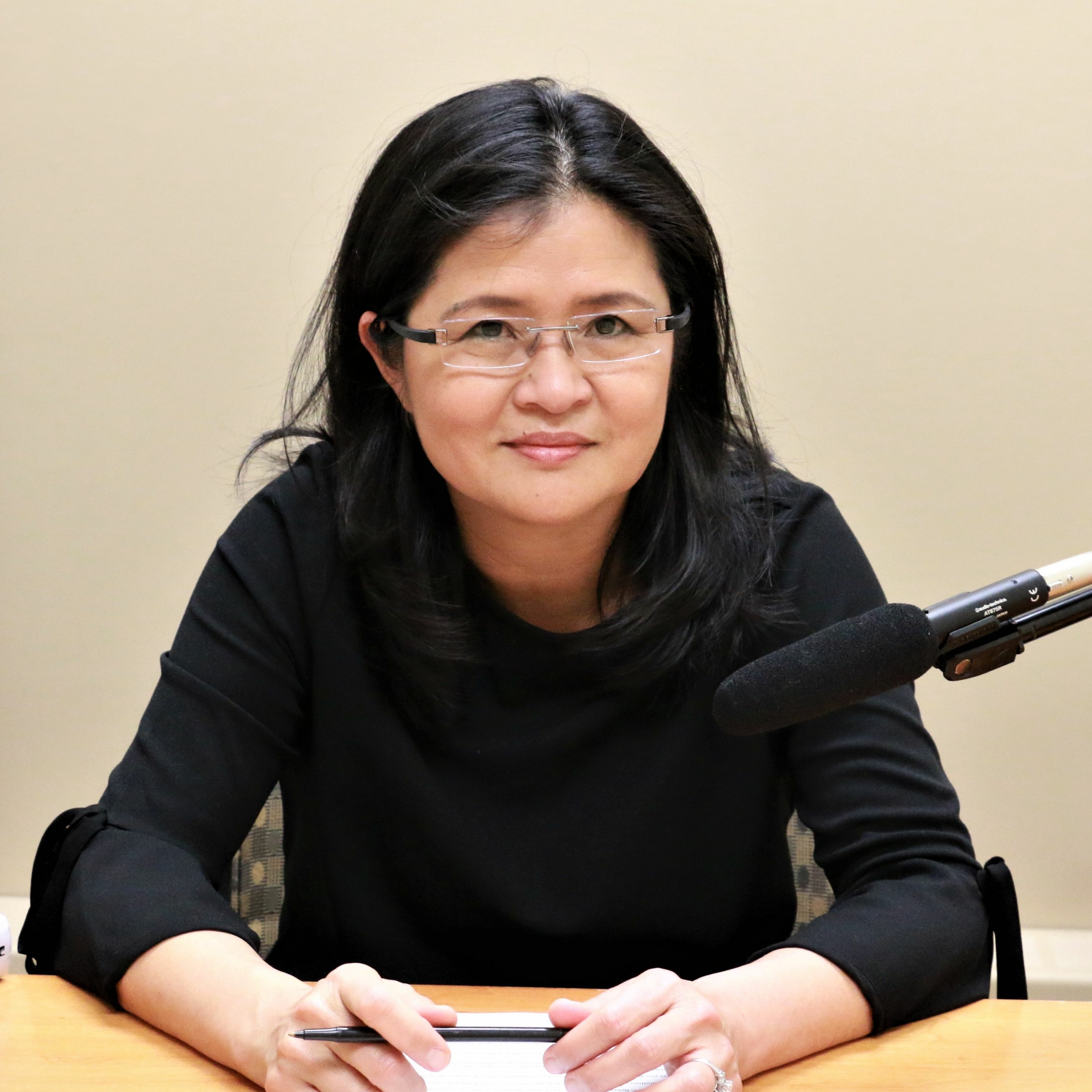
Welcome to CMS On Air, the podcast on migration and refugee issues brought to you by the Center for Migration Studies of New York. I'm Rachel Reyes, CMS's Director of Communications. The Kamai Rouge led by Marks of Leader Pol Pot, came to power in Cambodia in 1975. For four years, the regime emptied cities and forced virtually all of Cambodia's population into labor camps, where people were starved, overworked, tortured, and executed.
It is estimated that nearly two million people died. In this two-part series, Rachel Reyes speaks with author, chef, and manufacturer of Cambodian Foods, Chani Chi-Lox. In her memoir, Short Hair Detention, Chani chronicles the suffering her and her family endured under the Kamai Rouge. Only 13 years old when the Communists took over, Chani was torn away from her family and forced to work in remote labor camps.
She and her family were eventually resettled in Lincoln, Nebraska. Despite not knowing a word of English when she arrived to the United States at the age of 17, Chani quickly flourished, graduating high school, obtaining undergraduate degrees from the University of Nebraska-Lincoln, and earning a Master of Science in Applied Mathematics from Santa Clara University. She worked in Silicon Valley as an engineer in the aerospace and biotech industries for 30 years, before starting her own business, Anchor, Cambodian Food, and publishing her memoir. In this first episode of a two-part series, Rachel Reyes and Chani Chi-Lox discuss Chani's memoir and surviving under the Kamai Rouge in Cambodia.
Now here's her interview with Chani Chi-Lox. Hi, Chani. Thank you so much for joining us today. In 2017, you released your book Short Hair Detention, which describes your and your family's journey from Cambodia to the United States.
Your story is a harrowing account of violence under the Kamai Rouge, the agony of family separation, and survival. Fortunately, you and some of your family members were able to escape and emerge strong and successful after such a heartbreaking past. Why did you write the book? So I felt really good, like you saw Living the American Dream.
Every time my mom talked about things that happened during the genocide, I would always tell her, you know, mom, you should be proud. I think about that time. It's so sad. You came to this country, you have four children that she raised as a single mom, and she was a janitor, basically when she got here.
I couldn't get her to move forward. What I realized is that all my success beside all the things that people helped me to adapt to new country was the fact that she was there with me. She wasn't available to be in this country with me. I think it would be hard for me to be able to achieve all those.
When she passed away, I find it really hard to not think about what happened in the past. So she was the one that kind of protecting us from venturing into the past. And so I thought, well, I heard that people said, if you talk about it, you know, you're seeing a counselor or writing a book about it, it will help you get better and feel better. So I thought, well, maybe I complete my book that I started many years ago, my way of healing.
Would you share a bit about your time in Cambodia during the genocide? When it started the killing, I was just started my seventh grade and being 13 years old. We used to live in two-story brick home in the city, just like any city in the world. And the very next day, they activated us from our home and basically moving us to remote countryside to places that we never even heard of, to the environment that we only read in the book.
Everything was completely different. It was there that we experienced starvation. This is only like a month after they took over the country. And when I say starvation, our ration from the government basically reduced to one tablespoon of rice per person per day.
It was the experience that you never forget. You thought that with that little food, you would die soon, but you didn't. It's just a human body. It felt like your body consumed itself to live, to survive.
And as a surviving that condition, all you could think about was, please let me die because it's not something to live. This is just torture. I remember my roots have gone too far and they're not going to succeed because the world is not going to watch somebody, this too, the people starving, execution, threatening, the whole country turn into basically a jail. So when they starving us and they killed, I see all the dying around me, I thought for sure that somebody out there are going to stop this, but there's nothing happening.
They're starving, keep going on for days and weeks and two months. The feeling of starvation, you'll never forget physically, you feel like the crayon. Your internal stomach just twists and turns and grinding and just a ball of pain inside you. There's nothing you can do about it.
I honestly felt like that is something that I can explain, but something that to me more painful is to witness my family suffer through this as they may have witnessed how I suffer. Those are the things that you'll never forget. When I tell you about the pain, the crayon, it's almost like a story, but when I tell you how I see my little brother, he was nine years old and he never pleaded for extra. He's never cried.
He just endured quietly. And after the ration, he would get to the corner of the hut and just sit there quietly, look into the distance. That's the pain that when I share with you, it still bothered me. Can you tell me about the labor camps?
After the starvation, a couple weeks later, they basically moving all the children from their parents to different labor camps. And some of the labor camp that I was in, the condition was I felt like the way they treated us was an animal. At one point, we were deep into the jungle. Every morning, this is during the monsoon season, they would blow a whistle, getting every up before the sun came up.
And we would like zombie walking into the rain, cold, and then step into the deep water and walk through that deep water. Sometimes the water would come to our chest and just kind of walk through. And finally, we would get to the work site. And the work site is really small.
When I say work site, it's just a patch within the jungle that thin enough that we can clear to make land for planting. But really, it's not planting that they want. To me, it was labor. It was, you have to do this.
Because it wasn't efficient. It just took us like three or four hours to get there and working two or three hours without anything to eat. And then walk back for another good chunk of the day. And when we get back to our camp, it was dark and they would feed us with rice broth, with salted broth planted in the middle.
In my group, there's all the girls that are around that. And the broth is planted in the mud. And when we squat down to have our meal, the muds come above our angle. Always wet clothes.
And then we would walk through the cow manure, the mud in the mud and walk into a sleeping rack. I said, I was sleeping rack because they didn't build a place for us in that jungle. They build a place for the cattle. And above the cattle, they build, you know, under the grass roof, they build a rack.
That's where we go to sleep. So every night we sleep above the cattle. And sometime in the rain come and the wind blow, sideways, everything we had, we're sleeping in the rain. And I remember many times during that time, all I could think about was if I could see my mother one more time, I could die in peace.
And I remember that if I could just be strong enough and review the little ration they gave me, the suffering will be shortened, you know, we'll be gone. But then, you know, I thought of how my mom would feel if she lost a child. I actually imagined her agony just hurt for me to see that. So, you know, believe it or not, we all have a choice at that time to live or to die.
And I choose to live and pray that I live just a little longer so I can die in the comfort of my mom's arm and she wouldn't have closure. But you know, we survive. So that's how we get here today. There's so many other things that make me feel bad about what happened, girls that I had, for things that I wish I did it differently because it affected people's life.
But then other time it was about kindness. And when I talk about kindness, it's not like I'm starving people give me food. But it's like I'm starving and people reach out to me and say, how old are you? You know, because I was the youngest girl in the labor camp, one of the youngest girls.
And I keep losing weight so much that everywhere I walk and people thought, you know, it's like they think that I won't live very long. And that by that reaction, I was frightened. And when I was frightened that I won't live very long, it's always thinking about, well, I see my mom again, you know. And when I talk about the kindness is when people said, how old are you?
Because I just couldn't imagine such a young girl so skinny walking around like a skeleton. I would, you know, I would answer them and almost like taking advantage of the fact that they think I'm going to die so they're going to give me all of this, whatever they can have to keep me going. But then when they said, where are your parents? Because at that time I moved from camp to camp.
When they said that, I would cry. I would stop because I didn't think I could see my parents again. And those are the kind of kindness that made me cry. I never cry over heart labor or even starving.
The only time I remember crying is when somebody reached out. They were like an angel to me. So it's an experience that I felt like the deepest you go into something so terrible, you can also experience the most caring and loving that you may never experience otherwise. It's like the yin and yang.
Right? That's just some other thing that you know that happens. Thanks, Janne. Can you tell me the significance of the title of your book, Short Hair Detention?
What does it mean? When I finished the book, I was going to name the book, like, Love. Because a lot of things that I put in the book was a love between a daughter and a mom, which is between me and my mom. The expression, the feeling that I had with her.
How much she helped me to survive the things and how much I relive for each other. You know, her strengths. All the things that she encouraged us. But then I thought Short Hair Detention was something that I want to communicate to young adult, especially young girl.
I want to communicate to a young girl that preteen to say how significant it is when you have your freedom, when you have your choice. What's the meaning of freedom and what's not is the fact that even the length of your hair is being controlled by the government. It's like that's how much you don't have a choice. And for me, it was significant.
After the first starvation that we go through and the very first labor camp that I went to, they told us that all girls have to cut their hair. And being gone through sickness and starving and just being separate from my parents, I thought that it shouldn't matter how they want my haircut. It doesn't hurt me. But I felt that hope that I had someday that I might see my parent again was all vanished and was like, what else are they going to do?
Because I felt like they've done everything to destroy me. But then again, they're doing something to humiliate, to say you have no control of your body, even the length of your hair. You can't decide what to do with it. And that made me feel like I have no hope.
No hope of being myself, of being individual. But the other thing significant about naming the book that way is because when they lined up all my friends in the road to get the haircut, I'm not talking about hair salon. This is like a tree stump in the middle of nowhere with cast iron scissors. They told me that I didn't have to go in there because my hair was already short.
And now that instant I remember even when I was writing the book that I have a little bit of hope and even smile because at that instant I felt like they can't control us 100%. The situation doesn't let them humiliate me by making me sit there and cut my hair. The other thing about it is the picture that I had in front of the book was taken two months before the Camarouche took over. And in that picture my hair was already short.
And I lived through four years under the Camarouche regime. My hair never grow. Not even an inch. It was that malnutrition nutrition and starvation.
Not just to me, but the whole country was like a jail. Everybody, you know, if you ever go to on the internet and search for my Rouge victim and look at all the girls and all the women in there, they all have their hair short, not my choice. So that's how I choose the name of the book to be short hair detention. Now you go into further detail in your book about being separated from your family, your mother especially.
At the core of your story is your relationship with your mother, Chang Lee, who you call M. Family separation is receiving a lot of attention right now here in the United States. Where at the border the government has been forcibly taking children away from their parents. You've already spoken a bit about what it was like.
But can you tell me more about that experience and your thoughts on family separation? As a child, everything happened. You think it's going to be permanent. Maybe at the time to the parents they may think it's temporary, but to the child it's permanent.
So to me I think it's when I heard about the separation at the border, my first thought was like, who would make that procedure decide this is what we're going to do? If there's one mom in there, I think that probably have a hard time to approve that procedure. Because as a mom, as a parent, it has to be a better way than separating their children from their parents. Especially when they are new in a new environment.
Because it doesn't do any good or society any good to not welcome them. I'm thinking, you know, especially when that happened to me I was a young adult, was 13 years old. My goal now is to make sure that those young adult immigrant and refugees that came to this country, they may not go back to their country. This is going to be their country and their future.
As a person who experienced all their heart thing, I wanted to make sure that they feel welcome. And now, things that might happen to them we can't control, but what we can do is to make those people feel welcome. I hope that some of the things that I had been successful in this country will motivate them. Just because they come to the new country, they don't have to give up what they dream for.
You can tell that my English is still not good, I'm sure. But it's okay. It's okay. You don't have to be perfect in everything to try your best so you can reach your goal.
And that was one of my dream by continuing talking beside doing my food business to give everywhere I go to opening up that opportunity to share with them with everybody. For more information on Chanichi Labs, visit her at ChanichiLabs.com. Her memoir, Short Hair Detention is available for purchase on Amazon. CMS On-Air's The Music is provided by Danny Dabberstein and the Music Case.
Special thanks to Amy Chen for help with the production of this episode. To get more information on CMS's research, publications and events, visit us at CMSNY.org.