
EPISODE · Jun 3, 2026 · 17 MIN
Chapter 1
from Love in the Fall: A Novel · host Andrew Petiprin
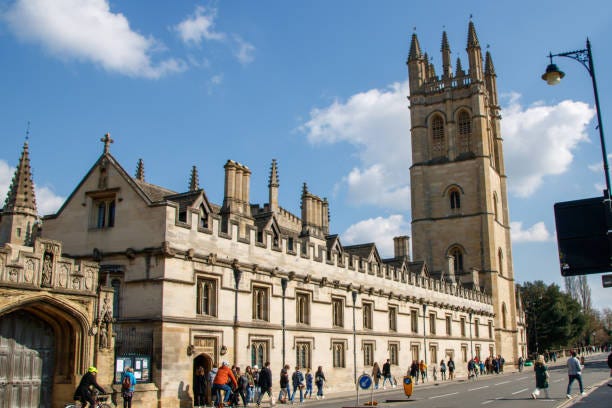
Part IChapter 1As the tower of Magdalen College, Oxford came into Daniel Perrin’s sight for the first time, he was daydreaming of Susan, whose name would have been a little old-fashioned for a woman of her generation, except she had a slight schoolmarm quality that had not yet found its purpose in childrearing. Susan’s parents had had respectable professional hopes for their only offspring, whom they raised in a small, prosperous Buckinghamshire village ten miles north of High Wycombe. Susan did A-Level English, French, Mathematics, and music – the last against her headmistress’ expressed wishes. After three years and a First-Class Honours degree in Politics, Philosophy, and Economics at St. Hilda’s College, Oxford, one stop past Magdalen over the bridge, Susan went home again, passed the civil service exam and began driving the M1 to the A4 to Constitution Hill every morning, passing through the security checkpoint at the Foreign and Commonwealth Office well before sunrise in the grey and golden months alike. As age twenty-two quickly became twenty-nine, her colleagues pitied her on the rare occasions when her simmering insecurity bubbled up and she fibbed about an ex-boyfriend in the RAF. “A Harrier pilot, you know.” She pretended to be officious, but no one feared her. In fact, everyone liked her. She was indispensable.Daniel was a romantic American who had imagined since adolescence standing on cobblestones in the Old World. He had wrongly assumed he would have to settle for the old-enough bricks of a city like Pittsburgh, which contrasted with the hermetically-sealed, air-conditioned silos of the southwest Florida suburbs where he had grown up. Daniel’s father Roger was a formidable failure whose fondness for cigarettes had transformed into a full-blown love affair after his second divorce and early retirement from the Pinellas County Sheriff’s Office. His smoking needs had caused him to self-select out of any professional opportunities requiring more than a few minutes’ time indoors, in the iron grip of newfangled anti-tobacco laws. “They actually think they can purify the whole world,” he told Daniel often, as the words rolled out of his mouth on billows of smoke, which he didn’t bother to exhale with any force.Working retail was Roger’s best option, and he got a job selling suits at J.C. Penney, where he took longer and more frequent breaks than his co-workers, who did not complain. He carried a pistol in an ankle holster in violation of the store’s employee handbook, which he was prepared to argue was in conflict with state law. The world being as it was, the store manager knew about Roger’s firearm and never addressed the matter, feeling a little safer with an old lawman roaming his sales floor. Roger regaled the stock boys with violent stories from the beat, and he had various explanations for the slight limp that took him off the police force and made him into a mall salesman. “I do what I want, boys. And it’s never the wrong thing. Never.”Roger spoke fluent French from adolescent years in Paris as a military brat, or, technically, a NATO brat. He implicitly projected to Daniel, his firstborn, a cosmopolitanism he assumed his progeny could never hope to attain. Despite Roger’s blue collar first career as a cop and subsistence-level second life in retail, he was proud to explain how he had turned his back on an elite intellectual life, crashing out of a Ph.D. program at the University of Maryland in 1977. “The political science department was full of Soviet sympathizers, son. Academia is no place for a man like me.”As a firstborn, Daniel took his father’s manly genius as challenge. Roger never dissuaded his son from the intellectual life. On the contrary. “The commies have temporarily receded into the woodwork, Daniel” – it was always Daniel, never Danny or Dan – “get in there and shake things up.” Daniel majored in French and spent lonely evenings in his dorm room dropping into AOL chatrooms full of aspiring European backpackers, whom he half-heartedly asked to let him tag along to Prague or Warsaw. He would often ask if people had read Hemingway’s A Moveable Feast, and he began to imagine meeting his soul mate on a train somewhere like Ethan Hawke did in Before Sunrise. But unlike Ethan Hawke, Daniel wouldn’t let his dream girl loose with some cockamamie plan to meet up again in a year. Then again, maybe meeting a girl could wait, and he would find out if there was a place for him with a super-secret intelligence service within the CIA like in Mission: Impossible.More seriously, Daniel treated life as a college student like a job, and his discipline was almost monkish. There was no shaking things up. He carried eighteen credits per term, and he rewarded himself for each day’s reading with VHS tapes of Woody Allen movies and solitary walks with cigarettes, which he felt the need to conceal from his father. Daniel knew Roger would not disapprove of the smoking. Rather, he was likely to judge his proficiency at it. Unlike his old man, Daniel loved to exhale with a great thrust, pushing the smoke out as a jet stream. Daniel stood just shy of six feet tall, which was a good three inches shorter than Roger, who was privately happy that his son had not exceeded him in stature. For his part, Daniel took it as a consolation that his nose was smaller than his father’s, and his eyes blue instead of green. Just before his college graduation, Daniel had shaved off his hopeless, sandy-colored goatee which matched his hair, parted neatly to the side since he was a little boy. He thought he might finally make a change to his style when he saw how the men looked in England. For all that Daniel disdained attention-seeking in others, he was, like Roger, prone to vanity.Daniel’s grades in college were nearly perfect, although he impressed no one in particular. He was surprised, therefore, to be called into the dean’s office and told to apply for two prestigious scholarships. Both awards paid for a graduate degree in the U.K. – one at Oxford, and the other one at Oxford or at any other British university. As it seemed like a pipe dream anyway, and France was where he was surely headed – destined, even – he thought he would make an experiment of refusing to apply for the Oxford-only one and agreeing to apply for the anywhere-one, but he would use it to choose Oxford. He pretended he liked the man whose name bore the second scholarship, Marshall, whereas the first one, Rhodes, was evil.When he was called for an interview at the British Embassy in Washington, he told one of the inquisitors, a thirty-something Indian-American scientist who was an alumna of the scholarship program, how he had just driven historic Route 40 through the Pennsylvania town where the scholarship’s namesake was born, and he admired the man deeply for what he did for Europe after World War II. The interviewer’s polite smile was betrayed by eyes that said, “this guy is a little odd. Not a lot odd.” Daniel thought, “That was dumb of me,” but the British ambassador was delighted. He examined Daniel’s transcript and when he noticed it contained various courses related to the Middle Ages, he asked him about Vlad the Impaler. Daniel panicked out of ignorance and changed the subject, volunteering the opening lines of Beowulf, then Sir Gawain and the Green Knight, both of which happened to be fresh in his mind but would soon leave his brain and never return. The fortieth of the forty scholarship awards, along with its accompanying automatic university entry, was offered to a young woman from California who decided to forgo Blighty and head straight to a prestigious American medical school. As the first alternate, Daniel was chosen instead. Susan, whose office was tasked with formally extending Her Majesty’s congratulations, left a scripted message on the answering machine Daniel shared with his roommate Erik, who was on his way off campus for good after spending his entire junior year trading music files with strangers on Napster. “Dude, some lady called. You got the England thing.”Just like that it would be England for Daniel. Roger would retain control of France.Before England came Washington, which Daniel reached belatedly because the airports had all been shut down three weeks prior. Consequently, Daniel had to fly from Tampa to Baltimore and then take a long taxi ride to meet the rest of his scholarship class for orientation. Each scholar was sent a pin with half Stars-and-Stripes and half Union Jack, and each was asked to wear it in his lapel or on her blouse or in some other prominent place on the business casual attire required as a “representative of your country, and a welcome guest in ours,” as the letter explained. Daniel reluctantly complied. His cab driver, Yusuf, said it was ok to smoke, so Daniel worked his way through half a pack of Kamel Reds all the way to Dupont Circle, where about a dozen students were having drinks in the bar of the Palomar Hotel and practicing to become masters of the shrinking universe which their grades and extracurriculars had almost qualified them to rule. Daniel decided he hated them all.Susan didn’t hate them all, but she resented the young women, elites seven years her junior, whom she perceived as marginally smarter and demonstrably prettier, or at least more put together than she was. Like them, she had never learned to cook. Unlike them, she had a small gap in her front teeth that was not unusual even among attractive people in Britain, but which would never have gone uncorrected in middle-class America. Susan was ginger, with a slim but not toned body. She applied makeup carefully but unadventurously, and she was imprecise and infrequent at shaving her legs.In an attempt to spruce herself up for her American debut, she had bought a new bra from a chain lingerie shop in the international terminal at Dulles Airport. She would soon experience its suffocating fit underneath the little black dress from Marks and Spencer that she always wore to semi-fancy dos. When Daniel entered the lobby of the Palomar, he was immediately met by a tall, smiling young man with thick, short dark hair, wearing penny loafers, khakis, and a blue and white Bengal stripe button-down. “Perino!” he exclaimed! “Daniel Perino, I’m Jonah Green. Join us for a drink! We heard you guys coming from the south would have more trouble getting here. I wonder if they’ll ever reopen Reagan. Or at least rename it,” he laughed. “It’s Perrin,” Daniel corrected him, noticing a subtle scar on his neck from a tracheotomy at some point in the past. Jonah was a Princeton man from a New York Jewish family that had settled in West Palm Beach before he was born. He did not raise the issue with Daniel of their common shallow roots in the Florida sand. Jonah had been interning on Capitol Hill that summer, and he made no secret of his intentions to find a way back there as quickly as he could with more credentials. To wit, he had strategically decided to do a master’s degree in the new Women’s Studies department at University College, London.Daniel propped up his suitcase and satchel against the wall next to the men’s room door before making his way to one of the two high, round tables, which had been pushed together to accommodate a group of five, now six. As Daniel maneuvered himself into the tall seat, a young man with thinning red hair and a babyface was holding court about cinema in between cigarillo puffs. His name was Sullivan Gallier of the great Louisiana Gallier family; but Sully had barely known his father, who disappeared into alcoholism and died under mysterious circumstances in Las Vegas. His mother heard little from her son’s wealthy relations, and she taught middle-school English for twenty years at the Academy of the Holy Name in uptown New Orleans. Sully was a lonely prodigy, graduating from high school at fifteen and Loyola University at eighteen. He was now on his way to Edinburgh, which he repeatedly promoted to his countrymen as one of the world’s most poetic cities. “I don’t buy it! The late 90’s were no golden age of cinema,” Sully declared. “Or if they were, a golden age is something we ought to be running away from, not praising. American Psycho, Fight Club, The Big Lebowski, they’re all so goddamn right wing. The Matrix is too of course, although I suspect we may realize it has a very different meaning someday. I can’t put my figure on it. But Beau Travail – now that’s a movie. It’s time we turn the gaze on men, I say. It’s a scandal that twenty-two out of forty of us here on this scholarship scheme are men. A scandal!” “The movies are all so irrelevant, really,” replied Jonah. “Except for these clever documentaries,” he added. “What a genius that Michael Moore is. Genius! He makes us laugh for two hours and sends us back to the parking lot ready to repeal the Second Amendment. Now there’s an example of art accomplishing something useful. Like Upton Sinclair!” As a lull formed between the pronouncements of Sully and Jonah, Daniel began to wind up a half-hearted defense of the movies Sully had criticized. All he could muster was a mumbling, “Well, I don’t know…I think,” when the din of a fire alarm suddenly drowned him out. America was on edge, and cities like Washington particularly so. None of the well-formed young people like Daniel would yet concede the possibility of a widespread terrorist threat from any particular group of people. But even being on the right side of the matters of the day, awful things could happen to anybody. As the siren continued to blare, the hotel restaurant emptied and guests began pouring down the stairs from their suites to the lobby and out through the front doors. A stampede had begun. Jonah, Sully, and the rest of the party at the high-top tables jumped up and darted fifteen feet to the exit. Daniel stood up more slowly in defiance of his panicky peers, and he began to walk leisurely to the door. Suddenly remembering his bags by the men’s room, he turned around quickly, walking straight into an oncoming redhead in a bathrobe, who knocked him through the door and off his feet. Daniel lay prostrate on the sidewalk. Susan was on top of him. Get full access to Andrew Petiprin at andrewpetiprin.substack.com/subscribe
NOW PLAYING
Chapter 1
No transcript for this episode yet
Similar Episodes
Mar 26, 2026 ·1m
Mar 19, 2026 ·34m
Feb 18, 2026 ·11m
Feb 11, 2026 ·45m