
EPISODE · Jan 28, 2026 · 20 MIN
CHAPTER 11: THE GREAT SYNAGOGUE – HOUSE OF PRAYER MEDIEVAL JEWISH QUARTER OF ZARAGOZA
from Judería medieval Zaragoza/Jewish quarter Zaragoza
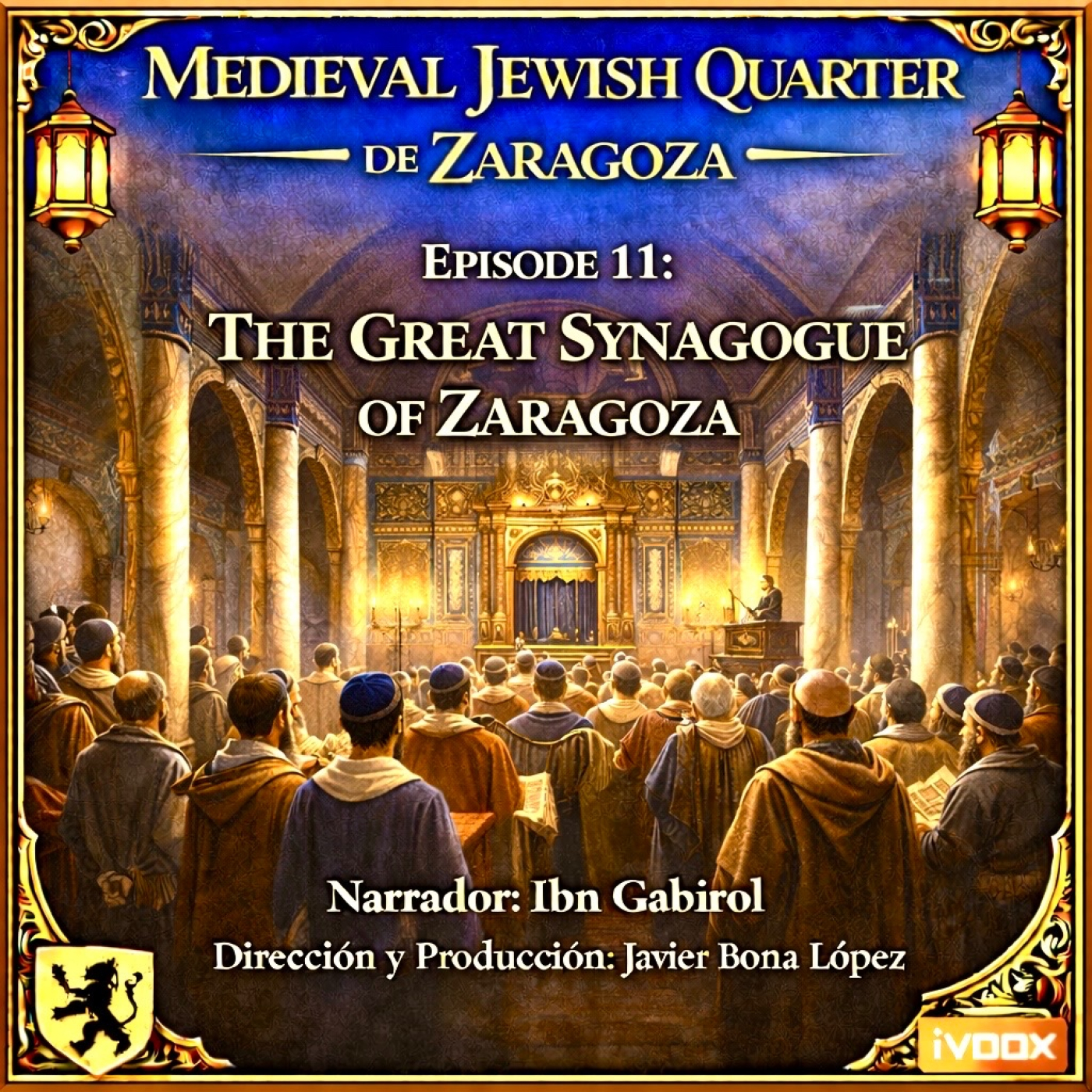
CHAPTER 11: THE GREAT SYNAGOGUE – HOUSE OF PRAYER MEDIEVAL JEWISH QUARTER OF ZARAGOZA Narrator: Ibn Gabirol Direction and Production: Javier Bona López Documentation and Advisory: Miguel Ángel Motis Dolader (San Jorge University of Zaragoza) In this chapter, Ibn Gabirol opens for us the doors of the most sacred place of the Jewish aljama of Zaragoza: the Great Synagogue, the Heichal Hagadol, the epicenter of the spiritual, intellectual, and communal life of Zaragoza’s Jews for centuries. Located on the site where the Seminary of San Carlos Borromeo now stands, the Great Synagogue was probably built in the 12th century, during the period of greatest prosperity of the Jewish quarter under the rule of the Banu Hud. Its first documented mention dates from 1311, but its foundations are much older, bearing witness to a community that had taken deep roots in Saraqusta. Architecture and Decoration The synagogue followed the basilica-type design typical of the great synagogues of Sefarad: three naves, with the central nave higher and wider, allowing clerestory light to flood the sacred space. Built of brick, plasterwork, and fine wood, it was a masterpiece of Mudéjar art. Its ceiling, richly decorated with “many labors,” according to the chronicler Diego de Espés (1596), was adorned with gilded muqarnas that imitated the vault of heaven. The mosaic floor was not mere decoration, but a visual language representing the harmony of the universe and the perfection of divine order. Yet the true decoration of the temple lay in the Word: large Hebrew characters in blue and red ran around the perimeter of the prayer hall, with verses from the Psalms and passages from the Prophets that guided the soul toward Jerusalem. The Sacred Foci Two architectural elements defined the spiritual geography of the temple: The Hejal (Aron HaKodesh): The Holy Ark, set into the eastern wall facing Jerusalem, housed the Sefer Torah, the scrolls of the Law. These scrolls, written in sacred ink on fine parchment by devoted scribes, were adorned with silver crowns (atarot), pomegranate-shaped finials (rimmonim), silver pointers (yad), and embroidered mantles (me’ilim) donated by the women of the community. The Bima (Tevah): An elevated platform in the center of the main nave, built of rammed earth and iron, from which the Torah was read and the ordinances of the aljama were proclaimed. It was the civic and spiritual center of the community, a place of power and responsibility. Liturgical Life Ibn Gabirol transports us to a Sabbath morning in a synagogue filled with worshippers. He makes us hear the voice of the hazzan chanting the Barchu, the Shema, and the Lecha Dodi; the aroma of Arabian incense, Ethiopian myrrh, and Indian aloes; the sound of parchment being unrolled; the melodic reading of the Torah in te’amim; and the choral responses of the congregation. It was a moment of communion with the ancestors, with history, with God, but also of communal unity. More Than a Temple The Great Synagogue was also a place of constant learning. In the bet midrash, students studied the Torah and the Talmud using the method of pilpul, debating and probing deeply into the sacred texts. On festival days (Pesach, Shavuot, Sukkot), the temple was transformed into a place of celebration, with special aromas, songs, and decorations. Mutual aid and charitable brotherhoods had their headquarters in the synagogue or nearby, caring for the sick, burying the dead, helping widows and orphans, and educating poor children. The End and Memory After the Edict of Expulsion of 1492, the synagogue was abandoned. In 1557, the Jesuits purchased it and consecrated it as a Christian chapel under the dedication of Our Lady of Bethlehem. In 1574, it was demolished to build the church of San Carlos Borromeo. No visible remains of the Great Synagogue survive, but its spirit lives on in the documents studied by historians such as Miguel Ángel Motis Dolader and Asunción Blasco Martínez, in the memory of the city, and above all in the faith of the Jewish people who, despite expulsions and persecutions, continue to recite the same prayers, study the same Law, and await the same redemption. Ibn Gabirol invites us to pause in the square of San Carlos Borromeo, close our eyes, and imagine a three-aisled temple with a gilded wooden ceiling, walls covered with Hebrew inscriptions, the glow of the Menorah, and the scrolls of the Law clothed in silver and silk. A house of prayer, a house of wisdom, a house of life. That was the Great Synagogue. And though its stones have disappeared, its memory is eternal. CREDITS AND SOURCES Narrator: Ibn Gabirol Direction and Production: Javier Bona López Documentation and Advisory: Miguel Ángel Motis Dolader (San Jorge University of Zaragoza) Main Sources: • Asunción Blasco Martínez. La Judería de Zaragoza en el siglo XIV. Instituto Fernando el Católico (IFC), 1988. • Asunción Blasco Martínez. Instituciones Sociorreligiosas Judías de Zaragoza (Siglos XIV-XV). Sinagogas, Cofradías, Hospitales. University of Zaragoza. • Miguel Ángel Motis Dolader. La judería de Zaragoza: Centro de la vida económica y social. Rolde de Estudios Aragoneses. • Miguel Ángel Motis-Dolader, Ana Ruiz-Varona, Lourdes Pérez-López. Urban Morphology and Functional Hierarchy of the Jewish Quarter of Zaragoza (Spain) at the End of the Fifteenth Century. Journal of Urban History, 2023. • Ángel Canellas López. La Judería Zaragozana. Cuadernos de Zaragoza, no. 2, 1974. • Asunción Blasco Martínez & Susana Lozano Gracia. La Judería de Zaragoza – Paso a Paso. Zaragoza City Council, 2023. • Sefarad Aragón. La desaparecida judería de Zaragoza. Self-published, 2010. • Leopoldo Torres Balbás. Studies on the Jewish quarter of Zaragoza and its baths. • Cultural Heritage of Aragon. Institutional records. • Guide to the Jewish Quarter of Zaragoza. Zaragoza City Council. • Zaragoza Municipal Archive (AMZ). Historical maps. Final Note If you enjoyed this chapter, I invite you to share it and help spread the word. You can also listen to our other series on the medieval Jewish quarters of Calatayud, Tarazona, and Híjar on the three main podcasting platforms. Zakhor. Remember. Shalom. © Series: Medieval Jewish Quarter of Zaragoza Production: Javier Bona López
NOW PLAYING
CHAPTER 11: THE GREAT SYNAGOGUE – HOUSE OF PRAYER MEDIEVAL JEWISH QUARTER OF ZARAGOZA
No transcript for this episode yet
Similar Episodes
No similar episodes found.
Similar Podcasts
No similar podcasts found.