
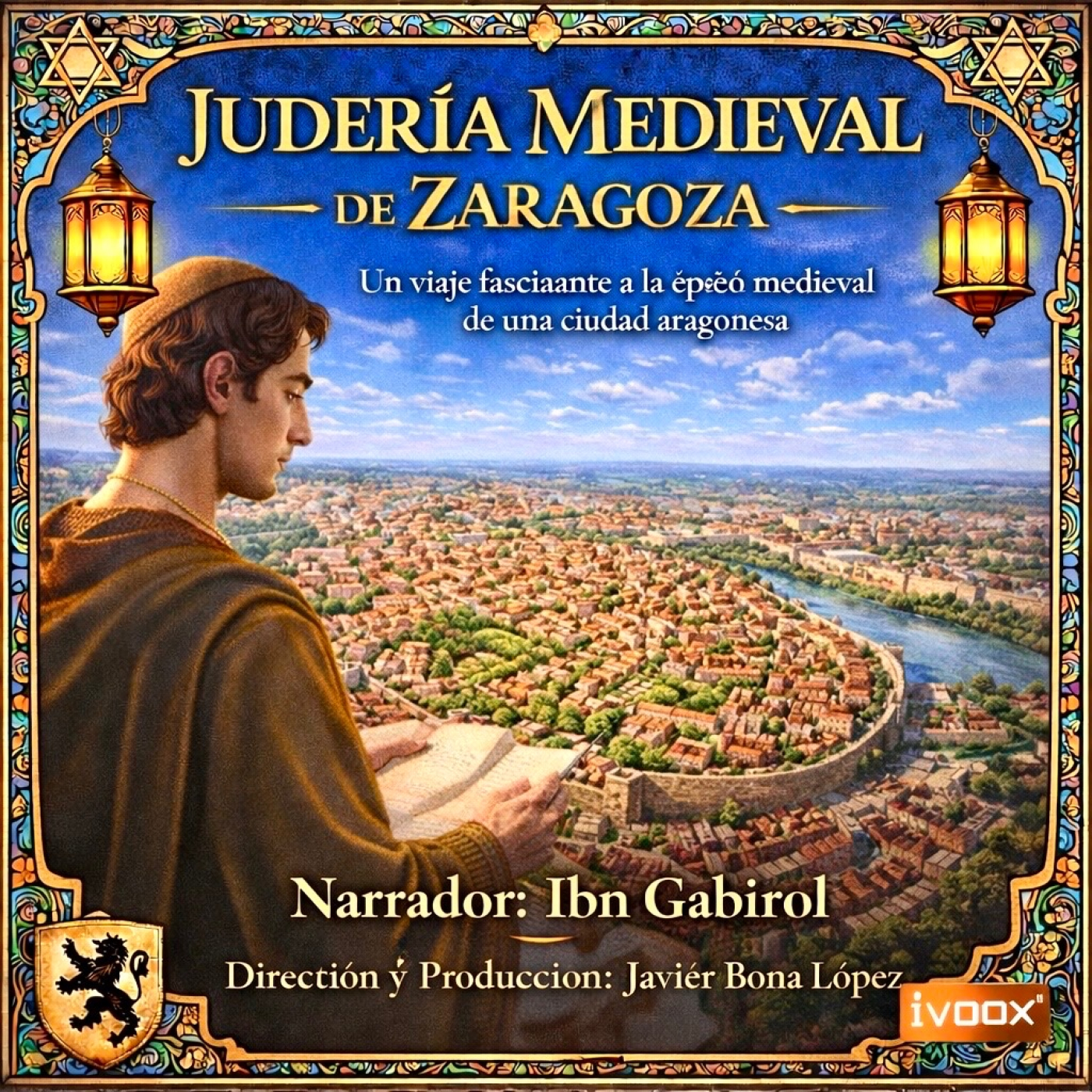
PODCAST · society
Judería medieval Zaragoza/Jewish quarter Zaragoza
by Javier Bona
Judería Medieval Zaragoza/Jewish Quarter Zaragoza Judería Medieval de Zaragoza: Un Viaje Sonoro a Través del Tiempo Sumérgete en las calles, los sonidos y las historias de una de las comunidades judías más importantes de la España medieval. Bienvenido a "Judería Medieval de Zaragoza", una serie podcast que te transportará a un mundo perdido en el tiempo. De la mano de nuestro narrador, el poeta y filósofo Shelomó ibn Gabirol (1021-1058/70), caminaremos por las estrechas calles de la aljama zaragozana, desde sus raíces en la Caesaraugusta romana hasta su esplendor en el siglo XV. Este no es solo un documental histórico; es una experiencia inmersiva y sonora diseñada para resucitar las voces, los aromas y las emociones de quienes vivieron en este enclave único. Cada episodio es un viaje a través de los siglos, explorando no solo los grandes acontecimientos, sino también la vida cotidiana, las creencias y las pasiones de sus habitantes. ¿Qué descubrirás en esta serie? • Filoso
-
74
JUDERÍA MEDIEVAL DE ZARAGOZA: UN VIAJE SONORO A TRAVÉS DEL TIEMPO
JUDERÍA MEDIEVAL DE ZARAGOZA: UN VIAJE SONORO A TRAVÉS DEL TIEMPO
-
73
MEDIEVAL JEWISH QUARTER OF ZARAGOZA: A SONIC JOURNEY THROUGH TIME
MEDIEVAL JEWISH QUARTER OF ZARAGOZA: A SONIC JOURNEY THROUGH TIME Beneath the stones of Zaragoza… there is a secret. A thousand years of history buried beneath the asphalt. A thousand years of voices no one wanted to hear. There was a time when these streets had other names— when the world’s knowledge was written in Hebrew, in Arabic, in Romance; when physicians, philosophers, and poets built a civilization that all of Europe admired… and feared. They were the Jews of Sepharad. And they lived here. In Zaragoza. For more than a thousand years. Until one morning in 1492, they closed their doors for the last time— and took the keys with them. What happened in those streets? Who were those men and women? What secrets still sleep beneath the Roman Theatre? Now, for the first time, their voices return. Medieval Jewish Quarter of Zaragoza. A sonic journey through time. On iVoox. Narrated by Solomon Ibn Gabirol. Directed and Produced by Javier Bona López. Zakhor. Remember. Serie Description Immerse yourself with us in the streets, sounds, and stories of one of the most important Jewish communities in medieval Spain. Welcome to “Medieval Jewish Quarter of Zaragoza”, a podcast series that will transport you to a world lost in time. Guided by our narrator—the poet and philosopher Shelomó ibn Gabirol (1021–1058/70)—we will walk through the narrow streets of Zaragoza’s Jewish aljama, from its roots in Roman Caesaraugusta to its height in the fifteenth century. This is not just a historical documentary; it is an immersive, sound-driven experience designed to bring back the voices, aromas, and emotions of those who lived in this unique enclave. Each episode is a journey across the centuries, exploring not only major events but also daily life, beliefs, and the passions of its inhabitants. What will you discover in this series? • Philosophy and Spirituality: Meet sages such as Bahya Ibn Paquda and his timeless work, Duties of the Heart. • Stories of Love and Conversion: Discover the extraordinary story of Eleazar, the Carolingian deacon who abandoned everything for love of a Jewish woman. • Architecture and Urban Planning: Explore the structure of the Old and New Jewish Quarters, their walls, six gates, and synagogues. • Daily Life: Feel the pulse of the market, the silence of the ritual baths (mikveh), and the solemnity of the rabbinical court (Bet Din). • Historical Context: From Roman and Visigothic Zaragoza, through Muslim Saraqusta, to the Christian conquest and the Inquisition. …and much more. With exceptional historical rigor—based on archival documentation and expert guidance—this series is an act of memory (Zakhor) to honor a legacy that still lives beneath the stones of today’s Zaragoza. The series “Medieval Jewish Quarter of Zaragoza” revives the city’s Jewish memory on iVoox in podcast format. The iVoox platform hosts the documentary podcast series “Medieval Jewish Quarter of Zaragoza,” directed and produced by Javier Bona López—an ambitious public-history project that reconstructs, with rigor and immersive storytelling, the life, urban fabric, institutions, and spirituality of Zaragoza’s Jewish community from the Middle Ages to the expulsion of 1492. Narrated by the historical figure Ibn Gabirol (Shelomó ibn Gabirol, 1021–1058/70), the series combines academic research, archival documentation, and sound recreation to take listeners through the Old Jewish Quarter, the New Jewish Quarter, the Castle of the Jews, the Great Synagogue, the Alcaicería, the mikveh, access gates, festivals such as the Purim of Zaragoza, and major spiritual landmarks such as the Shema. With historical advising by Miguel Ángel Motis Dolader (Universidad San Jorge, Zaragoza), the series is grounded in documentary sources, specialized bibliography, and recent studies on urban morphology, communal institutions, and coexistence in medieval Zaragoza. This project belongs to Javier Bona López’s broader effort to recover Jewish memory in Aragón, alongside other series such as Medieval Jewish Quarter of Tarazona, Híjar, and Calatayud, consolidating one of the most comprehensive public-history podcast initiatives on medieval Aragonese Judaism. The Series Combines (English) • Historical and documentary research • Urban and heritage reconstruction • Immersive first-person narrative • Sound recreation and dramatization • Accessible outreach for a broad audience Project Objectives (English) • To recover the historical memory of Zaragoza’s Jewish aljama • To share Zaragoza’s Sephardic/Judeo-Spanish heritage • To contribute to cultural tourism and heritage education • To bring medieval history to a general audience through podcasting • To highlight Zaragoza’s role as one of the great Jewish centers of the Crown of Aragón Main Thematic Axes (English) • Urban structure of the Jewish quarter (Old and New Quarters) • Communal institutions (Bet Din, self-government) • The Castle of the Jews as a functional center • The Great Synagogue and religious spaces • Mikveh and ritual practice • Gate systems and urban control • The Alcaicería and the luxury economy • Spirituality: the Shema, prayer, religious life • Festivals: Purim of Zaragoza • Conflicts, pogroms, and expulsion • Memory, diaspora, and the Sephardic legacy Methodology (English) • Use of specialized academic bibliography • Consultation of historical documentation • Integration of urban and archaeological studies • First-person historical narration • Outreach language with scientific precision • Archaeological excavations Target Audience (English) • General audiences interested in history • Teachers and students • Researchers and public historians • Cultural and heritage tourism • Sephardic communities and diaspora • Listeners of historical podcasts Value of the Series • A local focus with international reach • Integration of urban, social, and religious history • Immersive and emotional format • Potential for cultural routes, apps, guides, and museum projects CREDITS (English) • Narrator: Ibn Gabirol (Shelomó ibn Gabirol) • Direction and Production: Javier Bona López AUTHOR BIOGRAPHY Ignacio Javier Bona López is an archaeologist, historian, and cultural communicator. He has dedicated decades to the protection, dissemination, and recovery of Sephardic-Jewish heritage in Aragón, especially in Tarazona and Calatayud. For many years he served as President of the Centro de Estudios Turiasonenses, and he has been a coordinator of branches of the Institución Fernando el Católico, as well as Managing Director of the Tourism Board of the Diputación Provincial de Zaragoza. He was also President of Tarbut Sefarad Calatayud and a founding member of the Asociación de Amigos de la Cultura Judía de Tarazona Moshe de Portella. In addition, he coordinated the “Espacio Sefarad” initiative at the Diputación de Zaragoza and has collaborated with media outlets including Heraldo de Aragón, Aragón Radio, El Periódico de Aragón, and Radio SER Tarazona, among others. Bona López has promoted innovative projects in visual and historical reconstruction using new technologies—such as Histories of Calatayud and Tarazona in a Few Minutes—through his YouTube, Facebook, and Instagram channels, as well as podcast series including Desde Calatayud: Voces de Sefarad, Medieval Jewish Quarter of Tarazona, Medieval Jewish Quarter of Híjar, and Medieval Jewish Quarter of Zaragoza on iVoox. This podcast is part of his lifelong commitment to giving voice to the silenced stories of history. He is also the author of several works dedicated to recovering forgotten voices, including The Medieval Jewish Quarter of Tarazona, The Jewish Quarter of Calatayud: 16 Stories Between Stone and Word, Artificial Intelligence Applied to Heritage, Maderuela: Echoes of Moncayo, The Last Rabbi of Sepharad: Isaac ben Moses Arama Between Torah, Kabbalah and Philosophy, and The Digital Archaeologist of Bílbilis—all available on Amazon. Shalom.
-
72
CAPÍTULO 34: EL LEGADO PERDURABLE – ARQUEOLOGÍA JUDÍA MEDIEVAL EN LA MEMORIA DE ZARAGOZA
CAPÍTULO 34: EL LEGADO PERDURABLE – ARQUEOLOGÍA JUDÍA MEDIEVAL EN LA MEMORIA DE ZARAGOZA Narrador: Shelomó ibn Gabirol Dirección y Producción: Javier Bona López El capítulo final de la serie Judería Medieval de Zaragoza constituye una reflexión profunda sobre la memoria histórica de la comunidad judía zaragozana y sobre el papel de la arqueología en la recuperación de ese pasado. Narrado simbólicamente por la voz del poeta y filósofo medieval Shelomó ibn Gabirol, el episodio cierra el recorrido iniciado a lo largo de más de 35 dedicados a reconstruir la vida intelectual, religiosa y social de la aljama judía de Zaragoza. El relato sitúa al oyente en un escenario contemporáneo: una excavación arqueológica en el corazón de la ciudad moderna. Allí, bajo capas de tierra y de historia, permanece enterrada la memoria material de una comunidad que habitó Zaragoza durante más de mil años. El episodio plantea una pregunta fundamental: ¿qué queda hoy de aquella civilización sefardí que floreció en la ciudad medieval? La respuesta se encuentra en la arqueología urbana, una disciplina que permite reconstruir el pasado mediante el estudio de los estratos del suelo, los restos arquitectónicos y los objetos cotidianos. En una ciudad como Zaragoza —antigua Caesaraugusta romana, posteriormente ciudad islámica y más tarde capital del reino de Aragón— el subsuelo funciona como un auténtico palimpsesto histórico. Cada capa de tierra corresponde a una época distinta y revela aspectos de la vida de sus habitantes. El capítulo describe con detalle el método arqueológico: la excavación estratigráfica, el registro minucioso de cada hallazgo, la documentación fotográfica y el posterior trabajo de laboratorio. Fragmentos de cerámica, restos de estructuras domésticas, huesos de animales o utensilios metálicos se convierten en pistas que permiten reconstruir la vida cotidiana de las comunidades medievales. Sin embargo, la arqueología urbana presenta un desafío particular: la dificultad de identificar qué restos pertenecieron específicamente a judíos, cristianos o musulmanes. La mayoría de los objetos cotidianos no reflejan una identidad religiosa clara. Las cerámicas, los utensilios domésticos o las técnicas constructivas eran compartidos por las diferentes comunidades que convivían en la ciudad medieval. Por ello, los arqueólogos advierten contra la tentación de atribuir automáticamente carácter judío a cualquier hallazgo dentro del antiguo barrio hebreo. Investigadores como Miguel Beltrán Lloris o Juan Ángel Paz Peralta han señalado que la identificación arqueológica de la presencia judía solo puede realizarse con cautela y mediante la combinación de evidencias materiales y documentación histórica. A pesar de estas dificultades, en ocasiones aparecen hallazgos excepcionales que sí contienen marcadores claros de identidad. Entre ellos destaca una lucerna tardoantigua decorada con la escena bíblica de los exploradores de Canaán transportando un enorme racimo de uvas, una iconografía vinculada al relato del Libro de los Números. Este pequeño objeto constituye uno de los testimonios más antiguos de la presencia judía en la Zaragoza tardorromana. Otro hallazgo significativo es un fragmento cerámico con una estrella de seis puntas —el Maguén David— aparecido en el área de la antigua judería. Aunque el símbolo no siempre tuvo un significado exclusivamente judío en la Edad Media, su presencia en este contexto refuerza la identificación cultural del barrio. Especialmente conmovedor resulta el descubrimiento de un fragmento de janukiá, el candelabro utilizado durante la festividad de Janucá. Encontrado en un estrato fechado tras la expulsión de 1492, el objeto evoca el momento traumático del final de la presencia judía en la ciudad y plantea interrogantes sobre su contexto: ¿pertenecía a una familia que se preparaba para el exilio? ¿Fue ocultado por conversos que continuaban practicando su fe en secreto? Uno de los espacios arqueológicos más reveladores para el estudio de la judería zaragozana es el área del Teatro Romano de Zaragoza. Descubierto accidentalmente en 1972, este edificio monumental de época augustea había quedado abandonado en el siglo III. Durante la Edad Media, sus robustas estructuras sirvieron de base para la expansión urbana, y el barrio judío se desarrolló literalmente sobre sus antiguas gradas. Las excavaciones en este sector han proporcionado una gran cantidad de información sobre la vida cotidiana de la judería medieval. Los pozos ciegos y vertederos domésticos han conservado restos orgánicos y cerámicos que permiten reconstruir aspectos de la dieta, el comercio y las prácticas domésticas de la comunidad. El estudio de huesos animales ha revelado patrones de consumo compatibles con las normas alimentarias del Kashrut, lo que refuerza la identificación cultural del área. Entre los objetos recuperados destaca una escudilla del siglo XIV decorada con el escudo del Reino de Aragón, un símbolo que refleja la compleja identidad de los judíos aragoneses: fieles a su religión, pero plenamente integrados en la estructura política del reino. El capítulo subraya que la verdadera reconstrucción del pasado solo es posible mediante la colaboración entre arqueólogos e historiadores. Los documentos conservados en archivos medievales —protocolos notariales, registros fiscales, testamentos o contratos de compraventa— permiten identificar los nombres de familias, oficios y propiedades. Cuando estas fuentes documentales coinciden con hallazgos arqueológicos, la historia adquiere una dimensión tangible. Más allá de los objetos y las estructuras, el episodio insiste en que el legado más importante de la judería de Zaragoza es intangible. Se encuentra en la filosofía, la literatura y la espiritualidad desarrolladas por pensadores sefardíes. Entre ellos destacan figuras como Bahya ibn Paquda, autor de Los deberes de los corazones; el místico Abraham Abulafia, creador de la cábala profética; y el filósofo Hasdai Crescas, cuya crítica al aristotelismo influyó posteriormente en el pensamiento de Baruch Spinoza. Este legado intelectual sobrevivió al exilio de 1492 y continuó desarrollándose en comunidades sefardíes del Mediterráneo, especialmente en ciudades del Imperio Otomano como Salónica o Estambul, donde los exiliados mantuvieron su lengua —el judeoespañol— y sus tradiciones culturales. El episodio concluye con una reflexión sobre el significado de la memoria histórica. La arqueología puede recuperar objetos y estructuras, pero la verdadera preservación del pasado depende de la transmisión cultural y del recuerdo colectivo. El mandato hebreo Zakhor —recordar— se convierte así en el eje simbólico de toda la serie. El legado de la judería de Zaragoza no reside únicamente en las piedras enterradas bajo la ciudad moderna, sino en la continuidad de una tradición intelectual y cultural que sigue influyendo en el mundo contemporáneo. CRÉDITOS Narrador: Shelomó ibn Gabirol Dirección y Producción: Javier Bona López Documentación y asesoramiento histórico: Miguel Ángel Motis Dolader Zhakor Shalom FUENTES DOCUMENTALES Archivos • Archivo Histórico Provincial de Zaragoza (AHPZ) • Archivo de la Corona de Aragón (ACA) • Archivo Municipal de Zaragoza • Responsa rabínicos medievales relacionados con comunidades aragonesas Fuentes históricas medievales • Crónicas del Reino de Aragón • Documentación notarial de la judería de Zaragoza • Literatura filosófica hebrea medieval BIBLIOGRAFÍA (ESPAÑOL) • Beltrán Lloris, Miguel. El Teatro Romano de Caesaraugusta. Zaragoza: Ayuntamiento de Zaragoza, 2009. • Hernández Pardos, Antonio; Motis Dolader, Miguel Ángel; Franco Calvo, Jesús G. “El estudio de la cultura material de las juderías de Aragón: arqueología urbana y patrimonio sefardí”. Arqueología y Territorio Medieval, 26 (2019), pp. 225-250. • Motis Dolader, Miguel Ángel. Los judíos de Aragón en la Edad Media. Zaragoza: CAI, 1990. • Paz Peralta, Juan Ángel. “Arqueología de la judería de Zaragoza”. Jornadas de Arqueología Medieval, Zaragoza, 2005. • Blasco Martínez, Asunción. Los judíos del Reino de Aragón en la Edad Media. Zaragoza: Institución Fernando el Católico. Shalom
-
71
CHAPTER 34: THE ENDURING LEGACY – MEDIEVAL JEWISH ARCHAEOLOGY IN THE MEMORY OF ZARAGOZA
CHAPTER 34: THE ENDURING LEGACY – MEDIEVAL JEWISH ARCHAEOLOGY IN THE MEMORY OF ZARAGOZA Narrator: Ibn Gabirol Direction and Production: Javier Bona López The final chapter of the series Medieval Jewish Quarter of Zaragoza reflects on the enduring legacy of the Jewish community that lived in the city for more than a millennium. Narrated symbolically by the voice of the medieval philosopher and poet Shelomó ibn Gabirol, the episode serves as a closing meditation on history, archaeology, and collective memory. The narrative begins in the present day at an archaeological excavation site in the heart of modern Zaragoza. Beneath the contemporary city lies a complex stratigraphy of civilizations: Roman, Islamic, Jewish, and Christian. This layered urban landscape preserves fragments of a community that played a fundamental role in the intellectual and economic life of medieval Aragón. The chapter raises a central question: what material traces remain of the Jewish community of Zaragoza? Unlike monumental civilizations that left large temples or palaces, the Jewish presence in the city is often revealed through subtle archaeological evidence—domestic objects, fragments of pottery, architectural remains, and waste deposits from medieval households. Urban archaeology therefore becomes a crucial tool for reconstructing the past. In cities with continuous occupation such as Zaragoza—ancient Caesaraugusta—archaeologists must carefully excavate the soil layer by layer. Each stratigraphic level corresponds to a different historical moment. Through meticulous documentation, photography, and laboratory analysis, even the smallest fragment can provide valuable information about daily life in the medieval city. However, identifying specifically Jewish material culture presents a major challenge. Many objects used in everyday life were shared by Christians, Muslims, and Jews. Ceramics, household utensils, and construction techniques were often produced in the same workshops and used across religious communities. Because of this, archaeologists emphasize the need for caution when attributing artifacts to a specific cultural or religious group. Scholars such as Miguel Beltrán Lloris and Juan Ángel Paz Peralta have stressed that archaeological interpretation must combine physical evidence with written historical sources. Only through this interdisciplinary approach can the presence of the Jewish community be confirmed with confidence. Despite these challenges, certain discoveries offer clear markers of Jewish identity. One remarkable artifact is a Late Antique oil lamp decorated with the biblical scene of the explorers of Canaan carrying a giant cluster of grapes. This motif, derived from the Book of Numbers, provides one of the earliest visual indications of Jewish presence in late Roman Zaragoza. Another significant discovery is a ceramic fragment bearing a six-pointed star, the symbol later known as the Star of David. Although the symbol did not always function exclusively as a Jewish emblem during the Middle Ages, its appearance in the context of the Jewish quarter strongly suggests a cultural connection. Perhaps the most emotionally evocative artifact is the fragment of a Hanukkah lamp discovered in a stratigraphic layer dated shortly after the year 1492. This object evokes the dramatic moment of the expulsion of the Jews from Spain. It may have belonged to a family preparing for exile, or perhaps to a converso who secretly continued to observe Jewish rituals in private. One of the most important archaeological contexts for understanding the medieval Jewish quarter is the area surrounding the Roman Theatre of Zaragoza. Discovered accidentally in 1972, this monumental structure from the Augustan period had long been buried beneath the medieval city. After the theatre fell into disuse during the third century, its massive concrete structures were reused as foundations for later buildings. During the Middle Ages, the Jewish quarter developed directly above the ruins of the theatre. Houses were constructed following the semicircular shape of the ancient stands, creating a unique urban layout. Excavations in this area have yielded important insights into everyday life in the Jewish neighborhood. Domestic refuse pits have preserved organic remains that allow researchers to reconstruct diet and consumption patterns. Analysis of animal bones suggests adherence to dietary practices consistent with the laws of Kashrut, providing indirect evidence of Jewish cultural identity. Among the artifacts recovered is a fourteenth-century bowl decorated with the coat of arms of the Kingdom of Aragón. This object symbolizes the complex identity of the Jewish inhabitants of Zaragoza: members of a distinct religious community, yet deeply integrated into the political and economic structures of the Aragonese kingdom. The chapter also emphasizes the importance of combining archaeological findings with documentary sources. Medieval archival records—including notarial contracts, tax registers, and wills—provide detailed information about the families, professions, and properties of the Jewish community. When archaeological discoveries correspond with documented locations mentioned in these records, the historical reconstruction becomes far more precise. Beyond the physical remains uncovered through excavation, the episode stresses that the most enduring legacy of the Jewish community of Zaragoza is intellectual and spiritual. Medieval Aragón produced influential Jewish thinkers whose works shaped both Jewish and European philosophical traditions. Among them were Bahya ibn Paquda, author of Duties of the Heart; the mystical thinker Abraham Abulafia, who developed a prophetic form of Kabbalah centered on language and meditation; and the philosopher Hasdai Crescas, whose critique of Aristotelian cosmology influenced later thinkers including Baruch Spinoza. Following the expulsion of 1492, the intellectual and cultural traditions of Sephardic Jews continued in diaspora communities across the Mediterranean. Cities of the Ottoman Empire such as Salonica and Istanbul became new centers of Sephardic life, preserving the Judeo-Spanish language and many aspects of Iberian Jewish culture. The episode concludes with a reflection on memory itself. Archaeology can recover objects and structures, but the deeper legacy of Sepharad survives through language, philosophy, music, and historical awareness. The Hebrew concept of Zakhor—“remember”—becomes the guiding principle of the series. The Jewish quarter of Zaragoza no longer exists as a living community, yet its intellectual and cultural legacy remains embedded in the history of Aragón, Spain, and the broader Sephardic world. Through archaeology, scholarship, and storytelling, the voices of the past continue to resonate in the present. Within your broader project on Zaragoza, Calatayud, Tarazona, and Híjar, this chapter serves as a hinge point—where archival research, literary reconstruction, and historical analysis converge into a meditation on loss and continuity. Zakhor. Remember. Shalom BIBLIOGRAPHY (ENGLISH) • Assis, Yom Tov. The Golden Age of Aragonese Jewry. Oxford: Littman Library of Jewish Civilization. • Baer, Yitzhak. A History of the Jews in Christian Spain. Philadelphia: Jewish Publication Society. • Netanyahu, Benzion. The Origins of the Inquisition in Fifteenth-Century Spain. New York: Random House. • Roth, Cecil. The Sephardim: The History of the Jews of Spain and Portugal. Philadelphia: Jewish Publication Society. • Stillman, Norman. The Jews of Arab Lands: A History and Source Book. Philadelphia: Jewish Publication Society. Shalom
-
70
CAPÍTULO 33: MEMORIA DE SALÓNICA – EL ECO DE ARAGÓN EN EL IMPERIO OTOMANO
CAPÍTULO 33: MEMORIA DE SALÓNICA – EL ECO DE ARAGÓN EN EL IMPERIO OTOMANO Narrador: Ibn Gabirol Dirección y Producción: Javier Bona López El capítulo 33 traza un arco histórico y emocional que conecta la aljama medieval de Zaragoza con la ciudad otomana de Salónica, mostrando cómo el exilio de 1492 no supuso la desaparición de la identidad sefardí aragonesa, sino su transformación y expansión en el Mediterráneo oriental. Narrado por Ibn Gabirol, el episodio parte del esplendor de la judería zaragozana: una comunidad estructurada, con sinagogas, hospitales, cofradías, red comercial y proyección intelectual dentro de la Corona de Aragón. La expulsión decretada por los Reyes Católicos fractura ese mundo, pero no lo extingue. El renacer en el Imperio Otomano El sultán Bayezid II abre las puertas del Imperio Otomano a los judíos expulsados. Miles se establecen en Salónica, que pronto se convierte en uno de los principales centros sefardíes del mundo. Allí surge el “Call de Aragón”, barrio donde los exiliados recrean su comunidad de origen, fundando sinagogas como la de Aragón o la de Zaragoza, manteniendo instituciones propias y preservando estructuras comunitarias heredadas de la península. Salónica pasa a ser conocida como la “Jerusalén de los Balcanes”, una ciudad donde durante siglos el judeoespañol fue lengua dominante y donde la cultura sefardí alcanzó una extraordinaria vitalidad económica, rabínica y editorial. Vida cotidiana y continuidad cultural El episodio detalla la vida doméstica, la cocina, los oficios artesanos y la organización en torno a la sinagoga. Subraya el papel decisivo de la mujer sefardí como transmisora de la lengua, la tradición y el romancero. Se aborda el fenómeno lingüístico del judeoespañol, destacando la persistencia de rasgos aragoneses —como la conservación de la “f” inicial latina— y la dimensión identitaria de estos aragonesismos en el exilio. La lengua se convierte en un archivo vivo de memoria. El Purim de Zaragoza (17 de Shevat) Uno de los elementos más singulares es la celebración del Purim de Zaragoza, conmemoración propia de los judíos zaragozanos que rememoraba una salvación milagrosa en el siglo XIV. En Salónica, este rito se transforma en un acto de afirmación identitaria: celebrar el Purim local es afirmar el linaje aragonés y la continuidad histórica pese al exilio. El romancero como patria portátil El romancero sefardí actúa como vehículo de memoria histórica y emocional. En las baladas transmitidas de generación en generación, Zaragoza y Aragón adquieren un carácter casi mítico, convirtiéndose en una geografía idealizada que permite a los descendientes del exilio mantener un vínculo simbólico con Sefarad. Declive y aniquilación El capítulo culmina con la tragedia del siglo XX. Tras la incorporación de Salónica a Grecia en 1912 y el auge de los nacionalismos, la comunidad judía enfrenta tensiones crecientes. La ocupación nazi en 1941 desencadena la deportación masiva: entre marzo y agosto de 1943, aproximadamente el 96% de los judíos salonicenses fueron enviados a Auschwitz-Birkenau. La “Jerusalén de los Balcanes” fue prácticamente aniquilada. Sinagogas, cementerios y archivos desaparecieron. El judeoespañol perdió su principal bastión urbano. Conclusión El episodio cierra el círculo histórico: Zaragoza vive en Salónica durante cinco siglos, y la memoria de Salónica regresa hoy a Aragón a través de la investigación histórica y la recuperación patrimonial. El mensaje final es claro: la memoria —Zakhor— es la forma más profunda de supervivencia colectiva. Zakhor. Recuerda. Si habéis disfrutado de este viaje al corazón de la judería, os invito a compartirlo. Podéis escuchar otros capítulos y series sobre las juderías medievales de Aragón en las principales plataformas de podcasting como las de Calatayud, Tarazona e Híjar Shalom CRÉDITOS Narrador: Ibn Gabirol (Shelomó ibn Gabirol, 1021–1058/70) Dirección y Producción: Javier Bona López Documentación y Asesoramiento: Miguel Ángel Motis Dolader (Universidad San Jorge, Zaragoza) BIBLIOGRAFÍA 1. Díaz-Mas, Paloma. Los sefardíes: Historia, lengua y cultura. Riopiedras, 1997. 2. Motis Dolader, Miguel Ángel. La expulsión de los judíos de Zaragoza. Institución Fernando el Católico, 2015. 3. Benbassa, Esther; Rodrigue, Aron. Historia de los judíos sefardíes: De Toledo a Salónica. Abada, 2004. 4. Blasco, Santiago; Rubio, Adela. El Call de Aragón. Zaragoza, Ibercaja.
-
69
CHAPTER 33: MEMORY OF SALONIKA – THE ECHO OF ARAGON IN THE OTTOMAN EMPIRE
CHAPTER 33: MEMORY OF SALONIKA – THE ECHO OF ARAGON IN THE OTTOMAN EMPIRE Narrator: Ibn Gabirol Direction and Production: Javier Bona López Chapter 33 establishes a powerful historical and symbolic bridge between medieval Zaragoza and Ottoman Salonika (Thessaloniki), demonstrating how the 1492 expulsion did not extinguish Aragonese Sephardic identity but transplanted and transformed it in the Eastern Mediterranean. Narrated by Ibn Gabirol, the episode begins with the splendor of the Zaragoza aljama — a structured, economically active, intellectually vibrant Jewish community within the Crown of Aragon. The expulsion shattered this world but did not silence it. Rebirth in the Ottoman Empire Sultan Bayezid II welcomed the expelled Jews into the Ottoman Empire. Thousands settled in Salónica, which soon became one of the foremost Sephardic centers in the world. Communities organized themselves by Iberian origin, giving rise to the “Call of Aragon.” Synagogues named “Aragon” and “Zaragoza” became institutions of memory and governance. Salonika earned the title “Jerusalem of the Balkans,” with Ladino functioning as a major commercial and communal language. Daily life and linguistic continuity The chapter explores domestic life, culinary traditions, artisan trades, and synagogue-centered governance. Particular emphasis is placed on Sephardic women as guardians of language, ritual, and oral tradition. Ladino preserved archaic Iberian features, including distinct Aragonese phonetic elements. Linguistic continuity functioned as a cultural archive, binding the exile community to its Iberian origins. The Purim of Zaragoza (17 Shevat) A unique liturgical tradition — the Purim of Zaragoza — commemorated a medieval deliverance of the Zaragoza community. In Salonika, this local Purim became a ritual of collective identity and historical affirmation, reinforcing Aragonese lineage in exile. The Romancero The Sephardic ballad tradition transmitted medieval Iberian narratives across generations. Through these romances, Aragon became a mythic homeland — a portable memory carried in melody and language. Decline and destruction The Ottoman collapse, the annexation of Salonika by Greece in 1912, and rising nationalism destabilized the Jewish community. Nazi occupation in 1941 led to catastrophic deportations: approximately 96% of Salonika’s Jews were sent to Auschwitz-Birkenau in 1943. The “Jerusalem of the Balkans” was destroyed. Synagogues, cemeteries, archives, and Ladino urban culture were nearly erased. Conclusion The chapter concludes with a reflection on historical circularity: Zaragoza survived in Salonika for centuries; today, Salonika’s memory returns to Zaragoza through scholarship and heritage recovery. Memory — Zakhor — remains the ultimate form of survival. Within your broader project on Zaragoza, Calatayud, Tarazona, and Híjar, this chapter serves as a hinge point—where archival research, literary reconstruction, and historical analysis converge into a meditation on loss and continuity. Zakhor. Remember. Shalom CREDITS Narrator: Ibn Gabirol (Shelomó ibn Gabirol, 1021–1058/70) Directed and Produced by: Javier Bona López Documentation and Academic Advisory: Miguel Ángel Motis Dolader (Universidad San Jorge, Zaragoza) BIBLIOGRAPHY (ENGLISH) 1. Díaz-Mas, Paloma. The Sephardim: History, Language and Culture. 2. Motis Dolader, Miguel Ángel. The Expulsion of the Jews of Zaragoza. 3. Benbassa, Esther; Rodrigue, Aron. Sephardi Jewry: A History of the Judeo-Spanish Community, 14th–20th Centuries. 4. Blasco, Santiago; Rubio, Adela. The Call of Aragon. Shalom
-
68
CAPÍTULO 32: EL LIBRO VERDE DE ARAGÓN – INQUISICIÓN Y REPRESIÓN
CAPÍTULO 32: EL LIBRO VERDE DE ARAGÓN – INQUISICIÓN Y REPRESIÓN Narrador: Ibn Gabirol Dirección y Producción: Javier Bona López RESUMEN El capítulo 32 aborda uno de los documentos más inquietantes de la historia social aragonesa: el llamado Libro Verde de Aragón, un manuscrito clandestino del siglo XVI que funcionó como herramienta de señalamiento, exclusión y destrucción civil contra las familias conversas del Reino de Aragón. Desde la voz simbólica de Ibn Gabirol, el relato contrapone dos tipos de libros: aquellos que elevan el espíritu y aquellos que nacen del miedo y del odio. El Libro Verde pertenece a esta segunda categoría. No fue concebido como crónica neutral, sino como instrumento político y social en una sociedad obsesionada con la “limpieza de sangre”. ¿QUÉ ERA EL LIBRO VERDE? No se trataba de un códice oficial iluminado, sino de un manuscrito clandestino que circuló en Zaragoza y otras ciudades aragonesas durante el siglo XVI. Su nombre no hacía referencia a su encuadernación, sino al color verde de las velas que portaban los penitenciados en los autos de fe inquisitoriales. El verde simbolizaba la infamia pública. El contenido del libro consistía en: • Genealogías detalladas de familias conversas. • Vinculación documental con antepasados judíos. • Listas de condenados por el Santo Oficio. • Extractos de confesiones obtenidas bajo presión. • Relatos sobre la conjuración contra el inquisidor Pedro Arbués. En una sociedad dominada por los estatutos de limpieza de sangre, figurar en este libro equivalía a una muerte civil: exclusión de cargos, descrédito social, sospecha perpetua. EL AUTOR: JUAN DE ANCHÍAS La autoría fue atribuida por la historiografía, especialmente por Manuel Serrano y Sanz, a Juan de Anchías, notario del secreto del Tribunal de la Inquisición de Zaragoza. Anchías tenía acceso privilegiado a: • Procesos inquisitoriales. • Confesiones. • Registros de confiscaciones. • Árboles genealógicos. El poder del Libro Verde residía en que no inventaba los datos: utilizaba documentación real para exponer linajes conversos, convirtiendo la burocracia inquisitorial en arma social. CONTEXTO HISTÓRICO El capítulo explica el tránsito de la convivencia medieval a la persecución sistemática: • Pogromos de 1391 → conversiones forzadas masivas. • Ascenso social de conversos en administración, finanzas y corte. • Resentimiento de sectores de cristianos viejos. • Asesinato del inquisidor Pedro Arbués (1485). • Consolidación de la Inquisición como aparato de control. • Edicto de Expulsión de 1492. Tras la expulsión de los judíos, el foco se desplazó hacia los conversos. El Libro Verde funcionó como mapa genealógico de sospechosos. FAMILIAS SEÑALADAS El texto analiza la persecución de linajes fundamentales en la historia aragonesa: • Los Santángel, destacando a Luis de Santángel, financiador del viaje de Colón. • Los Caballería, altos funcionarios de la Corona. • Los Zaporta, poderosos mercaderes y banqueros zaragozanos. El Libro Verde contrastaba su servicio a la monarquía con sus raíces hebreas, reforzando la idea de “mancha indeleble”. EL PROCESO INQUISITORIAL: MECÁNICA DEL TERROR El capítulo incluye la recreación de un proceso típico: 1. Denuncia anónima. 2. Arresto nocturno. 3. Confiscación inmediata de bienes. 4. Aislamiento en cárceles secretas. 5. Interrogatorios sin conocimiento de cargos. 6. Tortura (garrucha, potro, tormento del agua). 7. Confesión forzada. 8. Auto de fe público. El auto de fe se presenta como espectáculo pedagógico del miedo: una liturgia del poder destinada a disciplinar a la sociedad. EL SIGNIFICADO HISTÓRICO El Libro Verde simboliza: • La genealogía como arma política. • La transformación de la fe en instrumento represivo. • La burocratización del odio. • El nacimiento de una cultura de sospecha hereditaria. Se subraya que la verdadera persecución sistemática se intensificó después de 1492, cuando los judíos ya habían sido expulsados y la Inquisición centró su atención exclusivamente en los conversos. CONCLUSIÓN El Libro Verde de Aragón representa uno de los ejemplos más claros de cómo la documentación administrativa puede convertirse en mecanismo de exclusión social permanente. La obsesión por la pureza de sangre generó una sociedad fracturada donde la identidad se convirtió en condena hereditaria. Sin embargo, el capítulo concluye con una reflexión central de tu serie: la memoria de Sefarad sobrevivió. Sobrevivió en la diáspora, en la lengua judeoespañola, en la liturgia, en la tradición oral. Frente al archivo del odio, permanece el archivo de la memoria. Zakhor. Recuerda. Si habéis disfrutado de este viaje al corazón de la judería, os invito a compartirlo. Podéis escuchar otros capítulos y series sobre las juderías medievales de Aragón en las principales plataformas de podcasting como las de Calatayud, Tarazona e Híjar CRÉDITOS Y FUENTES Narrador: Ibn Gabirol (Shelomó ibn Gabirol, 1021–1058/70) Dirección y Producción: Javier Bona López Documentación y Asesoramiento: Miguel Ángel Motis Dolader (Universidad San Jorge de Zaragoza) BIBLIOGRAFÍA • Serrano y Sanz, Manuel. El Libro Verde de Aragón. Revista de Archivos, Bibliotecas y Museos, 1905. • Kamen, Henry. La Inquisición Española: Una revisión histórica. Crítica, 2011. • Motis Dolader, Miguel Ángel. La Inquisición de Aragón en el siglo XV. Institución Fernando el Católico, 2018. • Pérez, Joseph. Historia de una tragedia: la expulsión de los judíos de España. Crítica, 2013.
-
67
CHAPTER 32: THE GREEN BOOK OF ARAGON – INQUISITION AND REPRESSION
CHAPTER 32: THE GREEN BOOK OF ARAGON – INQUISITION AND REPRESSION Narrator: Ibn Gabirol Direction and Production: Javier Bona López Chapter 32 examines one of the most disturbing documentary instruments of early modern Aragon: the so-called Green Book of Aragon, a clandestine sixteenth-century manuscript that functioned as a mechanism of social exclusion, genealogical denunciation, and civil destruction against converso families in the Kingdom of Aragon. Through the symbolic voice of Ibn Gabirol, the narrative contrasts two kinds of books: those that illuminate the spirit and those born from fear and hatred. The Green Book belongs to the latter. It was not conceived as neutral historiography, but as a political and social weapon in a society increasingly obsessed with “purity of blood.” WHAT WAS THE GREEN BOOK? The Green Book was not an official illuminated codex preserved in cathedral archives. It was a clandestine manuscript circulating in sixteenth-century Zaragoza and beyond. Its “green” designation did not refer to its binding, but to the green candles carried by penitents in public autos-de-fe. Green symbolized infamy and public shame. Its contents included: • Detailed genealogies of prominent converso families. • Documentary tracing of Jewish ancestry. • Lists of individuals condemned by the Inquisition. • Extracts of confessions obtained under coercion. • Accounts of the conspiracy surrounding the assassination of the inquisitor Pedro Arbués. In a society governed by statutes of limpieza de sangre (purity of blood), being named in the Green Book meant civil death: exclusion from public office, social suspicion, and permanent stigma. THE AUTHOR: JUAN DE ANCHÍAS Modern historiography, especially the research of Manuel Serrano y Sanz, attributes authorship to Juan de Anchías, notary of secrecy of the Inquisition of Zaragoza. Anchías had privileged access to: • Inquisitorial trial records • Confessional transcripts • Confiscation inventories • Genealogical investigations The book’s power lay in its documentary foundation. It did not fabricate lineages; it exposed them using archival data, transforming bureaucratic records into instruments of reputational annihilation. HISTORICAL CONTEXT The chapter situates the Green Book within the broader transformation of Aragonese society: • The pogroms of 1391 and mass forced conversions • The social and economic ascent of conversos • Growing resentment among Old Christian elites • The assassination of Pedro Arbués (1485) • The consolidation of the Spanish Inquisition • The Edict of Expulsion (1492) After the expulsion of the Jews, the Inquisition redirected its scrutiny toward New Christians. The Green Book served as a genealogical index of suspicion. FAMILIES TARGETED The manuscript named some of the most powerful families in Aragon: • The Santángel family, including Luis de Santángel, royal official and financier of Columbus’s 1492 voyage. • The Caballería family, long-standing administrators of the Crown. • The Zaporta family, influential merchants and financiers of Zaragoza. Despite their service to the monarchy, their Jewish ancestry rendered them vulnerable in a society that equated lineage with identity. THE INQUISITORIAL PROCESS: THE MECHANICS OF TERROR The chapter reconstructs a typical inquisitorial prosecution: 1. Anonymous denunciation 2. Night arrest 3. Immediate confiscation of property 4. Isolation in secret prisons 5. Interrogation without disclosure of charges 6. Use of torture (strappado, rack, water torture) 7. Forced confession 8. Public auto-de-fe The auto-de-fe is portrayed as a ritualized spectacle of power — a pedagogical performance of fear designed to discipline society. HISTORICAL SIGNIFICANCE The Green Book symbolizes: • The weaponization of genealogy • The bureaucratization of hatred • The transformation of faith into repression • The institutionalization of hereditary suspicion The persecution of conversos intensified after 1492. With Jews expelled, the Inquisition focused almost exclusively on New Christians. The Green Book functioned as a theoretical and documentary justification for decades of surveillance and prosecution. CONCLUSION The Green Book of Aragon stands as a stark example of how administrative documentation can become a mechanism of systematic exclusion. An obsession with blood purity fractured society and converted ancestry into inherited guilt. The text demonstrates how memory can be distorted into a tool of repression. Yet the memory of Sefarad endured — in language, liturgy, song, and diaspora. Against the archive of hatred stands the archive of memory. Zakhor. Remember. True nobility resides not in blood, but in compassion. Within your broader project on Zaragoza, Calatayud, Tarazona, and Híjar, this chapter serves as a hinge point—where archival research, literary reconstruction, and historical analysis converge into a meditation on loss and continuity. CREDITS AND SOURCES Narrator: Ibn Gabirol (Shelomó ibn Gabirol, 1021–1058/70) Direction and Production: Javier Bona López Documentation and Academic Advisory: Miguel Ángel Motis Dolader (Universidad San Jorge, Zaragoza) BIBLIOGRAPHY • Serrano y Sanz, Manuel. “El Libro Verde de Aragón.” Revista de Archivos, Bibliotecas y Museos, 1905. • Kamen, Henry. The Spanish Inquisition: A Historical Revision. Yale University Press, 2014. • Motis Dolader, Miguel Ángel. La Inquisición de Aragón en el siglo XV. Institución Fernando el Católico, 2018. • Pérez, Joseph. The Spanish Inquisition: A History. Yale University Press, 2005.
-
66
CAPÍTULO 31: 1492 – LAS LLAVES QUE NUNCA ABRIERON
CAPÍTULO 31: 1492 – LAS LLAVES QUE NUNCA ABRIERON Narrador: Ibn Gabirol Dirección y Producción: Javier Bona López El capítulo 31 constituye el clímax emocional e histórico de la serie dedicada a la judería medieval de Zaragoza. Bajo la voz narrativa de Ibn Gabirol, el episodio reconstruye el año 1492 como un punto de ruptura civilizatoria: no solo la expulsión física de una comunidad, sino la fractura definitiva de un modelo de convivencia que había caracterizado a Sefarad durante siglos. El relato se abre con una evocación lírica de la Zaragoza andalusí y bajomedieval: una ciudad donde hebreo, árabe y romance convivían en el espacio urbano, donde la filosofía, el comercio y la artesanía tejían una red cultural compleja. Esta memoria inicial no es nostalgia ornamental; es el contraste necesario para comprender la magnitud de la pérdida. ⸻ 1. El Edicto de Granada: arquitectura jurídica de la exclusión El núcleo histórico del episodio es la promulgación del Edicto de Expulsión, firmado el 31 de marzo de 1492 por los Reyes Católicos en la Alhambra de Granada. El documento, impulsado ideológicamente por el Inquisidor General Tomás de Torquemada, justificaba la medida bajo el argumento de que los judíos influían negativamente en los conversos. Desde el punto de vista jurídico, el edicto establecía: • Un plazo de cuatro meses para abandonar los reinos. • Prohibición de extraer oro, plata o moneda. • Obligación de saldar deudas pendientes con la Corona. • Alternativa formal: bautismo o exilio. En términos estructurales, se trató de una operación de ingeniería social: eliminar una minoría considerada teológicamente problemática para consolidar la unidad religiosa del Estado emergente. ⸻ 2. Liquidación patrimonial: economía del expolio Uno de los aspectos más documentados en el capítulo es el proceso de liquidación forzosa de bienes. La comunidad judía de Zaragoza poseía aproximadamente 460 casas, además de viñas, huertos y talleres. La necesidad de vender en un mercado sin competencia generó una depreciación masiva de activos. Los estudios de Miguel Ángel Motis Dolader demuestran que: • Inmuebles valorados en miles de sueldos se malvendieron por fracciones mínimas. • El fisco real supervisó las transacciones para garantizar el cobro de deudas. • Se produjo una transferencia patrimonial acelerada hacia manos cristianas. Desde la perspectiva económica, la expulsión supuso un error estratégico para la Corona: se eliminó una red comercial conectada con el Mediterráneo y se debilitó la base fiscal urbana. ⸻ 3. Transformación urbana: borrado simbólico Tras el 1 de agosto de 1492, la judería quedó vacía. Las sinagogas fueron consagradas como iglesias; la Sinagoga Mayor pasó a ser iglesia cristiana. El hospital judío fue absorbido por instituciones eclesiásticas. Este fenómeno no fue meramente inmobiliario, sino simbólico: • Reapropiación del espacio sagrado. • Reconfiguración de la memoria urbana. • Intento de eliminación identitaria. La ciudad experimentó una amputación cultural. La desaparición de médicos, traductores y artesanos especializados alteró el equilibrio socioeconómico. ⸻ 4. Los conversos y la lógica de la sospecha El capítulo subraya que la conversión no implicó integración plena. Los cristianos nuevos quedaron bajo vigilancia del Santo Oficio. La Inquisición desarrolló una cultura de sospecha basada en prácticas cotidianas: • Observancia del sábado. • Restricciones alimentarias. • Encendido de velas. El resultado fue una sociedad fracturada por la delación y el miedo. La conversión fue, para muchos, una prolongación del trauma. ⸻ 5. La diáspora sefardí: redistribución del talento Aproximadamente 211 familias zaragozanas partieron hacia Tortosa y Tarragona. Muchos se dirigieron a Nápoles, al Magreb y al Imperio Otomano. El sultán Bayaceto II comprendió el valor estratégico de estos exiliados. Bajo su protección: • Se desarrolló la imprenta hebrea en el Imperio Otomano. • Se fortalecieron redes comerciales internacionales. • El ladino se consolidó como lengua de cohesión cultural. La expulsión fue, paradójicamente, un motor de transferencia de capital humano hacia otros espacios geopolíticos. ⸻ 6. Las llaves como arquetipo memorial El símbolo central del episodio es la llave. No como objeto funcional, sino como dispositivo de memoria. Las llaves conservadas por generaciones sefardíes en Salónica, Estambul o Jerusalén representan: • La permanencia del recuerdo. • La continuidad identitaria. • La resistencia cultural frente al borrado. La llave no abre una puerta física; abre el archivo emocional de Sefarad. ⸻ 7. Dimensión historiográfica El capítulo no se limita a la evocación literaria. Se apoya en una sólida base documental: • Protocolos notariales de venta. • Registros fiscales. • Estudios urbanísticos de la judería. • Análisis historiográficos contemporáneos. Se integra así en la línea de investigación desarrollada en Aragón sobre morfología urbana y estructura socioeconómica de las aljamas. ⸻ Conclusión interpretativa El episodio plantea una tesis clara: la expulsión no fue únicamente una tragedia judía, sino un empobrecimiento estructural de la propia Corona. Fue una decisión política de homogeneización religiosa que sacrificó capital económico y diversidad intelectual. El mandato final —Zakhor— no es una consigna retórica, sino una categoría ética. Recordar no implica reabrir heridas, sino comprender las consecuencias del fanatismo cuando se convierte en política de Estado. En el marco de tu proyecto de reconstrucción histórica sobre Aragón —Zaragoza, Calatayud, Tarazona e Híjar— este capítulo actúa como eje articulador: conecta investigación documental, narrativa literaria y memoria colectiva en un punto de no retorno. ⸻ CRÉDITOS Y FUENTES Narrador: Ibn Gabirol (Shelomó ibn Gabirol, 1021–1058/70) Dirección y Producción: Javier Bona López Documentación y Asesoramiento: Miguel Ángel Motis Dolader (Universidad San Jorge de Zaragoza) Bibliografía principal 1. Motis Dolader, Miguel Ángel. La expulsión de los judíos de Zaragoza. Institución Fernando el Católico, 2015. 2. Blasco Martínez, Asunción. La judería de Zaragoza en el siglo XV. Institución Fernando el Católico, 2008. 3. Pérez, Joseph. Historia de una tragedia: la expulsión de los judíos de España. Crítica, 2013. 4. Kamen, Henry. La Inquisición Española: Una revisión histórica. Crítica, 2011.
-
65
CHAPTER 31: 1492 – THE KEYS THAT NEVER OPENED
CHAPTER 31: 1492 – THE KEYS THAT NEVER OPENED Narrator: Ibn Gabirol Direction and Production: Javier Bona López Chapter 31 represents the emotional and historical culmination of the series devoted to the medieval Jewish Quarter of Zaragoza. Through the narrative voice of Ibn Gabirol, the episode reconstructs 1492 not merely as a political event, but as a civilizational rupture: the forced erasure of a community that had shaped Sefarad for centuries. The opening evokes a luminous Zaragoza—where Hebrew, Arabic, and Romance languages coexisted in markets, schools, and intellectual circles. Philosophy, commerce, poetry, and science intertwined in an urban fabric that had long embodied pluralism. This memory is not ornamental nostalgia; it functions as structural contrast. What follows is the systematic dismantling of that world. 1. The Edict of Granada: Legal Architecture of Exclusion On March 31, 1492, in the halls of the Alhambra in Granada, the Catholic Monarchs signed the Edict of Expulsion. The ideological driving force behind the decree was the Inquisitor General Tomás de Torquemada, who argued that Jews were corrupting conversos and undermining Christian unity. The edict mandated: • A four-month deadline to leave the kingdoms of Castile and Aragon. • A prohibition against taking gold, silver, or minted currency. • Full settlement of debts owed to the Crown. • A formal alternative: baptism or exile. From a state-building perspective, the decree functioned as an instrument of religious homogenization, reinforcing a centralized confessional monarchy. From a human perspective, it constituted the forced displacement of thousands who had lived in Iberia for over a millennium. 2. The Liquidation of Life: Economic Dispossession The Jewish community of Zaragoza owned approximately 460 houses, along with orchards, vineyards, workshops, and commercial establishments. With only months to sell and no competitive market, property values collapsed. Research by Miguel Ángel Motis Dolader demonstrates: • Drastic undervaluation of real estate. • Direct fiscal supervision by royal commissioners. • Accelerated transfer of wealth into Christian hands. The expulsion thus became one of the most systematic episodes of forced asset liquidation in Iberian history. Economically, it deprived Aragon of a crucial mercantile and professional class deeply integrated into Mediterranean trade networks. 3. Urban Reconfiguration and Symbolic Erasure On August 1, 1492, Zaragoza awoke to silence. The Jewish quarter—once vibrant with artisans, merchants, scholars, and physicians—stood empty. Synagogues were consecrated as churches. Communal institutions were absorbed into Christian structures. This was not merely a change of ownership; it was a re-inscription of space. Sacred geography was overwritten. The loss was not only demographic but functional: • Commercial networks collapsed. • Specialized crafts declined. • Intellectual mediation between Christian and Islamic worlds diminished. The expulsion reshaped the city’s morphology and memory simultaneously. 4. Conversos and the Culture of Suspicion Not all Jews left. Some converted to Christianity, hoping to preserve their property and social standing. Yet conversion did not erase suspicion. Under inquisitorial scrutiny, conversos were monitored for signs of “Judaizing”: • Sabbath observance. • Dietary practices. • Candle lighting rituals. The Inquisition institutionalized distrust. Social cohesion fractured under denunciation and fear. Conversion became less an act of integration than an entry into perpetual vulnerability. 5. The Sephardic Diaspora: Redistribution of Knowledge Approximately 211 families departed from Zaragoza. Many traveled through Tortosa and Tarragona toward Italy, North Africa, or the Ottoman Empire. The Ottoman Sultan Bayaceto II reportedly recognized the strategic value of these exiles, welcoming them into his domains. In Ottoman lands: • Hebrew printing flourished. • International trade networks expanded. • Ladino emerged as a durable vehicle of cultural continuity. The expulsion thus redistributed intellectual and economic capital across the Mediterranean. Spain’s loss became another empire’s gain. 6. The Keys: A Metaphor of Memory The central symbol of the episode is the key. Many families preserved the keys to their homes in Zaragoza—not as practical tools, but as mnemonic artifacts. These keys came to represent: • The permanence of memory. • The continuity of identity. • The refusal of cultural annihilation. The key does not open a physical door; it opens remembrance. It embodies the Hebrew imperative Zakhor—Remember. Interpretative Conclusion The episode advances a clear thesis: the expulsion of 1492 was not solely a Jewish tragedy; it was a structural impoverishment of the Crown itself. Religious uniformity was achieved at the cost of economic vitality and intellectual pluralism. Through the voice of Ibn Gabirol, the narrative reframes history not as vengeance but as ethical memory. Zakhor is not a political slogan; it is a civilizational obligation. Within your broader project on Zaragoza, Calatayud, Tarazona, and Híjar, this chapter serves as a hinge point—where archival research, literary reconstruction, and historical analysis converge into a meditation on loss and continuity. CREDITS AND SOURCES Narrator: Ibn Gabirol (Shelomó ibn Gabirol, 1021–1058/70) Direction and Production: Javier Bona López Documentation and Academic Advisory: Miguel Ángel Motis Dolader (Universidad San Jorge, Zaragoza) Main Bibliography 1. Motis Dolader, Miguel Ángel. La expulsión de los judíos de Zaragoza. Institución Fernando el Católico, 2015. 2. Blasco Martínez, Asunción. La judería de Zaragoza en el siglo XV. Institución Fernando el Católico, 2008. 3. Pérez, Joseph. History of a Tragedy: The Expulsion of the Jews from Spain. Crítica, 2013. 4. Kamen, Henry. The Spanish Inquisition: A Historical Revision. Crítica, 2011.
-
64
CAPÍTULO 30: LA INQUISICIÓN EN ZARAGOZA – MIEDO Y CONTROL
CAPÍTULO 30: LA INQUISICIÓN EN ZARAGOZA – MIEDO Y CONTROL Narrador: Ibn Gabirol Dirección y Producción: Javier Bona López RESUMEN Este capítulo analiza en profundidad la implantación y consolidación del Tribunal del Santo Oficio en Zaragoza a finales del siglo XV, contextualizándolo dentro de la crisis social generada tras las conversiones masivas de 1391 y la progresiva obsesión por la “limpieza de sangre”. 1. Conversos y conflicto social Tras los asaltos de 1391, miles de judíos aragoneses aceptaron el bautismo. Nació así una poderosa élite conversa —familias como los Santángel, Caballería o Sánchez— que ocuparon puestos clave en la administración, la banca y el comercio. Su éxito económico y cultural despertó tensiones. La sospecha de “judaizar” (mantener prácticas judías en secreto) se convirtió en un instrumento político y social. La frontera entre judíos y conversos era fluida: lazos familiares, prácticas culturales compartidas y memoria común mantenían viva la identidad sefardí. Fernando II vio en esta situación una oportunidad estratégica: implantar una Inquisición dependiente directamente de la Corona, no del episcopado, reforzando así la centralización política en Aragón. 2. La resistencia foral aragonesa La llegada del tribunal en 1484 chocó frontalmente con los fueros aragoneses, que prohibían la tortura indiscriminada, la confiscación sin garantías procesales y el nombramiento de oficiales foráneos. El conflicto fue especialmente intenso en Zaragoza y Teruel. El nombramiento de inquisidores locales como Pedro Arbués buscó legitimar el tribunal ante la población, pero la tensión no disminuyó. 3. El asesinato de Pedro Arbués (1485) El 14–15 de septiembre de 1485, el inquisidor Pedro Arbués fue atacado mortalmente mientras rezaba en la Seo de Zaragoza. El asesinato, promovido por sectores conversos que buscaban frenar el tribunal, tuvo el efecto contrario: convirtió a Arbués en mártir y otorgó legitimidad moral a una represión masiva. Entre 1485 y 1487 se desató una oleada de autos de fe, ejecuciones y confiscaciones que descabezaron a la élite urbana. 4. La Aljafería: símbolo de la represión El Palacio de la Aljafería, antiguo palacio taifa del siglo XI (Qasr al-Surur), se transformó en sede inquisitorial. Sus salas mudéjares se convirtieron en audiencias; la Torre del Trovador en prisión. Los grafitis de los presos, aún visibles, constituyen testimonios directos del sufrimiento. La arquitectura del poder se convirtió en arquitectura del miedo. 5. El procedimiento inquisitorial El sistema estaba cuidadosamente reglado: • Edicto de Gracia • Denuncias anónimas • Proceso secreto • Tortura reglamentada (potro, garrucha, agua) • Auto de fe público El auto de fe funcionaba como teatro pedagógico del terror. La Plaza del Mercado se convertía en escenario de escarnio colectivo. Los condenados vestían sambenitos; los impenitentes eran relajados al brazo secular. 6. Impacto económico La confiscación de bienes fue estructural al sistema. Las fortunas conversas pasaron a la Corona y al tribunal. Esto alteró profundamente la economía zaragozana: quiebra de redes comerciales, desaparición de capital financiero y crisis estructural en sectores clave. 7. La expulsión de 1492 Aunque la Inquisición se centraba formalmente en conversos, el clima de hostilidad hizo inviable la permanencia judía. El Edicto de Expulsión de 1492 fue la culminación lógica del proceso iniciado con la implantación inquisitorial. Zaragoza perdió médicos, artesanos, comerciantes y eruditos. La sinagoga mayor fue transformada; la aljama desapareció como entidad viva. 8. Prolongación histórica (siglos XVI–XIX) El tribunal continuó activo hasta 1834. Con el tiempo, redujo ejecuciones y se centró en control moral (blasfemia, bigamia, protestantismo, ilustración). Aun así, su mera existencia generó cultura de sospecha y autocensura durante generaciones. INTERPRETACIÓN HISTÓRICA La Inquisición en Zaragoza fue: • Un instrumento de centralización monárquica. • Un mecanismo de disciplinamiento social. • Un sistema económico basado en confiscación. • Una ruptura traumática de la cultura de las Tres Culturas. El capítulo subraya que el daño no fue solo humano, sino civilizatorio: se quebró una tradición intelectual que conectaba figuras como Ibn Gabirol o Hasdai Crescas con la modernidad emergente. Si habéis disfrutado de este viaje al corazón de la judería, os invito a compartirlo. Podéis escuchar otros capítulos y series sobre las juderías medievales de Aragón en las principales plataformas de podcasting como las de Calatayud, Tarazona e Híjar CRÉDITOS Y FUENTES Narrador: Ibn Gabirol (Shelomó ibn Gabirol, 1021–1058/70) Dirección y Producción: Javier Bona López Documentación y Asesoramiento: Miguel Ángel Motis Dolader (Universidad San Jorge de Zaragoza) Bibliografía • Blasco Martínez, Asunción. La Inquisición en Aragón. Institución Fernando el Católico, 2015. • Motis Dolader, Miguel Ángel. La judería de Zaragoza en el siglo XV. IFC, 2008. • Kamen, Henry. La Inquisición Española: Una revisión histórica. Crítica, 2011. • Pérez, Joseph. Historia de una tragedia: la expulsión de los judíos de España. Crítica, 2013. CONTINUIDAD EN LA SERIE Este episodio se integra en el proyecto más amplio de recuperación de la memoria judía aragonesa desarrollado por Javier Bona López. Puedes escuchar también: • Podcast: Judería Medieval de Calatayud • Podcast: Judería Medieval de Tarazona • Podcast: Judería Medieval de Híjar Disponibles en iVoox, Spotify y principales plataformas. Cada serie aborda: • Contexto urbano y arqueológico • Personajes históricos documentados • Manuscritos y archivos • Economía y redes comerciales • Sinagogas y espacios comunitarios • Expulsión y diáspora CONCLUSIÓN La Inquisición en Zaragoza no fue un episodio aislado, sino un proceso estructural que transformó la ciudad durante siglos. El miedo se institucionalizó. La sospecha sustituyó a la convivencia. La uniformidad reemplazó a la diversidad. Recordar este capítulo no es reabrir heridas, sino comprender el mecanismo por el cual una sociedad puede destruir su propia riqueza cultural en nombre de la pureza. Zakhor. Recuerda.
-
63
CHAPTER 30: THE INQUISITION IN ZARAGOZA – FEAR AND CONTROL
CHAPTER 30: THE INQUISITION IN ZARAGOZA – FEAR AND CONTROL Narrator: Ibn Gabirol Direction and Production: Javier Bona López SUMMARY This chapter offers an in-depth analysis of the establishment and consolidation of the Tribunal of the Holy Office in Zaragoza at the end of the fifteenth century, situating it within the social crisis that followed the mass conversions of 1391 and the growing obsession with “purity of blood.” 1. Conversos and Social Conflict After the anti-Jewish pogroms of 1391, thousands of Jews in the Crown of Aragon accepted baptism. A powerful converso elite emerged—families such as the Santángel, Caballería, and Sánchez—who occupied key roles in administration, banking, and commerce. Their rapid ascent generated resentment. Accusations of “Judaizing” (secretly practicing Judaism) became a political and social weapon. Boundaries between Jews and conversos remained porous: family ties, shared customs, and collective memory preserved Sephardic identity beneath outward conformity. King Ferdinand II recognized the opportunity to implant a royal Inquisition directly dependent on the Crown rather than on local bishops, thereby reinforcing political centralization in Aragon. 2. Aragonese Foral Resistance The tribunal’s arrival in 1484 clashed with Aragon’s historic legal system (the fueros), which limited torture, protected due process, and restricted external appointments. Opposition in Zaragoza and Teruel was intense. The appointment of local inquisitors such as Pedro Arbués sought to provide legitimacy, but tensions escalated. 3. The Assassination of Pedro Arbués (1485) On the night of September 14–15, 1485, Inquisitor Pedro Arbués was mortally attacked while praying in Zaragoza’s cathedral. The assassination—intended to halt the tribunal—produced the opposite effect. Arbués became a martyr, and the Crown gained moral justification for sweeping repression. Between 1485 and 1487, numerous autos de fe led to executions, imprisonments, and confiscations that dismantled Zaragoza’s converso elite. 4. The Aljafería: Palace Turned Prison The Palacio de la Aljafería, originally an eleventh-century taifa palace (Qasr al-Surur, “Palace of Joy”), became the Inquisition’s headquarters. Mudéjar halls turned into courtrooms; the Tower of the Troubadour into a prison. Graffiti carved by inmates still survive, bearing silent witness to their suffering. The architecture of royal power was transformed into architecture of fear. 5. Inquisitorial Procedure The system was bureaucratically structured: • Edict of Grace • Anonymous denunciations • Secret proceedings • Regulated torture (the rack, strappado, water torture) • Public autos de fe The auto de fe functioned as a ritualized spectacle of terror. Zaragoza’s Market Square became a stage for humiliation. The condemned wore the sanbenito; the unrepentant were handed over to secular authorities for execution. 6. Economic Impact Confiscation of property was integral to the system. Wealth accumulated by converso families flowed into the coffers of the Crown and the tribunal. This altered Zaragoza’s economic structure: financial networks collapsed, commercial capital disappeared, and key sectors entered decline. 7. The Expulsion of 1492 Although formally directed at conversos, the Inquisition created an environment hostile to practicing Jews. The 1492 Edict of Expulsion was the logical culmination of escalating intolerance. Zaragoza lost artisans, physicians, merchants, and scholars. The main synagogue was converted, and the aljama ceased to exist as a living community. 8. Long-Term Continuity (16th–19th Centuries) The tribunal remained active until its definitive abolition in 1834. Over time, executions diminished, and the Inquisition shifted toward moral and ideological surveillance—blasphemy, bigamy, Protestantism, Enlightenment thought. Yet its presence sustained a culture of suspicion and self-censorship for generations. HISTORICAL INTERPRETATION The Inquisition in Zaragoza functioned as: • An instrument of royal centralization • A mechanism of social discipline • An economic system based on confiscation • A rupture in the intellectual continuity of the “Three Cultures” The damage was not only human but civilizational: a vibrant bridge between Jewish and Christian intellectual traditions was severed. If you have enjoyed this journey to the heart of Jewish philosophy, I invite you to share it. You can listen to other chapters and series about the medieval Jewries of Aragon on the main podcasting platforms such as those of Calatayud, Tarazona, and Híjar CREDITS AND SOURCES Narrator: Ibn Gabirol (Shelomó ibn Gabirol, 1021–1058/70) Direction and Production: Javier Bona López Documentation and Academic Advisory: Miguel Ángel Motis Dolader (Universidad San Jorge, Zaragoza) Bibliography • Blasco Martínez, Asunción. The Inquisition in Aragon. Institución Fernando el Católico, 2015. • Motis Dolader, Miguel Ángel. The Jewish Quarter of Zaragoza in the Fifteenth Century. IFC, 2008. • Kamen, Henry. The Spanish Inquisition: A Historical Revision. Yale University Press, 2014. • Pérez, Joseph. The Spanish Inquisition: A History. Profile Books, 2005. SERIES CONTINUITY This episode forms part of Javier Bona López’s broader historical podcast project on medieval Sephardic Aragón. You can also listen to: • Medieval Jewish Quarter of Calatayud • Medieval Jewish Quarter of Tarazona • Medieval Jewish Quarter of Híjar Available on iVoox, Spotify, and major podcast platforms. Each series explores: • Urban and archaeological context • Documented historical figures • Manuscripts and archival sources • Economic and commercial networks • Synagogues and communal spaces • Expulsion and Sephardic diaspora CONCLUSION The Inquisition in Zaragoza was not an isolated episode but a structural transformation lasting centuries. Fear became institutionalized. Suspicion replaced coexistence. Uniformity supplanted diversity. Remembering this history is not about reopening wounds, but about understanding how political power can instrumentalize faith—and how a society, in pursuit of imagined purity, can dismantle its own cultural richness. Zakhor. Remember.
-
62
CAPÍTULO 29: MÉDICOS DE REYES – EL LINAJE ALCONSTANTINI
CAPÍTULO 29: MÉDICOS DE REYES – EL LINAJE ALCONSTANTINI Narrador: Ibn Gabirol Dirección y Producción: Javier Bona López El capítulo aborda la trayectoria histórica, científica y política del linaje judío de los Alconstantini, una de las familias médicas más influyentes de la Zaragoza medieval y de la Corona de Aragón. Su historia constituye un ejemplo paradigmático de cómo la medicina, el conocimiento científico y la diplomacia se entrelazaron con el poder político en la Edad Media, convirtiendo a estos médicos judíos en figuras clave al servicio de los reyes aragoneses. ORIGEN Y EXPANSIÓN DEL LINAJE El apellido Alconstantini aparece documentado desde el siglo XII en distintos puntos del mundo mediterráneo. Las referencias del viajero Benjamín de Tudela mencionan miembros de la familia en Jerusalén y Alepo, lo que revela una temprana dispersión geográfica y una red cultural y comercial de amplio alcance. Paralelamente, el linaje se asentó en la Corona de Aragón, especialmente en Calatayud y Zaragoza, donde alcanzaría su mayor desarrollo. Esta presencia simultánea en Oriente Próximo y Aragón sugiere una familia vinculada al comercio, la erudición y la medicina, con conexiones transmediterráneas que facilitaron el intercambio de conocimientos científicos y farmacológicos. En Aragón, el apellido se asociaría de forma definitiva con la medicina cortesana y el servicio directo a la monarquía. LA BOTICA COMO CENTRO DE CIENCIA Y SABER La botica de los Alconstantini en Zaragoza no era una simple farmacia medieval, sino un auténtico centro de investigación científica. En ella se reunían: • Medicamentos procedentes de todo el Mediterráneo y Asia. • Instrumentos de precisión para destilación y preparación de remedios. • Bibliotecas con tratados médicos en hebreo, árabe y latín. • Huertos medicinales propios para el cultivo de plantas terapéuticas. La tradición médica del linaje se apoyaba en la herencia científica andalusí y oriental, especialmente en obras como el tratado farmacológico Al-Musta’ini de Ibn Biklarish, pionero en la clasificación sistemática de medicamentos. La medicina practicada por los Alconstantini combinaba farmacología, dietética, higiene y prevención, anticipando principios de la medicina moderna. La formación de estos médicos era rigurosa. Desde finales del siglo XIII se exigía un examen oficial ante comisiones mixtas judío-cristianas. El dominio del hebreo y del árabe resultaba imprescindible para acceder a las fuentes médicas clásicas, lo que convertía a las familias judías en depositarias privilegiadas del saber científico. MÉDICOS, DIPLOMÁTICOS Y ADMINISTRADORES REALES Los Alconstantini no fueron únicamente médicos. Su formación intelectual y lingüística los convirtió en figuras polivalentes dentro del aparato político de la Corona de Aragón. 1. Médicos de la corte Ejercieron como médicos personales de los reyes aragoneses, encargados no solo de curar enfermedades, sino de diseñar regímenes de salud, dietética y prevención para la familia real y la nobleza. 2. Diplomáticos y traductores Su conocimiento del árabe, hebreo y romance los convirtió en intermediarios indispensables en negociaciones con territorios musulmanes. Destaca Bahiel Alconstantini, quien acompañó a Jaime I en la conquista de Mallorca (1229), actuando como negociador en las capitulaciones con autoridades islámicas. 3. Administradores y financieros Algunos miembros del linaje ocuparon cargos administrativos de alto nivel: • Bahiel Alconstantini fue baile de Zaragoza, administrador de rentas reales. • Su hijo Mosse Alconstantini continuó como médico real y gestor de monopolios como las salinas. • Gestionaban préstamos, impuestos y propiedades reales, consolidando una gran fortuna. Esta combinación de medicina, diplomacia y finanzas convirtió al linaje en uno de los pilares técnicos del Estado aragonés. HERÁLDICA Y ESTATUS SOCIAL El prestigio alcanzado por los Alconstantini se refleja en la adopción de un escudo heráldico, privilegio excepcional entre familias judías. El blasón descrito para una rama del linaje incluye: • Un león rampante coronado. • Una espada en posición vertical. El león simboliza nobleza y poder; la corona, su vínculo con la monarquía; y la espada, su papel activo en los asuntos políticos. Este emblema subraya su condición cuasi-nobiliaria y su cercanía al poder real. PRESTIGIO Y VULNERABILIDAD El capítulo subraya la paradoja de los médicos judíos de corte: Prestigio • Gran riqueza y privilegios. • Protección directa del rey. • Influencia política y científica. • Acceso a la élite cristiana. Vulnerabilidad • Dependencia absoluta del favor real. • Tensiones con la nobleza y la Iglesia. • Resentimiento interno en las aljamas por privilegios fiscales. • Sospechas populares hacia la medicina judía, a veces asociada a magia. El Privilegio General de Aragón de 1283 prohibió a los judíos ejercer autoridad sobre cristianos, marcando el inicio de su progresiva marginación, aunque los reyes continuaron utilizando sus servicios médicos por necesidad. CRISIS Y DIÁSPORA Durante el siglo XIV el linaje siguió activo, sirviendo a reyes de Aragón y Navarra. Sin embargo, las persecuciones antijudías de 1391 y la presión social provocaron: • Conversiones al cristianismo de algunos miembros. • Pérdida progresiva de influencia. • Dispersión familiar. Tras la expulsión de 1492, los descendientes se establecieron en Italia, Francia y el Imperio Otomano, llevando consigo su tradición médica. SIGNIFICADO HISTÓRICO Y LEGADO El estudio del linaje Alconstantini redefine la medicina medieval aragonesa. Su importancia radica en varios aspectos: • Profesionalización de la medicina cortesana. • Sistematización farmacológica heredada del mundo andalusí. • Transmisión de saberes clásicos al Occidente latino. • Intermediación cultural entre Oriente y Occidente. • Integración de medicina, política y diplomacia. Los Alconstantini fueron auténticos “intelectuales totales”: médicos, traductores, diplomáticos y administradores. Representan un ejemplo temprano de figura renacentista antes del Renacimiento. CONCLUSIÓN El linaje Alconstantini simboliza la edad de oro de la medicina judía en Zaragoza. Su historia muestra cómo el conocimiento científico pudo convertirse en herramienta de poder político y en puente cultural entre religiones y civilizaciones. Aunque su presencia física desapareció de Aragón tras las persecuciones y la expulsión, su legado médico y científico perduró en Europa y en la diáspora sefardí. La botica de Zaragoza se convirtió así en un foco de transmisión del saber que iluminó la transición de la Edad Media hacia la modernidad científica. Su memoria permanece como testimonio de un tiempo en que Zaragoza fue uno de los grandes centros de ciencia, medicina y convivencia del Mediterráneo medieval. Si habéis disfrutado de este viaje al corazón de la filosofía judía, os invito a compartirlo. Podéis escuchar otros capítulos y series sobre las juderías medievales de Aragón en las principales plataformas de podcasting como las de Calatayud, Tarazona e Híjar. CRÉDITOS Y FUENTES Narrador: Ibn Gabirol (Shelomó ibn Gabirol, 1021–1058/70) Dirección y Producción: Javier Bona López Documentación y Asesoramiento Académico: Miguel Ángel Motis Dolader (Universidad San Jorge, Zaragoza) BIBLIOGRAFÍA • Ascoli, Luca. Notas sobre la historia de la familia judía Alconstantini de Calatayud antes de la expulsión de 1492. • Benjamín de Tudela. Sefer ha-Massaot (Libro de los Viajes). • Jaime I de Aragón. Llibre dels feits. • Castro, Américo. España y su historia. • Gómez Miedes, Bernardino. La historia del rey don Jayme de Aragón. • Bascapè, Giacomo C. Insegne e simboli. Araldica pubblica e privata, medievale e moderna. Ministero per i beni culturali e ambientali, 1983. • Roth, Cecil. “Stemmi di famiglie ebraiche italiane.” En Scritti in memoria di Leone Carpi, 1967.
-
61
CHAPTER 29: PHYSICIANS OF KINGS – THE ALCONSTANTINI LINEAGE
CHAPTER 29: PHYSICIANS OF KINGS – THE ALCONSTANTINI LINEAGE This chapter examines the historical, scientific, and political trajectory of the Jewish Alconstantini family, one of the most influential medical dynasties in medieval Zaragoza and the Crown of Aragon. Their story illustrates how medicine, scientific knowledge, diplomacy, and royal administration converged in the Middle Ages, elevating Jewish physicians to positions of extraordinary prominence within Christian courts. ORIGINS AND MEDITERRANEAN NETWORKS The surname Alconstantini emerges in the twelfth century across different regions of the Mediterranean world. The traveler Benjamin of Tudela, in his Sefer ha-Massaot (Book of Travels), mentions members of the family in Jerusalem and Aleppo, indicating an early geographic dispersion and transregional intellectual network. Simultaneously, the family established itself in the Crown of Aragon, particularly in Calatayud and Zaragoza. There, the name Alconstantini became permanently associated with medical excellence and royal service. This dual presence—Eastern Mediterranean and Iberian Peninsula—suggests a lineage connected to trade, scholarship, and medical expertise, capable of transmitting scientific knowledge across cultural and political boundaries. THE APOTHECARY OF ZARAGOZA: A SCIENTIFIC HUB The Alconstantini apothecary in thirteenth-century Zaragoza functioned not merely as a pharmacy, but as a laboratory, research center, and intellectual archive. It contained: • Medicinal substances imported from India, the Levant, and North Africa • Precision instruments such as scales, mortars, and distillation alembics • Medical manuscripts in Hebrew, Arabic, and Latin • Cultivated medicinal gardens along the Ebro and Jalón rivers Their medical practice drew from the Andalusi scientific tradition and pharmacological works such as Al-Musta’ini by Ibn Biklarish, a pioneering systematic classification of drugs. The Alconstantini practiced preventive medicine, emphasizing hygiene, dietetics, and regulated living—principles remarkably aligned with later modern medical thought. From the late thirteenth century onward, medical practitioners in Aragon were required to pass official examinations before mixed Jewish-Christian commissions. Mastery of Arabic and Hebrew granted access to foundational scientific texts, giving Jewish families a decisive intellectual advantage. PHYSICIANS, DIPLOMATS, AND ROYAL ADMINISTRATORS The Alconstantini were not solely court physicians; they were polyvalent state actors. 1. Royal Physicians They served as personal doctors to the kings of Aragon, overseeing not only treatment of illness but also preventive regimens and dietary systems for the royal household. 2. Diplomats and Linguistic Intermediaries Fluency in Arabic, Hebrew, and Romance languages made them indispensable in diplomatic negotiations. Bahiel Alconstantini accompanied King James I during the conquest of Mallorca in 1229, acting as chief negotiator in surrender agreements with Muslim authorities. 3. Financial and Administrative Officials Members of the family held high administrative offices: • Bahiel Alconstantini served as baile (royal administrator) of Zaragoza. • His son Mosse Alconstantini continued as royal physician and fiscal manager. • They controlled tax networks, monopolies such as the Aragonese saltworks, and major financial operations. Their influence extended from the apothecary bench to the fiscal core of the Crown. HERALDIC SYMBOLISM Remarkably, a branch of the family adopted a heraldic coat of arms—an exceptional privilege among Jewish families. The blazon described in heraldic sources includes: • A crowned rampant lion • A sword held upright The lion signifies nobility and courage; the crown emphasizes proximity to royalty; the sword reflects political agency. This emblem visually codified their quasi-noble standing within Christian society. PRESTIGE AND STRUCTURAL VULNERABILITY The chapter highlights a central paradox. Prestige • Royal protection • Economic privilege • Political access • Social distinction Vulnerability • Dependence on the monarch’s favor • Resentment from segments of the nobility and clergy • Fiscal tensions within Jewish communities • Popular suspicion toward Jewish physicians The turning point came with the General Privilege of Aragon (1283), which restricted Jews from exercising authority over Christians. Although often circumvented in the case of royal physicians, it marked the beginning of gradual marginalization. CRISIS, CONVERSION, AND DIASPORA The fourteenth century brought escalating instability. The massacres of 1391 fractured many Jewish communities. Some members of the Alconstantini family converted to Christianity to preserve status; others remained Jewish until the expulsion of 1492. After the expulsion, branches of the lineage reappear in Italy (notably Ancona), southern France, and the Ottoman Empire, carrying their medical tradition into the Sephardic diaspora. HISTORICAL SIGNIFICANCE The Alconstantini lineage compels a reassessment of medieval medicine in Aragon. Their legacy includes: • Professionalization of royal medicine • Systematic pharmacological methodology • Transmission of Greco-Arabic science into Latin Europe • Integration of medicine with diplomacy and statecraft They represent proto-Renaissance intellectual figures—physicians, translators, financiers, and diplomats in one. CONCLUSION The Alconstantini family embodies the zenith of Jewish medical culture in medieval Zaragoza. Their history demonstrates how scientific knowledge could function as both a tool of power and a bridge between civilizations. Although their physical presence in Aragon ended with persecution and expulsion, their intellectual legacy endured within European science and the Sephardic diaspora. The apothecary of Zaragoza was more than a medical shop—it was a crucible where Eastern wisdom was distilled for Western practice. Their story stands as testimony to a period when Zaragoza was one of the Mediterranean’s leading centers of science, intercultural exchange, and technical excellence. If you have enjoyed this journey to the heart of Jewish philosophy, I invite you to share it. You can listen to other chapters and series about the medieval Jewries of Aragon on the main podcasting platforms such as those of Calatayud, Tarazona, and Híjar. CREDITS AND SOURCES Narrator: Ibn Gabirol (Shelomó ibn Gabirol, 1021–1058/70) Direction and Production: Javier Bona López Documentation and Academic Advisory: Miguel Ángel Motis Dolader (Universidad San Jorge, Zaragoza) BIBLIOGRAPHY • Ascoli, Luca. Notes on the History of the Jewish Alconstantini Family of Calatayud before the Expulsion of 1492. • Benjamin of Tudela. Sefer ha-Massaot (Book of Travels). • James I of Aragon. Llibre dels feits. • Castro, Américo. España y su historia. • Gómez Miedes, Bernardino. La historia del rey don Jayme de Aragón. • Bascapè, Giacomo C. Insegne e simboli. Araldica pubblica e privata, medievale e moderna. Ministero per i beni culturali e ambientali, 1983. • Roth, Cecil. “Stemmi di famiglie ebraiche italiane.” In Scritti in memoria di Leone Carpi, 1967.
-
60
CAPÍTULO 28: LA HAGADÁ DE SARAJEVO – ARTE Y MEMORIA
CAPÍTULO 28: LA HAGADÁ DE SARAJEVO – ARTE Y MEMORIA Narrador: Ibn Gabirol Dirección y Producción: Javier Bona López El capítulo 28 se adentra en la historia, el arte y la extraordinaria supervivencia de la Hagadá de Sarajevo, uno de los manuscritos hebreos iluminados más importantes del medievo europeo. Más que un libro litúrgico para la celebración de Pésaj, se presenta como un símbolo de memoria colectiva, identidad sefardí y resistencia cultural. La narración, enmarcada por la voz evocadora de Ibn Gabirol, plantea el manuscrito como un “puente de papel y oro” que une la Corona de Aragón del siglo XIV con la Sarajevo contemporánea. Su trayectoria refleja la historia misma del pueblo sefardí: esplendor, persecución, exilio y supervivencia. I. El nacimiento en la Corona de Aragón La Hagadá fue creada hacia 1350, en un taller de iluminadores probablemente vinculado a Zaragoza o Barcelona, dentro de la Corona de Aragón bajo Pedro IV. Encargada por una familia judía de alto estatus —posiblemente vinculada a los Alazar de Zaragoza y a los Shoshan de ámbito catalán—, el códice combina excelencia material (vitela fina, oro bruñido, pigmentos de alta calidad) con una ambición estética propia del gótico internacional. El programa iconográfico incluye 69 miniaturas que recorren desde la Creación hasta el ritual del Seder, integrando tradición bíblica y midráshica. El lenguaje visual es inequívocamente europeo, mientras que la estructura narrativa es profundamente judía: un ejemplo paradigmático de síntesis cultural judía. II. El enigma heráldico y la conexión Zaragoza–Barcelona Los escudos representados en uno de los folios —las barras de Aragón y dos emblemas familiares (rosa y ala)— apuntan a una posible alianza matrimonial entre linajes destacados. La hipótesis sugiere que el manuscrito pudo ser un regalo nupcial, expresión de prestigio, piedad y capital simbólico. Este contexto sitúa la Hagadá como producto de una élite judía integrada en la vida económica y cultural del reino, capaz de dialogar con el entorno cristiano sin renunciar a su identidad religiosa. III. El arte como teología visual El manuscrito despliega una teología en imágenes. Las figuras bíblicas visten según la moda aragonesa del siglo XIV, recurso que actualiza la narrativa sagrada y la hace contemporánea para sus lectores medievales. Escenas como la salida de la sinagoga o la cena del Seder no solo ilustran el texto: documentan arquitectura, indumentaria y cultura material de las aljamas aragonesas. La Hagadá funciona así como: • Obra litúrgica • Manual pedagógico familiar • Documento histórico visual • Declaración identitaria sefardí El análisis de la historiadora Galia Pik ha permitido reconstruir aspectos de la vida cotidiana a partir de los detalles iconográficos: tejidos, vajilla, disposición ritual, mobiliario doméstico y jerarquías sociales. IV. De Aragón al exilio: la diáspora del manuscrito Tras el Edicto de 1492, el manuscrito salió de la Península con sus propietarios. Documentado en Italia en 1609 por el censor Giovanni Domenico Vistorini, sobrevivió gracias a una certificación que lo declaró inocuo doctrinalmente. Posteriormente llegó a Sarajevo, donde fue custodiado por la comunidad sefardí bajo dominio otomano. Durante siglos fue un libro vivo, utilizado en celebraciones familiares, como atestiguan manchas de vino y anotaciones marginales. V. Heroísmo en el siglo XX Durante la ocupación nazi en 1941, el bibliotecario musulmán Derviš Korkut ocultó la Hagadá en una mezquita rural para evitar su confiscación. Su acto fue posteriormente reconocido por Yad Vashem como “Justo entre las Naciones”. Décadas después, durante el asedio de Sarajevo en la guerra de los Balcanes, el manuscrito volvió a estar en peligro. Fue protegido en la cámara acorazada del Banco Central y presentado públicamente en 1995 como símbolo de una Bosnia multiétnica resistente a la destrucción. La Hagadá se convirtió así en emblema de convivencia interreligiosa y resistencia cultural frente a los totalitarismos. VI. Reconexión con Aragón Hoy conservada en el Museo Nacional de Bosnia y Herzegovina y reconocida por la UNESCO como Memoria del Mundo, la Hagadá ha sido objeto de renovada investigación por parte de especialistas como Miguel Ángel Motis Dolader y Galia Pik. Sus estudios han reforzado la conexión aragonesa del manuscrito, integrándolo en la memoria histórica de Zaragoza y del patrimonio sefardí español. La obra no solo ilumina el pasado judío, sino que interpela al presente sobre identidad, pluralidad y convivencia. Conclusión La Hagadá de Sarajevo no es únicamente un códice medieval. Es: • Testimonio del esplendor cultural sefardí • Cartografía material del exilio • Símbolo de convivencia interreligiosa • Ejemplo de resistencia cultural frente a la barbarie Su historia demuestra que la memoria puede sobrevivir a la expulsión, a la censura y a la guerra. En sus miniaturas doradas persiste el eco de Zaragoza en el corazón de Sarajevo. Si habéis disfrutado de este viaje al corazón de la filosofía judía, os invito a compartirlo. Podéis escuchar otros capítulos y series sobre las juderías medievales de Aragón en las principales plataformas de podcasting como las de Calatayud, Tarazona e Híjar. Zakhor. Recordad. Shalom. Créditos • Narrador: Shelomó ibn Gabirol • Dirección y Producción: Javier Bona López • Documentación y Asesoramiento: • Miguel Ángel Motis Dolader (Universidad San Jorge de Zaragoza) • Galia Pik Bibliografía 1. Motis Dolader, Miguel Ángel. La judería de Zaragoza en el siglo XIV. Zaragoza, Institución Fernando el Católico, 1988. 2. Motis Dolader, Miguel Ángel. “El legado material hispanojudío”. En La historia de los judíos en Aragón: Una historia por descubrir. Zaragoza, Prensas de la Universidad de Zaragoza, 2016. 3. Pik Wajs, Galia. La vida cotidiana de los judíos en el Aragón medieval. Un recorrido a través de las escenas de la Hagadá de Sarajevo. Diputación de Zaragoza, 2005.
-
59
CHAPTER 28: SARAJEVO HAGGADAH – ART AND MEMORY
CHAPTER 28: SARAJEVO HAGGADAH – ART AND MEMORY Chapter 28 explores the history, artistic significance, and extraordinary survival of the Sarajevo Haggadah, one of the most important medieval Hebrew illuminated manuscripts in Europe. Far more than a liturgical book for Passover, it stands as a symbol of collective memory, Sephardic identity, and cultural resilience. Framed through the evocative voice of Ibn Gabirol, the episode presents the manuscript as a “bridge of paper and gold” connecting fourteenth-century Crown of Aragon to twenty-first-century Sarajevo. Its journey mirrors that of the Sephardic people themselves: splendor, persecution, exile, and survival. I. Birth in the Crown of Aragon The Haggadah was created around 1350, likely in a workshop in Zaragoza or Barcelona within the Crown of Aragon under Peter IV. Commissioned by a prominent Jewish family—possibly linked to the Alazar family of Zaragoza and the Shoshan family of Catalonia—the codex combines exceptional materials (fine vellum, burnished gold, rich pigments) with the aesthetic ambition of International Gothic art. Its iconographic program includes 69 miniatures, spanning from Creation to the Passover Seder, integrating biblical and midrashic traditions. The visual language is unmistakably European, while the narrative structure remains deeply Jewish—an exemplary synthesis of Sephardic cultural dialogue. II. Heraldic Clues and the Zaragoza–Barcelona Connection One folio displays heraldic shields: the bars of Aragon and two family emblems (a rose and a wing), suggesting a matrimonial alliance between influential Jewish lineages. The manuscript may have been a luxurious wedding gift—an expression of prestige, devotion, and symbolic capital. This context situates the Haggadah within a cultivated Jewish elite fully engaged in the economic and cultural life of the kingdom while maintaining strong religious identity. III. Art as Visual Theology The manuscript functions as theology in images. Biblical figures are dressed in fourteenth-century Aragonese courtly fashion, bringing sacred history into the lived present of its medieval audience. Scenes such as the synagogue exit or the Seder meal not only illustrate scripture—they document architecture, clothing, and material culture of Aragonese Jewish communities. The Haggadah operates simultaneously as: • A liturgical text • A pedagogical family guide • A visual historical document • A declaration of Sephardic identity Art historian Galia Pik has demonstrated how the miniatures provide insight into textiles, domestic interiors, ritual arrangement, and social hierarchies. The manuscript becomes a primary visual source for fourteenth-century Jewish daily life. IV. From Aragon to Exile After the 1492 Edict of Expulsion, the manuscript left Iberia with its owners. In 1609, in Italy, the inquisitorial censor Giovanni Domenico Vistorini certified that it contained nothing contrary to Christian doctrine—ironically ensuring its preservation. It later reached Sarajevo, where the Sephardic community safeguarded it under Ottoman rule. For centuries it remained a living book, used during Passover celebrations, as evidenced by wine stains and marginal notes. V. Heroism in the Twentieth Century During the Nazi occupation of Yugoslavia in 1941, Muslim librarian Derviš Korkut hid the Haggadah in a rural mosque to prevent its confiscation. He was later recognized by Yad Vashem as “Righteous Among the Nations.” Half a century later, during the Siege of Sarajevo in the Bosnian War, the manuscript again faced danger. It was secured in the Central Bank vault and publicly displayed in 1995 as a symbol of Bosnia’s multiethnic identity and resistance. The Haggadah thus became an emblem of interreligious solidarity and cultural endurance against totalitarian destruction. VI. Reconnection with Aragon Today preserved in the National Museum of Bosnia and Herzegovina and listed by UNESCO in the Memory of the World Register, the manuscript has been the subject of renewed scholarly research. Historians such as Miguel Ángel Motis Dolader have strengthened the Aragonese connection, reintegrating the Haggadah into the historical memory of Zaragoza and Spain’s Sephardic heritage. The manuscript compels a broader reflection: Spanish history cannot be fully understood without its Jewish dimension. The Sarajevo Haggadah embodies that intertwined legacy. Conclusion The Sarajevo Haggadah is not merely a medieval codex. It is: • A testament to Sephardic cultural brilliance • A material map of exile • A symbol of interfaith solidarity • A case study in cultural resistance Its survival across expulsions, inquisitions, occupations, and sieges demonstrates that memory—when guarded with courage—can outlast empire and violence alike. Zakhor. Remember. Shalom. Credits • Narrator: Shelomó ibn Gabirol • Direction and Production: Javier Bona López • Research and Advisory: • Miguel Ángel Motis Dolader (Universidad San Jorge, Zaragoza) • Galia Pik Bibliography 1. Motis Dolader, Miguel Ángel. The Jewish Quarter of Zaragoza in the Fourteenth Century. Zaragoza: Institución Fernando el Católico, 1988. 2. Motis Dolader, Miguel Ángel. “The Hispano-Jewish Material Legacy.” In The History of the Jews in Aragon: A History to Be Discovered. Zaragoza: Prensas de la Universidad de Zaragoza, 2016. 3. Pik Wajs, Galia. Daily Life of the Jews in Medieval Aragon: A Journey Through the Scenes of the Sarajevo Haggadah. Zaragoza: Diputación de Zaragoza, 2005.
-
58
CAPÍTULO 27: HASDAI CRESCAS – FILÓSOFO DE LA TRANSICIÓN
CAPÍTULO 27: HASDAI CRESCAS – FILÓSOFO DE LA TRANSICIÓN Narrador: Ibn Gabirol Dirección y Producción: Javier Bona López El Capítulo 27 nos transporta al convulso final del siglo XIV en Sefarad, una época de profunda crisis existencial para el pueblo judío, marcada por las devastadoras masacres de 1391. En medio de esta oscuridad, emerge la figura monumental de Hasdai ben Abraham Crescas (c. 1340-1410), el último gran filósofo de la judería aragonesa y un pensador que sentaría las bases para la transición del pensamiento medieval a la modernidad. Nacido en Barcelona en una familia aristocrática, Crescas fue testigo directo de la violencia que asoló las aljamas de la Península. La tragedia golpeó su vida de la forma más cruel con el asesinato de su único hijo, un evento que se convirtió en el catalizador de su revolución intelectual. Roto por el dolor, pero imbuido de una inquebrantable resiliencia, Crescas se trasladó a Zaragoza, ciudad que se erigió como el último bastión de la esperanza judía en Aragón. Desde allí, asumió el liderazgo de las comunidades diezmadas, actuando no solo como rabino y juez, sino como un verdadero hombre de Estado que reorganizó la vida comunitaria y defendió a su pueblo ante reyes y cortes. El corazón del capítulo se adentra en la obra cumbre de Crescas, "Or Adonai" (La Luz del Señor). Este texto no es solo un tratado filosófico, sino una audaz y sistemática deconstrucción del edificio intelectual aristotélico que había dominado el pensamiento judío desde Maimónides. Crescas argumenta que la dependencia del racionalismo griego había dejado al judaísmo espiritualmente desarmado. Con una lógica implacable, ataca las 25 proposiciones de la física de Aristóteles, demostrando sus inconsistencias para liberar a Dios de las "cadenas" de la necesidad filosófica. La revolución de Crescas se manifiesta en su concepción de un universo infinito, poblado por infinitos mundos posibles, y un espacio vacío independiente de la materia. Estas ideas, que prefiguran las de gigantes como Giordano Bruno, Galileo y Newton, devolvían a Dios su omnipotencia absoluta. Para Crescas, la fe no debía someterse a la razón, sino que la razón debía servir para explorar las profundidades de una fe anclada en el amor y la voluntad. El guion explora cómo Crescas redefinió los pilares del judaísmo, desplazando el centro de gravedad desde el intelecto (propio de Maimónides) hacia el amor a Dios (devekut) y la observancia gozosa de los mandamientos. En su visión, la salvación era accesible a todos, no solo a una élite de filósofos. Esta "democratización" de la fe fue su respuesta directa a la crisis de 1391, ofreciendo un camino de esperanza y significado a un pueblo traumatizado. Además de su obra metafísica, el capítulo aborda su faceta como polemista en su obra "La inconsistencia de los dogmas cristianos", un manual de resistencia intelectual escrito en catalán para defender la fe judía frente a la presión de las conversiones. También se analiza su compleja postura sobre el determinismo y el libre albedrío, y su profunda influencia en pensadores posteriores, muy especialmente en Baruch Spinoza, quien encontró en Crescas un precursor de sus propias teorías sobre los atributos divinos, la extensión y los afectos. En conclusión, el capítulo presenta a Hasdai Crescas como una figura trágica y heroica, un "filósofo de la transición" que, desde la Zaragoza bajomedieval, transformó su dolor personal en una luz intelectual cuyo resplandor llega hasta nuestros días. Su vida y obra son un testimonio del poder de la resiliencia humana y de la capacidad del pensamiento para forjar nuevos mundos incluso en los momentos más oscuros CONCLUSIÓN: LA LUZ DEL SEÑOR EN EL OCASO DE SEFARAD Hasdai Crescas fue mucho más que un rabino medieval; fue un pensador revolucionario que tuvo la audacia de desafiar el consenso intelectual de su época para salvar la integridad espiritual de su pueblo. En Zaragoza, en medio del dolor por la pérdida de su hijo y la destrucción de sus comunidades natales, fue capaz de concebir un universo infinito donde el amor divino no estaba limitado por esferas de cristal ni por silogismos rígidos. Su obra representa el canto del cisne de la filosofía judía en España, un resplandor final que, antes de la expulsión definitiva, lanzó sus semillas hacia el futuro, influyendo de manera decisiva en el nacimiento del pensamiento científico y metafísico moderno. Su vida y su obra en la Zaragoza del siglo XIV permanecen como un testimonio de que la razón más poderosa es aquella que nace del compromiso con la verdad y del amor incondicional a la identidad propia en los tiempos de mayor adversidad. La transición que Crescas encarna no es solo el paso de una centuria a otra, sino la transformación de un Dios-Intelecto en un Dios-Amor y de un cosmos cerrado en un universo infinito. En este sentido, Crescas no es solo una figura de la historia judía aragonesa, sino un ciudadano universal de la república de las ideas. Su "Luz del Señor", encendida en la Zaragoza asediada del siglo XIV, atravesó los siglos para iluminar los pasillos de la academia renacentista y los escritos de los padres de la filosofía moderna. Su legado, aunque a menudo subterráneo y no siempre reconocido, es una prueba de que las ideas, cuando son lo suficientemente poderosas, no pueden ser contenidas por el exilio, la censura o la tragedia. La luz de Hasdai Crescas, la luz de un universo infinito impulsado por un amor infinito, sigue proyectando su resplandor sobre los fundamentos de nuestra propia comprensión del mundo. La historia de Hasdai Crescas es, en última instancia, una historia sobre la resiliencia del espíritu humano. Es la historia de un hombre que, enfrentado a la peor de las tragedias, eligió no la desesperación, sino la reconstrucción. Que, en lugar de maldecir la oscuridad, encendió una luz tan potente que su brillo aún nos alcanza. Una luz que nos recuerda que incluso en las noches más oscuras de la historia, la búsqueda de la verdad y el poder del amor pueden abrir el camino hacia un nuevo amanecer. Si habéis disfrutado de este viaje al corazón de la filosofía judía, os invito a compartirlo. Podéis escuchar otros capítulos y series sobre las juderías medievales de Aragón en las principales plataformas de podcasting como las de Calatayud, Tarazona e Híjar. Zakhor. Recordad. Shalom. CRÉDITOS Y FUENTES Narrador: Ibn Gabirol Dirección y Producción: Javier Bona López Documentación y Asesoramiento: Miguel Ángel Motis Dolader (Universidad San Jorge de Zaragoza) • Documentación y Asesoramiento: Basado en los trabajos de Asunción Blasco Martínez, José Lomba, Warren Zev Harvey, Moshe Idel y Gershom Scholem. BIBLIOGRAFÍA 7 Blasco Martínez, Asunción. "Azday/Hasday Cresques/Crescas: líder espiritual y hombre de Estado." Tamid: Revista Catalana Anual d’Estudis Hebraics, no. 15 (2020): 95-182. 8 Blasco Martínez, Asunción. La Judería de Zaragoza en el siglo XIV. Zaragoza, Institución Fernando el Católico, 1988. 9 Harvey, Warren Zev. Physics and Metaphysics in Hasdai Crescas. Amsterdam, Gieben Publisher, 1998. 10 Lomba Fuentes, Joaquín. La filosofía judía en Zaragoza. Zaragoza, Diputación General de Aragón, 1988. 11 Lomba Fuentes, Joaquín. El Ebro: Puente de Europa. Pensamiento musulmán y judío. Zaragoza, Mira Editores, 2002. 12 Pérez, Joseph. Los judíos en España. Madrid, Marcial Pons, 2005. 13 Ramón Guerrero, Rafael. “Hasday Crescas.” En Pensamiento y mística hispanojudía y sefardí, coordinado por J. Tarragona, Á. Sáez-Badillos y R. Izquierdo, 145-164. Cuenca, Ediciones de la Universidad de Castilla-La Mancha, 2001. 14 Sáenz-Badillos, Ángel, y Judit Targarona Borrás. Diccionario de autores judíos (Sefarad. Siglos X-XV). Córdoba, Ed. Almendro, 1988. 15 Sirat, Colette. La philosophie juive médiévale en pays de Chrétienté. Paris, Presses du CNRS, 1988.
-
57
CHAPTER 27: HASDAI CRESCAS – PHILOSOPHER OF TRANSITION
CHAPTER 27: HASDAI CRESCAS – PHILOSOPHER OF TRANSITION Chapter 27 transports us to the tumultuous end of the 14th century in Sepharad, a time of profound existential crisis for the Jewish people, marked by the devastating massacres of 1391. In the midst of this darkness, the monumental figure of Hasdai ben Abraham Crescas (c. 1340-1410) emerges, the last great philosopher of Aragonese Jewry and a thinker who would lay the foundations for the transition from medieval thought to modernity. Born in Barcelona into an aristocratic family, Crescas was a direct witness to the violence that ravaged the aljamas of the Peninsula. Tragedy struck his life in the cruelest way with the murder of his only son, an event that became the catalyst for his intellectual revolution. Broken by grief, but imbued with an unwavering resilience, Crescas moved to Zaragoza, a city that stood as the last bastion of Jewish hope in Aragon. From there, he assumed the leadership of the decimated communities, acting not only as a rabbi and judge, but as a true statesman who reorganized community life and defended his people before kings and courts. The heart of the chapter delves into Crescas's magnum opus, "Or Adonai" (The Light of the Lord). This text is not just a philosophical treatise, but a bold and systematic deconstruction of the intellectual edifice of Aristotle that had dominated Jewish thought since Maimonides. Crescas argues that the dependence on Greek rationalism had left Judaism spiritually disarmed. With implacable logic, he attacks the 25 propositions of Aristotle's physics, demonstrating their inconsistencies to free God from the "chains" of philosophical necessity. Crescas's revolution is manifested in his conception of an infinite universe, populated by infinite possible worlds, and an empty space independent of matter. These ideas, which prefigure those of giants like Giordano Bruno, Galileo, and Newton, returned to God his absolute omnipotence. For Crescas, faith should not be subject to reason, but reason should serve to explore the depths of a faith anchored in love and will. The script explores how Crescas redefined the pillars of Judaism, shifting the center of gravity from the intellect (proper to Maimonides) to the love of God (devekut) and the joyful observance of the commandments. In his vision, salvation was accessible to all, not just to an elite of philosophers. This "democratization" of faith was his direct response to the crisis of 1391, offering a path of hope and meaning to a traumatized people. In addition to his metaphysical work, the chapter addresses his facet as a polemicist in his work "The Inconsistency of Christian Dogmas", a manual of intellectual resistance written in Catalan to defend the Jewish faith against the pressure of conversions. His complex position on determinism and free will is also analyzed, and his profound influence on later thinkers, especially Baruch Spinoza, who found in Crescas a precursor to his own theories on the divine attributes, extension, and the affects. In conclusion, the chapter presents Hasdai Crescas as a tragic and heroic figure, a "philosopher of the transition" who, from late medieval Zaragoza, transformed his personal pain into an intellectual light whose radiance reaches us to this day. His life and work are a testament to the power of human resilience and the ability of thought to forge new worlds even in the darkest moments of history. CONCLUSION: THE LIGHT OF THE LORD IN THE TWILIGHT OF SEPHARAD Hasdai Crescas was much more than a medieval rabbi; he was a revolutionary thinker who had the audacity to challenge the intellectual consensus of his time to save the spiritual integrity of his people. In Zaragoza, amidst the pain of losing his son and the destruction of his native communities, he was able to conceive of an infinite universe where divine love was not limited by crystal spheres or rigid syllogisms. His work represents the swan song of Jewish philosophy in Spain, a final radiance that, before the final expulsion, cast its seeds into the future, decisively influencing the birth of modern scientific and metaphysical thought. His life and work in 14th-century Zaragoza remain a testament that the most powerful reason is that which is born from a commitment to truth and unconditional love for one's own identity in times of greatest adversity. The transition that Crescas embodies is not just the passage from one century to another, but the transformation of a God-Intellect into a God-Love and of a closed cosmos into an infinite universe. In this sense, Crescas is not only a figure in Aragonese Jewish history, but a universal citizen of the republic of ideas. His "Light of the Lord," lit in the besieged Zaragoza of the 14th century, crossed the centuries to illuminate the corridors of the Renaissance academy and the writings of the fathers of modern philosophy. His legacy, although often subterranean and not always recognized, is proof that ideas, when powerful enough, cannot be contained by exile, censorship, or tragedy. The light of Hasdai Crescas, the light of an infinite universe driven by an infinite love, continues to cast its radiance on the foundations of our own understanding of the world. The story of Hasdai Crescas is, ultimately, a story about the resilience of the human spirit. It is the story of a man who, faced with the worst of tragedies, chose not despair, but reconstruction. Who, instead of cursing the darkness, lit a light so powerful that its brightness still reaches us. A light that reminds us that even in the darkest nights of history, the search for truth and the power of love can open the way to a new dawn. If you have enjoyed this journey to the heart of Jewish philosophy, I invite you to share it. You can listen to other chapters and series about the medieval Jewries of Aragon on the main podcasting platforms such as those of Calatayud, Tarazona, and Híjar. Zakhor. Remember. Shalom. CREDITS AND SOURCES Narrator:** Ibn Gabirol Direction and Production:** Javier Bona López Narrator: Shelomó ibn Gabirol Direction and Production: Javier Bona López Documentation and Advising: Miguel Ángel Motis Dolader (San Jorge University of Zaragoza) Documentation and Advice:** Based on the works of Asunción Blasco Martínez, José Lomba, Warren Zev Harvey, Moshe Idel, and Gershom Scholem. BIBLIOGRAPHY 1. Blasco Martínez, Asunción. "Azday/Hasday Cresques/Crescas: líder espiritual y hombre de Estado." *Tamid: Revista Catalana Anual d’Estudis Hebraics*, no. 15 (2020): 95-182. 2. Blasco Martínez, Asunción. *La Judería de Zaragoza en el siglo XIV*. Zaragoza, Institución Fernando el Católico, 1988. 3. Harvey, Warren Zev. *Physics and Metaphysics in Hasdai Crescas*. Amsterdam, Gieben Publisher, 1998. 4. Lomba Fuentes, Joaquín. *La filosofía judía en Zaragoza*. Zaragoza, Diputación General de Aragón, 1988. 5. Lomba Fuentes, Joaquín. *El Ebro: Puente de Europa. Pensamiento musulmán y judío*. Zaragoza, Mira Editores, 2002. 6. Pérez, Joseph. *Los judíos en España*. Madrid, Marcial Pons, 2005. 7. Ramón Guerrero, Rafael. “Hasday Crescas.” In *Pensamiento y mística hispanojudía y sefardí*, coordinated by J. Tarragona, Á. Sáez-Badillos, and R. Izquierdo, 145-164. Cuenca, Ediciones de la Universidad de Castilla-La Mancha, 2001. 8. Sáenz-Badillos, Ángel, and Judit Targarona Borrás. *Diccionario de autores judíos (Sefarad. Siglos X-XV)*. Córdoba, Ed. Almendro, 1988. 9. Sirat, Colette. *La philosophie juive médiévale en pays de Chrétienté*. Paris, Presses du CNRS, 1988
-
56
CAPÍTULO 26: ABRAHAM ABULAFIA – EL CABALISTA DE ZARAGOZA
CAPÍTULO 26: ABRAHAM ABULAFIA – EL CABALISTA DE ZARAGOZA Narrador: Ibn Gabirol Dirección y Producción: Javier Bona López El capítulo 26 aborda la figura de Abraham ben Samuel Abulafia (1240–c.1291), nacido en la aljama de Zaragoza, como uno de los pensadores más radicales y transformadores del misticismo judío medieval. Su trayectoria representa un punto de inflexión entre la tradición racionalista heredada de Maimónides y una nueva vía mística centrada en la experiencia directa de la profecía. 1. Zaragoza como crisol intelectual La Zaragoza del siglo XIII aparece descrita como un espacio de síntesis cultural: hebreo, árabe y romance convivían en una ciudad marcada por la herencia intelectual de figuras como Ibn Gabirol y Bahya ibn Paquda. En este entorno, donde la lógica aristotélica coexistía con la espiritualidad hebrea, se formó el joven Abulafia. La aljama zaragozana ofrecía acceso a textos filosóficos, gramática hebrea y tradición talmúdica. Este ecosistema permitió que Abulafia desarrollara una mentalidad independiente y crítica, concebida no como mera repetición de la tradición sino como laboratorio espiritual. 2. Juventud errante y transformación interior Tras la muerte de su padre en 1258, Abulafia inició una vida itinerante por el Mediterráneo. Intentó viajar a Tierra Santa en busca del mítico río Sambation y las tribus perdidas de Israel, pero el fracaso de esta empresa redirigió su búsqueda hacia el interior. El episodio marca un giro simbólico: la geografía sagrada dejó de ser externa para convertirse en experiencia interior. El exilio y la errancia se transformaron en método espiritual. 3. El giro maimonidiano: razón y profecía En Italia estudió intensamente la Guía de los Perplejos bajo Hillel de Verona. Su lectura de Maimónides fue esotérica: interpretó que la unión con el Intelecto Agente equivalía a la experiencia profética. Aquí radica su audacia doctrinal: la profecía no sería un don arbitrario, sino una ciencia del alma alcanzable mediante disciplina técnica. Esto democratizaba la experiencia mística y debilitaba el monopolio rabínico sobre la mediación divina. 4. La Cábala Profética frente a la Cábala Teosófica Abulafia estableció una distinción clave: • Cábala de las Sefirot (teosófica): centrada en la estructura interna de la divinidad. • Cábala de los Nombres (extática o profética): centrada en la experiencia transformadora del individuo. Criticó la hipostatización de las sefirot por considerarla cercana al politeísmo. Su enfoque era antropocéntrico: la transformación del sujeto mediante técnicas de meditación lingüística. 5. Hokhmat ha-Tzeruf: la ciencia de la combinación El núcleo técnico de su sistema es la Hokhmat ha-Tzeruf (ciencia de la combinación de letras). Inspirado en el Sefer Yetzirah, concebía las letras hebreas como átomos de la creación. El método consistía en: • Permutar letras y nombres divinos. • Recitarlos con técnicas respiratorias. • Acompañar con movimientos corporales. • Saturar la mente hasta disolver el pensamiento discursivo. El objetivo: alcanzar el bitul ha-yesh (aniquilación del ego) y la unión con la fuente divina. La experiencia descrita es extática, luminosa y profundamente transformadora. 6. El episodio de Roma y la tensión mesiánica En 1280 viajó a Roma con la intención de revelar su doctrina al papa Pope Nicholas III. La muerte repentina del pontífice antes de su encuentro fue interpretada por Abulafia como señal providencial. Este gesto reforzó sus pretensiones mesiánicas y provocó alarma en las autoridades rabínicas, especialmente en Solomon ben Adret (Rashba), quien lo consideró peligroso tanto teológica como políticamente. 7. Excomunión y exilio En 1285 el Rashba emitió un herem contra Abulafia. Marginado, se retiró a la isla de Comino (cerca de Malta), donde escribió obras fundamentales como: • Sefer ha-Ot • Imrei Shefer • Otsar Eden Ganuz Su aislamiento no significó silencio, sino profundización mística. 8. Influencia posterior y legado Aunque condenado en vida, su influencia fue decisiva: • En la Cábala de Safed (siglo XVI), especialmente en Moses Cordovero y Chayyim Vital. • En el jasidismo europeo. • En el humanismo renacentista, a través de Giovanni Pico della Mirandola. • En la literatura contemporánea, como en El péndulo de Foucault de Umberto Eco, donde un ordenador llamado “Abulafia” permuta datos en homenaje a su método. En el siglo XX, estudiosos como Gershom Scholem y Moshe Idel lo reivindicaron como figura central del misticismo judío. 9. Conclusión conceptual El capítulo presenta a Abulafia como: • Revolucionario espiritual. • Sintetizador de razón y éxtasis. • Precursor de una concepción “informacional” del lenguaje. • Figura trágica entre carisma e institución. Su propuesta desplaza el centro de gravedad de la religión desde la jerarquía hacia la experiencia interior. El lenguaje deja de ser descriptivo para convertirse en generativo: no solo nombra el mundo, lo configura. En síntesis, Abraham Abulafia representa una revolución silenciosa: la idea de que la transformación espiritual no depende del templo ni del territorio, sino del trabajo disciplinado con la conciencia y el lenguaje. Su herencia no es un sistema cerrado, sino una invitación permanente a reordenar las letras de la propia existencia. Si habéis disfrutado de este viaje al corazón de nuestra aljama, os invito a compartirlo. Podéis escuchar otros capítulos y series sobre las juderías medievales de Aragón en las principales plataformas de podcasting, como Ivoox y Spotify y Apple incluyendo las de Calatayud, Tarazona e Híjar. Zakhor. Recuerda. Shalom. CRÉDITOS • Narrador: Ibn Gabirol • Dirección y Producción: Javier Bona López • Documentación y Asesoramiento: Basado en los trabajos de Moshe Idel, Gershom Scholem y la investigación de Iosa Octa Jiménez. FUENTES Y BIBLIOGRAFÍA 1 Jiménez, Iosa Octa. "Abraham Abulafia." Revista del Centro de Estudios Merindad de Tudela, nº 32 (2024). 2 Idel, Moshe. The Mystical Experience in Abraham Abulafia. State University of New York Press, 1988. 3 Idel, Moshe. Kabbalah: New Perspectives. Yale University Press, 1988. 4 Scholem, Gershom. Major Trends in Jewish Mysticism. Schocken Books, 1995. 5 Abulafia, Abraham. Otsar Eden Ganuz (Manuscrito). 6 Abulafia, Abraham. Sefer ha-Ot (Manuscrito). 7 Canellas López, Ángel. “La judería zaragozana”. Cuadernos de Zaragoza, nº 2 (1974).
-
55
CHAPTER 26: ABRAHAM ABULAFIA – THE KABBALIST OF ZARAGOZA
CHAPTER 26: ABRAHAM ABULAFIA – THE KABBALIST OF ZARAGOZA Direction and Production: Javier Bona López Chapter 26 examines the figure of Abraham ben Samuel Abulafia (1240–c.1291), born in the Jewish quarter of Zaragoza, as one of the most radical and transformative thinkers of medieval Jewish mysticism. His trajectory represents a turning point between the rationalist tradition inherited from Maimónides and a new mystical path centered on the direct experience of prophecy. 1. Zaragoza as an Intellectual Crucible Thirteenth-century Zaragoza is portrayed as a space of cultural synthesis: Hebrew, Arabic, and Romance coexisted in a city shaped by the intellectual legacy of figures such as Ibn Gabirol and Bahya ibn Paquda. In this environment—where Aristotelian logic coexisted with Hebrew spirituality—the young Abulafia was formed. The Jewish aljama of Zaragoza provided access to philosophical texts, Hebrew grammar, and Talmudic tradition. This ecosystem allowed Abulafia to develop an independent and critical mindset, conceiving Judaism not as mere repetition of tradition but as a spiritual laboratory. 2. Wandering Youth and Inner Transformation After his father’s death in 1258, Abulafia embarked on an itinerant life across the Mediterranean. He attempted to travel to the Holy Land in search of the mythical River Sambation and the Lost Tribes of Israel, but the failure of this endeavor redirected his quest inward. This episode marked a symbolic turning point: sacred geography ceased to be external and became an inner experience. Exile and wandering were transformed into a spiritual method. 3. The Maimonidean Turn: Reason and Prophecy In Italy, Abulafia studied the Guide of the Perplexed intensively under Hillel of Verona. His reading of Maimonides was esoteric: he interpreted union with the Active Intellect as equivalent to prophetic experience. Here lies his doctrinal audacity: prophecy would not be an arbitrary divine gift, but a science of the soul attainable through disciplined technique. This democratized mystical experience and weakened rabbinic monopoly over divine mediation. 4. Prophetic Kabbalah versus Theosophical Kabbalah Abulafia established a crucial distinction: • Kabbalah of the Sefirot (theosophical): centered on the internal structure of the divine. • Kabbalah of the Names (ecstatic or prophetic): centered on the transformative experience of the individual. He criticized the hypostatization of the sefirot as bordering on polytheism. His approach was anthropocentric: the transformation of the subject through linguistic meditation techniques. 5. Hokhmat ha-Tzeruf: The Science of Combination The technical core of his system is Hokhmat ha-Tzeruf (the science of letter combination). Inspired by the Sefer Yetzirah, Abulafia conceived Hebrew letters as the atoms of creation. The method consisted of: • Permuting letters and divine names. • Reciting them with controlled breathing techniques. • Accompanying them with bodily movements. • Saturating the mind until discursive thought dissolved. The goal was to attain bitul ha-yesh (annihilation of the ego) and union with the divine source. The described experience is ecstatic, luminous, and profoundly transformative. 6. The Roman Episode and Messianic Tension In 1280 he traveled to Rome intending to reveal his doctrine to Pope Nicholas III. The sudden death of the pontiff before their meeting was interpreted by Abulafia as a providential sign. This act reinforced his messianic claims and alarmed rabbinic authorities, particularly Solomon ben Adret (Rashba), who regarded him as dangerous both theologically and politically. 7. Excommunication and Exile In 1285 the Rashba issued a herem (ban of excommunication) against Abulafia. Marginalized, he withdrew to the island of Comino (near Malta), where he composed major works including: • Sefer ha-Ot • Imrei Shefer • Otsar Eden Ganuz His isolation did not mean silence, but mystical deepening. 8. Later Influence and Legacy Although condemned in his lifetime, his influence proved decisive: • In the Safed Kabbalah (16th century), especially in Moses Cordovero and Chayyim Vital. • In Eastern European Hasidism. • In Renaissance humanism through Giovanni Pico della Mirandola. • In contemporary literature, notably El péndulo de Foucault by Umberto Eco, where a computer named “Abulafia” permutes data in homage to his method. In the twentieth century, scholars such as Gershom Scholem and Moshe Idel reclaimed him as a central figure in Jewish mysticism. 9. Conceptual Conclusion The chapter presents Abulafia as: • A spiritual revolutionary. • A synthesizer of reason and ecstasy. • A precursor to an “informational” conception of language. • A tragic figure caught between charisma and institution. His proposal shifts the center of gravity of religion from hierarchy to inner experience. Language ceases to be merely descriptive and becomes generative: it does not only name the world—it configures it. In essence, Abraham Abulafia represents a silent revolution: the idea that spiritual transformation depends not on temple or territory, but on disciplined work with consciousness and sacred language. His legacy is not a closed system, but a perpetual invitation to reorder the letters of one’s own existence. If you have enjoyed this journey to the heart of our aljama, I invite you to share it. You can listen to other chapters and series about the medieval Jewish quarters of Aragón on major podcast platforms, including of Calatayud, Tarazona, and Híjar. Narrator: Shelomó ibn Gabirol Direction and Production: Javier Bona López Documentation and Advising: Miguel Ángel Motis Dolader (San Jorge University of Zaragoza) Zakhor. Remember. Shalom SOURCES AND BIBLIOGRAPHY Primary Sources 1. Abraham Abulafia. Otsar Eden Ganuz (manuscript). 2. Abraham Abulafia. Sefer ha-Ot (manuscript). 3. Abraham Abulafia. Imrei Shefer (manuscript). Major Scholarly Studies 4. Moshe Idel. The Mystical Experience in Abraham Abulafia. State University of New York Press, 1988. 5. Moshe Idel. Kabbalah: New Perspectives. Yale University Press, 1988. 6. Gershom Scholem. Major Trends in Jewish Mysticism. Schocken Books, 1995. 7. Jiménez, Iosa Octa. “Abraham Abulafia.” Revista del Centro de Estudios Merindad de Tudela, no. 32 (2024). 8. Canellas López, Ángel. “La judería zaragozana.” Cuadernos de Zaragoza, no. 2 (1974).
-
54
CAPÍTULO 25: UN DÍA EN LA JUDERÍA DE ZARAGOZA – VIDA COTIDIANA
CAPÍTULO 25: UN DÍA EN LA JUDERÍA DE ZARAGOZA – VIDA COTIDIANA Dirección y Producción: Javier Bona López Este capítulo nos sumerge en una reconstrucción sensorial y emotiva de un día completo en la judería medieval de Zaragoza. A través de la narración de Shelomó ibn Gabirol, el oyente es transportado a un mundo vibrante, donde cada hora del día está marcada por rituales, sonidos, olores y una profunda conexión entre la vida espiritual y la mundana. RECORRIDO DIARIO • Alba: El día no comienza con el sol, sino con la llamada del Shammash a la oración. Se describe el despertar ritual, la oración matutina (Shajarit), y la proclamación del Shemá Israel como pilar de la fe. • Mañana: La judería se transforma en un bullicioso centro de comercio. Se detallan los olores y sonidos de la Alcaicería (mercado de lujo), la Bercería (mercado de verduras) y los talleres de oficios (plateros, curtidores, herreros). Paralelamente, se destaca la importancia del estudio en el Talmud Torá y el prestigio de profesiones intelectuales como médicos y escribanos. • Mediodía: Una pausa para una comida ligera en familia. Se resalta el papel central de las mujeres como administradoras del hogar y tejedoras de la comunidad, cuyo espacio de socialización es el horno comunal. • Tarde: Continúa la labor comercial y artesanal. Es el momento de los trámites legales, como la redacción de una ketubá (contrato matrimonial). La jornada se interrumpe brevemente para la oración de la tarde (Minjá) antes de que el día decline y la comunidad se prepare para el descanso. • Crepúsculo y Noche (El Shabat): El capítulo describe con especial detalle la transformación de la judería ante la llegada del Shabat. La frenética preparación, la limpieza, la cocina de la adafina, y el encendido de las velas por parte de la mujer, que marca la entrada a un "palacio en el tiempo". La cena de Shabat se presenta como un banquete sagrado, lleno de bendiciones, cantos y unión familiar. CONCLUSIÓN: EL CÍRCULO INACABADO Así transcurre un día en nuestra aljama de Zaragoza. Un ciclo que se repite, pero que nunca es igual. Una danza constante entre lo sagrado y lo profano, entre el trabajo y la oración, entre el individuo y la comunidad. Cada gesto, desde lavarse las manos al amanecer hasta partir el pan en la cena, está impregnado de significado. Cada sonido, desde el martillo del Shammash hasta la bendición de las velas, es una nota en la sinfonía de nuestra existencia. Esta era nuestra vida. Un tapiz tejido con los hilos de la fe, la familia y el trabajo. Un círculo que, aunque el tiempo y la tragedia intentaron romper, sigue girando en la memoria. Porque la judería no era solo un lugar en el mapa. Era un estado del alma. Era la certeza de que, al final del día, las puertas se cerrarían y estarías en casa, rodeado de los tuyos. Era saber que si caías, una mano te levantaría. Que si llorabas, alguien lloraría contigo. Que si celebrabas, toda la comunidad danzaría a tu lado. Cada amanecer era una renovación del pacto. Cada atardecer, una despedida que contenía la promesa de un nuevo encuentro. El ritmo de las oraciones, el aroma de los mercados, el sabor del pan compartido, el calor de las manos entrelazadas en la bendición... Todo ello construía un mundo completo, un universo en miniatura donde lo divino y lo humano se entrelazaban en cada instante. Donde el trabajo era una forma de oración y la oración, una preparación para el trabajo. Donde el estudio era un acto de amor y el amor, un estudio constante de cómo ser mejores, cómo vivir con dignidad, cómo honrar la memoria de nuestros antepasados y preparar el camino para nuestros descendientes. Esa es la herencia que os dejo hoy. No un recuerdo de piedras muertas, sino la vibración de una vida plena, un eco eterno que aún resuena, para quien sepa escuchar, en las calles de esta ciudad inmortal. Porque aunque las puertas de la judería se cerraron para siempre hace siglos, el espíritu de aquellos días, la esencia de aquella vida, permanece. En cada rincón donde se alzó una sinagoga, en cada callizo que resonó con el canto de los niños estudiando, en cada piedra que fue testigo de nuestras alegrías y nuestras penas. Somos memoria. Somos presente. Somos futuro. Y mientras alguien recuerde, mientras alguien cuente estas historias, la judería de Zaragoza seguirá viviendo, día tras día, en el corazón de quienes la escuchan. Si habéis disfrutado de este viaje al corazón de nuestra aljama, os invito a compartirlo. Podéis escuchar otros capítulos y series sobre las juderías medievales de Aragón en las principales plataformas de podcasting, incluyendo las de Calatayud, Tarazona e Híjar. Zakhor. Recuerda. Shalom. CRÉDITOS • Narrador: Shelomó ibn Gabirol • Dirección y Producción: Javier Bona López • Documentación y Asesoramiento: Miguel Ángel Motis Dolader (Universidad San Jorge de Zaragoza)
-
53
CHAPTER 25: A DAY IN THE JUDERÍA OF ZARAGOZA – DAILY LIFE
CHAPTER 25: A DAY IN THE JUDERÍA OF ZARAGOZA – DAILY LIFE Direction and Production: Javier Bona López This chapter immerses us in a sensory and emotional reconstruction of a complete day in the medieval judería of Zaragoza. Through the narration of Shelomó ibn Gabirol, the listener is transported to a vibrant world where every hour of the day is marked by rituals, sounds, smells, and a profound connection between spiritual and mundane life. DAILY JOURNEY • Dawn: The day does not begin with the sun but with the call of the Shammash to prayer. The ritual awakening, the morning prayer (Shacharit), and the proclamation of the Shema Israel as the pillar of faith are described. • Morning: The judería transforms into a bustling commercial center. The smells and sounds of the Alcaicería (luxury market), the Bercería (vegetable market), and the craft workshops (silversmiths, tanners, blacksmiths) are detailed. Simultaneously, the importance of study in the Talmud Torah and the prestige of intellectual professions such as physicians and scribes are highlighted. • Midday: A pause for a light family meal. The central role of women as household administrators and community weavers is emphasized, whose space of socialization is the communal oven. • Afternoon: Commercial and artisanal work continues. It is the time for legal procedures, such as drafting a ketubah (marriage contract). The day is briefly interrupted for the afternoon prayer (Mincha) before the day declines and the community prepares for rest. • Twilight and Night (Shabbat): The chapter describes in special detail the transformation of the judería with the arrival of Shabbat. The frantic preparation, cleaning, cooking of adafina, and the lighting of candles by the woman, which marks entry into a "palace in time." The Shabbat dinner is presented as a sacred banquet, full of blessings, songs, and family unity. CONCLUSION The episode concludes by reflecting on how this daily cycle, woven with threads of faith, family, and work, constituted the soul of Sefarad. It is not a memory of ruins but the vibration of a full life whose echo, it is affirmed, still resonates in the streets of Zaragoza for those who know how to listen. CONCLUSION: THE UNFINISHED CIRCLE Thus passes a day in our aljama of Zaragoza. A cycle that repeats but is never the same. A constant dance between sacred and profane, between work and prayer, between individual and community. Each gesture, from washing hands at dawn to breaking bread at dinner, is imbued with meaning. Each sound, from the Shammash's hammer to the blessing of candles, is a note in the symphony of our existence. This was our life. A tapestry woven with threads of faith, family, and work. A circle that, although time and tragedy tried to break, continues turning in memory. Because the judería was not just a place on the map. It was a state of the soul. It was the certainty that, at the end of the day, the gates would close and you would be home, surrounded by your own. It was knowing that if you fell, a hand would lift you. That if you cried, someone would cry with you. That if you celebrated, the entire community would dance beside you. Each dawn was a renewal of the covenant. Each sunset, a farewell containing the promise of a new encounter. The rhythm of prayers, the aroma of markets, the taste of shared bread, the warmth of hands intertwined in blessing... All this built a complete world, a miniature universe where divine and human intertwined at every instant. Where work was a form of prayer and prayer, a preparation for work. Where study was an act of love and love, a constant study of how to be better, how to live with dignity, how to honor the memory of our ancestors and prepare the way for our descendants. That is the heritage I leave you today. Not a memory of dead stones, but the vibration of a full life, an eternal echo that still resonates, for those who know how to listen, in the streets of this immortal city. Because although the gates of the judería closed forever centuries ago, the spirit of those days, the essence of that life, remains. In every corner where a synagogue stood, in every alley that echoed with the singing of children studying, in every stone that witnessed our joys and sorrows. We are memory. We are present. We are future. And as long as someone remembers, as long as someone tells these stories, the judería of Zaragoza will continue living, day by day, in the hearts of those who listen. If you have enjoyed this journey to the heart of our aljama, I invite you to share it. You can listen to other chapters and series about the medieval Jewish quarters of Aragón on major podcast platforms, including of Calatayud, Tarazona, and Híjar. Narrator: Shelomó ibn Gabirol Direction and Production: Javier Bona López Documentation and Advising: Miguel Ángel Motis Dolader (San Jorge University of Zaragoza) Zakhor. Remember. Shalom
-
52
CAPÍTULO 24: EL CICLO DE LA VIDA – DE LA CUNA A LA TUMBA
CAPÍTULO 24: EL CICLO DE LA VIDA – DE LA CUNA A LA TUMBA Este capítulo ofrece un recorrido emotivo y detallado por los momentos fundamentales del ciclo vital en la comunidad judía medieval de Zaragoza. Guiado por la voz de Shelomó ibn Gabirol, el episodio reconstruye los ritos, tradiciones y significados profundos que acompañaban a la persona desde el nacimiento hasta la muerte, presentándolos no como simples costumbres, sino como el latido mismo de una comunidad unida por la fe y la responsabilidad mutua. TEMAS PRINCIPALES • Nacimiento e Infancia (Berit Milá y Simjat Bat) El episodio se abre con la alegría de una nueva vida. Se detalla la ceremonia de la circuncisión (Berit Milá) como sello físico y espiritual de la Alianza, y la ceremonia de imposición del nombre para las niñas (Simjat Bat), subrayando la acogida formal de cada recién nacido en el seno de la comunidad. • Educación y Madurez (Talmud Torá y Bar Mitzvá) Se explora la centralidad de la educación desde la infancia, incluyendo la iniciación simbólica al estudio de la Torá. El recorrido culmina con el Bar Mitzvá, momento en que el joven asume la responsabilidad religiosa y se convierte en miembro pleno de la comunidad. • Matrimonio y Familia (Ketubá y Jupá) El matrimonio se presenta como una alianza fundamental, no solo entre dos personas, sino entre dos familias. Se explica el significado de la ketubá (contrato matrimonial) y la jupá (dosel nupcial) como pilares legales y espirituales del nuevo hogar. • Vejez y Muerte (Hevra Kadisha y Fossar dels Jueus) La etapa final de la vida se aborda con solemnidad y respeto. Se describe la labor de la Hevra Kadisha (Santa Hermandad) en la preparación del cuerpo, la sencillez de las mortajas y la importancia del cementerio judío (Fossar dels Jueus) como la “casa de la eternidad”. • Ritos de Duelo (Shivá, Shloshim, Kadish) El capítulo concluye explicando las etapas estructuradas del duelo —Shivá, Shloshim y la recitación del Kadish— concebidas para acompañar a los dolientes en su dolor, al tiempo que refuerzan la fe, la memoria y la pertenencia comunitaria. CONCLUSIÓN: EL CÍRCULO INACABADO Así era el ciclo de la vida en nuestra aljama de Zaragoza. Un camino sagrado, marcado por rituales que nos daban sentido y pertenencia. Desde el primer llanto hasta el último suspiro, cada judío de Zaragoza sabía que era parte de algo más grande que él mismo: una comunidad, un pueblo, una historia milenaria. Estos ritos no eran meras formalidades; eran el ancla que nos mantenía firmes en medio de las tormentas, la brújula que nos orientaba en nuestro viaje por la vida. Eran la forma en que tejíamos, día a día, el tapiz de nuestra existencia, un tapiz de alegría y de duelo, de fe y de esperanza. Un círculo que, a pesar de la expulsión y la diáspora, nunca se ha cerrado del todo. Si habéis disfrutado de este viaje al corazón de nuestra aljama, os invito a compartirlo. Podéis escuchar otros capítulos y series sobre las juderías medievales de Aragón en las principales plataformas de podcasting, incluyendo las de Calatayud, Tarazona e Híjar. Zakhor. Recuerda. Shalom. CRÉDITOS • Narrador: Shelomó ibn Gabirol • Dirección y Producción: Javier Bona López • Documentación y Asesoramiento: Miguel Ángel Motis Dolader (Universidad San Jorge de Zaragoza) FUENTES Y BIBLIOGRAFÍA 1 Blasco Martínez, Asunción - "La contratación de Rabí Jucé ben Josuá como «Rav» o Marbiztorá de la aljama de Zaragoza (1454)". Aragón en la Edad Media, nº 16 (2000), pp. 113-146. 2 Blasco Martínez, Asunción - "Los judíos de Aragón y los juegos de azar". Sefarad, vol. 55, nº 1 (1995), pp. 29-52. 3 **CaCanellas López, Ángel - “La judería zaragozana”. Cuadernos de Zaragoza, nº 2 (1974).). 4 Motis Dolader, Miguel Ángel - La judería de Zaragoza en el siglo XV. Universidad de Zaragoza. 5 Pérez, Joseph - Los judíos en España. Marcial Pons, 2005. 6 Sanagustín Palomar, Jesús Óscar - "Comunidades, oficios y élites judías aragonesas a comienzos de la Baja Edad Media". Aragón en la Edad Media, nº 20 (2008), pp. 677-708. 7 Varios Autores - La judería de Zaragoza. A.C. Sefarad Aragón, 2010. 8 Archivo Histórico Provincial de Zaragoza (AHPZ) - Protocolos notariales medievales.
-
51
CHAPTER 24: THE CYCLE OF LIFE: FROM THE CRADLE TO THE GRAVE
CHAPTER 24: THE CYCLE OF LIFE: FROM THE CRADLE TO THE GRAVE Direction and Production: Javier Bona López This chapter offers an emotional and detailed journey through the key moments of the life cycle within the medieval Jewish community of Zaragoza. Guided by the voice of Shelomó ibn Gabirol, the episode reconstructs the rituals, traditions, and deep meanings that accompanied a person from birth to death, presenting them not as mere customs, but as the very heartbeat of a community united by faith and mutual support. KEY THEMES • Birth and Childhood (Berit Milá and Simjat Bat): The episode begins with the joy of a new life, detailing the circumcision ceremony for boys as a seal of the covenant, and the naming ceremony for girls, highlighting the welcoming of each new member into the community. • Education and Maturity (Talmud Torah and Bar Mitzvah): It explores the importance of education from an early age, with the symbolic introduction to the study of the Torah, and culminates in the Bar Mitzvah, the moment a boy becomes a responsible member of the community. • Marriage and Family (Ketubá and Jupá): It describes marriage as a fundamental alliance, not just between two people but between two families. The meaning of the ketubá (marriage contract) and the jupá (nuptial canopy) is explained as pillars of the new home. • Old Age and Death (Hevra Kadisha and Fossar dels Juheus): The final part addresses the end of life with deep respect. It details the work of the Hevra Kadisha (holy society) in preparing the body, the simplicity of the shrouds, and the importance of the Jewish cemetery (Fossar dels Juheus) as the "house of eternity". • Mourning Rituals (Shivá, Shloshim, Kadish): The chapter concludes by explaining the structured mourning process, designed to guide the bereaved through their pain while reaffirming their faith and connection to the community. If you have enjoyed this journey to the heart of our aljama, I invite you to share it. You can listen to other chapters and series about the medieval Jewish quarters of Aragón on major podcast platforms, including those of Calatayud, Tarazona, and Híjar. Zakhor. Remember. Shalom. CREDITS • Narrator: Shelomó ibn Gabirol • Direction and Production: Javier Bona López • Documentation and Advising: Miguel Ángel Motis Dolader (San Jorge University of Zaragoza) SOURCES AND BIBLIOGRAPHY 1 Blasco Martínez, Asunción – “The Hiring of Rabbi Jucé ben Josuá as ‘Rav’ or Marbiztorá of the Aljama of Zaragoza (1454).” Aragón en la Edad Media, no. 16 (2000), pp. 113–146. 2 Blasco Martínez, Asunción – “The Jews of Aragón and Gambling.” Sefarad, vol. 55, no. 1 (1995), pp. 29–52. 3 CaCanellas López, Ángel – “The Jewish Quarter of Zaragoza.” Cuadernos de Zaragoza, no. 2 (1974). 4 Motis Dolader, Miguel Ángel – The Jewish Quarter of Zaragoza in the Fifteenth Century. University of Zaragoza. 5 Pérez, Joseph – The Jews in Spain. Marcial Pons, 2005. 6 Sanagustín Palomar, Jesús Óscar – “Jewish Communities, Trades, and Elites in Aragón at the Beginning of the Late Middle Ages.” Aragón en la Edad Media, no. 20 (2008), pp. 677–708. 7 Various Authors – The Jewish Quarter of Zaragoza. A.C. Sefarad Aragón, 2010. 8 Provincial Historical Archive of Zaragoza (AHPZ) – Medieval Notarial Protocols.
-
50
CAPÍTULO 23: EDUCACIÓN Y TRANSMISIÓN - TALMUD TORÁ
CAPÍTULO 23: EDUCACIÓN Y TRANSMISIÓN - TALMUD TORÁ Dirección y Producción: Javier Bona López El Capítulo 23 explora el sistema educativo de la judería de Zaragoza, un pilar fundamental de su identidad y supervivencia. La narrativa, conducida por Shelomó ibn Gabirol, revela que la educación no era un privilegio, sino el motor de la comunidad, impulsado por la institución de la Talmud Torá. Este organismo de justicia social (Tzedaká), activo desde el año mil trescientos once hasta la Expulsión de mil cuatrocientos noventa y dos, garantizaba la alfabetización religiosa universal sufragando los costes para las familias humildes. La enseñanza se impartía en la red de sinagogas, especialmente en el Bet Ha-Midras ("Casa de Estudio"), y en la Yeshivá (centro de estudios superiores), con un currículum que abarcaba desde la Mikra (alfabetización y Torá) hasta la Guemará/Talmud (dialéctica y análisis crítico), integrando además disciplinas profanas como astronomía, matemáticas y medicina. El sistema educativo presentaba una clara demarcación de género. Mientras los varones recibían una educación formal y pública basada en el debate talmúdico, las niñas eran formadas intensivamente en el hogar, convirtiéndose en las principales transmisoras de la fe, la tradición oral y los ritos familiares. Esta estructura dual, que combinaba la razón y la emoción, fue la clave del éxito del modelo zaragozano. La judería fue un epicentro del "Renacimiento de las letras" en los siglos XI y XII, cuna de sabios como Bahya ibn Paquda, Shelomó ibn Gabirol, Hasdai Crescas y Yehudá Halevi, cuyo legado intelectual moldeó el pensamiento judío universal. A partir del siglo XIV, la presión de la Iglesia y la Inquisición amenazaron este sistema, que culminó con el Edicto de Expulsión de 1492. Sin embargo, el "estilo zaragozano" de estudio, una mezcla única de rigor talmúdico y profundidad filosófica, pervivió en la diáspora sefardí, dejando una huella imborrable en la historia. Si habéis disfrutado de este viaje al corazón de nuestra aljama, os invito a compartirlo. Podéis escuchar otros capítulos y series sobre las juderías medievales de Aragón en las principales plataformas de podcasting, incluyendo las de Calatayud, Tarazona e Híjar. Zakhor. Recuerda. Shalom. CRÉDITOS Y FUENTES Narrador: Shelomó ibn Gabirol Dirección y Producción: Javier Bona López Documentación y Asesoramiento: Miguel Ángel Motis Dolader (Universidad San Jorge de Zaragoza) FUENTES Y BIBLIOGRAFÍA 1 Blasco Martínez, Asunción. "Instituciones Sociorreligiosas Judías de Zaragoza (Siglos XIV-XV): Sinagogas, Cofradías, Hospitales". Sefarad, vol. 49, fasc. 2 (1989), pp. 227-236; vol. 50, fasc. 2 (1990), pp. 225-256. 2 Canellas López, Ángel. "La judería zaragozana". Cuadernos de Zaragoza, nº 2 (1974). 3 A.C. Sefarad Aragón. Libro de la judería de Zaragoza (2010). 4 Motis Dolader, Miguel Ángel. La judería de Zaragoza en el siglo XV. Universidad de Zaragoza. 5 Archivo Histórico Provincial de Zaragoza (AHPZ). Documentación medieval sobre instituciones educativas y cofradías judías.
-
49
CHAPTER 23: EDUCATION AND TRANSMISSION - TALMUD TORAH
CHAPTER 23: EDUCATION AND TRANSMISSION - TALMUD TORAH Direction and Production: Javier Bona López Chapter 23 explores the educational system of the Jewish quarter of Zaragoza, a fundamental pillar of its identity and survival. The narrative, led by Shelomó ibn Gabirol, reveals that education was not a privilege, but the engine of the community, driven by the institution of the Talmud Torah. This social justice organization (Tzedakah), active from the year thirteen eleven until the Expulsion of fourteen ninety-two, guaranteed universal religious literacy by covering the costs for humble families. The teaching took place in the network of synagogues, especially in the Bet Ha-Midrash ("House of Study"), and in the Yeshivá (center of higher studies), with a curriculum that ranged from the Mikra (literacy and Torah) to the Gemara/Talmud (dialectics and critical analysis), also integrating secular disciplines such as astronomy, mathematics, and medicine. The educational system had a clear gender demarcation. While boys received a formal and public education based on Talmudic debate, girls were intensively trained at home, becoming the main transmitters of faith, oral tradition, and family rites. This dual structure, which combined reason and emotion, was the key to the success of the Zaragoza model. The Jewish quarter was an epicenter of the "Renaissance of letters" in the 11th and 12th centuries, the cradle of sages such as Bahya ibn Paquda, Shelomó ibn Gabirol, Hasdai Crescas, and Yehudá Halevi, whose intellectual legacy shaped universal Jewish thought. From the 14th century onwards, the pressure of the Church and the Inquisition threatened this system, which culminated in the Edict of Expulsion of 1492. However, the "Zaragozan style" of study, a unique blend of Talmudic rigor and philosophical depth, survived in the Sephardic diaspora, leaving an indelible mark on history. If you have enjoyed this journey to the heart of our aljama, I invite you to share it. You can listen to other chapters and series about the medieval juderías of Aragón on major podcast platforms, including those of Calatayud, Tarazona, and Híjar. Zakhor. Remember. Shalom. CREDITS AND SOURCES Narrator: Shelomó ibn Gabirol Direction and Production: Javier Bona López Documentation and Advising: Miguel Ángel Motis Dolader (San Jorge University of Zaragoza) SOURCES AND BIBLIOGRAPHY 1 Blasco Martínez, Asunción. “Jewish Socio-Religious Institutions of Zaragoza (14th–15th Centuries): Synagogues, Brotherhoods, Hospitals.” Sefarad, vol. 49, no. 2 (1989), pp. 227–236; vol. 50, no. 2 (1990), pp. 225–256. 2 Canellas López, Ángel. "The Judería of zaragozana." Cuadernos de Zaragoza, no. 2 (1974). 3 A.C. Sefarad Aragón. Book of the Judería of Zaragoza (2010). 4 Motis Dolader, Miguel Ángel. The Judería of Zaragoza in the 15th Century. University of Zaragoza. 5 Provincial Historical Archive of Zaragoza (AHPZ). Medieval documentation on educational institutions and Jewish brotherhoods.
-
48
CAPÍTULO 22: LAS HABURÔT - RED DE AYUDA MUTUA
CAPÍTULO 22: LAS HABURÔT - RED DE AYUDA MUTUA Resumen El Capítulo 22 explora el corazón solidario de la judería medieval de Zaragoza a través de sus Haburôt (חברה), las hermandades o cofradías que constituían una red invisible pero indestructible de ayuda mutua. Narrado por Shelomó ibn Gabirol, este episodio revela cómo la comunidad judía de Sarakusta construyó un sistema de bienestar social extraordinariamente avanzado para su época, basado en el principio religioso de la Tzedaká (צדקה): la justicia como obligación sagrada, no como simple caridad. El capítulo documenta la estructura, funciones y significado de estas instituciones fundamentales que cubrían cada necesidad de la vida comunitaria, desde la educación de los niños hasta el cuidado de los enfermos, desde la dignidad de los pobres hasta el entierro de los difuntos. CONTENIDO PRINCIPAL 1. DEFINICIÓN Y FUNCIONES DE LAS HABURÔT Las Haburôt eran hermandades que fusionaban la ayuda mutua entre sus miembros con la beneficencia hacia los más desfavorecidos. Para su constitución legal requerían: • Licencia del Rey de Aragón (estatus legal y protección) • Estatutos refrendados (Takkanot - תקנות) • Adscripción a una sinagoga (o construcción de oratorio propio) La organización interna incluía adelantados o mayordomos que gestionaban el capital proveniente de cuotas y donaciones, decidiendo cómo y a quién ayudar. 2. LAS GRANDES COFRADÍAS Talmud Torá (תלמוד תורה) - 1329-1492 • Misión: Educación gratuita para niños pobres • Funciones: Pago de maestros (melamedim), compra de pergaminos y tablillas • Impacto: Movilidad social a través de la educación • Infraestructura: Sinagoga propia en la plaza de Abarraná Malbish Arumim (חברת מלביש ערומים) - Siglo XV • Misión: "Los que visten a los desnudos" • Funciones: Recolección de ropa usada y confección de prendas nuevas • Objetivo: Preservar la dignidad (kavod) de los necesitados • Actividad especial: Intensificación antes de festividades (Shabat, Pesaj, Rosh Hashaná) Bicur Holim (ביקור חולים) - Desde 1382 • Misión: "Visita de enfermos" • Funciones: Apoyo moral y material a enfermos y sus familias • Actividades: Lectura de salmos, provisión de alimentos, ayuda económica temporal • Colaboración: Estrecha relación con el Hospital de la Judería • Infraestructura: Sinagoga propia Otras cofradías importantes: • Hozé-Hezt: Limosnas al amanecer (para no avergonzar) • Nozé amitá: Portadores de ataúdes (entierro digno) • Rotfecédech, Lelezmuroz, Cabarim, Cefarim 3. COFRADÍAS GREMIALES Hermandades profesionales que fusionaban defensa de intereses económicos con socorro mutuo: • Hasquafim (חשקופים) - Zapateros (estatutos 1386) • Baldreseros - Curtidores de piel de cordero • Pellejeros (documentada 1485) • Posiblemente: torneros y plateros Funciones: • Ayuda económica semanal en caso de enfermedad • Pago de médicos • Pensión para viudas • Protección frente a gremios cristianos 4. EL HOSPITAL DE LA JUDERÍA Ubicado cerca del callizo del Toro, el spital de la juderia era el centro neurálgico de la asistencia institucional. Infraestructura (siglo XIV): • 2 grandes salas comunes ("palacios") • 5 habitaciones privadas • 9 camas + 2 jergones • Cocina equipada • Bodega con reservas • Ropa de cama y mantas Personal: • Hospitaleros: Gestión diaria del hospital • Colaboración con cofradías (especialmente Bicur Holim) Servicios: • Atención a enfermos pobres • Refugio para desamparados • Acogida de visitantes necesitados 5. SIGNIFICADO SOCIAL Y RELIGIOSO Las Haburôt representaban la materialización del concepto judío de Tzedaká (צדקה): • No es caridad, sino justicia y obligación sagrada • Reflejo de la convicción de que nadie debe ser abandonado • Sistema de bienestar social adelantado a su época • Red que cubría "desde la cuna hasta la tumba" Impacto comunitario: • Cohesión social • Movilidad social a través de la educación • Preservación de la dignidad humana • Protección económica y sanitaria • Fortalecimiento frente a presiones externas 6. OCASO CON LA EXPULSIÓN El sistema de Haburôt, que había funcionado durante más de dos siglos, desapareció con la Expulsión de 1492, llevándose consigo un modelo de solidaridad comunitaria único en la Europa medieval. Si habéis disfrutado de este viaje al corazón de nuestra aljama, os invito a compartirlo. Podéis escuchar otros capítulos y series sobre las juderías medievales de Aragón en las principales plataformas de podcasting, incluyendo las de Calatayud, Tarazona e Híjar. Dirección y Producción: Javier Bona López FUENTES Y DOCUMENTACIÓN El capítulo se basa en documentación histórica del Archivo Histórico Provincial de Zaragoza (AHPZ) y en las investigaciones de: 1 Asunción Blasco Martínez - "Las cofradías judías de Zaragoza" (Sefarad, 1990) 2 Ángel Canellas López - "La judería de Zaragoza" (Cuadernos de Zaragoza, 1974) 3 A.C. Sefarad Aragón - Libro de la judería de Zaragoza (2010) 4 Miguel Ángel Motis Dolader - Documentación y asesoramiento CRÉDITOS Narrador: Shelomó ibn Gabirol (1021-1058/70) Dirección y Producción: Javier Bona López Documentación y Asesoramiento: Miguel Ángel Motis Dolader (Universidad San Jorge de Zaragoza) Zakhor. Recuerda. Shalom.
-
47
CHAPTER 22: THE HABURÔT – A NETWORK OF MUTUAL AID
CHAPTER 22: THE HABURÔT – A NETWORK OF MUTUAL AID SYNOPSIS Chapter 22 explores the solidaristic heart of the medieval Jewish quarter of Zaragoza through its Haburot (חברה), the brotherhoods or confraternities that formed an invisible yet indestructible network of mutual aid. Narrated by Shelomó ibn Gabirol, this episode reveals how the Jewish community of Sarakusta built an extraordinarily advanced social welfare system for its time, based on the religious principle of Tzedakah (צדקה): justice as a sacred obligation, not merely charity. The chapter documents the structure, functions, and meaning of these fundamental institutions that covered every need of communal life, from the education of children to the care of the sick, from the dignity of the poor to the burial of the deceased. MAIN CONTENT 1. DEFINITION AND FUNCTIONS OF THE HABUROT The Haburot were brotherhoods that combined mutual aid among members with charitable assistance for the most disadvantaged. Their legal establishment required: • License from the King of Aragon (legal status and protection) • Ratified statutes (Takkanot – תקנות) • Affiliation with a synagogue (or construction of their own oratory) Their internal organization included wardens or stewards who managed funds from dues and donations, deciding how and to whom assistance would be given. 2. THE GREAT BROTHERHOODS Talmud Torah (תלמוד תורה) – 1329–1492 • Mission: Free education for poor children • Functions: Payment of teachers (melamedim), purchase of parchment and tablets • Impact: Social mobility through education • Infrastructure: Own synagogue in Abarraná Square Malbish Arumim (חברת מלביש ערומים) – 15th century • Mission: “Those who clothe the naked” • Functions: Collection of used clothing and production of new garments • Objective: Preserve the dignity (kavod) of those in need • Special activity: Intensified before major festivals (Shabbat, Passover, Rosh Hashanah) Bikur Holim (ביקור חולים) – From 1382 • Mission: “Visiting the sick” • Functions: Moral and material support for the sick and their families • Activities: Psalm readings, provision of food, temporary financial aid • Collaboration: Close relationship with the Jewish hospital • Infrastructure: Own synagogue Other important confraternities: • Hozé-Hezt: Dawn almsgiving (to avoid shame) • Nozé amitá: Bearers of coffins (dignified burial) • Rotfecédech, Lelezmuroz, Cabarim, Cefarim 3. GUILD CONFRATERNITIES Professional brotherhoods combining economic protection with mutual aid: • Hasquafim (חשקופים) – Shoemakers (statutes 1386) • Leather dressers – Lambskin tanners • Furriers (documented 1485) • Possibly turners and silversmiths Functions: • Weekly financial assistance in case of illness • Payment of physicians • Pensions for widows • Protection against Christian guild competition 4. THE JEWISH HOSPITAL Located near the Callizo del Toro, the spital de la judería was the institutional center of welfare. Infrastructure (14th century): • Two large communal halls (“palaces”) • Five private rooms • Nine beds + two pallets • Equipped kitchen • Wine cellar with reserves • Bedding and blankets Personnel: • Hospital wardens: daily management • Collaboration with confraternities (especially Bikur Holim) Services: • Care for poor sick individuals • Refuge for the destitute • Shelter for needy travelers 5. SOCIAL AND RELIGIOUS SIGNIFICANCE The Haburot embodied the Jewish concept of Tzedakah (צדקה): • Not charity, but justice and sacred obligation • Reflection of the conviction that no one should be abandoned • Social welfare system ahead of its time • Network covering life “from cradle to grave” Community impact: • Social cohesion • Social mobility through education • Preservation of human dignity • Economic and medical protection • Strengthening against external pressures 6. DECLINE WITH THE EXPULSION The Haburot system, which had functioned for more than two centuries, disappeared with the Expulsion of 1492, taking with it a unique model of communal solidarity in medieval Europe. If you have enjoyed this journey to the heart of our aljama, I invite you to share it. You can listen to other chapters and series about the medieval Jewish quarters of Aragon on major podcast platforms, including those of Calatayud, Tarazona, and Híjar. Zakhor. Remember. Shalom. CREDITS AND SOURCES Narrator: Ibn Gabirol (Shelomó ibn Gabirol, one thousand twenty-one to one thousand fifty-eight/seventy) Direction and Production: Javier Bona López Documentation and Advising: Miguel Ángel Motis Dolader (San Jorge University of Zaragoza) BIBLIOGRAPHY [1] Blasco Martínez, Asunción. "Jewish Socio-Religious Institutions of Zaragoza (Fourteenth–Fifteenth Centuries)." Sefarad, vol. fifty, no. two, nineteen ninety, pp. 279–302. [2] Canellas López, Ángel. "The Jewish Quarter of Zaragoza." Cuadernos de Zaragoza, no. two, nineteen seventy-four. [3] A.C. Sefarad Aragón. The Disappeared Jewish Quarter of Zaragoza. Self-published, two thousand ten. [4] Motis Dolader, Miguel Ángel. Various investigations on the Jewish quarter of Zaragoza. [5] Provincial Historical Archive of Zaragoza (AHPZ). Notarial protocols of the fourteenth and fifteenth centuries. Zakhor. Remember. Shalom.
-
46
CAPÍTULO 21: LAS MUJERES DE LA JUDERÍA - ROLES Y PODER
CAPÍTULO 21: LAS MUJERES DE LA JUDERÍA - ROLES Y PODER Este capítulo nos sumerge en el mundo a menudo silenciado pero fundamental de las mujeres en la judería medieval de Zaragoza. A través de una narrativa emotiva y sensorial, el narrador, Shelomó ibn Gabirol, nos guía por la vida, el poder y la resistencia de las mujeres que fueron el verdadero pilar de la comunidad. Puntos clave: • El Ciclo de la Vida: Desde el nacimiento y la ceremonia de las fadas, pasando por la educación oral en el hogar y el matrimonio como alianza estratégica garantizada por la ketubah (dote), el capítulo explora los rituales que marcaban la vida femenina. • Poder Económico: Lejos de estar confinadas al hogar, muchas mujeres eran motores económicos. Destacaron en el sector textil (seda), como mercaderas en la alcaicería y como prestamistas, especialmente las viudas, que gozaban de una notable autonomía financiera. Se exploran casos reales como el de Solbelida (1405) y Tolosana de la Caballería (1418). • Religiosidad Femenina: Aunque excluidas del espacio principal de la sinagoga, las mujeres crearon sus propios espacios de fe. Se destaca la figura de Cetí la Rabissa (1325) como líder espiritual y la importancia del mikvé (baño ritual) como un acto íntimo de purificación y renacimiento. • Figuras Destacadas: El capítulo se detiene en el conmovedor caso de Jamila, viuda de Jentó Arruetí (1415), cuyo testamento refleja el desgarro de las conversiones forzosas y su inquebrantable lealtad a la comunidad judía. • Violencia y Resistencia: Se aborda la violencia doméstica e interreligiosa, y la brutal persecución de la Inquisición (1484-1492), que se centró en las prácticas domésticas de las mujeres. A pesar del terror, su resistencia silenciosa mantuvo viva la herencia sefardí. • Sociabilidad y Maternidad: El capítulo explora las relaciones cotidianas con mujeres cristianas y mudéjares, y reafirma el poder de la mujer como madre y guardiana del hogar, la verdadera transmisora de la tradición y la identidad judía. Las mujeres de la judería de Zaragoza no fueron meras espectadoras de la historia. Fueron sus protagonistas silenciosas. En sus manos, en sus cantos, en sus oraciones, en su trabajo incansable, residía la fuerza que permitió a nuestro pueblo sobrevivir. Cuando los hombres eran expulsados, encarcelados o asesinados, eran las mujeres quienes mantenían viva la llama. Cuando las sinagogas eran profanadas o destruidas, eran las mujeres quienes convertían sus hogares en santuarios. Cuando la Torá era prohibida, eran las mujeres quienes la transmitían a través de las canciones de cuna, de las recetas de cocina, de los gestos cotidianos. Ellas son la memoria viva de Sefarad, la luz que nunca se extinguió. Su legado no está en los grandes monumentos ni en los textos eruditos, sino en la supervivencia misma del pueblo judío. Cada vez que una madre enciende las velas del Shabat, cada vez que una abuela cuenta a sus nietos las historias de los antepasados, cada vez que una mujer prepara la comida según las leyes de la kashrut, está honrando la memoria de esas mujeres de Zaragoza. Está diciendo: "Aquí estoy. Sigo aquí. Y no me olvidaré". La próxima vez que caminéis por las calles de una antigua judería, escuchad con atención. Quizás, si guardáis silencio, podáis oír el eco de sus voces, el murmullo de sus historias, el latido de sus corazones inmortales. Sentid la suavidad de la seda que hilaban, oled el pan que horneaban, ved el brillo de las velas que encendían. Porque ellas, las mujeres de la aljama, son el alma de Sefarad. Y su alma, como la nuestra, es eterna. Si habéis disfrutado de este viaje al corazón de nuestra aljama, os invito a compartirlo. Podéis escuchar otros capítulos y series sobre las juderías medievales de Aragón en las principales plataformas de podcasting, incluyendo las de Calatayud, Tarazona e Híjar. Zakhor. Recuerda. Shalom. Dirección y Producción: Javier Bona López EPÍLOGO: EL ESPACIO FÍSICO DE LA MEMORIA NARRADOR IBN GABIROL: La judería de Zaragoza era un laberinto de calles estrechas y casas apiñadas. Las viviendas judías compartían muros con las casas cristianas, creando una arquitectura de alta densidad poblacional y porosidad cultural. En esas calles, donde el sol apenas llegaba al mediodía, las mujeres transitaban llevando cántaros de agua, cestas de comida, niños de la mano. Cada piedra de esas calles, cada umbral de esas puertas, guarda la memoria de sus pasos. Hoy, cuando caminamos por lo que queda de la antigua aljama, estamos pisando el mismo suelo que ellas pisaron. Y si escuchamos con el corazón, podemos sentir su presencia. CRÉDITOS Y FUENTES • Narrador: Ibn Gabirol (Shelomó ibn Gabirol, 1021-1058/70) • Dirección y Producción: Javier Bona López • Documentación y Asesoramiento: Miguel Ángel Motis Dolader (Universidad San Jorge de Zaragoza) Bibliografía y Fuentes Documentales 1 Blasco Martínez, Asunción. "Mujeres judías zaragozanas ante la muerte (siglo XV)". Aragón en la Edad Media, nº 10-11, 1993, pp. 113-150. 2 Motis Dolader, Miguel Ángel. Procesos Inquisitoriales de Judeoconversas en Aragón (1484-1492). Edición y estudio preliminar, Dykinson, S.L. 3 Motis Dolader, Miguel Ángel. "Feminidad e identidad: las judeoconversas en el Aragón bajomedieval y la celebración del Shabat". En Las mujeres en la Edad Media, coordinado por Mª Isabel del Val Valdivieso y Juan Francisco Jiménez Alcázar, 2013, pp. 347-361. 4 Motis Dolader, Miguel Ángel. La aljama judía de Zaragoza en la Baja Edad Media. Institución "Fernando el Católico". 5 Archivo Histórico de Protocolos de Zaragoza (AHPZ). Protocolos notariales de los siglos XIV y XV.
-
45
CHAPTER 21: THE WOMEN OF THE JEWISH QUARTER – ROLES AND POWER
CHAPTER 21: THE WOMEN OF THE JEWISH QUARTER – ROLES AND POWER This chapter delves into the often-silenced world of women in the medieval Jewish quarter of Zaragoza, revealing their crucial role as the true pillars of the community. Narrated by the voice of Shelomó ibn Gabirol, the episode paints a vivid, 3D-sensory picture of their lives, exploring their domestic and public roles, economic power, and religious participation. The narrative follows the entire life cycle of a woman, from the celebratory birth rituals and the oral-based education in the warmth of the kitchen, to the strategic alliances of marriage sealed by the ketubah, which guaranteed women a remarkable degree of economic independence. The chapter highlights how women were the economic engine in sectors like silk spinning and how widowhood, though painful, often became a moment of maximum autonomy, with many widows becoming successful lenders and property managers. Key figures are brought to life, such as Jamila, a devout Jewess whose 1415 will reveals the heartbreaking reality of a family fractured by forced conversions, and Solbelida, a 15th-century merchant of astonishing solvency. The episode also explores the exclusively female religious spaces, like the mikvé (ritual bath) and the spiritual leadership of figures like Cetí la Rabissa. Finally, the chapter confronts the harsh realities of violence and the terror of the Inquisition, showcasing the silent, domestic resistance of women who fought to preserve their traditions. It concludes by celebrating these women as the silent protagonists of history, the living memory of Sefarad whose legacy lies in the very survival of the Jewish people. If you have enjoyed this journey to the heart of our aljama, I invite you to share it. You can listen to other chapters and series about the medieval Jewish quarters of Aragón on major podcast platforms, including those of Calatayud, Tarazona, and Híjar. Zakhor. Remember. Shalom. EPILOGUE: THE PHYSICAL SPACE OF MEMORY NARRATOR (IBN GABIROL): The Jewish quarter of Zaragoza was a labyrinth of narrow streets and crowded houses. Jewish homes shared walls with Christian houses, creating an architecture of high population density and cultural porosity. In those streets, where the sun barely reached at noon, women walked carrying water jugs, baskets of food, children by the hand. Every stone of those streets, every threshold of those doors, holds the memory of their steps. Today, when we walk what remains of the old aljama, we tread the same ground they trod. And if we listen with our hearts, we can feel their presence. CREDITS AND SOURCES • Narrator: Ibn Gabirol (Shelomó ibn Gabirol, 1021–1058/70) • Direction and Production: Javier Bona López • Documentation and Advisory: Miguel Ángel Motis Dolader (San Jorge University of Zaragoza) Bibliography and Documentary Sources 1 Blasco Martínez, Asunción. “Jewish Women of Zaragoza Facing Death (15th Century).” Aragón en la Edad Media, no. 10-11, 1993, pp. 113–150. 2 Motis Dolader, Miguel Ángel. Inquisitorial Trials of Judeoconversas in Aragón (1484–1492). Edition and preliminary study, Dykinson, S.L. 3 Motis Dolader, Miguel Ángel. “Femininity and Identity: Judeoconversas in Late Medieval Aragón and the Celebration of Shabbat.” In Women in the Middle Ages, coordinated by Mª Isabel del Val Valdivieso and Juan Francisco Jiménez Alcázar, 2013, pp. 347–361. 4 Motis Dolader, Miguel Ángel. The Jewish Aljama of Zaragoza in the Late Middle Ages. “Fernando el Católico” Institution. 5 Historical Archive of Protocols of Zaragoza (AHPZ). Notarial protocols from the 14th and 15th centuries.
-
44
CAPÍTULO 20: ARTESANOS Y GREMIOS – EL TRABAJO
CAPÍTULO 20: ARTESANOS Y GREMIOS – EL TRABAJO Serie: Judería medieval de Zaragoza Narrador: Ibn Gabirol Dirección y Producción: Javier Bona López Descripción Adéntrate en el corazón productivo de la judería medieval de Zaragoza, donde el trabajo no es solo un medio de subsistencia, sino una forma de oración y dignidad. Ibn Gabirol te guía por los talleres de orfebres, tejedores, zapateros y sastres, revelando los secretos de sus oficios y la compleja estructura social que los une. Descubre cómo se organizaba la comunidad en las “tres manos” —Mayor, Mediana y Menor—, cada una con su propio prestigio y función. Conoce a los maestros artesanos que dominaban técnicas legendarias, a los aprendices que soñaban con abrir su propio taller, y a las cofradías de ayuda mutua que sostenían a los más vulnerables. Desde el tintineo metálico de los orfebres hasta el golpeteo rítmico de los telares, desde el penetrante olor del cuero curtido hasta el aroma terroso de los tintes, este episodio te sumerge en una experiencia sensorial completa. Un viaje al alma trabajadora de una comunidad que construyó su mundo con esfuerzo, habilidad y solidaridad. Si habéis disfrutado de este viaje al corazón de nuestra aljama, os invito a compartirlo. Podéis escuchar otros capítulos y series sobre las juderías medievales de Aragón, como las de Calatayud, Tarazona e Híjar, en las principales plataformas de podcasting. Zakhor. Recuerda. Shalom. Serie: Judería medieval de Zaragoza Dirección y producción: Javier Bona López FUENTES Y BIBLIOGRAFÍA CRÉDITOS Y FUENTES • Narrador: Shelomó ibn Gabirol (mil veintiuno - mil cincuenta y ocho / mil setenta) . Dirección y producción: Javier Bona López • Documentación y Asesoramiento: Miguel Ángel Motis Dolader (Universidad San Jorge de Zaragoza) BIBLIOGRAFÍA PRINCIPAL Fuentes principales: • Blasco Martínez, A. “Actividad textil en la aljama de Zaragoza a fines del siglo XIV” • Motis Dolader, M.Á. La aljama judía de Zaragoza en la Baja Edad Media 1 Blasco Martínez, Asunción. "Médicos y pacientes de las tres religiones (Zaragoza siglo XIV y comienzos del XV)". Aragón en la Edad Media, Nº 13, 1997, págs. 153-200. 2 Motis Dolader, Miguel Ángel. La aljama judía de Zaragoza en la Baja Edad Media: Un análisis socioprofesional, institucional y científico. (Basado en el documento "El ejercicio de la medicina y la comunidad de facultativos en la aljama judía de Zaragoza"). 3 Canellas López, Ángel. La Judería Zaragozana. Cuadernos de Zaragoza, nº 2, 1974. 4 Pérez, Joseph. Los judíos en España. Marcial Pons Historia, 2005. Serie: Judería medieval de Zaragoza © Dirección y Producción: Javier Bona López
-
43
CHAPTER 20: ARTISANS AND GUILDS – WORK
CHAPTER 20: ARTISANS AND GUILDS – WORK Series: Medieval Jewish Quarter of Zaragoza Narrator: Ibn Gabirol Direction and Production: Javier Bona López Description Step into the productive heart of the medieval Jewish quarter of Zaragoza, where work was not merely a means of subsistence but a form of prayer and dignity. Ibn Gabirol guides you through the workshops of goldsmiths, weavers, shoemakers, and tailors, revealing the secrets of their crafts and the complex social structure that bound them together. Discover how the community was organized into the “three hands” — Major, Middle, and Minor — each with its own prestige and function. Meet the master artisans who mastered legendary techniques, the apprentices who dreamed of opening their own workshops, and the mutual aid brotherhoods that supported the most vulnerable. From the metallic chime of goldsmiths to the rhythmic pounding of looms, from the penetrating smell of tanned leather to the earthy aroma of dyes, this episode immerses you in a complete sensory experience. A journey into the working soul of a community that built its world through effort, skill, and solidarity. If you have enjoyed this journey into the heart of our aljama, I invite you to share it. You can listen to other chapters and series on the medieval Jewish quarters of Aragon, such as those of Calatayud, Tarazona, and Híjar, on the main podcasting platforms. Zakhor. Remember. Shalom. Series: Medieval Jewish Quarter of Zaragoza Direction and Production: Javier Bona López SOURCES AND BIBLIOGRAPHY CREDITS AND SOURCES • Narrator: Shelomó ibn Gabirol (1021 – 1058/1070) • Direction and Production: Javier Bona López • Documentation and Advisory: Miguel Ángel Motis Dolader (San Jorge University of Zaragoza) MAIN BIBLIOGRAPHY • Blasco Martínez, A. “Textile Activity in the Aljama of Zaragoza at the End of the 14th Century.” • Motis Dolader, M.Á. The Jewish Aljama of Zaragoza in the Late Middle Ages. 1. Blasco Martínez, Asunción. “Physicians and Patients of the Three Religions (Zaragoza, 14th Century and Early 15th Century).” Aragón en la Edad Media, No. 13, 1997, pp. 153–200. 2. Motis Dolader, Miguel Ángel. The Jewish Aljama of Zaragoza in the Late Middle Ages: A Socio-professional, Institutional and Scientific Analysis. 3. Canellas López, Ángel. La Judería Zaragozana. Cuadernos de Zaragoza, No. 2, 1974. 4. Pérez, Joseph. The Jews in Spain. Marcial Pons Historia, 2005. Series: Medieval Jewish Quarter of Zaragoza © Direction and Production: Javier Bona López
-
42
CAPÍTULO 19: MÉDICOS Y SANADORES – CIENCIA Y FE
CAPÍTULO 19: MÉDICOS Y SANADORES – CIENCIA Y FE Serie: Judería medieval de Zaragoza Narrador: Ibn Gabirol Dirección y Producción: Javier Bona López En el corazón de la aljama de Zaragoza del siglo XV, la medicina judía brillaba como un faro de conocimiento. Este episodio os sumerge en el mundo de los sanadores hebreos: físicos, cirujanos, boticarios y madrinas que fusionaban la sabiduría griega, la alquimia árabe y la fe hebrea para combatir la enfermedad. Acompañad a Ezmel Abnarrabi, cirujano legendario, en una jornada donde la vida y la muerte se deciden en el filo de un bisturí. Conoced a los físicos que leían los secretos del cuerpo en la orina, a los boticarios que destilaban remedios milagrosos, y a las madrinas que traían nueva vida al mundo con sus manos sabias. Pero ser médico judío era caminar sobre el filo de una navaja: indispensables para reyes y nobles, pero sospechosos para la Iglesia. Una historia de ciencia, compasión y resiliencia que cambió el mundo. CONCLUSIÓN: EL LEGADO Lea, la hija del tejedor, sobrevivió. Su historia, como tantas otras, es un testimonio del arte de nuestros sanadores. Físicos, cirujanos, barberos, madrinas... todos ellos formaban un ecosistema de cuidados que sostenía a nuestra comunidad. Su ciencia, una fusión de la sabiduría griega, la alquimia árabe y la fe hebrea, era un faro en un mundo a menudo oscuro y supersticioso. Eran hombres y mujeres que entendían que curar no era solo un oficio, sino un deber sagrado, una forma de reparar el mundo, Tikkun Olam. Su legado no está solo en los libros que escribieron o en las técnicas que perfeccionaron. Está en la memoria de cada vida salvada, de cada dolor aliviado, de cada niño traído al mundo. Un legado de ciencia, compasión y resiliencia que, incluso después de la expulsión de 1492, se dispersó por el mundo, enriqueciendo la medicina allá donde fueron. La próxima vez que sintáis el pulso de la vida en vuestras venas, recordad a estos hombres y mujeres de la aljama de Zaragoza. Recordad sus manos, sus mentes y sus corazones. Porque en su historia, encontramos la nuestra. Si habéis disfrutado de este viaje al corazón de nuestra aljama, os invito a compartirlo. Podéis escuchar otros capítulos y series sobre las juderías medievales de Aragón, como las de Calatayud, Tarazona e Híjar, en las principales plataformas de podcasting. Zakhor. Recuerda. Shalom. Serie: Judería medieval de Zaragoza Dirección y producción: Javier Bona López FUENTES Y BIBLIOGRAFÍA CRÉDITOS Y FUENTES • Narrador: Shelomó ibn Gabirol (mil veintiuno - mil cincuenta y ocho / mil setenta) . Dirección y producción: Javier Bona López • Documentación y Asesoramiento: Miguel Ángel Motis Dolader (Universidad San Jorge de Zaragoza) BIBLIOGRAFÍA PRINCIPAL 1 Blasco Martínez, Asunción. "Médicos y pacientes de las tres religiones (Zaragoza siglo XIV y comienzos del XV)". Aragón en la Edad Media, Nº 13, 1997, págs. 153-200. 2 Motis Dolader, Miguel Ángel. La aljama judía de Zaragoza en la Baja Edad Media: Un análisis socioprofesional, institucional y científico. (Basado en el documento "El ejercicio de la medicina y la comunidad de facultativos en la aljama judía de Zaragoza"). 3 Canellas López, Ángel. La Judería Zaragozana. Cuadernos de Zaragoza, nº 2, 1974. 4 Pérez, Joseph. Los judíos en España. Marcial Pons Historia, 2005. Serie: Judería medieval de Zaragoza © Dirección y Producción: Javier Bona López
-
41
CHAPTER 19: PHYSICIANS AND HEALERS – SCIENCE AND FAITH
CHAPTER 19: PHYSICIANS AND HEALERS – SCIENCE AND FAITH Narrated by Shelomó ibn Gabirol In the heart of the aljama of fifteenth-century Zaragoza, Jewish medicine shone like a beacon of knowledge. This episode immerses you in the world of Hebrew healers: physicians, surgeons, apothecaries, and midwives who fused Greek wisdom, Arabic alchemy, and Hebrew faith to combat illness. Join Ezmel Abnarrabi, a legendary surgeon, on a journey where life and death are decided on the edge of a scalpel. Discover the physicians who read the secrets of the body through urine, the apothecaries who distilled miraculous remedies, and the midwives who brought new life into the world with their skilled hands. But to be a Jewish physician was to walk a razor’s edge: indispensable to kings and nobles, yet viewed with suspicion by the Church. A story of science, compassion, and resilience that changed the world. CONCLUSION: THE LEGACY Lea, the weaver’s daughter, survived. Her story, like so many others, is a testament to the art of our healers. Physicians, surgeons, barbers, midwives… all of them formed an ecosystem of care that sustained our community. Their science, a fusion of Greek wisdom, Arab alchemy, and Hebrew faith, was a beacon in an often dark and superstitious world. They were men and women who understood that healing was not just a profession, but a sacred duty, a way of repairing the world, Tikkun Olam. Their legacy is not only in the books they wrote or the techniques they perfected. It is in the memory of every life saved, of every pain relieved, of every child brought into the world. A legacy of science, compassion, and resilience that, even after the expulsion of 1492, was dispersed throughout the world, enriching medicine wherever they went. The next time you feel the pulse of life in your veins, remember these men and women of the aljama of Zaragoza. Remember their hands, their minds, and their hearts. Because in their story, we find ours. If you have enjoyed this journey to the heart of our aljama, I invite you to share it. You can listen to other chapters and series about the medieval Jewish quarters of Aragon, such as those of Calatayud, Tarazona, and Híjar, on the main podcasting platforms. Zakhor. Remember. Shalom. Series: Medieval Jewish Quarter of Zaragoza Direction and Production: Javier Bona López SOURCES AND BIBLIOGRAPHY CREDITS AND SOURCES Narrator: Shelomó ibn Gabirol (one thousand twenty-one - one thousand fifty-eight / one thousand seventy) Documentation and Advice: Miguel Ángel Motis Dolader (San Jorge University of Zaragoza) MAIN BIBLIOGRAPHY 1. Blasco Martínez, Asunción. “Médicos y pacientes de las tres religiones (Zaragoza siglo XIV y comienzos del XV)”. Aragón en la Edad Media, No. 13, 1997, pp. 153-200. 2. Motis Dolader, Miguel Ángel. The Jewish aljama of Zaragoza in the Late Middle Ages: A socioprofessional, institutional, and scientific analysis. (Based on the document “The practice of medicine and the community of physicians in the Jewish aljama of Zaragoza”). 3. Canellas López, Ángel. The Zaragozan Jewish Quarter. Cuadernos de Zaragoza, No. 2, 1974. 4. Pérez, Joseph. The Jews in Spain. Marcial Pons Historia, 2005. Series: Medieval Jewish Quarter of Zaragoza © Direction y Production: Javier Bona López
-
40
CAPÍTULO 18 VINO Y TABERNAS – ALEGRÍA Y CONVIVENCIA
CAPÍTULO 18 VINO Y TABERNAS – ALEGRÍA Y CONVIVENCIA Serie: Judería medieval de Zaragoza Narrador: Ibn Gabirol Dirección y Producción: Javier Bona López En este capítulo, Ibn Gabirol nos invita a descender a las bodegas subterráneas de la judería de Zaragoza y a sentarnos en las tabernas donde la vida se compartía copa a copa. El vino, esa "poesía líquida", no era solo una bebida: era memoria, santificación y comunidad. Desde las viñas del Ebro hasta los cilleros excavados bajo tierra, descubriremos cómo se producía el vino kosher siguiendo estrictas regulaciones: la exclusividad del personal judío, la purificación del utillaje con agua hirviendo, la prohibición de aditivos animales. Conoceremos el vino mevushal, el vino cocido que permitía la convivencia con cristianos sin perder su pureza ritual. A través de los documentos del notario Antón Maurán (1462-1466), exploraremos el sistema de la sisa del vino, ese impuesto que financiaba la vida comunitaria. Y entraremos en las tabernas, donde Samuel el cuentacuentos narraba historias de Bagdad, donde Jafudá perdía su dinero a los dados contra Azarías, y donde Moshé el tabernero mantenía la paz con mano firme. El vino santificaba el Shabat con el Kidush, celebraba bodas con las Sheva Brachot, y marcaba el viaje de la esclavitud a la libertad en las cuatro copas del Seder de Pésaj. Pero tras 1492, ese mismo vino se convirtió en un secreto peligroso para los conversos vigilados por la Inquisición. Un episodio lleno de aromas de uva madura y mosto fermentando, de colores púrpura y dorado, de sonidos de chapoteo en los lagares y tintineo de copas. Una historia de alegría, convivencia y resistencia. Dirección y Producción: Javier Bona López Si habéis disfrutado de este viaje al corazón de nuestra aljama, os invito a compartirlo. Podéis escuchar otros capítulos y series sobre las juderías medievales de Aragón en las principales plataformas de podcasting. Zakhor. Recuerda. Shalom. CRÉDITOS Y FUENTES Narrador: Ibn Gabirol (Shelomó ibn Gabirol, 1021-1058/70) Dirección y Producción: Javier Bona López Documentación y Asesoramiento: Miguel Ángel Motis Dolader (Universidad San Jorge de Zaragoza) Bibliografía Principal: [1] Blasco Martínez, Asunción. La Judería de Zaragoza en el siglo XIV. Institución Fernando el Católico (IFC), 1988. [2] Grinval, Zeev. Las Puertas de la Ley. Buenos Aires, 2006. [3] Blasco Orellana, Meritxell; Lleal Galcerán, Coloma; Magdalena Nom de Déu, José Ramón; Motis Dolader, Miguel Ángel. Capítulos de la sisa del vino de la aljama judía de Zaragoza (1462-1466). Institución «Fernando el Católico», 2010. [4] García-Arnal, María-Elisa. “Los judíos de Aragón y los juegos de azar”. Aragón en la Edad Media, Nº 10-11, 1993, pp. 335-352. [5] Motis Dolader, Miguel Ángel. “Régimen fiscal de las comunidades judías de Aragón en la Baja Edad Media: la aljama de Huesca en el siglo XIV”. En Homenaje a Alfonso García Gallo, tomo II, vol. 1, 1995, pp. 322-333. [6] Motis Dolader, Miguel Ángel. La Inquisición de Aragón y sus relaciones con la comunidad judeoconversa de Zaragoza en el siglo XV. Institución Fernando el Católico (IFC). Otros documentos consultados: • Canellas López, Ángel. La Judería Zaragozana. Cuadernos de Zaragoza, nº 2, 1974. • Pérez, Joseph. Los judíos en España. Marcial Pons Historia, 2005. • Sanagustín Palomar, Jesús Óscar. Comunidades, oficios y élites judías aragonesas a comienzos de la Baja Edad Media. Tesis de Máster, Universidad de Zaragoza, 2022. • Blasco Martínez, Asunción. Instituciones y vida de la aljama judía de Huesca: (siglos XIV-XV). Institución Fernando el Católico (IFC), Serie: Judería medieval de Zaragoza © Dirección y Producción: Javier Bona López
-
39
CHAPTER 18 WINE AND TAVERNS – JOY AND CONVIVIALITY
CHAPTER 18 WINE AND TAVERNS – JOY AND CONVIVIALITY Series: Medieval Jewish Quarter of Zaragoza Narrator: Ibn Gabirol Direction and Production: Javier Bona López SUMMARY In this chapter, Ibn Gabirol invites us to descend into the underground cellars of the Jewish quarter of Zaragoza and to sit in the taverns where life was shared cup by cup. Wine, that "liquid poetry," was not just a drink: it was memory, sanctification, and community. From the vineyards of the Ebro to the cilleros excavated underground, we will discover how kosher wine was produced following strict regulations: the exclusivity of Jewish personnel, the purification of equipment with boiling water, the prohibition of animal additives. We will learn about mevushal wine, the cooked wine that allowed coexistence with Christians without losing its ritual purity. Through the documents of the notary Antón Maurán (1462-1466), we will explore the wine sisa system, that tax that financed community life. And we will enter the taverns, where Samuel the storyteller narrated stories of Baghdad, where Jafudá lost his money at dice against Azarías, and where Moshé the innkeeper kept the peace with a firm hand. Wine sanctified Shabbat with the Kiddush, celebrated weddings with the Sheva Brachot, and marked the journey from slavery to freedom in the four cups of the Passover Seder. But after 1492, that same wine became a dangerous secret for the conversos watched by the Inquisition. An episode full of aromas of ripe grapes and fermenting must, of purple and golden colors, of sounds of splashing in the wine presses and clinking of cups. A story of joy, coexistence, and resistance. Direction and Production: Javier Bona López If you have enjoyed this journey to the heart of our aljama, I invite you to share it. You can listen to other chapters and series about the medieval Jewish quarters of Aragon on the main podcasting platforms, such as those about Calatayud, Tarazona, and Híjar. Zakhor. Remember. Shalom. CREDITS AND SOURCES Narrator: Ibn Gabirol (Shelomó ibn Gabirol, 1021-1058/70) Direction and Production: Javier Bona López Documentation and Advice: Miguel Ángel Motis Dolader (San Jorge University of Zaragoza) If you have enjoyed this journey to the heart of our aljama, I invite you to share it. You can listen to other chapters and series about the medieval Jewish quarters of Aragon on the main podcasting platforms, such as those about Calatayud, Tarazona, and Híjar. Zakhor. Remember. Shalom. Main Bibliography: [1] Blasco Martínez, Asunción. La Judería de Zaragoza en el siglo XIV. Institución Fernando el Católico (IFC), 1988. [2] Grinval, Zeev. Las Puertas de la Ley. Buenos Aires, 2006. [3] Blasco Orellana, Meritxell; Lleal Galcerán, Coloma; Magdalena Nom de Déu, José Ramón; Motis Dolader, Miguel Ángel. Capítulos de la sisa del vino de la aljama judía de Zaragoza (1462-1466). Institución «Fernando el Católico», 2010. [4] García-Arnal, María-Elisa. "Los judíos de Aragón y los juegos de azar". Aragón en la Edad Media, Nº 10-11, 1993, pp. 335-352. [5] Motis Dolader, Miguel Ángel. "Régimen fiscal de las comunidades judías de Aragón en la Baja Edad Media: la aljama de Huesca en el siglo XIV". In Homenaje a Alfonso García Gallo, tomo II, vol. 1, 1995, pp. 322-333. [6] Motis Dolader, Miguel Ángel. La Inquisición de Aragón y sus relaciones con la comunidad judeoconversa de Zaragoza en el siglo XV. Institución Fernando el Católico (IFC). Other documents consulted: • Canellas López, Ángel. La Judería Zaragozana. Cuadernos de Zaragoza, nº 2, 1974. • Pérez, Joseph. Los judíos en España. Marcial Pons Historia, 2005. • Sanagustín Palomar, Jesús Óscar. Comunidades, oficios y élites judías aragonesas a comienzos de la Baja Edad Media. Master's Thesis, University of Zaragoza, 2022. • Blasco Martínez, Asunción. Instituciones y vida de la aljama judía de Huesca: (siglos XIV-XV). Institución Fernando el Católico (IFC), 1999. Series: Medieval Jewish Quarter of Zaragoza © Direction y Production: Javier Bona López
-
38
CAPÍTULO 17: HORNOS Y PAN ÁCIMO - EL PÉSAJ
CAPÍTULO 17: HORNOS Y PAN ÁCIMO - EL PÉSAJ Serie: Judería medieval de Zaragoza Narrador: Ibn Gabirol Dirección y Producción: Javier Bona López RESUMEN Adéntrate en el corazón caliente de la judería medieval de Zaragoza: los hornos comunitarios donde el fuego, la harina y el agua se transformaban en el sustento diario y, una vez al año, en el sagrado maçot, el pan ácimo del Pésaj. Descubre la topografía del fuego a través del Callizo del Forno, el Callizo de Forno del Hospital y la Calle del Forno del Salvage. Conoce el sistema del "Horno del Rey", ese monopolio real que controlaba el derecho a cocer pan. Acompaña a las mujeres de la aljama en su ritual cotidiano de amasar y hornear, convirtiendo el horno en un espacio de socialización y transmisión de tradiciones. Vive la fiebre purificadora que se apodera de la judería con la llegada del Pésaj: la búsqueda del jametz, la kosherización de los hornos, y la carrera contra el tiempo para elaborar el maçot en solo 18 minutos. Siéntate a la mesa del Seder y saborea la memoria: el maror amargo, el jaroset dulce, las cuatro copas de vino, y la esperanza de la copa de Eliahu. Y descubre el epílogo amargo: cómo tras 1492, el pan de la libertad se convirtió en el pan del miedo, horneado en secreto por los conversos bajo la mirada implacable de la Inquisición. Un capítulo lleno de olores a leña quemada y pan recién horneado, de sonidos de masa siendo amasada y fuego crepitante, de colores dorados y sabores que son memoria viva de un pueblo. Permanece en las palabras que pronunciamos al final del Seder, mirando hacia el futuro con esperanza: "L'shanah haba'ah b'Yerushalayim". El año que viene, en Jerusalén. Dirección y Producción: Javier Bona López Si habéis disfrutado de este viaje al corazón de nuestra aljama, os invito a compartirlo. Podéis escuchar otros capítulos y series sobre las juderías medievales de Aragón en las principales plataformas de podcasting. Zakhor. Recuerda. Shalom. CRÉDITOS Y FUENTES Narrador: Ibn Gabirol Dirección y Producción: Javier Bona López Documentación y Asesoramiento: Miguel Ángel Motis Dolader (Universidad San Jorge de Zaragoza) Bibliografía Principal: 1 Blasco Martínez, Asunción. La Judería de Zaragoza en el siglo XIV. Institución Fernando el Católico (IFC), 1988. 2 Blasco Martínez, Asunción & Lozano Gracia, Susana. La Judería de Zaragoza - Paso a Paso. Ayuntamiento de Zaragoza, 2023. 3 Canellas López, Ángel. La Judería Zaragozana. Cuadernos de Zaragoza, n.º 2, 1974. 4 Motis Dolader, Miguel Ángel. La judería de Zaragoza: Centro de la vida económica y social. Rolde de Estudios Aragoneses. 5 Motis-Dolader, Miguel Ángel; Ruiz-Varona, Ana; Pérez-López, Lourdes. "Urban Morphology and Functional Hierarchy of the Jewish Quarter of Zaragoza (Spain) at the End of the Fifteenth Century". Journal of Urban History, 2023. 6 Pérez, Joseph. Los judíos en España. Marcial Pons Historia, 2005. 7 Sanagustín Palomar, Jesús Óscar. Comunidades, oficios y élites judías aragonesas a comienzos de la Baja Edad Media: una época de coexistencia (1270-1342). Trabajo de Final de Máster en Investigación y Estudios Avanzados en Historia. Universidad de Zaragoza, Facultad de Filosofía y Letras, 2022. Director: Germán Navarro Espinach. 8 Sefarad Aragón. La desaparecida judería de Zaragoza. Autoedición, 2010. Archivos y otras fuentes: • Archivo Histórico de Protocolos de Zaragoza (AHPZ). Protocolos notariales de los siglos XIV y XV. • Archivo Municipal de Zaragoza (AMZ). Ordenanzas municipales medievales y planos históricos. • Documento "Arquitectura de la sacralidad y el sustento: Los hornos de la judería medieval de Zaragoza y la elaboración del pan ácimo en el contexto del Pésaj" (proporcionado por el usuario). • Hagadá de Sarajevo. Manuscrito iluminado del siglo XIV, producido en la Corona de Aragón. © Serie: Judería medieval de Zaragoza Producción: Javier Bona López
-
37
CHAPTER 17: OVENS AND UNLEAVENED BREAD - PASSOVER
CHAPTER 17: OVENS AND UNLEAVENED BREAD - PASSOVER Series: Medieval Jewish Quarter of Zaragoza Narrator: Ibn Gabirol Direction and Production: Javier Bona López SUMMARY Step into the warm heart of the medieval Jewish quarter of Zaragoza: the community ovens where fire, flour, and water transformed into daily sustenance and, once a year, into the sacred maçot, the unleavened bread of Passover. Discover the topography of fire through the Callizo del Forno, the Callizo de Forno del Hospital, and the Calle del Forno del Salvage. Learn about the "King's Oven" system, that royal monopoly that controlled the right to bake bread. Accompany the women of the aljama in their daily ritual of kneading and baking, turning the oven into a space of socialization and transmission of traditions. Experience the purifying fever that takes over the Jewish quarter with the arrival of Passover: the search for chametz, the koshering of the ovens, and the race against time to make maçot in just 18 minutes. Sit at the Seder table and savor the memory: the bitter maror, the sweet charoset, the four cups of wine, and the hope of Elijah's cup. And discover the bitter epilogue: how after 1492, the bread of freedom became the bread of fear, baked in secret by the conversos under the relentless gaze of the Inquisition. A chapter full of smells of burning wood and freshly baked bread, of sounds of dough being kneaded and crackling fire, of golden colors and flavors that are the living memory of a people. Direction and Production: Javier Bona López If you have enjoyed this journey to the heart of our aljama, I invite you to share it. You can listen to other chapters and series about the medieval Jewish quarters of Aragon on the main podcasting platforms, such as those about Calatayud, Tarazona, and Híjar. Zakhor. Remember. Shalom. CREDITS AND SOURCES Narrator: Ibn Gabirol Direction and Production: Javier Bona López Documentación and Advice: Miguel Ángel Motis Dolader (San Jorge University of Zaragoza) Main Bibliography: 10 Blasco Martínez, Asunción. La Judería de Zaragoza en el siglo XIV. Institución Fernando el Católico (IFC), 1988. 11 Blasco Martínez, Asunción & Lozano Gracia, Susana. La Judería de Zaragoza - Paso a Paso. Ayuntamiento de Zaragoza, 2023. 12 Canellas López, Ángel. La Judería Zaragozana. Cuadernos de Zaragoza, no. 2, 1974. 13 Motis Dolader, Miguel Ángel. La judería de Zaragoza: Centro de la vida económica y social. Rolde de Estudios Aragoneses. 14 Motis-Dolader, Miguel Ángel; Ruiz-Varona, Ana; Pérez-López, Lourdes. "Urban Morphology and Functional Hierarchy of the Jewish Quarter of Zaragoza (Spain) at the End of the Fifteenth Century". Journal of Urban History, 2023. 15 Pérez, Joseph. Los judíos en España. Marcial Pons Historia, 2005. 16 Sanagustín Palomar, Jesús Óscar. Comunidades, oficios y élites judías aragonesas a comienzos de la Baja Edad Media: una época de coexistencia (1270-1342). Master's Thesis in Research and Advanced Studies in History. University of Zaragoza, Faculty of Philosophy and Letters, 2022. Supervisor: Germán Navarro Espinach. 17 Sefarad Aragón. La desaparecida judería de Zaragoza. Self-published, 2010. Archives and other sources: • Historical Archive of Protocols of Zaragoza (AHPZ). Notarial protocols from the 14th and 15th centuries. • Municipal Archive of Zaragoza (AMZ). Medieval municipal ordinances and historical plans. • Document "Architecture of sacredness and sustenance: The ovens of the medieval Jewish quarter of Zaragoza and the making of unleavened bread in the context of Passover" (provided by the user). • Sarajevo Haggadah. 14th-century illuminated manuscript, produced in the Crown of Aragon. © Series: Medieval Jewish Quarter of Zaragoza Production: Javier Bona López
-
36
CAPÍTULO 16: LA CARNICERÍA KOSHER - SACRIFICIO RITUAL
CAPÍTULO 16: LA CARNICERÍA KOSHER - SACRIFICIO RITUAL Narrador: Ibn Gabirol Dirección y Producción: Javier Bona López Adéntrate en uno de los espacios más sagrados y cotidianos de la judería medieval de Zaragoza: la carnicería kosher. Ubicada junto a la Puerta Ferriza y el Castillo de los Judíos, este edificio semicircular albergaba nueve tiendas donde se materializaba día tras día una de las leyes fundamentales del judaísmo: el kashrut. Descubre el papel del shojet, el rabí de la degüella, un erudito de la Torá que realizaba el sacrificio ritual con reverencia y precisión. Conoce al bodeq, el inspector que examinaba las vísceras para garantizar la pureza de la carne. Sumérgete en los olores, colores y sonidos de este lugar donde la vida y la muerte se encontraban cada día, donde la sangre derramada no era profanación sino santificación. Explora también el extraordinario caso de Lorenzo de Peñaflor, un carnicero cristiano contratado en 1401 para trabajar en la carnicería judía, testimonio de la compleja convivencia entre culturas en la Zaragoza medieval. Un capítulo que transforma lo mundano en sagrado, donde cada acto de comer se convertía en un acto de adoración. Si este capítulo te ha gustado, te invito a compartirlo y difundirlo. También puedes escuchar nuestras otras series sobre las juderías medievales de Calatayud, Tarazona e Híjar en las tres plataformas principales de podcasting. Zakhor. Recuerda. Shalom. CRÉDITOS Y FUENTES Narrador: Ibn Gabirol Dirección y Producción: Javier Bona López Documentación y Asesoramiento: Miguel Ángel Motis Dolader (Universidad San Jorge de Zaragoza) Fuentes Principales: 1 Asunción Blasco Martínez. La Judería de Zaragoza en el siglo XIV. Instituto Fernando el Católico (IFC), 1988. 2 Asunción Blasco Martínez. "Significado del término matar en el aragonés medieval: un carnicero cristiano contratado para «matar et tallar» carne en la aljama de judíos de Zaragoza en 1401". AFA-XLII-XLIII, pp. 259-263. 3 Asunción Blasco Martínez. "El título «rabí» en la comunidad judía medieval aragonesa". Artículo sobre los roles y funciones de los rabíes en las aljamas aragonesas. 4 Miguel Ángel Motis Dolader. La judería de Zaragoza: Centro de la vida económica y social. Rolde de Estudios Aragoneses. 5 Miguel Ángel Motis-Dolader, Ana Ruiz-Varona, Lourdes Pérez-López. "Urban Morphology and Functional Hierarchy of the Jewish Quarter of Zaragoza (Spain) at the End of the Fifteenth Century". Journal of Urban History, 2023. 6 Ángel Canellas López. La Judería Zaragozana. Cuadernos de Zaragoza, n.º 2, 1974. 7 Asunción Blasco Martínez & Susana Lozano Gracia. La Judería de Zaragoza - Paso a Paso. Ayuntamiento de Zaragoza, 2023. 8 Sefarad Aragón. La desaparecida judería de Zaragoza. Autoedición, 2010. 9 Leopoldo Torres Balbás. Trabajos sobre la judería de Zaragoza y sus baños. 10 Patrimonio Cultural de Aragón. Fichas institucionales. 11 Guía de la Judería de Zaragoza. Ayuntamiento de Zaragoza. 12 Archivo Municipal de Zaragoza (AMZ). Planos históricos. 13 Jesús Óscar Sanagustín Palomar. Comunidades, oficios y élites judías aragonesas a comienzos de la Baja Edad Media: una época de coexistencia (1270-1342). Trabajo de Final del Máster en Investigación y Estudios Avanzados en Historia. Universidad de Zaragoza, Facultad de Filosofía y Letras, 2022. Director: Germán Navarro Espinach. 14 Joseph Pérez. Los judíos en España. Marcial Pons Historia, 2005. 15 Archivo Histórico de Protocolos de Zaragoza (AHPZ). Protocolos notariales del siglo XIV y XV. 16 Günnar Tilander. Documento desconocido. (Citado en nota 11 del artículo de Asunción Blasco Martínez). 17 M. Serrano y Sanz. Orígenes de la dominación española en América. (Citado en nota 25 del artículo de Asunción Blasco Martínez). 18 Rafael Andolz. Diccionario aragonés-castellano. Zaragoza, 1977; Jerónimo Borao: Diccionario de voces aragonesas, precedido de una introducción filológico-histórica. Zaragoza, 1859. 19 Vicente Foz y Ponz. Segunda parte del Diccionario del habla vulgar aragonesa. (Citado en el artículo de Asunción Blasco Martínez). 20 Domino Carolo de Fresne Ducange. Glossarium mediae et infimae latinitatis. Graz (Austria), 1954; y J. F. Niermeyer, Mediae latinitatis lexicon minus. Leiden, 1976. © Serie: Judería medieval de Zaragoza Producción: Javier Bona López
-
35
CHAPTER 16: THE KOSHER BUTCHERY - RITUAL SLAUGHTER
CHAPTER 16: THE KOSHER BUTCHERY - RITUAL SLAUGHTERU Series: Medieval Jewish Quarter of Zaragoza Narrator: Ibn Gabirol Direction and Production: Javier Bona López SUMMARY Step into one of the most sacred and everyday spaces of the medieval Jewish quarter of Zaragoza: the kosher butchery. Located next to the Ferriza Gate and the Castle of the Jews, this semicircular building housed nine shops where one of the fundamental laws of Judaism was materialized day after day: kashrut. Discover the role of the shojet, the rabbi of the slaughter, a Torah scholar who performed ritual slaughter with reverence and precision. Meet the bodeq, the inspector who examined entrails to guarantee the purity of the meat. Immerse yourself in the smells, colors, and sounds of this place where life and death met every day, where spilled blood was not desecration but sanctification. Also explore the extraordinary case of Lorenzo de Peñaflor, a Christian butcher hired in 1401 to work in the Jewish butchery, testimony to the complex coexistence between cultures in medieval Zaragoza. A chapter that transforms the mundane into the sacred, where every act of eating became an act of worship. Zakhor. Remember. If you enjoyed this chapter, I invite you to share it and spread it. You can also listen to our other series about the medieval Jewish quarters of Calatayud, Tarazona, and Híjar on the three main podcasting platforms. Zakhor. Remember. Shalom. CREDITS AND SOURCES Narrator: Ibn Gabirol Direction and Production: Javier Bona López Advisory: Miguel Ángel Motis Dolader (Universidad San Jorge de Zaragoza) Main Sources: 1 Asunción Blasco Martínez. La Judería de Zaragoza en el siglo XIV. Instituto Fernando el Católico (IFC), 1988. 2 Asunción Blasco Martínez. "Significado del término matar en el aragonés medieval: un carnicero cristiano contratado para «matar et tallar» carne en la aljama de judíos de Zaragoza en 1401". AFA-XLII-XLIII, pp. 259-263. 3 Asunción Blasco Martínez. "El título «rabí» en la comunidad judía medieval aragonesa". Article on the roles and functions of rabbis in Aragonese aljamas. 4 Miguel Ángel Motis Dolader. La judería de Zaragoza: Centro de la vida económica y social. Rolde de Estudios Aragoneses. 5 Miguel Ángel Motis-Dolader, Ana Ruiz-Varona, Lourdes Pérez-López. "Urban Morphology and Functional Hierarchy of the Jewish Quarter of Zaragoza (Spain) at the End of the Fifteenth Century". Journal of Urban History, 2023. 6 Ángel Canellas López. La Judería Zaragozana. Cuadernos de Zaragoza, n.º 2, 1974. 7 Asunción Blasco Martínez & Susana Lozano Gracia. La Judería de Zaragoza - Paso a Paso. Ayuntamiento de Zaragoza, 2023. 8 Sefarad Aragón. La desaparecida judería de Zaragoza. Self-published, 2010. 9 Leopoldo Torres Balbás. Works on the Jewish quarter of Zaragoza and its baths. 10 Patrimonio Cultural de Aragón. Institutional records. 11 Guía de la Judería de Zaragoza. Ayuntamiento de Zaragoza. 12 Archivo Municipal de Zaragoza (AMZ). Historical plans. 13 Jesús Óscar Sanagustín Palomar. Comunidades, oficios y élites judías aragonesas a comienzos de la Baja Edad Media: una época de coexistencia (1270-1342). Master's Thesis in Research and Advanced Studies in History. Universidad de Zaragoza, Faculty of Philosophy and Letters, 2022. Director: Germán Navarro Espinach. 14 Joseph Pérez. Los judíos en España. Marcial Pons Historia, 2005. 15 Archivo Histórico de Protocolos de Zaragoza (AHPZ). Notarial protocols from the 14th and 15th centuries. 16 Günnar Tilander. Unknown document. (Cited in note 11 of Asunción Blasco Martínez's article). 17 M. Serrano y Sanz. Orígenes de la dominación española en América. (Cited in note 25 of Asunción Blasco Martínez's article). 18 Rafael Andolz. Diccionario aragonés-castellano. Zaragoza, 1977; Jerónimo Borao: Diccionario de voces aragonesas, precedido de una introducción filológico-histórica. Zaragoza, 1859. 19 Vicente Foz y Ponz. Segunda parte del Diccionario del habla vulgar aragonesa. (Cited in Asunción Blasco Martínez's article). 20 Domino Carolo de Fresne Ducange. Glossarium mediae et infimae latinitatis. Graz (Austria), 1954; and J. F. Niermeyer, Mediae latinitatis lexicon minus. Leiden, 1976. © Series: Medieval Jewish Quarter of Zaragoza Production: Javier Bona López
-
34
CAPÍTULO 15: EL MIKVÉ – PURIFICACIÓN RITUAL
CAPÍTULO 15: EL MIKVÉ – PURIFICACIÓN RITUAL Narrador: Ibn Gabirol (Shelomó ibn Gabirol, 1021-1058/70) Dirección y Producción: Javier Bona López This chapter explores the mikveh, the Jewish ritual bath in medieval Zaragoza. It clarifies the historical error of confusing the public King's Baths with the private, ritual mikveh. The chapter details the mikveh's location near the Great Synagogue, its architecture designed to use "living water" (mayim jayim), and its crucial functions: the monthly purification of women (niddah), conversions, and the purification of utensils. It highlights the central role of women as guardians of family purity and the balanit (attendant) as a key community figure. The narrative, voiced by Ibn Gabirol, reconstructs the spiritual and social life around the mikveh, a practice that survived in memory even after the 1492 Expulsion. Créditos y Fuentes Narrador: Ibn Gabirol (Shelomó ibn Gabirol, 1021-1058/70) Dirección y Producción: Javier Bona López Documentación y Asesoramiento: Miguel Ángel Motis Dolader (Universidad San Jorge de Zaragoza) Fuentes Principales: 1 Blasco Martínez, Asunción (2023). Los judíos de Zaragoza y los baños. El baño público, y el ritual, baño frío o micvé. Zaragoza: Institución Fernando el Católico, Diputación de Zaragoza. 2 Blasco Martínez, Asunción (1988). La Judería de Zaragoza en el siglo XIV. Zaragoza: Institución Fernando el Católico. 3 Motis Dolader, Miguel Ángel. La judería de Zaragoza: Centro de la vida económica y social. Rolde de Estudios Aragoneses. 4 Canellas López, Ángel (1974). La Judería Zaragozana. Cuadernos de Zaragoza, no. 2. 5 Torres Balbás, Leopoldo. Estudios sobre la Judería de Zaragoza y sus baños. 6 Archivo Histórico de Protocolos de Zaragoza (AHPZ). Documentación del siglo XV. Nota Final: “Si este capítulo te ha gustado, te invito a compartirla y difundirla. También puedes escuchar nuestras otras series sobre las juderías medievales de Calatayud, Tarazona e Híjar en las tres plataformas principales de podcasting.” Zakhor. Recuerda. Shalom.
-
33
CHAPTER 15: THE MIKVÉH – RITUAL PURIFICATION
CHAPTER 15: THE MIKVÉH – RITUAL PURIFICATION Narrator: Ibn Gabirol (Shlomo ibn Gabirol, 1021–1058/70) Direction and Production: Javier Bona López Research and Consultation: Miguel Ángel Motis Dolader (San Jorge University of Zaragoza) Zakhor. Remember. Remember the whisper of water in the darkness, the echo of a blessing on the damp stone, the rebirth of a soul in the liquid embrace of the earth. Today, my steps lead me to a place that does not resonate with the clamor of the market nor with the debate of the academies. I head to the secret heart of the Jewish quarter, to a space of silence and mystery, where body and spirit meet, where life is purified and renewed. Today, I will speak to you of the mikvéh. In our tradition, the world is governed by a delicate balance between the pure and the impure, between taharah and tumah. It is not a moral judgment, not good versus evil. It is a state of being, a spiritual condition that brings us closer to or farther from the sacred. Death, certain illnesses, the vital flow of existence… all immerse us temporarily in a state of tumah, a ritual distance that prevents us from presenting ourselves before the Eternal in His fullness. And to restore that bridge, to return to the state of taharah, we need a primordial element, a divine gift older than humanity itself: water. But not just any water. We need mayim jayim, living water. Living water is that which has not stagnated nor been drawn by human hand. It is the water of rain falling from the sky, the water of a spring bursting from the earth’s depths, the water of a river flowing steadily toward the sea. It is the water of Creation, upon which the spirit of God hovered at the first dawn of time. And the mikvéh, our ritual bath, is the sacred vessel designed to contain that living water, to allow us to immerse ourselves in it and be reborn. It is not a mere bath for bodily hygiene; it is a sanctuary for the purification of the soul. A womb of stone and water where life regenerates, a portal that returns us to original purity. Come with me. Descend the steps into the gloom, feel the moisture in the air, listen to the silence heavy with prayers. Let us unveil the history of the mikvéh of Zaragoza, a place as fundamental to our existence as the synagogue or the home, a secret jealously guarded in the heart of the aljama. A STONE AND TIME ERROR: THE KING’S BATHS AND THE MIKVÉH Before immersing ourselves in the sacred waters of our mikvéh, I must untie a knot in the memory of this city, a stone and time error that has confused generations. If today you stroll along the Coso Bajo, near where our Jewish quarter began to breathe, you will find baths of Mudéjar architecture, a jewel of the 13th century. For a long time, the inhabitants of Zaragoza have called them “the Jewish baths.” It is an understandable mistake, but a mistake nonetheless. Those baths, known as the King’s Baths, were a public establishment. Their vaulted halls, alabaster columns, and pools of hot and cold water welcomed Christians, Muslims, and Jews alike. They were a place for cleanliness, health, and social life, a space where bodies relaxed and conversations flowed. It is true that, during the 15th century, my own family, the Cavallería, managed them by royal concession. Don Benvenist de la Cavallería, his wife Doña Tolosana, and their children zealously administered those facilities, ensuring their proper functioning. But their function was public, not ritual. They were a business, a service to the city, not a sanctuary for the Jewish soul. Our mikvéh was something else. Its essence, purpose, and location were radically different. Do not look for it on the bustling facade of the Coso. To find it, you had to venture into the labyrinth of our aljama, into the sacred space nestled beside the imposing Roman wall, those old “Piedras del Coso” that saw us born and grow. The mikvéh was there, in the heart of communal life, very close to the Great Synagogue. Its access was discreet, through a callizo, a dead-end alley that opened onto the Plaza del Castillo de los Judíos, our fortress and archive. It was not a place of passage, but a destination. One did not arrive there by chance, but with intention. The difference is fundamental. The King’s Baths were for the body; the mikvéh, for the soul. The former were a meeting place between cultures; the latter, an exclusive sanctuary for the observance of the Halajá, our law. To confuse them is like confusing the market with the temple, the public square with the home. Therefore, today, I ask you to forget the image of the baths of the Coso and accompany me to the true heart of Jewish purity in Zaragoza, to that hidden and sacred place that defined our spiritual life. ARCHITECTURE OF THE SACRED: BUILDING THE MIKVÉH The mikvéh was not a building that rose toward the sky, but a construction that sank into the earth. It was, by necessity and symbolism, a semi-subterranean work. Its design did not seek ostentation, but a direct connection with the sources of life, with the primordial waters lying beneath our feet. In a city like Zaragoza, embraced by the mighty Ebro, finding those waters was not difficult. The builders, masters in the art of reading the earth, dug until reaching the water table, allowing the underground water, pure and living, to spring directly into the ritual pool. Imagine the scene. Workers digging into the clayey earth of the aljama, not to raise walls, but to find a spring. The structure was built around this natural source. The walls were of sturdy stone and brick, materials speaking the architectural language of Aragón, perhaps with some alabaster detail brought from nearby quarries. There were no large windows nor superfluous adornments. The light, if any, was scarce, filtered from above, creating an atmosphere of gloom and introspection. The mikvéh was a womb, a sacred cave, a return to origin. The design had to scrupulously comply with the precepts of the Halajá, Jewish law, which is precise and demanding in the construction of a mikvéh. The ritual pool, the heart of the complex, had to contain a minimum volume of forty seah of water, an ancient measure equivalent to about 575 liters. This amount is not arbitrary; the sages calculated it as the volume necessary for a human body of average size to immerse completely, so that no part, not even the tip of a hair, remains outside the water. The water, as I have said, had to be mayim jayim, living water. This means it had to reach the pool naturally. It could not be drawn with buckets, nor pumped by a waterwheel, nor transported in containers. It had to flow directly from a natural source (a spring, an underground river) or be rainwater collected and channeled to the mikvéh. For this reason, many mikvés had a secondary reservoir, called bor ha-tevilá, where rainwater was gathered, then brought into contact with the water of the main pool to “vivify” it. Moreover, the pool itself could not be a movable object, like a tub or basin. It had to be built directly into the ground, forming part of the building, an extension of the earth itself. A staircase, generally of seven steps symbolizing the seven days of Creation, descended to the bottom of the pool, allowing a gradual and respectful immersion. Next to the ritual pool, there was usually a preparation room. It was a space where the person could undress and wash thoroughly before immersion. Because for the purification to be valid, the living water must touch every millimeter of the body. There can be no barrier, no chatzitzah: not a speck of dust, not a knot in the hair, not a jewel, not even nail polish. The body had to be completely clean and naked before entering the sacred waters. Although archaeology has yet to unearth our Zaragoza mikvéh, documents and logic allow us to reconstruct it in the imagination. A humble yet powerful space, dug into the earth, where architecture served the deepest faith, creating a tangible bridge between human being and the waters of Creation. THE WATERS OF LIFE: FUNCTIONS OF THE MIKVÉH The mikvéh was the epicenter of ritual life in the aljama, a place whose waters touched every aspect of our existence, from birth to death, from the most intimate to the most communal. Its functions were multiple, all aimed at restoring purity and maintaining holiness amid daily life. The Secret of Women: The Purification of Niddah The most important and frequent function of the mikvéh was linked to the cycle of life, to the mystery of the female body. According to the Torah, a woman, during her menstrual period and the seven days following, is in a state of niddah, a ritual impurity that implies a temporary separation in marital life. It is not a stigma nor a punishment, but the recognition of a powerful vital process. Blood is life, but also a symbol of life that could have been and was not. This state of niddah demands a time of respect and distance. At the end of this period, on the night of the seventh day without flow, the Jewish woman had the duty and right to go to the mikvéh. It was a deeply personal and spiritual moment. First, in the preparation room, she washed meticulously. She combed her hair to undo any knots, trimmed her nails, removed any adornments. Her body had to be a clean canvas to receive the embrace of living water. Then, naked as on the day of her birth, she descended the seven steps to the ritual pool. There, under the attentive and respectful gaze of the balanit, the mikvéh attendant, she performed the tevilá, the immersion. She submerged completely, ensuring every part of her body, every hair, was covered by the water. Upon emerging, she recited the blessing: “Baruch atá Adonai, Eloheinu Melech ha'olam, asher kideshanu bemitzvotav vetzivanu al ha-tevilá” (Blessed are You, Lord our God, King of the universe, who has sanctified us with His commandments and commanded us concerning the immersion). The immersion was often repeated three times, a number loaded with symbolism in our tradition. Upon leaving the mikvéh, the woman was reborn. The state of niddah disappeared, and she returned to a state of taharah, purity. She could resume intimate life with her husband. This monthly cycle, known as taharat ha-mishpajá (family purity), was not a burden but a pillar of Jewish marital life. It imposed a rhythm of closeness and distance, of longing and reunion, which, according to our sages, kept passion alive and elevated the marital relationship to a sphere of holiness. The mikvéh was, therefore, the guardian of the sanctity of the home and the continuity of our people. Preparation for the Sacred: Festivals and Conversion The mikvéh was not an exclusively female space. Men also came to its waters, especially before great festivals. Before Yom Kippur, the Day of Atonement, immersion helped purify the soul before presenting oneself before divine judgment. Before the three pilgrimage festivals—Pesaj, Shavuot, and Sukkot—tevilá was a way to prepare spiritually to celebrate the great milestones of our history. Likewise, the mikvéh was a gateway to our community. When a gentile, a non-Jew, decided to embrace the faith of Israel, immersion in the mikvéh was the final and indispensable step of conversion. After studying the Torah and being circumcised (in the case of men), the convert immersed in the living waters before the presence of a bet din, a tribunal of three rabbis. Upon emerging, he was considered a full Jew, a new soul born within the people of Israel. The mikvéh was, literally, the womb of his new identity. Purifying the Everyday: Utensils and the Ebro River The need for purity extended also to everyday objects. When acquiring metal or glass kitchen utensils from a non-Jew, they had to be immersed in the mikvéh before being used to prepare kosher food. It was a way to purify them of any ritual impurity they might have contracted and consecrate them to the service of a Jewish home. But what happened if the mikvéh was unavailable or if the quantity of objects to purify was immense, as in the great cleaning before Pesaj? For this, we had an alternative, a natural mikvéh of colossal dimensions: the Ebro River. We know of this practice thanks to an extraordinary document: a letter from King Pedro IV, dated 1341. In it, the monarch orders his officials to protect the Jews of Zaragoza and not allow anyone to disturb them “when, before their major festivals, they purify their utensils and clothes in the river.” This document is a jewel. It not only confirms the practice of purification in the river but shows the royal protection that sheltered our customs. However, purifying oneself in the river was not without dangers. It implied public exposure, the risk of currents, and the discomfort of cold water. Therefore, although the Ebro was a valid option according to Halajá, the mikvéh of the Jewish quarter remained the preferred place: an intimate, safe space designed specifically for the sacred encounter with the waters of life. GUARDIANS OF PURITY: THE ROLE OF WOMEN IN THE MIKVÉH If the mikvéh was the heart of family purity, women were its guardians. This space, although occasionally visited by men, belonged essentially to the female universe. It was a world of women, governed by women, for the holiness of women and, through them, of the entire community. The Balanit: Wisdom and Discretion At the center of this universe stood a figure of immense importance and respect: the balanit, the mikvéh attendant. She was not a mere employee. The balanit was a wise woman, often elderly, with deep knowledge of the complex laws of niddah and tevilá. Her role was crucial to ensure that purification was performed correctly. She was the one who received the women who came at dusk. With a mixture of authority and tenderness, she guided them through the process. She ensured that the mikvéh water was clean and at the right temperature, and that its level was correct. But her most delicate task was to supervise the immersion. With trained eyes, she verified that the woman submerged completely, that not a single hair floated on the surface. If she detected any impediment (chatzitzah), she discreetly pointed it out so it could be corrected. Her word was law in this sacred domain. The balanit was also a confidante. In the intimacy of the mikvéh, women shared their joys and sorrows, their hopes of conceiving, their concerns about health and family. The balanit listened, advised, and above all, kept silence. Confidentiality was her most sacred vow. What happened in the mikvéh stayed in the mikvéh. She was a pillar of the community, a spiritual matriarch who watched over the continuity and holiness of our people. A Sacred Female Space The mikvéh was much more than a place of individual purification. It was a space of socialization and strengthening of female bonds. In a society where public life was dominated by men, the mikvéh offered women their own sanctuary. There, free from the male gaze, grandmothers, mothers, daughters, and daughters-in-law met. The elders transmitted their wisdom to the younger ones, not only about the laws of niddah but about the secrets of marital life, pregnancy, childbirth, and child-rearing. In the gloom of the mikvéh, an invisible network of support and solidarity was woven. Good news was celebrated, such as a long-awaited pregnancy. Sorrows were consoled, like difficulty conceiving or the loss of a child. Friendships and alliances were forged that later extended into daily life in the aljama. It was a space of female power, a silent and profound power, based on shared experience and common spirituality. The Laws of Niddah: Sanctifying the Home Understanding the role of women in the mikvéh is impossible without grasping the depth of the laws of taharat ha-mishpajá, family purity. From the outside, the temporary separation during the period of niddah may seem a restriction, an exclusion. But from within, it is lived as a spiritual discipline that sanctifies marriage. This monthly rhythm of separation and reunion creates a cycle of longing and renewal. It forces the couple to relate beyond the physical, to cultivate conversation, friendship, and mutual respect. When the moment of union arrives after immersion in the mikvéh, it is not a routine act but a celebration, a reunion full of expectation and holiness. It is as if every month were a new honeymoon. Women, by scrupulously observing these laws and attending the mikvéh, did not merely fulfill a religious precept. They became the architects of the sanctity of their own home. They were those who, through their body and faith, maintained the delicate balance between the sacred and the profane, ensuring that the divine presence, the Shejiná, dwelled in their houses and blessed their families. The mikvéh was the source from which that sanctity flowed, and women, its priestesses. THE BEATING HEART OF THE ALJAMA: SOCIAL CONTEXT The mikvéh was not an island. It formed part of an incredibly rich and organized social and religious ecosystem, a network of institutions that allowed the Jewish community of Zaragoza to live a full life according to its traditions, even amid a often hostile Christian environment. A Network of Ritual Services Imagine the life of a Jew in our aljama. Upon waking, he prays in one of our twelve synagogues. Then, he goes to the market, but not to just any stall. He buys meat in the kosher butcheries, where the shojet, the ritual slaughterer, has performed sejitá according to the Torah’s rules. He buys bread, but if it is Pesaj season, he ensures it is matzá, unleavened bread baked in the communal ovens. He drinks wine, but only judiego wine, supervised by the rabbinate to guarantee its purity. In this network of services, the mikvéh was a central piece. It was the place that guaranteed the purity of people and, by extension, of everything they touched and consumed. Without the mikvéh, kosher life would be impossible. It was the starting point, the source from which the holiness that permeated every corner of communal life emanated. The Government of the Aljama and Mutual Aid This complex ritual life was governed by the aljama itself, which functioned as a city within the city, with its own government and laws. The Adelantados or Mucaddemin were our mayors, representatives before the king. The Dayyamin were our judges, resolving disputes according to Halajá. The Bedín was our prosecutor, ensuring compliance with ordinances. But government was not everything. The true strength of the community lay in its social fabric, in the haburót, mutual aid brotherhoods. If someone fell ill, the Bicurholim brotherhood sent doctors and volunteers to care for them. If a family fell into poverty, Malbish Arumim provided clothing and Guemilut Hasadim offered interest-free loans. If a child lacked resources to study, Talmud Torá financed their education. And if someone died, Nocé Amita and Cabarim ensured a dignified burial according to our rites. In this context of solidarity and self-organization, the mikvéh was a symbol of the community’s collective responsibility to maintain its identity and holiness. Its construction and maintenance were financed by the aljama, and access was guaranteed for all, rich and poor alike. It was a common heritage, a spiritual good that united us all. TRACES ON PARCHMENT: DOCUMENTARY MEMORY Although the pickaxe of time and intolerance erased our mikvéh from the face of the earth, its memory survives in the folds of old parchments, in documents that have slept for centuries in archives. They are faint traces, whispers of history that today’s scholars, like my good friend Miguel Ángel Motis Dolader, strive to decipher. In the Historical Archive of Protocols of Zaragoza (AHPZ), 15th-century documents speak of the mikvéh indirectly. They are contracts for the sale of houses and lands in the Jewish quarter. When describing the boundaries of a property, the scribe notes: “…and borders to the east with the women’s bath…” or “…next to the alley that leads to the ritual bath…”. They do not describe the building but confirm its existence and location in the heart of the aljama, near the synagogue and the castle. A document from 1495, published by the great researcher Serrano y Sanz in 1923, already mentioned this reality, although perhaps without giving it all the importance it deserved. It is these small mentions, these clues hidden in the legal language of the time, that allow us today to reconstruct the map of our lost Jewish quarter and place on it, with moving certainty, the place where our women were reborn in the water. And then there is the aforementioned letter from Pedro IV of 1341, that treasure that speaks to us of purification in the Ebro River. This document not only offers us a vivid vision of ritual life outside the walls of the aljama, but by contrast, underscores the importance of the mikvéh. If the king had to issue an order to protect those who purified themselves in the river, it was because this practice involved risks. The mikvéh, in contrast, offered safety, privacy, and the dignity that such a sacred act required. It is also important to mention again the Cavallería family. Their name appears linked to the baths, yes, but to the King’s Baths on the Coso. They were entrepreneurs, managers of a public business. Their history is fascinating and reveals the power and influence of Zaragoza’s Jewish elite. But we must not confuse their role. They were not the guardians of the mikvéh. The mikvéh had no owners; it belonged to the entire community. Its guardian was the balanit, and its beneficiaries, all the women of Israel in Zaragoza. These documents are our time machine. They allow us to look over the shoulder of a 15th-century scribe, hear the voice of a 14th-century king, and reconstruct, piece by piece, the reality of a vanished world. The mikvéh of Zaragoza is not a legend; it is a historical reality, engraved in ink and parchment. THE SOUL AND THE WORD: GIANTS OF THOUGHT I cannot speak of the spiritual life of Zaragoza without honoring the memory of the giants who walked these same streets, men whose thought and poetry illuminated not only our aljama but the entire world. Their souls, like the water of the mikvéh, sought purity, connection with the source of all wisdom. I myself, Shelomó ibn Gabirol, though born in Málaga, found in Zaragoza my poetic and philosophical voice. It was here, under the protection of the vizier Yekutiel ben Isaac, that I composed many of my poems and conceived my great work, Fons Vitae, The Fountain of Life. I sought the source of all being, the universal matter and form, in an effort to unite Plato’s philosophy with Abraham’s faith. But my thought was bold, perhaps too much for my time. I suffered the incomprehension of many of my co-religionists, who accused me of straying from tradition. In 1045, the community of Zaragoza pronounced against me a herem, an excommunication, which forced me to depart, with a broken heart, southward. My story is a bitter reminder that the search for truth is often a lonely path. But I was not alone in this quest. Before me, in the 11th century, the judge of our aljama, Bahya ibn Paquda, wrote an immortal work, the Duties of the Heart. Bahya taught us that faith does not consist only in fulfilling external rites, but in cultivating internal virtues: humility, gratitude, trust in God. His book is a mikvéh for the soul, a guide to purify the heart of pride, envy, and vanity. And centuries later, at the crossroads of the 14th and 15th centuries, rose the imposing figure of Hasdai Crescas, chief rabbi of Zaragoza and one of the most original philosophers in Jewish history. In his work Or Adonai, The Light of the Lord, Crescas dared to challenge the giant Maimonides and his synthesis of faith and Aristotelianism. With astonishing intellectual audacity, he criticized Aristotelian concepts of space, time, and infinity, proposing ideas that, according to today’s sages, anticipated modern physics. Crescas taught us that faith should not fear reason, but inspire it to reach new heights. These men, and many others like them, created in Zaragoza a vibrant intellectual atmosphere. Their debates and writings were the spiritual nourishment of our community. And although their works soared to the highest spheres of metaphysics, their feet were firmly planted in the life of the aljama, a life governed by Halajá and sanctified by the waters of the mikvéh. Because in Judaism, body and soul, reason and ritual, are not separate. They are two sides of the same coin, two paths leading to the same God. SCENES OF DAILY LIFE: THE MIKVÉH IN ACTION Let us leave for a moment the books and documents, and try to imagine, to see with the eyes of the heart, what life around the mikvéh was like. Let the everyday scenes speak to us of its importance. Imagine a young wife, let us call her Rahel. It is her first time in the mikvéh after her wedding. She is nervous. Her mother has explained the laws, but everything is new and solemn. The balanit, an elderly woman with kind eyes, receives her with a smile. “Do not fear, my daughter,” she says. In the preparation room, Rahel washes carefully, thinking of her mother’s words: “Each immersion is a renewal of your covenant with God and your husband.” She descends the steps; the cold water makes her skin prickle. She closes her eyes, recites the blessing with a trembling voice, and submerges. Upon emerging, she feels different, complete. A woman of Israel. Now, imagine a craftsman, David the coppersmith. He has just bought a batch of copper pots from a Christian merchant. They are good quality but not kosher. David takes them to the mikvéh. It is not night, but broad daylight. The space is empty, silent. One by one, he immerses each pot in the living water, reciting the corresponding blessing. It is a simple, almost mechanical act, but for David it is charged with meaning. He is transforming a profane object into a sacred utensil, fit to cook the food that will nourish his family according to the laws of the Torah. Visualize now the eve of Pesaj. The Jewish quarter is a hive of activity. Houses have been cleaned of any trace of chametz, leaven. At the river, outside the wall, a group of men and women purify large quantities of dishes, taking advantage of the protection granted by the king’s letter. The water of the Ebro is cold, but the atmosphere is festive. It is a communal work, a collective preparation for the great Festival of Freedom. Finally, imagine a stranger, a man arrived from the distant lands of Germania. He has decided to join our people. After months of study and the painful test of circumcision, the day of his rebirth arrives. Three rabbis, among them the great Hasdai Crescas, accompany him to the mikvéh. They ask the final questions to ensure the sincerity of his heart. Then, the man immerses in the water. Upon emerging, he is no longer the same. He is a Jewish soul. The rabbis embrace him and welcome him with the words of the psalmist: “Happy is the man who does not follow the counsel of the wicked.” He has been born again in the waters of the mikvéh of Zaragoza. These scenes, and a thousand more like them, formed the living fabric of our community. The mikvéh was not a monument, but a stage of life, a place where faith became flesh, where the great principles of the Torah translated into daily gestures of purification and holiness. THE SYMBOLISM OF WATER: AN OCEAN OF MEANING Why water? Why this element, and not another, has the power to purify? To understand the mikvéh, we must immerse ourselves in the ocean of symbolism that water represents in our tradition. From the very first page of the Torah, water is present as the source of all life. “And the spirit of God hovered over the face of the waters,” we read in Genesis. Before light, before earth, before man, there was water. It is the primordial element, the womb of Creation. To immerse in the mikvéh is, in a way, to return to that original state, to that moment before creation, to emerge anew, purified and renewed. It is a return to the cosmic womb. The water of the mikvéh also symbolizes the maternal womb. By immersing completely, we find ourselves in a state similar to the fetus in its mother’s womb: floating in a vital liquid, in a world without air, without sound, without individuality. Upon emerging, we breathe again, like a newborn. That is why conversion is considered a birth, and the purification of niddah, a monthly rebirth. Water cleanses, washes, dissolves. This physical property becomes a powerful spiritual symbol. By immersing, we not only wash our body but symbolically dissolve our impurities, our mistakes, our sorrows. The water of the mikvéh is not magical water that erases sins; repentance and the will to change are indispensable. But immersion is the physical act that seals that internal process, making it real and tangible. In our tradition, water is also a symbol of the Torah. Just as water descends from the heavens to give life to the earth, the Torah descended from Sinai to give life to our souls. Just as there is no physical life without water, there is no Jewish spiritual life without Torah. To immerse in the mikvéh is like immersing oneself in the ocean of divine wisdom, to come out strengthened and vivified. Finally, the water of the mikvéh connects us with the great moments of our history. It reminds us of the waters of the Flood, which purified the world of its corruption. It reminds us of the waters of the Red Sea, which parted to let us pass from slavery to freedom. It reminds us of the waters of the Jordan, which our people crossed to enter the Promised Land. Each immersion is an echo of those foundational moments, a reaffirmation of our covenant with God and our place in the history of salvation. For all these reasons, the tevilá, the immersion, is an act of immense depth. It is not a simple bath, but a cosmic drama in miniature, an act of creation, birth, purification, and redemption. It is the secret hidden in the heart of stone and water of the aljama. SILENCE AND MEMORY: THE DISAPPEARANCE OF THE MIKVÉH But hearts, even those of stone, can stop beating. The vibrant ecosystem of the Jewish quarter of Zaragoza was not eternal. Dark clouds began to gather on the horizon of Sefarad, and our carefully built world began to crumble. The year 1391 was a terrible omen. A wave of anti-Jewish violence, preached by the archdeacon of Écija, Ferrán Martínez, swept the peninsula. Although Zaragoza did not suffer the same devastation as Seville or Barcelona, the violence reached our doors. The Jewish quarter was attacked, and many of our brothers were killed or forced to convert under threat of death. Trust was broken. Fear, a slow poison, began to seep into the cracks of our community. The 15th century was the century of great pressure. Theological disputes, like the famous Disputation of Tortosa, became conversion machines. The preaching of saints like Vicente Ferrer, with his mix of eloquence and threat, pushed thousands of Jews to baptism. Entire families, some of great lineage, abandoned the faith of their fathers to become “new Christians,” the conversos, often viewed with suspicion by both old Christians and Jews who remained faithful. And then, the end came. In 1492, the Catholic Monarchs, Isabel and Fernando, signed the Edict of Expulsion. They gave us a choice: baptism or exile. For most of us, there was no choice. Abandoning the Torah was like tearing out the soul. And so, within a few months, we had to sell our houses, our workshops, our memories, and prepare to leave. Imagine the silence that fell over the aljama in those last days. The synagogues, once full of songs, fell silent. The market, once a hive of activity, emptied. And the mikvéh, the heart of our ritual life, was left without women coming to its waters. The last balanit closed the door for the last time, perhaps with tears in her eyes. The living water continued to spring in the dark, but there was no one to receive its blessing. After our departure, the aljama was occupied by Christians. The synagogues became churches or private homes. The cemetery was desecrated. And the mikvéh, our best-kept secret, was probably sealed, filled with earth and rubble, and forgotten. A new building was constructed above it, erasing its memory from the city’s surface. But memory is more resilient than stone. The exiles of Zaragoza, the Sarakustim, carried their traditions with them wherever they went. In the new Jewish quarters of Salonika, Smyrna, Istanbul, Jerusalem, they built new mikvés, and in them, women continued to fulfill the rite of purification, telling their daughters the story of the lost community, of distant Sefarad. The physical mikvéh of Zaragoza disappeared, but its spirit, its essence, survived in the heart of our scattered people. Today, archaeologists search for its remains beneath the streets of the modern city. Perhaps one day, an excavator will stumble upon a stone staircase descending into darkness, a pool still holding the echo of ancient blessings. It would be a miracle, a reunion with our past. But even if they never find it, the mikvéh of Zaragoza is not lost. It lives in documents, in tradition, in memory. And it lives in these words, which I have woven for you, so that you do not forget. ZAKHOR. REMEMBER. Remember the mikvéh. Remember that in the heart of our bustling aljama, there was a place of silence and water, a sanctuary for the soul. Remember that purity was not an obsession, but a way to sanctify life, to elevate the everyday to a sacred sphere. Remember the women of Zaragoza, the guardians of that purity. Remember their courage, their faith, their silent devotion. They were the pillars upon which the holiness of our people rested. Their monthly immersion in the living waters was not an act of submission, but of spiritual power, a power that renewed life and ensured the future. Remember that, although the stone building has disappeared, the tradition of the mikvéh continues. In every corner of the world where a Jewish community lives and prays, there is a mikvéh. The living water continues flowing, purifying, renewing. The legacy of the mikvéh of Zaragoza is not a pile of ruins, but an uninterrupted current of faith that has crossed the centuries. Water always finds its way. It flows, adapts, skirts obstacles, but never ceases to advance toward the sea. Such is the memory of our people. It can be buried, silenced, persecuted, but it always finds a crack through which to spring anew, to bear witness to a life that was and a faith that is. The water of the mikvéh of Zaragoza still flows in the river of memory. You only have to lean down, listen, and drink. CREDITS AND SOURCES Narrator: Ibn Gabirol (Shlomo ibn Gabirol, 1021–1058/70) Direction and Production: Javier Bona López Research and Consultation: Miguel Ángel Motis Dolader (San Jorge University of Zaragoza) Main Sources: • Asunción Blasco Martínez. The Jewish Quarter of Zaragoza in the 14th Century. Instituto Fernando el Católico (IFC), 1988. • Miguel Ángel Motis Dolader. The Jewish Quarter of Zaragoza: Center of Economic and Social Life. Rolde de Estudios Aragoneses. • Miguel Ángel Motis-Dolader, Ana Ruiz-Varona, Lourdes Pérez-López. “Urban Morphology and Functional Hierarchy of the Jewish Quarter of Zaragoza (Spain) at the End of the Fifteenth Century.” Journal of Urban History, 2023. • Ángel Canellas López. The Jewish Quarter of Zaragoza. Cuadernos de Zaragoza, no. 2, 1974. • Asunción Blasco Martínez & Susana Lozano Gracia. The Jewish Quarter of Zaragoza—Step by Step. City of Zaragoza, 2023. • Sefarad Aragón. The Disappeared Jewish Quarter of Zaragoza. Self-published, 2010. • Leopoldo Torres Balbás. Studies on the Jewish Quarter of Zaragoza and Its Baths. • Cultural Heritage of Aragón. Institutional files. • Guide to the Jewish Quarter of Zaragoza. City of Zaragoza. • Municipal Archive of Zaragoza (AMZ). Historical maps. • Joseph Pérez. The Jews in Spain. Marcial Pons Historia, 2005. Final Note: “If you enjoyed this chapter, I invite you to share and spread it. You can also listen to our other series on the medieval Jewish quarters of Calatayud, Tarazona, and Híjar on the three main podcast platforms.” Zakhor. Remember. Shalom. Shalom.
-
32
CAPÍTULO 14: EL PURIM DE ZARAGOZA – MILAGRO Y MEMORIA
CAPÍTULO 14: EL PURIM DE ZARAGOZA – MILAGRO Y MEMORIA Narrador: Ibn Gabirol (Shelomó ibn Gabirol, 1021-1058/70) Dirección y Producción: Javier Bona López SINOPSIS: Este capítulo narra la extraordinaria historia del "Purim de Zaragoza", un milagro local que salvó a la comunidad judía de la destrucción el 17 de Shevat de 1428. El relato se centra en la traición de Zaim Chamí, un converso conocido como Marcos, que acusa falsamente a los líderes judíos ante el rey de Aragón. La tensión aumenta con la amenaza de una masacre, pero la intervención divina a través de un sueño profético, revelado simultáneamente al sacristán Efrayim Baruch y a los otros once chamases de las sinagogas de la ciudad, cambia el curso de los acontecimientos. El profeta Eliahu se aparece en sus sueños, guiando a un hombre justo para que revele la verdad ante el rey. El capítulo detalla la confrontación, la exoneración de la comunidad y el castigo del traidor. Además, se explora la rica gastronomía asociada a esta celebración, describiendo platos emblemáticos como las "Orejas de Amán", el pan de Purim, tortas rellenas, mazapanes y el vino, que simbolizan la alegría y la gratitud por la salvación. El episodio concluye con la lectura de la "Meguilá de los Sarakustí", el pergamino que inmortaliza este milagro, reafirmando la resiliencia y la fe del pueblo judío de Zaragoza. CRÉDITOS Y FUENTES: • Narrador: Ibn Gabirol (Shelomó ibn Gabirol, 1021-1058/70) • Dirección y Producción: Javier Bona López • Documentación y Asesoramiento: Miguel Ángel Motis Dolader (Universidad San Jorge de Zaragoza) • Fuentes Principales: ◦ Asunción Blasco Martínez. La Judería de Zaragoza en el siglo XIV. (1988) ◦ Miguel Ángel Motis Dolader. La judería de Zaragoza: Centro de la vida económica y social. ◦ Motis-Dolader, M.Á., Ruiz-Varona, A., Pérez-López, L. Urban Morphology and Functional Hierarchy of the Jewish Quarter of Zaragoza. (2023) ◦ Ángel Canellas López. La Judería Zaragozana. (1974) ◦ Asunción Blasco Martínez & Susana Lozano Gracia. La Judería de Zaragoza - Paso a Paso. (2023) Nota Final: “Si este capítulo te ha gustado, te invito a compartirla y difundirla. También puedes escuchar nuestras otras series sobre las juderías medievales de Calatayud, Tarazona e Híjar en las tres plataformas principales de podcasting.” Zakhor. Recuerda. Shalom.
-
31
CHAPTER 14: THE PURIM OF ZARAGOZA – MIRACLE AND MEMORY
CHAPTER 14: THE PURIM OF ZARAGOZA – MIRACLE AND MEMORY Narrator: Ibn Gabirol (Shelomó ibn Gabirol, 1021-1058/70) Direction and Production: Javier Bona López This chapter recounts the extraordinary story of the "Purim of Zaragoza," a local miracle that saved the Jewish community from destruction on the 17th of Shevat, 1428. The narrative focuses on the betrayal of Zaim Chamí, a convert known as Marcos, who falsely accuses the Jewish leaders before the King of Aragon. Tension rises with the threat of a massacre, but divine intervention through a prophetic dream, revealed simultaneously to the sexton Efrayim Baruch and the other eleven chamases of the city's synagogues, changes the course of events. The prophet Elijah appears in their dreams, guiding a righteous man to reveal the truth to the king. The chapter details the confrontation, the community's exoneration, and the traitor's punishment. Furthermore, it explores the rich gastronomy associated with this celebration, describing emblematic dishes like "Haman's Ears," Purim bread, filled cakes, marzipan, and wine, which symbolize the joy and gratitude for their salvation. The episode concludes with the reading of the "Megillah of the Sarakustí," the scroll that immortalizes this miracle, reaffirming the resilience and faith of the Jewish people of Zaragoza. CREDITS AND SOURCES: • Narrator: Ibn Gabirol (Shelomó ibn Gabirol, 1021-1058/70) • Direction and Production: Javier Bona López • Documentation and Advising: Miguel Ángel Motis Dolader (San Jorge University of Zaragoza) • Main Sources: ◦ Asunción Blasco Martínez. La Judería de Zaragoza en el siglo XIV. (1988) ◦ Miguel Ángel Motis Dolader. La judería de Zaragoza: Centro de la vida económica y social. ◦ Motis-Dolader, M.Á., Ruiz-Varona, A., Pérez-López, L. Urban Morphology and Functional Hierarchy of the Jewish Quarter of Zaragoza. (2023) ◦ Ángel Canellas López. La Judería Zaragozana. (1974) ◦ Asunción Blasco Martínez & Susana Lozano Gracia. The Jewish Quarter of Zaragoza – Step by Step. (2023) ◦ And more sources detailed in the full script. Final Note “If you enjoyed this chapter, I invite you to share it and help spread the word. You can also listen to our other series on the medieval Jewish quarters of Calatayud, Tarazona, and Híjar on the three main podcasting platforms.” Zakhor. Remember. Shalom.
-
30
CAPÍTULO 13: LAS FIESTAS - CICLO DE LA FE
CAPÍTULO 13: LAS FIESTAS - CICLO DE LA FE Narrador: Ibn Gabirol (Shelomó ibn Gabirol, 1021-1058/70) Dirección y Producción: Javier Bona López Este capítulo explora el ciclo de las festividades judías en la Zaragoza medieval, presentadas como un tapiz tejido con los hilos dorados de la memoria y la fe. Desde la santidad semanal del Shabat, con sus rituales de preparación, encendido de velas y cenas familiares, hasta la solemnidad de los Días Terribles (Rosh Hashaná y Yom Kipur), marcados por el sonido del shofar y el ayuno purificador. El guion también recorre la alegría de Sucot (la Fiesta de las Cabañas), la luz de Janucá y el espíritu carnavalesco de Purim, culminando en Pésaj, la gran Fiesta de la Libertad, con la cena del Seder y la transmisión intergeneracional de la historia de la liberación de Egipto. Cada fiesta se presenta como un acto de resistencia y una afirmación de la identidad judía en el corazón de Aragón. CRÉDITOS Y FUENTES Narrador: Ibn Gabirol (Shelomó ibn Gabirol, 1021-1058/70) Dirección y Producción: Javier Bona López Documentación y Asesoramiento: Miguel Ángel Motis Dolader (Universidad San Jorge de Zaragoza) Fuentes Principales: • Asunción Blasco Martínez. La Judería de Zaragoza en el siglo XIV. Instituto Fernando el Católico (IFC), 1988. • Miguel Ángel Motis Dolader. La judería de Zaragoza: Centro de la vida económica y social. Rolde de Estudios Aragoneses. • Miguel Ángel Motis-Dolader, Ana Ruiz-Varona, Lourdes Pérez-López. Urban Morphology and Functional Hierarchy of the Jewish Quarter of Zaragoza (Spain) at the End of the Fifteenth Century. Journal of Urban History, 2023. • Ángel Canellas López. La Judería Zaragozana. Cuadernos de Zaragoza, n.º 2, 1974. • Asunción Blasco Martínez & Susana Lozano Gracia. La Judería de Zaragoza - Paso a Paso. Ayuntamiento de Zaragoza, 2023. • Sefarad Aragón. La desaparecida judería de Zaragoza. Autoedición, 2010. • Leopoldo Torres Balbás. Trabajos sobre la judería de Zaragoza y sus baños. • Patrimonio Cultural de Aragón. Fichas institucionales. • Guía de la Judería de Zaragoza. Ayuntamiento de Zaragoza. • Archivo Municipal de Zaragoza (AMZ). Planos históricos. • Joseph Pérez. Los judíos en España. Marcial Pons Historia, 2005. Nota Final: “Si este capítulo te ha gustado, te invito a compartirla y difundirla. También puedes escuchar nuestras otras series sobre las juderías medievales de Calatayud, Tarazona e Híjar en las tres plataformas principales de podcasting.” Zakhor. Recuerda. Shalom.
-
29
CHAPTER 13: FESTIVALS – THE CYCLE OF FAITH
CHAPTER 13: FESTIVALS – THE CYCLE OF FAITH Narrator: Ibn Gabirol (Shelomó ibn Gabirol, 1021–1058/70) Direction and Production: Javier Bona López This chapter explores the cycle of Jewish festivals in medieval Zaragoza, presented as a tapestry woven with the golden threads of memory and faith. From the weekly sanctity of Shabbat, with its rituals of preparation, candle lighting, and family dinners, to the solemnity of the High Holy Days (Rosh Hashanah and Yom Kippur), marked by the sound of the shofar and the purifying fast. The script also travels through the joy of Sukkot (the Feast of Tabernacles), the light of Hanukkah, and the carnivalesque spirit of Purim, culminating in Passover, the great Feast of Freedom, with the Seder meal and the intergenerational transmission of the story of the liberation from Egypt. Each festival is presented as an act of resistance and an affirmation of Jewish identity in the heart of Aragon. CREDITS AND SOURCES Narrator: Ibn Gabirol (Shelomó ibn Gabirol, 1021–1058/70) Direction and Production: Javier Bona López Documentation and Advisory: Miguel Ángel Motis Dolader (San Jorge University of Zaragoza) Main Sources: • Asunción Blasco Martínez. La Judería de Zaragoza en el siglo XIV. Instituto Fernando el Católico (IFC), 1988. • Miguel Ángel Motis Dolader. La judería de Zaragoza: Centro de la vida económica y social. Rolde de Estudios Aragoneses. • Miguel Ángel Motis-Dolader, Ana Ruiz-Varona, Lourdes Pérez-López. Urban Morphology and Functional Hierarchy of the Jewish Quarter of Zaragoza (Spain) at the End of the Fifteenth Century. Journal of Urban History, 2023. • Ángel Canellas López. La Judería Zaragozana. Cuadernos de Zaragoza, no. 2, 1974. • Asunción Blasco Martínez & Susana Lozano Gracia. La Judería de Zaragoza – Paso a Paso. Zaragoza City Council, 2023. • Sefarad Aragón. La desaparecida judería de Zaragoza. Self-published, 2010. • Leopoldo Torres Balbás. Studies on the Jewish quarter of Zaragoza and its baths. • Cultural Heritage of Aragon. Institutional records. • Guide to the Jewish Quarter of Zaragoza. Zaragoza City Council. • Zaragoza Municipal Archive (AMZ). Historical maps. • Joseph Pérez. The Jews in Spain. Marcial Pons Historia, 2005. Final Note “If you enjoyed this chapter, I invite you to share it and help spread the word. You can also listen to our other series on the medieval Jewish quarters of Calatayud, Tarazona, and Híjar on the three main podcasting platforms.” Zakhor. Remember. Shalom.
-
28
CAPÍTULO 12: EL SHEMA - LA ORACIÓN FUNDAMENTAL
CAPÍTULO 12: EL SHEMA - LA ORACIÓN FUNDAMENTAL Narrador: Ibn Gabirol Dirección y Producción: Javier Bona López Documentación y Asesoramiento: Miguel Ángel Motis Dolader (Universidad San Jorge de Zaragoza) En este capítulo profundamente espiritual, Ibn Gabirol nos guía a través del significado y la práctica del Shema, la oración más sagrada del judaísmo. No se trata de piedras ni mercados, sino del corazón mismo de la fe judía: la declaración que ha resonado en los labios del pueblo judío durante más de tres mil años. Shema Yisrael, Adonai Eloheinu, Adonai Echad. Escucha, Israel, el Señor es nuestro Dios, el Señor es Uno. Estas seis palabras en hebreo son mucho más que una simple oración. Son una afirmación de fe, un juramento de lealtad, un ancla en medio de la tormenta. Son las primeras palabras que un niño judío aprende y las últimas que un anciano pronuncia antes de entregar su alma al Creador. La vida del Shema en la Zaragoza medieval En la aljama judía de Zaragoza, el Shema impregnaba cada aspecto de la vida cotidiana: • En la Sinagoga Mayor: La voz unida de toda la comunidad recitaba el Shema, creando una vibración que parecía hacer temblar los cimientos del templo. El jazán (cantor) entonaba la melodía antigua que se remonta al Segundo Templo de Jerusalén, y la comunidad lo acompañaba en una armonía hipnótica. • En los hogares: Las familias susurraban el Shema en la intimidad, al calor del hogar, antes de dormir. Los niños lo aprendían en el heder (escuela elemental), repitiéndolo hasta que se grababa a fuego en su memoria. • En las mezuzot: Los artesanos escribían los versículos del Shema en pequeños pergaminos que colocaban dentro de las mezuzot, las cajitas clavadas en las jambas de las puertas. Cada vez que entraban o salían de casa, tocaban la mezuzá y se llevaban los dedos a los labios, un recordatorio constante de que sus hogares eran santuarios. • En las tefilín: Los hombres se ataban en el brazo y en la frente las tefilín, pequeñas cajas de cuero que contenían pergaminos con el Shema, cumpliendo literalmente el mandamiento de atar las palabras de Dios como una señal en la mano y entre los ojos. El Shema como escudo y fortaleza En tiempos de persecución, cuando la Inquisición proyectaba su sombra siniestra, el Shema era el último refugio de la identidad judía. Muchos mártires subieron al cadalso con el Shema en sus labios, gritando con todas sus fuerzas: ¡Shema Yisrael, Adonai Eloheinu, Adonai Echad! Su voz, ahogada por el crepitar del fuego, se convertía en un testimonio eterno de la indestructibilidad de la fe. El Shema en los momentos clave • En el lecho de muerte: La última palabra que pronunciaba un judío moribundo era Echad ("Uno"), afirmando que incluso en el umbral de la muerte, su fe en el Dios único permanecía inquebrantable. • En las festividades: En Yom Kippur, Pesach, Shavuot y Sukkot, el Shema adquiría significados especiales: purificación, libertad, aceptación de la Torá y gratitud por la providencia divina. • En los momentos de crisis: Cuando un judío enfrentaba enfermedad, pérdida o persecución, recitaba el Shema como una luz, una esperanza, una conexión con algo mayor que el sufrimiento inmediato. El hilo que tejía la comunidad El Shema era el hilo que unía al rico con el pobre, al sabio con el ignorante, al anciano con el niño. Todos recitaban el mismo Shema, todos proclamaban la misma verdad. Era una forma de igualdad, un recordatorio de que todos eran hijos del mismo Dios, miembros del mismo pueblo. Las mujeres también recitaban el Shema, transmitiéndolo a sus hijos desde la más tierna infancia. Las madres enseñaban a sus hijos el Shema incluso antes de que aprendieran a hablar correctamente, convirtiéndolo en la primera palabra de fe que escuchaban. La quintaesencia del judaísmo El Shema es teología, mandamiento, identidad y resistencia. Es la palabra que ha mantenido unido al pueblo judío a lo largo de milenios de exilio y dispersión. Es la melodía que ha acunado a los niños y consolado a los moribundos. Es el faro que ha guiado los pasos en la oscuridad. En la Zaragoza medieval, el Shema era más que una oración: era la expresión más profunda de la identidad judía, la palabra que conectaba a los judíos con sus antepasados y con las generaciones futuras. Era la palabra que los hacía judíos, que los hacía parte de un pueblo eterno que nunca renunció a su fe. La próxima vez que escuches estas palabras, Shema Yisrael, Adonai Eloheinu, Adonai Echad, recuerda: Recuerda a los judíos de Zaragoza que las recitaban en su magnífica Sinagoga Mayor. Recuerda a los mártires que las gritaron en las hogueras. Recuerda a las madres que las susurraron al oído de sus hijos. Recuerda a un pueblo que, a pesar de todo, nunca dejó de proclamar la unidad de Dios y la unidad de su destino. Porque en esas seis palabras reside el secreto de nuestra supervivencia, el misterio de nuestra eternidad. CRÉDITOS Y FUENTES Narrador: Ibn Gabirol (Shelomó ibn Gabirol, 1021-1058/70) Dirección y Producción: Javier Bona López Documentación y Asesoramiento: Miguel Ángel Motis Dolader (Universidad San Jorge de Zaragoza) Fuentes Principales: - Asunción Blasco Martínez. La Judería de Zaragoza en el siglo XIV. Instituto Fernando el Católico (IFC), 1988. - Asunción Blasco Martínez. Instituciones Sociorreligiosas Judías de Zaragoza (Siglos XIV-XV). Sinagogas, Cofradías, Hospitales. Universidad de Zaragoza. - Miguel Ángel Motis Dolader. La judería de Zaragoza: Centro de la vida económica y social. Rolde de Estudios Aragoneses. - Miguel Ángel Motis-Dolader, Ana Ruiz-Varona, Lourdes Pérez-López. Urban Morphology and Functional Hierarchy of the Jewish Quarter of Zaragoza (Spain) at the End of the Fifteenth Century. Journal of Urban History, 2023. - Ángel Canellas López. La Judería Zaragozana. Cuadernos de Zaragoza, n.º 2, 1974. - Asunción Blasco Martínez & Susana Lozano Gracia. La Judería de Zaragoza - Paso a Paso. Ayuntamiento de Zaragoza, 2023. - Sefarad Aragón. La desaparecida judería de Zaragoza. Autoedición, 2010. - Leopoldo Torres Balbás. Trabajos sobre la judería de Zaragoza y sus baños. - Patrimonio Cultural de Aragón. Fichas institucionales. - Guía de la Judería de Zaragoza. Ayuntamiento de Zaragoza. - Archivo Municipal de Zaragoza (AMZ). Planos históricos. Nota Final: “Si este capítulo te ha gustado, te invito a compartirla y difundirla. También puedes escuchar nuestras otras series sobre las juderías medievales de Calatayud, Tarazona e Híjar en las tres plataformas principales de podcasting.” Zakhor. Recuerda. Shalom.
-
27
CHAPTER 12: THE SHEMA - THE FUNDAMENTAL PRAYER
CHAPTER 12: THE SHEMA - THE FUNDAMENTAL PRAYER Narrator: Ibn Gabirol Direction and Production: Javier Bona López Documentation and Advisory: Miguel Ángel Motis Dolader (San Jorge University of Zaragoza) Episode Summary In this deeply moving chapter, Ibn Gabirol guides us through the most sacred prayer of Judaism: the Shema. These six words in Hebrew—"Shema Yisrael, Adonai Eloheinu, Adonai Echad" (Hear, O Israel, the Lord is our God, the Lord is One)—are the heart of Jewish faith, the declaration that has resonated on the lips of the Jewish people for over three thousand years. This is not merely a prayer; it is an affirmation, a declaration of faith, an oath of loyalty, and an anchor in the midst of the storm. It is the first words a Jewish child learns and the last words an elder pronounces before surrendering their soul to the Creator. It is the battle cry of the Jewish people, the proclamation that differentiates them from all other nations of the world. The Shema in Medieval Zaragoza In the medieval aljama of Zaragoza, the Shema permeated every aspect of Jewish life: In the Great Synagogue: The united voice of the entire community recited the Shema with the chazzan, creating a vibration that seemed to shake the temple's foundations. The melody, ancient and transmitted from generation to generation, rose in the central nave, with voices intertwining in an almost hypnotic harmony. In the Homes: Families whispered the Shema upon waking and before sleeping, transmitting it from generation to generation. Children learned it in the heder, the elementary school, repeating it over and over until it was engraved in their memory. In the Mezuzot: Artisans wrote the verses of the Shema on small scrolls that were rolled and placed inside the mezuzot, those little boxes nailed to the doorposts. Every time Jews entered or left their homes, they touched the mezuzah and brought their fingers to their lips, a gesture of reverence and love for God's word. In the Tefillin: Men bound on their arm and forehead the tefillin, small leather boxes containing scrolls with the Shema. It was a way of literally fulfilling the commandment to bind God's words as a sign on the hand and between the eyes. As a Shield in Persecution: Many martyrs ascended the scaffold with the Shema on their lips, shouting "Shema Yisrael!" while the flames consumed their bodies. It was their last act of defiance, their last affirmation of faith in a world that denied them the right to exist. On the Deathbed: The last word a dying Jew pronounced, if they had the strength, was "Echad" (One). It was the final affirmation that, even on the threshold of death, their faith in the one God remained unshakable. The Thread That Wove the Community: The Shema united the rich with the poor, the wise with the ignorant, the elder with the child. Everyone recited the same Shema, everyone proclaimed the same truth. The Shema as Practice But the Shema was not just a word. It was a constant practice, a ritual that permeated every moment of life: Morning and Night: Every morning upon waking and every night before sleeping, Jews recited the Shema, renewing their covenant with God each new day. In the Heder: Children learned the Shema even before learning to read, syllable by syllable, letter by letter. When they could finally recite the complete Shema, it was a moment of celebration in the family. In the Synagogue: The Shema was the heart of the service, recited twice a day in Shacharit and Maariv. On Yom Kippur, the Day of Atonement, it was recited with particular intensity and emotion. In the Festivals: At Pesach, the Shema was the prayer of freedom. At Shavuot, it was the prayer of acceptance of the Torah. At Sukkot, it was the prayer of gratitude. In Moments of Crisis: When a Jew faced illness, loss, or persecution, they recited the Shema. It was a light, a hope, a connection with something greater than immediate suffering. The Quintessence of Judaism The Shema is the quintessence of Judaism. It is theology, commandment, identity, and resistance. It is the word that has kept the Jewish people united throughout millennia of exile and dispersion. It is the melody that has cradled their children and consoled their dying. It is the beacon that has guided their steps in the darkness. It is the word that defines, sustains, and redeems them. In medieval Zaragoza, the Shema was more than a prayer. It was the deepest expression of Jewish identity. It was the word that united them with their ancestors and connected them with future generations. It was the word that made them Jews, that made them part of an eternal people, a people that had suffered but had never renounced its faith. The Secret of Survival In those six words, in that simple and profound declaration of faith, lies the secret of the survival of the Jewish people, the mystery of their eternity. The Shema is the word that defines, sustains, and redeems the Jewish people. It is the secret of their survival, the mystery of their eternity. Series: Medieval Jewish Quarter of Zaragoza If you enjoyed this chapter, we invite you to share and spread it. You can also listen to our other series on the medieval Jewish quarters of Calatayud, Tarazona, and Híjar on the three main podcast platforms. CREDITS AND SOURCES Narrator: Ibn Gabirol Direction and Production: Javier Bona López Documentation and Advisory: Miguel Ángel Motis Dolader (San Jorge University of Zaragoza) Main Sources: Asunción Blasco Martínez. La Judería de Zaragoza en el siglo XIV. Instituto Fernando el Católico (IFC), 1988. Asunción Blasco Martínez. Instituciones Sociorreligiosas Judías de Zaragoza (Siglos XIV-XV). Sinagogas, Cofradías, Hospitales. University of Zaragoza. Miguel Ángel Motis Dolader. La judería de Zaragoza: Centro de la vida económica y social. Rolde de Estudios Aragoneses. Miguel Ángel Motis-Dolader, Ana Ruiz-Varona, Lourdes Pérez-López. Urban Morphology and Functional Hierarchy of the Jewish Quarter of Zaragoza (Spain) at the End of the Fifteenth Century. Journal of Urban History, 2023. Ángel Canellas López. La Judería Zaragozana. Cuadernos de Zaragoza, no. 2, 1974. Asunción Blasco Martínez & Susana Lozano Gracia. La Judería de Zaragoza - Paso a Paso. Ayuntamiento de Zaragoza, 2023. Sefarad Aragón. La desaparecida judería de Zaragoza. Self-published, 2010. Leopoldo Torres Balbás. Trabajos sobre la judería de Zaragoza y sus baños. Patrimonio Cultural de Aragón. Institutional records. Guía de la Judería de Zaragoza. Ayuntamiento de Zaragoza. Zaragoza Municipal Archive (AMZ). Historical maps. Final Note: "If you enjoyed this chapter, I invite you to share and spread it. You can also listen to our other series on the medieval Jewish quarters of Calatayud, Tarazona, and Híjar on the three main podcast platforms." Zakhor. Remember. Shalom. .
-
26
CAPÍTULO 11: LA SINAGOGA MAYOR – CASA DE ORACIÓN
CAPÍTULO 11: LA SINAGOGA MAYOR – CASA DE ORACIÓN Narrador: Ibn Gabirol Dirección y Producción: Javier Bona López Documentación y Asesoramiento: Miguel Ángel Motis Dolader (Universidad San Jorge de Zaragoza) En este capítulo, Ibn Gabirol nos abre las puertas del lugar más sagrado de la aljama judía de Zaragoza: la Sinagoga Mayor, el Heichal Hagadol, epicentro de la vida espiritual, intelectual y comunitaria de los judíos zaragozanos durante siglos. Ubicada donde hoy se alza el Seminario de San Carlos Borromeo, la Sinagoga Mayor fue construida probablemente en el siglo XII, durante la época de máxima prosperidad de la judería bajo el reinado de los Banu Hud. Su primera mención documental data de 1311, pero sus cimientos son mucho más antiguos, testimonio de una comunidad que había echado raíces profundas en Saraqusta. Arquitectura y Decoración La sinagoga seguía el diseño basilical típico de las grandes sinagogas de Sefarad: tres naves, con la nave central más alta y ancha, permitiendo que la luz cenital inundara el espacio sagrado. Construida con ladrillo, yesería y madera noble, era una obra maestra del arte mudéjar. Su techo, ricamente decorado con "muchos labores" según el cronista Diego de Espés (1596), estaba adornado con mocárabes dorados que imitaban la bóveda celeste. El piso de mosaicos no era mera decoración, sino un lenguaje visual que representaba la armonía del universo y la perfección del orden divino. Pero la verdadera decoración del templo estaba en la Palabra: grandes caracteres hebraicos en azul y rojo recorrían el perímetro de la sala de oración, con versos de los Salmos y pasajes de los Profetas que orientaban el alma hacia Jerusalén. Los Focos Sagrados Dos elementos arquitectónicos marcaban la geografía espiritual del templo: El Hejal (Arón Hakódesh): El Arca Santa, integrada en el muro oriental orientado hacia Jerusalén, custodiaba los Sefer Torá, los rollos de la Ley. Estos rollos, escritos con tinta sagrada sobre pergamino de lujo por escribas devotos, eran adornados con coronas de plata (atarás), remates en forma de granadas (rimmonim), punteros de plata (yad) y mantos bordados (me'ilim) donados por las mujeres de la comunidad. La Bima (Tebáh): Plataforma elevada en el centro de la nave principal, construida con tapial y hierro, desde donde se leía la Torá y se comunicaban las ordenanzas de la aljama. Era el centro cívico y espiritual de la comunidad, lugar de poder y responsabilidad. La Vida Litúrgica Ibn Gabirol nos transporta a un sábado por la mañana en la sinagoga llena de fieles. Nos hace escuchar las voces del jazán cantando el Barchu, el Shema y el Lecha Dodi; el aroma del incienso de Arabia, la mirra de Etiopía y el aloé de la India; el sonido del pergamino al desenrollarse; la lectura melodiosa de la Torá en te'amim; las respuestas de la comunidad en coro. Era un momento de comunión con los antepasados, con la historia, con Dios, pero también de unidad comunitaria. Más que un Templo La Sinagoga Mayor era también un espacio de aprendizaje constante. En el bet midrash, los estudiantes estudiaban la Torá y el Talmud usando el método del pilpul, debatiendo y profundizando en los textos sagrados. En los días de fiesta (Pesach, Shavuot, Sukkot), el templo se transformaba en un lugar de celebración con aromas, cantos y decoraciones especiales. Las cofradías de ayuda mutua y beneficencia tenían sus sedes en la sinagoga o en sus proximidades, cuidando a los enfermos, enterrando a los muertos, ayudando a las viudas y huérfanos, y educando a los niños pobres. El Final y la Memoria Tras el Edicto de Expulsión de 1492, la sinagoga quedó abandonada. En 1557, los jesuitas la compraron y la consagraron como capilla cristiana bajo la advocación de Nuestra Señora de Belén. En 1574, la demolieron para construir la iglesia de San Carlos Borromeo. No quedan restos visibles de la Sinagoga Mayor, pero su espíritu pervive en los documentos estudiados por historiadores como Miguel Ángel Motis Dolader y Asunción Blasco Martínez, en la memoria de la ciudad, y sobre todo, en la fe del pueblo judío que, a pesar de las expulsiones y persecuciones, sigue recitando las mismas plegarias, estudiando la misma Ley, esperando la misma redención. Ibn Gabirol nos invita a detenernos en la plaza de San Carlos Borromeo, cerrar los ojos e imaginar un templo de tres naves con techo de madera dorada, muros cubiertos de inscripciones hebreas, el brillo de la Menorá, los rollos de la Ley vestidos de plata y seda. Una casa de oración, una casa de sabiduría, una casa de vida. Esa fue la Sinagoga Mayor. Y aunque sus piedras hayan desaparecido, su memoria es eterna. CRÉDITOS Y FUENTES Narrador: Ibn Gabirol Dirección y Producción: Javier Bona López Documentación y Asesoramiento: Miguel Ángel Motis Dolader (Universidad San Jorge de Zaragoza) Fuentes Principales: • Asunción Blasco Martínez. La Judería de Zaragoza en el siglo XIV. Instituto Fernando el Católico (IFC), 1988. • Asunción Blasco Martínez. Instituciones Sociorreligiosas Judías de Zaragoza (Siglos XIV-XV). Sinagogas, Cofradías, Hospitales. Universidad de Zaragoza. • Miguel Ángel Motis Dolader. La judería de Zaragoza: Centro de la vida económica y social. Rolde de Estudios Aragoneses. • Miguel Ángel Motis-Dolader, Ana Ruiz-Varona, Lourdes Pérez-López. Urban Morphology and Functional Hierarchy of the Jewish Quarter of Zaragoza (Spain) at the End of the Fifteenth Century. Journal of Urban History, 2023. • Ángel Canellas López. La Judería Zaragozana. Cuadernos de Zaragoza, n.º 2, 1974. • Asunción Blasco Martínez & Susana Lozano Gracia. La Judería de Zaragoza - Paso a Paso. Ayuntamiento de Zaragoza, 2023. • Sefarad Aragón. La desaparecida judería de Zaragoza. Autoedición, 2010. • Leopoldo Torres Balbás. Trabajos sobre la judería de Zaragoza y sus baños. • Patrimonio Cultural de Aragón. Fichas institucionales. • Guía de la Judería de Zaragoza. Ayuntamiento de Zaragoza. • Archivo Municipal de Zaragoza (AMZ). Planos históricos. Nota Final: Si este capítulo te ha gustado, te invito a compartirlo y difundirlo. También puedes escuchar nuestras otras series sobre las juderías medievales de Calatayud, Tarazona e Híjar en las tres plataformas principales de podcasting. Zakhor. Recuerda. Shalom. © Producción: Javier Bona López Serie: Judería medieval de Zaragoza
-
25
CHAPTER 11: THE GREAT SYNAGOGUE – HOUSE OF PRAYER MEDIEVAL JEWISH QUARTER OF ZARAGOZA
CHAPTER 11: THE GREAT SYNAGOGUE – HOUSE OF PRAYER MEDIEVAL JEWISH QUARTER OF ZARAGOZA Narrator: Ibn Gabirol Direction and Production: Javier Bona López Documentation and Advisory: Miguel Ángel Motis Dolader (San Jorge University of Zaragoza) In this chapter, Ibn Gabirol opens for us the doors of the most sacred place of the Jewish aljama of Zaragoza: the Great Synagogue, the Heichal Hagadol, the epicenter of the spiritual, intellectual, and communal life of Zaragoza’s Jews for centuries. Located on the site where the Seminary of San Carlos Borromeo now stands, the Great Synagogue was probably built in the 12th century, during the period of greatest prosperity of the Jewish quarter under the rule of the Banu Hud. Its first documented mention dates from 1311, but its foundations are much older, bearing witness to a community that had taken deep roots in Saraqusta. Architecture and Decoration The synagogue followed the basilica-type design typical of the great synagogues of Sefarad: three naves, with the central nave higher and wider, allowing clerestory light to flood the sacred space. Built of brick, plasterwork, and fine wood, it was a masterpiece of Mudéjar art. Its ceiling, richly decorated with “many labors,” according to the chronicler Diego de Espés (1596), was adorned with gilded muqarnas that imitated the vault of heaven. The mosaic floor was not mere decoration, but a visual language representing the harmony of the universe and the perfection of divine order. Yet the true decoration of the temple lay in the Word: large Hebrew characters in blue and red ran around the perimeter of the prayer hall, with verses from the Psalms and passages from the Prophets that guided the soul toward Jerusalem. The Sacred Foci Two architectural elements defined the spiritual geography of the temple: The Hejal (Aron HaKodesh): The Holy Ark, set into the eastern wall facing Jerusalem, housed the Sefer Torah, the scrolls of the Law. These scrolls, written in sacred ink on fine parchment by devoted scribes, were adorned with silver crowns (atarot), pomegranate-shaped finials (rimmonim), silver pointers (yad), and embroidered mantles (me’ilim) donated by the women of the community. The Bima (Tevah): An elevated platform in the center of the main nave, built of rammed earth and iron, from which the Torah was read and the ordinances of the aljama were proclaimed. It was the civic and spiritual center of the community, a place of power and responsibility. Liturgical Life Ibn Gabirol transports us to a Sabbath morning in a synagogue filled with worshippers. He makes us hear the voice of the hazzan chanting the Barchu, the Shema, and the Lecha Dodi; the aroma of Arabian incense, Ethiopian myrrh, and Indian aloes; the sound of parchment being unrolled; the melodic reading of the Torah in te’amim; and the choral responses of the congregation. It was a moment of communion with the ancestors, with history, with God, but also of communal unity. More Than a Temple The Great Synagogue was also a place of constant learning. In the bet midrash, students studied the Torah and the Talmud using the method of pilpul, debating and probing deeply into the sacred texts. On festival days (Pesach, Shavuot, Sukkot), the temple was transformed into a place of celebration, with special aromas, songs, and decorations. Mutual aid and charitable brotherhoods had their headquarters in the synagogue or nearby, caring for the sick, burying the dead, helping widows and orphans, and educating poor children. The End and Memory After the Edict of Expulsion of 1492, the synagogue was abandoned. In 1557, the Jesuits purchased it and consecrated it as a Christian chapel under the dedication of Our Lady of Bethlehem. In 1574, it was demolished to build the church of San Carlos Borromeo. No visible remains of the Great Synagogue survive, but its spirit lives on in the documents studied by historians such as Miguel Ángel Motis Dolader and Asunción Blasco Martínez, in the memory of the city, and above all in the faith of the Jewish people who, despite expulsions and persecutions, continue to recite the same prayers, study the same Law, and await the same redemption. Ibn Gabirol invites us to pause in the square of San Carlos Borromeo, close our eyes, and imagine a three-aisled temple with a gilded wooden ceiling, walls covered with Hebrew inscriptions, the glow of the Menorah, and the scrolls of the Law clothed in silver and silk. A house of prayer, a house of wisdom, a house of life. That was the Great Synagogue. And though its stones have disappeared, its memory is eternal. CREDITS AND SOURCES Narrator: Ibn Gabirol Direction and Production: Javier Bona López Documentation and Advisory: Miguel Ángel Motis Dolader (San Jorge University of Zaragoza) Main Sources: • Asunción Blasco Martínez. La Judería de Zaragoza en el siglo XIV. Instituto Fernando el Católico (IFC), 1988. • Asunción Blasco Martínez. Instituciones Sociorreligiosas Judías de Zaragoza (Siglos XIV-XV). Sinagogas, Cofradías, Hospitales. University of Zaragoza. • Miguel Ángel Motis Dolader. La judería de Zaragoza: Centro de la vida económica y social. Rolde de Estudios Aragoneses. • Miguel Ángel Motis-Dolader, Ana Ruiz-Varona, Lourdes Pérez-López. Urban Morphology and Functional Hierarchy of the Jewish Quarter of Zaragoza (Spain) at the End of the Fifteenth Century. Journal of Urban History, 2023. • Ángel Canellas López. La Judería Zaragozana. Cuadernos de Zaragoza, no. 2, 1974. • Asunción Blasco Martínez & Susana Lozano Gracia. La Judería de Zaragoza – Paso a Paso. Zaragoza City Council, 2023. • Sefarad Aragón. La desaparecida judería de Zaragoza. Self-published, 2010. • Leopoldo Torres Balbás. Studies on the Jewish quarter of Zaragoza and its baths. • Cultural Heritage of Aragon. Institutional records. • Guide to the Jewish Quarter of Zaragoza. Zaragoza City Council. • Zaragoza Municipal Archive (AMZ). Historical maps. Final Note If you enjoyed this chapter, I invite you to share it and help spread the word. You can also listen to our other series on the medieval Jewish quarters of Calatayud, Tarazona, and Híjar on the three main podcasting platforms. Zakhor. Remember. Shalom. © Series: Medieval Jewish Quarter of Zaragoza Production: Javier Bona López
We're indexing this podcast's transcripts for the first time — this can take a minute or two. We'll show results as soon as they're ready.
No matches for "" in this podcast's transcripts.
No topics indexed yet for this podcast.
Loading reviews...
ABOUT THIS SHOW
Judería Medieval Zaragoza/Jewish Quarter Zaragoza Judería Medieval de Zaragoza: Un Viaje Sonoro a Través del Tiempo Sumérgete en las calles, los sonidos y las historias de una de las comunidades judías más importantes de la España medieval. Bienvenido a "Judería Medieval de Zaragoza", una serie podcast que te transportará a un mundo perdido en el tiempo. De la mano de nuestro narrador, el poeta y filósofo Shelomó ibn Gabirol (1021-1058/70), caminaremos por las estrechas calles de la aljama zaragozana, desde sus raíces en la Caesaraugusta romana hasta su esplendor en el siglo XV. Este no es solo un documental histórico; es una experiencia inmersiva y sonora diseñada para resucitar las voces, los aromas y las emociones de quienes vivieron en este enclave único. Cada episodio es un viaje a través de los siglos, explorando no solo los grandes acontecimientos, sino también la vida cotidiana, las creencias y las pasiones de sus habitantes. ¿Qué descubrirás en esta serie? • Filoso
HOSTED BY
Javier Bona
Loading similar podcasts...
Frequently Asked Questions
How many episodes does Judería medieval Zaragoza/Jewish quarter Zaragoza have?
Judería medieval Zaragoza/Jewish quarter Zaragoza currently has 50 episodes available on PodParley. New episodes are automatically indexed when they're published to the podcast feed.
What is Judería medieval Zaragoza/Jewish quarter Zaragoza about?
Judería Medieval Zaragoza/Jewish Quarter Zaragoza Judería Medieval de Zaragoza: Un Viaje Sonoro a Través del Tiempo Sumérgete en las calles, los sonidos y las historias de una de las comunidades judías más importantes de la España medieval. Bienvenido a "Judería Medieval de Zaragoza", una serie...
How often does Judería medieval Zaragoza/Jewish quarter Zaragoza release new episodes?
Judería medieval Zaragoza/Jewish quarter Zaragoza has 50 episodes. Check the episode list to see recent publication dates and frequency.
Where can I listen to Judería medieval Zaragoza/Jewish quarter Zaragoza?
You can listen to Judería medieval Zaragoza/Jewish quarter Zaragoza on PodParley by clicking any episode. We provide an embedded audio player for direct listening, and you can also subscribe via your preferred podcast app using the RSS feed.
Who hosts Judería medieval Zaragoza/Jewish quarter Zaragoza?
Judería medieval Zaragoza/Jewish quarter Zaragoza is created and hosted by Javier Bona.
URL copied to clipboard!