
EPISODE · Mar 4, 2026 · 16 MIN
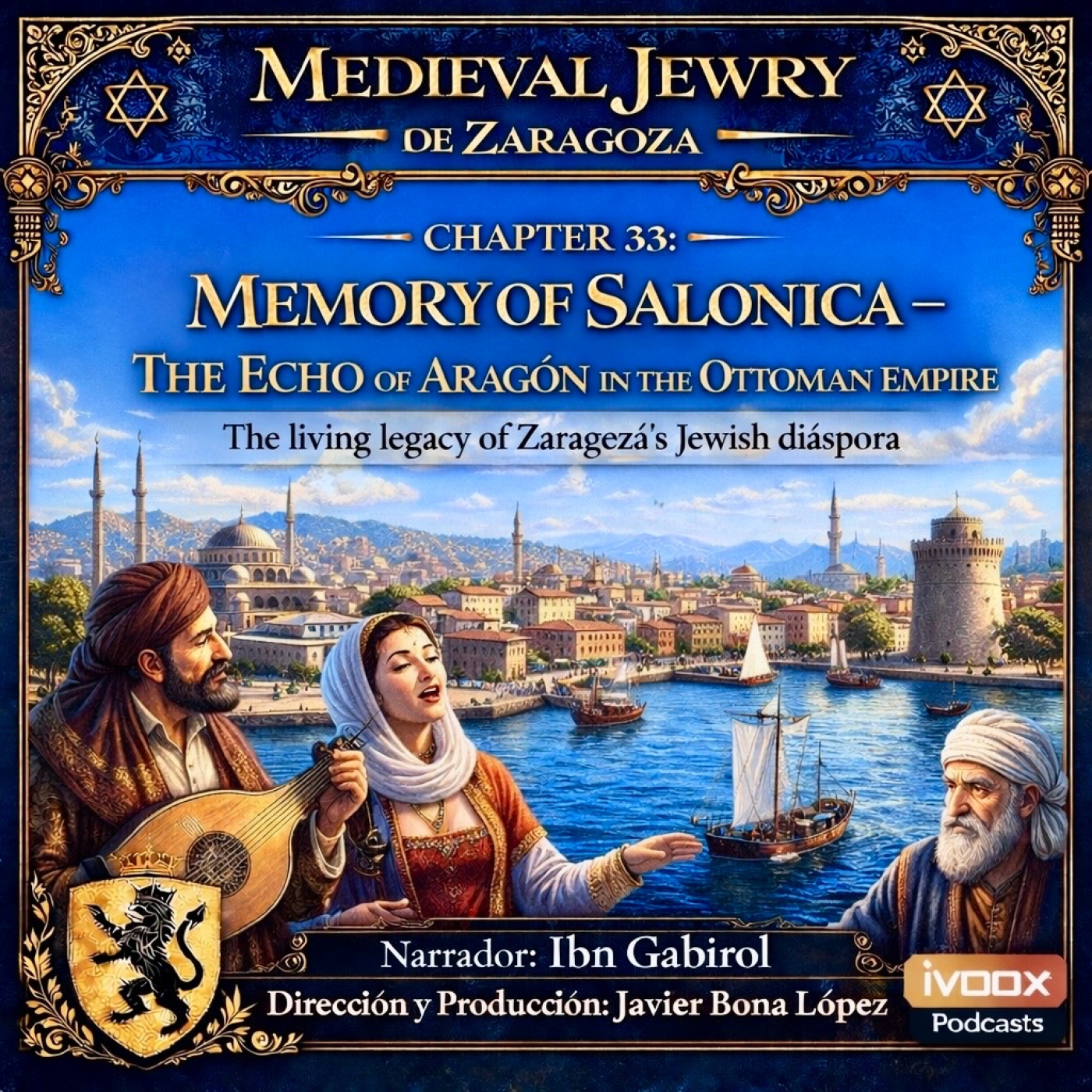
CHAPTER 33: MEMORY OF SALONIKA – THE ECHO OF ARAGON IN THE OTTOMAN EMPIRE
from Judería medieval Zaragoza/Jewish quarter Zaragoza
CHAPTER 33: MEMORY OF SALONIKA – THE ECHO OF ARAGON IN THE OTTOMAN EMPIRE Narrator: Ibn Gabirol Direction and Production: Javier Bona López Chapter 33 establishes a powerful historical and symbolic bridge between medieval Zaragoza and Ottoman Salonika (Thessaloniki), demonstrating how the 1492 expulsion did not extinguish Aragonese Sephardic identity but transplanted and transformed it in the Eastern Mediterranean. Narrated by Ibn Gabirol, the episode begins with the splendor of the Zaragoza aljama — a structured, economically active, intellectually vibrant Jewish community within the Crown of Aragon. The expulsion shattered this world but did not silence it. Rebirth in the Ottoman Empire Sultan Bayezid II welcomed the expelled Jews into the Ottoman Empire. Thousands settled in Salónica, which soon became one of the foremost Sephardic centers in the world. Communities organized themselves by Iberian origin, giving rise to the “Call of Aragon.” Synagogues named “Aragon” and “Zaragoza” became institutions of memory and governance. Salonika earned the title “Jerusalem of the Balkans,” with Ladino functioning as a major commercial and communal language. Daily life and linguistic continuity The chapter explores domestic life, culinary traditions, artisan trades, and synagogue-centered governance. Particular emphasis is placed on Sephardic women as guardians of language, ritual, and oral tradition. Ladino preserved archaic Iberian features, including distinct Aragonese phonetic elements. Linguistic continuity functioned as a cultural archive, binding the exile community to its Iberian origins. The Purim of Zaragoza (17 Shevat) A unique liturgical tradition — the Purim of Zaragoza — commemorated a medieval deliverance of the Zaragoza community. In Salonika, this local Purim became a ritual of collective identity and historical affirmation, reinforcing Aragonese lineage in exile. The Romancero The Sephardic ballad tradition transmitted medieval Iberian narratives across generations. Through these romances, Aragon became a mythic homeland — a portable memory carried in melody and language. Decline and destruction The Ottoman collapse, the annexation of Salonika by Greece in 1912, and rising nationalism destabilized the Jewish community. Nazi occupation in 1941 led to catastrophic deportations: approximately 96% of Salonika’s Jews were sent to Auschwitz-Birkenau in 1943. The “Jerusalem of the Balkans” was destroyed. Synagogues, cemeteries, archives, and Ladino urban culture were nearly erased. Conclusion The chapter concludes with a reflection on historical circularity: Zaragoza survived in Salonika for centuries; today, Salonika’s memory returns to Zaragoza through scholarship and heritage recovery. Memory — Zakhor — remains the ultimate form of survival. Within your broader project on Zaragoza, Calatayud, Tarazona, and Híjar, this chapter serves as a hinge point—where archival research, literary reconstruction, and historical analysis converge into a meditation on loss and continuity. Zakhor. Remember. Shalom CREDITS Narrator: Ibn Gabirol (Shelomó ibn Gabirol, 1021–1058/70) Directed and Produced by: Javier Bona López Documentation and Academic Advisory: Miguel Ángel Motis Dolader (Universidad San Jorge, Zaragoza) BIBLIOGRAPHY (ENGLISH) 1. Díaz-Mas, Paloma. The Sephardim: History, Language and Culture. 2. Motis Dolader, Miguel Ángel. The Expulsion of the Jews of Zaragoza. 3. Benbassa, Esther; Rodrigue, Aron. Sephardi Jewry: A History of the Judeo-Spanish Community, 14th–20th Centuries. 4. Blasco, Santiago; Rubio, Adela. The Call of Aragon. Shalom
NOW PLAYING
CHAPTER 33: MEMORY OF SALONIKA – THE ECHO OF ARAGON IN THE OTTOMAN EMPIRE
No transcript for this episode yet
Similar Episodes
Jun 5, 2026 ·4m