
EPISODE · Jan 24, 2026 · 17 MIN
CHAPTER 5: THE OLD JEWISH QUARTER – ROOTS IN THE ROMAN CITY
from Judería medieval Zaragoza/Jewish quarter Zaragoza
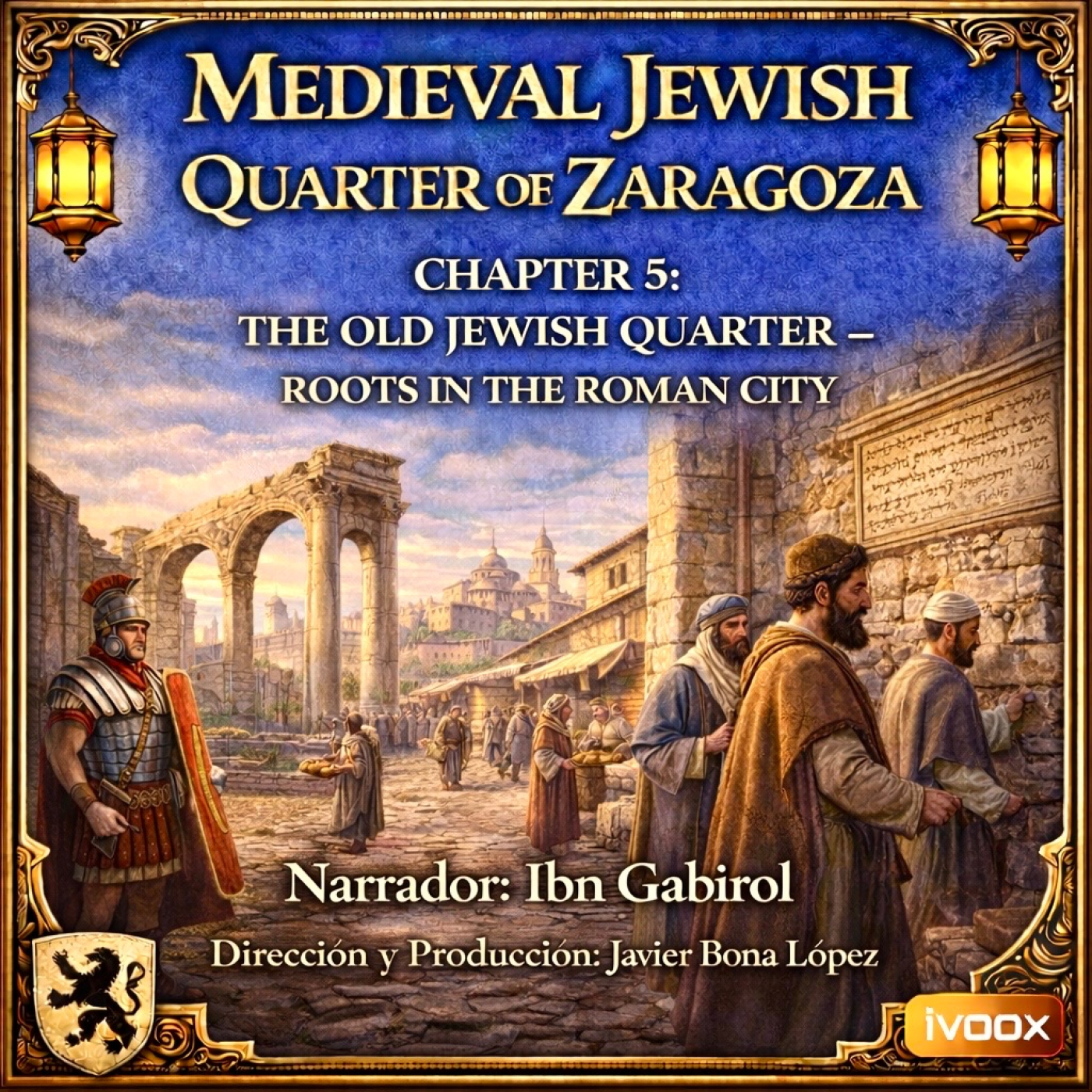
CHAPTER 5: THE OLD JEWISH QUARTER – ROOTS IN THE ROMAN CITY Caesaraugusta: The city beneath the city The chapter begins by contextualizing the founding of Caesaraugusta in 14 BCE by Emperor Augustus. This Roman colony was strategically located at the confluence of three rivers—the Ebro, Gallego, and Huerva—making it a vital communications hub for the empire. The Romans built walls, a central forum, straight streets, and administrative structures that would mark the character of the city for nearly two thousand years. Jews in Caesaraugusta The Jewish presence in Caesaraugusta dates back to the diaspora of 70 CE, when Emperor Titus destroyed Jerusalem. Although we do not know the individual names of the first Jews who arrived in the city, we know that by the second century a Jewish community was already established. During the Roman period, Jews enjoyed a special status recognized by law: they could trade, own property, and practice their religion, though they were not full Roman citizens. The Old Judería: Urban structure When Alfonso I conquered Zaragoza in 1118, he found a judería that was already millennia old. The Old Judería occupied the space that had been within the walls of the Roman enclosure of Caesaraugusta. Its heart was the cota 207, where the Castle of the Jews (Castillo de los Judíos) was located, a fortified sector of wall extending along seven towers. Here were the Great Synagogue (Berocolim), the kosher butcher shop, the community court (Bet Din), and other vital spaces of the community. The precise boundaries of the Old Judería were: to the north, Verónica Street; to the south, San Pedro Nolasco Square; to the east, Santo Dominguito de Val; to the west, Yedra Street. The streets were narrow and winding, not like the wide Roman roads, but adapted for defense and maximum use of space. Houses were built attached to each other, forming compact blocks with private interior courtyards. The Great Synagogue (Berocolim) The Great Synagogue, located at cota 204, was the spiritual heart of the community. It was a building of three small naves, each vaulted with elaborate work and gilded corbels. In the center was the altar, and in the cornice of the central nave was a frieze with Hebrew characters where one could read a psalm written in red and blue inks. The ritual candelabrum, the pilpito, had six doors in its lateral parament. Today, the site that the Great Synagogue occupied is occupied by the Church of San Carlos. Daily life The chapter presents a vivid picture of daily life in the Old Judería. It describes mornings with men leaving for the synagogue for morning prayers, women preparing breakfast, children going to the Talmud Torah school. It presents the kosher butcher shop, where the ritual slaughterer (shojet) sacrificed animals according to Jewish law, documented since 1228. It describes the ritual baths (mikvé), exclusively female spaces of ritual purification that were also spaces of female power. It presents the community court (Bet Din), where judges applied Jewish law (halakha) to resolve community conflicts. And it evokes the nights, with families gathered around the table, transmitting tradition from generation to generation. The New Judería As the Jewish community grew, the need to expand arose. Thus was born the New Judería, a neighborhood outside the walls that developed especially from the thirteenth century onward. Its main axis was the street "In the middle" (today Rufas Street), very busy because an irrigation channel ran through it. Here lived artisans, especially shoemakers like the Ardi family. The New Judería was more integrated into the medieval city, with less clear boundaries than the Old Judería. Archaeology and history The chapter emphasizes the archaeological importance of the Old Judería. Under the streets of Zaragoza are buried the remains of this community: pottery fragments, coins, tools, objects of daily life. Each artifact tells a story of the life lived in these streets. Modern archaeologists work to unearth these treasures and help us better understand the past. Continuity and change What is most remarkable about the Old Judería is its continuity. From Roman times to the expulsion of 1492, this space was home to Jews. Almost fifteen hundred years of history. Generation after generation lived, loved, suffered, and died in these narrow streets. Although there were changes—Roman walls deteriorated, new structures were built, institutions evolved—the essence of the place persisted. It was always a Jewish space, where tradition was practiced, transmitted, reinvented. Conclusion The chapter closes by inviting the listener to reflect on the history that lies beneath their feet when walking through the streets of Zaragoza. The city is a palimpsest, a document written again and again, with each generation adding its own lines to the text. The next chapter will explore the six gates of the judería, those points of entry and exit that controlled the flow of people and merchandise, symbols of separation and connection, of identity and belonging. Narrator: Ibn Gabirol (Shelomó ibn Gabirol) Direction and Production: Javier Bona López CREDITS AND SOURCES Final Note “If you enjoyed this episode, I invite you to share it and help spread the word. You can also listen to our other series on the medieval Jewish quarters of Calatayud, Tarazona, and Híjar on the three main podcasting platforms.” Sources and Bibliography [1] MOTIS DOLADER, Miguel Ángel. Caesaraugusta: History and Archaeology of Roman Zaragoza. Zaragoza City Council, Center of History, 2005. [2] CANELLAS LÓPEZ, Ángel. “The Jewish Quarter of Zaragoza.” Cuadernos de Zaragoza, No. 2, 1974, pp. 1–19. [3] SEFARAD ARAGÓN. The Disappeared Jewish Quarter of Zaragoza: Step by Step. Self-published, 2010. Zakhor. Remember. Shalom.
NOW PLAYING
CHAPTER 5: THE OLD JEWISH QUARTER – ROOTS IN THE ROMAN CITY
No transcript for this episode yet
Similar Episodes
No similar episodes found.
Similar Podcasts
No similar podcasts found.