Hey Ontario, come on down to BetMGM Casino and see what our newest exclusive, the Price is Right Fortune pick, has to offer. Don't miss out. Play exciting casino games based on the iconic game show, only at BetMGM. Check out how we've reimagined three of the show's iconic games, like Plinko, Cliffhanger and the big wheel into fun casino game features. Don't forget to download the BetMGM Casino app for exclusive access and excitement on the Price is Right Fortune Pick. Pull up a seat and experience the Price is Right Fortune Pick. Only available at BetMGM Casino. BetMGM and GameSense remind you to play responsibly. 19 plus to wager. Ontario only. Please play responsibly. If you have questions or concerns about your gambling or someone close to you, please contact Connects Ontario at 1-866-531-2600 to speak to an advisor free of charge. BetMGM operates pursuant to an operating agreement with iGaming Ontario.
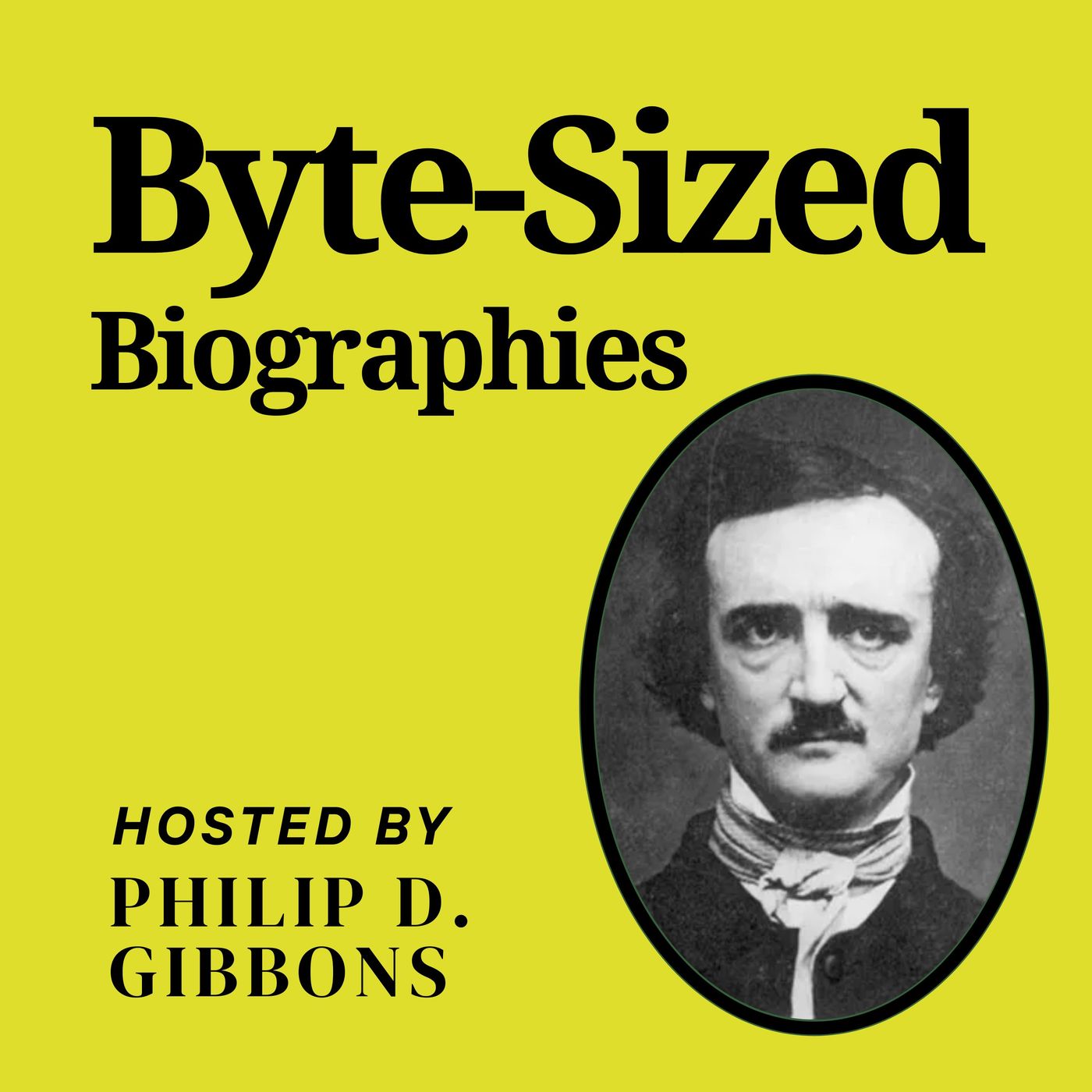
Welcome to Some Very Famous People You've Never Really Heard Of, bite-sized biographies of the famous, the infamous, and the quirky in less than an hour. My name is Philip D. Gibbons, and there is more information about me, this podcast, and a bibliography at someveryfamouspeople.com. There are also photographs of many of the individuals and items mentioned in this podcast. At the conclusion of part one of this presentation, there will be additional suggestions concerning further information about today's subject, Charles Dickens. Now let's get started with our story about Charles Dickens.
The most popular author of the 19th century, Charles Dickens' works and characters remain beloved over 150 years after his death. An international celebrity, dramatic speaker, and social commentator, the author's criticism of societal corruption, neglect, and classism within Victorian England earned him the adulation of especially lower-class readers able to access his work with unprecedented enthusiasm. Many of Dickens' stories and characters are traditionally accepted as products of his own childhood, economic uncertainty, and early professional experiences. However, for most of his life, very little was specifically known about the actual circumstances of Charles Dickens' upbringing, financial circumstances, family and domestic relationships. Much of what is believed even today resulted from a single biography written shortly after Dickens' death by a close business associate who received most of his information for the book from Dickens himself.
Despite dozens of biographies, voluminous critical and social analyses, and hundreds of motion picture productions, many of the actual details of the biography of Charles Dickens, one of the most prominent figures in Western literature, were unknown until the 20th century, and even today remains speculative. Charles Dickens was born on February 7, 1812, in Portsmouth, Hampshire, England. His father, John Dickens, worked in the vast British naval bureaucracy as a clerk in the Navy pay office. His mother, Elizabeth Barrow Dickens, managed a household that eventually encompassed eight children. Charles Dickens' maternal grandfather and uncle also worked as clerks in the Navy pay office, and it was the latter individual, Thomas Barrow, who introduced his sister to John Dickens. Only one year after the Dickens' marriage, Elizabeth's father, Charles Barrow, in 1810,
fled England after it was determined that he had misappropriated over 5,000 pounds, a sum equal to over 400,000 pounds today. Although he survived on the Isle of Man until 1826, out of the reaches of the British judicial system, this development was a great scandal within the family and never discussed openly. Whether Charles Dickens was aware of this incident is not known, but both the younger Barrow and John Dickens remained employed by the pay office. Dickens' clerk position was subject to occasional transfers, and during Charles Dickens' early life, he spent time in both London and Chatham-Kent, as necessitated by his father's postings. Dickens subsequently wrote extensively about his childhood in journalism and essays, but it is probably unwise to accept these descriptions as autobiographical or even factual.
After a brief assignment in London, John Dickens was then posted to Chatham in late 1816. He moved his family into a newly built home. The Dickens family also employed two servants, this residence certainly a very positive, nurturing environment for young Charles. Father and son enjoyed a close relationship in which John Dickens brought his son along when the clerk conducted business on the Navy pay office yacht, or observed the numerous military exercises and reviews that were commonplace during this time period. John Dickens also donated to charities and civic relief efforts, especially after a fire destroyed many homes in the center of Chatham. Considering himself a cultured and civilized man, John published an 1820 anonymous account of this local catastrophe in the Times of London. This prestigious accomplishment underlined both John Dickens' literary interest and his use of pretentious, grandiose prose, a style that his son would eventually incorporate into his characters, most notably within David Copperfield's Wilkins Macabre.
Dickens' father also took his son to central London to see stage entertainment presented by some of the most prominent performers of the era, ventures that only added to the boy's growing artistic appreciation and imagination. It is evident that John Dickens was an engaged and inspiring parent. Unfortunately, he and his wife had a propensity to live beyond their means, behavior that eventually had grave consequences. One example of this behavior was their practice of publishing paid-for birth announcements in local newspapers, a seemingly pretentious and unnecessary pastime, especially if money was tight. Despite a steadily increasing salary, in 1819, John Dickens was forced to borrow what was then the substantial amount of 200 pounds from an individual named James Milburn. Typically, this complicated transaction obligated Mr. Dickens to pay an annual annuity of 26 pounds to Milburn for the rest of John Dickens' life, the debtor only in his early 30s at the time. The desperation and financial irresponsibility prompting this act was only underlined when John Dickens defaulted on the arrangement within two years of receiving the loan. This forced his brother-in-law, Thomas Barrow.
who had co-signed the transaction to refund all of the original principal, plus half a year of the annuity. When it became clear that Barrow would not be repaid, Barrow forbade John Dickens from his home, a sanction that remained in place for many years. Charles Dickens' father also put the bite on others, including neighbors and even his separated mother. This lack of funds seems to have precipitated a relocation to more modest housing in Chatham in 1821. Although these financial straits probably created domestic tension, they do not initially seem to have greatly interrupted Charles Dickens' relatively pleasant childhood. Initially homeschooled with his older sister Frances, a.k.a. Fanny, the arrival of two more children, Harriet and Frederick, by 1820, prompted their assignment to a local school. Dickens' teacher subsequently remembered him as extremely intelligent and a voracious reader. Charles aided in this propensity by John Dickens' modestly-priced but extensive library that featured both the classics and contemporary titles.
The reassignment of John Dickens back to central London was a turning point in Charles Dickens' childhood. Now with six children and a cut in pay due to the new posting, the Dickens family was forced to reside in a smaller home. Economic necessity also prompted the inclusion of a boarder, in this case, the adult stepson of Elizabeth Dickens' sister-in-law, James Lammert. This new environment and period of Dickens' life was traditionally perceived as bleak and traumatic. Undoubtedly, the death of Charles Dickens' younger sister Harriet, his separation from school, friends and acquaintances in Chatham, and the downward spiraling financial circumstances of his father would have had a profound influence on any 10-year-old. In April of 1823, his sister Fanny was accepted as a student at the Royal Academy of Music, an acceptance that was accompanied by an expensive tuition. By now, Charles Dickens must have wondered not only how his parents would raise the money, but also when he would be able to resume his own education.
a question that had an obvious answer. He spent much of these early months in London, wandering the streets, at least taking in some very provocative sights and sounds. His mother unsuccessfully attempted to open up her own school within a newer, larger residence in Bloomsbury. And when that failed and every last household item of value was pawned, there seemed a distasteful but evident direction for now 12-year-old Charles. He would go to work and at the very least support himself.
A job was quickly found through a distant relative of James Lammert, who owned what could be best described today as a shoe polish factory, known then as Warren's Blacking Factory. Charles received six shillings a week to assemble and paste labels on jars of boot polish. Although this was initially rationalized by Dickens' parents as a foot in the door, a position that might lead to promotion and career opportunities, in truth, it was really just rudimentary child labor. Hey, Ontario, come on down to BetMGM Casino and see what our newest exclusive, the Price is Right Fortune Pick, has to offer. Don't miss out. Play exciting casino games based on the iconic game show only at BetMGM. Check out how we've reimagined three of the show's iconic games like Plinko, Cliffhanger, and the Big Wheel into fun casino game features. Don't forget to download the BetMGM Casino app for exclusive access and excitement on the Price is Right Fortune Pick. Pull up a seat and experience the Price is Right Fortune Pick. Only available at BetMGM Casino.
But Dickens had little time to wallow in his own personal misery when a much worse calamity befell him and his entire family. John Dickens, completely broke and already delinquent with some of the local merchants, was finally arrested for debt, the initial complaint supposedly over 10 pounds owed to a local baker. This was only the initial legal pretext to hold Dickens. Other amounts were undoubtedly piled on. Debt imprisonment was a major element of the early 19th century English judicial system. Fully half of all those confined during this time period were incarcerated over issues involving financial obligations. The process involving facilities and prisons, frequently operated by private sector individuals who paid for the privilege, was run on a for-profit basis in which mistreatment was common, and even the most basic services were provided for a fee.
Like most individuals, John Dickens was first conveyed by sheriff's order to what was known at the time as a sponging house. Here, in a dwelling frequently operated by the bailiff who arrested the victim, any readily available cash was squeezed out of the debtor, some earmarked for the creditor, but some winding up in the hands of the establishment's operator in the form of rent and outrageous prices for food and drink. The debtor either cleared the debt and concluded the matter, or if it was determined he was unable to do so, he was subsequently dragged before a court and then formally conveyed to literal prison. In the case of John Dickens, this was the notorious Marshallsea prison. In addition to a small group of criminals detained for various reasons by the Admiralty, the vast majority of the detained occupants at Marshallsea, approximately 600 individuals, were imprisoned for debt, two-thirds involving sums of less than 20 pounds. In a bizarre setup, those who could afford it could rent private single rooms to avoid being tossed into much more crowded conditions. Food and various other goods were formally available for a price.
even a tap room. Some prisoners were also allowed to leave during the day, including John Dickens, mostly to work, a sensible practice to improve the chances of a debt being repaid. Those unfortunate enough to be completely destitute faced confinement in separate, much more crowded conditions, literally consuming bread and water provided by external charitable contributions. Fees were routinely added to the initial debt, ensuring that many of the prisoners remained confined. Because he gave up the home that he rented upon entering the Marshalsea, John Dickens also installed his wife and three youngest children in his prison room.
Charles Dickens was sent to lodge with a family friend, a Mrs. Roilance. Never mind that this location was three miles from his place of employment. On Sundays, with his sister Fanny, who somehow remained a student at the music academy, he walked a round trip of 12 miles to visit his family in the jail. Eventually, better situated lodgings were found closer to the jail, but between his employment and the harrowing family situation, Dickens faced emotionally and physically challenging circumstances. Fortunately, John Dickens was able to extricate himself from the marshalsea on May 28th.
Exactly how is unclear. Some accounts credit a modest inheritance from his mother, as well as an application of the Insolvent Debtors Act. However, Charles Dickens remained at the shoe polish factory, working by a window which allowed public visibility of the rapid process by which Dickens and his co-workers composed and affixed labels to the polished containers. Although ashamed of his menial circumstances, Dickens subjected himself to this location, which at least exposed him to sunlight and the outdoors. The interior of the rat-infested filthy building was...
even more oppressive, as well as the other young employees referring to him as the little gentleman. Dickens' employment in such conditions continued for six months until John Dickens, after arguing with his son's employer, decided to remove him from the premises. Perhaps more realistic about losing her son's economic contribution, Charles' mother Elizabeth then interceded and was actually able to get his job back. Although John Dickens refused to allow his son's return to the factory, Charles Dickens later claimed to have both never forgotten or forgiven his mother's insensitivity and eagerness to return him to this hellish environment. For the next two years, Dickens attended the Wellington House Academy.
Unfortunately, the headmaster, one William Jones, seems to have been a most mercenary individual who Dickens later described as by far the most ignorant man that I have ever had the pleasure to know. Jones also had an enthusiastic penchant for corporal punishment, his distinctly violent personality evident in several future Dickens quasi-fictional characterizations. Although the Dickens family financial situation was modestly improved by the award of a disability penchant to John Dickens, Things seemed to come to a head again in early 1827. Fannie was almost kicked out of the Royal Academy of Music. Only an IOU, her talent, and a promise to teach at the school part-time saved her enrollment. The Dickens family was evicted in March of 1827. They found cheaper temporary digs elsewhere, and Charles left the Wellington House Academy, an undistinguished student but an enthusiastic participant in the school's occasional theatrical efforts. He did not return to school but instead went back to work at a law firm, Ellis and Blackmore. As a junior clerk for Edward Blackmore,
The solicitor struck by the 15-year-old's good looks and clever personality. Although his specific tasks were no more onerous than composing copies of documents and running errands, Dickens' spot-on propensity to mimic some of the local street merchants and neighborhood characters and his remarkable knowledge of the City of London were qualities that both of the firm's partners fondly reminisced about years later. But Dickens had no interest in the law itself. He left Ellis and Blackmore after a year and then worked briefly at another firm, only to decide upon a new direction. One of Charles Dickens' maternal uncles, John Barrow, was a successful journalist and publisher who in 1828 originated the Mirror of Parliament, a weekly which reported in detail on parliamentary events and even employed John Dickens as an on-site reporter. Although Charles' father had learned shorthand as a requirement for this position, it was most likely John Barrow who taught Dickens this practice and encouraged him to begin freelancing at the Doctors' Common, a collection of law courts that focused on civil law, namely domestic and slander cases.
Dickens seems to have been especially adroit at shorthand to the extent that he eventually joined his uncle at the Mirror of Parliament, impressing others with the speed and accuracy that he employed transcribing parliamentary debates. His ability as a freelance writer allowed him to compose short fiction pieces that were usually thinly veiled accounts of his own experiences, slice-of-life sketches, or dramatized profiles of interesting people he encountered while conducting his more mundane journalistic tasks. His first piece was published in the Monthly Magazine in December of 1833. Despite not receiving any payment for this, and seven other articles he published in the monthly, Dickens continued to submit to this periodical, chiefly because its contents were reviewed, attention worth more than any modest amount, the magazine might eventually cough up. At the same time of his newfound literary success, in August of 1834, Dickens was hired in a salary position by London's Morning Chronicle newspaper as a member of the paper's Parliament reporting team. One of his first assignments took him to Edinburgh, exposing him to even more grist for his fictional mill.
By late September, the Chronicle also published Dickens' less serious depictions of London life under his pseudonym, Boz, derived from an inside family joke concerning the nickname of one of his brothers. In early 1835, the owners of the Morning Chronicle resolved to begin publishing three times a week a sister paper, the Evening Chronicle, and hired an editor named George Hogarth, who immediately asked Dickens to compose one of his typical sketches for the very first edition of the new publication. Dickens must have sensed his previous efforts' potential. He responded by offering Hogarth a series of articles, also requesting a bump in his salary. The editor agreed, and throughout 1835, Dickens composed 15 such contributions. These pieces also reprinted in the Morning Chronicle. Hogarth was delighted with this output and took to inviting the younger man to his comfortable residence. This proved to be a fateful interaction. It was there that Dickens met the editor's 18-year-old daughter, Catherine Hogarth, and within a year, the couple was engaged. Between his straightforward news assignments and composing his less weightier stories, Dickens was extremely busy.
so busy that he relocated to temporary housing to be closer to his fiancée. Dickens' social and professional success allowed him some minimal personal financial security, but his father continued his profligate ways, so much so that Dickens had to personally intervene when, in the fall of 1834, John Dickens was again arrested for debt, tossed into another sponge house, and released only through the diligent efforts of his son. John Dickens would also begin about this time to contact friends and acquaintances of Charles, requesting modest and occasionally immodest loans, without the knowledge of his son, a constant source of embarrassment. About this time, Charles Dickens took to having his 14-year-old brother Fred reside with him, perhaps to extricate his brother from a stressful and depressing domestic environment. The success and high publishing profile of Dickens' stories, published under his pseudonym Boz, allowed him to expand both his personal and professional circle. One of his new acquaintances was the novelist William Harrison Ainsworth.
Although obscure today, Ainsworth became an overnight literary sensation with the publication of his 1834 work, Rookwood, a typical gothic historical novel of the time period. Dressed fashionably in the style referred to at the time as that of a dandy, Ainsworth became close friends with Dickens, suggested that he compile his various Boz sketches into book form, and most importantly, introduced him to Ainsworth's publisher, John McCrone. McCrone was enthusiastic and convinced the wildly popular cartoonist and illustrator, George Cruickshank, to collaborate on this project. Customarily, throughout the 19th century and even early into the 20th century, novels and fictional works were accompanied by etchings or caricatures, highlighting a particular work's most dramatic or important moments. And Cruxshanks, who illustrated Rookwood, among other notable works, participation was quite a coup.
Dickens composed a few new stories and waited on the artist's finished work for what would be his first published book, eventually entitled Sketches by Baz, Illustrative of Everyday Life and Everyday People, which appeared in February of 1836. The book debuted to glowing reviews, among them from George Hogarth and the Chronicle, only days after publication. Perhaps this was a form of a wedding gift to Dickens from his prospective father-in-law. Charles and Catherine Hogarth were married on April 2nd, 1836. Sketches by Boz was so successful that Dickens released another similarly styled collection in August of 1836. This publication also prompted another business deal when Dickens was approached by the publishers Chapman and Hall to collaborate with the illustrator Robert Seymour on a publication that included caricatures created by the illustrator, woven together with a narrative composed by Dickens. Seymour's cartoons typically lampooned political figures and social mores. In this case, he had a general idea of caricatures of members of a sporting club, of eccentrics and phonies involved in hunting and fishing.
to their comic detriment. Initially, unlike typical novels where the writer produced a plot and the illustrator provided a depiction of various scenes, in this case it was to be the opposite. In his negotiations with the publishers, Dickens convinced them that he should handle the plot in a traditional manner, especially as he knew nothing about hunting or fishing. Dickens was not even hired until early February 1836 for a deadline of March 31st, a situation which initially created some creative confusion that was removed by the April 20th suicide of Robert Seymour. While Dickens and Seymour bickered over the direction of their project, the cartoonist was known to be plagued by both emotional and financial problems. In any case, from this point on, any plot lines were handled exclusively by Dickens, who eventually entitled the project The Pickwick Papers. After his April wedding, Dickens only had time for a brief honeymoon. His first child, Charles Jr., born precisely nine months later. Although Seymour was the most famous of the two creators of The Pickwick Papers and sales of the first serialized chapters were not encouraging,
the publishers had enough faith in the up-and-coming writer to forge ahead. Eventually, a 19-year-old named Hablett Knight Brown was chosen to work with Dickens as a replacement illustrator. Nicknamed Fizz, he was young and agreeable, as opposed to the older, more established artist-collaborators Dickens previously worked with and proved a perfect match. In the fourth issue containing chapters 9 through 11, Dickens introduced Sam Weller, hired as a valet to the novel's main character, Samuel Pickwick. Pickwick is the president of the Pickwick Club.
and he and some of his fellow members traveled to various locations in England reporting back to the club on their observations intended to be of an analytical value, a plot device allowing Dickens to exploit humorous characters he either had met or embroidered from his own experiences. Weller was an idiosyncratic addition whose cockney attitude and streetwise manner was a contrast to the benign pickwick. His introduction propelled the novel to an increase of sales from roughly 400 copies to an eventual 40,000 by the time the novel's serialization concluded in November 1837. The Pickwick Papers was Dickens' most popular novel during his own lifetime, selling 1.6 million copies, although most of the revenue generated went to the publishers, a lesson that the 24-year-old took to heart. Despite the lack of a huge payday, the acclaim that Dickens received for The Pickwick Papers had various publishing entities making all sorts of offers. Already able to effectively multitask different writing assignments, Dickens took on even more responsibility, signing an agreement with publisher Richard Bentley to edit a publication eventually known as Bentley's Miscellany.
The writer resigned from the Morning Chronicle, believing that with a guaranteed income from both Pickwick and Bentleys, he no longer needed to transcribe parliamentary speeches, a less creative use of his time. He was already at work on another novel that incorporated many of the socially controversial issues affecting the poor, including workhouses, debt, child labor, and exploitation and violence. The first two chapters were to appear in the February 1837 of Bentleys, 24 installments in all, with the completed book eventually to be published, The Release of Serials, a method to provide Dickens with income from a book before its completion. Each serial typically contained two chapters and cost a shilling, one twentieth of a pound, or twelve pence. Printed on cheap stock, these episodes allowed economical access for the lower classes, who might not have been able to afford a complete volume. The illustrator Cruickshank provided one drawing for each serial episode. Dealing with much darker subjects and lacking the light-hearted tone of the Pickwick Papers, the novel and its characters dominated by London's petty and not-so-petty criminals was as much a social commentary as it was literary entertainment.
It was called Oliver Twist, with initial additions including the tagline of, or the parish boy's progress. And it included some of the author's most memorable characters, including the miser Fagan, the murderer Bill Sykes, the eponymous Artful Dodger, and the bureaucratic Mr. Bumble. Although exhausted by composing deadline material for two novels and extensive editorial work on Bentley's miscellany, Dickens began to also enjoy an uptick in his financial fortunes through bonuses for continued... phenomenal sales of the Pickwick Papers, and a renegotiation of his editorial contract that changed the terms from raises based on specific time periods to sales numbers augmented by his own personal contribution. This allowed the writer to move his wife, infant son, his wife's teenage sister, Mary Hogarth, and younger brother, Fred Dickens, into a typical Georgian brick house at 48 Doughty Street, a fashionable King's Cross address so exclusive that there were man gates at each end of the block to keep out non-residents.
Mary Hogarth was on hand to help her sister with the process of caring for her newborn child, a not unusual arrangement. Dickens' newfound success and family life was dealt a crushing blow when, after he, his wife, and Mary Hogarth returned from the theater on the evening of May 6, 1837, the 17-year-old Mary suddenly collapsed and died at 3 o'clock the next morning, only a few hours after this inexplicable medical event. As a result of this incident, Catherine Dickens suffered a miscarriage, and Charles Dickens was also badly shaken, so attached to his sister-in-law that for the rest of his life he would wear a ring he took from her finger.
This calamity also resulted in Dickens missing serial deadlines for the first and only time in his career. Despite this tragedy, eventually, the author's industrious approach did not diminish after the conclusion of the Pickwick Papers. His third novel, in serial form, became Nicholas Nickleby, following the format of his previous efforts appearing starting in March of 1838 and running until September of 1839, the novel eventually published in its entirety. The plot contains already recognizable Dickens essentials, including an orphaned younger protagonist from a family suddenly fallen on hard times, a nasty and deceitful relative.
that is responsible for his plight and mistreatment at a scandalous institution gleaned from actual 19th century corruption. In this case, the English boarding schools that victimized their students, both physically and mentally, and profited handsomely while doing so. Dickens and his illustrator Brown, a.k.a. Fizz, actually visited several of these Yorkshire boarding schools to accumulate background material. Unlike Oliver Twist, which numbered about 400 pages, Nicholas Nickleby would eventually span over 900 pages, similar to the Pickwick papers in length.
The extraordinary length of many of Dickens' works spawned the urban myth that he was paid by the word. Actually, he was paid for each installment, with some exceptions numbered 32 pages, regardless of word count. In the case of Nicholas Nickleby, the first issue quickly sold 50,000 copies, and subsequent issues routinely reached the sales figure. To add to his remarkably prodigious literary efforts, in March of 1838, Charles and Catherine Dickens welcomed their second child, predictably named Mary, after their recently deceased relative. It was during this time period that Dickens developed one of the most important professional relationships of his career. John Forster was the literary editor of The Examiner, a prominent intellectual weekly which published the likes of Lord Byron, Shelley, Keats, and Thackeray. Forster was an associate of William Harrison Ainsworth, who introduced the editor and critic to Dickens. For the rest of Dickens' life, he remained close friends with Forster, but also relied on his advice, the editor discussing the writer's structural ideas and reviewing all of Dickens' manuscripts before they were printed. So reliant was the writer on this confidant's opinion.
Forster eventually came to serve as a business advisor to Dickens, a precursor to today's literary agent. He also became very close to Catherine Dickens, practically a member of the Dickens family. Becoming keenly aware of the increasing value of his copyrights, Dickens assigned Forster the task of buying back the rights to sketches by Boz from John McCrone, who was capitalizing on Dickens' newfound prominence by releasing this Dickens' efforts in a similarly designed serial format, which allowed the publisher to keep 100% of the proceeds. Eventually, a deal was made, although McCrone was paid over 2,000 pounds, which came from an advance from Chapman and Hall. Most likely, Forster encouraged Dickens to sever his relationship with Richard Bentley.
Charles Dickens resigning from his editorial position at Bentley's miscellany in February of 1839. While Dickens gave this resignation the appearance of amicability, in truth he considered Bentley too intrusive editorially and believed the publisher was profiting way too much from Dickens' own popularity. He was replaced by William Harris and Ainsworth. Dickens already had negotiated an agreement with Richard Bentley that only entitled the publisher to split Oliver Twist's copyright ownership with the author for three years. He also obtained from the publisher an agreement to delay for six months his proposed fourth novel, eventually entitled Barnaby Rudge.
If the wild sales success and financial prosperity allowed Dickens a serious lifestyle upgrade, his family, and specifically his father, continued to be a serious drain on a growing household that already required significant income. In March of 1840, the author decided upon a solution to this persistent problem that can only be described as something one of his characters might implement. Feeling that his parents' proximity to London and most of their son's friends and business associates enabled their access to continued pleas for loans and cash, Dickens resolved to find them a place in the country. deliberately limiting their access. He rented a cottage in the tiny rural village of Alphington near Exeter in Devonshire in southwest England, approximately 200 miles from the capital. It was a very well-maintained residence with a landlady nearby and Dickens refurbishing the place from top to bottom with crockery, furniture, carpeting, even garden tools. He also helped his brother obtain a bureaucratic job within England's Treasury Department for the moment, lessening the financial burden of his younger brother.
By then, Dickens already had another dependent, his third child and second daughter, Catherine Elizabeth Kate Dickens, born October 29, 1839. Even before he concluded Nicholas Nickleby, Dickens was devising his next publishing venture. Yet Forster discussed with Chapman and Hall the publication of a weekly, with Dickens the editor assuming complete editorial control. The financial arrangement with the publisher also specified both salary and a healthy percentage of profits, with Chapman and Hall to assume all costs, including any illustrations. The publishers acquiesced to every one of their partner's demands, Charles Dickens now England's most commercially successful and popular author. With other contributors selected by Dickens, the publication...
entitled Master Humphrey's Clock, was slated to begin publication on March 31, 1840. Although contractually Dickens was bound to work on finishing Barnaby Rudge for Bentley to the exclusion of virtually all other projects, the writer circumvented that stipulation by publishing in his new journal anonymously, not in any rush to inconvenience himself on his former publisher's behalf. The first edition of the new journal sold 70,000 copies. The concept behind this effort was that Master Humphrey was an eccentric older man who kept manuscripts in his clock. He decides to assemble a small group of friends to read these and other manuscripts among themselves, the premise behind a succession of short pieces, and eventually the serial launching pad for Dickens' fourth novel, The Old Curiosity Shop, which was released starting in 1840 until November of 1841. In fact, after a promising start, sales were still brisk, but it was clear that the public was disappointed in the concept, wanting instead another novel-length story. With The Old Curiosity Shop, Dickens obliged. He changed the plot formula somewhat.
The novel's main character, Little Nell Trent, is a 14-year-old female orphan who lives with her grandfather in the London shop that he owns, the old curiosity shop of the title. Utterly devoted to his granddaughter, and getting on in years, her grandfather decides that to provide Nell with any significant inheritance, he must win at cards, his attempts to do so failing miserably. He borrows heavily from a hideous, sadistic, money-lending dwarf named Daniel Quilp, who is as evil as Little Nell is upstanding. Quilp eventually evicts Nell and her grandfather from the shop, the loan shark keenly interested in... marrying Nell once he is able to dispatch his current wife. Terrified of such a prospect, Nell and her grandfather flee to remote areas of England, with Quilp and others in relentless pursuit. The grandfather's brother abruptly returns to England, and hearing of the situation, desperately tries to locate the two destitute individuals. Ultimately, he finds them as caretakers in a remote country village, but it is too late. The frail and exhausted Nell has just recently died. Her broken-hearted grandfather, unable to stand the heartbreak, also quickly passes away.
Dickens' production process for Curiosity Shop produced a new response from the public that was unprecedented even for him. As Nell's mortality became clearer as the climax of the novel approached, and as the popularity of each serial exceeded even anything Dickens had ever elicited, apprehension over the fate of Nell became a popular topic. Possibly driven by his own tragedy involving his sister-in-law Mary Hogarth, Dickens' description of this character's death is among his most poignant, and as some critics eventually pointed out, probably his most overly sentimental description. Although accounts of Americans thronging the U.S. docks of any approaching British ships and demanding word of the young girl's fate are apocryphal, it is an indication of Dickens' immense international popularity that such stories were even invented. Again, sales of serial installments of Curiosity Shop routinely exceeded 50,000 copies. By comparison, one of Dickens' popular contemporaries, Thackeray, would never exceed 5,000 copies in a similar time period.
Dickens' consistent success prompted another residential relocation, this time to a magnificent London mansion known as Devonshire Terrace, where he would reside until 1851. But such expenditure, extensive travel, lavish entertainment of his increasingly posh social circle, and financial support of both family and friends, especially his parents, who still figured out ways to receive loans from Dickens' acquaintances, obligations their son would ultimately have to address actually had the writer so financially extended that he was forced to request advances from his publisher. With the conclusion of the old curiosity shop, In the introduction, through Master Humphrey's clock, of Dickens' next novel, Barnaby Rudge, Dickens then hit upon the concept of traveling to America and producing a quick account of his travels and general impressions, seemingly an easy way to pay back his advance, and then some.
This was not an original concept. Several popular such accounts already were widely available, most upper-class admonitions about the dangers of Jeffersonian democracy and the myth of American social equality, allegedly a fatuous notion used by demagogues to delude the masses. Dickens wished to avoid such mass generalizations and to leave the preconceptions of the old world behind, although he read just about everything in print on the topic. After making arrangements with his publisher to administer his household's financial obligations on January 3, 1842, Dickens boarded the paddle steamship SS Britannia and sailed out of Liverpool with his wife and his wife's maid. This was the technologically fastest mode of transatlantic transportation of the time period, and not without danger. The Britannia's sister ship, the President, having sunk during an 1841 storm, with all hands going down with the ship. However, Dickens and his entourage arrived in Boston safely on January 22, 1842. He was literally mobbed from the moment of his disembarkation.
installing himself at the Tremont House Hotel, where he received so many written requests and invitations that he decided to hire a secretary to answer them all. Whenever he left the hotel, crowds followed him, and he described his reception in a letter to one of his solicitors. I can give you no conception of my welcome here. There never was a king or emperor upon the earth so cheered and followed by crowds and entertained in public at splendid balls and dinners and waited on by public bodies and deputations of all kinds. If I go out in a carriage, the crowds surround it and escort me home.
If I go to the theater, the whole house, crowded to the roof, rises as one man, and the timbers ring again. You cannot imagine what it is. Dickens met anyone who was anyone in the city, ranging from William Ellery Channing to Henry Wadsworth Longfellow. He also visited charitable institutions, asylums, factories in industrial areas of Massachusetts, and academic facilities to form a comparison to Britain's similar establishments. Dickens made his way through various cities and towns in Massachusetts and Connecticut before reaching New York on February 12th. Although Dickens was quite positive about Boston, the extreme pressure of his celebrity and the demands of the public started to irritate him, especially his treatment in the press.
At whatever galas and public forums he addressed, Dickens continually raised the issue of the lack of international copyrights that allowed American publishers to reproduce his and other non-American writers' works without compensation. The situation also harmed American writers who routinely published in Europe with a similar lack of compensation. But in the midst of an American financial recession and the perception of Dickens as incredibly wealthy as a result of his remarkable success, he was attacked for this perspective as greedy and insensitive to those with much greater financial challenges who might wish to read his very popular work. One immediate development after a jam-packed gala attended by over 3,000 celebrants, including individuals recreating both his characters and scenes from his novels, was his very public announcement that for the rest of his trip, he would respectfully decline to participate in such spectacles. From New York, Dickens proceeded to Philadelphia and lengthy interviews with Edgar Allan Poe, who, as an editor of his own literary journal, had high praise for the old curiosity shop. Dickens promised that upon his return to England, he would try and find a publisher for Poe. Poe also was impressed by the revelations that the character Grip...
A raven who appears in the novel Barnaby Rudge was modeled after an actual pet that had lived in the Dickens household. Two years later, Poe would not only fashion a similar character in his wildly successful poem The Raven, he would also incorporate very similar phrasing that appeared in Barnaby Rudge. Grip frequently used the phrase, never say die, and nobody. This became nevermore. In another Rudge passage, the bird makes a noise, and someone utters the phrase, what was that, him tapping at the door? Is someone knocking on my shutter? In The Raven, this became the famous line,
While I nodded, nearly napping, suddenly there came a tapping, as of someone gently rapping, rapping at my chamber door. Dickens did attempt to get Poe an English publisher, but his efforts came to nothing, another of the many of the disappointments that marked Poe's ill-fated career. In Washington, D.C., Dickens visited both houses of Congress, where he delivered petitions dealing with the question of copyright. He also met formally with President Tyler and took part in a presidential reception. From there, it was on to Richmond and Dickens' first exposure to slavery, something that so disgusted him that he changed his plans, heading west as far as St. Louis and omitting his initial intent on traveling as far south as Charleston, South Carolina. Wherever he stopped, Dickens was usually subjected to several hours of official hotel greetings with hundreds of well-connected locals.
who he was forced to shake hands and chit-chat with. His wife also subjected to these grueling interactions, both remaining completely amiable. He then backtracked on the Mississippi River, made his way through Ohio, and a lengthy stay at Niagara Falls with side trips to Canada, both Toronto and Montreal. From there it was back to New York, and after a week of final trips to a shaker village and West Point, Dickens, Catherine, and the maid boarded a ship on June 7th bound for Liverpool. They arrived on the 29th of June and wasted a little time making their way back to London by train.
Thank you for listening to part one of this podcast about Charles Dickens. Information for this podcast came from the books Charles Dickens by Michael Slater and Dickens by Peter Aykroyd. There are also additional photographs, bibliographical and musical information at someveryfamouspeople.com. If you have enjoyed this presentation, please like us at our Facebook page, Some Very Famous People, and follow us on Twitter at Philip D. Gibbons. Subscribe to my YouTube page at Noblesse Oblige, and please tell a friend about Bite Size Biographies.