Can I pay? Hey, Jeff, how are you going? I am well. How are you?
I'm very well. Friday afternoon, podcast time. I love it. I'm starting to get into the swing of these.
It's good. Yeah, you're on a roll. Yeah, I'm on a roll. I'm really enjoying doing the podcasting again, and I sort of dropped some shackles and things are good.
Yeah, how are you? Friday afternoon ready to go for the weekend? Yeah, love a Friday afternoon. It's a movie night at the Davis household.
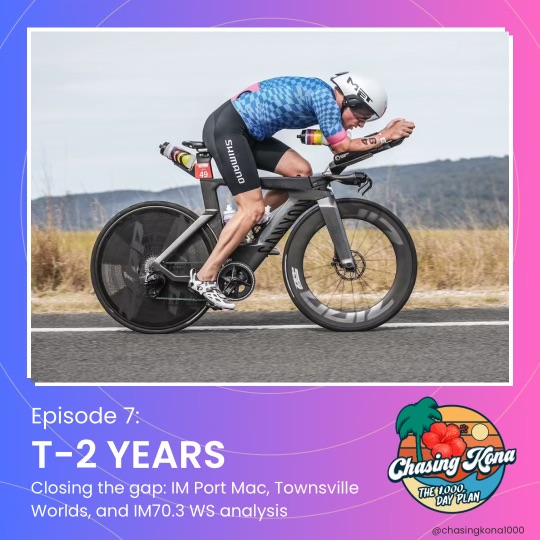
Nice. And then we've got a big weekend of training to look forward to. But let's do the pod. And I was reflecting on the fact that next weekend is Kona weekend, which means that we are two years out from the 1000 day target.
So a good opportunity to check in on progress and a bit has happened since we spoke about plans back in March. We had a bunch of races, which started with IMM Port Macquarie, which was a Kona qualifying opportunity. Good opportunity to see where I'm at. And then we had the unusual scenario in my book where we had no real off-season because we had cross-dry and long course world championships in Townsville.
And then we rolled into the traditional seasonal opener for me at least, which was Western Sydney, 70.3. And so I thought maybe we could unpack those races and search for some learnings in those in the same way that you and I would typically do over a coffee, which is I tend for any of the listeners that are interested like that kind of let's set a plan and a bit of a process and then go away and execute on it and then kind of reflect on that and see where the learnings are and how we shape up the next little block. So this is not unusual as far as the way that you and I would typically interact as coach and athlete. Yeah, just like a transparent chat.
Yeah, just listening in. We've moved the navel in this last year, which is really exciting. Yeah, and I want to touch on it a little later, but the interview that we did with our five Kona qualifiers was really insightful for me, particularly around that aspect of belief. Yeah.
And I think that's when I reflect on this little block, that's something that I really want to lean into in the coming period. So yeah, I think it's been exciting. Should we go back to Port Macquarie? Yeah, let's start there.
So I had a great day in Port, I think. A PB, 1019, which was ninth in my age group, which also turned out to be four spots and nine minutes off a slot. So close. I wasn't going to go to roll down and then Paul messaged me and he said, Mate, I think you should go.
And so I got to see Jimbo, then Paul, and then Ed, and then Josh, he mentioned alumni, HPT alumni get slots. So I think those guys actually felt a little bad for me that I didn't get a slot when they were also pumped and excited and they felt a lot. But that's not really how I felt about it. I was more like, oh, this is like, this is close now.
And so it's not a dream at all, really, I think we're making good progress. So the way I break the race down, I went 102 for the swim, 516 on the bike, 353 on the run. The swim, I don't want to talk about it too much. I think I only had six weeks of training.
You might call cause broken hands, broken the hands in the crash down at Tazzy. So I thought that was a past mark, you know, a couple of minutes slower than I would normally go, but whatever. But the bike and the run experience, I think, as well as the training and taper leading in, I think are interesting things to look at. The bike, I didn't have my power meter.
It didn't work for some reason, which was fine. Might have been a good thing. I just told myself that that was an opportunity to go by feel and just be in the race with the people who were riding around me. And the result there was a PB bike, which is great, particularly on a course like that, which is not an easy course.
I was reminded of the Jocko Willink video of good. Have you got my power meter? Good. Now I'm going to dial into my RPE.
Yeah, totally. Totally. And just race a little via racer. Yeah, man, I'm all over that at the moment.
I'm like, power isn't paced. It's like we've lost the plot. But that's for discussion later on. Let's get into point.
Yeah. But I think my bigger observations on the bike were we put in quite a big block of bike before the race. So no D-load weeks in the six weeks, and it was a pretty aggressive taper. And so I felt, and this might resonate with others, but not a lot of confidence in my bike, but come race day, the legs turned up and my endurance in particular with that later taper was really good.
Like the guys that I was riding with late into the bike, I was dropping. Yeah. So I think that's interesting. And then two, because it rained for about three months straight, remember that, the start of the game, which is raining every weekend, I did most of my riding on the kicker, which I noticed on the flax sections, I was always on the front of the people I was riding with.
And then on the back section of the course, which is where it's undulating hills, I would drift from the front of the group all the way back through the group, even against guys that were much bigger than me. So I'm not a big guy. And you would expect powder rate, weight ratio kind of comes in your favor when you start going up hills, but that wasn't really what was happening. And then on the downhill sections, I was fast against.
So that might be the arrow. Yeah. And we've been doing a fair bit on our aerodynamics. And so I think there's an aerodynamics element in that, but also that the kicker might be really effective on that steady grind, which is a, you know, mode what you get from a training, holding position to holding your position.
Yeah. Got off the back third, doesn't cake with standing at transition. And that was pretty exciting to hear that when does gave me the update. But yeah, my quads were quite sore.
That doesn't always happen. Like that's not a normal kind of thing. Quite often, most of the time I'd get off the bike and feel like, yeah, like nothing kind of like I'm going for run now. It's, it's different.
I think I was still in fifth up until the final lap that drifted back over that final 10 Ks. There was probably some good wins in the run. You know, I didn't stop at eight stations. I felt like, I, you know, I just felt like if I'd stopped, I wouldn't have started again.
Yeah. And it was the most uncomfortable one I reckon I've done, but I kind of gritted it out. And so I think that's good to know that just, you can keep going, even when it's incredibly painful. It's not that, yeah, I think I can, I got some confidence out of being able to go a little deep off on the run there.
Yeah. Yeah. It's 350, 350, 300. Oh, it's, yeah, it's okay.
But yeah, again, the qualifiers podcast, three of them spoke about getting their run right. And I don't feel like of my nine finishes, I've had a run that I've been proud of or like I thought that I was capable of. So for discussion, given first one, given the speed, differentials between me and my peers on the flat, the up and the downhill, do you think it's safe to conclude our aerodynamic optimization focus is paying dividends? He might know it's written down here.
Yes, but I don't know. No. It's like, I've seen you by positions, good by position. It's, but a good by positions only good if you can hold yourself in that by position.
Yeah. So, you know, for the amount of time that you're on the bike, if you're on it first, I find our 16, I wonder how much time you were out of the, out of the tuck. Were you, do you remember that or? Yeah, I do.
So the position I've got now, it's, it's interesting that I have come down on the front, but due to a few of the positional changes, it's actually very comfortable for me. Neck, you get sore in the back of the neck. Yeah, good question. So I changed helmets to a much lighter helmet and I don't get sore in the back of the neck.
So I can, I could hold, you know, say it was at bus. So I could hold that position for five hours straight. That's insane. Because I feel that's a major limit with most people.
They go into a heavily aerodynamic bike position and that's fine and it's great and it's narrow, but for Ironman, you've got to hold it five to six hours and at an age group level and you, that's, that's hard. So next, uh, uh, everything. So if you, and the only way to stop that sore neck is usually sort of, you know, you might drop your head down a bit just to get a bit of immediate relief or you will put your hands up on the base bars and try and get a bit of relief from that. So that's going to hurt you in time.
So I feel like there's, you know, whilst you're aero that we've got to remember that air, holding that arrow position is key as well. So we're going to hit the test track tomorrow and do a few more things and I'll be interested in how that, you know, how different things feel. I mean, you're not going to change position too much tomorrow. I don't think I, mainly your equipment tomorrow.
How are we all? Yeah. Well, maybe we've got the guru coming out. So, Steve, I've got a few things there in my head, but I'll wait to wait for a bit of guidance from Steve, whether we go equipment based or if we go position based, I would really like to test that like shrubbed position versus like a relaxed position because if the relaxed position doesn't have a huge cost, then that would be interesting to know.
Aero is, it's like coaching to me. I work, I work very hard on hand brakes as, and just as much, if not more than accelerators, pushing athletes to go harder. There's, you know, it's all very well and, but usually athletes are held back by their hand brakes, you know, whether it be, you know, project program compliance or not having their bikes serviced or, you know, just poor nutrition plans, these sorts of things, nutrition and pace and plan. So I think Aero is really important as a, you know, we've got to make sure that it's not going to hold your back.
Yeah. I spoke to Steve post race and because we've been talking about trialing some barely minor things and he's like, well, do you want to know like what's going to make the big difference or do you want to know what's going to make a small difference? And then we spoke post race and it is like, well, at nine minutes, we probably are in marginal gains territory where it makes a difference. So let's see what we find tomorrow.
But yeah, I felt comfortable in the position out at Port Macquarie. Port Macquarie, you do have the undulations. So quite a number of opportunities to get out of position without being overly penalized. But then Western Sydney, I was able to hold position for the full 90 case.
So I feel like the comfort part of the position is okay. Second question. So busted quads coming onto the run. Do you have any theories of that?
I wanted to, you know, did I over bike and I couldn't tell because I couldn't see my power meter. Was there something in the like different muscle usage of being outside on a hilly course versus months of being on the kicker on steady ERG mode? Like is there a difference in the muscle usage there? And or is there something nutrition related or something else going on there?
Any theories? My theory is like one of my theories at the moment with power because you didn't have power. And so so we can't blame over biking because we're not quite sure. You came out of a period post hand, broken hands where we decided to just to drop your FTP for a bit just so that we could get some good making sure that we're working on LT1 and below and really getting aerobic benefits.
So you mentioned also that we had like a six week period with no deloads. And so that was that was two things involved with that. The first one was the fact that it was heavily aerobic based, your program. You look back on it and it was just it was a T2 with on.
You know, there wasn't much in the way a tempo worker was no track work. You know, like your benefits were going to come from aerobic minutes in the story because, you know, making that's what was going to make you stronger. And that's what coaches do. That just took that took once we got to week three, I'm like, I'm going again, I'm going again.
We're going in. We're not deloading. We're forward. No, we're going again.
Not deloading. No signs of over-training positive performances in in training, positive mindset, no sickness, no sleep disturbances, everything good. So just keep going. You know, and I think so there was some really good benefits there for you.
And maybe we can tuck that into into further training blocks, but where you over-bike is a really interesting thing. We've got to get from A to B in the quickest time possible. Now, do you if you went five to seven minutes slower on the bike, were you going to be five to say, were you going to be 10 to 12 minutes faster on the bike? You know, was that going to be an investment worth worth making?
I feel not. I don't think it was a worth investment. I think you had to read, you had to use your fitness when you had it and go from there. I don't think that the bike maybe really was the, you know, when we say over-bike.
So over-bike means using too much energy and therefore depleting your muscle glycogen stores. So that's where you know, you've got it, you know, out of the 350 to 400 plus grams of carbohydrate or glycogen that you got stored in your muscles and your working muscles. A lot of that is in your cayenne quads. So, you know, you were depleting yourself of glycogen because you were using the big muscles.
So heavy, the heavy quads, probably yeah, maybe glycogen. Maybe we couldn't look at, you know, you carb load at about eight to 10 grams per kilo, don't you? So you could possibly look at diving that up and just getting your stores right. It's been a fair bit done on carb loading as well.
So, hold the guard. It was pretty, he does a lot of work on that. I've been following lately. So I feel like you don't want to think that you've over-biked because it was there to use and you use it.
That's, so why not? You still ran 353, which was commendable. So four in many men's languages, not easy to think to do. It's not as easy as it sounds.
So, you know, it's like, what is it? Five, fifteen, I think it's my best. Yeah, five thirty, I think. Five thirty, yeah, yeah.
Yeah. So five thirty ish paste. And that five thirty average consisted of a fair bit of five minute, okay, running. And some walking through eight stations and some slower run.
Faster running through HPT. Definitely. Always worse. Ten seconds through there.
So like five sixteen plus three fifty three, add them together. That was your AWS for getting your swim. Because that's usually what we're trying to balance out. I had forgotten about the, just as you said that, I forgot about how T2 focused we were through there.
I remember like every time I'd crack open training picks at the AT2, like literally by the time I was never going to the track. And so, as I would have to go back and look at the data, but as you say that, I have a feeling like there probably was a lot of five thirty per kilometer running that I was doing. And now on Wednesday, I ran five thirty per kilometer. Thanks for the moment.
And when, you know, yeah, and I mean, it worked, right? It's still PB at the end of the day. But when you're, when you're chucking in a bit of four minute kilometer work, five minute case doesn't seem so hard. That's like, it's interesting that a lot of my training was at the speed that ended up raising.
Yeah. Yeah. Good point. Good point.
So, over biking. Looking into some models of TSS bike to bike to run, there's a little bit of research done on that by Alan Cousins. He likes to look into that sort of stuff. Yeah.
There's ways a bit of ways about it. But you one of the issues that we see is, is he had plenty of aerobic fitness and you that came out in the bike, we saw that we just didn't quite have enough endurance. And endurance is the ability to go at the pace we want to for a longer time. That takes energy and you probably just ran out of energy and that's, that's you're running out of energy.
And so your body was slowing down to access fat oxidation to fuel your forward motion. Yeah. That's all it was. Your body is very smart.
It just on your brain, your body brain combo just conspires against you and says, let's get a bit slower so we can get that back going so we can keep you moving. Because obviously you want to keep moving. Central Galena. Central Galena.
Yeah. Yeah. Yeah. Okay.
More to do on the run. What do you conclude about the aggressive taper? I know we've been doing this a little bit, but we maintain volume right up to the final week. So people might, some people might be surprised by this, but the week before the race, I did a four hour ride and an 18 K run.
And I might say, nine, I mean, it's previously, I've often felt like the week before the race, I have felt like I wish I was racing today. Yeah. I often felt like a week late for me. So I wonder if that shorter, more aggressive taper is something that works for me.
Um, the Steve calls it the calls aerodynamics the dark art, but I could actually personally call tapering the dark art. It's very, very, very individual. Yeah. It's some good principles.
The aggressive taper is something that I've worked on a, like 15 years ago, coaching people, they first iron man, I was doing what I did. And that was a four week taper for the run and a three week taper for the bike. Can you believe it? Yeah.
But we've learned more now. We've got, we've got dudes like the Norwegians doing. Marathon. Yeah.
Doing marathons two weeks before the race. So I reckon a week before the race, I think they did it last in 2022. Yeah. But we've learned that we can push in and we've learned that the athletes are quite happy pushing in that they like the feeling of control by doing a little bit more.
But it's very personal and it depends on your, the deep well of training. You've got the guys in Kona, Paul's already over there. Dazz will be there tomorrow sometime. Um, they'll be rolling in in different periods.
And so that changes things. So you're now moving into it. They're going over to Kona where it's very hot and you don't want to take yourself too much and you've had a 10 hour flight. So compared to racing in Australia, so there's lots of differences.
So, um, I think it, it was the perfect storm. You, you were training well. There was no real intensity to shake off too much. There was, you were able to drive up to the race.
It wasn't a long war flight. Yeah. Cruising, get the race started. It was like not like too big a deal of it.
Yeah. Kind of in the end makes it a bit like, well, I do this every weekend. So yeah, for another one. Um, I guess what Steve would agree as far as dark arts go is unless you test, you don't know.
So exactly. I mean, we learned from that. Okay. Next one up was Worlds.
And I think the main aim for me for the Worlds was just to qualify. Yep. And I hedged my bets a little with Cross-Trying, Long course, Bet Managed to snag both of them. But again, can I advocate for people getting that experience?
We've got Willingong Worlds next year. I think everyone in the squad should try and get their three qualification races in. It's a really awesome experience. Experience.
Yeah, it really was. It really was. Yeah. I loved it was so fun.
It was a very different vibe on course. So normally, yeah, we've got our squad mates that we can high five and otherwise you feel like you, you're racing yourself out there. You definitely felt part of a team and it was fun. So I can recommend that to everyone.
As to the racing, Cross-Trying was a great Cross-Trying day. Really rough swim. The only rough day that we had the entire time was there. It was quite a technical mountain bike, like a lot of technical single track that suited proper mountain bikers and a hilly, beachy rock scramble of a run.
I was 13 that hard to know if that's any good because there was internationals there. You don't recognize the same names on the start list that you normally do. I'd say that my legs felt pretty flat on the bike. Very different style of riding a triathlon bike versus a mountain bike.
And then I had long course five days later and I felt like that was a bit of a veteran effort from me. So Swam Smart made the most of a pretty technical bike course and paced myself decently on the 30 kilometer baking hot run and got 11th in that. So when I look back at Worlds, like I can see in my data an attempt to refresh after port. I went from 102 chronic training load in port down to 87 in Townsville.
In Townsville route out of August, but I reckon it dipped. Yeah, VIRUS 62. Came from 62. Came from 62 drops.
So 102 down to 62 to freshen up post port. Freshen up everything. You, mentally, family, you work, everything. Yeah.
You work rest. And then you were able to do a nice little acceleration. Short, a little short dash up to 87, which put you in a good shape. Yeah.
Yeah, decent shape. But, you know, I think, you know, performance wise, I feel a little meh about it. Love the experience. But yeah, I didn't think it was the, you know, my most amazing results.
So two learnings from me from that one. One of which I don't think I worked out until Western Sydney, but one which I knew in the moment, and that is that to be at the front, you need to have a great run. And my run wasn't quite there, which was going to be about that. You know, I think I was a little over my normal raceway.
Interesting, both races. I was six out of the water and in the mix and held position. Okay. On the bike.
And it was mostly the run where the differential was. I don't think the cross drive five days earlier of long course affected me at all. So I don't, I don't kind of add that into the mix. I just thought, you know, I took a proper amount of rest after Ironman.
I knew qualifying for worlds was my target. Rather than any particular performance issue, I had a great time. We had a family hold out there. I enjoyed the experience, but nothing too much for me to take out of that particular race.
Did you have any thoughts on that one? I feel like that one's a bit of a, yeah. That was cool. When you were, when you were in for and really, you know, we, you know, to be honest, we really didn't put a huge focus on it.
No, but you can't. Like it's August. And then, and at the time, we didn't realise where Sydney really was going to be on. Did we or did you really know that?
You know, I didn't enter Western Sydney until after the race, but to your point, Greg and I had said, you know, we probably could have trained right through from Port Townsville and made a deal of that. But it's not really playing the long game like I've been an Ironman. You need to get the ecosystem back in order. Like you go invest a bit more back into the family.
You got to rest the body like it's a taxing effort. And, you know, Well, I was the 130 k by the 120 k, sorry, 120 k by and 30 k run. Well, it was a bit of an unknown. And we kind of said, oh, well, the difference is between it's between an Ironman and a, and a 70.3 and long behold, it was turned out pretty much like that.
So your port average speed was 34.2. Your Western Sydney average speed was 38.2, four k's an hour quicker. And Worlds was 35. So maybe it could have been 36 if you look at numbers.
Yeah. So you run times, you run, it was probably, yeah, your port run place was 534. Was Western Sydney was 447. So plonk in between that.
And that's probably should be just like 510 each or something. But it was 531. So it was pretty hot up there too. Hey, that was a hot race.
That's what I was going to say. I think it was a bloody hot race. And so when we go, is it a short Ironman or a long half Ironman? It felt like a short Ironman.
Like Greg said to me, all I could think in that run was I never want to do an Ironman. I'm like, yeah, and I didn't get harder than that. It is a long way. And the people at the point of the end, you know, they took it as a long 70.3 by the look of it from up and sleep.
Their context is not your context because you had to come out. And the Western Sydney opportunity was great because, oh, I'm in three slots. I've got a couple of slots out there. I was like, you obviously are your ears prepped up until I let's go.
Yeah. Yeah. Well, racing is a great way to train. And you spot on like that opportunity presented.
And I was like, let's go. And interestingly, I sent you that text message the day before the race. And I'm like, Pete, I am on. Have a great race.
I could feel it. Work stress was under control. There was no travel stress. The ecosystem around me was in balance.
I felt really strong on the bike in particular out at Western Sydney. And that's maybe something I want to talk about. So the same, you had the same chronic training loaders, Tansall 87. Yeah.
So you didn't drop, you didn't drop off between Tansall and Western Sydney. It was there was no cancer. Really? We had it was only weeks matter of like four weeks.
Three or four weeks, maybe? Think three weeks. But the difference being that I'd done that really sharp build into Tansville to try and get some fitness. And so for those that are familiar with training peaks, that meant I was solidly pink line above blue line for about six weeks, two months.
While at Western Sydney, I just kept the blue in the pink pad, meaning chronic training load as a proxy for fitness was similar, but fatigue was down and form was up. And so you've spoken conceptually previously about deducting your fatigue score from your fitness score to get a sense of where you're really at. Yeah. And that's kind of what I felt like, same fitness, but no fatigue.
And so I felt much more powerful. So that's just to recap on that the way. It's just something I picked up. So if you're running at say 80, let's call that 100.
So if you've got 100 chronic training load, but your training stress balance is minus 30, well, that's your debt. You've got to pay back and you probably had about your number is probably inflated. So it's probably about 70, 70 minus 30. And you can do it the other way too, so you're actually coming to the race.
If you're 70 and you've got a positive 30, you're probably more like 100 fitness. Yeah. The other thing I did was I made sure I got outside and did some nice long rides with Greg, and just the stimulus of being in proper terrain. And riding with a guy who's riding a little bit stronger than me at the moment, being very easy riding really well.
I think that helped as well. Yeah. So that was one that I thought was interesting. The race itself, the swim was okay.
To be honest, felt pretty easy. I think there's some time to be gained for me and getting better in my wetsuit. I think I'm better pool swimmer than the wetsuit swimmer. Yeah.
Yeah, we race in wetsuits. So that's something that is known and so therefore something I need to work on. On the bike, I just felt like it was a weekend ride. I had a little mitera that I'd agreed, again, Greg and I spoke the day before, and the mitera was by the horns and I just didn't let anyone ride away from me.
Well, I looked at the tracker and I've gone, oh 40. Wow. Next, all the other guys around are on 38. Wow.
Yeah. But then you brought under control, which is great. You got the advantage out of it. Put yourself in a great place early.
Yep. Yeah. There was a lot of the race where looking down at the screen, it was a four as the first number. It always feels nice when you're riding well.
But I just felt in control too. Got all my nutrition in from 30 Ks to the finish. I was thinking about getting ready for the run. And that's where I reckon I made the biggest mistake of my day.
Again, it's one that you've spoken about, particularly at Western Sydney. I was really confident on my run and I wanted to attack it. But as you come out of transitioning Western Sydney, you go up and down the hill and as you come down here, when you come to where everyone stands. And I was flying through there.
But two Ks into the run, my heart rate was 205 beats. I wasn't watching my watch. I looked back at it at the end of the race and I was like, ah, yeah, K, there it is. And then you go at the gates and there's no one.
Yeah, then there's no one out on the back end. No one but you and not in Ks running to go. Yeah. So something that happens to me when I get my heart rate a little high, particularly in the first part of the run is I often get cramps.
Yeah. And so sure enough, not long after that, I got a really high hamstring cramp. They're a bit of a mystery as far as talking of dark arts. Nothing more dark art than cramps.
You were wrapped in a riddle? But I've had enough of them over the years to know how to manage them. So I stopped, stretched, got my heart rate down, and then eased back into it right to the point of twinging without locking up. Did you have cramps up with it?
I did not. That's something we should have. Yeah. The problem with cramp going to be later.
Yeah, when I get them, they're always there. They never go away. So the key for me is to stand in control early in the run and build into it. So yeah, I just felt like I couldn't really stride out.
But I held a good rhythm. I didn't slow down the rest of the race. And I had that fun little bit at the end where three Ks to go, again on PPT, what corner? Crump, he had come down the run course and told me I had one second to sixth with seventh and eighth closing in.
And then Kate and Craig ran beside me a little longer after that and told me a similar thing. And then does yelled some abuse at me, which as I understand in hindsight, that was doing the track maths for me. Yeah, you had that odd situation that happened sometimes where you got guys popping up. You were popping up in front of guys and they're jumping over the top of you because they started later.
Yeah. That's kind of weird. That was a really funny day for me because from race coaching and a race is changing so much recently. And I've spent a fair bit of time on the tracker recently, but trying to do tracker and coach at the same time.
And Wesson Sydney for me was a conscious on not looking at the tracker. And there was plenty of people looking at the track, which was very handy. Yeah, everyone else was all over it. So I was trying to concentrate on the personal talking to people and seeing what they like and physical technique prompts and that sort of stuff.
That was kind of, it was coincidences that you were so close and I wasn't becoming aware of it until the guys were yelling at me, gum, peep, peep. This is what's going on here. Yeah. Well, yeah.
It's where it becomes a team sport again, isn't it? Like, so I knew I had that one second and in the end, it gave me a boost knowing it's that close. I really need to lean as hard as I can. And I got six and seventh by five seconds and 13 seconds respectively.
So that was fun in the end, went 31, 2, 21, 1, 41 for a 4, 37. So from this time in the 40, which is great. 50 in age group and how much of a PB is three or four minutes, particularly given I think I can run a fair bit better than that too. Yeah, so that was a buzz and then roll down very stressful, gross S, but to be there with Pete Ruskin and both get our slots, particularly with a performance that I felt was worthy of a slot.
I mean, Pete was the same. Like we were both like, unless becoming these positions when I've all been going to roll down. Well, that was we were happy with that in port two and the guys qualified for and and that's of course in Keynes, but everyone that was going to kind of got really, really cracking races. Yeah.
Yeah. It wasn't like, you know, come 70 or something and yeah, it wasn't like that. It was all single digit, yeah, single digit, um, placeings. Yeah.
So I was proud of that. And, you know, to be nice and important, 15, Western Sydney, I'm kind of jumping, starting to jump up into the positions. I need to be in order to qualify for Kona. So, um, back to the bike quickly.
Yeah. And in particular, how I felt between Port Townsville and Taupo. So Port Townsville and Western Sydney. I think there's some conclusions for me there, um, around making sure I can get outside and ride with some of the guys in the squad that benefited me physically and mentally, I think.
And the, the learnings from the where we start to taper, again, like, into Western Sydney, we didn't even really tape it. We just held form and, um, and poor, it seemed to work well, holding into the race as well. Do you think there's any conclusions to be drawn through that? There's definitely years.
I mean, uh, I speak to, I speak to Harry about this quite a bit. It's just like, and a lot of it actually comes from Camworth, to be honest. You also have Camworth and he's, he's a bike rider. So he, he talks about getting out there and producing speed.
He doesn't talk about powers. There's this, he, he's this incessant, um, talk about power now on Instagram. And it's just bullshit. It's like, no one cares about what your power was.
In fact, we want it to be low, but we want your place to be high. So we, you know, power was always just a training tool. It wasn't a measurement of performance. And, and it's, it's always talking about, can you imagine if I said to you, you know, like at the pool, like for 1200s on 386 watts.
It's like, you know, you just like, what? Even on the, even in the run, like down the track, what 51 K is at 415 watts. And so it's just, yeah. So that's the way it doesn't make sense.
Like power is a tool to train. So, um, and pace is where it's at. So generating pace, I did it. I did a tip on Instagram pages ago with this.
And it's like your job is to perform to produce speed, not power. Power as a result in a producing speech or, but your ability to ride a bike matters. And I think if you can get over the hills and, you know, we live in a great part of the world where we can go waterfall, like you can do six waterfall loops. I remember my last Ironman, my key ride for my last Ironman was five waterfall loops, five 30 Ks.
And I stuck to my, my pace target every single time. It was, I think it was 34 Ks an hour or something. And, and I just hit it every single time. And I think that's where you, that's where you get a real sense of whether you're going to have a good time and not, you know, like you're sitting on the, sitting on the trainer is good, but it's, you power is the outcome there.
It's not for you because we don't know what speed is. Yeah. So, yeah, I think outside is kind of handy. That's a tool.
So we spend a lot of time on the, on the indoor trainer during the week, don't we? Yeah. So weekends are good chance to get out there and crank it out. Yeah, I like that.
It's just another tool that the jobs to go fast. Jobs to go fast. It's the time. And measure these things by time, not by power.
And, I mean, you can train your ability, this again, you can train your ability to go fast by the way you ride, not necessarily by how hard or how easy you ride. Yeah. And I mean, I don't have particularly impressive power numbers and we did the inside test a little while back and actually brought my FTP setting down by 30. Yeah.
And it's like a hit to the ego to do that. And yet I'm riding faster. Yeah. The distances that I want to be going fast at.
So I'll take a bit. It was just a check on where you're at and where you're at was where you're at. Like was, there was so much context around that time, you know? Okay.
The other thing I wanted to quickly touch on, I mentioned at the start of the chat, we had the HPT credit qualifiers on last episode and a few of the things they said, which really resonated with me. One, there was this notion of belief or a mindset that all I need to do is go out and do what I do in training. I don't feel like I'm there yet. My mindset has been that I need to go out there and do something I've never done before, particularly around the second thing that resonated me, which was sorting out the run.
And there might be a connection to the third one, which they mentioned, which was sorting out nutrition. I feel like I've got the formula pretty sorted on the bike, but fueling through the run definitely depends on how my guts are going and certainly listening to fuel in and guys like that. It's definitely clear that you can train for that and be confident in that. And so I think trying what?
Guts on with nutrition. Public, uh, public I said something the other day on Instagram. And I thought it was fascinating. I did a screenshot.
I can send it through to you. He said, um, it's not necessarily about training the gut because all you're doing there is training tolerance. Do you not necessarily training absorption? So he said it's all very well that like he's basically saying, it's already well to do 120 grams, shove 120 grams in and, um, and be able to tolerate it.
But that's not necessarily meaning you're able to absorb it and get, get it transported across through the cells to where, where it's needed. So it's, it's, yeah, let's not necessarily talk about too much about how much you're taking, but you're getting, if you're, if you're running out of energy, maybe, yeah, maybe you just, you do need a bit more energy. Maybe you need some energy from different sources. Yeah, maybe I think it was just, um, it was interesting that there was that common thematic on nutrition, uh, nutrition run and belief.
Yeah. Now the guys, uh, and I think these recent results are giving me confidence that it's not like a moonshot that I need. There's, we're closing the gap and we just need to keep closing the gap. I think, I think you're probably a classic case of, um, thinking about the, the race as, as a triathlon rather than a bike and a run, you know, a swimmer bike and a run.
You're a good swimmer. Um, you're in our top lane. So, you know, and it's clearly from a 516 out of the book course and third off the bike, you're a good rider. We know that.
So you get that through your head. Um, and like it's just, it's just a matter of balancing them all out and looking at what it's like and not necessarily what's my, what's my nutrition on the bike versus what's, what is it on the run. I think if we can think of it as a whole, it's going to be a bit better. It's, it's obvious.
Like people say, oh, you know, you, you got some moving around and jumping around and so you can't absorb it. And it's like, oh, I don't know so much about that. It doesn't feel like it makes sense to me that you can't, like, because you're taking in a gel, it doesn't slush around, does it? It's, you know, I don't know.
I might be wrong. How much does she got moved around when it's when you're running? Is it bobbing up and down like 20 centimeters or is it moving two centimeters? No, I don't, I don't know.
But I mean, I prefer to think that, yeah, we're sort of thinking over this a whole rather than the sum of its parts. Yeah. Yeah. And even hearing you talk that way is interesting because yeah, I think I probably go, yeah, I'm a decent swimmer.
What am I going to do? Spend another five hours in the pool and get three minutes quicker. I'm not going to do that. I'm going to do like a good enough swimmer and that's my belief.
And then I think I probably attempted to think I'm not, I'm of the disciplines, I would be least confident to say I'm a good black rider, but that's not really what the results are saying. Yeah. And then I would also say I'm, I would almost think of myself more as a runner. And yet I've never put together a good marathon.
Like I want to go into a race thinking I'm confident I'm going to put together a good marathon. Yeah. And what time do you think I was 330 or 330? I think I can, yeah, I think I can run a 330.
Yeah. Nice, you 20 minutes. Yeah. Plus that's that that takes you under 10, which is a goal too, isn't it?
That's a goal too. Yeah. Yeah. I want to do a nine something.
Yeah. So you're going to be 25 maybe. Enter that yesterday. Oh, look out.
Yeah. Into the group started already. Yeah. Yeah.
Just kind of bringing a few others. That's good. So yeah, it's like, so that's a classic case. Plus I was a classic case of you should think of the triathlon as a whole.
Not necessarily as a bike and a run. Don't think of yourself as a certain type of bike or in a certain type of runner. Think of yourself as a triathlete. You're a very smart man, very intelligent, you're a deep thinker.
And it's about creating it. It's about crafting a race that's bulletproof. And it's being able to move with them, move with the moving parts of the race. And you also got less dynamics to it than something like a, you know, a Townsville or a, who had the Townsville height or sorts of strange things.
And then even ports quite a heli bike. Yeah. Yeah. It's a bit more like a flat out time trial.
Yep. Basso. But the point remains. To have belief in yourself as a triathlete and your ability to adapt with the race that's moving on around.
I reckon, I reckon nutrition will be a big part of it. I reckon you can get a fair bit of learnings about yourself in this next period of time. You know, you've got some races coming up and I think even in, like you're testing aero and I think we should test, test nutrition as well. I think there's a fair bit to learn there rather than just saying how many gels you had per hour.
I think you can really, there's a lot of people looking into a lot of different areas in nutrition. It's just how many more than gels you shoved in yourself. You know, the timing of it is, you know, how many you shoved in in the first two hours is interesting. Because there's a, there's a lot of research going on now about the effect of carbohydrate, exogenous carbohydrate on fat oxidisation.
And so that, you know, that could be affected too. Because if you're not oxidising fat to the level that we want, we would like it to. There's energy that's getting left off the table, add a certain intensity. And we might be able to test that up at Avon with my mate, Babsie.
His machines. Yeah, should we've been talking about getting Michelle on? Well, he's got the RER. You can do RER up there.
I think you're resting metabolic rate. That'd be interesting. Yeah, I think that'd be a really good place to do some research. Because that's, you know, as much as, you know, the conjecture as to what's led to this last two to three year increase in performance.
A lot of it is nutrition for sure. And there's a lot of people playing their cards close to their chest because it's, it's, they're, they're probably top secret information there. Yeah, what was the, that wild one, the bicarb soda was back in one, that seems to be back. Yeah, okay.
Well, they're good things to work on. And yeah, tomorrow we're back on the Steve Mackay aerodynamics loop. So we're back doing a fine incident, some gains there. I've got one to close with Pete, which is new tip of the week.
Yeah, tip, tip, tip for the week. And this was one that I don't know, I think that's mine, it put me onto this one. I think it's worth saying. So it's a, it's a tip for putting on your socks in transition.
So I don't know, I know you've watched transitions and the debacle that can go on there. But I saw this trick with the socks where you fold it back on itself. I'm so. So it's like that.
And you slide your foot into it. And you slide your foot into it. And it's just half on, folds up, off. Beautiful.
And particularly when you feed a cold or your hands are cold or whatever. It's, it's a real. Oh, that's how I do my socks at home. Is it?
Yeah. Getting practice. Yeah. So that one.
That's a good tip. Awesome. So you guys, we see it. I look for it all the time.
If you look, you see the baby on the T 100 races. Yeah. Yeah. Yeah.
Because I mean, they take a little bit more time, but in T 100, you haven't got that time, have you? No. And when I've been talking about, you know, beating guys by five seconds and 13 seconds, those kinds of things can add up, reduces the stress too. You know, you don't want to be fumbling around with things.
So that's my tip of the week. I'll take a little video that tomorrow and put it up on some socials. Yeah. Sounds good.
Okay. I will do you in the morning for some aero testing. That was the great chat. Team minus two years to go.
Okay. They make bike.