
EPISODE · Sep 30, 2025 · 9 MIN
ChatGPT: The Agentic App
from Interconnects · host Nathan Lambert
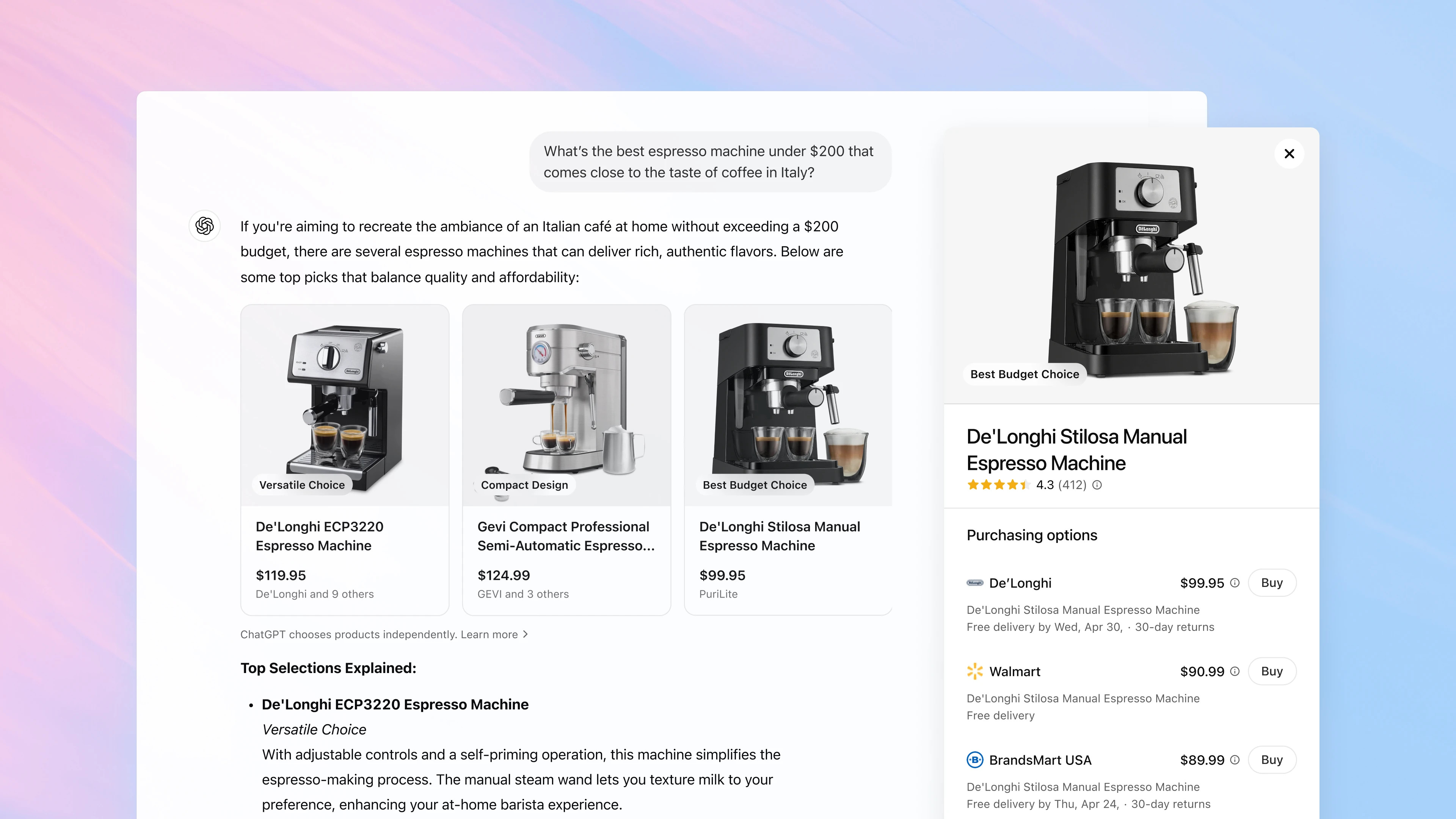
Ever since ChatGPT exploded in popularity, there has been a looming “how” to its monetization plans. Much has been said about shopping and advertising as the likely paths, especially with Fidji Simo joining as CEO of Applications under Sam Altman. Advertising as a business model for AI is logical but difficult to personalize and specialize. We know tons of people spend a lot of time using AI models, but how do you best get the sponsored content into the outputs? This is an open technical problem, with early efforts from the likes of Perplexity falling short. Shopping is another, but the questions have long been whether AI models actually have the precision to find the items you want, to learn exactly what you love, and to navigate the web to handle all the corner cases of checkouts. These reflect a need for increased capabilities on known AI benchmarks, rather than inventing a new way of serving ads. OpenAI’s o3 model was a major step up in search functionality, showing it was viable; the integration was either a business problem — where OpenAI had to make deals — or an AI one — where ChatGPT wasn’t good enough at managing websites for you. Yesterday, ChatGPT launched its first integrated shopping push with Buy It in ChatGPT, a simple checkout experience, and an integrated commerce backend built on the Agentic Commerce Protocol (ACP). The announcement comes with the perfect partners to complement the strengths of OpenAI’s current models. GPT-5-Thinking is the best at finding niche content on the web, and ChatGPT’s launch partner for shopping is Shopify (*soon, Etsy is available today), the home to the long tail of e-commerce merchants of niche specialties. If this works, it will let users actively uncover exactly what they are looking for — from places that were often hard to impossible to find on Google. This synergy is a theme we’ll see reoccur in other agents of the future. The perfect model doesn’t make a useful application unless it has the information or sandbox it needs to think, search, and act. The crucial piece that is changing is that where models act is just as important as the weights themselves — in the case of shopping, it is the network of stores with their own rankings and API. The ACP was built in collaboration with Stripe, and both companies stand to benefit from this. Stripe wants more companies to build on the ACP so that its tools become the “open standard for agentic payments” and OpenAI wants the long-tail of stores to adopt it so they can add them to their ever-growing internal recommendation (or search) engine. The business model is simple, as OpenAI says “Merchants pay a small fee on completed purchases.” OpenAI likely takes a larger share than Stripe, and it is a share that can grow as their leverage increases over shoppers. I’m cautiously optimistic about this. Finding great stuff to buy on the web is as hard as it has ever been. Users are faced with the gamification of Google search for shopping and the enshittification of the physical goods crowding out Amazon. Many of the best items to buy are found through services like Meta’s targeted ads, but the cost of getting what you want should not be borne through forced distraction. OpenAI will not be immune to the forces that drove these companies to imperfect offerings, but they’ll come at them with a fresh perspective on recurring issues in technology. If this works for OpenAI, they have no competitor. They have a distribution network of nearly 1B weekly users and no peer company ready to serve agentic models at this scale. Yes, Google can change its search feed, but the thoroughness of models like GPT-5 Thinking is on a totally different level than Google search. This agentic model is set up to make ChatGPT the one Agentic App across all domains. The idea of an agentic model, and really the GPT-5 router itself, shows us how the grand idea of one giant model that’s the best for every conceivable use-case is crumbling. OpenAI only chooses the more expensive thinking model when it deems a free user to need it and they have an entirely different model for their coding products. On the other hand, Claude released their latest model, Claude 4.5 Sonnet, yesterday as well, optimizing their coding peak performance and speed yet again — they have no extended model family. The reality that different models serve very different use-cases and how AI companies need to decide and commit to a certain subset of them for their development points to a future with a variety of model providers. Where coding is where you can feel the frontier of AI’s raw intelligence or capabilities, and Anthropic has turned their entire development towards it, the type of model that is needed for monetization of a general consumer market could be very different. This is the web-agent that OpenAI has had the industry-leading version of for about 6 months. Specialization is making the AI market far more interesting, as companies like OpenAI and Google have been in lockstep with their offerings for years. Every company would drop the same model modalities with approximately the same capabilities. Now, as hill-climbing benchmarks are no longer providing immediate user value, especially in text domains, the vision for each AI company is more nuanced. I predicted this earlier in the summer, in my post on what comes next: This is a different path for the industry and will take a different form of messaging than we’re used to. More releases are going to look like Anthropic’s Claude 4, where the benchmark gains are minor and the real world gains are a big step. What I missed is that this applies downward pressure on the number of models labs will release — the value can be more in the integrations and applications than the model itself. Expect releases like today, where Claude released Claude Sonnet 4.5 along with version 2 of Claude Code. The period will still be busy as the industry is on the tail end of the low hanging fruit provided by reasoning models, but over time the hype of model releases themselves will be harder to conjure. Interconnects is a reader-supported publication. Consider becoming a subscriber. Let’s consider the applications that are rolling out today on top of different models. If you haven’t pushed the limits of GPT-5-Thinking, and better yet GPT-5-Pro, for search you really need to, it’s a transformative way of using compute that can find many buried corners of the web. In terms of untapped model capability value, the abilities of search-heavy thinking models like GPT-5 seem far higher than coding agents, which are obviously heavily used. Search-heavy models are an entirely new use, where coding models were the first widespread LLM-based product. As coding agents become more autonomous, they’ll continue to flex and mold a new form for the software industry, but this will be a slow co-evolution. OpenAI is going to focus on its vertical Agentic App where Anthropic (and likely Gemini with Google Cloud) are going to power the long-tail of AI applications reshaping the web and the rest of work. OpenAI will only expand from here. Email, scheduling, travel bookings, and more everyday digital tasks are surely on their roadmap. Their biggest competitor is themselves — and whether their vision can be crafted into something people actually use. If shopping doesn’t work out as the vertical that lets them realize their valuation, they’re positioned to keep trying more. OpenAI has both the lead in the variety of models that power these agentic information tasks and the user base to incentivize companies to collaborate with them. The application paradigm that dominated the mobile era is going to rebound. AI applications started in a form where the user needed to be heavily involved in the work process. The first beneficiaries of this were IDEs and terminal tools. Both of these workplaces allow in-depth and detailed inspection of the process and results. The cutting edge of AI will still work there, but the long tail of casual use will all shift to the standard mode of applications — siloed, simple, and scalable in the cloud. The simpler an AI application is, the wider its potential audience. With this addition of shopping, OpenAI is poised to launch a standalone TikTok-style app with the release of its next video generation model, Sora 2, soon after Meta launched Vibes in their Meta AI app for only AI generated videos with a specific theme to start. At the same time, OpenAI’s Codex web agent is available in the ChatGPT application, which represents an even bigger change in the nature of software work than the addition of coding agents — it allows real websites, and soon businesses, to be built with only a prompt on your phone. In 6-12 months, these agentic applications that feel rough around the edges due to the quality of the AI today, rather than the interface, are going to feel seamless and second-nature to use, despite their complete novelty relative to the past decades of technology. If OpenAI is positioning itself to be The Agentic App, this also opens the door to the near future where many applications we use today shift to an agentic era. Want to schedule a meeting with someone? Let the Google Calendar agent handle that (or some startup that beats them to it). Your email application can find who the next client is and remind them of their appointment. The Banking App will file your taxes in one prompt. The list of these is infinite and across a wide spectrum of difficulty. OpenAI wants to be the one app, The Agentic App, that serves all of these, and the rest of the industry is racing to master their specific vertical before OpenAI gets there. This is a public episode. If you'd like to discuss this with other subscribers or get access to bonus episodes, visit www.interconnects.ai/subscribe
Embed this episode
Ready to play
ChatGPT: The Agentic App
No transcript for this episode yet
Similar Episodes
No similar episodes found.