Souls twisted and knotted into one. Carnage, murder, and vengeance until it is done. Three souls but just one vessel to dwell. Yet four souls are now bound to hell.
A witch's warning concerning chimeras. Introduction. Chimeras may be the most dangerous craze among the society of magic users in the area. While there are no regulations as of yet, I would like to propose that this in-depth study of the creatures themselves and their effects on the world around them, we should be regulating the practice of creating them.
Chimeras have long been part of wizardry studies and are even used to test one skill in some organizations. Yet, overall this time, the act of creating such an amalgamation has never been scrutinized. While they are renowned as the ultimate form of creation of a guardian such as a Golem, their wild and at best unreliable. Physiology of the Chimera.
Origins. While most consider the Chimera to be some wizard creation ages ago, most of my research concludes that it was taught to that unknown wizard instead of his own creation. Despite their often incoherent rambling, Chimeras themselves cite Chardigno, a god of chaos, who seemed to be the root of this practice. Chardigno is a manipulator in some amalgamation of life himself, who desires more beings like himself to be made.
The idea of Chimeras has been encouraged for thousands of years by this time. Agents of Chardigno have likely accelerated it. What makes a Chimera? While there are more traditional Chimera recipes, essentially any creature that is a purposeful living and functioning combination of other beings is considered a Chimera.
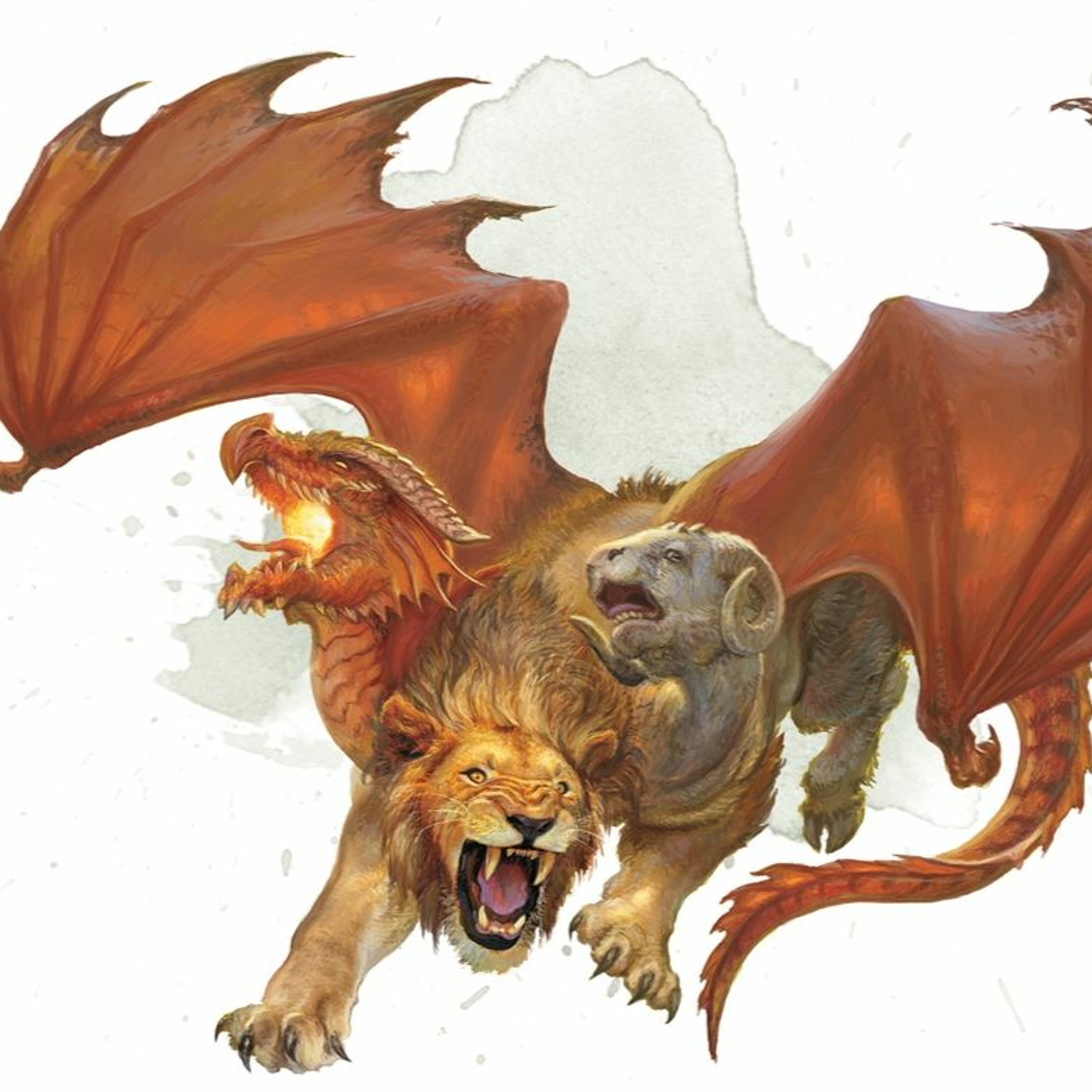
The most common occurrence is that of three beasts, a dragon or snake, a lion and a goat. There are still many ways to assemble, if you will, the creature, but popularity has changed over time. The first depictions have the body and head of a lion, and then a goat's head and neck coming from the shoulders. The tail is that of a snake.
The more modern practices use a dragon's head instead of a snake and have the head of all three horizontally attached. This orientation is much like the forward-facing heads of a hydra. The dragons are now used because they possess leather wings where flight and often use their powerful tails. Advanced compositions are rare, as getting so many different biologys to work together is a challenge and an even dangerous task.
Chimera's of four or more creatures are considered advanced and likely extremely powerful. The most common modern varieties are almost identical to the three-headed lion, dragon, and goat combination but replacing the tail with a snake's head. Capabilities of Chimera's. Often the concept of something being greater than the sum of their parts holds true.
With Chimera's however, they are, let's say, less than their sum. They retain many of the abilities controlled by the parts of their creature's presence. However, they often fail to account for the overall design of the animal to facilitate said powers. That being said, a lion can't fly or breathe fire upon their foes.
For example, the common Chimera uses the heads of a lion, a goat, and a dragon. Lions are pack hunters and, well, Chimera's are not. Dragons have large lungs and systems to create powerful breath weapons. The shorter and cramped way Chimera's are made causes much less powerful breath weapons.
A must state though that they are still powerful creatures and not to be taken lightly. Despite their weakened individual abilities, they are still more powerful than any individual use to create them. There are a few exceptions, such as dragons. Limitations of design.
Chimera's have many combinations possible and even some have been to experiment with some rather extravagant beasts. However, certain rules have to be followed. Without these considerations, the creation of the Chimera will fail or result in a short-lived disaster. Always use an herbivore.
First, regardless of the number of creatures used in combination, herbivores are essential to the monstrosity psyche. Herbivores, irrespective of what species, act as a balance for often aggressive predators used in creation. Everything needs a head. Part of animals used in the creation of a Chimera need a head.
Even if you use the Thagomizers alone of a Stegosaurus, no other animal knows how to control or use those faculties. The heads control their respective parts and can only do so for those respective parts. This rule excludes internal organ uses such as vascular systems and the nervous system. Never use a mentally damaged creature.
If the parts are used for a mentally damaged creature, the animal's brain can't handle the new pressures of working with other minds in a combination more organism, using unhealthy brains results in either a veiled creation or a severely disabled Chimera. They must be living. Under the technicality, creatures must not die before becoming a combination organism, while magic, especially necromancy, can bypass this requirement, it then qualifies as a zombie. This requirement is largely for definition purposes, but a zombie does work in totally different ways and is not autonomous like a Chimera.
Biological needs. Decite being a construct of sorts, they are still living creatures in essence. Their biological needs are limited to what remains of the beast. They will always need food and water to keep living as any other beast because they are alive.
A living construct, if you will. The food they require is dependent on the base creatures, since most consist of both predators and blang, they are omnivorous. One's made entirely of herbivores, don't need meat. Mating is a troublesome biological need for Chimera, since this is mostly a hormone-driven activity the Chimera could seek to meet as many times as the all-combines meet creatures mating habits.
However, since the faculties to do so are not a requirement, the frustration can turn into violence. This design flaw is rarely addressed among most Chimera into mad hormone-driven beasts unable to act on urges. No correct answer to my knowledge has come to fruition. Habitat and home.
Chimera are solitary creatures regardless of composition, and often live in concluded caves or other such shelters. The climates they survive in are mainly dependent on what the heads can handle. Unfortunately, this is an extensive rage and only excluding extremely arctic regions at most times. Their homes are not decorated and are simply a safe place to rest and eat in peace.
They are extremely territorial with their dens and will often kill any creature, even smaller insects that enter their homes. They can be reasoned with, and if the right offerings are made, most creatures can at least get a head start. Nearly immortal constructs. As a result of their unnatural creations, Chimera's have no known ending lifespan.
While physically, from harm or disease, they are not invulnerable. They do not age from time of creation. Many Chimera's have been found surviving for thousands of years if they aren't in populous areas. Lazy killers.
While there are dangerous creatures, they only hunt when they need food. They prefer to sleep and rest as a merely existing with multiple minds is a tiresome effort. Thus, they will do the bare minimum required for a task. They do, however, have an abundance of energy and can explode into action in most scenarios.
Intelligence and social behavior. Lowest common denominator. The drawback of Chimera intelligence is that they are typically very unintelligent in comparison to other sentient creatures. They are mentally as capable of the least intelligent brain used.
Most commonly, this is a goat. However, they are fully sentient creatures. Full self-awareness and even able to communicate vocally. They don't often think or that well.
However, exceptions exist with base animals all having a fair amount of intelligence. The lowest common denominator rule still applies, but it can be a very dangerous Chimera if the lowest is still above an average in mental faculties. Near perfect memory. Chimera is excel mentally in one aspect, and that is their memory.
They can recall and repeat nearly all information from the base animals' birth to their present time. While they may not understand all of the information they carry or how to use it, it is indeed their. Remembering people, animals, places, smells, and sounds are of no trouble to a Chimera. Language and communication.
These creatures, despite their abysmal mental capabilities, can still converse. They can speak any language that heads previously may have known most commonly found in jaconic heads. When speaking, they communicate with all heads simultaneously regardless of the phonetic ability. Their voice may be unusual and hard to understand, dialect, or animal noises.
They also know every language of their creator. Territorial loners. Aside from their creator's initial tasks, Chimera will often live alone and keep it that way. They don't desire companionship in any form.
They are sterile and unable to reproduce despite sometimes having the faculties to do so. As a result, they hold no biological responsibility to anything but themselves. Their homes are their place of rest, which is much needed. If disturbed unless there is an immediate benefit to not doing so, they will kill any intruders.
Often their attitude is sour to begin with anyways, making negotiations with a Chimera difficult. Vengeful nature. Even if they are not the brightest creatures around, they are adept at revenge. If Chimera's are cheated wrong or even perceive a slight against them, a desire to slay the offender arises.
While this can be quelled with a proper tribute, it is a hefty price either way. Most of all, they hate those who hurt them, especially their creators. Interactions with other creatures. Creation and creator.
Chimera recognizes its creator and often despises them. Their past lives are as their separate animals are still intact. And while they have no desire to hurt themselves, often have little desire to be what they have become. Most often, their whole existence is blamed on those who made them and festered into outright hatred.
Creators of Chimera should be careful as success quickly can turn into death. Wording spells and other failsays are often used but only lands for so long. They will also remember every detail about their creators, making it hard to hide from them. A Chimera if made correctly though is a magically bound to serve and assist the creator.
However, it is a dater's dance to keep a Chimera close as often they seek to find a gap or loophole in the established rules. Usually, this is why Chimera uses guardians as they can be instructed to do something simple and from a safe distance. Prey. Chimera's prefer to eat sizable slow-moving herbivores such as cattle.
While this isn't always an available food source, they don't enjoy hunting as much as they enjoy sleeping. They can catch and kill more dangerous or smaller prey, but usually do so with as little effort as possible. Its attitude is why it's a regular food or most desirable deals to Chimera's. Intruders.
Chimera's are not intelligent and they know it. Thus, they tend to be overly cautious. Any creatures they deem dangerous ranging from rats to dragons are dealt with quickly if intruding in their den. Animals' unubiters speak are violently killed and removed, even if it is a suitable prey.
Their instinct to live in seclusion is higher than their desire for food. However, those who can entice a Chimera can walk away. These opportunities are often where an negotiation for food or other things they desire. They are sticklers to the terms of such deals though, and if the agreement is broken often it results in a vengeful Chimera finding the offenders and removing them.
Fearless or stupid. Chimera's are often arrogant as well as vicious. They see all creatures as equal, below themselves. This attitude is typically founded for animals, beast, and even humanoids in most cases.
However, more powerful creatures such as dragons, liches, or anything able to best a Chimera are still treated with the same disrespect, even if they've been beaten and spared to the Chimera's lives. Many Chimera meet their doom to a dragon this way. If they don't, it doesn't aid their already inflated egos. Variations.
While I usually have accounted for whole creatures fully adapted to different life-salesen and environments as variations, Chimera's are distant prospect. Below are the various advantages and disadvantages of using the animals in making of a Chimera. Since there are so many ways to make a Chimera of viable, there are well-known 15,000 different cases. It would be daunting, let alone the possibilities of one.
Lions. Lions are fierce and strong creatures. They add an air of an intimidating presence to the Chimera. They also make them less likely to be intimidated.
They unfortunately won't back down from a challenge as it is easily, even if overmatched, their laziness is also increased widely using a lion. Dragons. Dragons are powerful creatures and often with powerful breath weapons. Getting a dragon to agree to such a process willingly is rare but often resulting in the most powerful Chimera's.
They possess a healthy mind and a breath weapon like the dragon used. They are also able to fly, although clumsily. Using a dragon will make a Chimera prideful and greedy though. Dragons instill the desire to hoard treasure which, over time, will attract endangered dangers.
Goats. As with any herbivore, the goat provides a healthy balance for up to three predatory heads. They also offer increased running speed, climbing ability, and a powerful headbutt. Unfortunately, goats are stubborn and not the most intelligent creatures.
The goat makes the Chimera both aggressive and severely hamper their mental capabilities. Even more so, if a fainting goat is used, the Chimera will faint if it gets too round up. Snakes. Snakes add a powerful venomous bite and infrared vision.
This creature makes them able to operate in lower light to near pitch black. Mostly active at night or underground, snakes also provide a fair amount of stealth and patience. However, they become cold blooded losing a fair amount of climate control. Eagles.
Eagles are raptors such as griffins, hippocriffs, falcons, and hawks all give the Chimera incredible flight speed and abilities with feathered wings. They also provide an astonishing eyesight and the ability to process visual information quickly. Using raptors gives them a bludgeoning damage vulnerability as their bones become hollow to reduce weight for carrying such a massive creature in an air. Scorpions and spiders.
Scorpions and spiders both provide a potent venom, either via biting or tail-stinger in the scorpions case. They also give a fractal vision on their respective head, quickly able to discern movement. They can't protect as well against piercing attacks, especially well-placed aero shots and can't see nearly as far. While they don't negate any of the other head's sight abilities, it makes for a blind side, only 30 feet or so away from the arachnid head, with areas that don't overlap with where other heads can't see.
Mammoths and elephants. Elephants and mammoths both provide massive weather resistance, making them able to survive in arctic environments. It's important to note that this will negate the drawbacks of potential cold bloodiness. They are also healthy, physically tough, and making them harder to take down with physical harm.
Of course, they also have the massive advantage of a prehensile limb and an intelligent urner before stevidiness. However, they are massive, negating any possibility of flight and require nearly triple the amount of food. This drawback also makes any amount of stealth nearly impossible. Catablipus.
Another unintelligent but utilitarianly useful herbivore is not of the catablipus. Providing the ability to turn foes to stone with their gaze is powerful. They aren't the most intelligent though. Catablipus also gives them the unfortunate blood rage under a full moon that catablipus become carnivorous.
This craze turns the chimera from dumb, yet still sentient creature, into a purely instinctual rage-filled beast for hours putting them on a rampage. While it's hard to quell the beasts at this time, the repercussions of such recklessness often catch up with them and get them a target on their head. Leachrona. A carnivorous and intelligent creature that survives on wits is always an advantage.
Leachrona significantly increases the chimera's intelligence and is seemingly the one exception to the lowest common denominator. This ability makes them highly sought after for a creature of chimera creation. If they weren't so rare. They also retain Leachrona's ability to mimic any voice they've heard perfectly, making him excellent deceivers and vicious mockers.
Unfortunately, this makes the beast a much more challenging to create as Leachrona are also nearly always bloodthirsty killers. Thus their aggression is overpowering and often on constant rampages. Creatures that cause too many waves don't survive long. Wolfcan and dogs.
Wolves and dogs are pack predators and are among the only predators that serve as a balancing animal in a concoction. Warrgs will also drive this benefit. Unfortunately, you'll be trading off this feature for an icy breath weapon if you use a winter wolf or one of its variations. They all also provide a keen sense of smell.
Since they excel at tracking down prey, unfortunately not one documented creator of a chimera that uses such a creature has been found. The cost of using a canine? Your life it seems. Bovine.
Cows, oxen, and bison are not known for their intelligence and thus fall in the same pitfalls of using many herbivores as the balancing animal. They make up for this pitfall, making sturdy body and incredibly powerful chimeras. They get confused quickly though and have reduced eyesight as far as distance goes, creating another potential blind spot. Dinosaurs.
Well, dinosaurs are a broad group. They offer many advantages as they are some of the rarest and most potent naturally occurring creatures in nature. Herbivores with highly offensive abilities and defensive, massively overbearing offense with carnivores. It seems they would be the most popular choice without rarity and consideration.
Alas, if it wasn't for the multitude of drawbacks, dinosaurs have some of the lowest intelligence that we know of and hinder mental abilities greatly. On top of that, they are only viable and exclusively reptilian combinations. Fish. Sharks and predatory fish may seem like an excellent way to make a chimera adaptable to water and wet environments, with their features uniquely able to support many kinds of adaptations.
Fish body can make a whole of the record for the most animals and abilities used, 20. They are also very unintelligent though and hinder any problem solving ability. They also demand a water environment and must states emerge. Amphibians.
Like fish, amphibians allow for excellent aquatic adaptations and can support a larger number of creatures. Amphibians can support up to 10 animals but require wet environments to survive. It may seem like an advantage to support that many creatures, but it often brings in more complications than one can handle. Humanoids.
Humanoids are the most dangerous and highly immoral animals used in chimeras. Most often, they can only support one or two other creatures and end up being handicapped. Many issues lie with using humanoids outside of the moral implications but also with significant advantages. First, is that humanoids retain any skills, knowledge and training they once possessed.
Unfortunately, most realize the monstrosity they've become, leading to severe mental trauma. We also assume that no trauma was sustained during the creation process. Instead of leaving the intelligence at the lowest bar, humanoids average out on the intellect and since they are more mentally versatile, they act as an herbivore in mental balance. While theoretically, some minds may be strong enough to avoid this fate, all humanoid chimeras eventually go insane, often losing any advantage they once held.
It's also important to note that nearly all societies treat this as an act of murder or in some cases worse like a war crime. There have also been a task force sent after those who have created such a chimera. DM notes. Chimeras are a classic fantasy monster that falls within the easy to understand, lets glue some monsters together.
There are powerful foes, but often how or why they exist is overlooked as some wizards did it. I encourage you as a DM to consider what animals are being used and why. As always, this is only my take on the creature with my own twists. Chimera hooks.
A chimera is guarding an artifact it took a shining to and the party is seeking it. Unable to stay there revenge, a chimera is seeking the party who unfortunately has a descendant of their foul creator. Rumors of animals being gathered by a local madman are being slaughtered for his experiments. When confronted you find that you are too late, the chimera has been created.
Sources say that a chimera of a legal composition has been created, you are tasked with finding the creation and its creator then handling the issue. A friendly chimera is seeking help, but no one believes it to be friendly or frankly, same. Thanks for reading or listening. This is my 66th ecology.
If you would like to know more of the article this is attached to you, has my other ecologies and also consider contributing my Patreon. www.patreon.com slash port 1. F-O-R-T-U-A-N.