
EPISODE · Dec 24, 2025 · 5 MIN
CHINESE THOUGHT AND WESTERN PHILOSOPHY
from alexis karpouzos's podcast
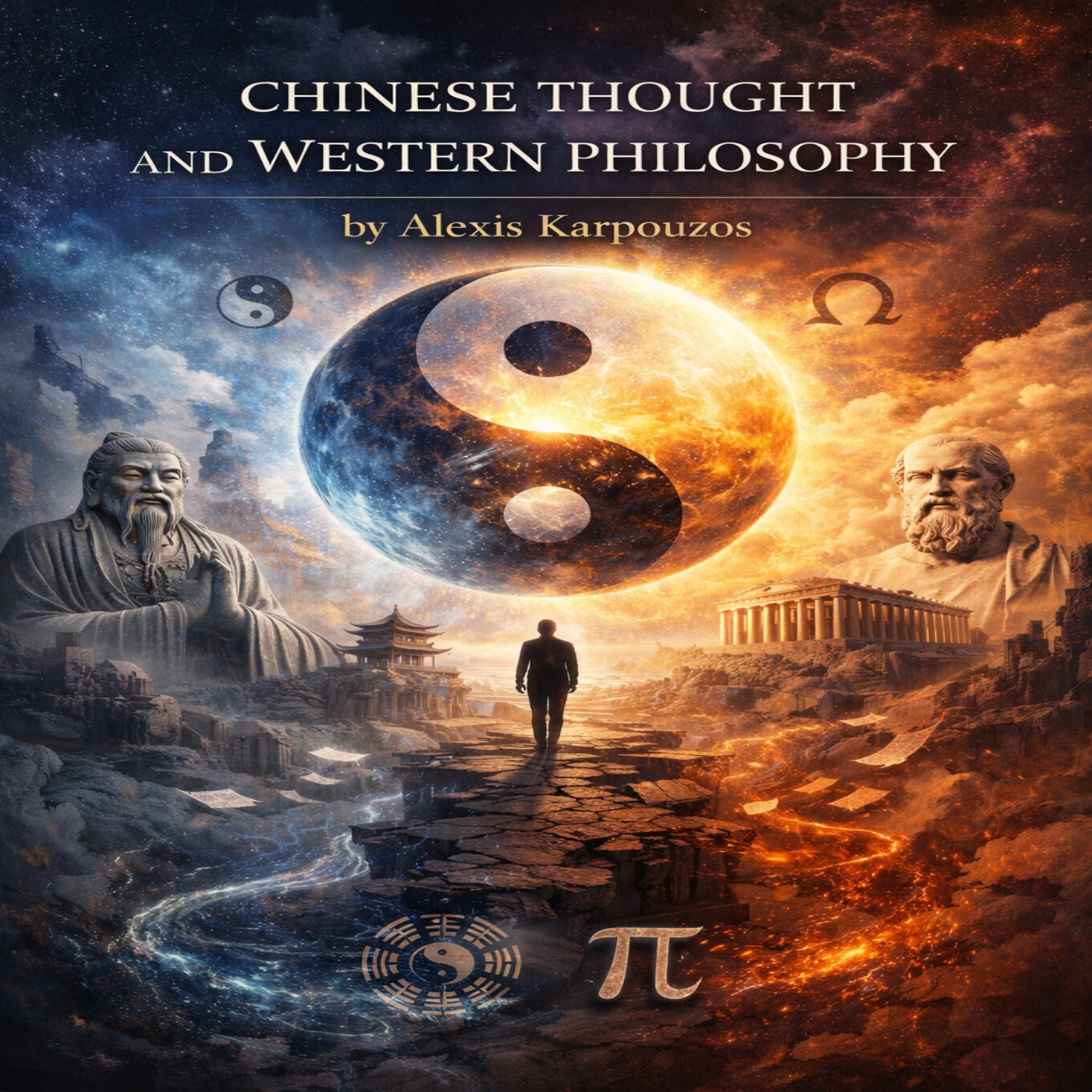
CHINESE THOUGHT AND WESTERN PHILOSOPHYby Alexis Karpouzos and Ceo of AcademiaThe dialogue between Chinese thought and Western philosophy opens a horizon where two distinct civilizations of meaning encounter one another beyond the limits of cultural comparison. In the work of Alexis Karpouzos, this encounter is not treated as a synthesis imposed from above, but as a living resonance—an exploration of how different modes of thinking illuminate the same fundamental questions of existence, consciousness, and cosmic order. Chinese philosophy, shaped by Daoism, Confucianism, and Buddhism, approaches reality as a dynamic process rather than a fixed structure. It emphasizes harmony, relationality, and the continuous transformation of being. Concepts such as Dao, Qi, Yin and Yang, and Wu Wei articulate a worldview in which opposites interpenetrate and meaning arises through balance rather than domination. Knowledge here is not abstract mastery but attunement to the rhythms of the cosmos. Western philosophy, by contrast, has historically pursued truth through analysis, conceptual distinction, and the assertion of rational autonomy. From Greek metaphysics to modern rationalism and existential inquiry, it has sought to define being, subjectivity, and knowledge through logical clarity and critical reflection. Yet within this tradition lies an unresolved tension: the desire for absolute foundations alongside the recognition of finitude, becoming, and the limits of reason.Alexis Karpouzos approaches these two traditions not as opposites but as complementary expressions of humanity’s philosophical quest. Chinese thought offers a wisdom of immanence, continuity, and non-duality, while Western philosophy provides a language of critique, transcendence, and self-reflection. When brought into dialogue, they reveal hidden correspondences: between Dao and Logos, emptiness and being, intuition and reason, silence and speech. This comparative perspective does not aim to dissolve differences but to deepen understanding. It invites a rethinking of philosophy itself—not as a closed system of doctrines, but as a transformative path that integrates insight, experience, and ethical responsibility. In a world marked by fragmentation and cultural dissonance, the encounter between Chinese thought and Western philosophy becomes a gesture of reconciliation, pointing toward a more holistic vision of knowledge. Through this dialogue, philosophy regains its original vocation: to awaken consciousness, to harmonize thought with life, and to reconnect humanity with the living intelligence of the cosmos.The most central and famous concept of Alexis Karpouzos is that the World is neither pure order, nor chaos, nor a simple dialectical contradiction - it is an open and creative play of forces. Man does not dominate the world, but man and the world cooperate and co-form. Hosted on Acast. See acast.com/privacy for more information.
Embed this episode
NOW PLAYING
CHINESE THOUGHT AND WESTERN PHILOSOPHY
No transcript for this episode yet
Similar Episodes
No similar episodes found.
Similar Podcasts
No similar podcasts found.