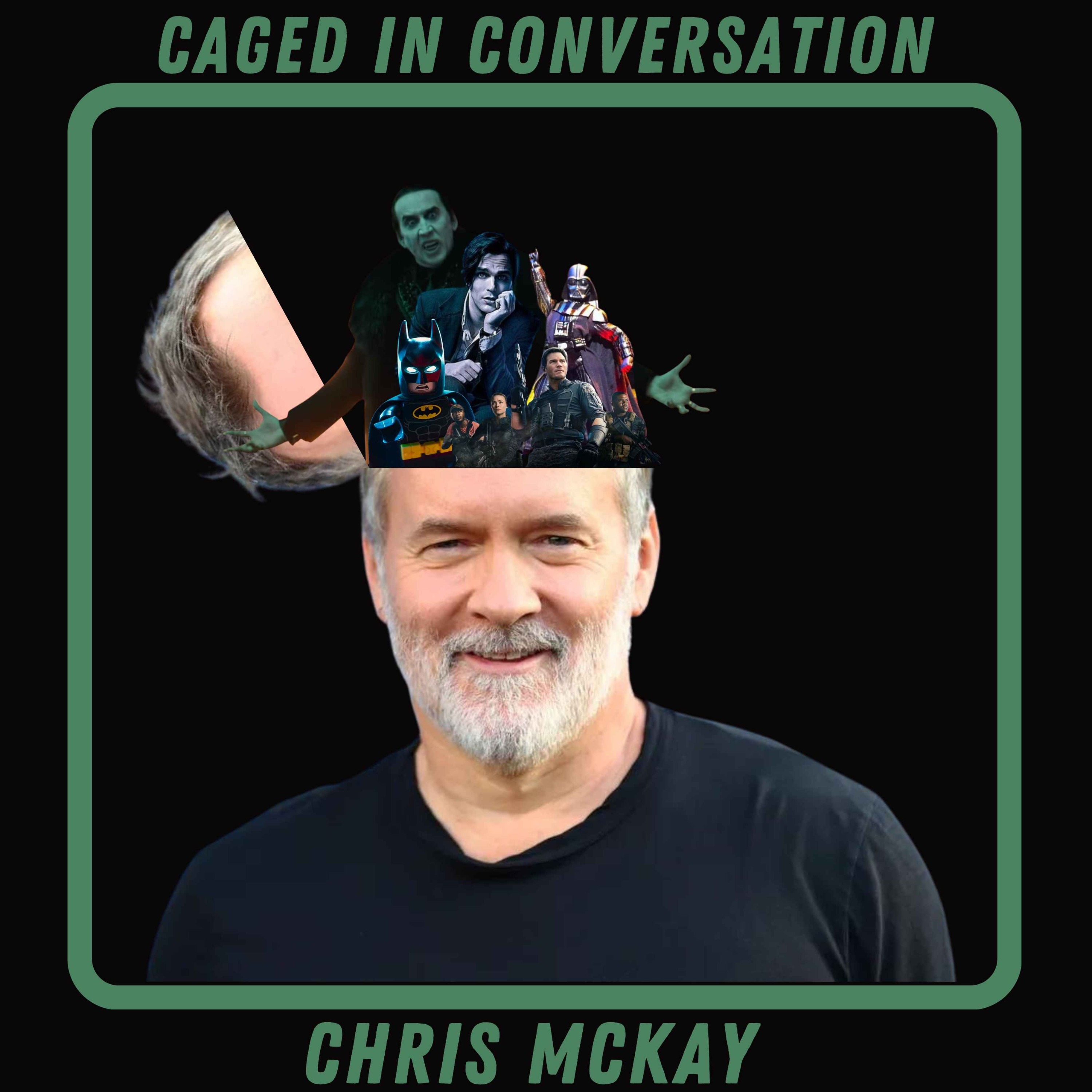
You're listening to the Caged in podcast, you bullshit artist. Hello and welcome to Caged in as ever brought to you by the breadcrumbs collective and hosted by me, Petros Pat Silvers. We are here for a very special Caged in conversation of this week with the director of the Lego Batman movie, the Tomorrow War and the brand spanking new Nicholas Cage film, Renfield, it is of course, Chris McKay. This was a fantastic conversation I had of him about all things Renfield, all things Nicholas Cage.
This conversation basically divulged into a Nicholas Cage kind of nerd out, which is something I am prone to do here. So I was very happy that it got to that place. And Chris was an absolute gen. This is a nice, a hefty 45 minute conversation about all things, as I said, Renfield.
And most importantly, for my son at least, and maybe some of you listening out there, we get the closest to the definitive answer of how many Lego bricks it took to make the Lego Batman movie. So all exciting, exciting stuff. So yeah, without further ado, enjoy my conversation with Chris McKay. Whoa, whoa, whoa, whoa, whoa, whoa, whoa, whoa, whoa, whoa, whoa, whoa, whoa, one last thing before we get into this episode, Chris McKay does a massive spoiler for this film.
So if you have not seen it, when you hear the following noise, just skip 15 seconds and you'll be in the all clear and ready to go. Now enjoy my conversation with Chris McKay. So I'm joined on the podcast a day by the director of Renfield, Chris McKay. How are you today, Chris?
I'm doing good. How are you doing? You all right? Yeah, I'm very well.
I got to see the film a couple of days ago. I've just got to commend you on the kind of tightrope act of kind of balancing the tonal shifts of comedy, horror and heart, like, how does it feel? So what it's like a year out, since you wrapped filming, like, how is that time in between Ben trying to find that kind of balance for you with the film? Yeah, I mean, you know, I was fortunate, obviously, it starts with a really good script.
And when you hire Nick Holt in Nick Age to do these performances, that you've kind of spoiled for choices as far as that goes. I mean, you know, the doing horror comedy is there's there's there's very few good ones. And so we kind of knew that there was going to be a challenge. But I just thought, you know, this idea of like seeing Dracula through the lens of his assistant, through the lens of a codependent relationship with a toxic narcissist boss from hell, played by Nicholas Cage, as some as a kind of rock and roll Dracula.
That seemed like a lot of fun. And seemed like, you know, like, I'm always thinking it's like original and new, and at least it's like a at least a fresh spin on something. And so in a world where you could have just done a regular Dracula movie to do one. Yeah, through this lens of his assistant just felt like, you know, felt like something is like really special.
And I was really, really happy to work with Cage and work with all because there's wonderful actors and really giving a game. Well, I'm really interested to know where your kind of origins for your love of horror kind of come from. Because I'm looking at your previous work, like even going back as far as robot chicken or even the like, Batman, you've kind of peppered Dracula in for out those projects, like, so what were the kind of movies you want to watch as a kid that kind of got you into horror? Probably the first horror movies I saw actually were the hammer horror movies from the 50s and 60s.
So when I was a kid, this TV station, I grew up in Chicago and this TV station would play, would play, you know, a block of movies every week. And they usually were on a theme. So so you do Universal Monsters Week or King Kong Week or in this case, Hammer Week, where so I saw horror of Dracula, I saw the Oliver Reed, you know, werewolf movie, actually doing Frankenstein, all that kind of thing. And so that's probably like the first stuff that I got to see, where I got to see these characters, because I don't think they play the universe stuff so later.
So I saw I saw the Hammer stuff first and obviously is in color and it was these beautiful sets. And I remember the horror of Dracula, the specifically ending, which we try to mimic a little bit of in our movie because I wanted the beginning of our movie to feel like the third act of somebody else's high kilometer. So I so the horror of Dracula ends with Peter Cushing running across this table, leaping for the drapes, pulling the drapes down and having the sunlight hit Dracula and then Dracula melting into this puppet, this little fakey looking puppet that they did, you know, which was we were obviously very inspired by in our movie because we do the same sort of thing where the vampire hunter shoots out the drapes and the drapes fall and Dracula goes on fire and then you get to see sort of a puppet version of Dracula there as he's destroyed. And that kind of starts, you know, hopefully that's the signal of the audience.
But hey, look, this is, this is where Dracula's story and these movies kind of ends and we're in the redfield, you know, redfield story kind of takes over. And that's kind of, you know, kind of how we started like that. But I was just drawing on these films and that's something that means a kid. Obviously you evoke the 1931 Todd Browning film.
Was there like an element of trepidation with that? Or you kind of like all gung ho to be like, we want to pay tribute to this and kind of have it there in the DNA? Because obviously like you kind of, you know, you kind of super imposed cage and hold spaces into that movie as well. So like it's not just referencing it.
It's like we're fully showing, we're recording that stuff almost. Yeah, yeah, I mean, I I wanted to find as many ways to show love to these old movies as I could, but obviously not in a way where it's like bogging down the narrative or whatever. And and so whenever I could throw an Easter egg in, I would. And in this particular case, I also wanted there to be a real history with Holt and Cage as Renfield and Dracula.
And by combining our heroes, by compositing our heroes into the, you know, staircase scene in the Todd Browning movie and putting cage up on the staircase, that image that we've all, whether you've seen the movies or not, you've seen that image somewhere, whether it's been parodied in Family Guy or Simpson's or a poster or something or in a montage of clips of things, you've seen that thing, you know, I, you know, I am Dracula. And that just to me, there's a great way to do it homage, but it's also a great way of creating a real relationship that the audience can feel because again, maybe this is part of our collective unconscious or pop culture. And you just kind of like feel that these guys have been together, the oldness and braininess or the footage and the way it's sort of shot, you know, these angles that people are using, like, just kind of creates a history, history of this guy's and that was important to me about it really at the end of the day. It played so well in the screening I was in just like the sudden change of aspect ratio and obviously like for the silly literature, it was like a great kind of like, they're doing it and it's kind of like, it's a real, it's a real ballsy move.
Speaking of like ballsy moves, obviously, this film, yeah, I think you could say it's quite ballsy. So like when you first saw the script, what kind of leapt out to you was something ballsy in it that kind of grabbed you and said, oh, I want to direct that. Yeah. The fact that they weren't just doing, you know, another Dracula movie where, you know, we've all seen done a million times and even just any, even the art about Dracula sort of take, you know, some of the beats from Dracula, the original Dracula story.
The fact that they were just doing, you know, cage when he readies like this, you know, this is really brave that, you know, that these guys are going to do a movie like this. And I think it was just, yeah, the fact that they're just, they're going to, you know, the universal is going to let us make a movie about Dracula, but who's the lens of his assistant? It's going to be about codependency and it's going to, you know, had what I thought, you know, at least what I, you know, it's not all in there in the scripts, but what felt like splat stick humor, you know, that there was that and that got really exciting. So I'm a big, like Sam Raimi and early Peter Jackson fan, you know, that evil dead too and dead alive and that sort of thing.
So the idea that you could do something like that with a studio budget or, you know, like with a movie for an already movie, that seemed like a lot of fun. Um, and, and being able to play with a color palette because obviously this movie is because it's a horror comedy and because modern horror comedies that you can't do, like, I don't think, you know, you can't do like straight parody. You can't do the Dracula dead and loving version anymore or any of that sort of thing. You kind of have to ground this in a world that feels, still feels like that world.
I think people, I think that, you know, I love those movies, airplane and they could go and all that stuff. But I just don't think that people are people are in a movie like this. I don't think people are as willing to go there or invest in it. And I knew they needed kind of invest in these characters.
You're going to do a codependent relationship. You got to care. It can't be surface level. You got to kind of care about these guys.
And that's why you got to hire Nicole, but so we got to hire Nick Cage. That's why I got to ground it in something that's appeals to Pause. I real times as much as much as you can, much as you can make it feel real and earn. And I think the relationship with Nick and Nick, the run field and drag relationship, regardless of anything else in the movie, those two guys are really playing it.
They're playing all the humor. They're also playing all the drama and all of Dracula is truly, you know, he's manipulative. He's one of his love bombing run field, next minute, he's menacing run field, next minute, he's gaslighting, and he's really truly playing a true narcissist, like going through all of the lack of empathy, the grandiose, the feeling, you know, the grandiose self, you know, feeling, feelings of himself, all that kind of thing is not displaying Cage does it brilliantly. And Holt is, you know, holds a guy you really root for, you know, what matter what he does, whether he's playing a war boy in in Ferri Road or he's doing Romeo and Juliet or he's playing in the great.
You, you he's unafraid to be unlikable or weird or strange or flirt with unlikeability. But at the same time, he's so charming and so vulnerable that you want to follow him in audiences or root for him. And this is a movie that's got to you got to root for this guy. No, he ends the movie, you know, this is coming up for the movie.
That comes out or not. He ends the movie, you know, reciting his affirmations while punching Dracula in the fucking face with Dracula fang hands, like some sort of weird or wolverine thing, like, you know, the movie could do that. You know, hopefully we earned that. That's the thing that's the most exciting, you know, for me, that's the exciting, you know, script.
Well, because I read I read in Total Film magazine that you could said about casting Renfield that you kind of needed somebody like you said, who could capture that vulnerability, but can still get weird. Was it a tough road to find your end field or was it was it quite easy to fall on? Well, you know, I met Nicole once before this for a different movie. And, and I was, and I always, and I really liked meeting him.
And I was fascinated with his career. And when I read this script, my only thought was this movie doesn't work unless we get nickels. I didn't see anybody else for the role. It's just like, this is the guy that this movie, you know, lizard dies by when I'm in cast this guy, because there's there's there's nickels and then this kind of thing and then not a lot of other people.
And so, so yeah, on the one hand, it was very easy because I just saw that one guy. And that's what I wanted. And I'm the other hand, it's hard because obviously like he's a busy guy and doing a lot of things. And can you make his schedule work with some other, you know, A-list actors schedule that gets it to be Dracula, unfortunately, both Cage and Holt and Aquafina's scare and Aquafina's schedules worked out.
So we're really lucky that we were able to get everybody and that, you know, wherever we make it work. Amazing. I'm really interested to know what that first meeting with Nicholas Cage was like, obviously, like, yeah, I'm a massive fan. And in the kind of press for this, I had a carrot dangled to me that I possibly could have interviewed him.
And it was kind of like that feeling alone was like, Oh God. So what is it like for you? Obviously you get to meet kind of actors all the time and stuff like that. But like, there is a certain gravitas to Cage.
You don't have to say that as a fan, like he kind of feels like an old school movie star in a way. What was that initial meeting like with him? No, he is an old school movie star. Like he's like, so and there's very few of those people.
I mean, I get nervous around people all the time. Like that's like, you know, that's like, you know, for me, like, you know, because you're meeting your heroes, right? And Cage or somebody I grew up with, you know, from, you know, raising Arizona and, you know, Peggy's got married and moonstruck and all of that stuff. Like, you know, those were movies that were, you know, big, you know, movies.
And then into, you know, rock and con air and kiss of death and all the stuff he was doing, Red Rock West and, you know, like just, you know, just like amazing performers and performers. And he's a guy that like, like I would go see his movies because he's in it. Like, you know, maybe like, you know, the David Caruso or Richard Price, I think wrote the scripts and like that. But you know, it's Cage that I want to see because I was talking about, he puts in this really physical performance and he's like, and he's so great because again, talking about vulnerability, like he plays, he's really jacked up in that movie.
That's like in the phase of his life where he's like getting super jacked up for movies. And yeah, the same time he's got this fucking, you know, puffer. He's really puffer all the time. So he's playing this like, you know, like really, you know, dangerous, you know, and it's a remake on Richard Woodmark by the original version of it.
But he plays this really guy who's really scary. You know, he's one breath away from fucking dying and he's got to ever suffer with him in all times really. It's really great performance. And that's one of the most worth seeing just because he Cage, you know, what do you think about anything else?
And you know, it's Cage, it's so good in the movie. Not many movies do you get to say you can see Nicholas Cage bench press a stripper as well. That's a stripper. That's a stripper.
That's a stripper in that movie. That angle too, they had down on him. But yeah, like that's like that to me, you know, so, you know, he's just this guy who's, we have a, you know, a deep love for and he's done all of these different things. Like he's played every kind of, you know, avant garde stuff to very real things.
And he went to one's an Oscar and, you know, and, you know, adaptation and just all the stuff that he's done. You know, it's been, he's just had this amazing career. It could happen to you. I find him so charming and it could happen to you.
And so, you know, he's not doing like, he's just playing a cop, you know, it's like, it's, it's still not anything that's, you see what think about Nick Cage, but he's just so good in it. And he's just so charming, you know, and he's got chemistry, like, he has chemistry with all the other actors, he's got chemistry with the camera. Like he really, he's just a fucking movie star and yet he's the nicest, nicest person you'll ever meet. Like he's just so genuine and real, like real all the time.
And that's, and the thing, like you were asking, I think you questioned, started like, what's it like, you know, the first conversation. It's like, this condition I had with him was like, over a, he was, I think it was over Zoom, but I don't think there was, I don't think there was picture. I think it was just over audio. And we were just talking about the script and he was so enthusiastic.
And, you know, and then that's what he was on set. He's got this childlike enthusiasm. It's full of joy. And he just wants, he just loves making movies, loves being on set.
After all these movies that he's been in, he just, he shows up every day and said, even with the four hours of makeup, he said 20 pounds, a good body makeup, get everything on him, 20 pounds of makeup that he has to sit in the chair four hours and do and then come on work at 10 or 12 hour a day. And then go take it off. It's like, and again, we're not, we're not caring cancer or anything. We're doing this stuff.
But it's just like somebody that's that level and a world where the ego is so easy to get into an ego place, you know, when you're getting chauffeured around and all this stuff and people, you know, are trying to take care of it. So easy people to get, you know, just like, just get twisted up about like, what's real? It's not real. Here's this guy was just like, he just wants to, he just wants to play and have fun and just create and it's just, it's like, it's a joy to be around.
It's inspiring to be around both Holt and I were just like, every day I was like, wow, we're just fucking inspired to work with this guy. Well, everyone I've spoke to, he's ever worked with him. Oh, he says that like when he comes to set, he kind of knows the script back to front kind of, yeah, I mean, he could do the lines, book, any, any much way, but what kind of, what kind of character quirks did he bring to Dracula? What did Dracula look like before Nick was cast and what did he bring to the world?
Yeah. I mean, you know, he starts with the costume, it starts with what he's wearing and you know, he was very, he had great ideas about costuming. He's a great idea about everything, a great idea about script, you know, some inline changes and things like that, word changes, but it started with Lisa Lavas, who was another great partner, Lisa is amazing and she and Kay started working on the costume, he started working on the rings, Kay was really big on the rings and wanted like a full set of rings and had some spare specific ideas about what should be in some of the rings and stuff like that. And that was really cool.
And he also like, he also wanted certain fabrics and stuff like that, like a lot of the velvet and the rhinestones and that sort of thing. And we were also, you know, I mean, that was the case where I was able, but you know, something we had talked about before, Kay showed up was, you know, synthesizing some of the bellagosi stuff with the Christopher Lee stuff with very modern cuts and, you know, cut as far as the shape and cut, but also like the coloring, like bring like a really high, very regal collar, like something you see like, you know, maybe more French cut than that thing. So there's lots of that stuff that kind of came. And so it was just simply, you know, once Kay's came on board, is synthesizing that, Christian Tinsley with the special makeup effects, you know, we talked a lot about like, you know, one point at the time, like facial hair, because you know, the original brand stoker as written had, you know, Dracula had a mustache and all that kind of thing.
It's gonna be very Eastern European. And really, the story of Dracula was about sort of the fears of Eastern European immigration in the London. That's sort of like the original text was kind of about and sometimes that stuff is brought out a little bit more in different movies, but Dragus was for students or something. And I thought, oh yeah, what if you know, what if he had, you know, a beard and stuff like that.
So we were playing around with stuff like, you know that kind of thing, once we saw Cage and it was clean shave and we did the white base paint and the widow's peak wig and stuff like that, like it all came together in a really, really great way and it just looks so good. And Christian did such a nice job with that. And Christian and Cage worked together a lot with the makeup of the eyebrows would feel like and that kind of thing. And yeah, it was just a really great team collaboration.
And but you know, it's all based on like what, you know, once Cage got cast, people just got really excited. It was a lot of excitement when he was cast in this movie as far as like through the crew. It's just like, it just, and I've been on the movie for like a couple months before we cast Cage. And it's just like, it was just like, it was, it was just like some of shockwave through everybody and everybody's game just like stepped up and they were just like, you know, pins and needles, like, you know, with excitement, like when the first camera test when we had in the full makeup and costume, you get in front of the camera and I had all these candles, you know, on set for the camera test, all the smoke, it was playing like the score from Coppola Stracula as he entered, you know, as he entered the room for even got a camera and it just sets a tone and people just got like really psyched about making the movie and that was that was a great, you know, kind of coalescing of everybody's like, you know, you know, all their, you know, hopes and dreams about this movie suddenly just like I kicked up a notch.
Yeah, in the way that kind of this film like, almost like is a book end with Todd Browning's film, it's almost like a weird book ending with in kind of Cage's like rise, we get vampires kiss. And that's kind of like, I don't know on this kind of new way, you've kind of coming out of like what some people obviously you don't have to comment on this, but what some people would call a slump, like I don't particularly believe that anyway, but kind of what you read on the internet, it's kind of great to see this mirroring that like it feels like a role that he's was born to play right because we've got, yeah, we have vampires kiss with the fact that he produced Shadow of the Vampire and was going to play, yeah, it was going to play the full role at one point. And yeah, it's kind of this, the casting, as soon as I saw it, it's like this makes complete sense. So Cage, when he was when he was when he was really young, his father played the movie Nastvaratu, or when he was five years old.
And so Cage saw the movie and Dr. Calgar was five years old, and that made obviously a huge impression of that kind of silent movie acting, that kind of creepiness of all that. But that's, you know, that's that started his love of horror movies, that started his love of, you know, his love of movies in general. And again, you see a lot of the way Cage uses his body.
He really uses like his hands in things in a way, and a lot of that can be drawn back to, you know, to Kevin Dr. Calgari and Max Shrek in Nastvaratu. Amazing. So another thing with this film is as well, I guess a lot of people will be shocked at how kind of gruesome and violent it was.
And you kind of mentioned about that kind of slapstick horror, which I kind of reveled in any time there was kind of something gruesome, I'm loving it. I'm loving it. And I'm always fascinated about that kind of action, like set pieces and stuff like that. Like, how do you how do you go about it?
Is it like, do you storyboard it? Like, yeah, what's the kind of practicalities to stuff like that? Yeah, I mean, it's, you know, it starts with Chris Brewster, who's our stunt coordinator, second year director, and basically he does, and we would go over the scene, we talk about like, what are you know, my hopes and dreams are, and what I think I see in the action scene, I actually see how I see his appointments and needs a goal, and all that kind of thing. But I also said, like, there also has to be moments of there's gonna be moments of violence that we need that are meant to be funny.
And then just need to be an overall tone of humor to the scene. There needs to be, action has to be brutal. I like brutal action, but it also has to be funny. It has to be moments, it's either so brutal, it's funny, or it's just, or it's just has like, you know, something that's inventive or whimsical.
And so we studied like, um, sides, obviously, that studying, you know, modern any of our rations scenes in John Wick, or what have you, but also say like Jackie Chan, because there's no one funnier as far as doing action scenes in Jackie Chan. And then it was like looking at the splat's thick stuff in an evil dead movie, evil dead too, specifically, and in the dead alive stuff we talked about, and bringing, and bringing Tinsley into Christian Tinsley, special So Bruce would go off, he'd start to shoot something, block something together, you know, like with the stunt team, sometimes we'd have access to the set early on, so we could do there, sometimes it's in rehearsal space, but you'd go and he'd block all this stuff, add sound effects, add music, cut it together. And then we'd sit there and look at that, I'd go and maybe ask him to try one other thing, or I'd get the storyboard artist to draw some things, and then I would also show it to Christian Tinsley, and then we would start to kind of brainstorm some things like, can we add this here, can we do a face rip, can we do this or whatever? And he would then go off and do some tests in his thing, shoot those tests, and marry all this together.
So basically you have a picture in audio blueprint, it's animatic, picture and audio blueprint, it's a little bit of a previs, it kind of shows the stunts, shows a little bit of some of the action, you know, as far as the whimsical action that we wanted, so the splat stick stuff that we wanted from Tinsley, you put all that stuff together, it kind of helps you make your day, because you know, you've got a real solid blueprint, you know, what angles, because obviously with stunts, there's only certain angles at work, you know, makes your stacking punches, no one's hitting each other in the face, or kicking each other in the chest, or rarely, or you're really doing that, you've got to stack it, so it plays, so you're only, so certain angles are going to work, so you kind of are starting to map out what your day looks like, and that's also where you get to play with tone, you have to figure out what music works and what doesn't, you have to figure out how long or short something's going to last, and whether or not you can kind of push it some more, because obviously you also want to try to, you know, grow your ideas when you're doing this stuff, so when you're on set, you don't leave any money on the table, you can really go for it, and get as much out of as you can, and then bring it back and then post, you know, be able to kind of like massage it more. Yeah, it seems like a real big part of this, like something you're passionate about, and you kind of see it in the film is practical filmmaking, is that something like obviously, yeah, a lot of the effects look like, and I think I've seen footage as well, like some behind the scenes stuff, and it looks kind of groovy and real. How important was it to be kind of practical effects as much as possible? I like shooting stuff practically, I mean, you know, even on something like tomorrow, where the aliens were, for the most part, you know, had to be CG, I wanted us to be on as many practical sets and locations as possible, to have practical, you know, muzzle flash, you know, like real muzzle flash, and that sort of thing, and same with Renfield, you know, where it's like, I like, you know, to be in places where, you know, where we're blowing squibs, and we're, you know, we're blowing, you know, gallons of blood and things like that, and you know, or cages in that makeup, where it's like, yeah, some people would have just done that, put some dots on him and do a lot of that stuff.
And later, I wanted all this stuff to be real in tactile so that like, like, cage really feels the weight of this. And when he looks in the mirror, he doesn't see himself, he sees this monster, you know, and so as much as possible, I want all this up to be to be real, I think it changes the performance, I think it changes it for the audience, even if, you know, people think it looks fake or whatever, I don't sometimes that's okay, and especially like this, it can be kind of okay, because it's, it's kind of, you know, it's meant to be a little over the top, and it's meant to be all much to that sort of thing, and that's kind of fun. And, and I think that, you know, even the dumb puppet that we use in the beginning movie, it doesn't look, you know, real, but it's fun, it gets a laugh, you know, because it's just sort of silly and, you know, version of drag on. Yeah, especially when you have those kind of reference points of like evil dead stuff like that, I mean, like the kind of claymation in the original, that doesn't really stand up now, but we will love it as kind of like, gritty horror fans.
And another thing I had to, yeah, I really want to mention was the kind of set design and the lighting in this, because it's kind of like, this, it really sets a tone to the movie. Like, how early on did that come? How paramount was that to the look of the film for you? Yeah, I think there was like two things when I read the script that were reasons why I wanted to do the movie.
One is to do a movie about code, you know, code of pen relation between Dracula and Renfield. That was something, you know, like the story, this, you know, Renfield going through this redemptive arc. That was something that was really important. The second thing was really important to me and, you know, you sort of thought everything else goes wrong.
Like, you know, at least the movie will do this. And I wanted to try to imitate the art style of Basel Goghos. Basel Goghos was this guy who did these paintings of the old universal monsters. At the time that Basel Goghos came around, the universal monsters had only been seen in black and white.
So no one had ever seen them what they looked like in color. They just seen, you know, Frank's nine Dracula and Wolfman, Saturin, black and white. And Basel Goghos did these covers for famous monsters magazine, which is this old school magazine out here in the States. And it's, it's, he interpreted Frank and Sine and Dracula and the Wolfman in color with these really garish, really saturated colors.
And for me doing like a horror comedy and trying to differentiate it from, because you got to make it feel a little real, you know, for a modern audience, the movie has to feel real on some level. So I knew shooting wise, we weren't going to sort of like ape like an old movie style for the whole movie. We could do a bit, you know, in the beginning to sort of go back to the top browning movie. But the movie has to feel like a modern movie.
And so I wanted to shoot it like a 20 Scott movie as much as possible. But by doing it with the color scheme and saturation of these Basel Goghos paintings. So that's why, you know, everyone's got kind of the colors are really saturated. And the sort of lit sometimes you top down or this underlit stuff and things like that with really big color and allicammon, the production designer is an incredible artist.
And really great partner. And he built all those sets he and his team, Chris Crane, a bunch of really great guys, guys and girls came in and just did some amazing stuff, the set decorating team, did incredible stuff with all the sets, Gary tours and the props. They built all this wonderful stuff and sets that we can light from I like practical lighting to talk about practical effects. I like practical lighting and sets as much as possible.
I don't want to bring a lot of lights in. I want to be able to have the camera go around and find stuff where we can so try to do as little lighting as possible, try to do everything as practically as possible. Set code to meeting that sets entirely lit from above and some things outside the windows. And that's it.
There's no, there's very little, sometimes Andy and the guys would bring in just like a little light next to the camera when we're doing closeups. It's like that little soft light. It's a great little more beauty. But other than that, everything's lit from above because I wanted to feel like, what if you're like, if you're in one of those, you know, stuff help getting just like top light, gymnasium coming down you, he shaped it, shaped so that it does a certain thing and falls off in a beautiful way.
So it's not like it's like he just threw something up, it's shaped and really delk away. And then Dave Cole, who was our colorist, came in and did really, really fine delicate work to highlight the colors, to carve off some of the lighting and things like that and really shape it some more. So it's all these different departments coming in and doing this really great work costuming, Lisa's costumes, probably a certain color and things like that in order to get a sort of amount of saturation and life out of the costumes. So really, yeah, really great team.
Yeah, it looks fantastic. I want to know as well how much is your work in animation kind of informed like your live action filmmaking. Do you feel like they've either inform the other or yeah, absolutely like the you know, especially when we're talking about the thing, we're talking about animatics. I mean, when you're doing animation, you're building these, you know, building storyboards that then become these, you know, previs, reels and these layout reels and so you are building these things so that what you know, what, you know, storyboards is helping the next department see, you know, how they want to block and then that department helps helps the animation, the animation team see it and then the ladders, the lighting team, so you are building these things.
And so, and to me, that's a great way to kind of get a first take at what your story is doing and try to figure out if you're getting the tone or not, or if you can achieve, you know, what more you can get out of the tone if possible. So that's, you know, I love, I always try to bring in some of these animation tools because I think every filmmaker should do an anime movie, do a short film, do something because it's storytelling in slow motion and you get a lot of, you get to really get, you get to figure out exactly, you know, what, you know, sometimes what your story and character needs and animation is really great. You're spending, you know, even cheap animation, you know, there's very, these days, you know, you're spending a million dollars a minute probably on anime movies like that. So you got to really make sure it's jam-packed with story and character information.
And so as much as I can try to get as much story and character out in a live action thing, that's what I'm trying to do, I'm trying to fill the frame with information, as much as you can see on the puzzle. You talk about filling the frame there. I noticed, well, I was watching this, you kind of had a couple of actors who people may notice, so Caroline Williams and William Braggsdale, were they purposely popped in there for obviously their kind of horror credentials? Look, if it had been up to me, I would have cast, you know, way more.
I would have, every part would have been filled with someone from an old, you know, horror movie that meant something to me. Yeah, Caroline Williams would text a chance I'm asking her to, and a bunch of other movies, she's wonderful and a lot of fun to work with. And I really wanted to do something with her and actually looked at her for tomorrow, at one point, because I wanted her to be part of the Army, the ordinary and tomorrow, and William Braggsdale, obviously the Fright Knight connection. He's also like, you know, just like, you know, he did Justified and he's been doing it, he was like, oh, it's Arkansas, where I saw him, he doesn't really great stuff.
He's still like a really fine actor. And I just, you know, because he was, you know, in Fright Knight and, you know, kind of, he now was sort of playing the writing with Dowl Roll, I guess, movie, he's playing the vampire hunter, as opposed to the, you know, the kid, he sees the rear window vampire situation. But yeah, he's awesome. He was great.
Amazing, amazing. So what I've fascinated about is obviously throughout your career, you've kind of played in these amazing sandboxes, not just in kind of IP, obviously, you've done like, yes, groundbreaking animation, you did a sci-fi action movie and now a horror comedy. Is there like a, which all kind of, especially with the latter two, they all like genres that, I don't know, like, aren't really that served that much? Is it like, and it kind of feels like, yeah, like, is there like any other genres that you'd like to like tackle in the future that you kind of haven't yet?
Yeah, I mean, I'm always looking for something new. I think that's the thing, I'm looking for something that's going to be, you know, whether it's new that's out there or new, it's original, you know, like, I mean, obviously, you know, with like a Batman that's there's an IP there, but you know, the thing that was super hooky for me was, you know, you're gonna tell, you're gonna tell Batman story in a way that no one else can tell it. You're gonna actually solve Batman's problem. There's no upside, there's no upside to that in the live action Batman movie because it sort of makes sequels tough.
But to be able to do a story, we're actually kind of getting to Batman's, you know, like, you know, stuff and solve it maybe. That seems really appealing. Tomorrow war is, you know, like a sudden military sci-fi action movie that we don't do a lot of, but it was such a fun genre. And but it was a father and daughter story.
And that's what was really appealing is I'm looking for genre stuff that has an emotional human component to it, you know, drag on Renfield codependency. And that's the thing, even in a sort of a big silly comedy with, you know, splat stick humor and action that there could be something about codependency in the movie. I thought that, you know, to me, that's what it was appealing. So that's what I'm looking for.
You know, I love to do like a movie that takes place in outer space on another planet. I think that would be a lot of fun. Like that's something I'm sort of actually looking for. I also really like fantasy.
And there's a couple of there's a couple of books that I've been reading that I'd love to turn into a movie and then kind of like, I mean, I know that sounds like all other places, but like, you know, there's a series of big James Elroy fan and a big sort of like what I would call like, you know, film the war, you know, film, war type novels in that world. And there's a couple of authors whose books I really love that I'd like to turn into a movie or turn their, you know, book series into a TV show or something like that. So there's still things, those are some things along the way that I love to sing my teeth and do. Amazing.
I have two quick questions for you to wrap up. One of them I'd be remiss not to ask you because I recently watched Lego Batman again for I don't know how many times I've watched it with my four year old son. He's kind of assaulted by it. And on the last rewatch, I told him I was going to be speaking to you.
And I said, do you have any questions about this film? He had one solitary question for you, Chris, which is how many Lego bricks did it take to make that film? I used to have that answer. Hold on.
I used to have my answer. And it's obviously in the millions. I used to have the exact answer. But let's just say it was like, you know, 1.5 million Lego bricks or something like that.
But it's a lot, obviously. And we do in an analogic where we made the movie in Sydney. You know, we there are there are bricks individually made bricks. It's CG that we make and age and stuff like that.
So that the movie feels like it feels tactile like that. So the guys work really hard to make that stuff feel real. Amazing. You would have made a little four year old today with that.
My final question is I always ask my guests on this podcast as I close a question. Obviously, you've got a horse in the race with this. But what is your favorite Nicholas Cage movie? Renfield can't count.
Right. That's a really good question. I mean, I, you know, I think, you know, I really liked, I really liked the rock. I think that's I think he's so good in that movie.
He and Sean Connery is so much fun. I think all the actors are having a good time. I think it's Michael Bay's best movie. It's most accessible and fun movie.
And it cages performance and adaptation as the two brothers just tickles me every time I watch it. I just love it so much as love watching him in that movie. He is so he's so good in both roles. I just, and so endearing.
I just really, you know, no matter what anybody thinks of that movie, which I think is a great movie, I just, I just, he is so watchable in that movie. I just, I don't know. I just, I love it. What's your answer?
It changes. It changes all the time. Red Rock West has got a special place in my art. The rest of the solid movie.
That's when he's in the Jackup Days. Yeah. Well, Chris, he's still a solid guy. Like he runs one day and I like, I was like, he goes like a patting him or kind of, you put him in my hand and shoulder to the guy over here.
And he's still like, he's still like, you know, he's still built. Like he's still really solid guys really surprised. And he's like, he still works out. So, yeah.
Amazing. Well, thank you so much for the time, Chris. And again, congratulations on Renfield. Thank you.
Thank you very much. Did you like the movie? Did you enjoy it? I loved it.
I loved it. Yeah. Yeah. Yeah.
Yeah. Yeah. It was like, yeah. Yeah.
It's like on Tuesday. So yeah, we, yeah. One of the film journalists that I kind of know him from doing the podcast and he said, I've got to sit next to you. It was like, because how often do you get to sit next to you?
Yeah. A guy, a guy who's like so, so kind of into the cage, like over that you get to experience a film with them. So yeah, I was kind of, I, I, I, I loved it. I can't wait to watch it again.
Obviously, as soon as it's kind of out here in cinemas, I'll be watching next Friday. That's cool. Well, thank you for reaching out to do this. It's wonderful.
Thank you, man. Thank you so much, Chris. Cheers. Good talking to you.
Take care. There we have it guys. Chris McKay, hopefully by now, you have all seen Renfield. I would be, I'm dying to know what you think about it.
Please do let me know you can find me on all the socials at CagedinPod on Twitter, Instagram, Facebook, Letterbox and TikTok or you can drop me an email, which is CagedinPod at gmail.com. Well, let's have a little chat. Let's talk about Renfield. As I said, I'm going to cover this film at a later date when I could kind of give it the full pated in treatment instead of something a little bit more rush.
You would have heard that if you'd listened to the previous episode on this feed. If you're listening to this right now to have released it or in the future, look at the episode below this. It was a conversation I had with the star of this film, Nicholas Hull, which is absolutely mind-boggling. But that happened.
It kind of absolutely blows my mind that I got to do that. And the time I recorded the kind of intra-altra for that episode, I was like, I think I was still in the shock of, of doing it. Like, I kind of came out of it and chatting to people I knew, who knew that I was doing it. And they're like, how did it go?
And I'm like, you know what? I have no actual idea. I felt like in the moment that just my ears were a whooshing sound. And then I was like, I just asked my next question when he stops talking.
And I felt like if I had more time, I would have done a lot better. I feel like my unique selling point is you warm to me. I'm not sure if I'm instantly somebody who is appealing. Maybe not.
Maybe you can let me know, guys, if that is the case. So that's my next week here on the pod. I've got a great conversation coming up with a guy called Jason Zenowick, who has a Nicolas Cage Dracula tattoo. I'm not sure if you might have seen this on socials, it kind of got a bit buzzy, got a bit like viral.
Over the festival, he got invited on stage by Nicolas Cage to show off his tattoo. And he then got his leg signed. And then that tattooed underneath the tattoo of Nicolas Cage as Dracula. And we talk about his whole journey, how it got to how he got to that place being on that stage.
It's a fun, wild journey. We're getting stuff about fandom. We even talk about science because Jason is a science teacher. So it was an amazing conversation, a really lovely guy.
And it's conversations like that. And just as important to me as the ones like with Nicolas Hulk, because it's the fandoms, right? Like these films almost don't exist without nice passion. I'm not talking about the toxic fandom.
That's a whole different conversation. We talk about nice, reasonable people who like the films and kind of go out and support actors that they love. And Jason is one of them. And he's kind of a man after my own heart.
We kind of get into it. So yes, do stick around and listen to that on next week. I know for some people like they don't know who the person is or whatever. Do you know what I mean?
Like, they're not talking about film. Who is this guy? Trust me, it's a really fun conversation. And you won't want to miss it.
If you enjoyed this episode or any other episode of the podcast, please feel free to head on over to Patreon.com forward slash Cajun in pod where you can get a little bit of bonus content for a little bit of money. You give us more money. I'll shake my booty until it falls off. So yeah, do that.
Or head on over to teapublic.com or slash cajun in pod or cajun in pod.etc.com to grab one of our brand new t-shirts. Got a few designs up on etsy. There's two designs up on etsy at the moment. And there's five designs up on teapublic.
I am meaning to put the other designs up on etsy as well. And yeah, teapublic, if you're in the US, please, all from there. It's just much lower shipping if you're in the UK order from etsy. It works out a better deal for you.
Works out like slightly better deals. It just makes it nice and easy for everyone in that way. It's kind of, yeah, you get your t-shirts for a tiny fashion without paying ridiculous money on shipping, which is one thing I did want to do. That's why I kind of signed up to both of them to make it nice and fair for you, the listeners.
So if you don't want to be part of any money, but would still like to support the podcast, you can do that by heading over to Apple podcast, Spotify or whatever you're listening to us right now. If they have a system to rate and review, please do so. At least five stars. And in your review, please do let me know what's, Bill Murray says to Scott, your Hanson at the end of Lost in Translation.
And I'll be sure to read out the best ones here on the podcast. So as ever, guys, I've been PatronsPats with us. I've been Cagedin. You've been amazing and I'll catch you next time.