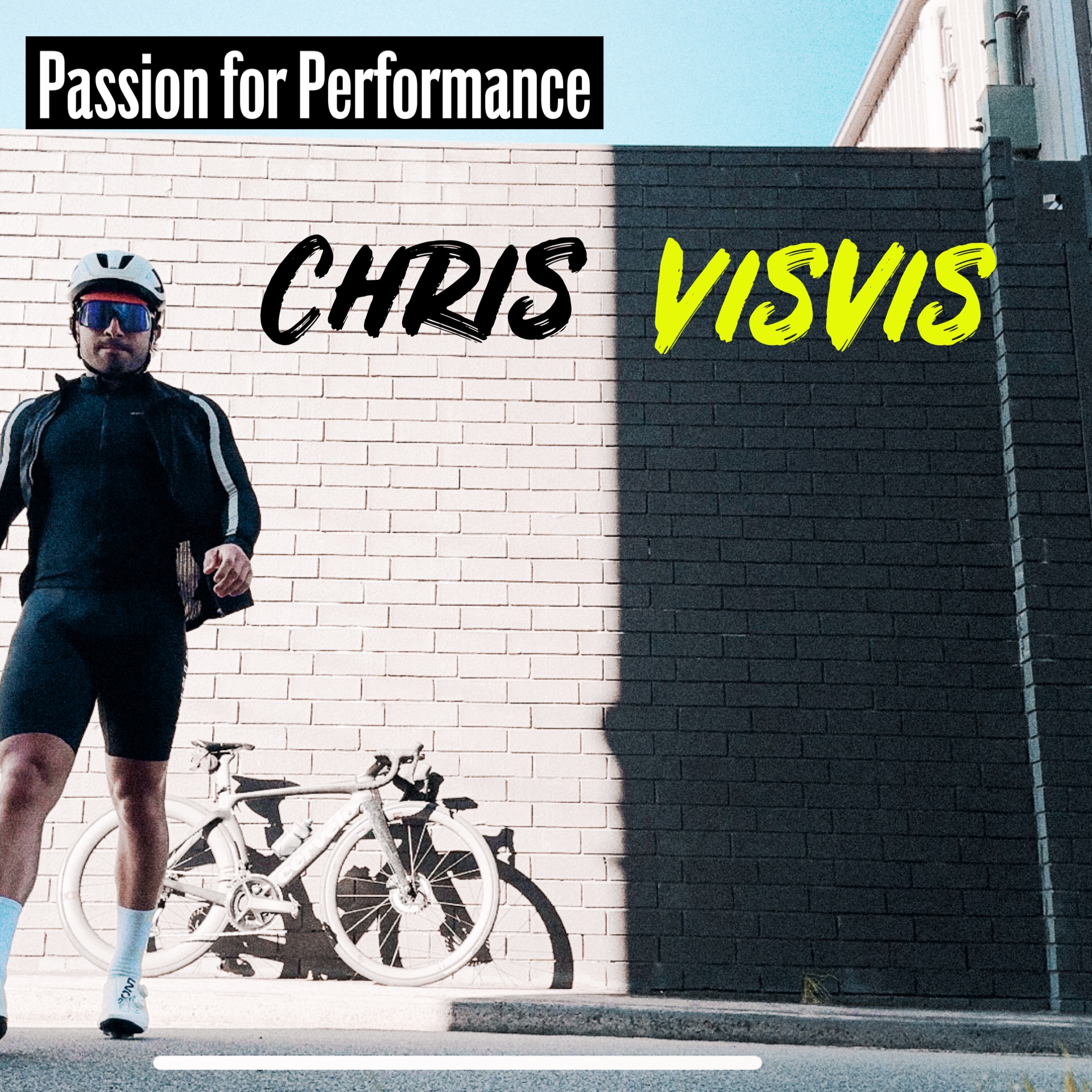
Okay, welcome back to the podcast. For those that have already listened to us and welcome to the podcast, for those that are new to our podcast who will obviously be Chris's friends and network. So welcome to the Passion for Performance podcast. We're going to talk to Chris Visvis today, who's a HPT athlete.
I've known Chris for quite a while, probably through the Whitehorse network. I used to see you in the cafes quite regularly, Chris didn't I? Yeah. In the doing a fair bit of coffee at that stage and photography of coffee and all that sort of stuff.
But yeah, I'll give you a brief introduction to Chris. And I've worked together for, how long do you reckon now Chris? Would it be 18 months? Yeah, 18 months.
18 months, yep. And then towards the end of this year, we're going on two years. Yep, yep, cool. So Chris is a cyclist by background as he came to me and with an interest in triathlon.
And we hooked up together and have worked together for that 18 months. Things have been going well. We've had our challenges with the run. We haven't had our challenges with the bike.
The swim's gone pretty well. And all in all, we've had a bit of a blast doing it all. Welcome to the podcast, Chris, after my rain blinks. Thank you.
I am happy to be here. It's my first podcast, sir. It isn't really. It's going easy on me.
It's going easy on you. Well, you and I never have too much trouble having a bit of a chat at the cafe. Definitely. John keeps that conversation rolling pretty much.
He's there on a Tuesday morning. I can talk underwater. He can. Great guy.
I always have to see too. It'll be right at the point where I have to leave to make my first morning meeting at work. Until the next time, Pete. He's a real character.
He's meeting John and yourself at the cafe. It's kind of what I like about White Horse. There's a community there that all knows each other. It's cool.
Okay, let's get into it. Let's talk about Chris first. Let's introduce you to everyone. Give the Chris story.
Tell us about what I always like to go back to school and sport. What was your experience of school and sport? Where did you grow up in that? Yeah.
I grew up in San Suzy. So not too far from the Shire, but not in the Shire. Everyone reminded me of that when I was growing up. But when you gave me this question, I had to really think about it because I landed on the answer that sport wasn't really a huge component of my upbringing.
The earliest sport that I did do was my parents put me in gymnastics all through primary school. Dad just thought it was a good, well-rounded sport. I can strengthen your flexibility. It's quite a functional kind of sport.
I just have a lot of great memories doing that all through primary school. Once high school started, my mum was like, oh, you need to focus on your studies now. The people at gymnastics or the coaches there were like, you really need to be putting more time into gymnastics and to get to that next competitive level of gymnastics. My parents were very, they always liked to throw out a word balance as I was growing up.
So they didn't want me to become unbalanced, I guess, in gymnastics and mum put more of a priority on school and education. So that's kind of where the gymnastics era ended, which I had a great time doing. But I was also kind of happy for it to end there because I don't know if it's just a place I was doing a gymnastics at, but the coaches were much more serious with the competitive athletes. Where did you go to the gymnastics?
It was Bill Parsons. Oh, yeah. Like yelling at athletes. I've heard he's had multiple heart attacks during coaching because I'm serious.
And that scared me as a young person. My daughter Ellen was a gymnast and she was at the YMCA at Carring Bar. Bill Parsons was a notorious, it was a noted program that was very serious and very good. He definitely had the passion there for it.
As someone in primary school saying that, you're like, that's scary. I don't know. I don't want to be yelled at. I mean, that was fun.
That was really cool. All that I can do now with gymnastics, I can probably still just play handstand on layers and I'm tricking it about it. What level did you get to? Do you remember?
Five or five? Yeah. And I honestly forget the levels. Yeah, they changed after one finish.
They made a big change to the levels. Yeah. But I would imagine that you weren't far off the top levels. I think the top levels went to eight or nine or something.
That rings between 10. Maybe not. I'll cut your account. Maybe someone that's listening that's got a bit of an experience.
Can put the gymnastics levels in the comments. Let us know. Refresh out the comments. Yeah, exactly.
I'm going to go into high school. And yeah. So wait, I'm sorry. Oh, yeah.
Go back. When did you finish? How old were you in your gymnastics? It was 2003, 2004, year five or six in primary school.
Okay. And then I started high school 2005 and the trend of studies coming first still running true. And I didn't really do much sport during high school. Like is in organized sport on weekends or any endurance sports that in that time, it was more on Saturdays.
I went to Greek school, like a good Greek boy. I started at the United States. I went to church. And then school sport on Thursdays.
Which I did tennis pretty much most of high school. And I loved tennis. I did such a cool game. Yeah, it's just the coordination, the speed, the skill that's involved.
I reckon tennis players are probably some of the biggest people on the planet. Yeah. Like the sprinting, the strength. The different aspects.
And you know, those games can go for matches, can go for like four hours maybe. Definitely it's super taxing. And in the heat and everything. So the one thing that I did do every day in high school was I rode my bike every day still.
I would rip around my mountain bike after school just for whatever. And then I felt great. Yeah. And then towards the second half of high school, I had a friend who was into mountain bike riding.
And we would go mountain bike riding in the Royal National Park. And then just go rip in through the trails. And I was just like a little bit fitter than him. And I loved that.
So we just like push ourselves to just, yeah, go as hard as we can through the Royal National Park. And that was awesome. Because no one else was into mountain biking in my high school. So, yeah.
So that was really awesome to have a friend who did that as well. Yeah. Then about, I think I would have been in your tent when everyone roughly turned 16. I remember a new bike shop opened up in San Susie.
And that bike shop was called Bike Culture. And a guy named John Odom's opened up that bike store. That's a rocky point right there. That's it.
Yeah. That's exactly the one. So when I went into that bike store, I'm like, whoa, this place is cool. And it's opened up right close to home.
And John probably thought of me as an annoying teenager coming to the store. Like I said, I'm just kidding. I'm just going to spend anything money. I'm just going to give him a conversation.
But anyway, I ended up getting a part time job there just a couple hours a week. Just cleaning. And I could just be around bikes, which I really enjoyed. John was a really fit guy.
Like he would do mountain bike races. And he was kind of dabbling in road cycling. And that's what power in cycling was kind of becoming more available to everybody. So he was dabbling in that world.
And he had a coach. And I picked up an old extra large road bike off a garage sale. And I was riding that around for a good couple months. And I did a team's time trial in high school.
And it was at the Regatta Center. And I just remember doing the bike component out of my team. And I was just going as hard as I could on this extra large road bike. And people on time trial bikes were passing me.
But I remember that moment I really liked the feeling of going fast. Like I've always loved it. But at that point, just on a track, just all the feelings. Something about moving forward through space really fast.
It feels really good. And that was the first time of competition bike thing that I ever did. Even though it was a team's time trial in a triathlon. Sorry, a time trial leg of a team's triathlon.
And from that point, I think I was hooked on that feeling of going as hard as I could for as long as I could. And then there was a guy that worked at that bike shop called Martin Hoyle. And he's an old school roadie. Martin, Martin, Martin, Martin, Martin.
Awesome. He gave me my first road bike. Like road bike that fit me. It was his wife's old road bike.
It was his aluminium virus with beautiful lugs and stuff. And I rode that thing into the ground. I upgraded it with components and I rode it till the shift has died. He was a bit of a lover of steel bikes.
Yeah. I had my bike here. I had my bike here. You loved that.
Awesome. Yeah. And I might have been pretty much chat underwater as well. So he was awesome to have as like a bit of an old school mentor as well.
Just in that road biking space that taught me the road biking, the bunch etiquette. Just all the things that come naturally now. Yeah. He was the one that taught a lot of other people and they included himself.
Really? Yeah. Wow. You got coached in the day by the others.
By the others. That follows on to my coaching now. You coached the squad to coach the squad. Yep.
That's it. And that definitely shows just as little side side quests as if you for whatever reason can't make it to swim. So I'm sort of one night. You're right.
You're right. You're right. You're right. Over the weekend that everyone kind of just chips in and keeps that that up.
That's happening. That's happening. But it's also in the knowledge part. There's a lot to know in this sport.
Isn't there? So if someone comes up and says, you know, on the group chat and says, what's the best? What's the best front end from a new, from my old, sort of like P3? There's going to be a lot of guys that love froth on that sort of stuff.
I just sit back and watch it all flow in. It doesn't have to be me. Definitely. Yeah.
That's interesting. You're a mighty head such an... Yeah. Mindy was the guy that showed me the ropes.
And they're working at Endeavour for a while too. Yeah. It was a mechanic. Definitely.
What he didn't know about bikes wasn't the earth knowing. Yeah. And then something I kind of... Yeah.
When I rode the Vitus aluminium bike into the ground, my dad helped me buy an actual race road bike. So I had a wheelie with Kevin Yolo. Oh, wow. And yeah, dad basically paid the whole five grand cost price.
And I was like over the moon to get like a legit road bike. So that's how the influence on you. 100%. Definitely.
The culture of cycling is amazing, isn't it? Yeah. And that was the last barrier to entry of like, okay, I've got a decent bike now. I can just go ride till the cows come home.
And then that's when I just started doing a riding more with John and being able to ride because I had the bike to do so. Yeah. And when I was driving over here, I kind of reflected on this a little bit more. But my parents separated when I was really young.
So I never really... I never had a solid fire figure like at home. I would say my dad on weekends won all some terms. I don't know what's wrong.
But like as for like fire only direction through the week, it was kind of... To each other's and... Yeah. Whoever was around.
Yeah. Your leader's in sport. That's it. And so without like unknowingly John ended up being that kind of mentor in the bike riding space and along with Martin, Marty a little bit there as well.
And yeah, it was a good thing to get fit up because at the time I was like, I'm just going to get his fit as John. And then even now it's like, I just got to get his fit as John. A lot of people want to be as fit as John. Yeah, exactly.
Well, the world champ. Yeah, that's basically it. Yeah, it gets fit as the world champ. I've got some more notes here on this like my early training and racing.
Yeah, I feel like I've been rambling for a while now. No, no, no. I've got what we're here for. So back in the...
What year would it be around 2010 at the time? The... Wow, I can't believe that 16 years ago when I started road biking. The training plan was the classic.
This was the classic training plan at the time. How many cases a week? Yeah, just like, oh, yeah, I'd do 400, 500 k's a week. That's just what you've got to do.
Or you just race till you're fit enough. Or this is what it was. It was Monday, rest day, Tuesday, do the Colutesy or the triathlon chop. If you're really feeling savvy, you'd do the triathlon chop and then you'd go around the beaches loop around the eastern suburbs and then end up at Colutesy and then ride Colutesy back to the south.
I know I didn't know that. Was the triathlon chop going around East Gardens at that point? Or was it back around George Hospital? It was.
It changed. It did change. Yeah, back then in 2010, it was the triathlon... The 5am triathlon chop from Shell went...
It definitely went around East Gardens. You'd go around East Gardens and you'd take a turn off. Well, maybe... No, sorry, it was before the East...
Before you go around the East Gardens shopping center, you'd take a turn off and do all the hills through eastern suburbs. It's like Artistry, Kooji, or... You did that bit. Yeah.
And you'd peel off to that bit and then you'd finish in Kings Cross by 625. Yep. For the Colutesy bunch. And then Colutesy would leave at 630.
Or maybe I've got it wrong. It would leave at 620. And so you just got to be at Colutesy at 620. Otherwise you missed the bunch and you've got no express ride back to the south.
If you missed the Colutesy bunch, I'll catch it up. Exactly. Yeah. Because they go the expressway.
It's like a guy that owns giant cycles in Ramsgate. He rode for Team Sky and he would do the Colutesy bunch quite often. Okay. So when he was on the front, a pro rider from Team Sky, it was just on.
And anyone who could pull a turn with CJ was like, yeah, you've got legs, something like that. I've never done the Clutesy. I'm too scared. Yeah.
I was always too scared. Yeah. I think I was too scared of the hill at Sylvania. You want to go down the front?
No. Donald's up to... From Sylvania, McDonald's up to the top at the shopping center. That part is bad.
That would drop me. It's brutal. It's never hold onto me. Yeah.
Yeah, that was actually brutal. I was like, why am I on the limit on such a normal stretch of road? Anyway, back to what the training plan was. It was a Tuesday, that chop.
Then Wednesday, you just go do something long and easy. And just as I was finishing high school, I was working casually at a cafe and going to uni. So I had those that little bit extra time to potentially skip a lecture and get it for a long easy ride on Wednesday morning. Thursday, do the chop again.
Okay. Yeah. And then Friday, something easy. Saturday, the bunch usually did a reverse loop of the Royal National Park.
So in it, in it oddly up artillery. And then on to a strong solid course. And then back up. And then either if you're feeling like you've got a bit to give, you go out to Stammall.
But I think most of the times it was just up waterfall and back to Sothe. So it's got like two to two and a half, three hours. And then, and that was Saturday. And then Sunday was like the kitchen sink.
It was like, it was, oh, did you do the one that goes south first and then join the. Yeah. But if the one you're talking about is the 6.30 leave it sub-land. Yeah.
Do a loop of small national parks. So down well for out it, oddly. At like a pace that's so fast. Yeah.
You're just hanging on for dear life. If you can, if you can exit aldi with the fastest guys like you're on. Like you're absolutely on. And early, early, early kept up like a good handful of times.
Usually I'd get dropped just before aldi because it was once, once you start going up, um, up Gary, the first field, the Royal National Park, like the pace was on it. I always remember looking at the power made. I'm like, oh, I need 300 watts going up there. And then, okay, cool.
First of all done. I'm on. I'm on. Or if you weren't on, they would do a quick restop at the top there.
And then that was your little moment to get on smash quick bar swap turns till flat rock. And then up flat rock it was kind of just survival of who can get out of, out of a aldi. First off, just hang on. You've got a good range of gradients in that.
Yeah, he's, yeah. They're three different hills. Yeah, you have different strengths. I imagine something, what would be your strength in the National Park?
Something a bit steeper, I guess maybe. Yeah, I tend to do better on like a good five minute. Yeah. If I can, if I can make it to the five minute climb.
Yeah. For some reason I struggle on the. So the guys that maybe the rollers, they come out of flat rock killing it. Yeah.
Yeah. I was always on the wheel just like trying to hang on after flat rock and then, yeah, then all the usually punch out of decent ish five minute power and kind of hang on. Yeah. Yeah.
And then everyone would regroup at the 7-Eleven. Yeah. Yeah. Get a chucky milk, a coffee, something sloppy.
And from there, it was like, I always remember feeling, ah, the ride's done now, isn't it? Nope. We're going to swap off turns all the way up the stage. I would have just finished, I would have finished high school.
So between like 18 to 20, early 20s, like 20. Yeah. Yeah. Yeah.
Did that for like four, five years. Yeah. That was a great ride. And all the, the, the longtime riders of the Sutherland cycling club would do that ride.
And also anyone that was like young and up and coming that wanted to go to Europe or something. Yeah. Okay. So, the guy would do that and aim that he would do that when he was fit as like a bit of a testing ride.
Lucky Dale, John Oedams would do it as like a little, like a tidy up before race to see where the form kind of live because if you could swap, if you could do through the National Park and be a hitter through there and then swap turns all the way into the Daniel Park along the expressway, it's like you're on form. Yeah. You're doing like 80, 90, 100 Ks of like intense riding. And if you can, if you can keep pulling turns on the front, like, go.
Dan, correct. I remember Dan Bricall. Dan Bricall. He is so strong.
Like the turns he used to pull just phenomenal. Yeah. I remember getting, I think I've mentioned this on a podcast many times ago, many episodes ago. I remember one day when he was training for Nationals TT, he was, we come around the airport drive, corner drive, sorry, at the airport.
We were sitting on like 46 or something, you know, as a group, because that would be an effort. You'd come down through the off-rock Dale, you'd come down through the sort of past the airport there and then since you'd hit corner drive off the ramp down, that was on. It was on. It was on.
And so you got around to the ground to mascot. For those two Ks or whatever it is like. It was on. So we're sitting sort of 46, 47.
He's just ridden from the back of the group, went through the whole group and rode off. He would at least have been doing 52, 53. That's incredible. I guess that's not a big deal to some of the gun that was, but he was fine.
And everyone's just like, what the hell is that? Whenever there's a night and day difference between someone that comes and passes, so easily, seemingly so easily, when everyone's like going full gas, it's always just like, what the hell is he on? What is he doing? Damn, he was going to do that.
Yeah, he was a central part of the cycling community. Yeah. He was a very quietly spoken and I heard where he's like, I heard he used to do like, he'll repeat something out easily, but I never saw it. I don't know if it was just really, but someone said just to like, I don't know, just prove how hard he was as a rider.
Yeah, but the big deal with the Shire of course is the wall, isn't it? Up at Oxford. Yeah, super steep. Yeah.
I think I've done that once. I've run up at more times than I've ridden up. Yeah, because bushes would run up occasionally as well. Cool.
Yeah. I haven't done that one in a long time, but I know it's steep. It's actually steep. Yeah.
So where, so you're, that's got you at a high school now. So that's got me at a high school and I'm kind of into my university years and I thought I'd just take this moment to be like, yeah, balance is still like a key theme there because at the time I was riding a lot, like five or six days, but I was also doing unifold time, engineering, working at a cafe, which would give me some funds to pay for cycling and to travel and that sort of thing. Which cafe? It was a cafe called Fudis in Sensuzy, which as of last year, it doesn't exist anymore.
But it was, yeah, it opened in 2004 and I asked for a job in like 2010 or whatever because I was in trouble in the coffee. Yeah. Yeah. And coffee hadn't fully formed into the science that it is today, but I basically wanted a job at a cafe because that cafe, because it was like 200 meters from my home.
Yeah. And I had to go to five 30 and wake up at like five 15 and just walking there as a zombie and start just growing. But I had to fight to get a job there. Oh really?
Like I asked like three or four times and I'm like, oh, wait for three until like, until you think I'm good enough for you to pay me. Sorry. Because it was so close to home and I've seen like a nice guy who's kind of a bit of a joker and I'm like, that looks like a cool boss. There's no water was it.
That's so. Yeah. I think it was. Well, say really?
Yeah, you know, there was because I get espresso is from. When did water start? Was it 2007? Maybe.
Maybe there was. Oh, no, they're in volume 17 now. So the year 17. So it was really cool to be in the coffee space as it was sort of maturing to some more specialty.
But anyway, that was a part time job. I really liked it. That lasted about five years. So I did a bunch of cycling, a bunch of university and a bunch of coffee.
So no wonder we've gone for a while. After this conversation, cycling, coffee. And then we'll enter into the photography world in a minute. Yeah.
Because I was into photography too and still I haven't been. You take awesome photos, Pete. Oh yeah. With the iPhone and a lot of filters.
Not about camera. Yeah. That's a field. Okay.
So yeah, so you've come out of the university in good shape. Yeah. During that time, I made sure to keep fit. I did, I still raced.
I did crit racing Friday nights, Sutherland. The club that all my friends were part of was Sutherland's cycling club, Gold School club. How about the Southern Cross was around much in those days? No, I think it kind of existed.
But we. It started as a junior club and then expanded into parents. I think it can. Yeah.
Yeah. It was more for junior's. That's right. It's a very strong club now.
Yeah. Definitely. Definitely strong club. And I did some mountain bike racing because I had the same mountain bike I had during high school.
And I did some road road racing as well. I did the Canberra tour. Just other random road races that were out and about. I never really did them too much as part of the team.
It was all just a bit of a solo endeavour or a couple people from Southern would do it and I would do it too. But I never got on a team and then went and did races with a team. Yeah. Because the time investment never really aligned with uni or I just had other things going on that didn't really allow me to do that.
Also, I think there was a little bit of self-doubt there. It was like, am I going to have to be on a cycling team? Like you really have to take things up and notch in terms of commitment to be able to be enough to be on that team with the races. And then the sacrifice for that was I think quite a lot.
Like I wouldn't be able to have a part-time job because I couldn't afford the time or I need more recovery and I might have to scale back uni a little bit as well. Or I wasn't smart enough to be able to do uni and do that at the same time. It feels like a large gap from good here to making it on to a turning. Correct.
It's a big gap. Doing 12 to 14 hours a week to then doing 20 hours a week is huge. Yeah. And I'd say like a great example of someone who has natural talent did uni and raced in a continental team would be J.
Dun. If anyone had a J Dun. He did well. He looked like an awesome time doing it.
He's not scarred now after the fact that he's all rides for fun. A bit of a crack and a few tries to. Yeah. And he still has a really healthy relationship with the sport after doing that and making that sacrifice at the time which probably didn't feel like a sacrifice because he enjoyed it as well.
And I think Harry would have been part of maybe a team at some point. Yeah. I think he was a development team went to Boulder and over there with us. I thought that was so cool when he went over to Boulder and trained like that would have been a dream to do something like that.
But just a little side note on Harry is he was writing like when I was working at Black Culture Harry was also up and coming as a cyclist as well because I think he's a couple of years younger or a couple of years older than me. It's one way or the other. But he was cycling at the time. What are you now?
I'm 32. He's 32. He's 30 this year. He was a cracking cyclist.
Super punchy. Yeah. He had a natural talent. Yeah.
Like a bunch of people were. Yeah. One with a bike. Yeah.
Yeah. Yeah. I'd say it. Yeah.
I spend a lot of time on it. They're just friends of the bike. Yeah. That's a really good way to put it.
So that's kind of the story there from like primary. So what about the obvious? Yeah. The obvious next segue is the this photography link.
You obviously picked up a camera at some stage and you know and then became a bit of a content creator of this such and you've got a great YouTube channel now. Thank you very much. Yeah. The YouTube the YouTube journey is not an easy one and you know anyone that has anything to do with YouTube is will I'll tell you this is like probably a cemetery of people behind them that have just thrown their hands in the air and given up many times and given up and so it's a journey that you've got to stick with if you're really passionate about.
Definitely. Definitely not wrong there. So was there one person or was it a slow burn to get into it? Someone that inspired you?
At the start. Okay. The answer is not really but here's the timeline and you can draw the conclusion for yourself. So I've always like I always thought cameras were cool.
Just cool. Like just you know parents have like those little point shoot film cameras and they moved on to digital and data was like tech and new things and I loved that I loved that he got like these little compact cameras which we've still got to this day. And I got some new batteries for our little old school digital camera from like 2000 and it's got like two megapixels but it still works. And I think I was just frustrated when mama's using that camera and she was like mama you can take a better photo than that because it would be like slow or whatever and then I just I just liked cameras and doing it and just taking photos.
It's just a fun thing to do especially when digital came in. But really the catalyst for me to be to take better photos and when I started putting more time and intent into it was when I started dating Sarah. She was in photography and I'm like I want to have the same common interest as her. So I am.
That's cool. I want to be better at photos and so I did and I grew to love it. And that's what it really began when I really was like oh okay let's learn a little bit more about this thing. Before that I didn't know what made a good photo even that subjective but like the basic photography.
I didn't learn those until Sarah I was like oh my crush. That's when it kind of really started. It started with just taking photos on holidays and then because I liked taking photos it would be taking photos while cycling and I just because it was what I was doing. I always liked taking photos of what I was doing and whether it was making coffees at the end of the day or writing my bike it was just something I really liked.
I think the basis of it comes down to who you are as a person as well. You're a naturally affable kind of guy. You hold conversations with people and anyone. You can walk into training and talk to anyone.
That's it. Now that you're saying that I'm thinking about it. We'll have a chat with whoever and go to learn something from him. It's a nice skill to have.
If you can do that it's cool because not everyone has that natural ability to be able to be like that and to be around people like that makes you feel good. It's like a conversation with Chris. He's got a cool YouTube channel and that makes you feel good. Good to see you for that.
Thanks. That must make you feel good. There's nothing better than sitting down editing and coming up with a video that you're proud of and it's got cool music and great be role. You're able to tell a story.
100%. You skip to the good part. Being the motivator for YouTube because a lot of people put their hands up in the air and it's just too much. They break the consistency.
I've definitely broken the consistency many, many times. The thing that keeps me coming back is the one thing is when I look back on any YouTube video I've made, I've never regretted making it. How many hours I've been talking about overwhelmed, I've felt how many things went wrong. That's the one thing when I look back on.
I'm glad I captured that moment of myself at that point in time. That's what I cherish most when I look back on the years. I look back on those YouTube videos. I'm like, oh, it was all worthwhile when I watched those videos.
I don't get that with at least a much less degree if I watch back on an Instagram video. It feels like if you watch a bunch of short form, you're having a dinner of candy in the moment. It's great afterwards. Don't get that with YouTube.
YouTube always feels like one of the satisfying meals when I watch back on these my own videos or other people's more meaningful videos that they've put themselves into a little bit more. The acceptance of that medium now is having a chat before the podcast recording. It used to be turned social media but it's less about social media now. It's more about just media.
If you turn the TV on, it used to be channel 79 to 10. Now there's FoxDell and then FoxDell became the thing. That was the streaming. Then you had the streaming services.
Now you've got YouTube and YouTube has seen as a genuine legitimate point that you can go and look at stuff. You've got that choice. You can curate whatever you want to watch. It really did start with photos.
Photos was like the thing that started with. I remember a distinct moment when I was working at the cafe and I was like, oh, video started pop up on Instagram. You could put videos on Instagram. I was like, oh, I'll try this video thing.
Just because it seemed like things were going. I've always liked video but it always scared me because it's a whole different beast of photos. There's so many more barriers to making a video. At least there was like 10, 15 years ago.
You needed a decent computer. You needed a video editor and you learned how to use that video editor. Camera is when it's good. You run into battery life storage issues.
Every issue under the sun. That was just a hit record. Let alone what do you feel? How do you feel?
What are you filming? Does it have anything to do with anything? Videos for me started with hitting record and putting clips together and saying what happened? You'd now script a...
If you've got something in mind, you'll do a rough script of it. You know what sort of shots you want. There'll be some framework there to help that overwhelm and just a little bit of structure. For many years, it was just like, let's record everything and see what happens on the timeline.
It would be this huge, like arduous, painful thing on the timeline to work out what I can do with this footage. Man, you see some of the...no doubt you always like this. You see some of the editing of the shots of creators right now and there's that many channels down there. There's the transitions, it's the sound, it's the video, it's the b-roll, it's the titles.
The layers are incredible. The layers are incredible. I don't know how you do it. Well, it gets complicated just in a regular video and then you've got Adobe After Effects and video effects and that's on a whole other level of gets way more complicated in terms of layers, which I haven't dealt into that world because I just haven't had the time, hasn't interested me.
As a cinematic, seems to be a thing now. Yes, it's definitely a buzzword. Definitely a buzzword. Everyone wants to be cinematic now.
The main inspirations I had when I was getting into video was number one, Casey Neisten. And I think with the Peter McKinnon era, and there's been a whole bunch of other synths down but they're the two that I'll just keep it simple back. And they're still there aren't they? Yeah, still there.
Casey Neistat because... Casey doesn't, he's much less though, doesn't he? Yeah, but when he was in his logging era, the way that he would film in this scrappy fashion made you feel like you could do it too. Yeah.
That's what I felt and I just loved the way that he could just craft. I guess he's probably turned around. I guess he's picked up the mantle there isn't he? 100% he's doing pretty full on the answer.
Incredible videos as well. Just the craftsmanship. Yeah. The hand-built feel.
Like when you showed me the hand- The hand-built. The washing machine there out of wood. Like that's what it feels like on one of his videos. The clutch pencils and the engraving of the name.
That's it. Well that's very cool. And it's very curated actually. It's got to be weird and wacky.
It's got to be crazy. It all comes from TomSaks which I didn't realize that until Vans started being a YouTuber and I realized that's where all that hand-built. Yeah, and that's where it takes me to originally come from. That's where TomSaks went with TomSaks and was doing art and doing...
But you know he's door and throws things and mess everywhere and that's all curated. Look, I didn't realize at the time when I first started to watch it. Same I thought it was just a hand-built scrappy thing. Yeah, but that's curated.
That's how it's supposed to look. Yeah, exactly. It's kind of cool. But also just Casey, who just put a camera on order, he'll record and that's it.
It would all be the story that he's crafting in the moment in his head. It's just incredible. What was he doing? He was that?
He was that? He was that? He was that? He was that?
He was that? He was that? He made a bit of money off selling a thing. Yeah, the nice that brother is all.
Yeah. Yeah, they sold that and done. When you say you're still going with the YouTube? Okay, so it's time to kill her, isn't it?
It's time to kill her because you know just like with endurance sports how much work it takes to do something and then how much work it takes to do something good. Yeah. So I'm always in this battle mentally with like, okay, I think I just have to get the video out and if it's not as good as I envisioned it, whatever the standard of good is for me in that moment, then it's just sort of got to go out because it's within the constraints that I can work with and work with my assistant. I wonder if that Tom Sacks and nice that look.
I wonder if that was born out of the imperfection of it was a landing for them, a landing place that they knew that it took a lot of effort and it was going to be imperfect. Yeah. So they leaned on imperfect. Yeah.
Yeah. I think so. And I think I should lean on that a little bit more to get more videos out. Yeah.
I think versus I don't want to sound cross with perfectionism. I'm definitely a perfectionist. I'm happy to, yeah, like, oh, you're enough. We're done.
Let's go next. I think more than happy with that mindset. I don't get bogged down in details too much. But that minimum standard of like the story has to be kind of cohesive.
You have to be able to watch it and be like, okay, if you're looking at a point eight to point B, what I'm trying to say, the one way I like to put it is like imagine you're in a river and the editor or the person who's creating stories putting these little bits of wood for you to jump on as the viewer to get from one point in the river to the other. There's not enough pieces of wood there you might fall in. So I'm just going to put just the right amount of pieces of wood so you can get from one side to the other. Yeah.
That's what I like to try and think of it. Yeah. There's a number of different streams you can go down. You can be a pro athlete that's got a YouTube channel that's got a YouTube channel that intends to get on there and they end up being a life of a triathlete.
And this is what I eat and it's all pretty boring to be honest. Yeah. Because it's just same. It's a silly to sell it every day.
Exactly. They're just leaning on their achievements in space. Yeah. Yeah.
And then you've got the opposite end where it might be an age group trying to sound like a pro. And that sort of doesn't sit right as well. The best one is, and I've said this to you before and I mean it, the best thing I think is just to land in the middle somewhere and go, this is my experience. You did a really good video.
You do stuff and talk about what you did. Yeah. You did one on the long run. So if anyone's listening and want to go back to Chris's YouTube channel, look at his long run.
It's a really good example of, hey, this is my experience of long running. This is what I've tried and these are the mistakes I've made. And this is what I'm going to try. Yeah.