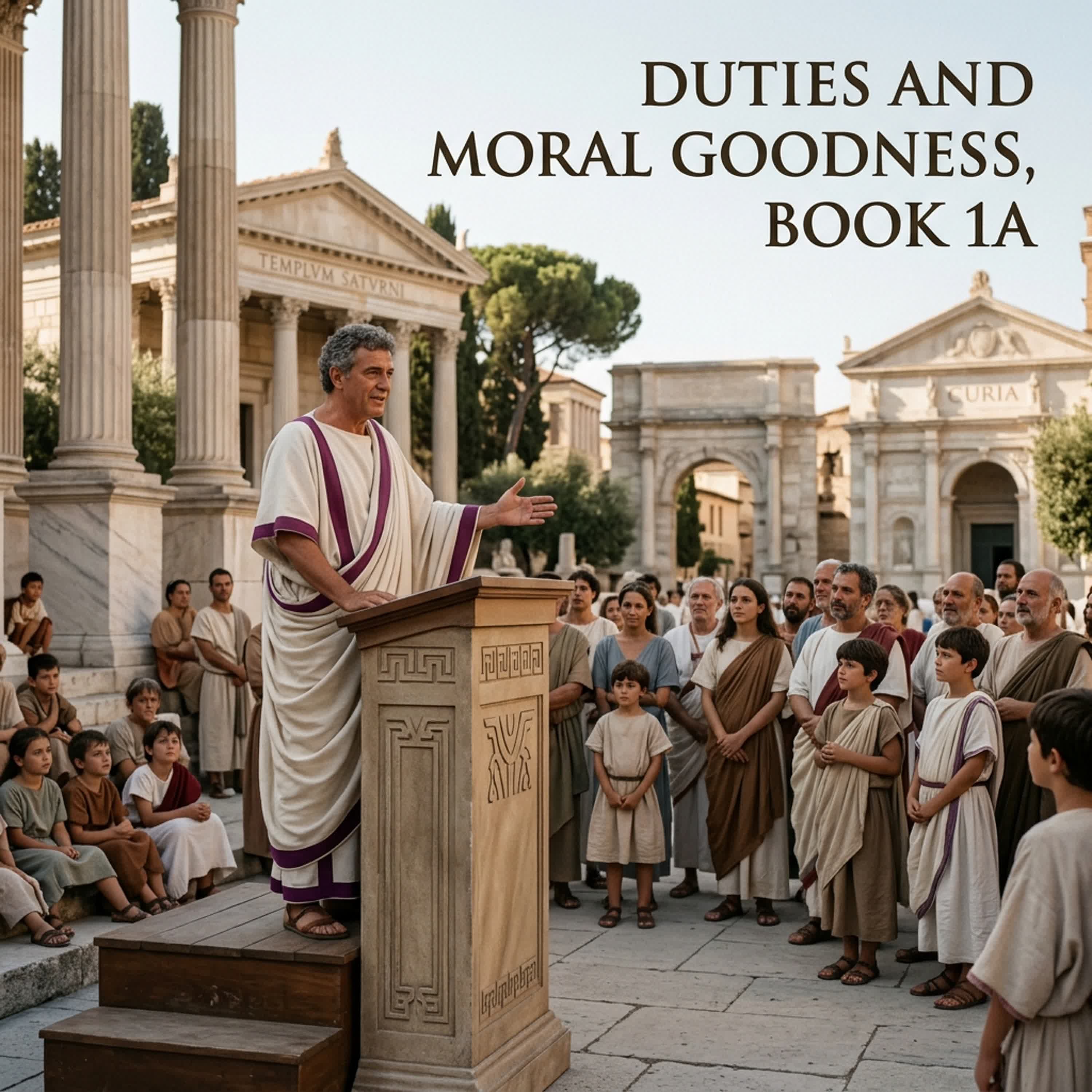
Cicero, De Officiis - 01 - Part 1
from Wisdom for the Present: Western Wisdom Literature Hosted by Kanu Emeruwa
What happens when the broken thing isn't your physical body, but your moral compass? In a world of infinite gray areas, where corporate self-interest often masquerades as progress, we struggle daily to read the ethical X-rays of our choices. We often treat ethics as a static, theoretical set of rules, but the ancient Roman statesman Marcus Tullius Cicero offers a far more dynamic approach. Written in 44 BC as his beloved republic was violently collapsing around him, Cicero’s masterpiece De Officiis ("On Moral Duties") serves not as a dry academic lecture, but as an urgent, hyper-practical survival guide for the modern soul. The conflict at the heart of De Officiis lies in how we bridge the gap between abstract moral theories and real-world action. Influenced by the skepticism of the New Academy, Cicero rejects the arrogant claim that humans can possess absolute, divine certainty. Instead, he advocates for navigating a world of probability using reason to determine what is most likely right in any given situation. To do this, he lays out the four cardinal virtues—wisdom, justice, fortitude, and temperance—not as static pillars, but as active, interconnected mechanical systems. Wisdom acts as our navigation, justice as our steering, fortitude as our shock-absorbing suspension, and temperance as our brakes. The struggle is keeping these systems in harmony when our moral road gets treacherous. In our digital age, we often surrender our moral agency to corporate algorithms and technical compliance, using the literal wording of policies to mask unethical behavior. Cicero calls this chicanery—the weaponization of the letter of the law to violate its spirit. Whether it is an ancient general ravaging an enemy’s fields by night because his truce only specified "days", or a modern corporation using a convoluted terms-of-service agreement to exploit and monetize user data, this rigid legalism is morally bankrupt. Furthermore, Cicero exposes the human ego that drives these actions, noting how easily the lust for power and wealth—epitomized by Julius Caesar—can dismantle justice. Even Cicero's own legendary ego, though laced with vanity, warns us that true greatness must be rooted in actual justice rather than the fickle applause of the crowd. Writing in the chaotic aftermath of Caesar’s assassination, with Mark Antony’s hitmen hot on his trail, Cicero knew the terror of living in a world where truth is weaponized and institutions lie in ruins. In such environments, our moral logic easily breaks down under the weight of fear and self-preservation. We fall prey to confirmation bias, prioritizing short-term expediency and personal safety over the broader human fellowship. To combat this ethical paralysis, Cicero introduces a groundbreaking five-part decision-making matrix. When our obligations collide—such as when keeping a formal promise would cause devastating real-world harm—Cicero instructs us to calculate which duty holds the greater moral weight, preventing us from becoming victims of our own rigid, unthinking logic. Ultimately, reclaiming our moral agency means moving from passive observation to active engagement. Cicero famously shatters our modern obsession with minding our own business, declaring that there are two kinds of injustice: inflicting wrong, and failing to prevent it when we have the power to do so. True justice is not merely keeping our hands clean; it requires the friction of active defense and civic courage. As we listen to this episode, we are challenged to separate Cicero’s enduring wisdom from his ancient blind spots—such as his acceptance of Roman imperialism and slavery. By cultivating a healthy skepticism and applying his practical tools, we can learn to act not for the gallery of social validation, but for the genuine good of the human community. In This Episode * Virtue is a Verb: Discover why Cicero, as a New Academy skeptic, believed that philosophy is not about finding absolute, unreachable truths, but about taking practical, moral action in an imperfect world. * The Four-Virtue Car Analogy: Understand how the cardinal virtues of wisdom, justice, fortitude, and temperance function together as a dynamic machine to navigate life’s complex decisions. * The Double Face of Injustice: Learn why merely "minding your own business" and avoiding active harm is not enough, and how failing to prevent wrong is itself a form of injustice. * Chicanery and Legalism: Explore how weaponizing the letter of the law to violate its spirit—whether in ancient military truces or modern corporate legal loopholes—destroys social trust. * The Five-Part Duty Matrix: Master Cicero's triage system for resolving ethical dilemmas when multiple moral rights or competing expediencies clash. * The Myth of Rigid Promises: Examine why strict, unyielding adherence to a promise can sometimes become a vice if keeping it causes disproportionate harm to others. * The Audit of Generosity: Uncover the dangers of performative giving, and why true generosity must always be grounded in justice and directed toward actual need rather than personal status. Practical Reflection * Are you acting for the gallery or for the good? If all public recognition and social media validation vanished, which of your ethical actions and good deeds would you still perform? * Where are you committing an injustice of omission? Is there a situation in your work, community, or personal life where you are keeping your head down to "mind your own business," but in doing so, failing to protect or speak up for someone vulnerable? * Are you mistaking rigidity for integrity? Review your current commitments: Are you pushing to keep a promise or deal that, due to changed circumstances, will now cause collateral harm to those around you? Suggested Substack Excerpt When the world falls into ethical gray areas, how do we find our way? Discover Cicero’s urgent, 2,000-year-old framework for balancing ambition, morality, and social duty in a collapsing world. AI Disclosure This episode was created using Google NotebookLM Audio Overview, based on human-curated source material, structured guidance, and editorial review. AI is used as a tool for clarity and delivery, not as a replacement for thoughtful study or engagement with the original texts. Copyright © 2026 Wisdom for the Present / Kamashcu Production Studios. All rights reserved. This is a public episode. If you would like to discuss this with other subscribers or get access to bonus episodes, visit wisdomforthepresent.substack.com
Embed this episode
No transcript yet.