
EPISODE · Aug 3, 2026 · 22 MIN
🏛️ Civilization Born from Anatolia
from HAKAN AKARCALI PodcastBox / Özgün Eser İncelemeleri / Reviews of Original Works · host Hakan AKARCALI
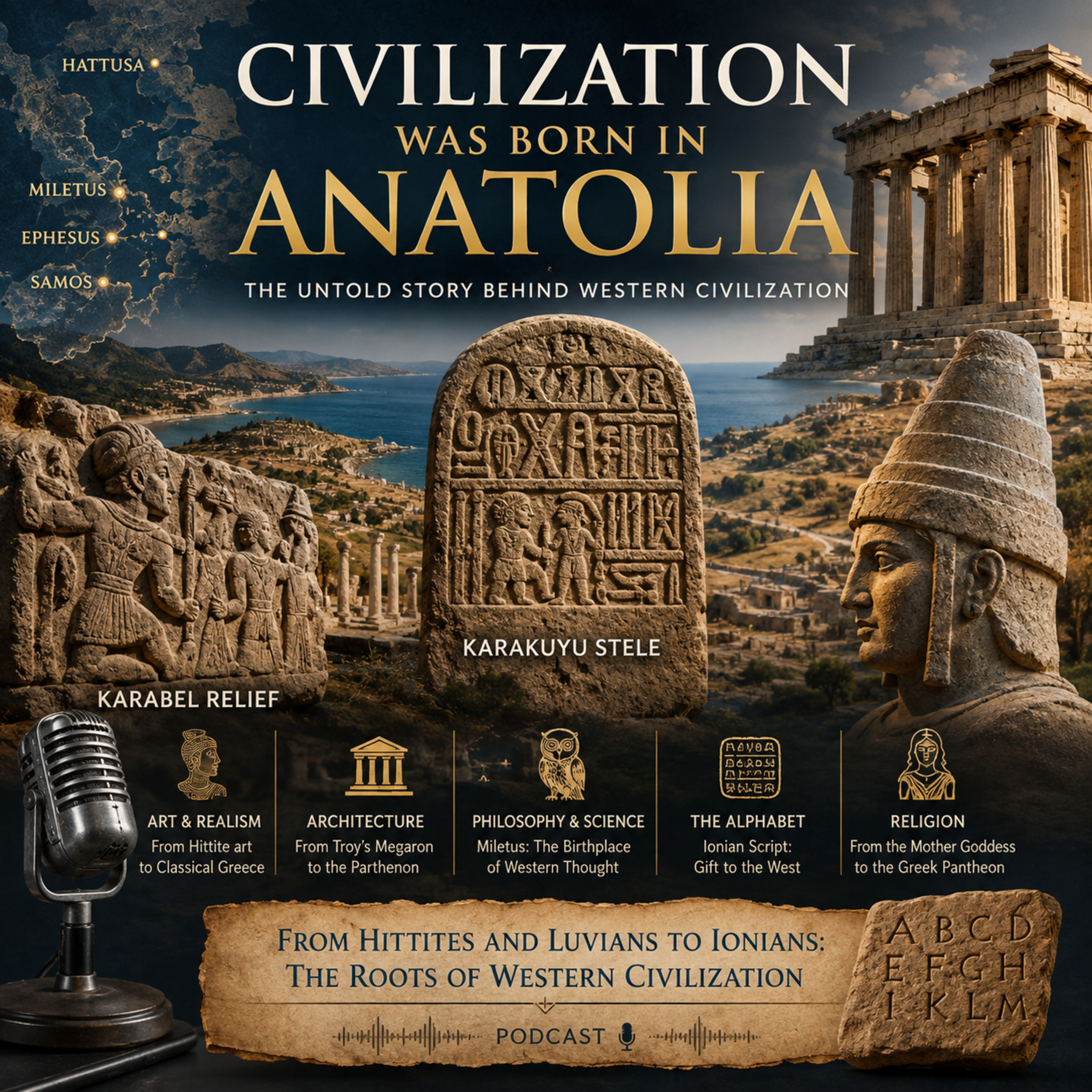
Were the foundations of Western civilization truly laid in Greece, or in Anatolia, whose historical role has long been overlooked? In his groundbreaking book Civilization Was Born in Anatolia, Prof. Dr. Fahri Işık reexamines this question through archaeological discoveries, inscriptions, architecture, and the history of art. The book argues that many of the defining elements of Western civilization and Classical Greek culture did not originate on the Greek mainland, but were first developed by the indigenous civilizations of Anatolia.Drawing on evidence such as the Karabel Rock Relief, the Karakuyu Inscription, and numerous Luwian and Hittite monuments, the book challenges the long-accepted concept of a "Dark Age" following the collapse of the Hittite Empire. According to the evidence presented, Luwian culture, language, artistic traditions, and political institutions continued uninterrupted in western Anatolia, providing the cultural foundation upon which the Ionian civilization later flourished.The book further argues that many artistic innovations traditionally credited to Classical Greece had already appeared in Anatolia centuries earlier. Neo-Hittite sculptures display natural human anatomy, movement, expressive facial features, and the famous "Archaic Smile" long before comparable examples emerged in Athens. The Gate God of Hattusa, dating to around 1200 BC, is presented as a remarkable example of realistic anatomy and dynamic composition. Artists from Ionian cities such as Samos, Miletus, and Ephesus are believed to have carried this artistic heritage across the Aegean.A similar continuity is proposed in architecture. The megaron plan, first seen at Troy, is presented as the prototype of the Greek temple. The earliest peripteral temples are argued to have been built in Anatolia, while the stoa—one of the defining features of Greek urban life—is described as having evolved in the Ionian cities before becoming a hallmark of Greek architecture.The book also highlights Miletus, located on the Anatolian coast, as the birthplace of Western philosophy and science. Thinkers such as Thales are portrayed as pioneers who sought rational explanations for nature instead of mythological ones, laying the foundations of Western thought within the intellectual environment of Anatolia.Anatolia's contribution extends to the alphabet as well. The Phoenician writing system was refined in Ionia through the introduction of vowel letters, creating a more complete alphabet. In 402 BC, Athens officially adopted the Milesian alphabet as the standard writing system of the Hellenic world, making it the direct ancestor of the alphabets used throughout the Western world today.The book also explores cultural continuity in religion, tracing goddesses such as Artemis, Hera, Demeter, and Aphrodite to the Anatolian Mother Goddess Kubaba/Cybele tradition, while connecting Apollo with the Luwian deity Apaliunas and Zeus with the Anatolian Storm God.The Karabel and Karakuyu monuments are presented not only as remarkable works of art but also as historical documents that illuminate the political authority of the Kingdom of Mira and the continued use of Luwian hieroglyphic writing. The Karabel Relief identifies King Tarkasnawa, while the title "Great King" found in the Karakuyu Inscription is interpreted as evidence of an independent political authority that emerged in western Anatolia after the decline of Hittite central power.Prof. Dr. Fahri Işık's Civilization Was Born in Anatolia presents a comprehensive reexamination of conventional historical narratives by placing Anatolian archaeology at the center of the discussion. Through archaeological evidence, inscriptions, and comparative analysis, the book argues that Anatolia was not merely a bridge between civilizations, but a primary creative center in the development of art, architecture, philosophy, writing, and the cultural foundations of what later became Western civilization.
Embed this episode
NOW PLAYING
🏛️ Civilization Born from Anatolia
No transcript for this episode yet
Similar Episodes
No similar episodes found.
Similar Podcasts
No similar podcasts found.