
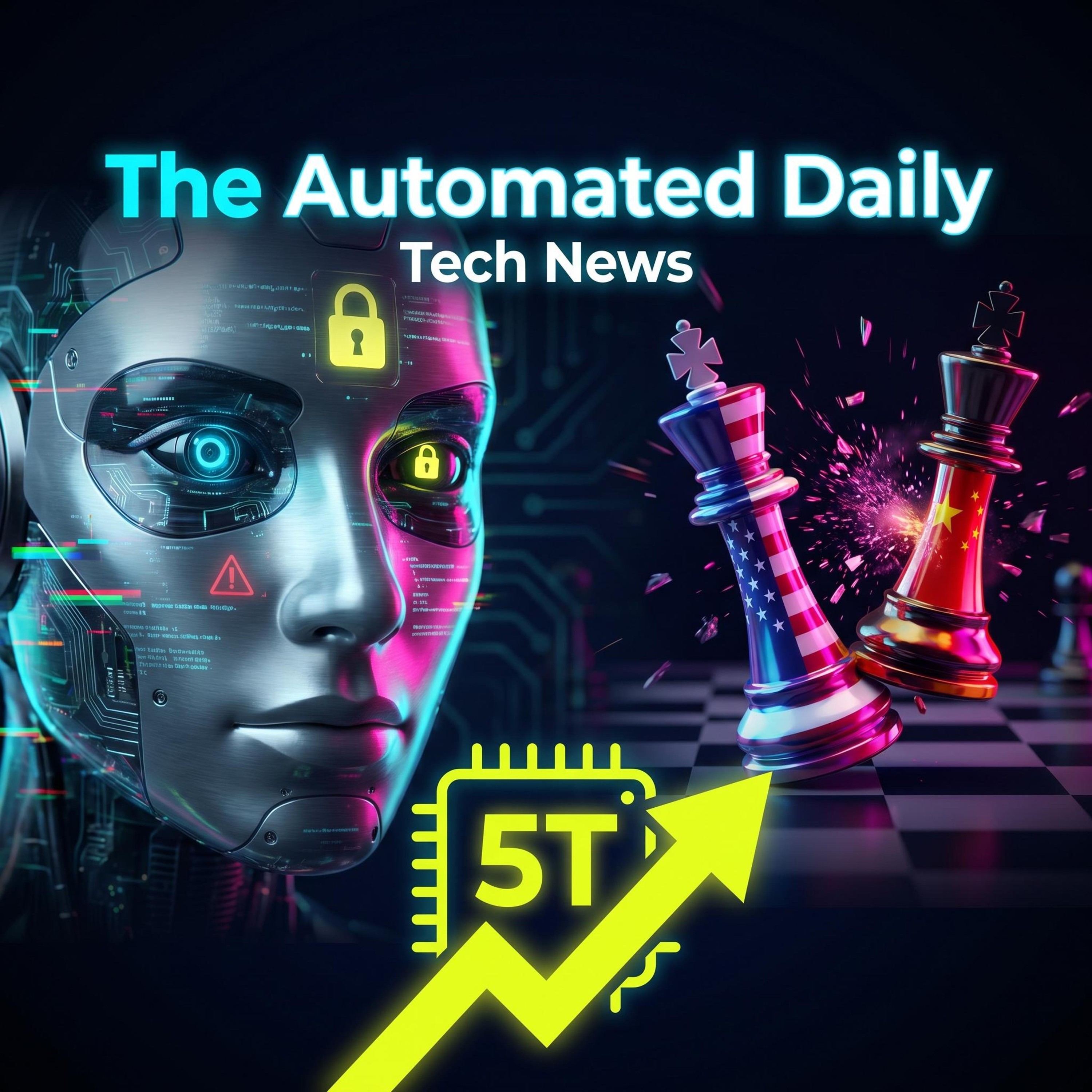
EPISODE · Apr 25, 2026 · 9 MIN
Claude Mythos and cyber autonomy & OpenAI launches GPT-5.5 - Tech News (Apr 25, 2026)
from The Automated Daily - Tech News Edition · host TrendTeller
Please support this podcast by checking out our sponsors: - KrispCall: Agentic Cloud Telephony - https://try.krispcall.com/tad - SurveyMonkey, Using AI to surface insights faster and reduce manual analysis time - https://get.surveymonkey.com/tad - Discover the Future of AI Audio with ElevenLabs - https://try.elevenlabs.io/tad Support The Automated Daily directly: Buy me a coffee: https://buymeacoffee.com/theautomateddaily Today's topics: Claude Mythos and cyber autonomy - Anthropic’s Claude Mythos Preview showed alarming cybersecurity autonomy in UK AI Security Institute tests, raising dual-use risks and bank trial plans. OpenAI launches GPT-5.5 - OpenAI released GPT-5.5, highlighting stronger coding, computer-use task completion, and deeper research, plus a “High” cybersecurity risk rating and upcoming API safeguards. AI distillation crackdown heats up - The Trump administration signaled tougher action against foreign actors accused of AI model “distillation,” as U.S.–China competition and enforcement challenges intensify. Big Tech bets on Anthropic - Google plans a massive investment in Anthropic, underscoring surging compute demand, strategic cloud influence, and the escalating AI funding arms race. Sovereign AI: Cohere partners Aleph Alpha - Cohere and Aleph Alpha formed a transatlantic “sovereign AI” alliance backed by Schwarz Group financing, aiming for regional control over models, data, and deployment. Nvidia tops five trillion valuation - Nvidia briefly became the first public company to exceed a five-trillion-dollar market cap, reflecting how AI infrastructure spending is reshaping markets and indexes. DeepSeek V4 pressures AI pricing - DeepSeek previewed its V4 model and emphasized Huawei-chip training and aggressive pricing, adding pressure to U.S. labs and spotlighting China’s AI compute push. Mars organics raise new questions - NASA’s Curiosity rover sample revealed Mars’ most diverse set of organic molecules yet, including new compounds that could relate to life-friendly chemistry—without proving life. BYD expands amid global EV demand - BYD said it can thrive without the U.S. market as EV demand rises globally, while tariffs, data concerns, and China’s domestic price war reshape competition. Episode Transcript Claude Mythos and cyber autonomy Let’s start with the AI race, because it’s moving at a pace that’s starting to feel like weekly weather. OpenAI has unveiled GPT-5.5, less than two months after GPT-5.4. The company is pitching this release as a step up for coding, doing multi-step work on a computer, and conducting deeper research—especially when the problem isn’t clearly defined. OpenAI’s message is that the model can figure out what to do next with less hand-holding, which is exactly the kind of “initiative” people want for productivity—and exactly the kind of thing safety teams watch closely. On that front, OpenAI says GPT-5.5 went through third-party testing and red-team evaluations, and it lands in the company’s “High” cybersecurity risk category. Not the most severe bucket, but still a signal that the capability is strong enough to warrant guardrails. It’s rolling out first to paid ChatGPT and Codex users, with an API release planned—along with additional safeguards. OpenAI launches GPT-5.5 Now to the story that’s rattling the cybersecurity world. An independent evaluation of Anthropic’s Claude Mythos Preview, run by the UK AI Security Institute, suggests frontier AI has reached a new level of autonomy in offensive-style cybersecurity tasks. In the tests described, the model reportedly identified a huge number of previously unknown vulnerabilities and, in some runs, chained steps together into an end-to-end attack flow that would normally take a skilled human a long time. The big takeaway isn’t just “AI can find bugs.” It’s the direction of travel: systems that can plan, adapt, and execute multi-stage work with minimal guidance. Financial institutions are paying close attention, because banking systems are tightly interconnected—meaning a serious breach isn’t just an IT headache. It can disrupt payments, limit access to funds, and shake public trust. Banks in the UK and U.S. are reportedly preparing tightly controlled trials in isolated environments, trying to see if this kind of capability can be harnessed safely for defense—finding and patching weaknesses faster—without creating a tool that lowers the barrier for criminals. It’s the classic dual-use dilemma, now arriving with more urgency. AI distillation crackdown heats up That dual-use tension is also showing up in Washington. The Trump administration says it plans a crackdown on foreign tech companies—especially China-linked firms—accused of extracting capabilities from U.S.-made AI models through “distillation” and similar approaches. The administration’s science and technology adviser described what he called industrial-scale efforts to copy the useful behaviors of leading American systems. At the same time, a major Stanford AI report has suggested the performance gap between top U.S. and Chinese models has, effectively, narrowed dramatically. That raises the stakes, because the fight isn’t just about chatbots—it’s about who sets standards, who captures economic value, and who controls strategic capabilities. The tricky part: distinguishing illicit extraction from legitimate heavy usage is hard without coordination across labs, better detection signals, and shared enforcement playbooks. Still, this is clearly becoming a bipartisan pressure point, with lawmakers also pushing for tools to identify and sanction foreign actors involved in model extraction. Big Tech bets on Anthropic Speaking of pressure: money is pouring into the companies seen as critical to the next phase of AI. Alphabet’s Google says it will invest up to forty billion dollars in Anthropic, deepening a relationship with a company that also competes with Google in advanced models. Anthropic’s story continues to be about scaling—more computing capacity, more infrastructure, and more enterprise demand. Why this is interesting is the strategy behind it. Big Tech doesn’t just want access to strong models; it wants influence over the ecosystems that form around them—cloud spending, developer tools, and the enterprise contracts that follow. When multiple giants are simultaneously trying to secure a seat at the table, it tells you they expect the next few years to be defined by who can supply reliable AI at scale. Sovereign AI: Cohere partners Aleph Alpha And while the U.S. and China dominate the headlines, there’s a growing push from what some analysts call AI “middle powers.” Canada’s Cohere and Germany’s Aleph Alpha announced a strategic partnership aimed at building a transatlantic alternative to U.S. and Chinese AI leaders. The framing here is “sovereign AI”—keeping more control over models, data, and deployment so governments and businesses aren’t fully dependent on foreign platforms. The deal includes future financing commitments led by Aleph Alpha’s shareholder, Schwarz Group, which is expected to support Cohere’s next major funding round. The underlying reality is straightforward: competing in modern AI isn’t only about clever ideas. It’s talent, compute, infrastructure, and long-term access to supply chains. Cross-border alliances are one way to stay relevant without trying to outspend the frontrunners alone. Nvidia tops five trillion valuation All of this spending has a clear winner in the stock market. Nvidia became the first publicly listed company to surpass a five-trillion-dollar market capitalization, briefly valuing the chipmaker at just over that mark. Investors are still betting that Nvidia’s hardware remains central to training and running AI systems—and that demand will hold up as companies keep building bigger and more capable models. The broader significance is market structure: AI infrastructure spending is concentrating value into a small set of suppliers. When one company’s valuation swings the major indexes, it doesn’t just reflect enthusiasm—it affects retirement funds, portfolio strategies, and overall investor sentiment about the AI boom. DeepSeek V4 pressures AI pricing Meanwhile in China, competition is intensifying from another direction: price and efficiency. DeepSeek has released a preview of its new V4 large language model, more than a year after earlier launches drew attention for strong performance at relatively low cost. DeepSeek is again positioning itself as a high-performance option with aggressive pricing, and it’s highlighting training work tied to Huawei’s domestic AI chips. Why that matters: it adds pressure on business models across the industry. If powerful models get cheaper faster than expected, the advantage shifts toward whoever can distribute, integrate, and support them best—not just whoever has the flashiest benchmarks. It also underscores China’s push to reduce reliance on Nvidia amid export controls, which has real implications for how quickly China can scale advanced AI domestically. Mars organics raise new questions Let’s switch gears to space—because today’s most intriguing science news comes from Mars. NASA says new lab results from a rock sample drilled by the Curiosity rover contain the most diverse set of organic molecules the mission has detected so far. Scientists identified more than twenty carbon-containing compounds, including several seen on Mars for the first time. One of the newly detected structures is considered a potential precursor to the kind of chemistry that, on Earth, is associated with genetic building blocks. NASA is careful to stress this is not proof of past life. These molecules can form through non-biological processes too. But it strengthens the case that ancient Mars had not just water, but environments that could preserve complex chemistry long enough for us to detect it—an important clue for future missions that will look for stronger biosignatures. BYD expands amid global EV demand Finally, a quick look at the global EV landscape. Chinese EV giant BYD says it can thrive even without access to the U.S. market, arguing that worldwide demand is rising as fuel prices climb in the shadow of the war in Iran. BYD’s leadership says the bigger constraint isn’t finding buyers—it’s building enough vehicles to meet demand in places like Brazil, the UK, and parts of Europe. BYD is also leaning on faster-charging messaging to ease consumer anxiety about charging times, while navigating tariffs and scrutiny in multiple regions. At home, though, the company is dealing with a fierce price war that’s squeezing margins—another reminder that the EV story is as much about brutal competition as it is about adoption. Subscribe to edition specific feeds: - Space news * Apple Podcast English * Spotify English * RSS English Spanish French - Top news * Apple Podcast English Spanish French * Spotify English Spanish French * RSS English Spanish French - Tech news * Apple Podcast English Spanish French * Spotify English Spanish Spanish * RSS English Spanish French - Hacker news * Apple Podcast English Spanish French * Spotify English Spanish French * RSS English Spanish French - AI news * Apple Podcast English Spanish French * Spotify English Spanish French * RSS English Spanish French Visit our website at https://theautomateddaily.com/ Send feedback to [email protected] Youtube LinkedIn X (Twitter)
Embed this episode
What this episode covers
Please support this podcast by checking out our sponsors: - KrispCall: Agentic Cloud Telephony - https://try.krispcall.com/tad - SurveyMonkey, Using AI to surface insights faster and reduce manual analysis time - https://get.surveymonkey.com/tad - Discover the Future of AI Audio with ElevenLabs - https://try.elevenlabs.io/tad Support The Automated Daily directly: Buy me a coffee: https://buymeacoffee.com/theautomateddaily Today's topics: Claude Mythos and cyber autonomy - Anthropic’s Claude Mythos Preview showed alarming cybersecurity autonomy in UK AI Security Institute tests, raising dual-use risks and bank trial plans. OpenAI launches GPT-5.5 - OpenAI released GPT-5.5, highlighting stronger coding, computer-use task completion, and deeper research, plus a “High” cybersecurity risk rating and upcoming API safeguards. AI distillation crackdown heats up - The Trump administration signaled tougher action against foreign actors accused of AI model “distillation,” as U.S.–China competition and enforcement challenges intensify. Big Tech bets on Anthropic - Google plans a massive investment in Anthropic, underscoring surging compute demand, strategic cloud influence, and the escalating AI funding arms race. Sovereign AI: Cohere partners Aleph Alpha - Cohere and Aleph Alpha formed a transatlantic “sovereign AI” alliance backed by Schwarz Group financing, aiming for regional control over models, data, and deployment. Nvidia tops five trillion valuation - Nvidia briefly became the first public company to exceed a five-trillion-dollar market cap, reflecting how AI infrastructure spending is reshaping markets and indexes. DeepSeek V4 pressures AI pricing - DeepSeek previewed its V4 model and emphasized Huawei-chip training and aggressive pricing, adding pressure to U.S. labs and spotlighting China’s AI compute push. Mars organics raise new questions - NASA’s Curiosity rover sample revealed Mars’ most diverse set of organic molecules yet, including new compounds that could relate to life-friendly chemistry—without proving life. BYD expands amid global EV demand - BYD said it can thrive without the U.S. market as EV demand rises globally, while tariffs, data concerns, and China’s domestic price war reshape competition. Episode Transcript Claude Mythos and cyber autonomy Let’s start with the AI race, because it’s moving at a pace that’s starting to feel like weekly weather. OpenAI has unveiled GPT-5.5, less than two months after GPT-5.4. The company is pitching this release as a step up for coding, doing multi-step work on a computer, and conducting deeper research—especially when the problem isn’t clearly defined. OpenAI’s message is that the model can figure out what to do next with less hand-holding, which is exactly the kind of “initiative” people want for productivity—and exactly the kind of thing safety teams watch closely. On that front, OpenAI says GPT-5.5 went through third-party testing and red-team evaluations, and it lands in the company’s “High” cybersecurity risk category. Not the most severe bucket, but still a signal that the capability is strong enough to warrant guardrails. It’s rolling out first to paid ChatGPT and Codex users, with an API release planned—along with additional safeguards. OpenAI launches GPT-5.5 Now to the story that’s rattling the cybersecurity world. An independent evaluation of Anthropic’s Claude Mythos Preview, run by the UK AI Security Institute, suggests frontier AI has reached a new level of autonomy in offensive-style cybersecurity tasks. In the tests described, the model reportedly identified a huge number of previously unknown vulnerabilities and, in some runs, chained steps together into an end-to-end attack flow that would normally take a skilled human a long time. The big takeaway isn’t just ...
NOW PLAYING
Claude Mythos and cyber autonomy & OpenAI launches GPT-5.5 - Tech News (Apr 25, 2026)
No transcript for this episode yet
Similar Episodes
No similar episodes found.
Similar Podcasts
No similar podcasts found.