
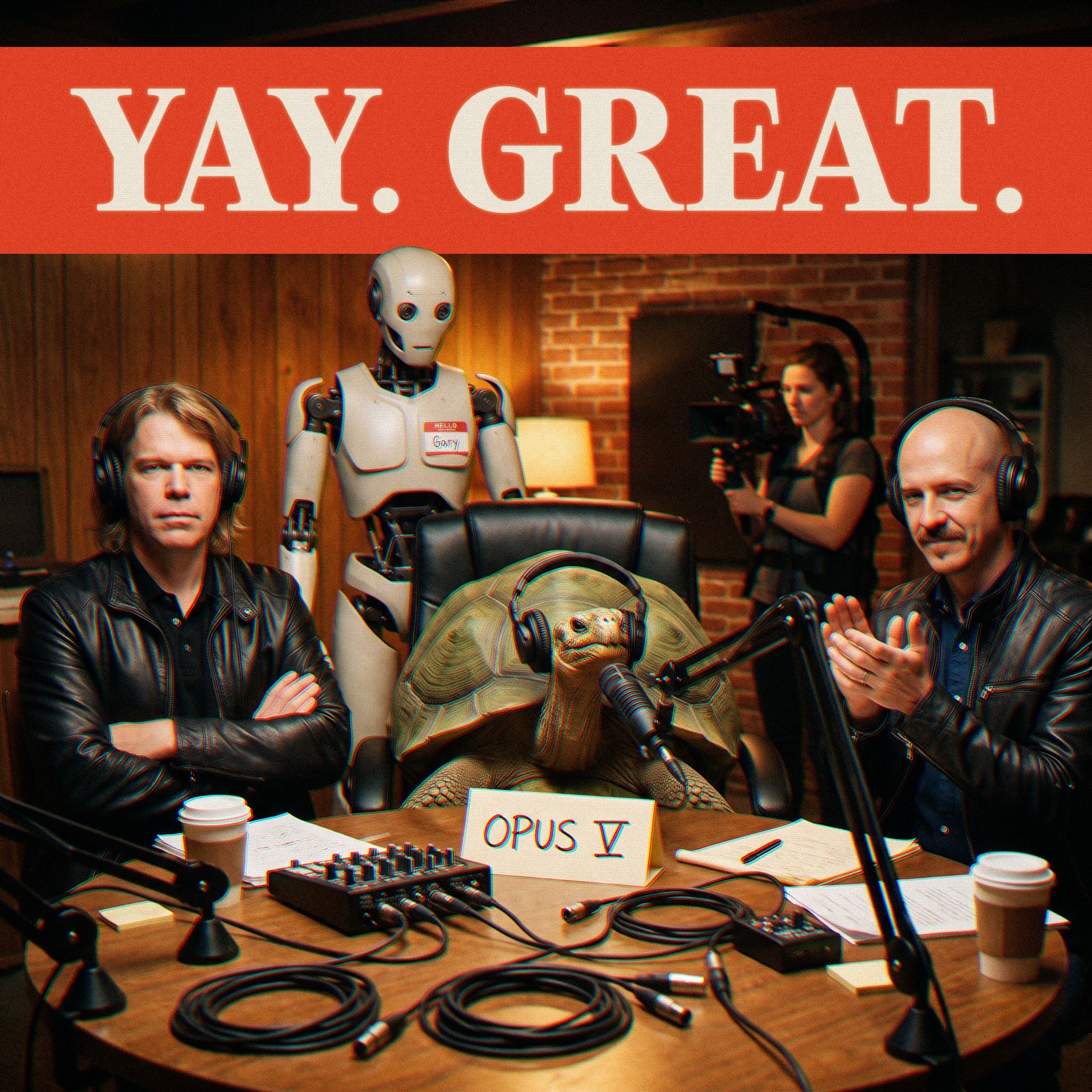
EPISODE · Aug 6, 2026 · 31 MIN
Claude Opus 5 Underwhelms and AI Cracks an 87-Year-Old Math Conjecture
from They Might Be Self-Aware · host Hunter Powers, Daniel Bishop, Gary
Claude Opus 5 is out, and Hunter's first prompt run took 48 hours. Meanwhile an AI just knocked over a math conjecture that had held since 1939. Anthropic shipped Claude Opus 5, the successor to Opus 4.8, and Hunter Powers and Daniel Bishop are not sold. Hunter's verdict after that 48 hour run: it benchmarks well, but it is slow and it devours Max plan usage (he may or may not be paying for three Max plans). Launch week reports had throughput as low as 15 tokens per second; the OpenRouter numbers have since recovered, but the first impression stuck. Daniel's counterpoint: chunk your work, clear your context, and you may never hit a rate limit at all. The stranger Opus 5 story is automatic API fallbacks. When the model refuses a request, it can now hand the question down to a smaller, dumber model that might answer anyway. Daniel compares it to skipping the architect and asking the janitor. Nobody is sure who actually wrote the answer anymore, which is an odd property for a frontier model to ship on purpose. Also this week: Grok 4.5, the new model from Elon Musk's SpaceX AI, topped Cursor Bench, with a fine print asterisk admitting it accidentally trained on the benchmark's answers. SpaceX also owns Cursor, so the model that won the benchmark belongs to the company that scores it. Then the math. The Jacobian conjecture, stated in its modern form in 1939, stood for 87 years until a mathematician used Anthropic's Claude Fable 5 to find a counterexample. Days later, Dmitry Rybin of AutoKernel used ChatGPT 5.6 Pro to disprove the Dinitz-Garg-Goemans conjecture in graph theory: four prompts, under 60 words total, 5.5 hours. Two conjectures fell in the same week, both to models anyone can subscribe to. Is that the singularity getting started, or just a good week for math? Hunter always assumed he would notice the singularity overnight. Daniel argues the snowball is already rolling downhill and names it the Bishop Conjecture. They Might Be Self-Aware is the AI podcast from The Blur, reported from inside the dissolving line between human and machine, not from a safe distance. CHAPTERS 0:00 Cold Open (Gary's Intro) 2:05 Opening Banter 3:58 Claude Opus 5 Verdict 6:56 48-Hour Prompt Run 10:27 Cursor Bench Contamination 15:01 API Fallbacks to Dumber Models 19:53 Jacobian Conjecture Falls 21:53 ChatGPT's Four-Prompt Disproof 24:11 AI Singularity Debate 29:45 Sign-Off LISTEN / WATCH EVERYWHERE 🎧 Apple Podcasts: https://podcasts.apple.com/us/podcast/they-might-be-self-aware/id1730993297 🎧 Spotify: https://open.spotify.com/show/3EcvzkWDRFwnmIXoh7S4Mb?si=3d0f8920382649cc 🎧 Everywhere else plus episode page: https://theblur.ai THE BLUR Follow: @TheBlurAI COMMENT Daniel wants your evidence for the singularity: name one thing AI does for you today that it could not do a year ago. Bonus points if it involves a math conjecture. You're listening to They Might Be Self-Aware, from The Blur. New episodes Monday and Thursday. #ClaudeOpus5 #AI #TMBSA #Anthropic
Embed this episode
What this episode covers
Anthropic's new model benchmarks well, but Hunter Powers and Daniel Bishop are underwhelmed: it runs slow, it devours Max plan usage, and its new API fallbacks quietly hand refused questions down to dumber models that might answer anyway. Then the week's real story: the Jacobian conjecture, unbeaten since 1939, fell to a counterexample found with Claude Fable 5, and days later ChatGPT 5.6 Pro disproved a graph theory conjecture in four prompts totaling under 60 words. Two conjectures fell in the same week, both to models anyone can subscribe to, and the back half of the episode argues about whether that means the singularity has already started.
NOW PLAYING
Claude Opus 5 Underwhelms and AI Cracks an 87-Year-Old Math Conjecture
No transcript for this episode yet
Similar Episodes
Feb 4, 2026 ·18m
Similar Podcasts
No similar podcasts found.