
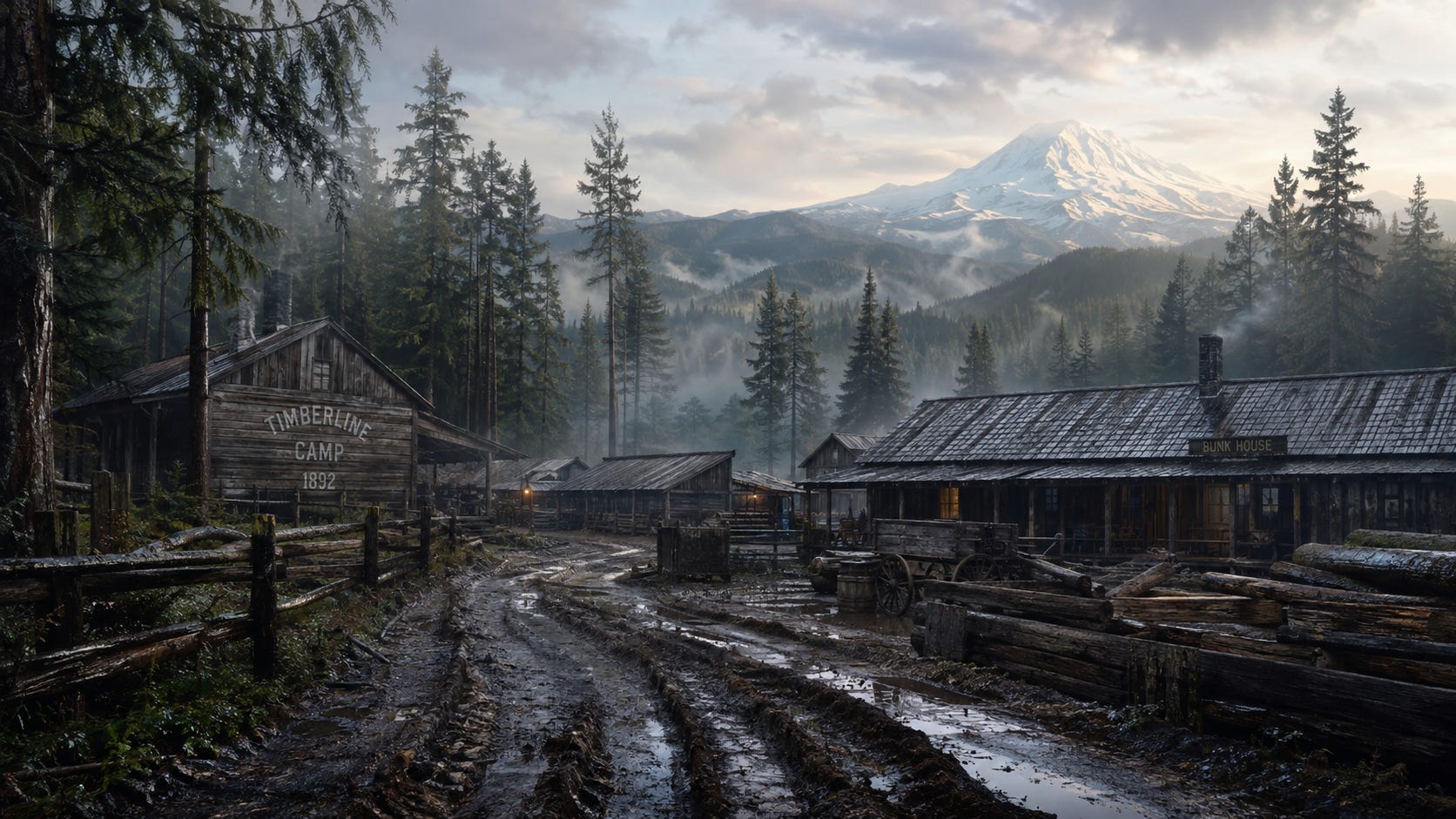
EPISODE · Sep 2, 2026 · 16 MIN
Clear Weather
from Timberline: Lessons from the Mountain · host Jay Allen Ford
Narration Script The rain stopped sometime before dawn. Nobody in Timberline heard the precise moment it happened. There was no great clearing of clouds, no final theatrical drumming against the cookhouse roof. The weather simply exhausted itself during the night, leaving water hanging from every cedar bough and the camp beneath a washed blue sky. By breakfast, sunlight had reached the cookhouse windows. Maggie O’Donnell regarded it suspiciously. “Don’t get used to it.” Sam Mercer looked toward the window with half a biscuit in his mouth. “To what?” “That.” “Sunshine?” “Exactly.” Sam swallowed. “You against sunshine now?” “I’m against anything that gets men hopeful before they’ve finished their coffee.” Across the table, Ned Avery lifted his mug. “I’m willing to risk it.” “You’re willing to risk most things that don’t require thinking,” Tom Grady said. Ned considered that. “Saved me considerable effort.” A few men laughed. Maggie came down the length of the table carrying another pan of biscuits and slapped Sam’s hand away before he could reach it. “You’ve had three.” “I’ve had two.” “You’ve taken three.” “That’s different.” “It’ll become very different if I break your fingers.” Sam withdrew his hand. While Maggie was looking at him, Ned reached across from the opposite side and took one. Pete Hawkins saw him. Ned looked at Pete. Pete looked at Ned. Neither said anything. Ned tore the biscuit open and slid half across the table. Pete accepted the bribe. At the end of the table, Jack Mercer drank his coffee and pretended not to have noticed any of it. Morning moved through the cookhouse in its usual disorder. Tin cups struck wood. Chairs scraped. Somebody complained about a wet blanket. Somebody else said that if Danny Walker snored any louder, the camp could sell the sound to the railroad as a warning signal. Danny told him what he could do with the railroad. Maggie informed both men that breakfast would improve considerably if they ate it instead of describing one another’s defects. The room smelled of coffee, bacon grease, woodsmoke, damp wool, and biscuits still hot enough to soften butter on contact. Outside, water fell steadily from the eaves. Not rain anymore. Just what the rain had left behind. Jack finished his coffee and stood. The room settled by degrees. Not silence exactly. Timberline rarely achieved that before the men had gone to work. Conversations shortened instead. Cups emptied. Men began listening with one ear while finishing whatever remained on their plates. “North crew stays where they were yesterday,” Jack said. “Ground’s still soft above the road, so watch your footing. Tom, you’re with them until noon.” Tom nodded. “Lower road gets cleared before another team goes through. Olav wants the rut at the bend filled before we put more weight over it.” Someone near the middle groaned. Jack looked toward the sound. “Good. You volunteered.” Laughter moved down the table. “No heroes,” Jack continued. “No bodies. If the ground looks wrong, stop. If a line looks wrong, stop. If the man beside you looks like he’s about to do something stupid—” “Stop Sam?” Ned offered. Sam pointed across the table. “I know where you sleep.” “Everybody knows where I sleep. You can hear me from Tacoma.” Another laugh. Jack let it pass. “If something’s wrong, call it. I don’t care who you are or how long you’ve been here.” He picked up his coat. “Move.” Benches scraped backward. The cookhouse emptied. Ned finished the last bite of the biscuit he had stolen and nearly collided with Maggie carrying a stack of plates. She caught the top one before it slid. “Avery.” “Morning, Maggie.” “You’ve already said morning.” “Still seems to be one.” “Get out.” “Yes, ma’am.” He went. Pete passed behind Maggie a moment later. “Wasn’t me.” “I know.” “How?” “You look guilty before you steal something.” Pete considered that. “That seems unfair.” “So does washing dishes.” Pete left quickly. Maggie smiled despite herself and started clearing the table. The world beyond the cookhouse smelled new. Rain had washed dust from the road and loosened the sharp sweetness of pitch from freshly cut wood. Ferns crowded the ditches, heavy with water. Salal leaves shone. Every hoofstep brought the dark smell of wet earth up from beneath the road. Tahoma stood beyond the trees. Clear. Not completely—the lower slopes disappeared behind ridges and timber—but the white upper mountain held the morning light as though the weather had polished it overnight. A few men stopped long enough to look. Then work carried them away. Axes rode shoulders. Crosscuts flashed dull silver. Teams shifted in their harness. Farther down the works, Ol’ Skookum waited with steam feathering faintly above it, iron dark with damp and morning shade. Jack walked the road with Sam. Neither hurried. Jack rarely hurried when he was looking at ground. Yesterday’s rain had softened the shoulders of the road and left brown water standing in hollows where wagon wheels, horses, and dragged timber had beaten the earth hard. Sam nudged a loose stone with his boot. “Could’ve used another day.” “For what?” “Drying.” Jack looked uphill. “Could’ve used another week.” “Elias got one?” “No.” “Then I suppose we’ll work with today.” Jack glanced at him. “That was almost intelligent.” “Don’t tell anybody.” They passed Ned Avery and Tom Grady carrying peaveys toward the lower landing. Ned had his balanced across one shoulder. “You two planning to walk all morning?” Sam answered without turning. “Management.” “That what they call it?” “That’s what we call it.” Ned looked at Tom. “What do we call it?” “Lazy.” “Good. Wanted to make sure.” Jack kept walking. “Lower landing first. Then you can insult us.” “We can do both.” “I know.” The road narrowed. Work separated them. By midmorning, Timberline had found its rhythm. From a distance, logging sounded like violence. Axes struck timber. Crosscuts whispered through kerfs. Wedges rang beneath steel. Chains dragged. Teamsters called. Peaveys bit bark. Men shouted distances, instructions, warnings, insults. Logs hit skids hard enough to send the sound through a man’s boots. But inside all that noise there was order. Almost a dance. One sound answered another—steel, wood, leather, hooves, voices. Men who worked together long enough learned the rhythm until they knew almost without looking where everyone around them ought to be. One man drove a wedge while another watched the crown. One pulled while another gave. Teamsters heard changes in harness. Fallers heard changes in the saw. Men on a landing knew from the sound of a shout whether somebody wanted another hand or everybody needed to move. Noise meant work was moving. What a woodsman learned to notice was the interruption. A saw stopping halfway through a stroke. A teamster suddenly going quiet. A chain that should have been dragging and wasn’t. Three men talking one moment and none of them talking the next. In the woods, silence did not always mean peace. Sometimes it meant somebody had noticed something. Then everybody else had better notice too. At the lower landing, Ned and Tom worked a Douglas fir onto the skids. The tree had been down long enough that its cut end had begun drying lighter than the bark. Mud streaked one side from the haul. Tom set his peavey. Ned did the same. “Ready?” “Been ready.” “You say that every time.” “Still true.” “Lift.” They leaned. The hooks bit. The log rolled a quarter turn and settled. Ned shifted his peavey farther down. “Again.” They moved it another few inches. Pete came around the end carrying a chain. “Jack wants the next one held until this is clear.” Tom nodded. Ned glanced toward Pete’s boots. “You planning on growing into those?” Pete looked down. “What?” “Your feet appear to be losing an argument.” The leather around Pete’s right sole had begun separating near the toe. Pete kicked at the dirt. “Still work.” “Until they don’t.” “You buying me new ones?” “No.” “Then your concern feels less useful.” Tom snorted. Ned grinned. “Lunch, you give me your apple and I’ll stop talking about them.” “You already ate your apple yesterday.” “Exactly why I need yours.” Pete shook his head and carried the chain away. Tom set his peavey again. “Lift.” Ned hooked in beside him. The log moved. Sun reached the landing before noon. Steam rose from wet bark where the light touched it. The morning chill left quickly, and coats came off one by one, thrown across stumps or hung from broken limbs. Work moved steadily. Logs came in. Chains went out. Teams turned. The landing filled and changed by inches. Jack passed through once, asked Tom how much room he had left, looked over the road, and kept moving. Nobody paid much attention. There was work to do. They ate outside. The day was too clean to waste beneath a roof. Men sat on logs, stumps, boxes, and whatever else would hold them. Lunch pails opened. Cloth and paper wrappings came loose. Coffee went around from a blackened pot somebody had carried down from the cookhouse. Pete surrendered half his apple to Ned after all. “You said the whole thing.” “I reconsidered.” “That isn’t how agreements work.” “It is when I own the apple.” Ned bit into the half Pete had given him. “Good apple.” “I know.” “You can have some.” Pete stared at him. Ned held the apple out. Pete stared harder. “What?” “You just took it from me.” “And now I’m sharing.” Tom shook his head. “There’s something wrong with you.” “Several things.” Ned finished the apple. Nearby, Sam sat with his back against a stump and stretched his legs toward the sun. “This is almost pleasant.” Jack ate without looking up. “That concerns me.” “Why?” “Means you’ll start talking.” “I’ve been talking.” “Exactly.” A horse sneezed somewhere along the road. Someone farther uphill called for a wedge. A crosscut started again. Birds moved through the brush beside the landing. Somebody laughed at something Pete missed. A teamster swore mildly at a horse and received no sympathy from the horse. Pete leaned backward on his hands and turned his face toward the sky. “You think it’ll stay clear?” Half the men laughed. Pete looked around. “What?” Ned pointed his spoon at him. “Never ask that where Maggie can hear you.” “She’s half a mile away.” “Doesn’t matter.” “Why?” “She’ll know.” Pete looked toward the cookhouse, invisible through the trees. “That doesn’t make sense.” Ned scraped the bottom of his tin. “You haven’t been here long enough.” Lunch ended. Men stood. Pails closed. Somebody rolled a cigarette and tucked it behind one ear for later. Jack looked at the sky once. Clear. Then at the road. Still damp. “Back at it.” The afternoon found the rhythm again almost immediately. A team brought another fir down the skid road. The horses leaned into their collars, muscles rolling beneath damp coats. Their driver talked to them quietly, never raising his voice unless he needed something quickly. The log traveled over the greased road skids with a low wooden groan. Mud pressed outward beneath its weight. Harness creaked. Chains talked against iron. At the landing, Tom raised a hand. The team stopped. Ned and Pete moved in with peaveys. The log had come to rest slightly crooked below the decking skids. Nothing unusual. They had straightened worse all week. Tom pointed. “Need the butt six inches over.” Ned stepped toward it. Pete moved to the other side. “Not there,” Ned said. Pete stopped. Ned tapped the ground with the end of his peavey. “You’re downhill of it.” Pete shifted. “That better?” “Unless you’re trying to become shorter.” “I’m already shorter than Jack.” “Everybody’s shorter than Jack.” Tom set his hook. “Enough.” Ned set his. Pete found his bite farther down. “Ready?” “Ready.” “Bring her.” They leaned. The hooks bit. The fir rolled a fraction and settled square against the decking skids. Tom checked both ends. “Again.” They reset. Steel bit bark. Three men leaned into three wooden handles. The log began climbing. A quarter turn. Another. The spikes along the skids caught the bark. Somewhere uphill, an ax struck timber. Harness jingled behind them. A man called from the road. Tom shifted his peavey. “Again.” They leaned. The log climbed another few inches. Something knocked beneath Ned’s end. Small. Wood against earth. Tom’s head lifted. Ned looked at him. “What?” They listened. A horse blew through its nose. Someone laughed farther down the road. Tom looked at the skid. Still square. “Settled.” Ned nodded. “Again?” Tom stepped closer. “Easy.” They set their hooks. “Bring her.” The men leaned. The log rolled upward. Its weight came onto the skids. Something shifted beneath Ned’s end. The skid sank and kicked sideways. The fir twisted. “OUT!” Tom jumped clear. Pete dropped his peavey. Ned turned. His boot found wet bark. His foot went out. “Ned!” He caught himself with one hand. Almost. The fir rolled back. Jack was already running. He hit the landing at full stride, dropped beside Ned, and put two fingers beneath his jaw. The landing went silent. Jack’s eyes met Sam’s. Sam ran for Doc. Tom stopped Sam and held him. The Men Went Silent. CLEAR WEATHER Read the companion four-part story. Get full access to Timberline: Lessons by the Campfire at www.timberlinecampfire.com/subscribe
Embed this episode
Ready to play
Clear Weather
No transcript for this episode yet
Similar Episodes
No similar episodes found.
Similar Podcasts
No similar podcasts found.