
EPISODE · May 14, 2026 · 29 MIN
Columbus in the Service of the Hanseatic League
from A Different America = A Different World
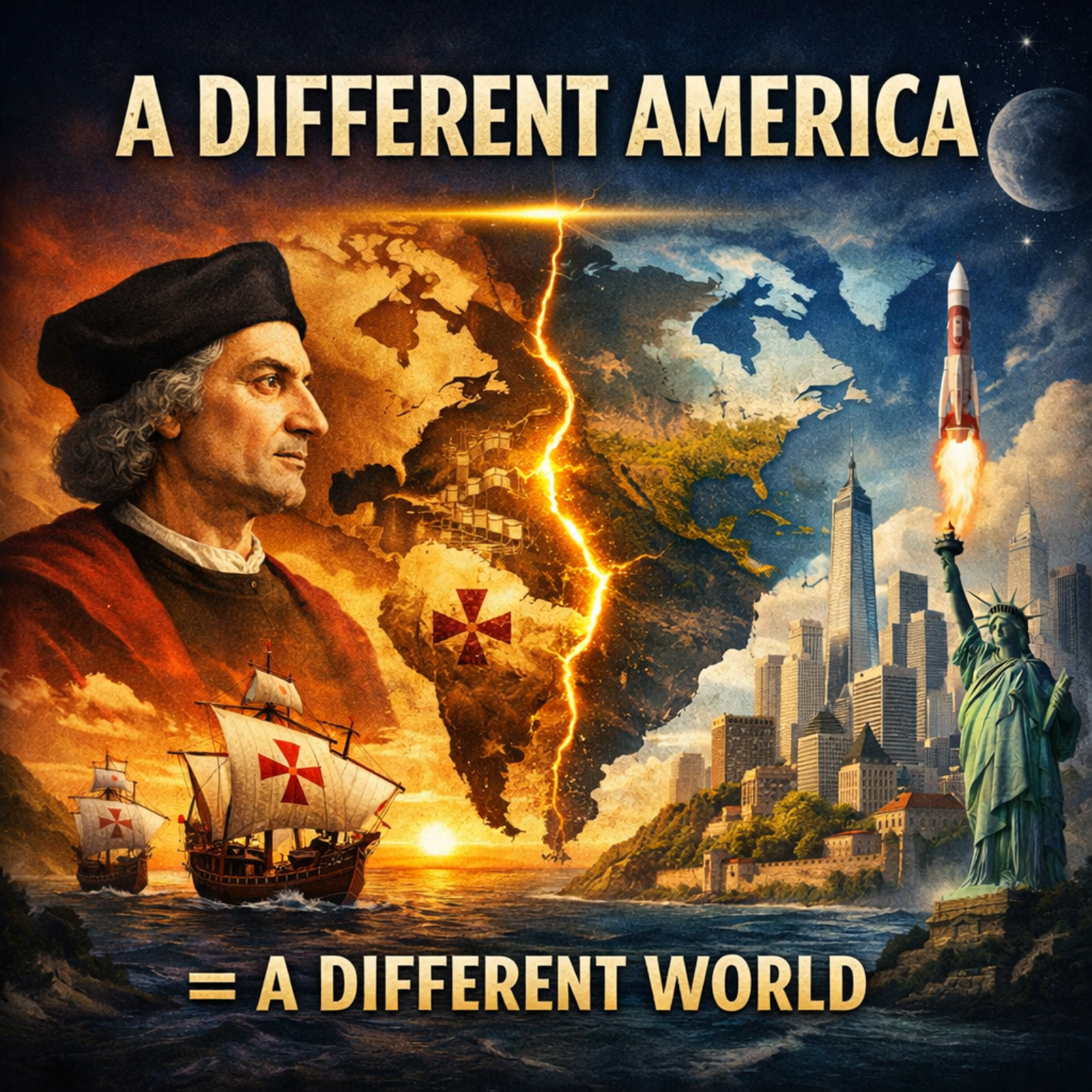
In this episode, we explore one of the most unusual and fascinating alternative-history scenarios: Christopher Columbus rejected not only by Portugal and Spain, but ultimately financed by the Hanseatic League. Instead of sailing for a royal crown, Columbus enters the service of a powerful network of northern trading cities built on ports, warehouses, ships, contracts, and commerce. The consequences would have transformed the entire Atlantic world. Rather than a centralized Spanish colonial empire, America might have emerged as a vast Hanseatic trading sphere — a world of port cities, commercial stations, maritime republics, merchant elites, and urban federations. The Caribbean becomes a network of northern trade hubs. Coastal America develops through warehouses and shipping routes instead of viceroyalties and royal courts. The Atlantic itself turns into a space dominated not first by kings, but by merchants. This episode follows how such a Hanseatic America might have developed from the late fifteenth century onward. We examine why Columbus could realistically have turned toward northern commercial circles, why the Hanseatic League might have accepted such a risky venture, and how the first expeditions would have reshaped Europe’s balance of power. We also explore how Spain, Portugal, England, France, and the emerging Dutch world would have reacted to a northern-controlled Atlantic. The cultural consequences would have been enormous. Instead of a largely Spanish-speaking Latin America, the New World might have evolved into a multilingual commercial civilization shaped by Low German, Dutch, Scandinavian, and creole influences. Religion in America might have become more diverse after the Reformation. North America may never have produced the same United States we know today. Instead, powerful maritime republics, urban leagues, and coastal federations could have dominated the continent. This is not simply a story about “different flags on the same map.” It is a story about a completely different logic of globalization — one built less on dynastic conquest and more on trade, contracts, shipping, and financial networks. Because sometimes history is changed not only by emperors and armies, but by merchants in a town hall, investors in a harbor, and one stubborn navigator who refused to stop believing there was another world beyond the horizon.
Embed this episode
Ready to play
Columbus in the Service of the Hanseatic League
No transcript for this episode yet
Similar Episodes
No similar episodes found.
Similar Podcasts
No similar podcasts found.