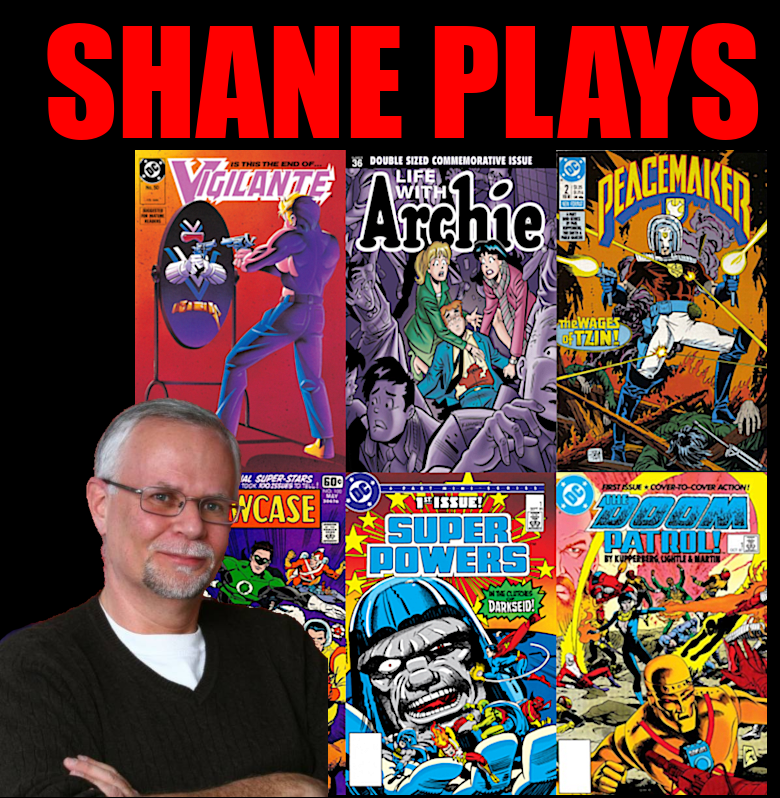
Hey, it's Shane. Welcome to episode 253 of Shane Plays Geek Talk. Thanks so much for listening. Today's guest is Paul Kupferberg, who has written over 1,400 comic books over four decades. He's done a lot, including reboots of the Doom Patrol. Of course, he's written for Peacemaker and Vigilante, which I thought it'd be timely to talk with him, given that they're getting higher profile because of the HBO Max TV series. He's also the writer who killed Archie and married him off to Betty and Veronica in the comic books, in the life of Archie comic books. And how did he marry him off to both Betty and Veronica? Well, tune in if you don't already know and you'll find out.
We also talk about the fact that in the real world, superheroes would be just nuts. There's the willing suspension of disbelief versus the art style in comic books. What does Archie mean to Paul? And I was surprised to find that Archie's very meaningful to Paul. Target audiences for comic books over different eras. Does Paul prefer the JSA or the JLA?
armchair quarterbacking by comics fans, the challenges of continuity in serialized fiction over time. With one example, we talk about Wonder Woman, Wonder Girl, and Wonder Todd, which is kind of a famous trying to fix continuity things that has come up in comic books. Which classic Silver Age DC comics issues didn't have a number on the cover and why? One positive early benefit of the direct market in the comics industry. I like to call that out because I'm often not exactly down on the direct market, but I would love to see comics get back into like convenience stores. And I talk about that a lot on the show. What was the first comics miniseries? Why was it a last minute thing?
What did James Gunn, director James Gunn, think of Paul's version of Peacemaker? Which comics character has Paul had the strongest fan feedback to? What does he consider his strongest as Stain's comic work? And what's the one comics character he would love to return to? We talk about this and a whole lot more. It was wonderful talking to Paul. I appreciate his time. Again, thank you for listening. And with no further ado, let's get on with the show. Why, yes, I believe we shall. Oh, I got an Ivan here.
Getting geeky in Little Rock, it's Shane Plays Geek Talk and Journey into the things we love. I'm your host, Shane Stacks. Thanks so much for listening. I really appreciate having you. This is Shane Plays. I do talk about games. This is not just a show about games. It's when I play. It's when I geek out. It's when I have fun, which can include games, comic books, which today we'll be talking a lot about comic books. I have a tremendous guest on. I'm still kind of surprised at this caliber of guest with as easy as it came together.
So, many thanks for my guests for just being very pleasant to schedule with. Who I'll introduce here in a moment. It's just when I play. It's when I have fun and get geeky. So, that's where the Shame Plays comes from, and it's geek talk. So, with no further ado, as listeners will know, one of my main passions is comic books. Love comic books. Never get tired of talking about them. It's one of the joys of my life. And we have a guest today who has written, I think, 72.6% of all comic books ever, or something like that. And it is the Paul Kupferberg. Paul, welcome to Shame Plays.
Nice to meet you. Thanks for having me, Shane. So glad to have you. I want to thank our mutual friend, William Burkine, Bill Burkine, for making the introduction. So just, you know, I'm sure most people listening to this will know your name if they read comic books at all and some of what you do. But let me let people know a little bit more that they may not realize. Paul, you've been writing comic books, and not just mainstream comic books, but what I would call heavily into DC Marvel type comic books, mainstream comic books.
for over four decades. Some of the things you've worked on are Doom Patrol. Now, it wasn't the original Niles Calder and did all that, but you reinvigorated and did my favorite era of Doom Patrol. which was in the 80s. I didn't have a lot of familiarity. Most of my knowledge with the original Doom Patrol came later. So your Doom Patrol is my Doom Patrol, even though I love all the other stuff. And I read it and I've got the collected Silver Age stuff and everything. Now, there's a couple of heroes or anti-heroes, however you want to look at them, that are probably on a lot of people's lips right now that you're involved with. Of course, there's the Peacemaker series on HBO Max that includes a version of Angelante. And you've worked on both characters in the comics. And of course, you know, the new, the James Gunn Suicide Squad.
feature peacemaker heavily as well. Now, Wikipedia, Paul, says that you've got a thousand comic book writing credits, but I was doing some research and there's an article out there called Paul Kupferberg, my 13 favorite comic book stories I've ever written. And that'll be linked in the show notes at shameplays.com. So go check out shameplays.com, find the show notes for this episode. And you said you've written 1400 comics. Yeah, approximately. The thousand number in Wikipedia is from several years ago. But yeah, approximately, you know, between, and I'm counting everything in comic books, you know.
Probably one production for House of Mystery to, you know, a show. Yeah, I think people forget. I'm starting to see it a little bit more. DC Comics is doing it more often these days where you get the main title and then there'll be like a backup story. And that used to be very common in comics. Plus, on top of that, we also had all these anthology titles. It was House of Mystery, Secrets, Ghosts, Weird War Tales, you know, all these places for when I came to this in 1975. So it was this place for new writers to, you know, fail.
and learn how to do it well yeah you could test out new talent and you could also test out characters or teams to see if people would you know even that advanced you know we were just happy to do a weird war tale about you know whatever war you happen to have a story for uh you know whatever ghost story you could stick a helmet on but um it was just a chance you know it was just it was just opportunities to to learn how it's done you know there's It's difficult to write a six-part epic, you know, a comic book epic, but it's way tougher to write a six-page comic book story. You know, in that House of Mystery, all these weird war tales, it was all about these short, you know, Twilight Zone kind of stories. But, you know, when you're writing a six-pager in an anthology like that, you're starting from scratch. You don't have Clark Kent and Lois Lane and the familiarity of the Daily Plan and all that. So you're not only telling the story and introducing all these elements, you've also got to introduce all the characters. So, you know, it's a very tight, compact...
way of storytelling and you learn a lot. I imagine. Yeah, I remember, you know, I used to love reading those old horror anthologies or the war anthologies. Especially the horror ones or the sci-fi ones would always end on a twist, usually a shocking twist, you know, like Twilight Zone. From the, you know, old code when you weren't allowed to do too hard. Right. Some weird little twist to justify it. And you wrote a lot.
during the code days what would be considered the code days and especially in the days when the code was really being enforced because i can't remember what i think it was in the 90s or 2000s i remember reading about it where marvel was like we'll just run it without the code and like nobody even really blinked you know dc i think the code would be put to sleep in 2010 yeah um it had served its purpose it was it was uh you know it was it was useless it was an appendix you know it would cause trouble it was nothing you know nothing it could really do um and yeah but frankly back in my day i never had anything rejected by the code because i knew the rules you know i knew what i was writing for um and you know a five-page intro for House of Mystery, isn't going to be breaking much ground that's going to be bothering the code. You know, I never thought about that. That's a good point you bring up, that not only did a five- or six-page story have to have a beginning, middle, and end, but they almost always introduced characters you didn't know. Like, a lot of times that character was going to die in that story or something, you know, so. Hey, there's a world, you know, is world-building.
Yeah, I can't only imagine that led to some really strong writing chops, as evidenced by your career. It's one of the strongest careers in comics out there. I mean, I would put that up against anybody's. So here's some other stuff people might not know about you. You were, for a time, the editor of the Weekly World News. Yes, I was. Now, I know that Batboy had been way before you took over as the editor, but was he still hanging around the offices at that point? Oh, yeah, Batboy, Bigfoot. Yeah, applaud the alien advisor to President Clinton. Yeah, we spoke regularly.
It's the best gig I ever had. I've been writing for them for a while. And the executive editor was an old friend, Jeff Rovin, who used to work at DC Comics many years ago. In the early 70s, he was one of Joe Kubrick's assistants and he did some writing. And then he later became one of Tom Clancy's collaborators. But anyway, he was editing the paper and wanted to change up the staff. So he hired me. He also hired Bob Greenberger from DC Comics. And we, in turn, hired designers and art directors from the DC staff. So, you know, it was like old home week. Plus, you know, like putting together a 48-page tabloid in the space of a week.
You know, I used to do six to eight comic books a month, you know, 22 page comic books a month. A 48 page tabloid is nothing. So let me ask you this, like behind the scenes in the editorial and among the writers, what is the tone? I mean, are you having fun or I mean, is it I mean, what is going on here? It's just, you know, it's like the whole idea of those stories is to take, you know, a plausible grain, you know, a bit of sand, that plausible bit of sand and you throw it into the oyster and, you know, you wait for it to develop this story oyster. And you just kind of like, you know, like one of my favorite things that I wrote was about a story about a fight that broke out at a dyslexics convention. Of course, everybody at the drawing thought they had the winning ticket. Yeah, I can only imagine the writers for just...
Just being completely amused at themselves the whole time they're writing. So did you have, like, feedback? Were there people out there that, like, really thought that you were, like, the only source of truth out there? Like, they were... I had neighbors back in the old days, you know, when I was married and living, you know, in, you know, and we were at a party at one of the neighbors. And then she's origin from, you know, Pennsylvania, West Virginia, that, you know, that area. And her stepfather, very nice man named Lloyd, you know, every week he went to the Piggly Wiggly and he picked up his tabloids. And when he heard I was working for them, he asked me, where do you get your stories? You're like, well, we have informants and we have. My ex-wife nudged me and made me tell him the truth. But, you know, we maintain the fiction.
it's called we maintain the fiction no we are the world's reliable newspaper and um uh the only time i ever broke it was this guy called up um he introduced himself some kind of clergyman and you know after decades of research had uncovered the location of the garden of eden and had the book he'd written the book to reveal this and he wanted uh the weekly world news to publish excerpts from it and i said well you know uh i kept it up for a little and finally i realized he was serious so i said look you know uh This, you know, I said, you know, we make everything up. Don't lie. Nothing publishes true. And he went, oh, I know, but this is. But for once. Something I could. I gave it to the New York Times. So how big, like, I guess, and you were the editor starting in, what, 2007, something along those lines? 2006 until it ended in 2007. Okay. So at that time, it was still a print tabloid, right? Yeah. Okay. Because it looks like it's still active and very much publishing new. Do you have anything to do with the publication at all right now? I have nothing.
Actually, a friend and I tried to acquire it after it first folded in 2007. And we actually looked like we were on our way to getting plans on what to do with it. Which, you know, now, 15 years later, it's like, you know, would have been totally out the window anyway. But still, I haven't really had anything to do with it. You know, the little I've seen hasn't been terribly amusing. You almost need to invent a new term to represent the energy of the print edition's cover. The energy that would come off the rack at you with that, it was just, they were like all works of art. Yeah.
The next book I'm publishing is called The Devil and Leo Persky. And Leo Persky is a reporter for a fictional newspaper, very much like the Weekly World News, except in this world, everything they print is true. Is true. That sounds like fun. Yeah, and he's a little geeky guy who goes around getting in trouble. And so I already published half a dozen short stories featuring him and his mother, actually. I wrote one about his mother. And I recently wrote a new novella, The Devil and Leo Persky, which I'm putting them all in a book, which will be out sometime this month.
And the cover is a takeoff on the Weekly World News. On the Weekly World News. Like dead on. That sounds, that must have been, even being the editor during the final, you know, with the internet coming along and being so disruptive to print publications, that had to be fun. It was also disappointing because I was hired both as an editor, you know, to do writing and all that. But part of my job was licensing because I had just come out of several years. My last few years at DC had been in the licensing department. So I was, I had already, you know, had set up a deal for action figures, you know, Bat Boy and stuff to start doing action figures.
I had a diamond who was going to start carrying us into comic book shops. That stuff would sell. I guarantee it would sell. People love that kind of stuff. The company nixed the diamond plan, which actually would have put the paper in the black. It would have been 2,000 copies a week of non-returnable material. I don't know how much you know about the print publishing, especially back in those days, but it's expensive. You don't just publish it and send it out and the guy on the other end takes his cut. Walmart takes their cut if it sells and if it doesn't sell. We were still paying half a buck a copy on the racks, even if it didn't sell.
So, you know, so we had this non-returnable deal with Diamond, but the company nixed it because the distributor didn't like that idea, their distributor. But their distributor was owned by the company that publishes. So, yeah, the merchandise would be outperforming the paper. Yeah, but it should have been longer. I would go so far as to say that the Weekly World News is...
I don't know if I would say it's Americana. It's darn close, but it's up there. It's got a very beloved place in pop culture. Yeah, and it introduced, you know, evergreen concepts into pop culture. Yeah. You know, Apple ID will live forever. Elvis sightings were invented by the Weekly World News. And I would even, and I'm not trying to get political. I'm just saying that this instant acceptance of reptile overlords among certain, you know, we're really being ruled by reptiles. You know, that got into the public consciousness through stuff like that. Our biggest sellers were tourists through heaven and hell.
You know, redneck, shoot down angels. That'd be a dream job to write for the weekly world news, I think. Again, it was awesome. I was really well paid to do a fairly easy job with my friends. Doesn't get much better than that. So, well, I'll tell you, you know, I want to make sure people that, because I bet a lot of people don't know that you did.
the weekly world news if they're mainly just comic book fans. So I want to make sure people knew about that. And then, and then, and also you're, of course, you're the man who killed Adrian Chase, the original vigilante. And, and, and based on my, on your description of this, it was with relish because you were like, this guy's a looney tunes. Yeah, no, he wasn't. You know, even when Mark Wolfman was writing vigilante, he wasn't presenting him like, you know, some angel or something like that. But, but I think that you're caught when you, you know, when you took it over, you're like, this guy is in the history of humanity. Seriously.
no one has ever put on a costume and gone out into the night to fight crime right i mean people may have joked around and you know somebody may have done it you know once nobody has ever like you know i'm gonna go and take care of clean up this city um so if you really would do something like that you're knocking fuzz it's true and that's where you like that's that's where you have to go okay like now i'm not i'm not talking about comics as a art form you can take a story wherever you want and but mainstream comics dc marvel style you know it's a fantasy right you can't you can't think about it too hard like batman running around in real life would be an incredibly troubling individual so you got a kind of willing suspension of disbelief and just enjoy it for the fantasy of it back when i was reading batman originally and you know the the end of the jack shift era the science fiction batman right robots and all that stuff. And giant typewriters. Yeah, and giant typewriters. Absolutely. I have an old typewriter, old Corona typewriter, the Batman action figure person. Oh, because it's a giant typewriter. Nice. But back then, it could be plausible because it was all so implausible. The whole world was fantasy. You didn't, for a second, think that anybody existed in the world drawn by, you know, Dick Sprang. You get to Neil Adams, that's a real world, man. These people are living, breathing, hairy human beings. And it becomes real. And that's what took over, that reality took over, you know, in the art and in the writing.
And sure, you know, it was being written by, it started being written by people who had grown up on the material and wanted to make it, I'm going to say elevated, but that's really not the word. They wanted to bring it more up to their level, their level of, you know, sophistication, for want of a better word. You know, I grew up on comics when they were, you know, I really went nuts on comics in the 80s. Yeah. You know, and that's, so to me, that's what I, that's my first love. Right. Grim and Gritty, Down and Dirty. You know, we came to, you know, that became a thing. Like, you know, okay, I can do that.
Frankly, you know, after a dozen years of writing guys in costumes who could fly and get punched through walls and stand back up, it was a relief to write somebody who wasn't a superhero. My whole run of Vigilante, I kept the costumes to a minimum. You know, I didn't have super villains in there. I wasn't writing a superhero comic. I was writing a sweet level, you know, comic about a crazy guy who ran around killing people. Yeah, it's basically, what was the Charles Bronson movie? Yeah. It was like, you know, a comic book version of that, you know, a guy with a gun cleaning up. You know, The Punisher is the same thing. It's like, my family got killed, I'll seek revenge. Right. Which, again, you know, it's wish fulfillment, it's fantasy or whatever. It has its place, but anytime. It's like Alan Moore famously was shocked that everyone loved Rorschach.
Because he's like, Warshaw is a psychopathic scumbag. You're not supposed to like it. You know, when you put him on the comic book page and I guess he's not real, you know, people like, you know, think he's, think he's great. But yeah, Alan Moore was like, no, you're not supposed to like Warshaw. Why is Wolverine so popular? Right. They turned Batman into a psychopath. And that's all they published is Batman comics. I still like the, the more, I guess, early modern age comics. That's still my, I mean, you know, I, I, I saw, uh, Dark Knight Returns come along and I saw Watchmen come along and I saw the other stuff come along and they're very, very good stories. Uh, but I haven't always been happy with how the.
industry has quote-unquote matured, you know, to where it can't just be fun anymore, you know, and it's like if somebody has a code against killing, people are like, well, that's stupid. It's like, no, it's a fantasy. It's somebody trying to stand against the darkness. But I like it, you know, I just love comic books. My first love is superhero comics, but I love the medium in general. I don't remember there not being comic books in my life. My brother was a couple years older than me. He read comics. We lived right in the building next door to my grandmother and my uncle who was, you know, he was 10 when I was born.
You know, my mother's my mother's brother. So he's a comic book. So, you know, from as soon as I'm conscious, there's, you know, Donald Duck and Mickey Mouse and and Wonder Woman. For some reason, Wonder Woman was the first superhero comic I was back around 5960. It was Bob Kaniger and Andrew Esposito. And Kaniger had turned it into this kind of fairy tale, a kid's book. You know, lots of genies and dragons. And that's where Bird Boy and Murboy were introduced and Wonder Girl and Wonder Top, you know, which were originally different ages of one, not different characters. But anyway.
all that stuff it was just it was great you know i mean in 1960 you know fairy tale kind of stuff you know because television was and remains you know for morons but more so back then you know i mean like if you look back at all that sitcoms from the 50s and 60s I can't imagine what they thought of us. It's kind of an essay on what they thought of the average American, maybe? Is that kind of what you're saying? That Aaron Sorkin, I Love Lucy movie. You know, it recounts one of the difficulties that she had was she was pregnant and they thought they'd have to end the show because they couldn't have a pregnant woman on TV.
It's like, we can't show a pregnant woman on TV. There are pregnant women watching this. Why can't you? Yeah, it's like the husband and wife had separate beds and all that stuff. I don't know. I don't know. It's just, you know, it continues to amaze me. It's more in advertising these days. I'm like, I'm actively insulted by advertising, you know, especially the ones about fathers. Because dad's always a moron. Yeah, dad is in popular culture, popular on TV anyway. Dad's a buffoon. And that's a problem. My kid was little. I'd be out with him. And he'd be like, oh, I'm stuck babysitting.
No, it's called childcare. Yeah. My child. I am not babysitting my child. I care. Right. He's my son. Yeah. Well, yeah, that's, I've actually seen analysis and essays on, on the constant. And it's not just dads who get shafted on TV. I don't want to, I don't want to say, but yeah, I've actually seen pretty good discussion analysis on the negative effects of that. If dad's always the, at best an affable buffoon, you know? Yeah. Yeah. So, well, and the last thing, and this is interesting. You're talking about different types of comics and.
You know, you're also one thing I've discovered getting ready to talk to you for this podcast was how much of a Archie Andrews fan you are. Now, you know, I knew that you wrote some Archie, but I didn't realize that you are the man who killed Archie Andrews in the life of Archie Comics. So what is what is Archie meant to you? Evidently quite a bit. Well, Archie, I didn't write Archie until 2009.
That was the first time I ever wrote that. I had written four Archie comics before that, some advertising comics for Radio Shack. TRS-80 computer. Yeah, affectionately known as the Trash 80. I have nothing against the TRS-80, but... Yeah, I mean, I grew up reading, you know, Archie was one of the whatever, seven... Archie was ubiquitous. Everybody had Archie comics. At one point, I must have been like 12 years old, I traded literally 30, you know, whatever comic books for 300 Archies. And I read every single one of them and loved it. You know, back then in the 60s, there were, you know, whatever, seven or eight comic book companies.
and you can pretty much pick up everything. I mean, Archie... You know, it's funny, you know, everybody talks DC and Marvel, but when it comes to sales, you know, Archie was kicking their asses. Richie Rich, all that stuff, outselling DC and Marvel a lot of the times. So, you know, I was always a fan, and I dipped in on Archie Comics my entire life. You know, every now and then you pick up, let's see what's going on in Archie, and what was going on was the same exact thing, only in different clothes. You know, it was cool. It was like, you could always go to Archie, you could always rely on Archie. Yeah, it's funny. I mean, especially...
Now, when you came along and they were doing The Life of Archie and all these different, they've had like Archie horror comics and they've had this and that. But for decades, Archie was just comfortable, fun. You could count on it. He knew he had their superhero line, you know, that they periodically tried. Great characters that's never been able to get any traction on him. And I got to work on some of those at DC Comics as the Impact Comics line, you know. I got to be the editor of The Fly and Black Hood and write some of the later stories. But the Archie stuff, in 2009, I started, a few years before that, I started pitching to Archie to Victor Borlick. I mean, I'd known Victor for years, so.
You know, I should try to sell to Archie. You know, I've been selling some stuff to Bongo Comics for the Bud Simpson title. So I got to talk to Victor and started buying the shorts for me, the comedy stuff. And they were very easy to write for me. I mean, like, you know, I realized that all these years of, you know, keeping up with Archie, I had I had absorbed them. They're not, you know, on the surface, they're very simple characters. You can define any one of the Archie characters in two or three words. But if you start looking at them, if they say to you.
Here's your opportunity to treat them like real people, like grownups, adults. You know, you're writing these stories about real things happening in their lives. And I said, what kind of things? They said, anything you think will be interesting. You know, they never said no to any of the story ideas for Life of Archie. You know, breast cancer, gun violence, whatever, you know, the gay marriage. But, you know, but anything I wanted to do, you know, first story arc, I said, can I kill Miss Grundy? And they went, it could be a good story. And I went, I think so. I think, OK, you know.
So they were open to letting me do whatever as long as I was. So I found them very easy and comfortable to write. You know, I knew who Archie was. Archie is the guy, Archie doesn't trip over his own feet all the time because he's a class. He is tripping over his own feet because he's so overanxious to be the good guy, to be helpful. You know, he's just tripping over himself to help you. You know, he means no harm. He's not an evil bone in his body. You know, Jughead is the smartest kid in Riverdale. Jughead can convince anybody to do anything. You know, I did this one story, this short, where he gets the gang to dig up his backyard for the septic system by, you know, hiding a treasure map.
you know, in the attic that they happen to find. Yeah, sometimes the laziest people are the cleverest, yeah. And, you know, Moose isn't an idiot. Moose is dyslexic. You know, that caught my eye when I was reading up on your work with Life of Archie was that, you know, you did stuff like that, like that Miss Grundy figured out that he was dyslexic and not just, you know, an idiot. So, yeah, just so people know if they're not familiar, Life of Archie, you know, as you pointed out, was like sort of a...
realistic take on Archie, I guess. Not super realistic, but like these are real people living real lives. They're not just doing gags. They're not just two-dimensional gag characters. There was one story, you know, what if Archie marries Veronica? So there were two separate storylines going on. Which is genius, because there's going to be some people that are going to be mad if he marries Veronica and some people, so that was genius. That was very smart. Although in the last issue, when he has to look up and go, I've always loved you, and they're both kneeling over him because we couldn't make that one. So, you know, universe specific.
So I had to do those whole last two issues, which is the death of at the one year later, you know, aftermath thing, without ever saying which world this is. And that leads, okay, so... I mean, everybody, you know, Betty and Veronica are like Mary and Ginger Ann or other kids. Like everybody has a preference, even though you like both characters. Right. So who, if you had your druthers, who would you have Archie go with? Or who would you, you know, if you had the choice, who would you want to date? I always had a thing for Reggie, but that's because it would be the wrong choice. I'd go for Veronica. Yeah. I think that I've always been partial to Veronica, but I think it would be the better move to go with Betty. That's what I've always thought. Yeah. And you know what? And I'm not, I mean, I like Archie.
I grew up with Archie, of course, and Jughead and the gang and all the, you know, the gags and all that. I couldn't watch. And I'm all for different interpretations of characters and all that. But I personally was not, I'm like, I'm not into what, like they did that Riverdale TV show. I don't know if you saw any of it, but it seemed very dark to me. Also, you're not a 13 year old girl. Okay. So that's an important point I wanted to bring up when we were talking about comics.
And the different eras of comics in this and that, you know, I read a thing not that long ago where a guy was recounting a visit to the DC offices when he was pretty young. And this is when Julia Swartz was still there. And they were talking about something. And the kid, when he was a kid, he said, well, I would have this character do whatever. And Julia Swartz went, how old are you? And he said, I'm 13. He's like, you're already too old. This is you're not my target audience. So I think people forget, you know, when we take these characters so seriously. And it's like I said, you can interpret or you can do.
cool things with, I'm not against what Frank Miller did. I'm not against what, in fact, I love those stories. But the superhero comics, as we think of, that was the ground that led all this stuff was for kids. It was power fantasies for kids. They read comics from, you know, eight to 13. So, you know, in early 1960s, when DC started doing the 80 page giants, you know, the stories they reprinted were mostly from the last, from, you know, two, three, four, maybe five years prior to when the reprints were being done because they knew that.
Nobody who read that story three years ago is still reading comic books. And if he did, he's probably not going to remember that story. I think that a lot of the editors of old and a lot of the creators of old, like I, to me, like if they met me, they'd be like, you're a weird dude because you've been reading comics since you're, you know, 10 or 11 and you're still into them. That was, that wasn't the concept of what was going to happen, right? No. But also, you know, the, it's kind of gotten, the doors have been thrown open. You know, everybody thinks they know how the sausage is made.
I see all these things on online about people, you know, suppositions about why this was done or that was done or this was done. And I got a laugh. You know, they think complicated motives. And it's like, dude, they didn't think that three years ago to set this up. Now we're free to after three writers believe it was just a coincidence. You know, that type of thing, the motive for doing these things. It's just they don't know how it works, but they think they think they do. Yeah.
And I think the thing that I think best defines the problem overall with having older readers who have developed these things. I heard a discussion a few years ago at a convention, people talking about whatever the book was, whatever the writer was. And one of the people in the discussion said, yeah, and that's when the writer stopped doing what I thought he should. Well, right. It's like, well, that's not how it works. You're either entertained by the story or not. But if the artist do exactly what you want, how can you be entertained? Yeah, exactly. The reader has no say in the story. The reader has a reaction to the story. I don't care.
Because if I get what you expect, you would tell me you were bored because I expected that. But if I don't give you what you expect, what you want, you think, you know, I'm terrible because, you know, I can't do it right the way you would do it. And by the way, I've read enough fan fiction to know they don't know. They don't know. Well, everybody's an expert till they do it. Right. So there's a lot of money, money morning or what is it? Not money morning. Aren't you our quarterbacking and money morning quarterbacking? Yeah. So, yeah, those are good points. And to clarify, I said something earlier, like I don't.
my take on like julius schwartz or these old years i don't think they were mean-spirited people i don't i think they would have been more like that's a weird development that people are still reading these comics i knew julius pretty well i mean i worked with him for years and we we stayed uh you know we we stayed in touch and you know traveled together a couple times conventions i traveled with him you know when he was older um and so you know i i you know i for all his faults uh you know i love julius schwartz he was you know the grandpa i never had and and also a great editor uh but his but he he knew what he didn't know you know, it reached a point where I would pitch stories to him, uh, where he'd go, I don't get it, but you know, go ahead and do it. That's pretty much, that's what you kids like these days. Right. Yeah. Which is, you know, given that, um, um, it was stuff with these guys, you know, Julie started in 1944.
Like, you know, he has seen, you know, he was there practically, you know, in the early walking stages of the industry and saw it through to adulthood. You know, he ended his run on Superman having Alan Moore write it. You know, you don't get much more up to date at that point than that. Was that the issue of whatever happened to the Man of Steel? Is that what? Yeah. So what did somebody like you, like I love all eras of comics. What was it like?
because this has come up a couple of times. I mean, you're, you're an established veteran of comics. You've written a lot of stories. What was it like to see like that second or third generation that grew up on comics, like, uh, like Alan Moore and come along and do these, like, what were you like, this is great. Or were you like, what the heck are they doing? I mean, what was it like to see that change in the kinds of stories that were being written by in mainstream comics? Not, you know. Yeah. I, I, I may not have always agreed with the approach, uh, or, you know, cared for the stories. Uh, but.
I don't have any objections. I may have storytelling problems or I may have whatever, but as far as the books themselves... Dark Knight, Watchmen. My main thing about Watchmen is I'm glad DC didn't let Moore screw up the Charlton characters. I think more people know these days is that they're all analogs for the Charlton characters. Watchmen has been a phenomenal success and DC has sold millions and millions of copies of that graphic novel. My feeling is I like what I like, you like what you like. We don't have to like the same thing, but I don't have a problem with what you like. I don't care if you don't like what I like.
You know, it doesn't affect me. I don't. Your judgment doesn't matter to me. You know, I'm secure enough. That sounds like a dangerously mature approach to life, Paul. Well, you know, the last few years I've been living in this infantile zoo called the Internet. You know, I love cherry pie.
Within three comments, you got some schmuck telling you that it stains his teeth and he doesn't like to eat it. I don't care. Why are you pissed on my enjoyment? Well, and within five comments, somebody's invoked Godwin's law. And, you know, like, go start your own thread about your staining teeth. Leave me alone. Let me enjoy. Yeah, yeah. You see jokes like somebody will say, you know, here's a picture of a stick or here's a rock, now argue. And there's some truth to it. So, well, let's talk about this. You've done so much. Like, I could touch on any one element of your career and do an entire show on just that.
I think I'm worth it. Yeah, we'll do a series. This is the first of the series of 50 interviews with Paul Kupferberg about his comics work. Get to the ones on my work on Mad Libs. Oh, did you do Mad Libs too? I've done Mad Libs. I loved Mad Libs. I wrote a book called Careers in Robotics. I wrote a book called How to Be a Rodeo Clown. I'd written a bunch of books for the school library market back in the early 2000s. And it was like, you know, I also wrote one on the 1918 influenza pandemic and on the depression.
And fun stuff, The Seeking of the Titanic. But along the way, there was rodeo clowns and, you know. So having written a book on the influenza pandemic of, was it 1918, I think? What perspectives does that give you on what we're dealing with right now? Oh, well, you know, like even with my limited knowledge and, you know, the fact that this was whatever, 15 years ago that I wrote it, it was like, you know, I heard you hear about these spreading, you know, where it starts and where it spreads. And it's like, well, you know, that was called the Spanish flu because it was first recognized in Spain, but it actually got started in Kansas. So the first cases were actually, you know, back in Kansas. And, you know, it was the first time the world had been hit by, it didn't have to be an epidemic, a pandemic, but World War I. Oops. You had all these soldiers being shipped across the sea to Europe. And suddenly this stuff is just, you know, it's all over the place.
And as soon as this thing started spreading, it was like, this is going to be, you know. the numbers aren't going to be as bad. Thank God we've got science now. But, you know, but it's going to be, I know it was going to be pretty bad. I mean, I just, you know. Well, I wonder if there's any parallels. Like, I think that it's easy within a generation or two to forget the realities of life. And I wonder if, like, a lot of people, you know, like lockdowns, this and that and the other. And there was a lot of that stuff going on, you know, basically 100 years ago. And I think, you know, based on old articles I read and stuff, and a lot of people are like, oh, this is unprecedented. And I'm like, no, I don't really think it's unprecedented. It's unprecedented in our scope of experience. You know, they asked it to be.
There are some estimates that go well over 100 million people dying. Well, on to more cheerful topics. Your Twitter status is, or your Twitter handle currently says, Paul, pre-order Supertown Kupferberg. Would you like to tell us about Supertown? And Supertown is all in caps. It is Supertown. And it's all about, well, I'll just read you the back cover cup. Evil can't hide when the WizKid is on patrol. All young Wally Crenshaw wants is to be a super. Ever since he saw Hyperion in the Justice Brigade save the day in Washington, D.C. But nothing ever happens in his hometown.
A strange atmospheric anomaly means the internet is only on a couple hours a day, and cell phones don't work there at all. In many ways, Crumbly-by-the-Sea, New Jersey, is a town that technology forgot. And that's exactly why a certain super has retired there, hoping never to have to risk his life in limb-fighting super-powered villains or dimensional aliens ever again. But Sleepy Crumbly-by-the-Sea is about to get a wake-up call, and things may never be the same again. Again, again, again. It's from Claire Books, and it's available on Amazon for pre-order. And it's Supertown.
By Paul Kupferberg. So, man, you seem incredibly prolific. Like you've got, you know, I was doing some research. You just, you kickstarted a book not that long ago. That was, I guess you don't, you don't write for money, but you always, yeah, but you always send in a. But I always start in the manuscript for a channel. It's about my experience in writing and then some, you know, little writing tips and stuff and, and, and experiences in, in, and after, you know, a career in comic books. So yeah, I did that. That's done.
That year, I think I did three books, three or four books published. I had my Paul Kupferberg's Illustrated Guide to Writing Comics. Are those all currently available right now, like if somebody wants to get them right now? Oh, yeah, yeah. They're all available on Amazon. Paul Kupferberg's Illustrated Guide to Writing Comics, which is exactly what it sounds like. There's also the JSA Ragnarok novel, which is the Justice Society of America. So it's prose, but it's JSA? All prose. It's a novel I wrote in 2005 that didn't get published into a whole string of reasons at the time. And finally, last year, the year before, I'm able to work things out so I could publish it in a limited edition.
I love the idea of it. Have you seen any of the Stargirl TV show? There's a lot of JSA love in that. Yeah, it's good stuff. I don't watch a lot of those. I don't watch any of this stuff. Because again, I'm not a 13-year-old girl. But that seemed to be well done. So do you consider yourself more of a JSA guy or a JLA guy? Or do you like both equally? Well, you know, it's funny. I came in right at the cusp. Like, you know, Flash 121, The Flash of Two Worlds. Right, yeah, huge issue. Yes, it was the story that introduced the concept.
of the multiverse of the DC universe. I saw that. I didn't see the original, which was published in what, 61, I think, 62. But first time I saw it, I was like 10 years old. It was a Flash annual reprint. And I read this story and I get to the panel after Flash runs across the bridge into Keystone City and he goes over to the newsstand and he picks up a newspaper and he goes, Keystone City, you know, my God. Actually, I can read it. John Byrne did a reproduction of the panel for me as a birthday present. A glance at a newspaper and a nearby stand reassures him. June 14th, 1961. Well, the date's right.
But the place and everything else isn't. So he's looking at the Keystone City Herald newspaper with the date of June 14th, 1961. And my birthday is June 14th. I am a 10-year-old. And by 10, you know, the multiverse, I'd already seen the JSA and the JLA, you know, in the crossovers by then. Because there had been a bunch of stories between 61 and 65 when I saw the reprint.
it was like the multiverse was born on my birthday that's pretty neat i am here i am i am the rest of my life jla all the way but i love um writing the jsa novel i i had a it's it's uh set in 1945 and in you know current modern day uh 2005 so the section set in 1945 with the jsa was just You know, so much fun to write. Just, you know, getting to write, you know, all the Golden Age verse guys. It was just a ball. Did you get to have some fun with Johnny Thunder? Did you do anything? That's always, characters always kind of fascinated me with his lightning bolt. Yeah, I didn't have, I didn't have much room to use him. Actually, in the 40s section, there was just too much magic going, you know, around. I had to kind of neutralize him because the villain's a wizard and it's a whole Ragnarok thing. The Last Days of the Justice League story by Roy. Absolutely. This is kind of an extension of that. This is, you know, that demon comes back, sorcerer comes back.
And he's like, you know, I'm going, you're coming back with me back to, you know, into Ragnarok to fight, you know, to fight every day through the rest of eternity. So that's, that's the basis of this. And, you know, trying to escape his clutches again. Yeah. If listeners aren't aware, the Ragnarok story you're talking about is, so after Crisis on Infinite Earths, where they combined everything into one Earth and they had all these little loose pieces of, you know, they're like, well, how does the JSA fit into this new thing? So they, in my opinion, they gave them a very strong sendoff where they basically had them.
fighting uh searcher you know uh to prevent you know the end of the world over and over and over and over but of course they eventually brought them back and everything but it's an example of the kind of writing gymnastics you have to do when you're like we gotta make all this stuff fit together you know where the fans will get upset these serialized fiction uh over the course of 10 20 30 40 50 years it's like what next i mean that was the idea behind crisis i think it was a misguided idea but that was the idea behind crisis like well we'll just knock it all down and start from the beginning only to make it more complicated you know because like roy decided he had to explain The original idea of Crisis was it would be done and never mentioned again. Oh, really? Yeah, oh, really. We were never supposed to mention it again. It was like, starting from scratch, go. Roy had a... I love Roy. He's the boy. I love him. But he had to fix those continuity things.
When Paul keeps mentioning Roy, he's referring to Roy Thomas, who had a very strong career in comics as well with both Marvel and DC. One time he was even the editor-in-chief of Marvel Comics, but he wrote The Last Days of the Justice Society, one shot we're talking about here, along with his wife, Dan Thomas. And other writers went, well, if Roy can do it, then I can do it. And, you know, the whole thing just doesn't matter. I was 12 or 13 when Crisis came out, and I absolutely loved it. It blew me away. So did Secret Wars for Marvel. I love them both dearly.
Seeing what has happened in the comics world with event marketing and having a crisis every few years, as much as I love them, I wish neither of them had ever happened for how they rippled out and affected. We've got to have another crisis. We've got to reboot again. And it's just like, I don't know. But the original Crisis on Infinite Earths was a heck of a powerful event. And I'll give it that. Other than Showcase 100, you'd never seen anything like it. Do you remember Showcase 100? It was written by Paul Levitz and myself and joined by Joe Stanton. And it was a 36-page story in which we featured every character.
who had ever appeared in Showcase. You listed that in your 13 favorite issues you've ever written. How did you do that? How did you fit that many characters into 36 pages? Well, I sat, you know, I don't remember many plotting sessions, but I remember we spent an afternoon at his apartment plotting in Showcase 100 and, you know, trying to fit everybody in, make, you know, a modicum of sense. Some sense, yeah. And the idea was that every character that had graduated into its own feature or series would be in story. We figured we could limit it that way, so, you know, it wouldn't be too overwhelming.
And when we got the pages back, Joe just threw everybody else in the other characters that didn't get their own. So there's Dolphin making an appearance, and there's Manhunter 2070 making an appearance. So yeah, Joe just shoved them in there. See, I love stuff like that. And Showcase is an example of that kind of anthology comic that we started talking about at the beginning of the conversation, where you could just...
put stuff in there and see if people would like it. It was a great tryout. It kind of became redundant in the direct market days because the original concept behind Showcase was put out a concept and then you can wait six months until sales figures are in and see if it's sold. and then launch it off into a series. If you're unsure, then you do a couple of trials. Again, it used to literally take six or more months for finalized sales figures to be gathered. So a comic puppy that came out in June, you didn't know how it sold until December. So you were always six months behind. But at least in showcase, you could have an idea of how the concept would sell. But then you get into the direct market where you know your orders before you publish a comic. You know your numbers. So it doesn't matter. You don't need that. Plus, you've got the advantage of having all these number ones, which used to be a disadvantage.
If you look at, you know, Justice League of America, Green Lantern, the Adam as well, they have no number on the first issues. There's no number one on it because they thought, you know, that readers didn't want, wouldn't trust something new. They wanted something tried and true. That's why when they put Flashback in, you know, in a monthly comic, they started the numbering from the 1949 or 51 series. That's why he started at 105. He said at number one, the number one was bad. Well, there's so much. I mean, I don't want to keep you over long. There's a few more topics that, you know, I'd like to bring up here. We've already spent.
an hour talking, so I don't want to abuse your time, but if you're okay, I have a couple more things I'd like to admit to. One, I want to point out that you wrote the first miniseries, and miniseries are very common now. Now, was that your idea to do a miniseries, or how did that happen? It was my idea to do a miniseries. The World of Krypton, a three-issue story. Now, this isn't the John Byrne World of Krypton. This is from, I think, 1979? No, this is me and E. Nelson Grigwell and Howard Chaikin and Murphy Anderson, and it was originally intended to be a three-issue art in Showcase, but...
The movie got to come out coinciding with the movie. Then the movie got pushed back and Showcase got canceled. And then when the movie was finally coming out, DC realized that it didn't have any product for the time of the movie because they weren't allowed to do any adaptations of the film because of a contractual problem with Mario Fuso, who wrote the original screenplay. So they couldn't do straight adaptations. That's why they rushed out of Elliot Nagin's Superman novel instead of doing a novelization in the movie because you couldn't. So they remembered the World of Krypton three-issue showcase arc that was in the draw, and they just threw it out there. It really was just like...
You know, get it on the stand if you need something. So it accidentally became the first miniseries. Which, I mean, that's an important piece of comic book history, because miniseries became increasingly important. Yeah, it was a whole new concept. You know, recently, a few years before that had been, on television, had been Roots and Rich Man, you know, which were television miniseries, which were, you know, the first of their kind. So, I guess it was just in the air.
Well, there's so much. I really recommend people. And I'll put some links. Again, go to the show notes at ShanePlays.com. People won't believe how many different comic books and series you've written until they actually go look at your bibliography. You know, I'm just looking. I could pick out so much here that you've worked on, you know, but I do want to. There's a couple of characters I want to throw out there just because they're relevant in what's happening on TV right now. So there's going to be people that are naturally curious about the characters. We already talked a little bit about Vigilante. I still can't remember the name of that Charles Bronson movie. I've seen.
those movies a million times. I can't believe I can't remember them. Well, you know, because you can't remember, it infected me. It is Death Wish. Death Wish, right. We'll talk about Peacemaker here in a second. And I just want to preface it by the Peacemaker you're seeing in the Suicide Squad movie and on HBO Max, other than the appearance, is pretty different, probably, than the Peacemaker that Paul... I think, actually, after watching a few episodes, I realized the characters, the tone is right, the character dynamics with Peacemaker, Christopher Smith.
are the same it's just he's put him in with a different rest of the cast so you know in my version in the 80s in the um in the miniseries i did um he heard voices in his helmet and believed his helmet absorbed the souls of the people he kills and is kind of and also the the soul of his dead father who's a nazi concentration commandant um is in there kind of goading him on you know kicking his ass telling him he's worthless and all that, you know, but you can't do it. I mean, you know, the Peacemaker miniseries was 30 years ago when Nazis were still plausible. His father in the TV show is still pretty scary. Yeah, well, that's exactly it, but that's the same. It's just a different character. And Gunn, you know, James Gunn has, you know, when I first heard about the Peacemaker thing, I jokingly tweeted to James Gunn. It's like, yeah, I'm the guy who sounds like a lot of your, you know, series may have, you know, been not based on it. He goes, no, you're all over this. I was reading Checkmate and Vigilante while I was writing a Suicide Squad movie.
This is definitely all on you. How does that, and I'm not asking you to brag or something like that, I'm just curious, how does that make a creator feel when 30 years later, a movie and TV show director of James Gunn's caliber comes along and is impressed enough with what you wrote to, you know what I'm saying, to inform what he's doing? How does that feel? It's great. And, you know, it's a compliment, you know. I think money's a bigger compliment, but it's still a compliment. You know, I mean, you know, DC gives me, you know, there's a contract, you know, with DC and they pay up for use of things like this. But in comparison with what the, you know, the budget of these things.
you know we're like you know i think catering i think craft service spends more money than than i got but still i know it's cool it really is it's like you know it's validation it's nice to see that this stuff i mean yeah you know fans remember it to this day people come up to me at conventions and i'm signing peacemakers and vigilantes and all that stuff but you know it's nice to see that it had some impact beyond that I think, you know, my impact on Archie comics, you know, the life of Archie comics, I don't think they would have gone ahead with the horror stuff and the other kind of stuff. And that stuff is sold very well. I've been impressed with how well that, you know, because at first I was like, what are they doing here? But then I started reading about very, it's been very well received. Like, not just as a, I want to buy this and stick it in a box and sell it in 10 years as a collectible, but like people are really enjoying what they're doing. I was getting, you know, people reacted.
more, there was more sincerity and depth of feeling from fans for the Archie stuff than anything I've ever worked on. Really? See, that's saying something with as much as you've worked on. Yeah. There was, and the death, you know, the reaction, the death of Archie. And, you know, it was all, it was all built up to, and there was a, there was a story reason. And again, you know, when I said before, Archie will trip over his own feet to, you know, to help a friend, he will also take a bullet for him. And I, you know, and he did. And so I think the story was, was well in character, you know, and.
The people who don't understand the alternate world, the what-if story, the outrage over killing a character like Archie as though I could do it if the publisher didn't let me was incredible from all over the world. I was interviewed in India, Great Britain, Germany. It was worldwide news. I have to ask, with you saying that, Archie's a famous character. Yeah.
But he's always, like up until, you know, like the time frame you were doing the stuff and the publisher was experimenting, like I said, it was just comfort, two-dimensional gags, that kind of stuff. Were you surprised or did you have a sense that Archie was that popular worldwide? I didn't know how popular Archie was. You know, it was also interesting just as a writer to kind of go off. Like, you know, again, I've written, if I never wrote another superhero comic book story, I think I'd be okay. You know, I think I could deal with that. It's really you that retired into Crumbly, isn't it?
in supertown it's really you you retired actually that supertown is was what earned a um a rejected uh uh proposal for a trickster series at uh so you know that's what you do with old material um you know something stefano and i were developing but yeah no the archie stuff was a surprise it was just uh uh you know after writing it for a while i kind of felt it like I mentioned the Miss Grundy death. When I wrote that page, I was getting choked up. It never happened. I may grin or giggle at something. I've written it as a good line. I was getting emotional. I had to get up and walk away from the computer for a few minutes. I killed Miss Grundy. I was like, oh my god. I really was drawn into the series. I think it was one of the better writing experiences I've ever had. It's probably my strongest sustained work.
You know, especially considering I did 37 issues, but in reality, that's like 70 stories. Right, because of the dual universe thing. Right. And each month I'm writing two different stories, but with the same characters. you know, I had to, like, come up with a flow chart. So I remember, like, Jughead is doing this in this one, and that in this one, and Reggie is this in that. You know, so, like, they were in different places. And I once, I sent them a script, and the editor sent it back and goes, no, I think you meant this section for Betty. Reggie's in the wrong place. I think, like, everybody did in the Veronica. Well, I still think that's absolutely genius to have parallel worlds with both. Because part of you once seemed to be with Veronica, part of you once seemed to be with Betty, right? And so that's, and nobody gets, nobody loses.
It's also an interesting contrast because in the Betty continuity, Archie was teaching music at Riverdale High. And in the Veronica continuity, he was trying to catch up and be a big businessman with Mr. Lodge and not being able to stand the immorality that he finds there. No, that's good stuff. That's one of the things I was very surprised when I started reading up to prepare for this talk is how strong Archie featured, which I love that. I love to be surprised. It's just like you were talking earlier about an entertainment that if I give you what you expect, you're not really being entertained. So I love to be delighted and surprised when I'm talking to people or reading up on them. I want to recommend people again.
Go look up all the stuff that Paul Kupferberg has done. I mean, it's prose. He writes novels. He writes comic books. He's all over the place. He was the editor of the Weekly World News. Don't forget the Mad Libs. The Mad Libs. The cornerstone of your career is the Mad Libs. I've written coloring books first.
like DreamWorks stuff, and yeah. You have had a prolific and varied career. Show me a paycheck. You'll write it. You don't write for money, but you always turn it into manuscript for a check. That's true. It's like, you know, whatever I'm writing, I'll do the best I possibly can on that job, and whether I'm getting paid top rate or bottom rate, I don't think about it when I'm writing it. I only, you know, grumble and curse when I receive the check. But, you know, I put the same effort into it.
Well, that's a mark of a professional. You know, you're delivering no matter what rate you agree to, you know, you're going to be a master craftsman. So before I forget, is there anything else? Like, I didn't want to know, Peacemaker was originally a Charlton hero, right? Didn't he come from another company? Okay. Vigilante, no, that was straight up a DC character. Yeah, I think he popped up in an annual and then went on to do his own thing. And it was Adrian Chase, quite different from Vigilante in the HBO series, HBO Max series. He was a...
a kind of, not exactly like the Punisher, but he lost some loved ones due to crime. He was a judge, and he got tired of it. He's like, well, the people that get off on technicalities, I'm going to go take care of them as a Vigilante. But now the Vigilante in the TV series is more like kind of a zany friend, kind of the zany friend sitcom character almost. But is there anything that you want to share on Vigilante or Peacemaker since they're kind of in the public eye right now? Well, I mean, you know, they're difficult characters. I mean, you know, the original Peacemaker in Charlton was kind of, you know, he was a standard issue of the guy, you know.
His motto was, I love peace so much, I'm willing to fight for it. You know, and when we brought him into Vigilante originally, you know, I was like, no, this is... I think Keith Giffen had done some groundwork on the Peacemaker character for an earlier project that DC was going to do with the Charming characters. It was just blockbuster comics or, you know, comic cavalcade, whatever, a week-end comic featuring short serialized, you know, like action comic people. It was supposed to be originally the Charming one. I was writing Captain Atom for that.
I wrote a 12-part serial for Captain Adam that, you know, was never used. I don't think, you know, maybe a couple of pages were drawn by Jose Delbo. So Keith had originally done it. I think Keith had come up with the voices in the helmet concept as well. And, you know, I kind of expanded on it and added the Nazi Daddy. You know, but the original one was P.A. loves me so much he's willing to fight for it. And I turned it into he loves me so much he's willing to kill for it. Right. Which they've really, they've ran with in the TV show. I mean, yeah. You know, it's like you don't have to rationalize him.
or just let him go. So just like, you know, let him off the leash and make him, you know, the crazy. Yeah, that's, you know, that's, that's kind of what they've done on the TV show. Just let him off the leash, but point him at the direction of the problem you want solved. Like you said, the TV show, the Peacemaker show is, is a sitcom. You know, it's just a sitcom about violent psychopaths. You know, which is quite entertaining.
But it is, so you do need the wacky next door neighbor, and that's Vigilante. And you need the daddy and mommy figure, you know. And you need an eagle that will give you hugs. And you need a hugging eagle. Every show could benefit from a hugging eagle. Well, I wanted to give you the chance because, you know, we keep talking about stuff you've done. Now, Wikipedia, which could be out of date, has you currently as a writer and executive editor at Charlton Neo Comics and Pixie Web Comics and a contributing author with Crazy Gate Press. How much of that is true? Crazy Gate is still ongoing. Charlton Neo Comics was Roger McKenzie, Morton Todd, and myself.
And we kind of resurrected the old Trump comic title because ain't nobody using it. I do like those old Charlton characters. You're talking about The Fly and some of those other characters. I think they're good characters. The Fly and that was Archie. You're right, yeah. I think they're doing them now as the Red Circle or something like that. Right. We just took the Charlton title. We've used some of the public domain characters that are out there, but mostly we encourage people to do original stuff in the vein of the old Charlton comic. We were fine with six and eight pages. We love that stuff. Most of our comics were anthologies. So we were just having fun. And after a while, it's fun, but I wrote about 250 pages of comics for this thing.
And, you know, earned nothing. Nothing at all. No, not a fan. Yeah. And so you get tired of going to your friends and going, you know, this will be fun. And plenty of them did. Bless them. You know, I go and say, hey, I can't pay you, but let's do this and have some fun. You know, Rick Burchett wanted to do a Western story. So I wrote him a Western story. And Rick Burchett drew me a Western story. Oh, nice. So, you know, but after a while, you got to kind of go, OK, this was fun, but I need to concentrate on something that's going to happen. Daniel Persky out this month from Crazy 8 Press. You can check us out at Crazy8Press.com. You can check me out at PaulKupperberg.com.
And I'm also on Facebook and Twitter. And type Paul Kupferberg into Amazon. You've got all kinds of cool stuff on Amazon. Oh, yeah. All my books, all my current books. And, you know, it looks like every old comic book I ever wrote, somebody has a copy. So one last question before I give you the bad joke of the week, because I always end the show with a bad joke. You've written so much, very, very varied and prolific, especially with DC Comics, but not just exclusively DC Comics. Do you have a character or team?
or title that you always wanted to work on but never got to. Yeah, I actually did get to work on the character, but one that I would love to return to, Conan. Conan! Go figure, right? I wrote one issue for Savage Story to Conan back in the 90s, and it was just...
That's so much fun. So you didn't have a specific storyline or something you wanted to do? It was just real fun to write in? You know, I came up with three different storylines that I could do within, you know, the fun. But yeah, I just liked the character. I was surprised. Like, first, I was just like calling editors at Marvel going, got work, got work, got work. And Michael Rockwitz, you know, was kind enough to hook me up with an issue of Savage Sword. And it was just so much fun to write. Ever since, I wanted to get back to the, you know, we weren't going in. And do you have any, like you're talking about, calling editors, calling editors, calling editors. I know that things have changed somewhat, but...
Do you have your ear to the ground or any tips on aspiring comics writers, how they can get some work? No clue. No clue. How do you break into comics? I go, well, in 1975. Now I have no clue. You know, I don't know how to do it. Everybody who I ever worked with is either dead or retired. You know, she's lost a really good friend this weekend, Brian Augustine. I saw that. Died of a broke this weekend. And it's like, you know.
You know, it's just when in 1975, when I came into D.C., I didn't realize it at the time, but I was displacing Bob Kaniger and Leo Dorfman and Bob Haney. You know, I was one of the guys, one of the kids coming in and slowly but surely pushing the old guys out. And, you know, I didn't realize that was what was happening until it happened to me. And, you know, Bob Haney is somebody I started researching. Bob Haney did so much stuff. I was kind of stunned when I figured out how much stuff he did.
Bob was just crazy prolific and just like, he was great. Great character. He was Chevy Chase's uncle. Was he really? Where I started, I was reading the old Brave and the Bold, like the old, and that kind of turned me on to Bob Haney and I was shocked to find out how much he'd done.
The Batman by Amy Napparrow is my favorite Silver Age rendition of Batman. I love O'Neill and Adams, but I don't care about continuity about Amy's story. Oh yeah, they were just fun. It's been an astounding pleasure to talk with you. Maybe I can run into you someday and buy you dinner or something to pay you back for your time.
I am going to be, when we finish up, I'm going to Amazon and I'll be ordering that JSA book. I'm quite, yeah, I'm quite interested to check that out. You can also order my books from me directly. And, and, and I, uh, I signed them at paulcupperberg.com. Is that the best place to do that? You can drop me a note at, uh, at, uh, pcupperberg at gmail.com. Okay.
I'll do that then. Because I imagine you have some inventory handy. I can't see all the boxes behind that new chair, but those are short boxes full of books. I will order it from you. So one, so I can get it signed in too to help get some of that inventory out of your office. Well, I've got to end. I'm sorry to do this to you, but I have to do it. And I accept no responsibility for any mental damages. But here's the bad joke of the week. All right. And I picked this one out for you since you're such a cool writer. What's the coolest letter in the alphabet? I don't know, Mr. Bones. What is the coolest letter in the alphabet? Well, it's B because it's surrounded by A.C.
Oh, that's fun. I wish this is, it's a podcast so they can't see it, but I wish they could have seen the look on your face. That was great. Everyone loves the bad joke of the week. It's the joke you love to hate. I love bad jokes. Again, it's been a pleasure. Thank you so much. You know, we barely, I keep saying this, but people need to go research. I barely scratched the surface of stuff that you've worked on. So I hope one of these days you get to write some more Conan. Yeah, me too. Although, you know, I can do what I've started doing is, you know, just writing past issues of these guys. Like I just started, I had this Superman novel I've been wanting to write forever. And I decided I'm just going to write it, but call the power something different. Super guy.
No. Sure. Sorry, that reminds me, and I know I'm trying to wrap this up, I'm terrible at wrapping things, but you were talking about Wonder Woman and Super Taut, or Wonder Taut, and Wonder Girl. I've heard, I don't know if it's true, you probably have insight, that when they did the Teen Titans, it caused a problem because they shoved Wonder Girl in the Teen Titans as a quote-unquote sidekick, and then later, like, no, that's Wonder Woman when she was younger, so it caused some, they were trying to figure out how to explain that. I think what happened was, Bob forgot, Canada was a...
was a unique individual. Kaniger was full of shit. He was just a bullshitter, a self-aggrandizer. I loved him. He was a pretentious snob. He wore tweezy with the mask. He poked a pipe and wore aftershave.
turtlenecks and you know right so um and he was a close doctor so get you get you get the wall on his face and tell you these stories and he didn't care you know he didn't care about that stuff he just like like you know um why do i start on because we were talking about wonder girl in the titans oh right so he had originally like you know it would be queen of holiday going well here's a story of you when you were a top here's a story when you were a girl and then you know if they were well forgot that they were separate that they were the same character you know he probably went oh wonder girl wonder time i'll do all together wouldn't that be fun you know and he wrote that story and murray who also didn't care about continuity you know bold enough he just he just saw you know Wonder Bear, oh, there's a teenage character. I'm sure that's a matter of continuity not mattering. Right. That all happened just to screw with John Byrne's head. 20 years. Well, then it led to, so like when you try to like force everything to fit in continuity and as a younger reader, I was a continuity. I'm like, this better fit continuity. But now I'm like, no, just tell me a good story and don't, you know, treat me like a complete idiot. But it leads to all these gymnastics. That's how you come up with all this. Well, Donna Troy and this and that. And then we got it. And then it never quite works explaining, you know, because they try too hard to make it fit.
There's always going to be gaps. You know, it's ridiculous to try. The insistence on, you know, explaining every inconsistency is just, you know, it's ridiculous. Grown people shouldn't be wasting their time that way. Yeah. Like I said, you know, don't completely treat me like an idiot, but just tell me a good story. You know, have fun with it. You know, a good story will hold up regardless of, and I think the Silver Age is proof of it. Everything's a good story because I was 8, 9, 10, 11, 12 years old.
And, you know, my heroes were doing cool stuff. Right. You're a hero. Like I said, it's escapist fantasy entertainment. So that's a great note to end on. Thank you again for your time. So much. It's been a genuine pleasure, Paul. You probably don't understand how much it means to people like me to get to spend time talking with folks like you. I don't understand that. I used to hang out at DC and talk to like Bob Haney and Bob Schminger and, you know, Julian Schwartz and all these guys. And what you're feeling now, trust me, I know exactly. The cycle of fandom. Well, it's been a treat. So I wish you nothing but the best. Thank you.
Thanks so much for listening to ShanePlays Geek Talk. I certainly hope you enjoyed this journey into the things we love. For your convenience, show notes with helpful links for each episode can always be found at ShanePlays.com. You can catch the podcast in several places, including on the blog at ShanePlays.com, iTunes, Google Play Music, Stitcher, Podbean, Amazon Music, Verbal, YouTube, and more. ShanePlays is also carried on Sci-Fi.radio. Sci-Fi.radio is sci-fi for your Wi-Fi.
S-C-I-F-I dot radio. If you like what you hear and would like to support Shame Plays Geek Talk, you can do so for as little as $1 per episode on Patreon at patreon.com slash shameplays. Thanks again for listening, and we'll see you next time. Stay geeky, my friends.