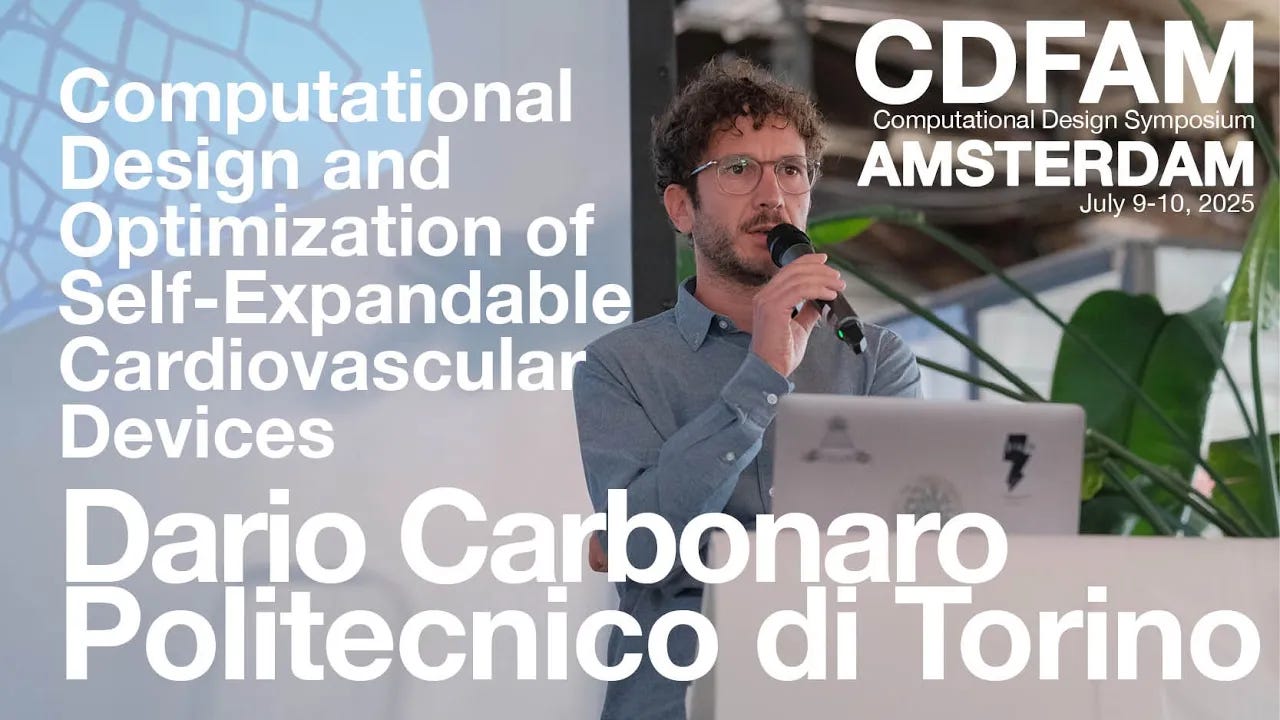
Computational design and optimization of self-expandable cardiovascular devices - Dario Carbonaro episode artwork

EPISODE · Jul 31, 2025 · 18 MIN

Computational design and optimization of self-expandable cardiovascular devices - Dario Carbonaro

from CDFAM Computational Design Symposium · host Duann Scott

Recorded at CDFAM Computational Design Symposium, Amsterdam , 2025 https://cdfam.com/amsterdam-2025/ Organization: Politecnico di Torino Presenter: Dario CarbonaroPresentation Abstract Self-expandable cardiovascular devices, such as vascular stents, stent-grafts, and transcatheter aortic valves (TAVs), are medical devices implanted into diseased anatomies through minimally invasive procedures. Specifically, these devices are crimped into small catheters, where they are subjected to high strains, allowing them to pass through and be placed within the anatomy. Additionally, self-expandable cardiovascular devices are commonly fabricated from nickel-titanium (NiTi) and are capable of elastically recovering their initial shape when extracted from the catheter, even after being subjected to high strains. This capability is related to the super-elastic property of NiTi, which refers to the material’s ability to elastically sustain high strains. The effectiveness of the treatment depends on the interaction between the devices and the anatomy in which they are implanted. Furthermore, the forces exerted by the devices on the anatomy depend on their design, including geometric and material characteristics. In this context, the computational design and optimization of vascular stents represents an efficient tool for improving their mechanical characteristics and consequently enhancing outcomes and safety of the treatments. In this presentation, an overview is provided on the design optimization of self-expandable cardiovascular devices, with a focus on both geometric features and material properties. Firstly, a computational framework is presented for the multi-objective shape and cross-sectional size optimization of self-expandable TAV frames, based on finite element simulations of the implantation procedure in different diseased anatomies. Secondly, a computational framework for the design of innovative self-expandable femoral stents is introduced, in which inverse homogenization topology optimization is adopted to generate 2D unit cells with prescribed mechanical characteristics of clinical relevance, incorporating geometric constraints to ensure manufacturability. Finally, a study is presented that combines experimental tests on NiTi samples with finite element analysis of stent-graft mechanical testing, highlighting the potential for designing and optimizing the mechanical properties of self-expandable cardiovascular devices by finely tuning the temperature and processing time of the material heat treatment. This is a public episode. If you would like to discuss this with other subscribers or get access to bonus episodes, visit www.designforam.com

NOW PLAYING

Computational design and optimization of self-expandable cardiovascular devices - Dario Carbonaro

0:00 18:07

No transcript for this episode yet

We transcribe on demand. Request one and we'll notify you when it's ready — usually under 10 minutes.

Take the Leap Colleen Biggs When was the last time you took a leap of faith trusting that everything is going to work out? Do you crave growth, or are you merely content with the status quo? If you want more out of your life, out of your career, and out of your relationships, you are in the right place. It's time for you to step into the Spotlight to expand your influence and attract the right clients. Your Host, Colleen Biggs, will expose the actions you need to take, through the experiences and interviews of our guests, so you no longer are sitting on the sidelines, but that you are finally taking an active role in defining the design of your life rather than living it by default. We will be interviewing elite leaders that will share their greatest regrets, successes, and how they did it! Week after week you will learn all about how you too can take the leap of faith, trust in yourself and stop living a life only by default. Talent Stacker Jonathan Mendonsa Data suggests that the average cost of college in 2019 was $122,000 while the entry-level salary for a college graduate at the same time period was 50,000. ROI is a distant memory.hopefully for that that $122,000 the student graduates with a degree and possibly some skills. The reality is, as most individuals approach graduation, they realize that ultimately what they have to prove to their employers that they actually have the skills and since you don't need a degree or permission to start building skills, let’s document the stories and best practices of individuals that crushed the game by focusing on building their skills and their talent stack. Maybe you feel like you don’t have a talent stack. What are the skills you need to be able to generate an above-median income and when paired with interest-led learning this talent stack will allow you to work towards financial independence and design your future?If you're up for this challenge to go from no Talent Stack to designing you API Intersection Stoplight Building a successful API requires more than just coding. It starts with collaborative design, focuses on creating a great developer experience, and ends with getting your company on board, maintaining consistency, and maximizing your API’s profitability.In the API Intersection, you’ll learn from experienced API practitioners who transformed their organizations, and get tangible advice to build quality APIs with collaborative API-first design.Jason Harmon brings over a decade of industry-recognized REST API experience to discuss topics around API design, governance, identity/auth versioning, and more.They’ll answer listener questions, and discuss best practices on API design (definition, modeling, grammar), Governance (multi-team design, reviewing new API’s), Platform Transformation (culture, internal education, versioning) and more.They’ll also chat with experienced API practitioners from a wide array of industries to draw out practical takeaways and insights you can use.H Epic: Silver Wing Realm EPIC is your new HQ for Realm’s exhilarating action and adventure stories, with new episodes dropping every Monday introduced by host Faith McQuinn.Embark on your greatest adventures yet, whether it’s crash landing on a desolate planet with only a cerebrally-embedded AI to guide you, or realizing that your latest game design is the only thing staving off total global annihilation. So unsheath those earbuds, clench that steering wheel, and buckle up because EPIC is about to take off.This month, we are featuring Silver Wing: On a desert planet in the far future, an old dragon hunter embarks on a desperate journey to save her estranged son. For centuries, the dragons have been sleeping. But in their rest, they provide a crucial energy source necessary to keep the planet Toon Flats habitable. Amphet Dahl is a diviner, gifted with the ability to sense the dragons’ dreams and memories and to the disappointment of her son, Afton, she uses this ability to

Frequently Asked Questions

How long is this episode of CDFAM Computational Design Symposium?

This episode is 18 minutes long.

When was this CDFAM Computational Design Symposium episode published?

This episode was published on July 31, 2025.

What is this episode about?

Recorded at CDFAM Computational Design Symposium, Amsterdam , 2025 https://cdfam.com/amsterdam-2025/ Organization: Politecnico di Torino Presenter: Dario CarbonaroPresentation Abstract Self-expandable cardiovascular devices, such as vascular stents,...

Can I download this CDFAM Computational Design Symposium episode?

Yes, you can download this episode by clicking the download button on the episode player, or subscribe to the podcast in your preferred podcast app for automatic downloads.
URL copied to clipboard!