
EPISODE · Jan 5, 2026 · 23 MIN
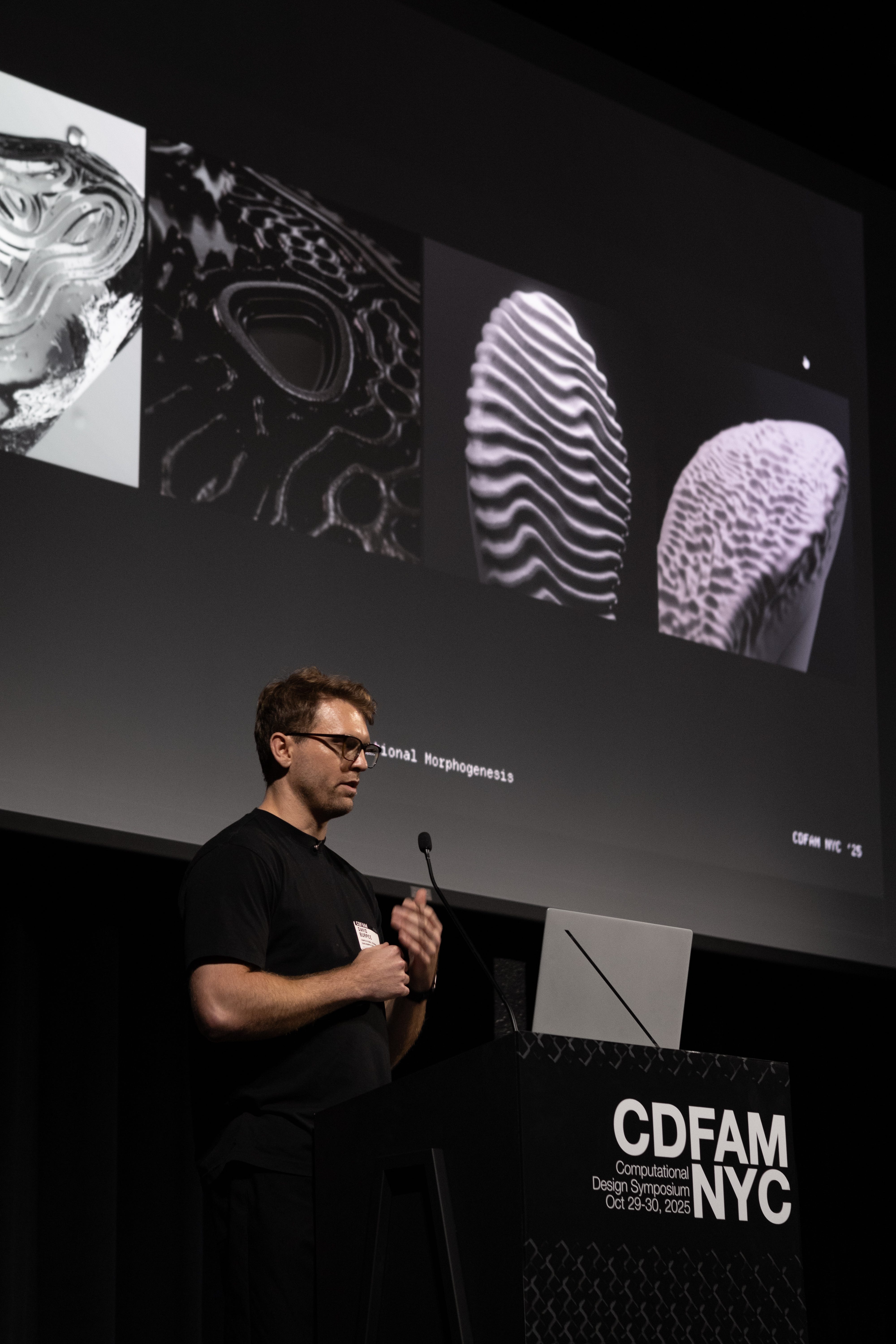
Computational Morphogenesis: Leveraging Proceduralism to Unlock Temporal Design - David Burpee
from CDFAM Computational Design Symposium · host Duann Scott
Recorded at CDFAM Computational Design Symposium, NYC, October 29-30, 2025https://cdfam.com/nyc-2025/OrganizationDavid Burpee DesignPresenter:David BurpeeComputational Morphogenesis: Leveraging Proceduralism to Unlock Temporal DesignPresentation AbstractCurrent paradigms of design and engineering operate on the premise that realized designs are static – that is once they are designed and manufactured they exist in their final state. Likewise even flexible computational systems tend to not incorporate the dimension of time as a design tool. Despite dozens or hundreds of sliders, variables, and graphs, most products – even those designed computationally – are “frozen” at a certain point and designed as a static object.New advancements in material science research particularly around Engineered Living Materials or ELMs have elucidated these shortcomings in our design and engineering workflows. How can we model, simulated, validate, product performance or behavior in this dynamic, temporal environment? We need new processes, workflows, methods, and tools in order to effectively utilize this new dimension of material typologies, as well as continue to design in ways that are more connected to engineering simulation and validation.In this presentation I will explore the use of proceduralism as an essential creation environment that is uniquely able to design in conjunction with these temporal constructs. I will present a subset of my work that utilizes computationally-driven simulations for the creation of physical product, as well as some of my teaching and research through the NSF grant project designing with Engineered Living Materials at the University of Washington.Speaker BioDavid Burpee is a multidisciplinary Computational Design Leader based in the Pacific Northwest, with expertise spanning Footwear, Apparel, Consumer Goods, Automotive, Medical, and Architecture industries. He lectures on Computational Design and Algorithmic Thinking at the University of Washington and is a Computational Researcher on a National Science Foundation grant exploring Engineered Living Materials (ELMs).With over a decade of Computational Design experience, David has delivered advanced design strategy, tools, and training for companies including Nike, PUMA, FILA, General Motors, Harry’s Razors, and EQLZ. His work demonstrates a proven methodology that merges creativity, deep technical capabilities, and broad market impact.Originally trained as an Architectural Designer with a Master of Architecture from USC, David has contributed to highrise and supertall projects in Los Angeles, Seattle, and across Asia. His work integrates computational approaches at every scale, from skyscrapers to small installations.Driven by a passion for biomimicry, generative systems, and sustainable innovation, David applies computational design to address complex ecological and social challenges through creative, high-performance solutions.Join us at CDFAM Barcelona, where the forefront of computational design and advanced manufacturing comes alive. This gathering brings together innovators, researchers, and industry leaders to explore the future of design through simulation, generative tools, and performance-driven workflows. Set in one of Europe’s most dynamic creative hubs, CDFAM Barcelona is the place to connect, learn, and be inspired by what's next in the world of computational fabrication. This is a public episode. If you would like to discuss this with other subscribers or get access to bonus episodes, visit www.designforam.com
Embed this episode
NOW PLAYING
Computational Morphogenesis: Leveraging Proceduralism to Unlock Temporal Design - David Burpee
No transcript for this episode yet
Similar Episodes
No similar episodes found.
Similar Podcasts
No similar podcasts found.