
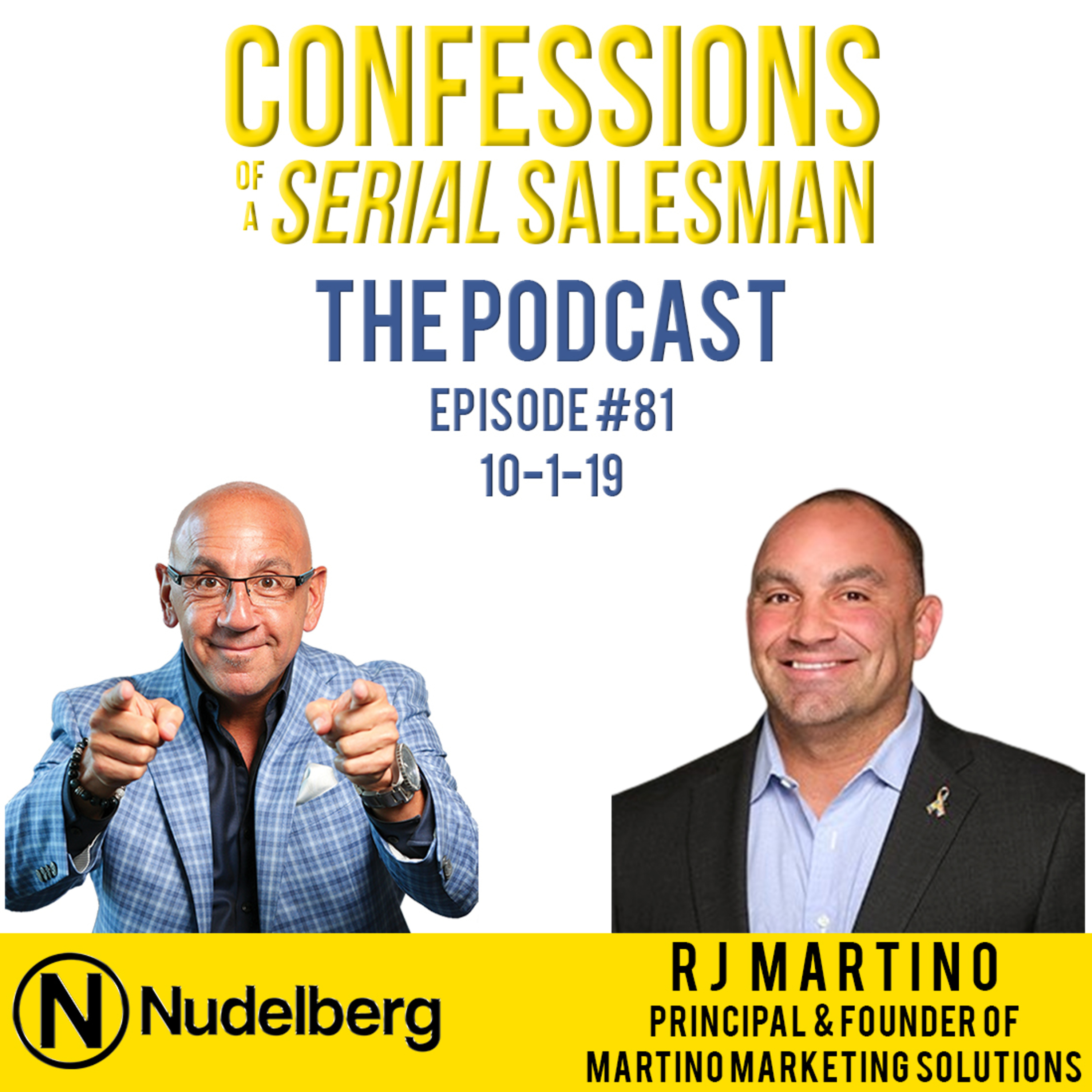
Tell me something good. It's time for Confessions of a Serial Salesman. Author, expert sales trainer, and serial entrepreneur Steve Nudelberg wants to help you change your life and your business using his 27 rules for influencers and leaders. Tell me something good.
This is the Confessions of a Serial Salesman podcast. With Steve Nudelberg, here's Josh Cohen. And welcome to yet another edition of Confessions of a Serial Salesman, the podcast based on the book with 27 rules for influencers and leaders, so on and so forth. Hardcover you know, paperback you know, audio book you know, the man you know.
We're at 81 or 88 once we're into the wide receiver range of episodes. So last week I think we dubbed this the T.O. edition. And for me, we'd be O.J.
McDuffie. O.J. McDuffie. He's a friend.
He lived on my block in West End. Kind of a lifetime dolphin. He's a good dude. He's a really good guy.
Maybe Lyon. Maybe Lyon. Maybe Lyon. Maybe Lyon.
Maybe Lyon. We actually have up and do the podcast because he's a great friend. I wanted to do him all the time. I wanted to do him at charity events and parties.
I don't know what he's doing other than going to charity events and parties. Oh, no. He has a very interesting company that sells. Oh, no.
Oh, no. That's right. You know what? Now that you say it.
I think I saw him last night like I Read Weekend. But he would pop up the same things I would be at. And eventually, you know, we just kind of chatted for a minute. And I said, yo, man, I'm a huge fan of your role in Jerry Maguire.
And he was really going to come with me at that. And I said, we were talking about it on the air yesterday. Jerry Maguire is a perfect movie. It's a chick flick.
Love story. Disguised as a football movie. But all your favorite broadcasters and players are in the movie. And then the general manager of the Cardinals is played by Glenn Fry.
May God rest his soul. God rest his soul. Formerly of the Eagles band. Not the Philadelphia Eagles football team.
So we're to anyone. And you have a unique relationship with your guest today. Set up who he is. Introduce us to us, please.
And then I'll share to the audience what you told me before. That'd be great. That'd be great. So RJ Martino is visiting us today.
RJ and I have been, first of all, friends forever. Our families are friends. We have had some amazing times together. But he's one of those guys that is a salesman's salesman.
Like, you just say, hey, I got this thing and I need to sell it. And wind you up. And away you go. So he's been a friend.
Like I said, we've done business together. He's actually worked for and with On The Ball for some bits of time. He now has taken an entrepreneurial bite and has his own company, Martino Marketing. But I can't say enough great accolades about the guy.
And why I want him here is because I want everybody to know that being a career sales guy, it's not all sunshine and rainbows. RJ, welcome to the podcast. Thanks, Josh. Thank you very much.
So come on, get nice and posted the mic for us. So right when I sat down in the studio today, Steve said, this is the only salesman I know better than me. Literally. So here he said that.
I think he bought it, too. I mean, he doesn't say that. He doesn't say that about many people. So to me, it means one of two things.
It means either he respects you tremendously or he wants something from you. Or I can see that he respects you tremendously and he wants something from you. I just don't know what it is yet. Right.
But that's quite a compliment. But also, there's a little bit of a cross to bear. That's a little bit of pressure for today's podcast. Tell me a little bit about yourself.
Yeah, okay. Why I think what I think. Why does Steve feel like you're the best salesman you ever know? Well, that's pretty big.
I appreciate that. I spent a long time in my league baseball. I was also with the Tampa Bay Lightning. Actually, when the Tampa Bay Lightning was very bad.
That's what we got. That was those guys that have all moved on to great things. Yeah. Yeah, then I came down here with the Florida Panthers down in 2003.
Made the playoffs one time in 12 years that I was there. So it was a very exciting time. We got very creative. And what were you doing in sales with these NHL teams that are, let's be honest, these are not, you know, original eight towns.
This is in Boston, New York, Philadelphia, Chicago. You know, you're selling hockey in St. Petersburg, Tampa, Florida, and then in Sunrise, Florida. So what were you doing?
Well, we had to compete with Sunshine. We had to compete with the beaches. We had to compete with everything going on. You were selling what?
Corporate partnerships? Yeah. Yeah, we were selling luxury suites, premium seating, heck, whatever anybody would buy. They would package it up, including the bathroom.
Yeah. Whatever it took. Okay. It was a hybrid approach.
We would reach out to companies and really do these analysis in old school style and find out what they were interested in, what they were trying to accomplish, what their initiatives were, and then figure out what tools we had that we were able to help them to accomplish those goals. What was great about knowing them back in the day was that they made it not about hockey. They made it about all of the other things, why you want to be involved with a professional sports team, the camaraderie, the loyalty, the credibility. They had unbelievable access at that point.
You know, you guys made great access. I did a ton of business in that building because they were willing to listen to what the client wanted. They really lit the fire on that. So this was the forefront of not selling the game.
It's all the ancillary. It's the experiential. It's the networking introduction. It's a part of being a part of something larger than more than just, hey, some employees go to a hockey Exactly.
Or throwing a logo on a billboard, you know, 100 tickets and a half-page ad. That's what sports marketing used to be, was a logo and some tickets and boom, you know, you got signed a job. And it was like, it's so much more than that. And people who, you know, who leverage that investment today and do it really, really well have guys like you and that team of guys that were working there to thank.
Because they would say, listen, we want to really understand what you want to do, and then we'll figure out what we have to help you do that, which is the key to all selling. So this was innovative at the time? At the time. Yeah, we had a great team.
We had a great team of guys and girls who really had a common goal of doing whatever we needed to do to achieve our goals. Did you have to sell it that way because you had to sell it that way? Oh, yeah. Tuesday Night Against Ottawa?
Right. You tell me how to sell it that way. So it's a case of, you know, invention is the mother of, you know, necessity is the mother of invention. Oh, yeah.
People were like, okay, we don't really know hockey, don't understand hockey, we don't have emotional connection, too. There better be something else that they're getting that gets them in the door to pay for the parking, to pay for a jersey, to experience that. So then they're actually into the overall experience and can be a repeat customer, right? Exactly.
Exactly. You see the players. With minor league baseball, the great part, I never worked for a team in minor league baseball, but in some of the work that we did in advance. Well, you know what?
The canvas was wide open. You could do anything, say anything. There were no rules. Those were really fun things to work with.
Some of the most fascinating, creative, and actually buzzworthy of marketing events that happened currently in American minor league baseball, with theme nights, with jerseys that they do. Hell, there was a minor league double-A ball team that was having coming to American nights where they were serving fake food from the fake restaurant from the A. Murphy or some of the whole movie, and the uniforms were big food, big towels, right? Some of the most creative, innovative events, because what they realize is we've got 19-year-old Dominican kids and 20-year-old Venezuelans, they don't speak English, nobody knows them, we're in a small town here, but it's not about that.
It's the event, it's the experience. Because it's the event, it's the event, not the game. And what it turns out to be a lot of times is what they did early on, either in Ninely Baseball or with Tampa Bay, and then even in the work that we did together at the Panthers, it was access. People don't understand that it's not necessarily what you buy, what you can buy, it's what you can't buy, and that all starts with listening to people, which, take away all of the things that you've done in your career, you are a people person.
I have never met anybody that doesn't love you. There's such a thing? There's a people person? There are people persons.
There's non-people persons. Well, yeah, I'm not a people person. But normally the people persons aren't exceptional in sales, because they're more considerate and hate to ask for money, and they're more givers and takers. So to be exceptional in sales and see who claims you are, and to be a people person, that's a real combination, that's a real combination that probably has to do with authenticity that we often speak of, where it's at the core of any success.
Totally. I don't know what you would say. Well, I think that it's obviously being yourself, being kind. I think love has a lot to do with it, of giving love and listening to people with what they want, what they need, what their goals are, like I said, doing that proper needs analysis.
So I think being a part of their team and knowing that we're going to do this thing together, no matter if we take it down the road, it doesn't work, we're going to switch it over and figure out what we need to do to make this thing be a positive relationship. Because you thought of it, just use the keyword there, the relationship. You thought of it as a partnership. A company that was going to buy a luxury suite, you knew, was doing so not just so that people could watch freaking hockey.
It was so they could get business done, and they could connect, network, and grow just as you were in it together. If a relationship isn't semiotic, somebody's got to figure it out and get the hell out, right? You know, that's so great. When I think about this, and we talked a little bit before we got on to do the show, you know, there's old school way of being in sales.
There's new school way, which is some new tools and stuff. But really, fundamentally, when you become someone's guy, like, you know, the day when, you know, I got a guy. Like I said a couple weeks ago. Like I said, we had a great team.
Everybody worked together, which is obviously part of that. So, you know, everyone did their part to make sure that we had guys to be able to be the guys, you know? So a lot of support there. But yeah, I think concierge services of what you do as a salesperson, you want to be more than just sell what product or service that you have.
So connecting like what we did with salespeople, we connected people with like-minded people in their targeted industries, and that was above and beyond what they did with what they're doing with the team. I think that, you know, a lot of people listen to this podcast. They're of the millennial generation up to the age now of whatever it is, 36, I guess they fit. And they're in between the digital cyber disconnect and the personal attention that maybe your dad's man provided, you know, when he was selling women's shoes back in the day.
So they're in the midst of this. And I think the important part is not, forget this, people always don't want to have that guy. Someone they know is living out for him, is heads up for him, that they have that relationship with beyond, he just wants the money. So what's interesting is that it comes down, and we did a post on this this week in social media, it comes down to pain and pleasure.
If you remove someone's pain, you know, and they will think of you in a pleasurable way. Correct. And they want to do things with you, for you, around you. So the worst thing that anybody can say is, no, I don't do that.
You know, you were never that way. You were a very resourceful guy. Find a way. Which is why I think you have the role you have now.
He alluded to a business that we had for a short period of time called SalesFuel, and we would be the lead. People would say to me all the time, hey, listen, if I get in the room with the right person, I know I can nail it. Okay, we'll get you in the room with the right person. And then we created a business, strictly around not really selling the product, similar to what I do with ESPN, is just go out and introduce people and put two people together.
That's a real skill set that, you know, you have to be adept at listening, learning, making the right introduction, putting the right personalities together. But in the end, I think you said something you may not even know that you said is that you love it. You know, that's what you're driven by. And my money follows.
Well, so there's a big distinction between having lots of friends and then actually asking for the business. Right. You know, and that's what happens when we get stuck at the door. Like, I really love the banter, but I can't get past it.
My earlier, you know, being a people person, you're not being so successful as you are in sales. That's a unique combination. I think it's also that we're talking about love and passion. I think you have to have love and passion for what you do to help, not only help others, but obviously your goal is to sell a product or service.
So being able to go in with the passion and knowledge of what you have to offer of your services and then being able to listen to them as far as what they want, need, what their initiatives are, what their challenges are. You know, a lot of people don't, sales people don't ask, what are your biggest challenges? Simple, basic stuff. They want you to know all those things.
Knowing what you have to offer, you can put together a compelling program. So a lot of people who listen to this podcast in sales are attuned to giving that potential partner, customer, client, what it is that they want, and not necessarily what it is that they need. How do you communicate that? That's a great question.
I understand that. But I think this is where you're consulting them, and it isn't in your best interest to actually offer theirs. How do you communicate that? Directly, just like you did.
Sometimes they want what they want, right? Regardless of what they need. Well, then you've got to dig a little bit deeper to understand why do you want that. Just ask more questions, I think, is the key to putting together a win-win situation.
You put together a program that they want that isn't what they need, they're not going to come back. So you're probably not going to grow a long-term relationship. So a lot of it is just exposing new options. You know, I think salespeople, unfortunately, sometimes take the quickest route.
Oh, you know, here's, I can just lay up, and here you go, and done, and I got a sale. But they might have to work harder or deeper, or be at risk of not getting the deal. And so, you know, I think at the end of the day, people buy people. And if you've developed that trust, which is what's so significant, you know, in all of this, is that everybody I know that knows you, like they mention your name, it's like, okay, I trust him.
Because he's done it over and over and over again. So to do it, and do it often, you know, you can get lucky one time to hit a big deal. But, you know, sometimes you walk away from a deal and say, hey, this is not what you should be doing, and I'm just going to walk, because I want to be part of this. Really?
You build real respect with people. Yeah, you know what? I know this is something you want to do, but this is not going to work, based on what we know. And I don't want to be, you know, part of that.
It takes a lot of discipline. Well, when people know that you have their best interests, first and foremost, that's you're differently than someone trying to sell me. Because nobody wants to be sold. They want a heads up on something.
They want a good referral on a good call to someone's guy. And I'm thinking back to the times that we've worked together, where sometimes it wasn't right with the Panthers, and you would say, hey, you need to be talking to the Marlins or the Dolphins, and he would actually make that connection. When you do that, and you do that over and over, it always comes back. It's like, listen, we don't really have the right solution for what you need, and I can't think of a specific one.
But even if it was Homestead, or whatever, you knew the landscape of what opportunities were available to people, or concerts, or whatever. You know, so it wasn't just, hey, I work for the Panthers, and this is what I do. It wasn't defined by the Panthers. It was a part of what you did.
So how much of this comes down to you being a people person, as we mentioned earlier, with a close family, the child divorce that wants to make others happy, and how much of this is you realizing, hey, the path to success in this industry is recognizing their wants and needs, and helping to serve that to their own growth. Some of this is your nature, your nurture, before you even enter the workforce. A lot of it is. Okay, yeah, I agree.
Because you're a decent person, apparently. Yep, apparently. So that carries through. Well, I mean, you're supposed to say, Steve, so I got a question.
But if I knew you another way, I'd be like, this guy's tremendous. But if you're a long time for him, that's a company we keep. You know what I'm saying? You're a little skit.
Finally, thank you. I was the one that had to come in and grab his badge from the Florida Panthers at the VB&T Center. One of the few times it's ever happened in my career. I can see the look on his face, and it's interesting for people who listen to this, if you've ever had to fire somebody, it's a really difficult thing to do.
Unless you don't like them. But even if you do, it's just, you know, for me, anybody I've ever fired in my career, which I've had to, I always, like, I get that, you know, service switch, and, you know, like, you're really changing people's lives. Correct. I walk in and I look down his face and I knew something was up and he goes, they want your badge.
I blame them. I blame them the entire time. You didn't say I want, you said they need. Well, one of the perks of being, so I was a consultant for the Panthers for many years.
I was with the Panthers team and you know what, those guys are everywhere around the country now and still calling, you know, Greg Lynch said something today. He works with FAA. What did I tell you? Yeah, listen, I bonded with the guys as somebody who was their peer, not laying some bullshit on them.
I did this stuff and I tried to give them ways to get through it. So when the circumstances pointed back at me that I needed to go, it was just awkward because one of the perks of being working with the Panthers was you got a badge in the building. When we could walk in, you know, a stadium at will, it was cool as hell. I was bummed to lose my badge.
Yeah, yeah. I was just joking when concerts were happening and standing in the concourse. It's backstage pass. Sorry, I'm just walking in, man.
It really wasn't backstage pass. It was really cool when I was dating. Hey, come on. We're good.
You ever seen the movie? See, it did change a lot of people's lives though. We still talk about Dan Gwyn and a bunch of the guys that we did training for on LinkedIn and just phone calls, 50 cups of coffee, all the good things that you were doing at the time with these guys. It really changed their lives.
They took it and ran with it which, you know, it's really, I had this conversation and I'm really glad you said that because I had this conversation the other day. There's training and there's exposure. I expose many more people to different and new concepts about how to sell. Not very many want to be trained.
They'll take it and go, wow, that was really cool. Why is that? There's no ways. People are better ready.
They're afraid of change. They're not willing to do the work. Change is hard. You know, human behavior.
We're resisting. It's our natural. You know, if I roll this one of the paper and you're going to blink, that's just, you know, that's just your reflex. That's your DNA telling you to protect your eyes.
Our reflexes to resist change do it in the same way. Have those creature of habit behaviors that's what helps us survive. So you're fighting all of that. All of that.
Now you've trained some salespeople in your career. You know, when you're working at UM, you made a presentation there. What are the things that you talk about that the audience might want to hear? What are the important things to you?
Well, very important to me is coaching and like you talked about before, being able to listen to people, understand their pains, their needs, their wants people, I spent some time with a company called Neptune Society and we did free-need cremation sales. That's about as hard as you can do. Yeah, I went from Katy Perry's kind of sexy, right? Yeah.
And then I went to free-need cremation sales. But it was huge. Concerts in the arena. You know, concerts in the arena, pretty sexy.
Cremation services, not so sexy. Peace of mind. We call it peace of mind. Because really, I say all the time, there's two things that we buy we hope we never have to use.
And it's our funeral arrangements and our home insurance. There's two things you pay for you hope you never have to use, right? So selling something like that's a different set of challenges. It's a different skill set I'm not doing entirely.
Oh yeah, it was kind of an answer to your question here. We have 1099s throughout the country and different ages from young to old and obviously being able to sell and find out the needs for somebody to have a conversation about being in the room. Right, just being in the room. So our process was being able to make a call, go into their home and make a presentation.
And these are people that know that their time is quickly. Not necessarily. No, could be 40, 50, 60, 70. I had veterans that were over nine years old that just wanted to take care of their loved ones and relieve the burden and have that peace of mind.
So that's kind of what resonated with me with that position and being able to walk through the process. So to answer your question, I think understanding your players, the way I look at it, where the coaches are players, we have to understand their needs, their wants and listen to them just like we would a sales deal. We have to understand what are your wants, what do you want to be and then use those points that they give you, those clues that they leave you to be able to motivate them throughout the course of the year. So I think for me, the takeaway is you could be really great at selling a sexy product but strip away your product and see if you're as good doing it across multiple categories which I think would make a great game show by the way.
I really hear the premise. Still people buy from people that they know, like, and trust. It's just maybe not as fun. For sure.
Nobody's taking pictures of me. No one's like, I can't wait to use my Neptune services. I've learned that from some of the clients that I've coached. We were working in the hearing aid business when we did stuff with your ex and Paige who I tried to get on this program.
We were selling a product that nobody wanted to wear. There's anybody who goes, hey, look at me, I got hearing aids on. And they're expensive as hell. They're $5,000 for repair but let's test you.
Let's test your skills. So when you get around salespeople who get it, the conversations like what we had before are so real and so genuine. What are the challenges? They're all the same across every category.
How do you beat them? Mostly the same. So you can plug different products and services in there. It's just if you can meet people on their level and connect, the world opens up.
And that's what I think your best skill set is. You just have this one teddy bear and people can't see it. He's a big dude. People person.
You're a people person. There you go. You are. I've had some of the best parties ever.
Let's talk about the parties. Just talk about the parties. You know what? I hate to use this word but it's appropriate.
When you go to war with people and we work together in the trenches on a bunch of different products. We certainly did it together at the Panthers. We did it together at sales school which was my company. There's nothing more than celebrating.
And I tell us to sales you've got to celebrate the wins. They don't come that often so you've got to celebrate the wins and this guy was a master at celebrating. You know how to celebrate the wins. You have to.
And there was a lot of wins apparently because it sounds like you did a lot of celebrating. It's just a... So if I was putting together a sales team today you'd be one of those guys. What do you think makes up a great salesperson?
What are the skills you would look for if you were hiring someone? Sure, sure. I think passion and I think that it's dedication, hard work, grind. You know all the basics of what makes a good player.
You've got to put in the time. You've got to be prepared. You've got to know your product. You've got to know your services.
You've got to know who you're targeting. What they need. You've just got to be knowledgeable and understand the landscape of what you're doing. And if there was one consistent theme you saw in sales people that did not achieve what would it be?
I know from my purview what I see but I'm curious. One thing that you see over and over... People person? No, no.
The ones that you see. They're not talking about what you said. No, no. Because I know this is my takeaway is that you mentioned the grind.
People think that there's a way to get away from the grind and it's a little short cut. It's the grind that makes it great. You know, it's doing the work over and over and over again. There's nothing sexy about it.
You know, we were sitting there and in the middle of we got done doing what we're doing and I spent a half hour prospecting and I think you saw that. There's just no getting away from it. This is what great sales people do and I think there's a misnomer that you can get to a place where there is no prospecting where there is no grind. No, it doesn't stop.
I think that tied into getting on the phone and the videos I think that's a great concept being able to send out videos now with technology but being involved with charities and being able to give back in the community, like-minded people. Everybody has their defenses down and you're able to help each other and common goals. I think those are the ways that you really network and drive business and help each other. Which is the funny thing is none of that has changed in 40 years.
They're just new tools, right? So it is old school. It's old school methodology with new tools and if you marry those two together there are some incredible results that people can get. And the tools should make it more effective if you have those tools.
More efficient. I think it's fun. All of the prospecting I did I did with video and I think that makes it certainly more entertaining if you will. Steve, as we put a bow on this 8-1 why don't you tell us something good as we like to do?
What do you got for us? Well, aside from the fact that we're going to go celebrate Tequila. There will be a tequila in Bobby more than one. No.
Here's a really good thing. Friday, Mark, my son and I will be heading north to Gainesville. Game day is in Gainesville this weekend when they play Auburn. And what's your relation with that coaching staff?
Go get her. There's a very special human being you will see on most of the shots when you see Dan Mullen standing right next to him in a black paper shirt and that would be Jake Noodleberg. That would be the son of him. And it's been a month since I've seen him and you know, it's tough and I'm excited to see him.
I'll see my grandson. So we'll have all the Noodlebergs together on the sidelines and look for us. But what's good about it is go Gators. Okay, there it is.
Thanks again, RJ. Pleasure, my man. Thank you, Josh. Steve, we'll try for 82.
We're getting closer. So who would be 82? Would that be like one of the Steelers guys? Is that Stallworth?
Oh, John Stallworth's 82? Was that an 82? That kind of feels about right. Yeah, kind of feels about right.
I just remember Super Bowl highlights of John Stallworth. Slow motion. That's low motion. That's exactly what I'm thinking.
The same image with the tip ball and the, yeah. Oh, yeah. We're getting closer to 100. Our 100 is going to be great.
You'll be part of the party. There's a big celebration. He can't. He'll be there.
So you'll be there. And in closing, I'm just going to say one thing that I'm going to up my watch game and maybe wear a million dollar watch the next time I'm going to do it. There you go. There you go.
Watch sponsors. Watch sponsors. Steve's available. Hit them up on the link.
We're Steve Norbert. Just going to say thank you for listening. We will catch you next time on the Confessions of a Sales in the podcast. How long, everybody?