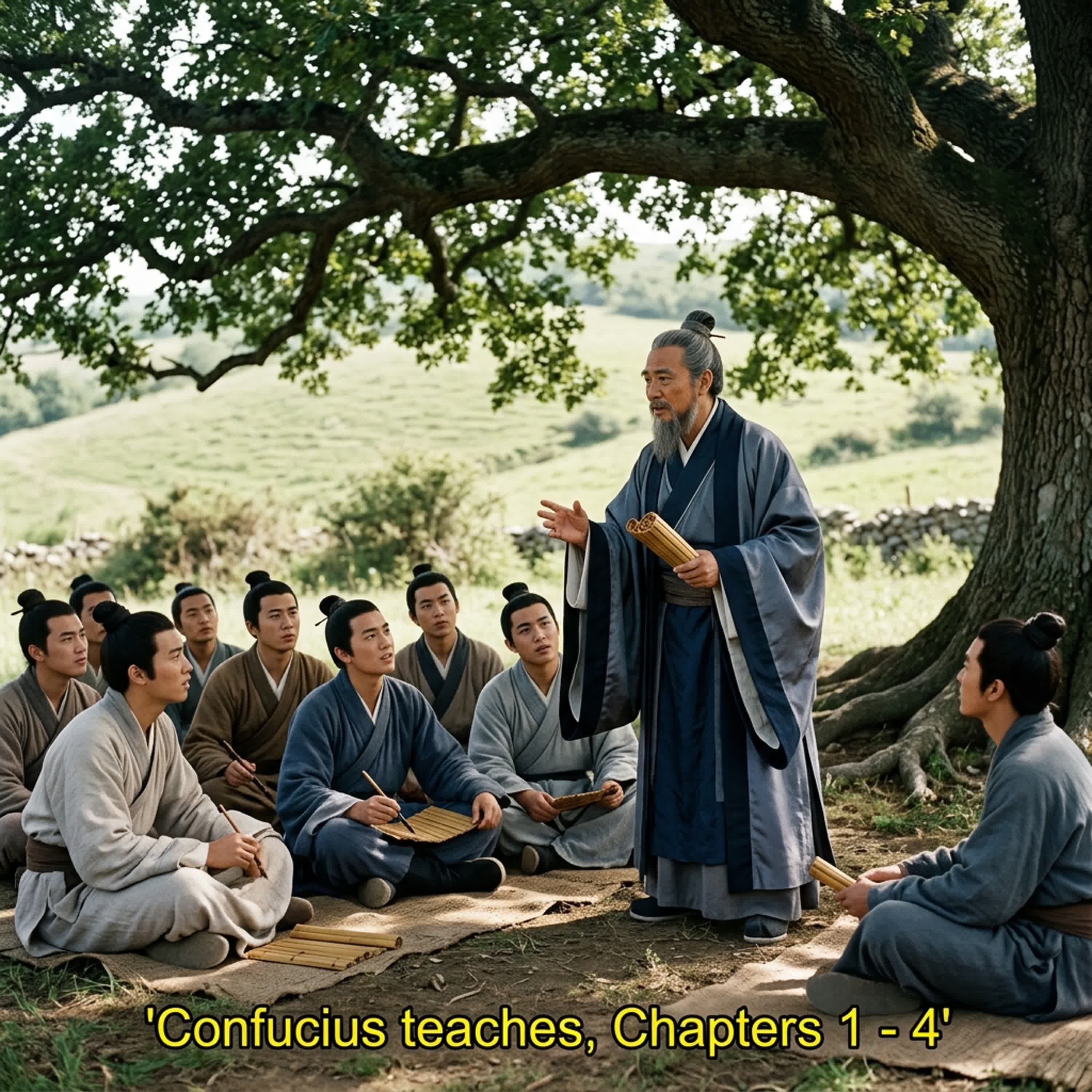
Confucian Analects - 1 - Chapters 1-4
from Wisdom for the Present: Eastern Wisdom Literature Hosted by Kanu Emeruwa
What if the secret to overcoming professional burnout isn't managing your overflowing inbox or escaping a demanding boss, but examining how you treat your family? In this episode of Wisdom for the Present, we dive into Books 1–4 of the Confucian Analects, an ancient text that delivers a surprisingly abrasive psychological audit for 21st-century life. Rather than offering dry academic history, our discussion extracts raw moral insights that challenge our hyper-independent lifestyles. By shifting our focus from public success to the intimate arena of the home, this text suggests that the living room is the ultimate crucible of character. The core conflict of the Analects lies in its refusal to start in the public square, bypassing boardrooms and halls of power to audit our relationship with our parents. The philosopher Yu establishes that filial piety and respect for elders are the literal roots of all benevolent actions. This framework sets up a profound tension with the modern hero's journey, which valorizes separation and hyper-independence. Here, the home is treated as the original training ground where the human ego must face the friction of duty, subordination, and respect. If we cannot tolerate this friction in our private lives, our public impact will inevitably be structurally compromised. We often hide behind performative actions, but the Analects strips away our moral high ground by distinguishing material transaction from true disposition. Providing material support without reverence is categorized as baseline animal husbandry—no different than feeding livestock. The text zeroes in on the "countenance"—the subtle facial expressions and tight jaws that reveal our internal resentment and impatience. By forcing us to control our demeanor, the philosophy combats our tendency to gamify our morals. Just as modern organizations rely on strict compliance rules that incentivize people to find loopholes rather than cultivate integrity, the ego seeks to maintain a polite public mask while harboring deep arrogance. This fragmentation of character leads directly to cognitive chaos, a modern storm of information overload and intellectual isolation. The text beautifully diagnoses this double pathology: "Learning without thought is labor lost; thought without learning is perilous". In our digital age, we constantly consume data through endless feeds without pausing for silent synthesis, leaving our brains as mere conduits for noise. Conversely, when we rely purely on isolated internal logic without subjecting our views to empirical facts or history, we fall prey to confirmation bias and conspiracy, constructing perilous, self-serving realities. Reclaiming our agency requires a commitment to rigorous personal discipline and self-examination. By adopting a daily audit—questioning our faithfulness in obligations, sincerity in relationships, and active practice of knowledge—we begin to rewire our behavioral defaults. This slower, decadal path of growth challenges our obsession with quick life hacks and demands that we become "North Stars" of quiet consistency. When we encounter frustrating people, we must resist externalizing our anger, turning inward instead to use their flaws as a mirror for our own shadow work. In a world fatigued by performance, holding this line eventually creates a magnetic, resilient community. In This Episode * The Root of Virtue: Discover why the home, not the public square, is the absolute bedrock of leadership and personal integrity. * Reverence vs. Material Support: Why providing financial or material support to parents without genuine reverence is mere "animal husbandry". * Mastering the Countenance: How regulating your facial expressions and micro-expressions can actively rewire your internal ego and neutralize annoyance. * The Cognitive Balance: Unpacking why modern information consumption ("doomscrolling") is labor lost, and why isolated thinking is deeply perilous. * The Three-Point Daily Audit: A practical heuristic for self-examination covering professional faithfulness, personal sincerity, and active practice of wisdom. * The "North Star" Leadership Model: Why leading through embodied virtue and cultural gravity is far more effective than forcing compliance through punitive laws. * Turning Conflict into a Mirror: How to use frustrating interpersonal interactions as a diagnostic tool for your own internal growth. Practical Reflection When performing a duty for a family member or colleague, what does your countenance (facial expressions, body language, tone) reveal about your inner posture? Are you practicing genuine reverence or performative martyrdom? Are you currently "renting" information through constant consumption, or are you creating intentional spaces of silent synthesis to truly "own" what you learn? The next time someone triggers or frustrates you, what hidden part of your own ego or unacknowledged shadow is their behavior mirroring back to you? Suggested Substack Excerpt Are your career struggles actually rooted in how you treat your family? Discover the ancient psychological diagnostic of the Confucian Analects and how to build character from the inside out. AI Disclosure This episode was created using Google NotebookLM Audio Overview, based on human-curated source material, structured guidance, and editorial review. AI is used as a tool for clarity and delivery, not as a replacement for thoughtful study or engagement with the original texts. Copyright © 2026 Wisdom for the Present / Kamashcu Production Studios. All rights reserved. This is a public episode. If you would like to discuss this with other subscribers or get access to bonus episodes, visit wisdomforthepresent.substack.com
Embed this episode
No transcript yet.