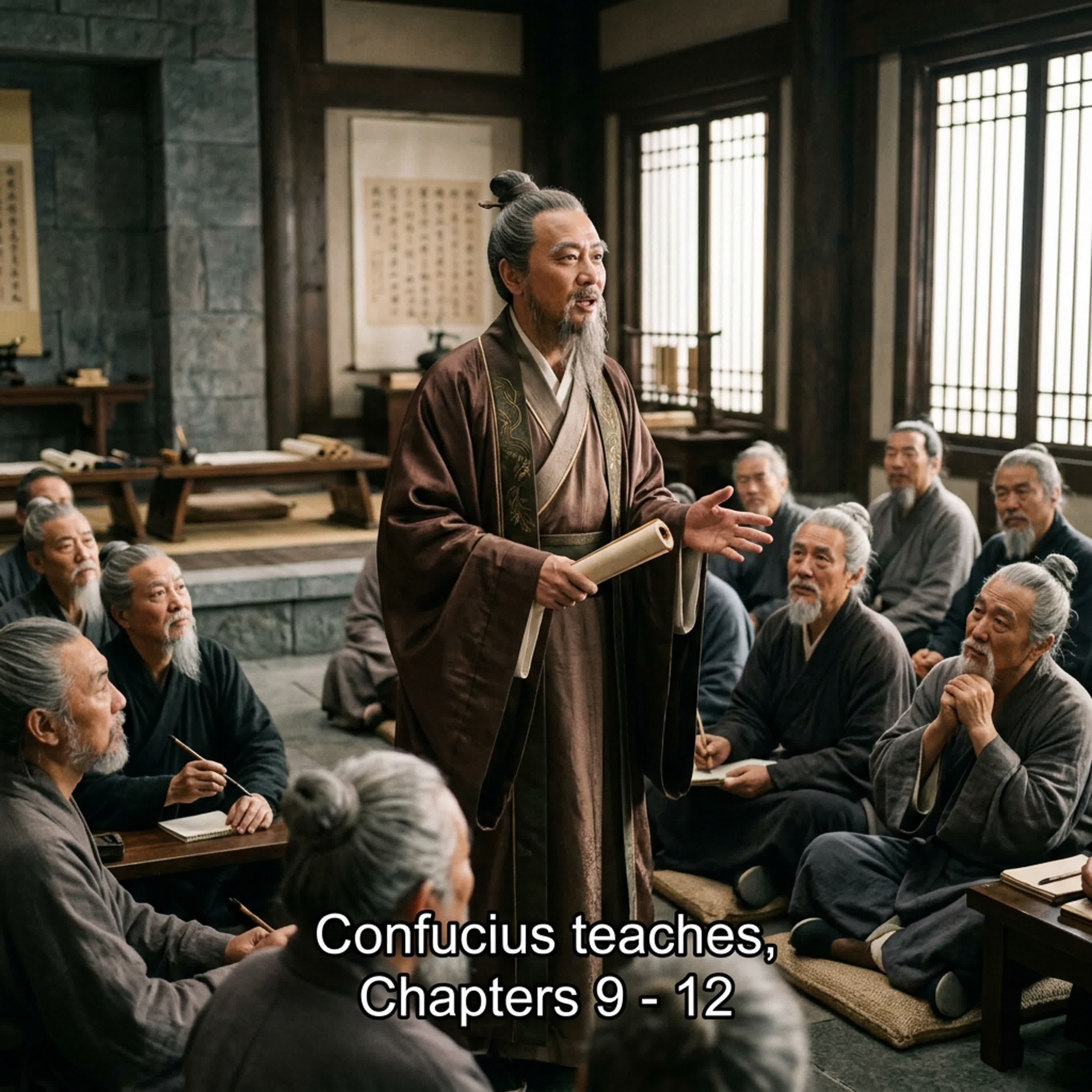
Confucian Analects - 3 - Chapters 9-12
from Wisdom for the Present: Eastern Wisdom Literature Hosted by Kanu Emeruwa
How do we find stability when the world around us is in systemic, cascading failure? While we often seek macro-level solutions—strategic pivots, defensive maneuvers, or power grabs—ancient wisdom suggests a completely different starting point. In Books 9 through 12 of the Analects of Confucius, we are presented with a radical operating system for the human mind that links macroscopic political survival directly to microscopic personal habits, such as straightening a sitting mat or controlling one's ego. This classic text challenges our modern tendency to separate our messy internal lives from our external careers, arguing that without internal alignment, our outward actions are mere performances destined to cause harm. By examining these ancient dialogues, we uncover a timeless psychological guide for reducing friction in our relationships, our workplaces, and our own minds. The core tension of this discussion lies in the historical reality of the Spring and Autumn period—a violent era of political fragmentation, warring states, and rampant corruption. Confucius was not a serene guru meditating in isolation; he was actively navigating a collapsing society where rulers contemplated starving their own populations through heavy taxation, and mobs threatened his very life. In this high-stakes environment, the Analects introduces the conflict between expediency and ethical consistency. Confucius illustrates this by adapting to harmless cultural shifts, like wearing an economical silk cap, while fiercely holding the line against changes that feed psychological arrogance, such as refusing to alter where he bows to a ruler. This distinction teaches us to separate practical convenience from moral compromise, showing that our physical, embodied actions directly shape our internal states. At the center of Confucius's psychological framework is the concept of Ren, or perfect virtue, which is achieved when we "subdue ourselves and return to propriety". To make this actionable for the modern reader, the episode frames the human mind as a computer: subduing the self is the core code that restricts the ego, while propriety (Li) acts as the user interface through which we interact with others. Subduing the self is not about erasing our identity, but rather about targeting the selfish, self-aggrandizing impulses that generate social friction, such as entering a room needing to prove we are the smartest person there. When we run this internal code and eliminate this friction, we free ourselves from the cognitive biases that cloud our judgment—what the text identifies as foregone conclusions, arbitrary predeterminations, obstinacy, and egoism. Navigating outer chaos requires a deep structural defense, a theme vividly illustrated when Confucius was surrounded by a hostile lynch mob in Kwang. Instead of panicking or resorting to violence, he anchored his mind in a cosmic mission, neutralizing his terror by outsourcing his fate to a higher order. This mental pivot highlights how we can manage acute crises by connecting our immediate struggles to a broader purpose. On a societal scale, the text explores the breakdown of trust during times of famine, revealing that while economic security and national defense are crucial, trust is the ultimate foundation of any state. Confucius famously argued that if forced to choose, a leader must part with weapons and even food before sacrificing public trust, because without trust, the social contract evaporates and society inevitably fractures. Ultimately, reclaiming our personal agency requires us to align our titles with our actions—a concept known as Zenming, or the rectification of names. This doctrine demands extreme accountability: a parent must act like a parent, and a leader must carry the true burdens of leadership, rather than merely collecting the benefits of their status. True character is not loud or performative, but is built on the microscopic habits of self-regulation and mindfulness that keep us anchored when the winter of hardship arrives. As Confucius observed, it is only when the year becomes cold that we see how the pine and the cypress are the last to lose their leaves. By cultivating this deep, structural integrity, we build a mind and a life stable enough to weather any storm and ultimately find peace. In This Episode * The Power of Micro-Habits: How microscopic personal practices, like straightening your sitting mat, establish internal mental order and reduce cognitive load. * Subduing the Ego: Shifting from self-aggrandizement to a "frictionless" way of navigating social networks to prevent interpersonal damage. * Convenience vs. Compromise: Distinguishing between harmless adaptations (like switching cap materials) and actions that feed inner arrogance. * Cosmic Anchoring: How Confucius managed acute terror when surrounded by a lynch mob in Kwang by aligning his identity with a greater mission. * Trust as the Ultimate Currency: Why public trust is the irreplaceable foundation of any organization or state, far outweighing military or economic metrics. * The Wind and the Grass: Understanding leadership through social contagion and the mirroring of top-down behavior rather than forced compliance. * The Rectification of Names (Zenming): Demanding absolute accountability by ensuring that our actual behavior matches the moral responsibilities of our titles. Practical Reflection * Where in your daily routine are you introducing friction by allowing a disorganized environment or an checked ego to dictate your reactions? * If forced to choose in your career or organization, are you prioritizing short-term "food" (resources, metrics) at the expense of "trust" (integrity, social capital)? * When the winter of personal or professional hardship hits, what are the enduring qualities of character—your "pine and cypress" leaves—that will stay green? Suggested Substack Excerpt In a world of constant noise and systemic disruption, ancient wisdom offers a surprising survival strategy: microscopic personal order, self-mastery, and the radical preservation of trust. Learn how subduing the ego and straightening your daily "sitting mat" can build a character capable of weathering any storm. AI Disclosure This episode was created using Google NotebookLM Audio Overview, based on human-curated source material, structured guidance, and editorial review. AI is used as a tool for clarity and delivery, not as a replacement for thoughtful study or engagement with the original texts. Copyright © 2026 Wisdom for the Present / Kamashcu Production Studios. All rights reserved. This is a public episode. If you would like to discuss this with other subscribers or get access to bonus episodes, visit wisdomforthepresent.substack.com
Embed this episode
No transcript yet.