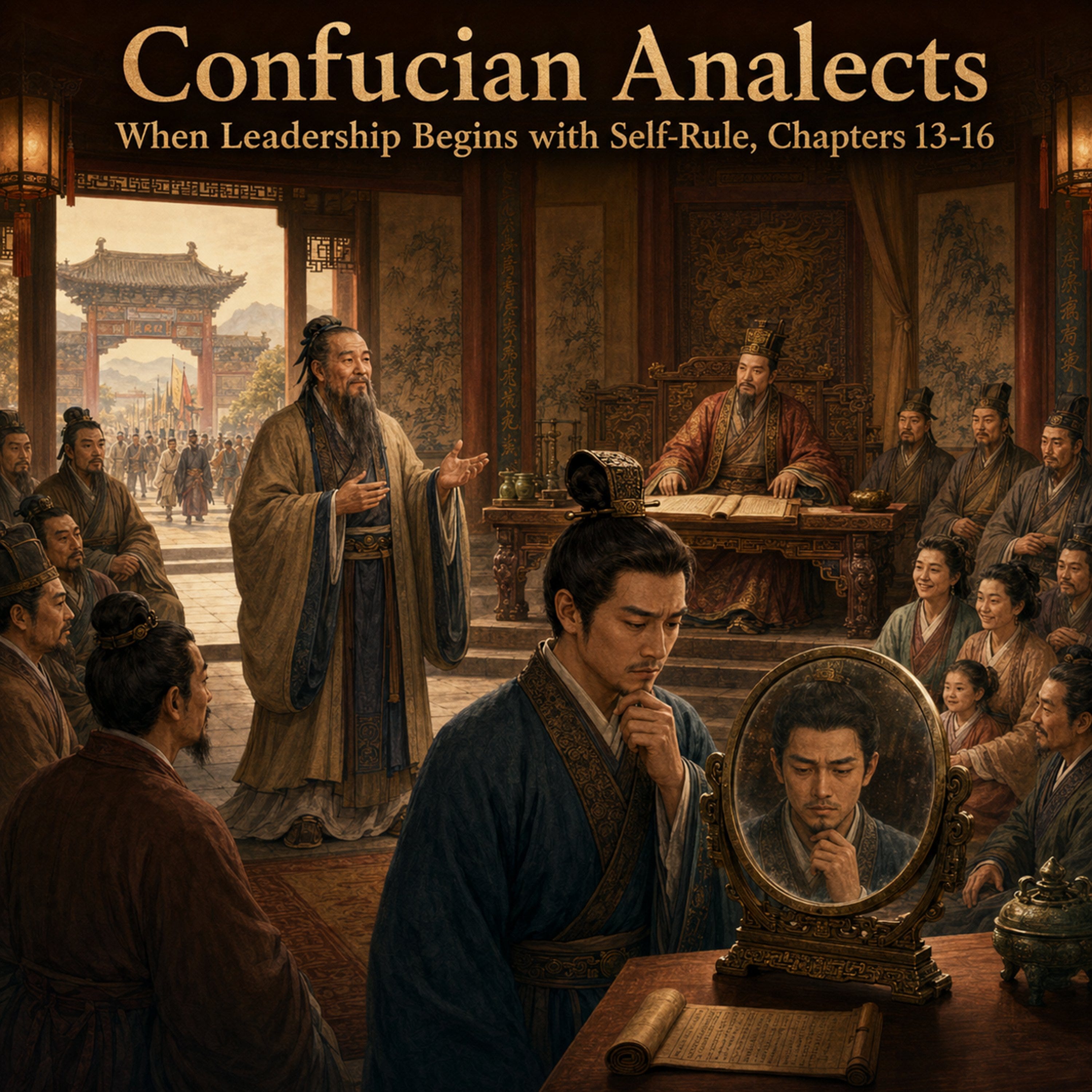
Confucian Analects - 4 - Chapters 13-16
from Wisdom for the Present: Eastern Wisdom Literature Hosted by Kanu Emeruwa
In an era dominated by quick life hacks and tactical optimization, we often look outward to fix our most pressing anxieties. But what if the ultimate antidote to systemic chaos isn't a new external strategy, but a radical pivot inward? This episode dives into Books XIII–XVI of the Analects, exploring how these ancient, blunt, and surprisingly modern dialogues offer a psychological operating system for surviving a world in slow-motion collapse. Far from dusty, mystical pronouncements, this classic text acts as a sharp mirror, challenging our core assumptions about ethics, success, and the bedrock of human character. The backdrop of these dialogues is far from a peaceful ivory tower—it is a landscape of profound institutional failure where central governments are functionally bankrupt and authority has dissolved into factional warlordism. Confucius is blunt and out of patience, famously dismissing the corrupt politicians of his day as empty, useless buckets. In this environment of deep systemic breakdown, his students—ambitious young men looking to build careers in a highly volatile market—plead for political playbooks and tactical maneuvers. Instead, they are met with a paradigm-shifting response: when the systems around you break down, your only reliable leverage is your own cultivated character. This inward turn creates a sharp distinction between two human archetypes: the "superior man" of cultivated moral excellence and the "mean man" who is reactive, small-minded, and entirely driven by immediate gain. The core diagnostic metric of this division lies in the location of one's compass—whether it is internal or external. In a modern workplace, this manifests in the bosses we serve and the leadership we practice; while a superior leader establishes predictable parameters based on actual capacity, a mean leader projects their chaotic anxieties, expecting the impossible while being easily swayed by empty flattery. Relying on external validation in a broken environment inevitably guarantees a downward spiral into compromise. When societies and organizations begin to fracture, the decay always starts in our vocabulary. Confucius’s first executive action—the seemingly abstract "rectification of names"—reveals a terrifyingly precise cascade of logical breakdown and confirmation bias. If we refuse to call things by their true names, language loses its grip on reality, operations fail, organizational trust evaporates, and justice devolves into a tool of the powerful. We see this modern cascade whenever we substitute sanitized jargon like "synergistic realignment" for painful layoffs, or mistake social media metrics for true human connection. Specious words confound virtue, paralyzing our collective ability to make sense of the world. To reclaim our agency in the face of this noise, the text offers rigorous practical frameworks. It shifts us from intrusive, "helpful" projection to the boundary-setting empathy of the "Silver Rule"—never doing to others what we would hate receiving ourselves. It prompts us to ruthlessly audit our inner circle to ensure we are sharpening our character against the upright rather than rusting among the glib-tongued. By practicing the nine considerations of self-audit—from active listening to pausing before anger—we transition from reactive cogs in a broken system to stable anchors of integrity. True uprightness isn't about rigid adherence to abstract laws, but about preserving our primary human relationships and refusing the prideful stagnation of uncorrected errors. In This Episode * The Inward Pivot: Why external systemic collapse demands a radical shift toward internal character over tactical manipulation. * Internal vs. External Compass: How to use the "superior man" and "mean man" diagnostic tool to locate your moral anchor. * Predictable vs. Reactive Leadership: The mechanics of how superior leaders build up teams based on capacity while mean leaders project anxiety. * The Rectification of Names: Why linguistic precision is a moral imperative, and how false language triggers organizational collapse. * The Silver Rule of Empathy: Contrast the invasive nature of the Golden Rule with the boundary-respecting power of non-harm. * Auditing Your Wetstone: Why you cannot out-willpower a toxic environment, and how to evaluate if your inner circle is sharpening your tools. * The Nine Considerations: A complete mindfulness self-audit framework for processing inputs, speech, anger, and material gain. Practical Reflection Do you manage others—as a leader, colleague, or parent—by providing clear parameters based on their actual capacity, or are you projecting your own unmanaged anxieties onto them? Where in your life or organization are you substituting sanitized jargon for difficult truths, and how is that imprecise language obscuring reality? Are you pursuing learning, self-improvement, or patience for your own internal alignment, or are you doing it to collect the applause and metrics of others? Suggested Substack Excerpt In this episode, we unpack Books XIII–XVI of Confucius’s Analects to discover a powerful psychological operating system that prioritizes internal character over external manipulation in times of systemic collapse. AI Disclosure This episode was created using Google NotebookLM Audio Overview, based on human-curated source material, structured guidance, and editorial review. AI is used as a tool for clarity and delivery, not as a replacement for thoughtful study or engagement with the original texts. Copyright © 2026 Wisdom for the Present / Kamashcu Production Studios. All rights reserved. This is a public episode. If you would like to discuss this with other subscribers or get access to bonus episodes, visit wisdomforthepresent.substack.com
Embed this episode
No transcript yet.