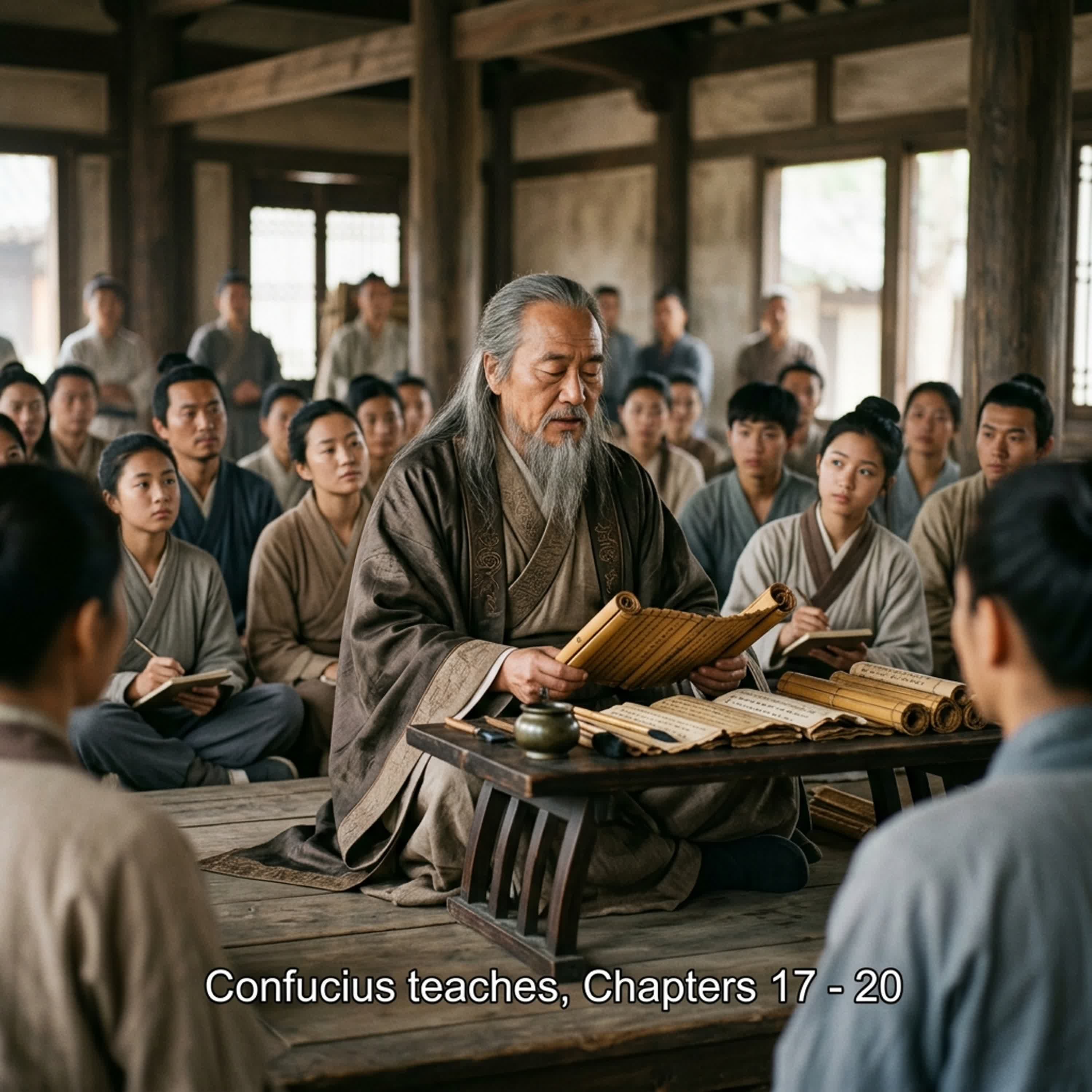
Confucian Analects - 5 - Chapters 17-20
from Wisdom for the Present: Eastern Wisdom Literature Hosted by Kanu Emeruwa
What does it take to lead, make hard choices, and stay human when the world around you is fracturing? While modern professional culture often looks to psychology or self-help to address these questions, some of the most profound tools for navigating modern crises have been preserved for over two millennia in Confucius's Analects. This is not a rigid text about superficial etiquette; it is a pragmatic, battle-tested manual for surviving social collapse and organizational decay. By contrasting our shared human "hardware" with the "software" we develop through habit, the Analects reveals that our baseline natures are nearly identical, but the practices we choose are what set us wide apart. This realization forces us to run a grueling audit of our habits and look at how our greatest strengths can become our worst liabilities if left unchecked. The text plunges us into the ultimate dilemma of the engaged citizen: do you step into a deeply corrupt system to influence it from within, or do you retreat to keep your hands clean? We see this play out as Confucius faces pressure to serve under rebellious military warlords like Yang Ho and Pi Hsi. His disciple Tsze-lu demands strict ideological purity, arguing that associating with evil is a betrayal of their doctrines. Yet, Confucius rejects this moral isolationism, asking if he is merely a hollow, inedible "bitter gourd" meant to be hung on a wall as decoration rather than consumed to feed a starving world. This ancient friction challenges us to weigh the comfort of a pristine, ineffective moral image against the dangerous, gritty work of stepping into the "dark fluid" of reality to make a real difference. This necessity for calibration leads to the "six becloudings," a psychological masterclass showing how our best intentions decay when divorced from active learning. We watch benevolence devolve into "foolish simplicity" or toxic empathy that enables toxic behavior. We see raw data collection ("knowing") separate from critical synthesis, resulting in "dissipation of mind" and the digital paralysis of information overload. Sincerity degrades into a reckless disregard for consequences under the banner of uneducated authenticity, while straightforwardness becomes crude verbal assault. Rather than acknowledging these shifts, our egos instinctively "gloss" over our faults, painting over internal rot to project an illusion of perfection. To reclaim control, we must bypass these defensive algorithms and actively recalibrate our virtues. This psychological struggle is tested by the chaos of societal collapse and the personal storm of grief. We confront the "swelling flood" of societal decline, highlighting the choice between Confucius's human solidarity and the recluses who retired into total isolation. This clash is mirrored in the debate over the traditional three-year mourning period, where the disciple Tsai Wo argues for a highly modern, efficient one-year limit aligned with natural agricultural cycles. We explore how today’s hyper-accelerated corporate landscape has fully embraced Tsai Wo's logic, compressing bereavement into a few days and expecting workers to return immediately to "harvest the new grain". Confucius’s response exposes the cruelty of optimized grief, defending the biological reciprocity and the natural, unhurried timeline required to process profound loss. Reclaiming our agency ultimately demands a shift to a powerful, calibrated model of leadership. Rather than relying on volatile "fierceness" and fear-based compliance, a true leader cultivates gravitational "majesty"—an authority derived from competence and consistency. This framework requires banishing the bad practices of cruelty, oppression, injury, and administrative stinginess, while actively aligning tasks to the specific cognitive architectures of our teams. When we inevitably fall short, we are challenged to treat our errors not as flaws to be hidden, but as public "eclipses" of the sun and moon. By openly acknowledging our shadow and publishing our "code patches," we do the transparent work of realignment, turning temporary darkness into a powerful testament to our integrity. In This Episode * The Infrastructure of Depth: Why profound philosophy requires an intentional entry point—a "door" of foundational study rather than a superficial glance over a shoulder-high wall. * Nature vs. Practice: How acknowledging that our baseline human nature is nearly identical shifts the burden of greatness onto the rigorous habits of daily practice. * The Six Becloudings: How noble virtues like benevolence, sincerity, and boldness decay into toxic liabilities like toxic empathy, reckless authenticity, and insubordination when uncalibrated by continuous learning. * The Bitter Gourd Dilemma: Why true moral utility requires us to step off the wall of pristine ideological purity and engage directly with the messy, corrupt realities of our organizations and societies. * Human Solidarity over Cynical Withdrawal: Why retreating into total isolation to escape a "swelling flood" of societal decline is a form of self-preservation that ultimately fails to address our shared human destiny. * Honoring the Timeline of Grief: A critique of optimized modern corporate bereavement, defending the psychological necessity of letting grief run its natural course based on biological reciprocity. * The Astronomy of Flaws: Why the superior leader rejects "glossing" over mistakes and instead treats errors as temporary "eclipses"—publicly and transparently realigning themselves to rebuild trust. Practical Reflection Which of your primary strengths or virtues might be casting a shadow, and what steps are you taking to prevent it from decaying into a beclouding or liability? Are you acting as a "bitter gourd" hanging safely on the wall in some area of your professional or civic life—using cynicism or demands for absolute purity to absolve yourself of the responsibility to make a difference? Where are you rushing a mourning process or pretending to feel "at ease" with a profound personal or professional loss just to satisfy external pressures of efficiency? Suggested Substack Excerpt Explore how Books XVII-XX of the Analects serve as a pragmatic, battle-tested manual for leading with integrity, calibrating our virtues, and navigating personal grief and organizational power in a collapsing society. AI Disclosure This episode was created using Google NotebookLM Audio Overview, based on human-curated source material, structured guidance, and editorial review. AI is used as a tool for clarity and delivery, not as a replacement for thoughtful study or engagement with the original texts. Copyright © 2026 Wisdom for the Present / Kamashcu Production Studios. All rights reserved. This is a public episode. If you would like to discuss this with other subscribers or get access to bonus episodes, visit wisdomforthepresent.substack.com
Embed this episode
No transcript yet.