
EPISODE · May 30, 2026 · 25 MIN
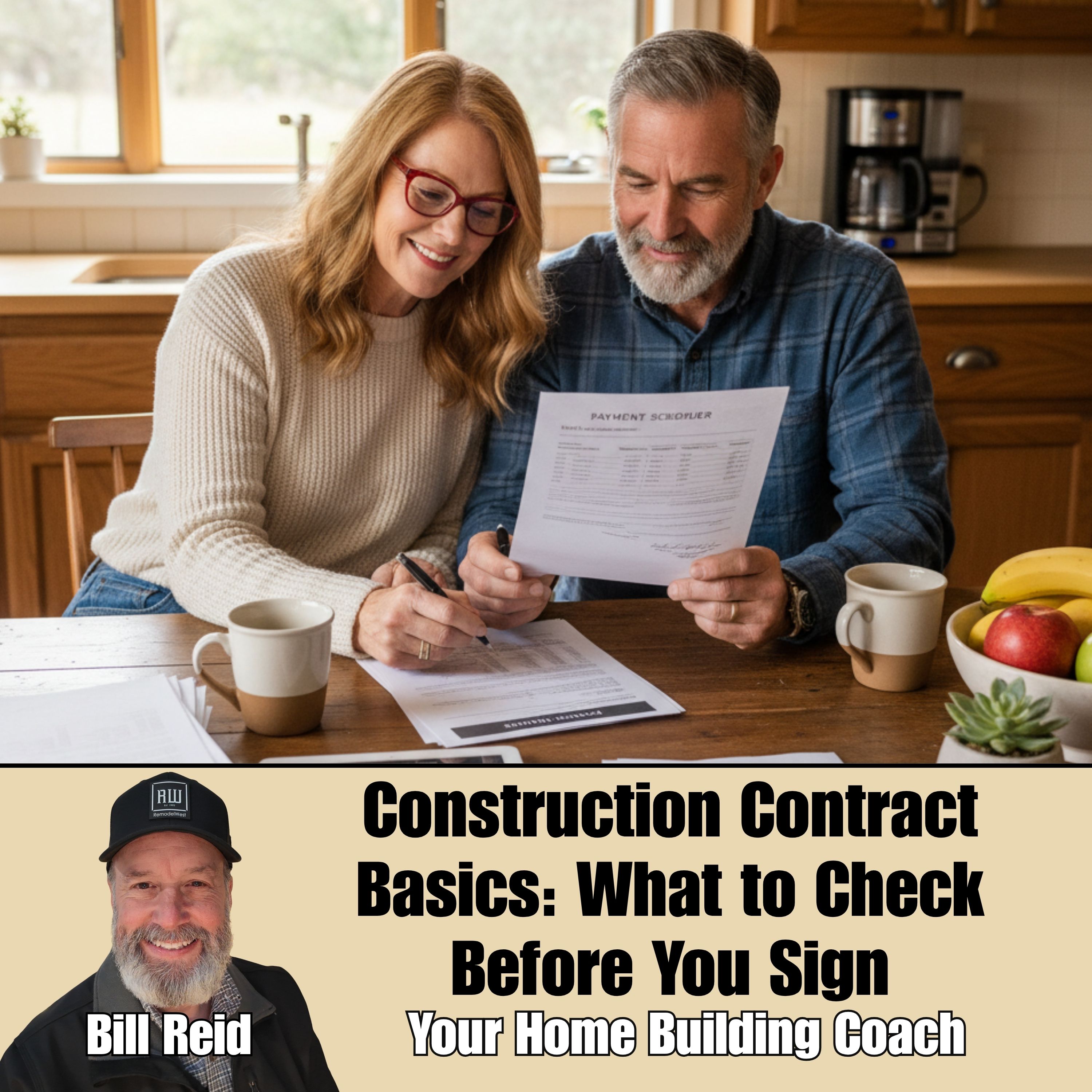
Construction Contract Basics: What to Check Before You Sign
from Your Home Building Coach with Bill Reid
That construction contract sitting on your kitchen table is the single most important document in your entire project. You've earned your way to this moment—months in design, weeks comparing bids, careful contractor selection. Now there's just one piece of paper between you and breaking ground. After 35+ years as a residential construction expert, Bill Reid has seen what goes wrong when homeowners treat this signing moment as a formality instead of the protection it's meant to be.WHAT YOU'LL DISCOVERIn this episode, Bill slows down the contract signing moment and walks you through three critical checks every homeowner must complete before picking up that pen.First, understand exactly who you're contracting with. You sign with one entity—the general contractor. The GC then contracts with subcontractors independently. You don't contract with subs, but here's the wrinkle most homeowners miss: mechanics liens mean unpaid subs or suppliers can still file claims against your house even when you've paid your general contractor in full. Bill explains the simple lien waiver discipline that prevents double-payment nightmares.Second, confirm what must be inside the document. Rule number one sounds obvious but gets violated constantly: have a contract. Verbal agreements and handshakes fall apart six months into construction when everyone remembers the version that favors them. Real contracts point to your actual plans, your specific scope of work, and your spec list—not generic boilerplate. Bill explains why the best projects include a supplemental scope of work document that gathers every email decision and conversation into one central reference the contract can point to.The payment section deserves your closest attention. Healthy contracts structure progress payments tied to completed milestones—foundations in and inspected, framing up and inspected, money follows work. Bill shares California's legal cap on down payments: cannot exceed the lesser of one thousand dollars or ten percent of contract price. On a fifty thousand dollar remodel, the legal maximum down payment is one thousand dollars, not five thousand. Every payment after that cannot exceed the value of work actually completed. Never let your money get ahead of the work—that's your steering wheel for the entire project.Bill addresses the contractor financing challenge directly. Sometimes materials like windows or cabinetry must be ordered well ahead of construction start. There are legal ways to handle this through draw requests tied to the project schedule after crews deploy on site, but this requires consultation with a construction law attorney or your architect to structure properly.With each progress payment, you ask for a lien release from the general contractor and from major subs and suppliers. Money goes out, signed release comes back—that discipline closes the loop on mechanics lien exposure.Third, verify the company name and license number on the contract are legitimate. Bill shares real examples from Northern California where state investigators arrested a dozen people for unlicensed contracting, including one caught using a license number that had already been revoked. Here's the scam: an individual who can't get work legitimately partners with someone who holds a license, so the name on the truck and the person you've been talking to don't match the license number on the paper.The protection is simple and free. Every state that licenses contractors has an online lookup tool. In California, it's the Contractor State License Board at CSLB.ca.gov. Search by name, business, or license number. You'll see status, classification, bond, workers comp, and disciplinary history. Check three things: Is it active and in good standing? Does the classification match the work you're hiring for? Does the name on the license match the company on your contract?Bill gives you a line to remember: A contractor saying "we're licensed" is a sales statement. A license number you looked up yourself is a fact. Don't take the claim, get the fact.At the signing table, ask to see the contractor's pocket license card and compare it against a photo ID. Confirm the person signing has genuine authority to bind the company.Bill also recommends asking each contractor candidate for their standard contract template weeks before you're choosing anyone. This move buys you calm review time at your own kitchen table with no pressure, gives you a baseline to catch changes when the real contract arrives, and serves as a free background check—how quickly they respond and how complete the document is tells you how they run their business.KEY TAKEAWAYS- You contract with one entity, the general contractor—subs contract with the GC, not with you, but unpaid subs can still lien your house- Every construction project legally requires a written contract in most states—California requires it for any project over five hundred dollars- Progress payment schedules tied to completed milestones keep your money from getting ahead of the work and preserve your leverage- California caps down payments at the lesser of one thousand dollars or ten percent of contract price—every payment after that cannot exceed value of work completed- Lien waivers collected with each progress payment prevent mechanics lien claims from unpaid subs or suppliers- Verify contractor license numbers yourself using free state lookup tools—active status, correct classification, name match required- Request the standard contract template early in the selection process for calm review and baseline comparisonMENTIONED IN THIS EPISODEEpisode 57 - Cost Plus Contracts: Understanding the True Cost StructureEpisode 58 - Fixed Price Contracts: When Certainty Matters MostEpisode 51 - The Two Estimating Windows Every Homeowner Must UnderstandASK BILL A QUESTION - Call or text 530-289-6368Voicemails may be featured on a future episode, first name only. Let me know in your message if you'd prefer to stay off the air. Free Story: The Tale of Two Homeowners Watch: YouTube Listen: Podcast Read: AMAZON , All Book StoresVisit: Homepage Follow: Instagram: Facebook: Learn: BuildQuest Planning Platform: Contact: Email: [email protected] in this episode:The Awakened Homeowner BookThe Awakened Homeowner Book
Embed this episode
NOW PLAYING
Construction Contract Basics: What to Check Before You Sign
No transcript for this episode yet
Similar Episodes
No similar episodes found.
Similar Podcasts
No similar podcasts found.