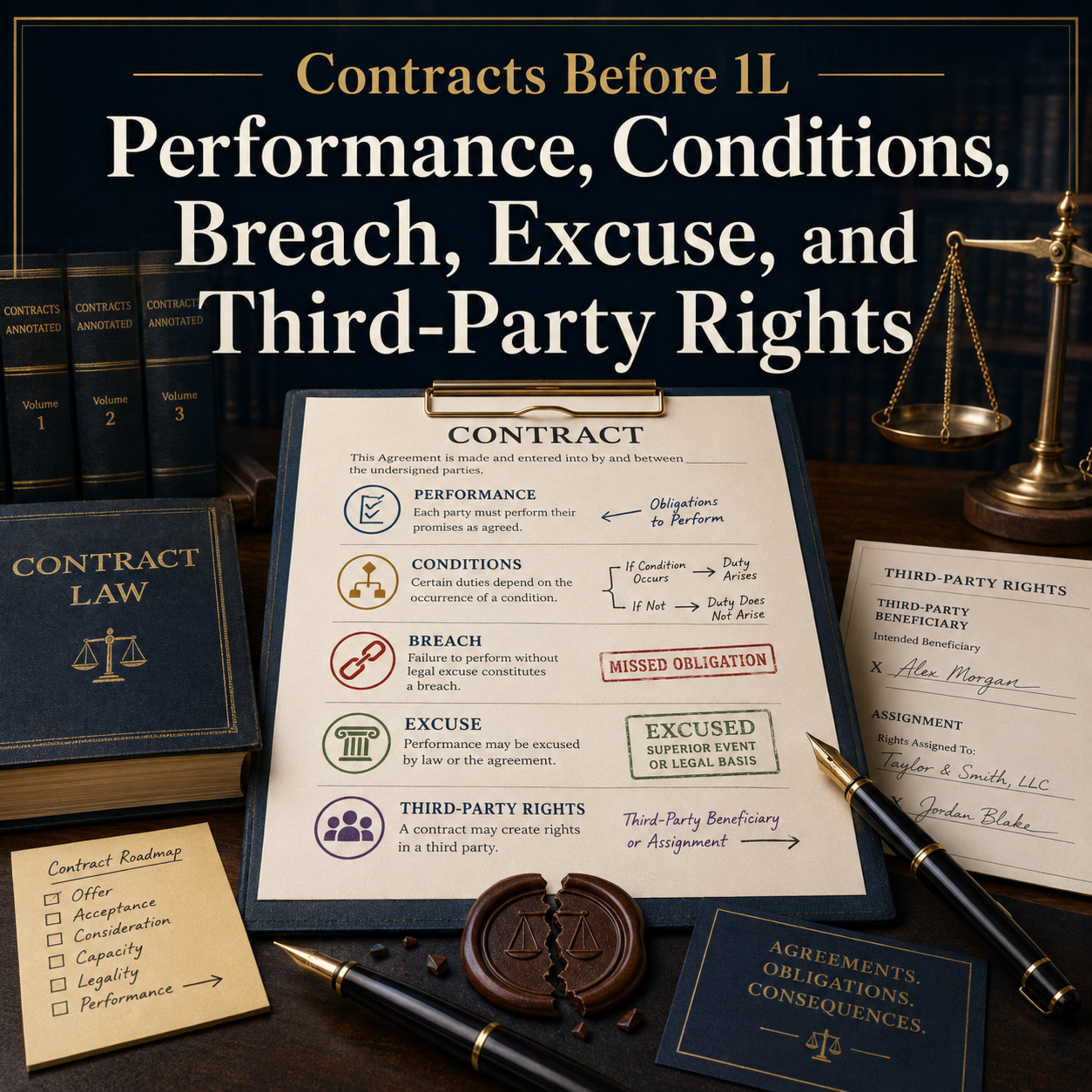
Contracts Before 1L: Performance, Conditions, Breach, Excuse, and Third-Party Rights episode artwork

EPISODE · May 30, 2026 · 59 MIN

Contracts Before 1L: Performance, Conditions, Breach, Excuse, and Third-Party Rights

from Law School · host The Law School of America

Click Here for the Review Guide: Performance, Conditions, Breach, Excuse, and Third-Party RightsIn this episode, we explore the high-stakes, real-world implications of contractual obligations—focusing on how performance is measured, when breaches occur, and how legal doctrines of excuse operate to handle impossible or unfair situations. Whether you're a law student, a legal professional, or simply interested in the mechanics of contract law, this breakdown delivers clarity on the nuanced ways law allocates risk amidst human unpredictability. Most construction projects, like pipelines, run into delays that threaten entire businesses—and many fail to grasp why performance timing is everything. This episode uncovers the real-world importance of performance, conditions, and breach, going beyond the theory to show how legal concepts translate into practice when stakes are high and delays costly.Imagine you're 58 days into a multimillion-dollar pipeline build, only 15 miles laid despite tight schedules and market volatility. Your contractor’s progress seems impossible, and crucial deadlines are slipping away. This scenario highlights why understanding whether performance is due, excused, or breached can make or break you. We break down how to diagnose if a failure originates from broken promises or failed conditions—name-dropping the crucial distinction between promises and conditions, and how this impacts legal obligations in practice.You'll discover:The difference between express conditions—triggered by words like "if" or "provided that"—and constructive conditions, implied by law to facilitate fairness and order.How the "perfect tender" rule under the UCC demands absolute conformity for goods, and the exceptions that prevent economic sabotage.The multi-factor test for "substantial performance" and how courts evaluate whether project imperfections justify partial payment or total breach.The stark contrast between material breaches that justify cancellation, and minor deviations that require damages.When anticipatory repudiation allows the non-breaching party to act immediately, and the delicate timing around retraction and adequate assurances.How doctrines like impossibility, impracticability, and frustration of purpose serve as legal escapes when external forces make performance impossible or pointless.Why does this matter? Because ignoring these nuances can lead to catastrophic mistakes—either by hasty breach or unknowing acceptance of defective performance. The path to mastery lies in understanding the precise seismic shifts that turn promises into enforceable obligations, and breaches into strategic decisions.Whether you’re a law student facing exams or a professional navigating high-stakes contracts, this episode arms you with clarity on performance and breach, ensuring you're prepared for real-world and test scenarios alike. Perfect for anyone who needs to decode contractual failure and navigate the fine line between compliance and breach, this is essential listening to see performance in a new light.Get ready to see through the chaos, master the performance grid, and approach breach law with confidence—and perhaps even a little daring.Key Topics:The distinction between promises and conditions and their impact on performance timingSubstantial performance doctrine in common law and perfect tender rule under the UCCClassifying breaches: material versus minor, and their remediesAnticipatory repudiation: how clear refusals to perform can be addressed earlyThe doctrines of impossibility, impracticability, and frustration of purpose as excusesHow third-party beneficiaries, assignments, and delegations influence contractual rights and obligationsCritical analysis of contractual modification standards under common law versus UCCThe importance of specificity in drafting, especially related to express vs constructive conditionsPractical exam tips: decoding contractual language, applying multi-factor analyses, and

Click Here for the Review Guide: Performance, Conditions, Breach, Excuse, and Third-Party RightsIn this episode, we explore the high-stakes, real-world implications of contractual obligations—focusing on how performance is measured, when breaches occur, and how legal doctrines of excuse operate to handle impossible or unfair situations. Whether you're a law student, a legal professional, or simply interested in the mechanics of contract law, this breakdown delivers clarity on the nuanced ways law allocates risk amidst human unpredictability. Most construction projects, like pipelines, run into delays that threaten entire businesses—and many fail to grasp why performance timing is everything. This episode uncovers the real-world importance of performance, conditions, and breach, going beyond the theory to show how legal concepts translate into practice when stakes are high and delays costly.Imagine you're 58 days into a multimillion-dollar pipeline build, only 15 miles laid despite tight schedules and market volatility. Your contractor’s progress seems impossible, and crucial deadlines are slipping away. This scenario highlights why understanding whether performance is due, excused, or breached can make or break you. We break down how to diagnose if a failure originates from broken promises or failed conditions—name-dropping the crucial distinction between promises and conditions, and how this impacts legal obligations in practice.You'll discover:The difference between express conditions—triggered by words like "if" or "provided that"—and constructive conditions, implied by law to facilitate fairness and order.How the "perfect tender" rule under the UCC demands absolute conformity for goods, and the exceptions that prevent economic sabotage.The multi-factor test for "substantial performance" and how courts evaluate whether project imperfections justify partial payment or total breach.The stark contrast between material breaches that justify cancellation, and minor deviations that require damages.When anticipatory repudiation allows the non-breaching party to act immediately, and the delicate timing around retraction and adequate assurances.How doctrines like impossibility, impracticability, and frustration of purpose serve as legal escapes when external forces make performance impossible or pointless.Why does this matter? Because ignoring these nuances can lead to catastrophic mistakes—either by hasty breach or unknowing acceptance of defective performance. The path to mastery lies in understanding the precise seismic shifts that turn promises into enforceable obligations, and breaches into strategic decisions.Whether you’re a law student facing exams or a professional navigating high-stakes contracts, this episode arms you with clarity on performance and breach, ensuring you're prepared for real-world and test scenarios alike. Perfect for anyone who needs to decode contractual failure and navigate the fine line between compliance and breach, this is essential listening to see performance in a new light.Get ready to see through the chaos, master the performance grid, and approach breach law with confidence—and perhaps even a little daring.Key Topics:The distinction between promises and conditions and their impact on performance timingSubstantial performance doctrine in common law and perfect tender rule under the UCCClassifying breaches: material versus minor, and their remediesAnticipatory repudiation: how clear refusals to perform can be addressed earlyThe doctrines of impossibility, impracticability, and frustration of purpose as excusesHow third-party beneficiaries, assignments, and delegations influence contractual rights and obligationsCritical analysis of contractual modification standards under common law versus UCCThe importance of specificity in drafting, especially related to express vs constructive conditionsPractical exam tips: decoding contractual language, applying multi-factor analyses, and

NOW PLAYING

Contracts Before 1L: Performance, Conditions, Breach, Excuse, and Third-Party Rights

0:00 59:08

No transcript for this episode yet

We transcribe on demand. Request one and we'll notify you when it's ready — usually under 10 minutes.

The Small Business Startup School – Business Notes | Financial Literacy | Retail Psychology – For Professionals & Entrepreneurs The Small Business Startup School Inc. Starting or buying a small business? While personal circumstances may vary, business patterns remain timeless. On The Small Business Startup School, we explore strategies, insights, and practical solutions to help entrepreneurs confidently navigate their journey.Hosted by Ola Williams—a retail entrepreneur, fintech founder, and financial coach with over two decades of experience—this podcast marries financial awareness and retail psychology with optimism to deliver actionable takeaways.Join us to learn, grow, and connect as we uncover the keys to business success.Let’s continue to learn together and be encouraged to keep on connecting! The 48 Laws of Power by Robert Greene (Full Audiobook) Robert Greene Amoral, cunning, ruthless, and instructive, this multi-million-copy New York Times bestseller is the definitive manual for anyone interested in gaining, observing, or defending against ultimate control – from the author of The Laws of Human Nature.In the book that People magazine proclaimed “beguiling” and “fascinating,” Robert Greene and Joost Elffers have distilled three thousand years of the history of power into 48 essential laws by drawing from the philosophies of Machiavelli, Sun Tzu, and Carl Von Clausewitz and also from the lives of figures ranging from Henry Kissinger to P.T. Barnum.Some laws teach the need for prudence (“Law 1: Never Outshine the Master”), others teach the value of confidence (“Law 28: Enter Action with Boldness”), and many recommend absolute self-preservation (“Law 15: Crush Your Enemy Totally”). Every law, though, has one thing in common: an interest in t Guardians Of Innocence Guardians Of Innocence Guardians of Innocence is a powerful and informative podcast designed to equip parents, teachers, and communities with the knowledge and tools needed to protect children from the growing threat of trafficking. Each episode dives deep into the tactics traffickers use to target vulnerable children—both online and in real life—and provides actionable advice on how to recognize the warning signs.Through expert interviews with cyber safety professionals, law enforcement, and survivors, we uncover the latest grooming methods, share real-world stories, and empower listeners to become vigilant guardians of innocence in their own families and communities.Guardians of Innocence is more than just a podcast; it’s a call to action to safeguard our children, raise awareness, and foster a united front against trafficking.Listen. Learn. Protect. The Laura Ingraham Show Laura Ingraham The most-watched woman in the history of cable news brings her no-holds-barred political and cultural commentary to podcasting with The Laura Ingraham Show. A bestselling author, breast cancer survivor, and mother of three internationally adopted children, Laura was the most listened-to woman in talk radio before launching her own podcast. A trailblazer across media platforms, she brings a unique perspective to this twice-weekly show, drawing on her experience as a white-collar criminal defense litigator and a Supreme Court law clerk.New episodes drop twice a week—delivering the clarity, courage, and common sense America needs.

Frequently Asked Questions

How long is this episode of Law School?

This episode is 59 minutes long.

When was this Law School episode published?

This episode was published on May 30, 2026.

What is this episode about?

Click Here for the Review Guide: Performance, Conditions, Breach, Excuse, and Third-Party RightsIn this episode, we explore the high-stakes, real-world implications of contractual obligations—focusing on how performance is measured, when breaches...

Can I download this Law School episode?

Yes, you can download this episode by clicking the download button on the episode player, or subscribe to the podcast in your preferred podcast app for automatic downloads.
URL copied to clipboard!