
EPISODE · Aug 13, 2026 · 1H 18M
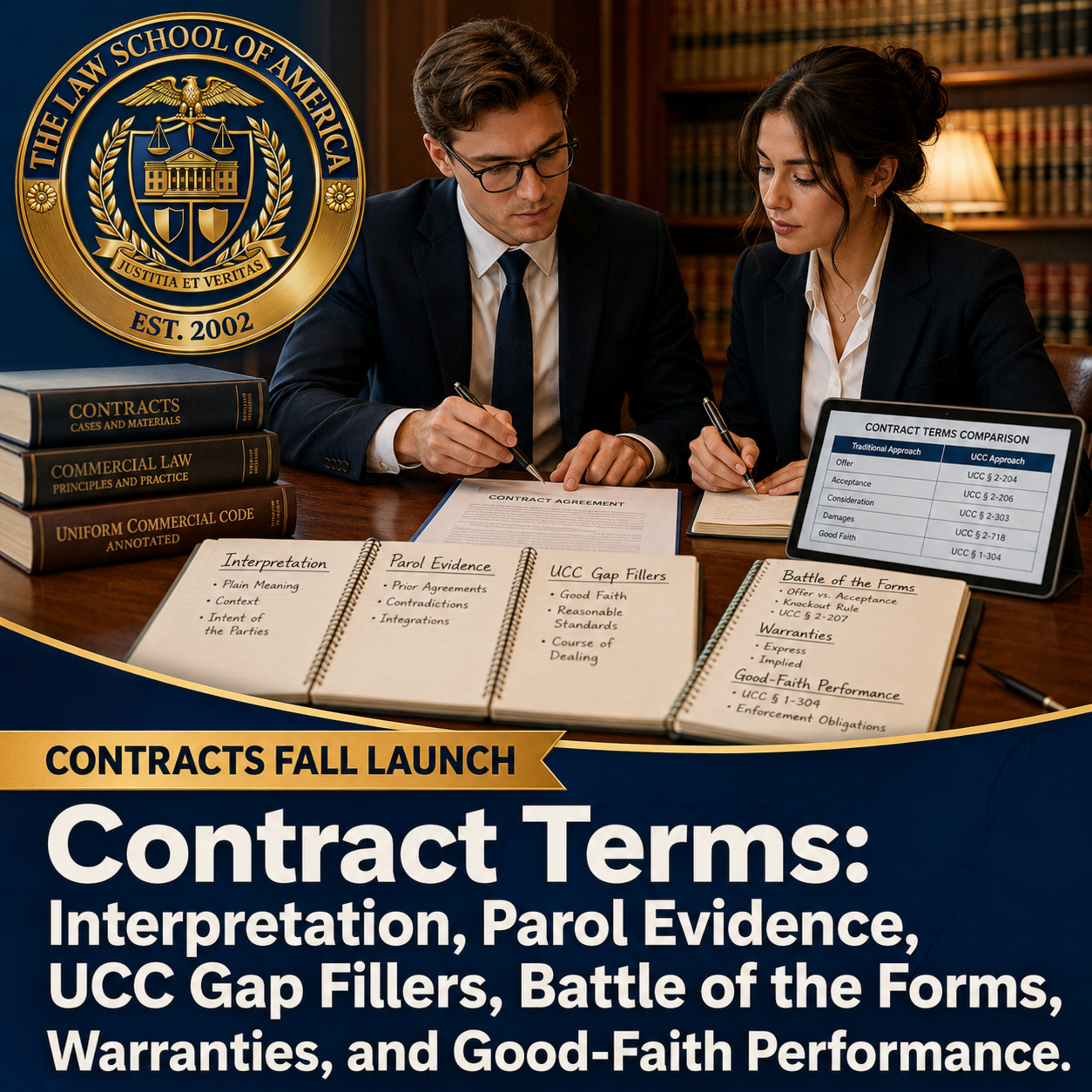
Contracts Fall Launch: Contract Terms: Interpretation, Parol Evidence, UCC Gap Fillers, Battle of the Forms, Warranties, and Good-Faith Performance
from Law School · host The Law School of America
📘 FREE COMPANION STUDY GUIDE 📘👉 CLICK HERE TO OPEN YOUR FREE STUDY GUIDE 👈Turn this episode into an exam-ready study plan.🎧 EPISODE SUMMARY 🎧Formation establishes that a contract exists, while interpretation determines its requirements.Contract terms can derive from oral statements, writings, course of performance, course of dealing, trade usage, statutory gap fillers, warranties, and implied duties.Contracts are read as a whole, prioritizing specific and negotiated terms over boilerplate, applying trade meanings to technical terms, and construing unresolved ambiguities against the drafter.Ambiguity requires multiple reasonable meanings; mere disagreement is insufficient.The parol-evidence rule bars prior or contemporaneous evidence that contradicts an integrated writing. A complete integration bars supplemental terms, whereas a partial integration allows consistent additional terms.The rule does not bar evidence proving fraud, mistake, invalidity, ambiguity, conditions precedent, lack of consideration, or subsequent modifications.Express terms receive the greatest weight, prevailing over inconsistent course of performance, course of dealing, or usage of trade.UCC Article 2 provides default terms for price, delivery, time, and termination, but quantity must be stated or measured via valid requirements or output terms.The battle of the forms separates formation from terms. A definite acceptance forms a contract despite additional or different terms unless acceptance is expressly conditional on assent.Between merchants, additional terms enter the agreement unless the offer limits acceptance, the terms materially alter it, or the offeror objects. Different terms are removed via the knockout rule, and conduct can establish a contract.Express warranties arise from affirmations, descriptions, or samples forming the basis of the bargain, excluding mere puffery.The implied warranty of merchantability ensures fitness for ordinary purposes, while fitness for a particular purpose requires the seller's knowledge of the specific use and the buyer's reliance.Warranty disclaimers must meet conspicuousness requirements and generally cannot negate inconsistent express warranties.Remedy limitations restrict available relief rather than eliminating the underlying contractual obligation.Every contract imposes a duty of good faith in performance and enforcement, preventing opportunistic abuse of discretion without rewriting express terms.The central lesson is that a contract extends beyond a single document, incorporating express text, commercial context, statutory rules, warranties, and good-faith obligations.ℹ️ INFORMATION, PRIVACY POLICY & TERMS OF USE ℹ️The Podcast and Website PurposeThe Law School Podcast and 1L Study Aide webpage supplements law-school and Bar Exam study with strategies, condensed rules, quizzes, and flashcards.Educational DisclaimerContent is for educational and informational purposes only. It is not legal advice, creates no attorney-client relationship, and does not guarantee law-school or Bar Exam success.Privacy PolicyNo account or login is required.This webpage uses no forms or analytics to collect personal information.Quiz and flashcard activity stays in your browser and may clear when local site data is removed.Terms of UseBy using this webpage, you agree to use its content only for lawful, personal, noncommercial educational purposes. It supplements—not replaces—courses, textbooks, official materials, or qualified instruction.
Embed this episode
Ready to play
Contracts Fall Launch: Contract Terms: Interpretation, Parol Evidence, UCC Gap Fillers, Battle of the Forms, Warranties, and Good-Faith Performance
No transcript for this episode yet
Similar Episodes
No similar episodes found.
Similar Podcasts
No similar podcasts found.