
EPISODE · Aug 14, 2026 · 1H 3M
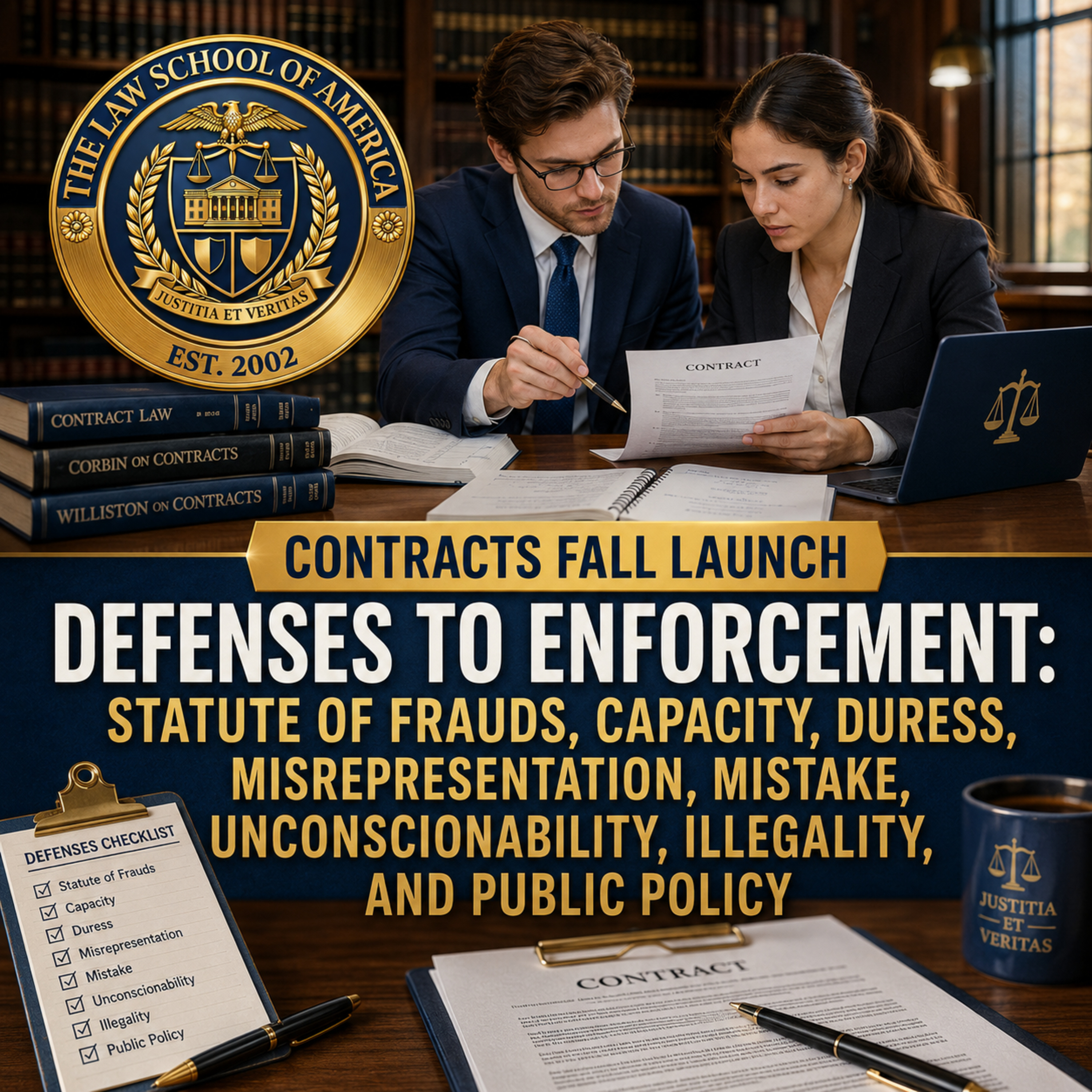
Contracts Fall Launch: Defenses to Enforcement: Statute of Frauds, Capacity, Duress, Misrepresentation, Mistake, Unconscionability, Illegality, and Public Policy
from Law School · host The Law School of America
📘 FREE COMPANION STUDY GUIDE 📘👉 CLICK HERE TO OPEN YOUR FREE STUDY GUIDE 👈Turn this episode into an exam-ready study plan.🎧 EPISODE SUMMARY 🎧An apparent agreement may fail because no contract formed, the agreement is void, the contract is voidable, or a legal rule makes an otherwise valid contract unenforceable.The Statute of Frauds requires certain agreements to be evidenced by signed writings. Traditional categories include marriage-related promises, agreements not performable within one year, interests in land, personal promises by estate representatives, suretyship promises, and qualifying sales of goods.The one-year provision turns on whether full performance is theoretically possible within one year, not whether it is probable.Article 2 generally requires a writing indicating a contract, signed by the party to be charged, and stating quantity. Merchant confirmations, specially manufactured goods, judicial admissions, accepted payment, and accepted goods may satisfy or avoid the writing requirement.Multiple related writings and electronic records may collectively satisfy formal requirements. Part performance and promissory estoppel may provide relief in appropriate cases.A minor’s contracts are generally voidable by the minor. The minor may disaffirm, later ratify, or incur restitutionary liability for the reasonable value of necessities.Mental incapacity and intoxication may make a contract voidable when the condition seriously impaired understanding or reasonable action and the other party knew or had reason to know. Formal guardianship may produce a void agreement under some rules.Duress requires an improper threat that induces assent while leaving no reasonable alternative. Undue influence involves unfair persuasion arising from domination, vulnerability, trust, or confidence.A fraudulent or material misrepresentation may make a contract voidable when it induces justified reliance. Misrepresentation may occur through false statements, concealment, half-truths, or nondisclosure when a duty to disclose exists.Fraud in the execution concerns deception about the document’s nature and may prevent assent. Fraud in the inducement concerns deceptive reasons for entering a known agreement and ordinarily makes the contract voidable.Mutual mistake may justify avoidance when both parties were mistaken about a basic assumption, the mistake materially affected the exchange, and the adversely affected party did not bear the risk. Unilateral mistake receives narrower relief.Unconscionability examines serious unfairness in the bargaining process and contractual terms. A court may refuse enforcement, sever an offensive term, or limit its application.Contracts violating law or important public policy may be unenforceable. Courts may examine the law’s purpose, relative fault, protected class, seriousness of the misconduct, forfeiture, and public interest.The central lesson is that contractual autonomy depends on legally meaningful consent and lawful subject matter. Courts enforce bargains, but they do not automatically enforce every apparent agreement.ℹ️ INFORMATION, PRIVACY POLICY & TERMS OF USE ℹ️The Podcast and Website PurposeThe Law School Podcast and 1L Study Aide webpage supplements law-school and Bar Exam study with strategies, condensed rules, quizzes, and flashcards.Educational DisclaimerContent is for educational and informational purposes only. It is not legal advice, creates no attorney-client relationship, and does not guarantee law-school or Bar Exam success.Privacy PolicyNo account or login is required.This webpage uses no forms or analytics to collect personal information.Quiz and flashcard activity stays in your browser and may clear when local site data is removed.Terms of UseBy using this webpage, you agree to use its content only for lawful, personal, noncommercial educational purposes. It supplements—not replaces—courses, textbooks, official materials, or qualified instruction.
Embed this episode
Ready to play
Contracts Fall Launch: Defenses to Enforcement: Statute of Frauds, Capacity, Duress, Misrepresentation, Mistake, Unconscionability, Illegality, and Public Policy
No transcript for this episode yet
Similar Episodes
No similar episodes found.
Similar Podcasts
No similar podcasts found.