
EPISODE · Aug 15, 2026 · 1H 15M
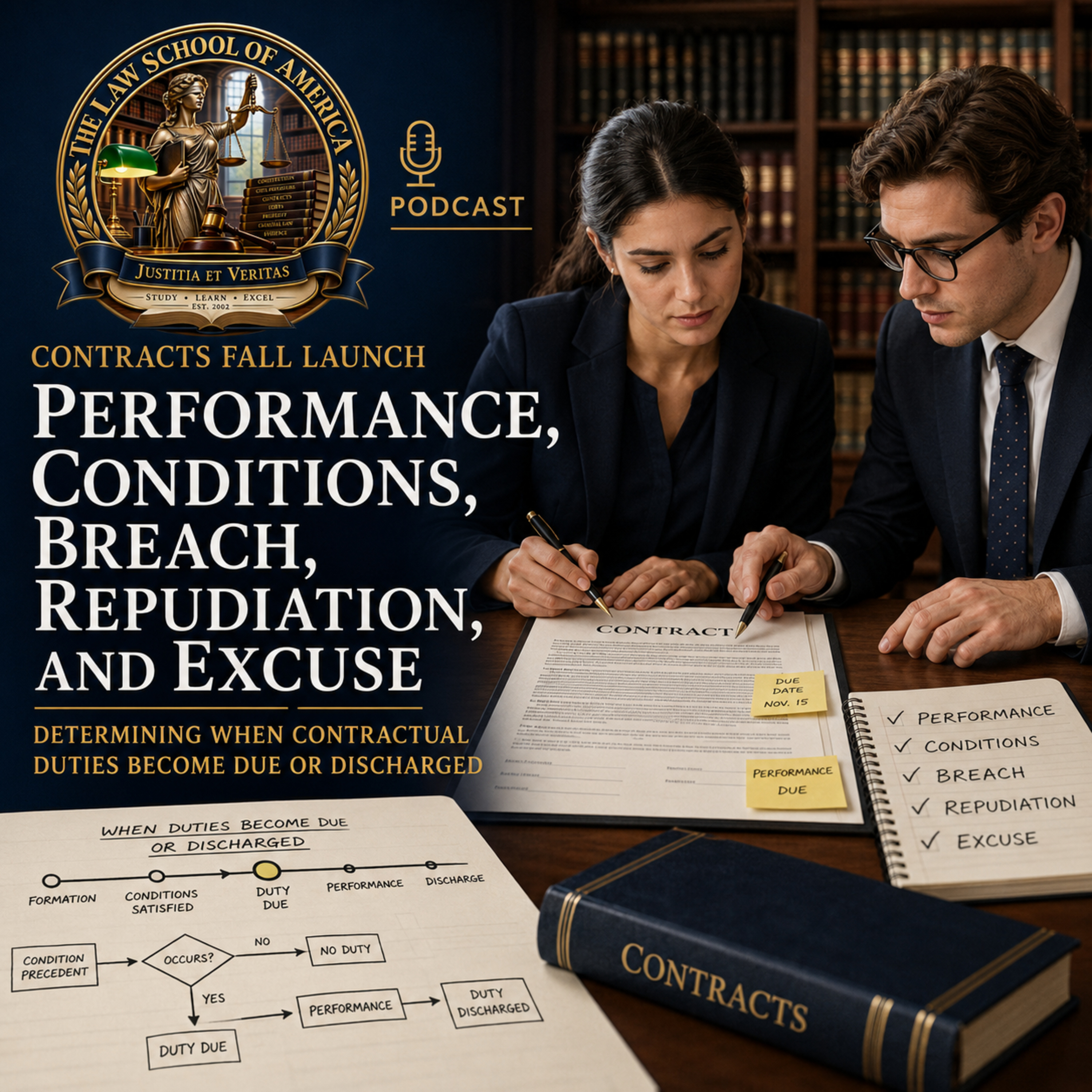
Contracts Fall Launch: Performance, Conditions, Breach, Repudiation, and Excuse: Determining When Contractual Duties Become Due or Discharged
from Law School · host The Law School of America
📘 FREE COMPANION STUDY GUIDE 📘👉 CLICK HERE TO OPEN YOUR FREE STUDY GUIDE 👈Turn this episode into an exam-ready study plan.🎧 EPISODE SUMMARY 🎧A condition is an event that must occur, unless excused, before a contractual duty becomes due or is discharged. A promise is a contractual commitment whose nonperformance constitutes breach. The same language may create both.Express conditions are created by the parties and generally require strict compliance. Constructive conditions are imposed by law and often permit substantial performance.Conditions may be precedent, concurrent, or subsequent. They may be satisfied through occurrence, performance, certification, approval, time, or notice.A party may not wrongfully prevent a condition and then rely on its nonoccurrence. Waiver may excuse compliance with a condition and may arise expressly or through conduct.Under common law, substantial performance allows recovery of the contract price minus damages for defects. A material breach excuses the injured party’s remaining performance; a minor breach permits damages but ordinarily does not discharge remaining duties.A divisible contract may permit recovery for completed units even when later units are breached.Under Article 2, the perfect-tender rule generally permits rejection when goods fail in any respect to conform. The seller may have a right to cure. Acceptance limits rejection but does not necessarily eliminate damages. Revocation requires a nonconformity substantially impairing value and additional circumstances justifying the original acceptance.Installment contracts use substantial-impairment standards rather than ordinary perfect tender.Anticipatory repudiation requires an unequivocal indication of unwillingness or inability to perform. A repudiating party may retract before the injured party materially relies, cancels, or treats the repudiation as final.Reasonable insecurity may support a demand for adequate assurances. Failure to provide adequate assurance may become repudiation.Impossibility may discharge objectively impossible performance. Impracticability may excuse performance made extremely and unreasonably difficult by an extraordinary event. Frustration may apply when performance remains possible but the mutually understood principal purpose is substantially destroyed.Force-majeure clauses expressly allocate extraordinary risks and may displace default excuse doctrines. Their application depends on language, causation, notice, mitigation, and the degree to which performance was prevented or delayed.The key lesson for Saturday is that contractual liability depends not only on what was promised, but also on whether duties became due, whether performance was sufficient, and whether nonperformance was breached, waived, or legally excused.ℹ️ INFORMATION, PRIVACY POLICY & TERMS OF USE ℹ️The Podcast and Website PurposeThe Law School Podcast and 1L Study Aide webpage supplements law-school and Bar Exam study with strategies, condensed rules, quizzes, and flashcards.Educational DisclaimerContent is for educational and informational purposes only. It is not legal advice, creates no attorney-client relationship, and does not guarantee law-school or Bar Exam success.Privacy PolicyNo account or login is required.This webpage uses no forms or analytics to collect personal information.Quiz and flashcard activity stays in your browser and may clear when local site data is removed.Terms of UseBy using this webpage, you agree to use its content only for lawful, personal, noncommercial educational purposes. It supplements—not replaces—courses, textbooks, official materials, or qualified instruction.
Embed this episode
Ready to play
Contracts Fall Launch: Performance, Conditions, Breach, Repudiation, and Excuse: Determining When Contractual Duties Become Due or Discharged
No transcript for this episode yet
Similar Episodes
No similar episodes found.
Similar Podcasts
No similar podcasts found.