
EPISODE · Aug 16, 2026 · 1H 13M
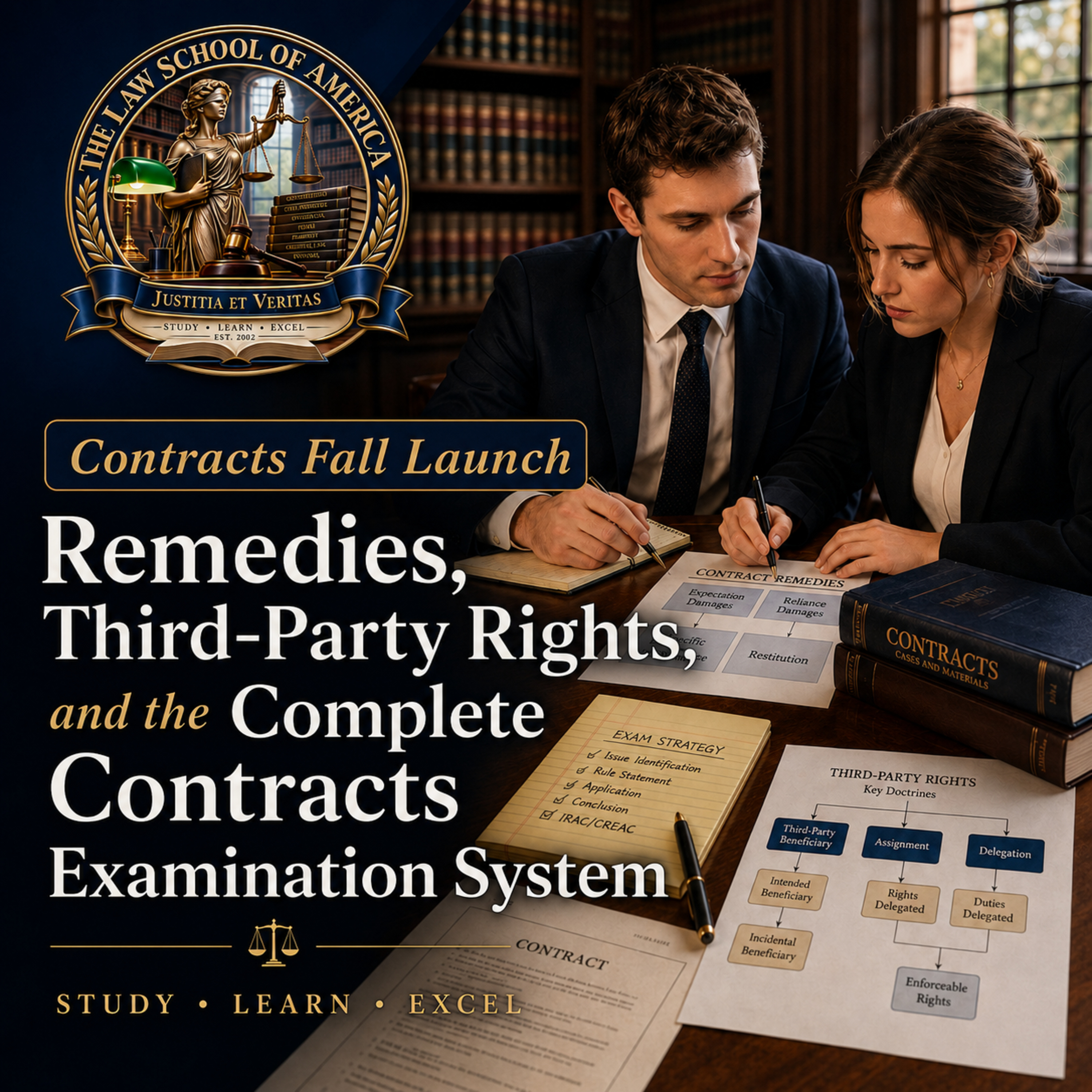
Contracts Fall Launch: Remedies, Third-Party Rights, and the Complete Contracts Examination System
from Law School · host The Law School of America
📘 FREE COMPANION STUDY GUIDE 📘👉 CLICK HERE TO OPEN YOUR FREE STUDY GUIDE 👈Turn this episode into an exam-ready study plan.🎧 EPISODE SUMMARY 🎧Contract remedies primarily compensate rather than punish. Expectation damages protect the benefit of the bargain. Reliance damages reimburse losses caused by reliance. Restitution prevents unjust enrichment.Expectation damages may include loss in value, incidental loss, and consequential loss, reduced by costs or losses avoided.Construction damages may involve cost of completion, cost of repair, diminution in value, expected profit, expenses incurred, payments received, and costs avoided.Consequential damages require foreseeability, causation, reasonable certainty, and reasonable mitigation. Incidental damages cover reasonable expenses incurred in responding to breach.A claimant must mitigate but need not take unreasonable risks, accept inferior performance, enter a humiliating relationship, or make extraordinary expenditures.Article 2 provides buyer remedies including cover, market damages, damages for accepted goods, cancellation, incidental and consequential damages, specific performance, and replevin. Seller remedies include withholding or stopping delivery, resale, market damages, an action for the price in limited cases, incidental damages, cancellation, and lost-volume profit.Liquidated damages are enforceable when damages were difficult to estimate and the amount is reasonable rather than punitive.Specific performance is available when damages are inadequate and enforcement is sufficiently certain, feasible, and equitable. Injunction, rescission, and reformation provide additional equitable relief.An assignment transfers rights. A delegation transfers duties. Delegation ordinarily does not release the original obligor. A novation substitutes a new obligor and releases the original party by agreement.An intended third-party beneficiary may enforce a contract after rights vest. An incidental beneficiary ordinarily may not. Vesting may occur through reliance, suit, requested assent, or contractual terms.The complete Contracts analysis follows a predictable path: governing law, formation, consideration or alternative enforcement, terms, defenses, performance, breach, excuse, third-party rights, and remedies.The central lesson for Sunday is that even a complicated Contracts problem becomes manageable when every fact is placed within the proper doctrinal stage and every claimed remedy is connected to a proven breach and a legally protected interest.ℹ️ INFORMATION, PRIVACY POLICY & TERMS OF USE ℹ️The Podcast and Website PurposeThe Law School Podcast and 1L Study Aide webpage supplements law-school and Bar Exam study with strategies, condensed rules, quizzes, and flashcards.Educational DisclaimerContent is for educational and informational purposes only. It is not legal advice, creates no attorney-client relationship, and does not guarantee law-school or Bar Exam success.Privacy PolicyNo account or login is required.This webpage uses no forms or analytics to collect personal information.Quiz and flashcard activity stays in your browser and may clear when local site data is removed.Terms of UseBy using this webpage, you agree to use its content only for lawful, personal, noncommercial educational purposes. It supplements—not replaces—courses, textbooks, official materials, or qualified instruction.
Embed this episode
Ready to play
Contracts Fall Launch: Remedies, Third-Party Rights, and the Complete Contracts Examination System
No transcript for this episode yet
Similar Episodes
No similar episodes found.
Similar Podcasts
No similar podcasts found.