
EPISODE · Feb 16, 2026 · 1H 8M
Coordination and Commitment in International Climate Action (Hsiao 2026) | FT50 ECTA
from Revise and Resubmit - The Mayukh Show · host Mayukh Mukhopadhyay
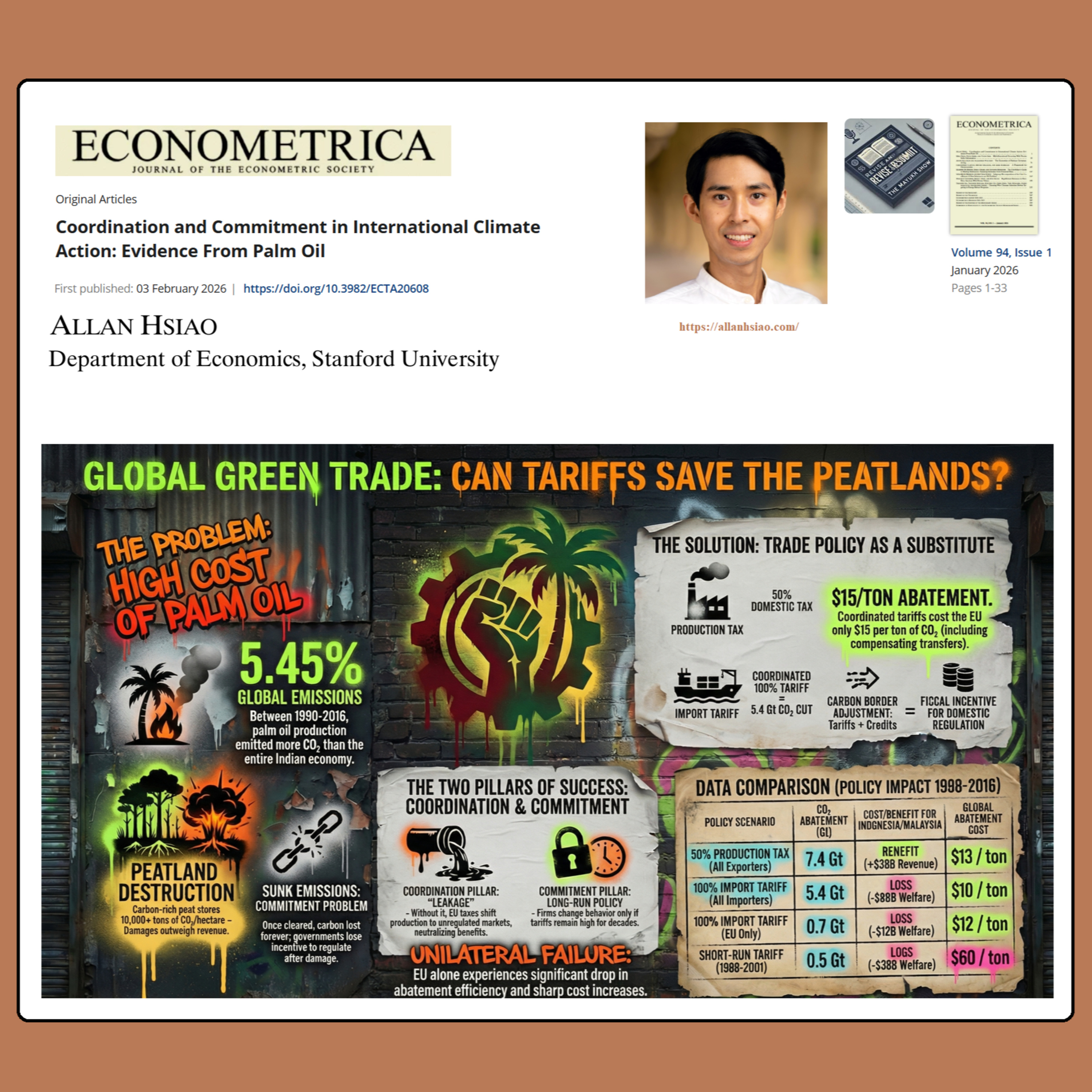
English Podcast starts at 00:00:00Bengali Podcast starts at 00:18:59Hindi Podcast starts at 00:36:04Danish Podcast starts at 00:51:15ReferenceHsiao, A. (2026), Coordination and Commitment in International Climate Action: Evidence From Palm Oil. Econometrica, 94: 1-33. https://doi.org/10.3982/ECTA20608More details on Author Page https://allanhsiao.com/Youtube Channelhttps://www.youtube.com/@weekendresearcherConnect over linkedinhttps://www.linkedin.com/in/mayukhpsm/Welcome to Revise and Resubmit 🎙️🌍There is a particular kind of sadness in the way the world shrugs. Not at the catastrophe itself, but at the paperwork around it. Forests vanish, skies thicken, coastlines redraw themselves, and somewhere a committee meets, nods gravely, and postpones. Meanwhile, the everyday products that pass through our hands keep their promises. Smooth. Convenient. Affordable. Quietly connected to places we will never see. 🛒🌿Palm oil is one of those connections. It lives inside modern life like a hidden ingredient, and behind it sits a hard truth: when local rules are weak, the damage does not stay local. It travels. It accumulates. It becomes everyone’s weather. ☁️🔥Today’s episode follows a piece of research that refuses the shrug. It asks a practical question with moral weight: if a country cannot, or will not, police its own environmental harm, can the rest of the world use trade to change the outcome? 📦⚖️We are talking about “Coordination and Commitment in International Climate Action: Evidence From Palm Oil” by Allan Hsiao, published online in January 2026 in Econometrica (Volume 94, Issue 1). This is a prestigious FT50 journal, and the paper is published by The Econometric Society and Wiley. 🏛️📚Hsiao builds a dynamic empirical framework that treats policy not as a slogan but as a lever you can actually measure. Then he applies it to palm oil, a major driver of deforestation and carbon emissions. The numbers are the kind that make you sit up straighter. Relative to business as usual, a 50%50% domestic production tax is associated with about 7.47.4 gigatons less CO2CO2 from 19881988 to 20162016, roughly 0.260.26 gigatons per year. Coordinated, committed import tariffs of similar magnitude reduce emissions by 5.45.4 gigatons over the same period. 🌳➡️📉But the heart of the story is not just “tariffs work.” It is the conditional clause the world keeps trying to avoid. Without coordination and without commitment, trade penalties do less, because the market is clever and leakage is real. Production shifts. The harm relocates. The conscience feels cleaner while the atmosphere stays the same. 🧭🕳️And then comes the twist that feels almost like hope dressed as bureaucracy: the cost of these coordinated tariffs is about $15 per ton of CO2, even after accounting for transfers that acknowledge the welfare losses of producing countries. The paper also explores alternatives like export taxes and a carbon border adjustment mechanism that can nudge producing nations toward stronger domestic protections, not by scolding, but by aligning incentives. 💸🌐If you want more research stories told with care and clarity, subscribe to Revise and Resubmit on Spotify, and subscribe to the YouTube channel Weekend Researcher. You can also listen on Amazon Prime and Apple Podcast. 🔔🎧🎥📲And heartfelt thanks to Allan Hsiao, and to the publisher, The Econometric Society and Wiley, for this work in Econometrica, a truly prestigious FT50-listed journal. 🙏📖Curious question to carry into the episode: if the world can price carbon at the border, can it also learn to price what it usually calls “someone else’s problem,” and finally commit long enough for the forest to notice? 🤔🌿
Embed this episode
Ready to play
Coordination and Commitment in International Climate Action (Hsiao 2026) | FT50 ECTA
No transcript for this episode yet
Similar Episodes
No similar episodes found.
Similar Podcasts
No similar podcasts found.